Want more images or videos?
Request additional images or videos from the seller
1 of 9
Claus HoieWatercolor Still life Painting Vegetables Claus Hoien Greengrocer Kitchen Series
$1,200List Price
About the Item
- Creator:Claus Hoie (1911 - 2007, Norwegian, American)
- Dimensions:Height: 18 in (45.72 cm)Width: 20 in (50.8 cm)
- Medium:
- Movement Style:
- Period:
- Condition:good. needs new mat frame has minor wear. please see photos.
- Gallery Location:Surfside, FL
- Reference Number:1stDibs: LU3828992312
About the Seller
4.9
Platinum Seller
Premium sellers with a 4.7+ rating and 24-hour response times
Established in 1995
1stDibs seller since 2014
1,858 sales on 1stDibs
Authenticity Guarantee
In the unlikely event there’s an issue with an item’s authenticity, contact us within 1 year for a full refund. DetailsMoney-Back Guarantee
If your item is not as described, is damaged in transit, or does not arrive, contact us within 7 days for a full refund. Details24-Hour Cancellation
You have a 24-hour grace period in which to reconsider your purchase, with no questions asked.Vetted Professional Sellers
Our world-class sellers must adhere to strict standards for service and quality, maintaining the integrity of our listings.Price-Match Guarantee
If you find that a seller listed the same item for a lower price elsewhere, we’ll match it.Trusted Global Delivery
Our best-in-class carrier network provides specialized shipping options worldwide, including custom delivery.You May Also Like
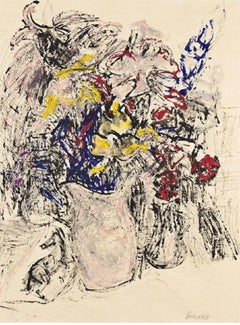
Still Life with Flowers
By Theresa Bernstein
Located in New York, NY
Gouache and pen and ink on paper. Signed in ink in lower right corner.
Provenance: private collection, Columbus, OH; private collection, Chicago.
Bernstein (1890-2002) was raised ...
Category
1930s American Modern Still-life Drawings and Watercolors
Materials
Gouache
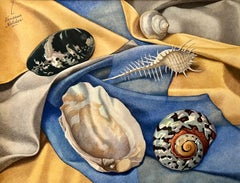
Sea Shells – Blue
Gold
By Zama Vanessa Helder
Located in Los Angeles, CA
Sea Shells – Blue & Gold, c. 1940s, watercolor on paper, signed upper left, 15 x 19 ¼ inches (image); title and artist’s name and address inscribed verso, presented in a newer glazed...
Category
1940s American Modern Still-life Drawings and Watercolors
Materials
Paper, Watercolor
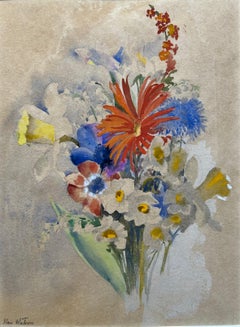
Flower Bouquet
Located in Los Angeles, CA
(Note: This work is part of our exhibition Connected by Creativity: WPA Era Works from the Collection of Leata and Edward Beatty Rowan)
Watercolor on paper, 12 x 9 ½ inches unframed sheet, 15 x 12 ½ inches framed, signed lower left
About the Artist:
Nan Watson...
Category
1930s American Modern Still-life Drawings and Watercolors
Materials
Watercolor
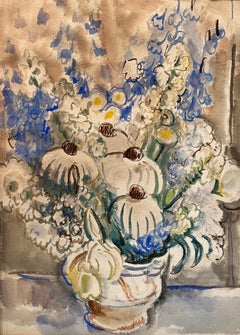
Flowers Still Life
Located in Los Angeles, CA
(Note: This work is part of our exhibition Connected by Creativity: WPA Era Works from the Collection of Leata and Edward Beatty Rowan)
Watercolor...
Category
1930s American Modern Still-life Drawings and Watercolors
Materials
Watercolor
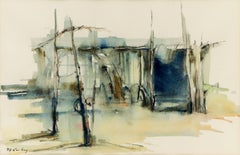
Pawel Kontny “New Mexico” 20th-Century Southwestern Modernist Watercolor
By Pawel Kontny
Located in Denver, CO
This 20th-century watercolor painting, “New Mexico,” by Polish-American artist Pawel Kontny, captures the enduring architecture and serene spirit of the American Southwest. The work ...
Category
Mid-20th Century American Modern Still-life Paintings
Materials
Watercolor
$2,200
H 16.25 in W 21.5 in
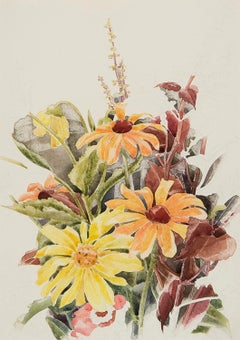
Garden Flowers
By Charles Demuth
Located in New York, NY
Charles Demuth was one of the most complex, talented, and deeply sensitive artists of the American modern period. Whether he was painting floral still lifes, industrial landscapes, or Turkish bathhouses, art was, for Demuth, fraught with personal meaning. A fixture of the vanguard art scene in New York, Demuth navigated the currents of Modernism, producing some of the most exquisite watercolors and original oil paintings in twentieth-century American art.
Demuth was born in Lancaster, Pennsylvania, the only child of a well-to-do family. He had an awkward and introverted childhood shaped by a childhood illness, Perthes, a disease of the hip that not only left him permanently lame, but, as part of the “cure,” bedridden for two years in the care of his mother. This long period of incapacitation had a deep impact on Demuth, who came to see himself as an invalid, an outsider who was different from everyone else. It was perhaps during this period of indoor confinement that his keen interest in art developed. Several relatives on his father’s side had been amateur artists, and, following his convalescence, his mother encouraged his artistic pursuits by sending him to a local painter for instruction. The majority of his early pictures are of flowers, a subject for which Demuth maintained a lifelong passion.
Following high school, Demuth enrolled at the Drexel Institute of Art in Philadelphia, a school renowned for its commercial arts program. He advanced through the program rapidly, and, in 1905, at the encouragement of his instructors, he began taking courses at the Pennsylvania Academy of the Fine Arts. The two leading teachers then at the Academy were William Merritt Chase and Thomas Anshutz. Anshutz, himself a former student of Thomas Eakins, was well liked by his students, and is best known as the teacher of Robert Henri, John Sloan, and several of the other artists of the Ashcan School. Demuth, too, adopted a similar idiom, working in a controlled, realistic manner while at the Academy, where he remained until 1910.
In 1907, Demuth made his first trip to Europe, staying in Paris. He spent time on the periphery of the art scene composed of the numerous American artists there, including John Marin and Edward Steichen. He returned to Philadelphia five months later, and immediately resumed courses at the Academy. Despite his introduction to advanced modern styles in Europe, Demuth’s work of this period retains the academic style he practiced before the trip. It wasn’t until he had summered at New Hope, Pennsylvania, in 1908 and 1911, that his style began to evolve. New Hope was a prominent American Impressionist art colony whose members were largely affiliated with the Pennsylvania Academy. Demuth dropped the conservative tone of his style and adopted a freer and more colorful palette.
Although he remained based in Philadelphia, Demuth frequently went to New York during this period. Many of the same American artists of the Parisian art scene Demuth had encountered on his earlier European trip now formed the nucleus of New York’s avant-garde, which centered around Alfred Stieglitz’s 291 gallery. It wasn’t long before Demuth began to apply modernist-inspired strategies to his work. He was particularly influenced by the watercolor work of John Marin, also a former student of Anshutz, whose bold use of color in the medium Demuth freely adapted into looser washes of color.
In 1912, Demuth again left for Paris, this time studying in the Académie Moderne, Académie Colorossi, and Académie Julian. In Paris Demuth met the American modernist Marsden Hartley. Hartley, a principal figure in the expatriate art circle, acted as a mentor to Demuth, and introduced him to the wide array of modern styles currently practiced in Europe. Hartley also introduced Demuth to many of the members of the Parisian avant-garde, including Gertrude Stein. Demuth was an aspiring writer, and he spent many hours in conversation with Stein. He wrote extensively during this period, and published two works shortly after his return to America. He also developed an interest in illustrating scenes from literary texts. From 1914 to 1919, Demuth produced a series of watercolors of scenes from books such as Emile Zola’s Nana and Henry James’s The Turn of the Screw.
Upon his return to America, Demuth settled in New York. In 1914, Demuth had his first one-man show at Charles Daniel’s gallery, which promoted emerging modern American artists, including Man Ray, Rockwell Kent, Yasuo Kuniyoshi, Stuart Davis, and Max Weber. Demuth drew closer to the artistic vanguard in New York, becoming friends with many in the Stieglitz and Daniel circles, including Georgia O’Keeffe, Marcel Duchamp, Carl Van Vechten, and Edward Fiske.
New York’s cosmopolitan atmosphere and active nightlife appealed greatly to Demuth. In a sketchy style well suited to watercolor, he painted many vaudeville and circus themes, as well as nightclub, café, and bathhouse scenes. Often with Duchamp, Demuth took part in an urban subculture replete with nightclubs, bars, drugs, and sexual permissiveness, which, for a homosexual artist like himself, allowed room for previously unattainable personal expression. Demuth’s pictures of sailors, bathhouses, and circus performers embody a sensual and sexual undercurrent, expressing the artist’s sense of comfort and belonging in the bohemian subculture of New York.
Simultaneously, Demuth deepened his interest in floral pictures, painting these almost exclusively in watercolor. His style evolved from the broad color washes of his earlier pictures to more spare, flattened, and sinuous compositions, inspired by the drawings of Aubrey Beardsley and other artists of the Aesthetic Movement. Demuth’s flower watercolors are moody and atmospheric, sensuous and elegant, introspective and yet full of expressive power. Moreover they are beautiful, and are unequivocally among the finest still lifes in American art. Despite numerous subsequent artistic undertakings that led him in a variety of directions, Demuth never stopped painting flower pictures, ultimately adding fruits and other still-life objects to his repertoire.
In 1916, Demuth began to develop a style later known as Precisionism, a form of landscape painting infused with Cubism, in which space is divided into precisely drawn geometric regions of color. Demuth first began to paint the landscape in an appropriated Cubist mode while on a trip with Hartley to Bermuda. In these early landscapes, in which the curvilinear forms of trees intersect the geometrically articulated architectural forms, Demuth explored ideas that shaped the future development of modernism in America.
The full realization of Demuth’s explorations came after his return to America in 1917, when he turned his attention to industrial subjects. These works derive from a “machine aesthetic,” espoused by New York artists such as Francis Picabia, Joseph Stella, Albert Gleizes, and Duchamp, by which artists viewed machines as embodying mystical, almost religious significance as symbols of the modern world. Rather than painting the skyscrapers and bridges of New York as did most of his like-minded contemporaries, Demuth returned to his home town of Lancaster, where he painted factories and warehouses in a Precisionist idiom. The titles for these pictures are often contain literary references, which serve as clues for the viewer to aid in the decoding of the artist’s meaning.
In 1923, Demuth planned a series of abstract “poster portraits” of his friends and contemporaries in the New York art and literary scene. In these “portraits,” Demuth combined text and symbolic elements to evoke the essential nature of his sitters’ distinguishing characteristics. In this fashion, he painted portraits of such artists as Georgia O’Keeffe, John Marin, and Arthur Dove. His most famous poster portrait, I Saw the Figure 5 in Gold...
Category
20th Century American Modern Still-life Drawings and Watercolors
Materials
Paper, Watercolor
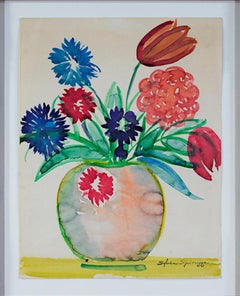
"Vase of Flowers on Chartreuse Tablecloth, " Watercolor signed by Sylvia Spicuzza
By Sylvia Spicuzza
Located in Milwaukee, WI
"Vase of Flowers on Chartreuse Tablecloth" is a watercolor signed by Sylvia Spicuzza. This watercolor is of a simple flower arrangement. There are red tulips, blue, red, and pink chr...
Category
1950s American Modern Still-life Drawings and Watercolors
Materials
Watercolor
$2,025
H 17.25 in W 14.25 in
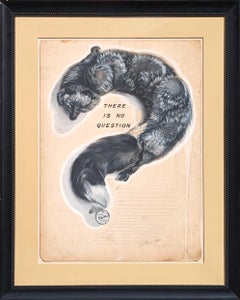
"There is No Question" Early Modern Original Foley
s Ad Layout with Mink Stole
Located in Houston, TX
Early modern original watercolor and gouache ad layout for Foley's by Houston portraitist Robert C. Joy. The work features a mink stole laid out in the shape of a question mark. Ther...
Category
Early 20th Century American Modern Animal Drawings and Watercolors
Materials
Watercolor, Gouache
$1,200
H 31.75 in W 26.25 in D 1 in
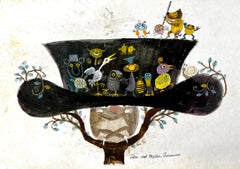
Dancing Animal Critters on a Top Hat, Bear, Frog, Owl, Crane Bird, Bee, Snail
By Alice and Martin Provensen
Located in Miami, FL
Enter the whimsical world of famed children's book illustrators husband and wife team Alice and Martin Provensen. On top of a heavy tree trunk sits a...
Category
1980s American Modern Animal Drawings and Watercolors
Materials
Gouache
$18,000
H 11.75 in W 20.5 in D 1 in
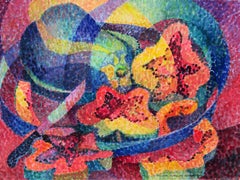
Still Life with Knife
Located in San Francisco, CA
This artwork "Still Life with Knife" c.1980 is a watercolor on heavy watercolor paper by California artist Charlotte Huntley. It is signed at the low...
Category
Late 20th Century American Modern Figurative Drawings and Watercolors
Materials
Watercolor
More From This Seller
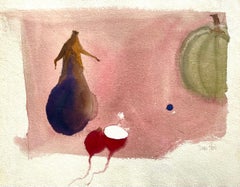
View AllWatercolor Still life Painting Vegetables Claus Hoien Greengrocer Kitchen Series
Located in Surfside, FL
Delicate watercolor of vegetables. Japanese eggplant and radishes and a squash gourd.
Framed 18 X 20 image is 11 X 13.5
Claus Hoie was a Norwegian-American...
Category
20th Century American Modern Still-life Drawings and Watercolors
Materials
Watercolor
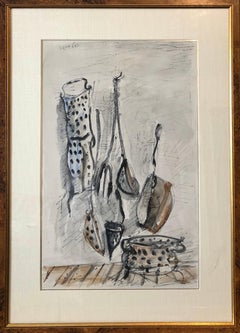
Israeli Yosl Bergner Modernist Watercolor Painting Drawing Pots, Pans
By Yosl Bergner
Located in Surfside, FL
Abstract Composition, Kitchen Utensils.
Ink and watercolor of kitchen implements. Hand signed in Hebrew upper left. Dimensions: (Frame) H 25" x 18" (Sight) H 18.5" x W 11.75"
Bergn...
Category
Mid-20th Century Modern Still-life Drawings and Watercolors
Materials
Archival Ink, Watercolor
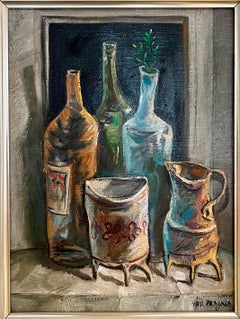
Israeli Yosl Bergner Modernist OIl Painting Kitchen Bottles Coffee, Vase
By Yosl Bergner
Located in Surfside, FL
Yosl Bergner
Abstract Composition, Kitchen Utensils.
Oil painting of kitchen implements. Hand signed in English bottom right
Titled and signed ve...
Category
Mid-20th Century Modern Still-life Drawings and Watercolors
Materials
Archival Ink, Watercolor
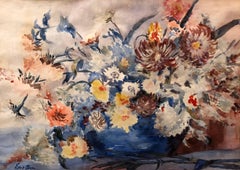
British Modernist Vibrant Watercolor Painting of Flowers, Sir Jacob Epstein
By Sir Jacob Epstein
Located in Surfside, FL
Sir Jacob Epstein KBE (10 November 1880 – 19 August 1959) was an American British sculptor who helped pioneer modern sculpture. He was born in the United States, and moved to Europe in 1902, becoming a British subject in 1911. He often produced controversial works which challenged ideas on what was appropriate subject matter for public artworks. He also made paintings and drawings, and often exhibited his work.
Epstein's parents were Polish Jewish refugees, living on New York's Lower East Side. He studied art in his native New York as a teenager, sketching the city, and joined the Art Students League of New York in 1900. For his livelihood, he worked in a bronze foundry by day, studying drawing and sculptural modelling at night. Epstein's first major commission was to illustrate Hutchins Hapgood's 1902 book Spirit of the Ghetto. Epstein used the money from the commission to move to Paris.
Moving to Europe in 1902, he studied in Paris at the Académie Julian and the École des Beaux-Arts. He settled in London in 1905 and married Margaret Dunlop in 1906. Epstein became a British subject on 4 January 1911. Many of Epstein's works were sculpted at his two cottages in Loughton, Essex, where he lived first at number 49 then 50, Baldwin's Hill (there is a blue plaque on number 50). He served briefly in the 38th Battalion of the Royal Fusiliers, known as the Jewish Legion during World War I; following a breakdown, he was discharged in 1918 without having left England.
In London, Epstein involved himself with a bohemian and artistic crowd. Revolting against ornate, pretty art, he made bold, often harsh and massive forms of bronze or stone. His sculpture is distinguished by its vigorous rough-hewn realism. Avant-garde in concept and style, his works often shocked his audience. This was not only a result of their (often explicit) sexual content, but also because they deliberately abandoned the conventions of classical Greek sculpture favoured by European Academic sculptors to experiment instead with the aesthetics of art traditions as diverse as those of India, West Africa, and the Pacific Islands.
Between 1913 and 1915, Epstein was associated with the short-lived Vorticism movement and produced one of his best known sculptures The Rock Drill.
Between the late 1930s and the mid-1950s, numerous works by Epstein were exhibited in Blackpool. Adam, Consummatum Est, Jacob and the Angel and Genesis, and other works, were initially displayed in an old drapery shop surrounded by red velvet curtains. The crowds were ushered in at the cost of a shilling by a barker on the street. After a small tour of American fun fairs, the works were returned to Blackpool and were exhibited in the anatomical curiosities section of Louis Tussaud's waxworks.
Bronze portrait sculpture formed one of Epstein's staple products, and perhaps the best known. These sculptures were often executed with roughly textured surfaces, expressively manipulating small surface planes and facial details. Some fine examples are in the National Portrait Gallery. He completed a bust of Winston Churchill...
Category
1930s Modern Still-life Drawings and Watercolors
Materials
Paper, Watercolor
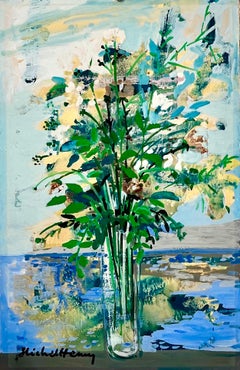
Small, Charming, Fauvist Painting Michel Henry French Modernist School of Paris
By Michel Henry
Located in Surfside, FL
Michel-Henry was born in Langres in 1928 and has shown strong passion for drawing since his childhood. Michel-Henry is acknowledged as an important painter in French contemporary a...
Category
1960s Modern Still-life Paintings
Materials
Paper, Gouache
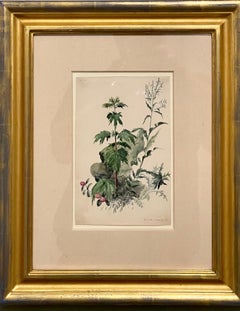
Plants, Bristol 1863 Watercolor Painting American Artist Charles DeWolf Brownell
By Charles De Wolf Brownell
Located in Surfside, FL
Charles De Wolf Brownell (American, 1822 - 1909)
Watercolor on paper depicting several plants in close proximity
Hand dated and inscribed "Br...
Category
19th Century Naturalistic Landscape Drawings and Watercolors
Materials
Watercolor
Still Thinking About These?
All Recently ViewedMore Ways To Browse
Town And Country
Worlds Fair
Vintage Giclee Prints
Mid Century Modern Signed Print
Marilyn Monroe Photographs For Sale
Pop Art Acrylic
Still Life Painting On Wood
Ecole Des Beaux Arts
Photography Series
Black And White Abstract Photography
Tree Painting
Black And Gold Abstract Art
Oil Paintings By Unknown Artists
Black And White Interiors Photography
Paintings Of The Streets Of London
The Cars
Black And White Photography Architecture
Stamp Collection