Want more images or videos?
Request additional images or videos from the seller
1 of 5
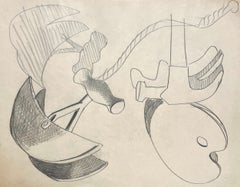
Harold HaydonStill Life at a Table, Study in Yellow by Artist Harold Haydonca. 1931
ca. 1931
Price:$285
About the Item
- Creator:Harold Haydon (1909 - 1994, American)
- Creation Year:ca. 1931
- Dimensions:Height: 6.75 in (17.15 cm)Width: 8.5 in (21.59 cm)
- More Editions Sizes:Matted to 12" x 14"Price: $285
- Medium:
- Movement Style:
- Period:
- Condition:See Photos.
- Gallery Location:Chicago, IL
- Reference Number:Seller: #123911stDibs: LU2591214048702
Harold Haydon
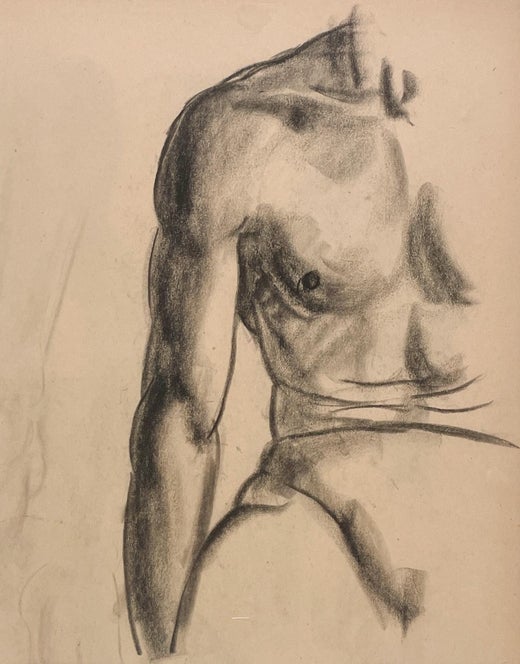
Harold Emerson Haydon was born in Fort William, Ontario, Canada in 1909. Haydon came to Chicago with his family in 1917 and became a naturalized American citizen in 1941. He attended the University of Chicago Lab School and the University of Chicago, where he earned a Bachelor’s Degree and Master’s Degree in Philosophy. He also studied painting at the Art Institute of Chicago. Haydon was a long-time Professor of Art at the University of Chicago, teaching from 1944-1975. He became an instructor at the Art Institute of Chicago from 1975-1981. Haydon also taught as an Adjunct Professor of Fine Arts at Indiana University from 1975-1982. In addition, Haydon served as the noted art critic of the Chicago Sun-Times from 1963-1985. He died in Chicago in 1994.
About the Seller
5.0
Recognized Seller
These prestigious sellers are industry leaders and represent the highest echelon for item quality and design.
Established in 2000
1stDibs seller since 2023
119 sales on 1stDibs
Typical response time: 2 hours
Authenticity Guarantee
In the unlikely event there’s an issue with an item’s authenticity, contact us within 1 year for a full refund. DetailsMoney-Back Guarantee
If your item is not as described, is damaged in transit, or does not arrive, contact us within 7 days for a full refund. Details24-Hour Cancellation
You have a 24-hour grace period in which to reconsider your purchase, with no questions asked.Vetted Professional Sellers
Our world-class sellers must adhere to strict standards for service and quality, maintaining the integrity of our listings.Price-Match Guarantee
If you find that a seller listed the same item for a lower price elsewhere, we’ll match it.Trusted Global Delivery
Our best-in-class carrier network provides specialized shipping options worldwide, including custom delivery.You May Also Like
Tribute to Morandi #29
By Bob Stuth-Wade
Located in Dallas, TX
Bob Stuth-Wade: Tribute to Morandi, 2018
"Life is what happens while I'm thinking of something else."
"Driving. Listening to the radio. Talking on the phone. Thinking of where I'm ...
Category
2010s American Modern Still-life Drawings and Watercolors
Materials
Paper, Ink, Watercolor
Paul Simon
s Live Concert Setup - Technical Drawing in Pen on Heavy Cardstock
Located in Soquel, CA
Paul Simon's Live Concert Setup - Technical Drawing in Pen on Heavy Cardstock
Detailed, accurate drawing of musical equipment for a live concert. The instruments and equipment are r...
Category
Late 20th Century American Modern Landscape Drawings and Watercolors
Materials
Postcard, Felt Pen, Laid Paper
$760 Sale Price
20% Off
H 28 in W 38 in D 0.25 in
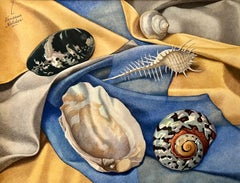
Sea Shells – Blue
Gold
By Zama Vanessa Helder
Located in Los Angeles, CA
Sea Shells – Blue & Gold, c. 1940s, watercolor on paper, signed upper left, 15 x 19 ¼ inches (image); title and artist’s name and address inscribed verso, presented in a newer glazed...
Category
1940s American Modern Still-life Drawings and Watercolors
Materials
Paper, Watercolor
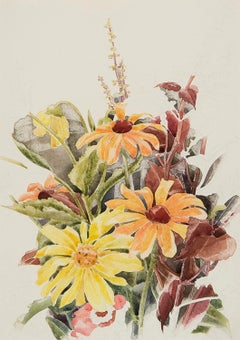
Garden Flowers
By Charles Demuth
Located in New York, NY
Charles Demuth was one of the most complex, talented, and deeply sensitive artists of the American modern period. Whether he was painting floral still lifes, industrial landscapes, or Turkish bathhouses, art was, for Demuth, fraught with personal meaning. A fixture of the vanguard art scene in New York, Demuth navigated the currents of Modernism, producing some of the most exquisite watercolors and original oil paintings in twentieth-century American art.
Demuth was born in Lancaster, Pennsylvania, the only child of a well-to-do family. He had an awkward and introverted childhood shaped by a childhood illness, Perthes, a disease of the hip that not only left him permanently lame, but, as part of the “cure,” bedridden for two years in the care of his mother. This long period of incapacitation had a deep impact on Demuth, who came to see himself as an invalid, an outsider who was different from everyone else. It was perhaps during this period of indoor confinement that his keen interest in art developed. Several relatives on his father’s side had been amateur artists, and, following his convalescence, his mother encouraged his artistic pursuits by sending him to a local painter for instruction. The majority of his early pictures are of flowers, a subject for which Demuth maintained a lifelong passion.
Following high school, Demuth enrolled at the Drexel Institute of Art in Philadelphia, a school renowned for its commercial arts program. He advanced through the program rapidly, and, in 1905, at the encouragement of his instructors, he began taking courses at the Pennsylvania Academy of the Fine Arts. The two leading teachers then at the Academy were William Merritt Chase and Thomas Anshutz. Anshutz, himself a former student of Thomas Eakins, was well liked by his students, and is best known as the teacher of Robert Henri, John Sloan, and several of the other artists of the Ashcan School. Demuth, too, adopted a similar idiom, working in a controlled, realistic manner while at the Academy, where he remained until 1910.
In 1907, Demuth made his first trip to Europe, staying in Paris. He spent time on the periphery of the art scene composed of the numerous American artists there, including John Marin and Edward Steichen. He returned to Philadelphia five months later, and immediately resumed courses at the Academy. Despite his introduction to advanced modern styles in Europe, Demuth’s work of this period retains the academic style he practiced before the trip. It wasn’t until he had summered at New Hope, Pennsylvania, in 1908 and 1911, that his style began to evolve. New Hope was a prominent American Impressionist art colony whose members were largely affiliated with the Pennsylvania Academy. Demuth dropped the conservative tone of his style and adopted a freer and more colorful palette.
Although he remained based in Philadelphia, Demuth frequently went to New York during this period. Many of the same American artists of the Parisian art scene Demuth had encountered on his earlier European trip now formed the nucleus of New York’s avant-garde, which centered around Alfred Stieglitz’s 291 gallery. It wasn’t long before Demuth began to apply modernist-inspired strategies to his work. He was particularly influenced by the watercolor work of John Marin, also a former student of Anshutz, whose bold use of color in the medium Demuth freely adapted into looser washes of color.
In 1912, Demuth again left for Paris, this time studying in the Académie Moderne, Académie Colorossi, and Académie Julian. In Paris Demuth met the American modernist Marsden Hartley. Hartley, a principal figure in the expatriate art circle, acted as a mentor to Demuth, and introduced him to the wide array of modern styles currently practiced in Europe. Hartley also introduced Demuth to many of the members of the Parisian avant-garde, including Gertrude Stein. Demuth was an aspiring writer, and he spent many hours in conversation with Stein. He wrote extensively during this period, and published two works shortly after his return to America. He also developed an interest in illustrating scenes from literary texts. From 1914 to 1919, Demuth produced a series of watercolors of scenes from books such as Emile Zola’s Nana and Henry James’s The Turn of the Screw.
Upon his return to America, Demuth settled in New York. In 1914, Demuth had his first one-man show at Charles Daniel’s gallery, which promoted emerging modern American artists, including Man Ray, Rockwell Kent, Yasuo Kuniyoshi, Stuart Davis, and Max Weber. Demuth drew closer to the artistic vanguard in New York, becoming friends with many in the Stieglitz and Daniel circles, including Georgia O’Keeffe, Marcel Duchamp, Carl Van Vechten, and Edward Fiske.
New York’s cosmopolitan atmosphere and active nightlife appealed greatly to Demuth. In a sketchy style well suited to watercolor, he painted many vaudeville and circus themes, as well as nightclub, café, and bathhouse scenes. Often with Duchamp, Demuth took part in an urban subculture replete with nightclubs, bars, drugs, and sexual permissiveness, which, for a homosexual artist like himself, allowed room for previously unattainable personal expression. Demuth’s pictures of sailors, bathhouses, and circus performers embody a sensual and sexual undercurrent, expressing the artist’s sense of comfort and belonging in the bohemian subculture of New York.
Simultaneously, Demuth deepened his interest in floral pictures, painting these almost exclusively in watercolor. His style evolved from the broad color washes of his earlier pictures to more spare, flattened, and sinuous compositions, inspired by the drawings of Aubrey Beardsley and other artists of the Aesthetic Movement. Demuth’s flower watercolors are moody and atmospheric, sensuous and elegant, introspective and yet full of expressive power. Moreover they are beautiful, and are unequivocally among the finest still lifes in American art. Despite numerous subsequent artistic undertakings that led him in a variety of directions, Demuth never stopped painting flower pictures, ultimately adding fruits and other still-life objects to his repertoire.
In 1916, Demuth began to develop a style later known as Precisionism, a form of landscape painting infused with Cubism, in which space is divided into precisely drawn geometric regions of color. Demuth first began to paint the landscape in an appropriated Cubist mode while on a trip with Hartley to Bermuda. In these early landscapes, in which the curvilinear forms of trees intersect the geometrically articulated architectural forms, Demuth explored ideas that shaped the future development of modernism in America.
The full realization of Demuth’s explorations came after his return to America in 1917, when he turned his attention to industrial subjects. These works derive from a “machine aesthetic,” espoused by New York artists such as Francis Picabia, Joseph Stella, Albert Gleizes, and Duchamp, by which artists viewed machines as embodying mystical, almost religious significance as symbols of the modern world. Rather than painting the skyscrapers and bridges of New York as did most of his like-minded contemporaries, Demuth returned to his home town of Lancaster, where he painted factories and warehouses in a Precisionist idiom. The titles for these pictures are often contain literary references, which serve as clues for the viewer to aid in the decoding of the artist’s meaning.
In 1923, Demuth planned a series of abstract “poster portraits” of his friends and contemporaries in the New York art and literary scene. In these “portraits,” Demuth combined text and symbolic elements to evoke the essential nature of his sitters’ distinguishing characteristics. In this fashion, he painted portraits of such artists as Georgia O’Keeffe, John Marin, and Arthur Dove. His most famous poster portrait, I Saw the Figure 5 in Gold...
Category
20th Century American Modern Still-life Drawings and Watercolors
Materials
Paper, Watercolor
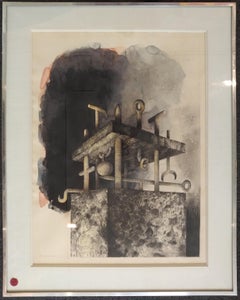
UNTITLED No. 26
Located in New York, NY
Avant-Garde
Argentine
Category
1970s American Modern Still-life Drawings and Watercolors
Materials
Paper, Conté, Charcoal, Watercolor, Pencil
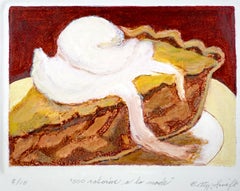
"500 Calories al mode" The Perfect Meal - Menu - Dessert - Collograph Watercolor
Located in Soquel, CA
"500 Calories al mode" The Perfect Meal - Menu - Dessert - Collograph Watercolor
The artwork "500 Calories al mode" by Betty Swift, created one of a group show at San Francisco Stat...
Category
1980s American Modern Still-life Drawings and Watercolors
Materials
Watercolor, Laid Paper, Etching
$750
H 14 in W 11 in D 0.5 in
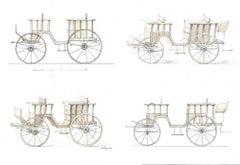
Kutschen (carriages); Group of four designs for hansom cabs.
By Alfred Juergens
Located in Middletown, NY
Four pencil drawings, each with hand coloring in watercolor, each 6 3/4 x 10 inches (sheet) (172 x 254 mm), full margins. Each with inscriptions and notations by the artist in the up...
Category
Mid-20th Century American Modern Still-life Drawings and Watercolors
Materials
Handmade Paper, Watercolor, Pencil
$800
H 6.78 in W 10.01 in
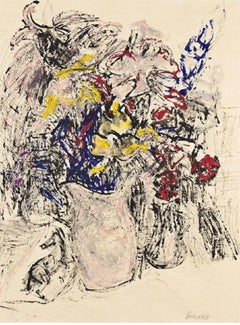
Still Life with Flowers
By Theresa Bernstein
Located in New York, NY
Gouache and pen and ink on paper. Signed in ink in lower right corner.
Provenance: private collection, Columbus, OH; private collection, Chicago.
Bernstein (1890-2002) was raised ...
Category
1930s American Modern Still-life Drawings and Watercolors
Materials
Gouache
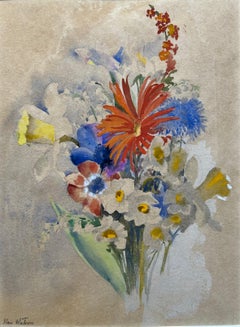
Flower Bouquet
Located in Los Angeles, CA
(Note: This work is part of our exhibition Connected by Creativity: WPA Era Works from the Collection of Leata and Edward Beatty Rowan)
Watercolor on paper, 12 x 9 ½ inches unframed sheet, 15 x 12 ½ inches framed, signed lower left
About the Artist:
Nan Watson...
Category
1930s American Modern Still-life Drawings and Watercolors
Materials
Watercolor
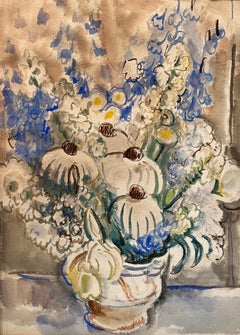
Flowers Still Life
Located in Los Angeles, CA
(Note: This work is part of our exhibition Connected by Creativity: WPA Era Works from the Collection of Leata and Edward Beatty Rowan)
Watercolor...
Category
1930s American Modern Still-life Drawings and Watercolors
Materials
Watercolor
More From This Seller
View AllA Stunning ca. 1950s Cubist Watercolor of Irises by Rita Duis (Astley-Bell)
Located in Chicago, IL
A stunning Modern Cubist watercolor on paper of purple irises by Chicago and New York artist Rita Duis (Astley-Bell). Signed and inscribed "Duis A.W.S." (American Watercolor Society...
Category
1950s American Modern Still-life Drawings and Watercolors
Materials
Watercolor, Paper
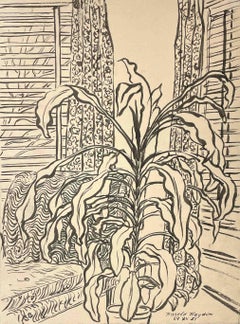
1951 Ink Drawing Still Life, Studio Interior by Chicago Artist, Harold Haydon
By Harold Haydon
Located in Chicago, IL
A highly finished, 1951 detailed ink drawing of a still-life and studio interior by notable Chicago Modern artist, Harold Haydon. A striking drawing completed on fine, hand-made pap...
Category
1950s American Modern Still-life Drawings and Watercolors
Materials
Paper, Ink
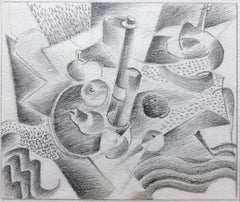
A Striking 1940s Cubist Still Life Drawing by Modern Artist Stanley Bielecky
By Stanley Bielecky
Located in Chicago, IL
A striking 1940s Modern cubist still life drawing by Notable Chicago and Michigan artist Stanley Bielecky. Image size: 4 x 5 inches. Archivally matted to 13 1/4 x 16 inches. Estate stamped and numbered 58, lower left.
Stanley Bielecky was an Indiana artist who painted the American Scene, from the industrial factories and workers around East Chicago to the pastoral settings of Mackinac Island...
Category
1940s American Modern Abstract Drawings and Watercolors
Materials
Graphite, Paper
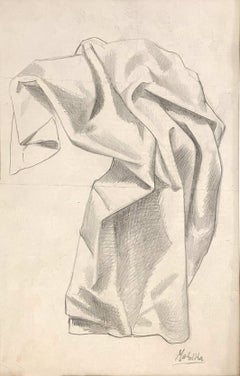
A Fine 1930s Modern Drawing of Classical Drapery by NY Artist, Jan Matulka
By Jan Matulka
Located in Chicago, IL
A fine ca. 1938 graphite on paper, study of classical drapery by notable New York Modernist artist, Jan Matulka. The image is drawn on the back of a typewritten, folded sheet of bus...
Category
1930s American Modern Still-life Drawings and Watercolors
Materials
Paper, Graphite
A Stylish, Early 1940s Woman
s Fashion Study Featuring Elizabeth Arden Cosmetics
Located in Chicago, IL
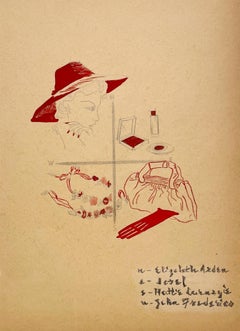
A stylish, vintage early 1940s fashion study featuring elegant designs for women's accessories and Elizabeth Arden cosmetics.
Artwork size: 11 3/4 x 8 3/4 inches. Archivally ma...
Category
1940s Art Deco Still-life Drawings and Watercolors
Materials
Paper, Pencil, Watercolor
1930s Surrealist Still Life with Hammer, Palette and Chopper by Jan Matulka
By Jan Matulka
Located in Chicago, IL
A captivating 1930s Surrealist graphite still life drawing with a hammer, palette and chopper by notable New York Modern artist, Jan Matulka. Artwork size: 8 1/2 x 11 inches. Archivally matted to 14 x 16 1/2 inches. Estate stamped. Provenance: Estate of the artist.
An innovative drawing by Matulka reminiscent of the famed series of Modern works by the American painter and contemporary of Matulka, the New York artist Stuart Davis. In 1927, Davis began work on a series of five paintings based on a still life he had created by nailing an eggbeater, an electric fan, and a rubber glove to a table in his studio. Using this group of incongruous and unlikely items, he created his first truly abstract works. An example of these paintings, Egg Beater...
Category
1930s Modern Still-life Drawings and Watercolors
Materials
Paper, Graphite