Want more images or videos?
Request additional images or videos from the seller
1 of 8
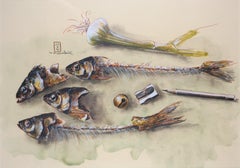
Manfred K. SchwitteckStill life with fish bones, pencil and pencil sharpener1992
1992
Price:$411.34
$572.40List Price
About the Item
- Creator:Manfred K. Schwitteck (1948, German)
- Creation Year:1992
- Dimensions:Height: 18.51 in (47 cm)Width: 23.63 in (60 cm)Depth: 0.79 in (2 cm)
- Medium:
- Movement Style:
- Period:
- Condition:
- Gallery Location:Berlin, DE
- Reference Number:1stDibs: LU2438212429272
About the Seller
5.0
Vetted Professional Seller
Every seller passes strict standards for authenticity and reliability
Established in 2014
1stDibs seller since 2023
23 sales on 1stDibs
Authenticity Guarantee
In the unlikely event there’s an issue with an item’s authenticity, contact us within 1 year for a full refund. DetailsMoney-Back Guarantee
If your item is not as described, is damaged in transit, or does not arrive, contact us within 7 days for a full refund. Details24-Hour Cancellation
You have a 24-hour grace period in which to reconsider your purchase, with no questions asked.Vetted Professional Sellers
Our world-class sellers must adhere to strict standards for service and quality, maintaining the integrity of our listings.Price-Match Guarantee
If you find that a seller listed the same item for a lower price elsewhere, we’ll match it.Trusted Global Delivery
Our best-in-class carrier network provides specialized shipping options worldwide, including custom delivery.You May Also Like
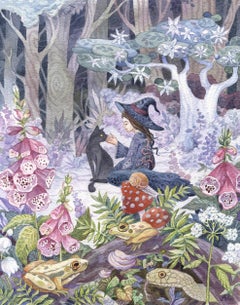
"Foxglove" (2024) By Ania Mohrbacher, Original Fantasy Watercolor Painting
Located in Denver, CO
"Foxglove" (2024) Is an original watercolor fantasy painting, which depicts a young witch and her black cat in the center of a clearing in a forest, rife with magical flora and fauna...
Category
2010s Surrealist Figurative Drawings and Watercolors
Materials
Watercolor, Archival Paper
$850
H 14 in W 11 in D 1 in
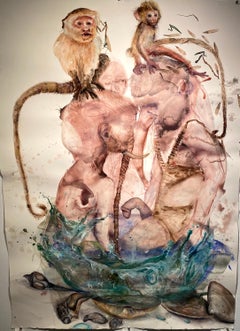
Watercolor on paper: )"Monkey at Sea" (elephant nose )
Located in New York, NY
Shiri Mordechay's paintings are a whirlwind of emotion and complexity, drawing the viewer into a vibrant and dynamic world. Each piece is packed with countless details, your eyes are...
Category
2010s Surrealist Figurative Drawings and Watercolors
Materials
Watercolor, Archival Paper
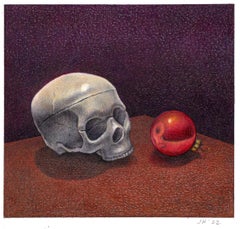
Skull and Ornament - Vanitas, Still Life, Color Pencil Drawing, Framed
By John Hrehov
Located in Chicago, IL
Drawings of skulls are often called vanitas, which often contain collections of objects symbolic of the inevitability of death and the transience and vanity of earthly achievements and pleasures; it exhorts the viewer to consider mortality and to repent. This still life vanitas drawing is matted with a heavy white mat and framed in a bronze toned wooden frame measuring 15.75 x 16.25 inches.
John Hrehov
Skull and Ornament
colored pencil on paper
7h x 8w in
17.78h x 20.32w cm
JHR006
John Hrehov
Education
1985 MFA-Painting, University of Illinois at Urbana-Champaign
1981 BFA-Painting, Cleveland Institute of Art, Cleveland, OH.
Solo Exhibitions
2017 John Hrehov, Paintings and Drawings. Tom Thomas...
Category
2010s Surrealist Still-life Drawings and Watercolors
Materials
Archival Paper, Color Pencil
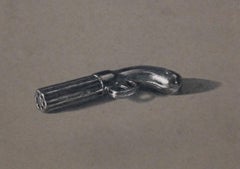
Gun from Clue
By A.J. Fries
Located in Buffalo, NY
An original mixed media drawing by American artist A.J. Fries.
Category
21st Century and Contemporary Realist Figurative Drawings and Watercolors
Materials
Gouache, Graphite, Paper
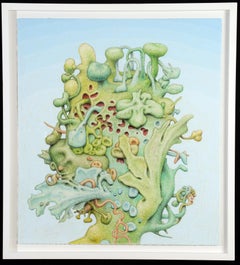
Untitled
By Alexander Ross
Located in Saint Louis, MO
Alexander Ross
Untitled, 2007
Watercolor, colored pencil, gouache and graphite on paper
Framed Dimensions: 28 x 25.5 inches (71.1 x 64.8 cm)
Image Dimensions: 23 x 22 inches (58.4 ...
Category
Early 2000s Contemporary Still-life Drawings and Watercolors
Materials
Watercolor, Gouache, Archival Paper, Color Pencil, Graphite
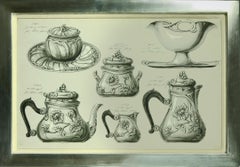
Collection of Watercolour Designs for Silverware.
Located in London, GB
[ANON.]
Collection of Watercolour Designs for Silverware.
South Germany, [Late 19th century].
A series of 9 watercolours, each framed and glazed, ...
Category
Late 19th Century Figurative Drawings and Watercolors
Materials
Paper, Watercolor, Pencil
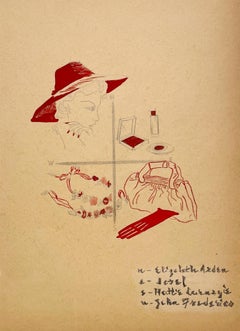
A Stylish, Early 1940s Woman
s Fashion Study Featuring Elizabeth Arden Cosmetics
Located in Chicago, IL
A stylish, vintage early 1940s fashion study featuring elegant designs for women's accessories and Elizabeth Arden cosmetics.
Artwork size: 11 3/4 x 8 3/4 inches. Archivally ma...
Category
1940s Art Deco Still-life Drawings and Watercolors
Materials
Paper, Pencil, Watercolor
$185
H 12 in W 16 in D 0.13 in
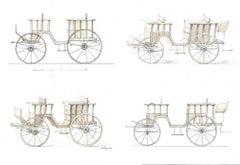
Kutschen (carriages); Group of four designs for hansom cabs.
By Alfred Juergens
Located in Middletown, NY
Four pencil drawings, each with hand coloring in watercolor, each 6 3/4 x 10 inches (sheet) (172 x 254 mm), full margins. Each with inscriptions and notations by the artist in the up...
Category
Mid-20th Century American Modern Still-life Drawings and Watercolors
Materials
Handmade Paper, Watercolor, Pencil
$800
H 6.78 in W 10.01 in
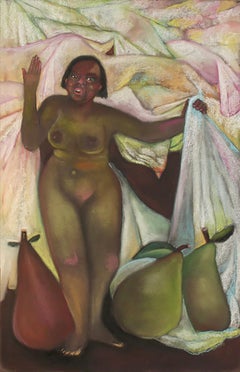
Big Fruit Nude, colorful, imaginative nude with fruit on pastel on toned paper
By Stephen Basso
Located in Brooklyn, NY
*ABOUT Stephen Basso
Stephen Basso's highly original pastels and oil paintings are romantic, yet thought provoking fantasies. His whimsical works are alive with boundless imagina...
Category
2010s Surrealist Figurative Drawings and Watercolors
Materials
Pastel, Archival Paper
$1,100
H 38 in W 27.01 in D 0.99 in
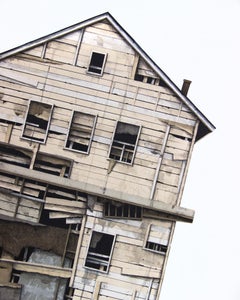
"House Studies Series I", Layered Paper and Drawing Collage, Architecture
By Seth Clark
Located in Philadelphia, PA
This layered paper and drawing collage titled "House Studies Series I" is an original artwork by Seth Clark made of paper, charcoal, pastel, graphite, and acrylic on wood. Through a ...
Category
21st Century and Contemporary Contemporary Still-life Drawings and Water...
Materials
Paper, Charcoal, Pastel, Acrylic, Wood Panel, Graphite
More From This Seller
View AllStill life with fish bones, pencil and pencil sharpener / - The irony of art -
Located in Berlin, DE
Manfred K. Schwitteck (*1948), Still life with fish bones, pencil and pencil sharpener, 1992. watercolor over pencil on handmade paper, 31.5 x 45 cm (visible size), 47 x 61 cm (frame...
Category
1990s Surrealist Still-life Drawings and Watercolors
Materials
Watercolor, Etching
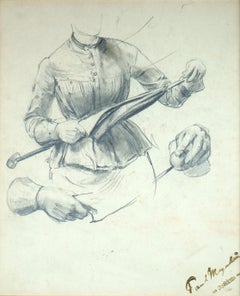
Study with Torso, Hands, and Umbrella - The characteristic of the inconspicuous
Located in Berlin, DE
Paul Friedrich Meyerheim (1842 Berlin - 1915 ibid.). Sketch of a female torso with hands and an umbrella. Pencil on paper, 27.5 x 22.5 cm (visible size)...
Category
1890s Realist Figurative Drawings and Watercolors
Materials
Pencil
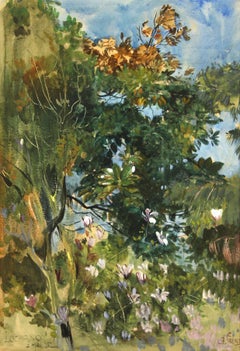
Plant Impression in Locarno - Floral Crescendo -
Located in Berlin, DE
Alexander Frenz (1861 Rheydt - 1941 Düsseldorf). Plant impression in Locarno. Gouache and watercolour. 35 x 23,5 cm (visible size), 49,5 x 38,5 cm (fra...
Category
1890s Impressionist Landscape Drawings and Watercolors
Materials
Watercolor
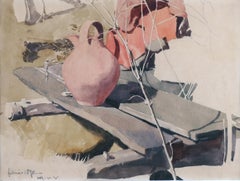
Clay jug on a bench - The essence of the clay jar revealed by the sunlight -
By Hans Richard von Volkmann
Located in Berlin, DE
Hans Richard von Volkmann (1860 Halle (Saale) - 1927 ibid.), Clay jug on a bench. Pencil and Watercolour on paper. 20 x 26,7 cm (visible size), 37 x 45 cm (frame), dated and monogrammed lower left "Februar 1890 - HR. V. V."
- Minimally tanned. Framed behind glass in a passepartout.
About the artwork
Using the technique of his early youth - pencil and watercolour - Hans Richard von Volkmann depicts a still life. However, this is not a conventional indoor still life, but an open-air depiction, painted outdoors and not in the studio. It is therefore an open-air painting, characteristic of von Volkmann's oeuvre, which could have been painted in the Willingshausen colony of painters, where open-air painting was programmatically practised there and the artist stayed there that year.
And indeed, this painting is a manifesto of open-air painting. Von Volkmann demonstrates that leaving the studio for the light of nature leads to an entirely new quality of art. To prove this, he uses the genre of still life, which can be described as the studio subject par excellence. Moreover, light plays an essential role in the classical still life. It is the real protagonist of the still life. And it is precisely this moment, essential to the still life, that von Volkmann exploits to demonstrate the potential of plein-air painting: He presents the objects as they appear in the sunlight. The date of February and the bare branches in the foreground make it clear that this is a clear winter day in bright sunlight. The delicate plant in the foreground casts a clearly defined shadow, as does the jug. However, the shadow is most pronounced on the jug itself: The underside of the handle appears almost black, making the top, and therefore the jug itself, shine all the more brightly. The shining of the objects in the sunlight is also visible on the bench. As complementary phenomena to the shadow zones, light edges can be seen on the boards of the seats and the upper foot of the bench shines entirely in the light. To achieve this intensity of light, von Volkmann activated the bright white of the painting ground.
By depicting the objects in glistening sunlight, von Volkmann demonstrates that this quality of light is only to be found outdoors. And this light leads to a new way of looking at the objects themselves. The jug on the bench seems like an accidental arrangement, as if the artist had stumbled upon this unintentional still life and captured it with fascination. And in this fascination there is a moment of realisation that refers to the objects themselves. It is only when they shine brightly in the sunlight that their true nature is revealed. In this way, sunlight allows the objects to come into their own, so to speak. Sunlight, which is not present in the studio, gives the still life an entirely new dimension of reality, which is also reflected in the colours interwoven by the sunlight: The bench and the jug stand in a harmonious grey-pink contrast to the green of the implied meadow.
The emphasis on the jug as the central subject of the picture also implies that the watercolour has not been completed. This non finito inscribes a processuality into the picture, making it clear that something processual has been depicted, the temporality of which has been made artistically permanent. This is why von Volkmann signed the painting and dated it to the month.
About the Artist
Von Volkmann made his first artistic attempts at the age of 14. He painted many watercolours of his home town of Halle. This laid the foundation for his later outdoor painting.
In 1880 his autodidactic beginnings were professionalised with his admission to the Düsseldorf Art Academy. There he studied under Hugo Crola, Heinrich Lauenstein, Johann Peter Theodor Janssen and Eduard von Gebhardt until 1888. Von Volkmann then moved to the Karlsruhe Academy, where he was Gustav Schönleber's master pupil until 1892.
In 1883 he came for the first time to Willingshausen, Germany's oldest painters' colony, at the suggestion of his student friend Adolf Lins...
Category
1890s Naturalistic Still-life Drawings and Watercolors
Materials
Watercolor
High Moorland Landscape in the fog - The world as a transcendent phenomenon -
Located in Berlin, DE
Charles Edward Brittan Jr (1870 Plymouth - 1949). High moor landscape in the fog. Gouache, signed at lower left "Charles E. Brittan", 18 x 34.5 cm (passepartout), 45 x 62 cm (frame)....
Category
Early 20th Century Realist Landscape Drawings and Watercolors
Materials
Watercolor
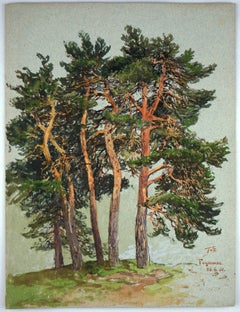
Norwegian Pine Grove - The inner glow of the trees -
Located in Berlin, DE
Themistokles von Eckenbrecher (1842 Athens - 1921 Goslar), Norwegian pine grove, 1901. Watercolor on blue-green paper, 30 x 22 cm. Signed, dated and inscribed in his own hand "TvE. Fagermes [i.e. Fagermes]. 26.6.[19]01."
- Slight crease throughout at left margin, otherwise in good condition.
About the artwork
Themistokles von Eckenbrecher often traveled to Norway to study the nature that fascinated him there. On June 26, 1901, near the southern Norwegian town of Fagernes, in the summer evening sun, he saw a small pine grove, which he immediately captured in a watercolor. He exposed the trees growing on a small hill in front of the background, so that the pines completely define the picture and combine to form a tense motif. The tension comes from the contrast of form and color. The trunks, growing upward, form a vertical structure that is horizontally penetrated by the spreading branches and the pine needles, which are rendered as a plane. This structural tension is further intensified by the color contrast between the brown-reddish iridescent trunks and branches and the green-toned needlework.
Themistokles von Eckenbrecher, however, does not use the observed natural scene as an inspiring model for a dance of color and form that detaches itself from the motif and thus treads the path of abstracting modernism. Its inner vitality is to be brought to light and made aesthetically accessible through the work of art.
It is precisely in order to depict the inner vitality of nature that von Eckenbrecher chooses the technique of watercolor, in which the individual details, such as the needles, are not meticulously worked out, but rather a flowing movement is created that unites the contrasts. The trees seem to have formed the twisted trunks out of their own inner strength as they grew, creatingthose tense lineations that the artist has put into the picture. The inner strength continues in the branches and twigs, culminating in the upward growth of the needles. At the same time, the trunks, illuminated by the setting sun, seem to glow from within, adding an almost dramatic dimension to the growing movement.
Through the artwork, nature itself is revealed as art. In order to make nature visible as art in the work, von Eckenbrecher exposes the group of trees so that they are bounded from the outside by an all-encompassing contour line and merge into an areal unity that enters into a figure-ground relationship with the blue-greenish watercolor paper. The figure-ground relationship emphasizes the ornamental quality of the natural work of art, which further enforces the artwork character of the group of trees.
With the presentation of Themistokles von Eckenbrecher's artistic idea and its realization, it has become clear that the present watercolor is not a study of nature in the sense of a visual note by the artist, which might then be integrated into a larger work context, but a completely independent work of art. This is why von Eckenbrecher signed the watercolor. In addition, it is marked with a place and a date, which confirms that this work of nature presented itself to him in exactly this way at this place at this time. At the same time, the date and place make it clear that the natural work of art has been transferred into the sphere of art and thus removed from the time of the place of nature.
About the artist
Themistocles' parents instilled a life of travel in their son, who is said to have spoken eleven languages. His father, who was interested in ancient and oriental culture, was a doctor and had married Francesca Magdalena Danelon, an Italian, daughter of the British consul in Trieste. During a stay in Athens - Gustav von Eckenbrecher was a friend of Heinrich von Schliemann and is said to have given him crucial clues as to the location of Troy - Themistokles saw the light of day in 1842.
After an interlude in Berlin, where Themistokles was educated at the English-American School, the journey began again. From 1850 to 1857 the family lived in Constantinople, after which the father opened a practice in Potsdam, where Themistokles, who wanted to become a painter, was taught by the court painter Carl Gustav Wegener.
In 1861 the von Eckenbrechers left Potsdam and settled in Düsseldorf. There Themistokles received two years of private tuition from Oswald Aschenbach, who greatly admired the talented young artist. After his artistic training, he undertook extensive travels, often accompanied by Prince Peter zu Sayn-Wittgenstein, which took him to northern and eastern Europe, but above all to the Middle East and even to South America. The paintings that resulted from these journeys established his artistic reputation and led to his participation in large panoramas such as the 118 x 15 metre Entry of the Mecca Caravan into Cairo, painted for the City of Hamburg in 1882.
1882 was also the start of a total of 21 study trips to Scandinavia, most of them to Norway, and the unique Norwegian landscape with its rugged fjords became a central motif in his work. Along with Anders Askevold and Adelsteen Normann...
Category
Early 1900s Naturalistic Landscape Drawings and Watercolors
Materials
Watercolor