1890s Still-life Drawings and Watercolors
to
1
6
3
Overall Width
to
Overall Height
to
14
132
1,072
949
14
8
19
36
36
71
94
89
117
61
11
1
6
2
1
3
3
2
2
1
1
1
1
1
1
1
1
1
1
1
7
7
4
2
1
1
1
5
5
4
Period: 1890s
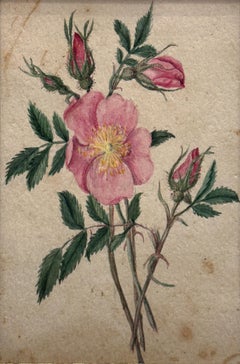
"Moss Rose" Emily Cole, Early American Female Artist, Light Pink Flower, Floral
Located in New York, NY
Emily Cole
Moss Rose, circa 1890
Watercolor on paper
Sight 5 1/2 x 3 3/4 inches
Provenance
The artist
Edith Cole Silberstein, the artist's granddaughter, by descent
Dr. Clark S. Mar...
Category
Academic 1890s Still-life Drawings and Watercolors
Materials
Paper, Watercolor
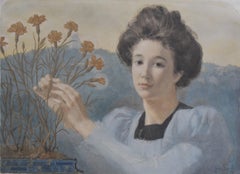
Gustave Riquet (1866-1938) Les Œillets de la vie, 1898 watercolor signed
Located in Paris, FR
Gustave Riquet (1866-1938)
Les Œillets de la vie, 1898 (Carnations of life)
Signed and dated on the lower right,
The text on the lower left is the following "Cueille dès aujourd'hui les oeillets de la vie" , which can be translated as "Pick today the carnations of life"
watercolor on paper
37.5 x 51.5 cm
In good condition
In a modern frame : 53 x 67 cm
The text clearly gives the meaning of this allegorical portrait...
Category
Symbolist 1890s Still-life Drawings and Watercolors
Materials
Watercolor
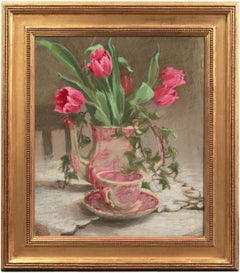
Still Life, Red Tulips with Japanese Porcelain
, Belgian Lace, Japonaiserie
Located in Santa Cruz, CA
A finely-drawn, pastel still-life showing red tulips informally arranged in a Chelsea soft paste porcelain Chocolate pot decorated in the Japanese style and set beside a cup and sauc...
Category
Academic 1890s Still-life Drawings and Watercolors
Materials
Gold Leaf
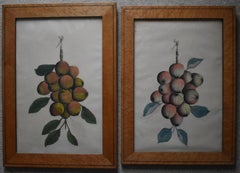
French School Swags of Apples a Pair of Watercolour Paintings c1890
Located in Holywell, GB
Martin Jules CHOUARD (1839-1919) Swags of Apples a Pair of Watercolours c1890
A near pair of decorative watercolour paintings signed and presented in expensive stylish maple frames....
Category
French School 1890s Still-life Drawings and Watercolors
Materials
Watercolor
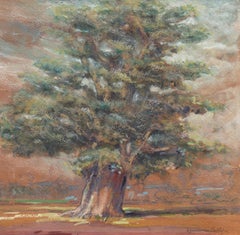
The Old Oak Tree, Bushey School of Art, British
Located in Santa Cruz, CA
Signed lower right, 'Laurence Bell' (British, died 1916) and painted circa 1910.
Bell studied at the Bushey School of Art in Hertfordshire in England. His preferred subject was land...
Category
1890s Still-life Drawings and Watercolors
Materials
Paper, Gouache
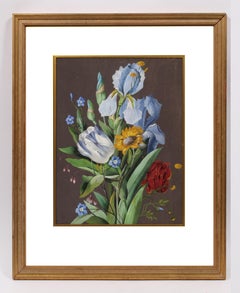
Colorful Still Life
Located in Buffalo, NY
A stunning 19th Century antique gouache on paper still life by an unknown artist.
This beautiful work comes in its original antique frame with new archival mat presentation.
Category
Realist 1890s Still-life Drawings and Watercolors
Materials
Paper, Gouache
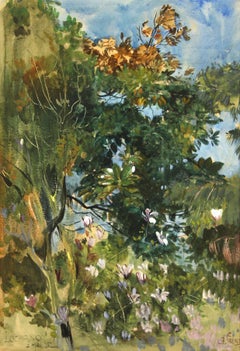
Plant Impression in Locarno - Floral Crescendo -
Located in Berlin, DE
Alexander Frenz (1861 Rheydt - 1941 Düsseldorf). Plant impression in Locarno. Gouache and watercolour. 35 x 23,5 cm (visible size), 49,5 x 38,5 cm (fra...
Category
Impressionist 1890s Still-life Drawings and Watercolors
Materials
Watercolor
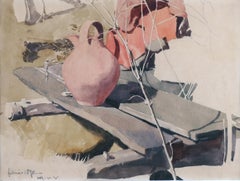
Clay jug on a bench - The essence of the clay jar revealed by the sunlight -
By Hans Richard von Volkmann
Located in Berlin, DE
Hans Richard von Volkmann (1860 Halle (Saale) - 1927 ibid.), Clay jug on a bench. Pencil and Watercolour on paper. 20 x 26,7 cm (visible size), 37 x 45 cm (frame), dated and monogrammed lower left "Februar 1890 - HR. V. V."
- Minimally tanned. Framed behind glass in a passepartout.
About the artwork
Using the technique of his early youth - pencil and watercolour - Hans Richard von Volkmann depicts a still life. However, this is not a conventional indoor still life, but an open-air depiction, painted outdoors and not in the studio. It is therefore an open-air painting, characteristic of von Volkmann's oeuvre, which could have been painted in the Willingshausen colony of painters, where open-air painting was programmatically practised there and the artist stayed there that year.
And indeed, this painting is a manifesto of open-air painting. Von Volkmann demonstrates that leaving the studio for the light of nature leads to an entirely new quality of art. To prove this, he uses the genre of still life, which can be described as the studio subject par excellence. Moreover, light plays an essential role in the classical still life. It is the real protagonist of the still life. And it is precisely this moment, essential to the still life, that von Volkmann exploits to demonstrate the potential of plein-air painting: He presents the objects as they appear in the sunlight. The date of February and the bare branches in the foreground make it clear that this is a clear winter day in bright sunlight. The delicate plant in the foreground casts a clearly defined shadow, as does the jug. However, the shadow is most pronounced on the jug itself: The underside of the handle appears almost black, making the top, and therefore the jug itself, shine all the more brightly. The shining of the objects in the sunlight is also visible on the bench. As complementary phenomena to the shadow zones, light edges can be seen on the boards of the seats and the upper foot of the bench shines entirely in the light. To achieve this intensity of light, von Volkmann activated the bright white of the painting ground.
By depicting the objects in glistening sunlight, von Volkmann demonstrates that this quality of light is only to be found outdoors. And this light leads to a new way of looking at the objects themselves. The jug on the bench seems like an accidental arrangement, as if the artist had stumbled upon this unintentional still life and captured it with fascination. And in this fascination there is a moment of realisation that refers to the objects themselves. It is only when they shine brightly in the sunlight that their true nature is revealed. In this way, sunlight allows the objects to come into their own, so to speak. Sunlight, which is not present in the studio, gives the still life an entirely new dimension of reality, which is also reflected in the colours interwoven by the sunlight: The bench and the jug stand in a harmonious grey-pink contrast to the green of the implied meadow.
The emphasis on the jug as the central subject of the picture also implies that the watercolour has not been completed. This non finito inscribes a processuality into the picture, making it clear that something processual has been depicted, the temporality of which has been made artistically permanent. This is why von Volkmann signed the painting and dated it to the month.
About the Artist
Von Volkmann made his first artistic attempts at the age of 14. He painted many watercolours of his home town of Halle. This laid the foundation for his later outdoor painting.
In 1880 his autodidactic beginnings were professionalised with his admission to the Düsseldorf Art Academy. There he studied under Hugo Crola, Heinrich Lauenstein, Johann Peter Theodor Janssen and Eduard von Gebhardt until 1888. Von Volkmann then moved to the Karlsruhe Academy, where he was Gustav Schönleber's master pupil until 1892.
In 1883 he came for the first time to Willingshausen, Germany's oldest painters' colony, at the suggestion of his student friend Adolf Lins...
Category
Naturalistic 1890s Still-life Drawings and Watercolors
Materials
Watercolor
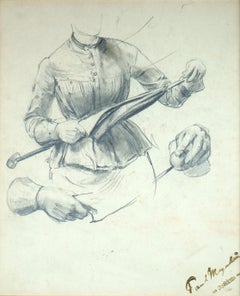
Study with Torso, Hands, and Umbrella - The characteristic of the inconspicuous
Located in Berlin, DE
Paul Friedrich Meyerheim (1842 Berlin - 1915 ibid.). Sketch of a female torso with hands and an umbrella. Pencil on paper, 27.5 x 22.5 cm (visible size)...
Category
Realist 1890s Still-life Drawings and Watercolors
Materials
Pencil
Related Items
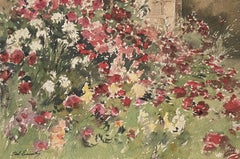
Paul Lecomte (1842-1920) A Flowerbed, signed watercolor
By Paul Lecomte
Located in Paris, FR
Paul Lecomte (1842-1920)
A Flowerbed
signed lower left
Watercolor on paper,
15.5 x 23.5 cm
Framed : 25.5 x 33 cm
This is a particularly original work by Paul Lecomte. It shows his ...
Category
Impressionist 1890s Still-life Drawings and Watercolors
Materials
Watercolor

$1,148
H 6.11 in W 9.26 in
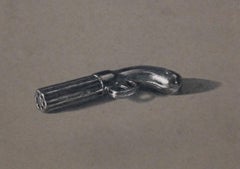
Gun from Clue
By A.J. Fries
Located in Buffalo, NY
An original mixed media drawing by American artist A.J. Fries.
Category
Realist 1890s Still-life Drawings and Watercolors
Materials
Gouache, Graphite, Paper
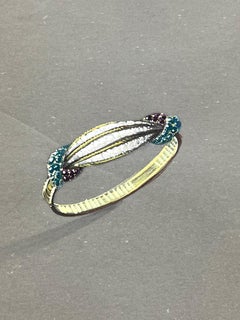
Original Parisian Vintage Jewelry Design Art by Van Cleef
Boucheron Designer
Located in Cirencester, Gloucestershire
Teal and Amethyst Gemstone Twist RingJewelry Design
circa mid 20th century
by Paul Touzet (French b. 1917)
original gouache painting, with pencil on tracing paper
unframed
overall pa...
Category
French School 1890s Still-life Drawings and Watercolors
Materials
Watercolor, Gouache, Pencil
1920
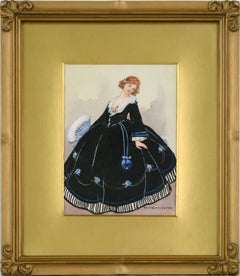
s Historical Fashion Illustration of Lady in 17th Century Dress
Located in Soquel, CA
Finely detailed historical figurative fashion illustration painted in watercolor in 1921, of a lady in 17th century dress; complete with a full blac...
Category
Realist 1890s Still-life Drawings and Watercolors
Materials
Paper, Watercolor
$695
H 12.25 in W 10.25 in D 0.75 in
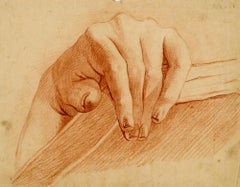
Studio di mano (study of hand) – Florentine School 18th century
Located in Middletown, NY
Red chalk on cream laid paper, 7 1/4 x 9 3/8 inches (182 x 236 mm), the full sheet. In very good condition with minor toning and two small nicks in the top sheet edge. Some modern no...
Category
Italian School 1890s Still-life Drawings and Watercolors
Materials
Crayon, Laid Paper
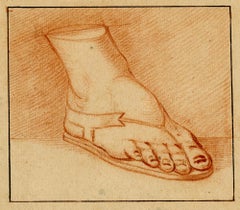
Studio di piede (study of foot) – Florentine School 18th century
Located in Middletown, NY
Red chalk on cream laid paper, 6 3/8 x 7 inches (160 x 176 mm), the full sheet. In very good condition with minor toning and some modern notations in pencil on the verso, as well as ...
Category
Italian School 1890s Still-life Drawings and Watercolors
Materials
Crayon, Laid Paper
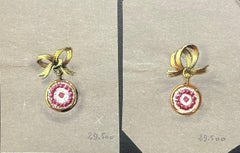
Original Parisian Vintage Jewelry Design Art by Van Cleef
Boucheron Designer
Located in Cirencester, Gloucestershire
intage Elegance Bows of Timeless Charm Jewelry Design
circa mid 20th century
by Paul Touzet (French b. 1917)
original gouache painting, with pencil on tracing paper
unframed
left des...
Category
French School 1890s Still-life Drawings and Watercolors
Materials
Watercolor, Gouache, Pencil
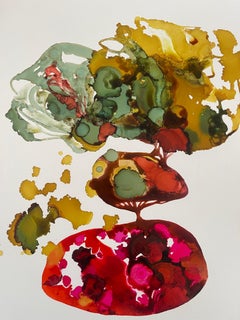
Underworld
Located in San Francisco, CA
Paula Valenzuela
Underworld, 2025
Alcohol ink and watercolor ink on Yupo paper
14 x 11 inches
This one-of-a-kind work on paper comes unframed. External, visible frame and glass in s...
Category
Contemporary 1890s Still-life Drawings and Watercolors
Materials
Paper, Ink, Watercolor
Original Parisian Vintage Jewelry Design Art by Van Cleef
Boucheron Designer
Located in Cirencester, Gloucestershire
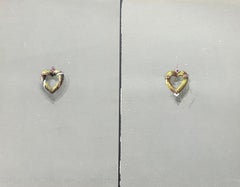
Timeless Love: Twisted Gold Heart Pendant Duo Jewelry Design
circa mid 20th century
by Paul Touzet (French b. 1917)
original gouache painting, with pencil on tracing paper
unframed
l...
Category
French School 1890s Still-life Drawings and Watercolors
Materials
Watercolor, Gouache, Pencil
Original 70
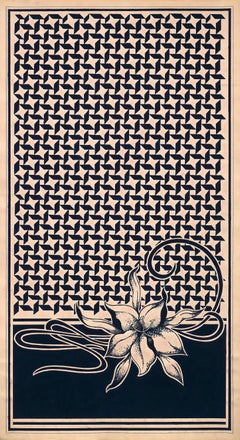
s Hand Painted Textile Design Gouache Navy Blue Color on White Paper
Located in ALCOY/ALCOI, ES
Compass Rose and Flower design. Sealed on the back with the design studio name and number 397
We offer a small number of these original illustration designs by this design studio ba...
Category
Modern 1890s Still-life Drawings and Watercolors
Materials
Paper, Gouache
$1,017
H 34.65 in W 18.9 in D 0.12 in
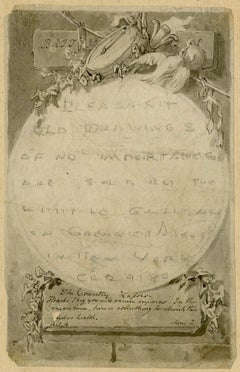
Ink and wash cartouche with a mirror, doves, and a drum
Located in Middletown, NY
A lovely and curious composition, circa 1780.
Ink and wash on tissue thin Japon paper, adhered to period cream laid paper, 5 1/4 x 3 3/8 inches (132 x 84 mm), the full sheet. With ...
Category
French School 1890s Still-life Drawings and Watercolors
Materials
Ink, Handmade Paper, Watercolor
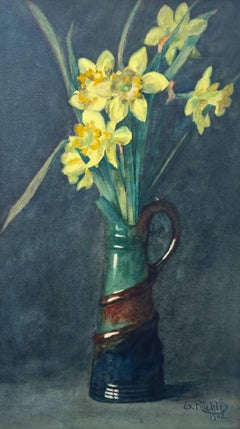
"Daffodils in Ceramic Pitcher"
Located in Southampton, NY
Here for your consideration is a beautiful watercolor still life on heavy paper by the German artist, E. Riehle. Signed and dated lower right, 1903. In good condition with it's orig...
Category
Academic 1890s Still-life Drawings and Watercolors
Materials
Paper, Watercolor
Previously Available Items
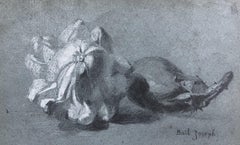
Joseph Bail (1862-1921) A Still life with vegetables, signed drawing
Located in Paris, FR
Joseph Bail (1862-1921)
A Still life with vegetables,
signed lower right
Charcoal and white chalk on blue grey paper
14.5 x 23.8 cm
Framed : 21.5 x 31,5 cm
Joseph Bail particularl...
Category
Realist 1890s Still-life Drawings and Watercolors
Materials
Charcoal, Chalk
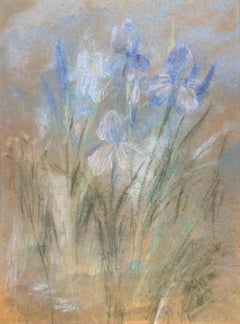
Irises
By John Henry Twachtman
Located in Bryn Mawr, PA
Provenance
Milch Galleries, New York;
Mr. and Mrs. Franklin Biggs, Middleton, Delaware (by 1983);
Coe Kerr Gallery, New York;
Ira and Nancy Koger (acquired from the above, 1984);
Pri...
Category
American Impressionist 1890s Still-life Drawings and Watercolors
Materials
Paper, Pastel, Watercolor
Still life with dead goldfinch - The mystic blue transcends death -
Located in Berlin, DE
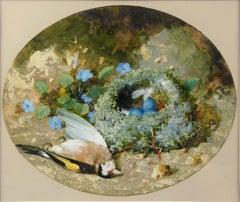
William Cruickshank (1848-1922). Still Life with a Dead Goldfinch and Nest. Watercolour and gouache on buff paper, 21 x 24.5 cm (visible size), 40 x 42 cm (frame), signed W Cruickshank on the left. Framed behind glass in a passpartout.
About the artwork
The painting has an atmosphere of melancholy beauty. The clutch of eggs, recalling the wonderfully mysterious blue of Romanticism, the matching blue flowers and the goldfinch with its black, yellow and red plumage show nature in all its beauty, and yet the goldfinch is dead. It lies on its back, its head bent backwards in an unnatural way, its claws lifeless and one wing outstretched in a last effort. This makes the scene a natura morta, a still life that spreads the melancholy silence of an eternal moment. Yet there is also an inherent movement in the picture, enhanced by the streaky application of paint.
A movement that here signifies the intertwining of life and death: death, which the goldfinch has met in mid-life, before it has been able to hatch its offspring, while at the same time the mysterious blue eggs that have not hatched point to a higher life after death. Finally, the goldfinch feeding on the thorny thistles traditionally represents Christ and his redemptive sacrificial death. The goldfinch is depicted in a similar way in Carel Fabritius' famous painting The Thistle Finch (1654), in the Mauritshuis in The Hague. The bird is alive, but chained and thus prevented from flying.
In this tradition, Cruickshanks' painting is a memento mori that is immediately appealing to today's viewer - a meditative image of life and death that also contains an affirmation of life in all the beauty of creation. In order to enhance the readability of this pictorial sense, the objects depicted are tilted into the plane so that the individual elements of the picture can be more easily related to one another, but without destroying the sense of space.
Cruickshank, who specialised in this type of painting, combined the emblematics of the Baroque with the imagery of Romanticism and a style borrowed from landscape painting. Cruickshank's mastery of materials is evident in his fusion of watercolour and gouache, in which the more intense colours of gouache concretise the motif from an indeterminate, moving colour space. The painted objects have the aesthetic quality of fine painting, although, as in the case of the nest, they are formed by a virtuoso structure of blotches.
Selected bibliography
Algernon Graves: The Royal Academy of Arts. A complete dictionary of contributors and their work from its foundation in 1769 to 1904, vol. 2: Carroll to Dyer, London 1905.
Leo R. Schidlof: The miniature in Europe. In the 16th, 17th, 18th, and 19th centuries, vol. 1: A - L, Graz 1964.
Jeremy Maas: Victorian painters, London 1996.
Daphne Foskett: A Dictionary of British miniature...
Category
English School 1890s Still-life Drawings and Watercolors
Materials
Watercolor, Gouache
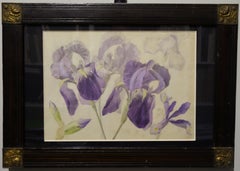
"purple iris" botanical study 1850 watercolor and pencil cm. 30 x 20
Located in Torino, IT
Art Decò,Iris,Purple ,Flowers,Frame,
botanical study of 1850 original liberty frame
Category
Art Deco 1890s Still-life Drawings and Watercolors
Materials
Watercolor
Still Thinking About These?
All Recently ViewedMore Ways To Browse
Thomas Mccormick Gallery
Tim Armstrong
Tomato Sculpture
Ton Schulten
Vignobles De France
Vintage Bomber Seats
Vintage Grain Elevator
Vintage Magic Posters
Vintage Orient Express Posters
Vintage Velvet Posters
Violin Posters
Visser T Hooft
Volney Richardson
Walter J Watson
Western Cattle Paintings
William Frates
William Willis
Wood Carved Garuda