1 of 1
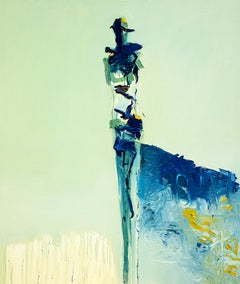
George D. GreenERIE1982
1982
$3,200List Price
About the Item
- Creator:George D. Green (1943, American)
- Creation Year:1982
- Dimensions:Height: 43.25 in (109.86 cm)Width: 47 in (119.38 cm)
- Condition:good.
- Gallery Location:Los Angeles, CA
- Reference Number:Seller: 100010461stDibs: G130911243390
Authenticity Guarantee
In the unlikely event there’s an issue with an item’s authenticity, contact us within 1 year for a full refund. DetailsMoney-Back Guarantee
If your item is not as described, is damaged in transit, or does not arrive, contact us within 7 days for a full refund. Details24-Hour Cancellation
You have a 24-hour grace period in which to reconsider your purchase, with no questions asked.Vetted Professional Sellers
Our world-class sellers must adhere to strict standards for service and quality, maintaining the integrity of our listings.Price-Match Guarantee
If you find that a seller listed the same item for a lower price elsewhere, we’ll match it.Trusted Global Delivery
Our best-in-class carrier network provides specialized shipping options worldwide, including custom delivery.You May Also Like
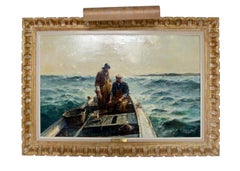
Mid Century Modern Framed Ram Boat Signed Oil Signed Jack Lorimer Gray 1950s 60s
By Jack L. Gray
Located in Keego Harbor, MI
Jack Lorimer Gray, 1927-1981, was born in Halifax, Nova Scotia to Scottish parents. His talents as an artist were spotted by E. Wyly Grier while Gray was still a child. He attended t...
Category
1950s Landscape Paintings
Materials
Oil
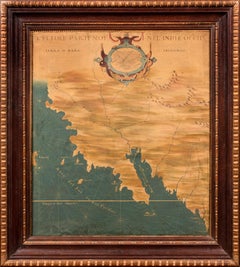
The 1564 Medici Danti Map of California
By Fra Egnazio Danti
Located in New York, NY
Florentine, Probably Seventeenth Century
Titled
L’ultime parti note nel Indie occidentali
Dated on the edge of the cartouche: “M.D. LXIII. M.AG” [1564…the month of August]
In the 1560s Cosimo I de’Medici, the powerful Duke of Florence, undertook a major renovation of the Palazzo Vecchio, the venerable palace that to this day dominates the city at the Piazza della Signoria. For the Sala della Guardaroba, literally the wardrobe room, but in fact the storeroom of the Duke’s most precious holdings, Cosimo conceived of a grand decorative project that was to reflect in one space the entire cosmos --both an indication of the Duke’s ambition and an allusion to his name. The plan, supervised by Giorgio Vasari, involved the construction of walnut cabinets to contain the Medici treasures, on the outside doors of which were to be placed large hand-painted maps specially commissioned to document and illustrate the current knowledge of the world. Portraits of famous men were to decorate the tops of the cabinets and two large globes –one representing the terrestrial world, the other celestial—were to descend from openings in the ceiling. The commission for the maps, inspired by Ptolemy’s Geographia, was given to the celebrated mathematician and cosmographer, Fra Egnazio Danti (Perugia 1536-1585 Alatri). Fifty-three maps were ultimately created. Thirty were conceived and executed by Danti between 1563 and 1575. The remaining twenty-three were completed by Stefano Bonsignori between 1576 and 1686. They remain in place in Florence in the room for which they were created.
The present work is an exact-size painted, drawn and inscribed copy of Danti’s map of California...
Category
17th Century Old Masters Drawings and Watercolor Paintings
Materials
Canvas, Paper, Ink, Watercolor, Gouache, Pen
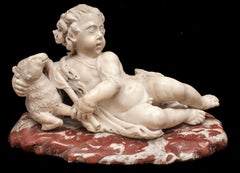
The Infant Saint John the Baptist with a Lamb
Located in New York, NY
Provenance:
James Byrnes, Los Angeles (1917-2011)
Giusto Le Court was born Josse or Justus de Corte in the Flemish city of Ypres. His father Jean was a sculptor and presumably his earliest training was with him before he entered the studio of Cornelis van Mildert. The young artist was clearly influenced by the dominant Flemish sculptor of the time, Artus Quellinus the Elder, with whom he may have worked on the decoration of the Amsterdam City Hall.
Following the lead of many northern artists he travelled to Rome, perhaps more than once, before settling in Venice around 1655. It was there, as one of a colony of expatriate artists, that he made his name as a sculptor. One of his first Venetian commissions was for the monument to Alvise Mocenigo in the Church of San Lazzaro dei Mendicanti, where Le Court sculpted the marble figures of Strength and Justice. He also collaborated with the celebrated architect Baldassare Longhena, most famously for the high altar of Santa Maria della Salute, where he carved the multi-figured altarpiece depicting the Queen of Heaven Expelling the Plague.
The present marble sculpture depicts the infant Saint John the Baptist, reclining, wearing his traditional hair-shirt, embracing a lamb, and holding the bottom of his attribute, a reed cross. Attached to his shirt is a baptismal cup, with which he would become associated later in his life. Veneration of the infant Saint John the Baptist was prevalent throughout Italy and images of the saint in childhood—often called “Giovannino,” or little John...
Category
17th Century Renaissance Sculptures
Materials
Marble
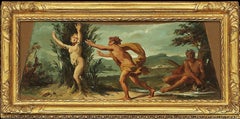
Seven Scenes from the Life of Apollo
By Jacopo Guarana
Located in New York, NY
Attributed to
Jacopo Guarana
(Verona 1720 – 1808 Venice)
Canvas, unsigned
The Deeds of Apollo
Provenance: Suida-Manning Collection
These seven scenes are brilliant evocations o...
Category
18th Century and Earlier Baroque Figurative Paintings
Materials
Oil
Italian 18th Century Oval Religious Oil on Canvas Painting with Saint Dominic
By Francesco de Mura
Located in Firenze, IT
This beautiful Italian 18th Century old masters oil painting on oval canvas with giltwood frame is attributed to Solimena and features a religious scene.
In this splendid oval-shaped painting are depicted Saint Dominic...
Category
18th Century Old Masters Figurative Paintings
Materials
Canvas, Oil

$13,175
H 21.66 in Dm 15.75 in
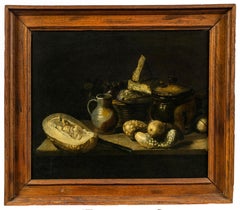
Still Life with Squash, Gourds, Stoneware, and a Basket with Fruit and Cheese
Located in New York, NY
Provenance:
Selma Herringman, New York, ca. 1955-2013; thence by descent to:
Private Collection, New York, 2013-2020
This seventeenth century Spanish still-life of a laden table, known as a bodegón, stands out for its dramatic lighting and for the detailed description of each object. The artist’s confident use of chiaroscuro enables the sliced-open squash in the left foreground to appear as if emerging out of the darkness and projecting towards the viewer. The light source emanates from the upper left, illuminating the array, and its strength is made apparent by the reflections on the pitcher, pot, and the fruit in the basket. Visible brush strokes accentuate the vegetables’ rough surfaces and delicate interiors. Although the painter of this striking work remains unknown, it is a characteristic example of the pioneering Spanish still-lifes of the baroque period, which brought inanimate objects alive on canvas.
In our painting, the knife and the large yellow squash boldly protrude off the table. Balancing objects on the edge of a table was a clever way for still-life painters to emphasize the three-dimensionality of the objects depicted, as well a way to lend a sense of drama to an otherwise static image. The knife here teeters on the edge, appearing as if it might fall off the table and out of the painting at any moment. The shape and consistency of the squash at left is brilliantly conveyed through the light brush strokes that define the vegetable’s fleshy and feathery interior. The smaller gourds—gathered together in a pile—are shrouded partly in darkness and stand out for their rugged, bumpy exterior. The stoneware has a brassy glaze, and the earthy tones of the vessels are carefully modulated by their interaction with the light and shadow that falls across them. The artist has cleverly arranged the still-life in a V-shaped composition, with a triangular slice of cheese standing upright, serving as its pinnacle.
Independent still-lifes only became an important pictorial genre in the first years of the seventeenth century. In Italy, and particularly through the revolutionary works of Caravaggio, painted objects became carriers of meaning, and their depiction and arrangement the province of serious artistic scrutiny. Caravaggio famously asserted that it was equally difficult to paint a still-life as it was to paint figures, and the elevation of this new art form would have profound consequences to the present day. In Spain Juan Sanchez Cotan...
Category
17th Century Old Masters Still-life Paintings
Materials
Canvas, Oil
$20,000
H 20.5 in W 24.5 in
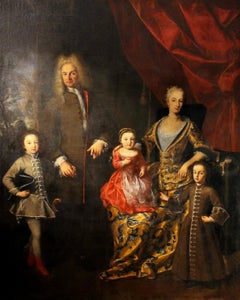
Oil on Canvas Painting Portrait of the Italian Noble Family of Zanardi Count
By Lucia Casalini Torelli
Located in Firenze, IT
This museum quality old master oil on canvas formal portrait painting depicting the family of the Count Zanardi is signed by the artist- the female painter Lucia Casalini Torelli- and published in a book dedicated to Casalini Torelli’s workshop and academy.
This palatial masterpiece artwork comes directly from the ancient Villa Maraini Guerrieri - Palidano di Gonzaga (Mantua), an historic Italian heritage building owned by the descendants of the family portrayed for more than two centuries, until 1998.
The big scale of this oil on canvas masterpiece painting states the relevance of Lucia Casalini Torelli as a painter. The present artwork is a formal family portrait painting that aim to introduce the characters depicted according to their social role in the society. The noble family is all gathered under a loggia overlooking a park, the landscape in the background is partially covered by a beautiful red cloth on the right side.
The father stands up and holds the hand of his eldest son, proudly introducing his future heir. The son wears a light-blue dress and red boots, he is depicted in a serious pose holding a black tricorn hat under his arm and a rapier sword on his belt.
The mother wears an elegant gold and dark green brocade dress, she is sitting with her youngest daughter on her knees while her second son is by her side. The little daughter wears a lovely long red and dress with white lace and holds an apple on her hand. The son stands next to his mother and is dressed in a brown priestly clothes.
This palatial old masters piece was probably painted in 1740 due to the similarities with Cardinal Doria’ s portrait, now on display at the Doria Palace Museum, the official residence of the Prince of Genoa.
The painting features original canvas (“prima tela”) and antique original patina, it is in excellent overall condition considering the age, use and its large scale. A formal detailed condition report and the results of the inspection with the UV lamp accompanied by photos is available on request.
As well as for its exceptional quality and quite perfect state of conservation, this painting is particularly important and even more valuable both for the artist who painted it and for its absolutely exclusive provenance.
Lucia painted the most prominent and powerful noble families of her time, the location of these paintings is unknown to the art market as it is extremely likely that the portraits are still kept in private collections.
Furthermore, Lucia was one of the most appreciated artists of her time, so important that she was admitted as a member of the academy at a time when women were forbidden to attend these studies.
In 1706, Felice Torelli...
Category
18th Century Old Masters Portrait Paintings
Materials
Canvas, Oil
$173,682
H 94.49 in W 85.44 in D 1.19 in
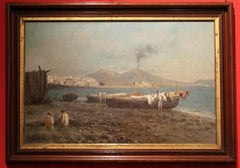
Italian Impressionist Oil on Board Marine Landscape Painting Naples Bay View
By Francesco Coppola Castaldo
Located in Firenze, IT
Everyday fishermen life is captured in this wonderful Italian impressionist late 19th century oil painting on thin board titled fishermen ashore. We love the neutral and natural colo...
Category
Late 19th Century Impressionist Landscape Paintings
Materials
Oil, Board
$4,192
H 20.08 in W 28.75 in D 1.19 in
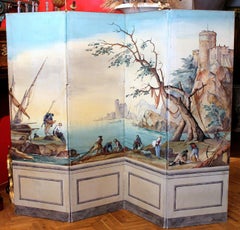
French Tempera on Canvas Four Panels Folding Screen with Seascape View
Located in Firenze, IT
This French early 20th Century folding screen is made up of four canvases entirely painted with textured tempera featuring a marine l...
Category
Early 20th Century Realist Landscape Paintings
Materials
Canvas, Tempera
$5,869
H 63 in W 78.75 in D 0.79 in
New Move
By Frank Arnold
Located in Fresno, CA
"New Move 8" Oil on Canvas is a mix of blues and greens with chrome yellow accents. Frank Arnold is thought by many to be one of the foremost abstract figurative painters and sculpto...
Category
2010s Abstract Abstract Paintings
Materials
Canvas, Oil