Art by Medium: Woodcut
to
173
2,390
243
153
97
182
Overall Width
to
Overall Height
to
6
544
2,074
443
18
31
183
230
92
120
129
97
89
66
5
2,436
587
250
215
203
114
61
44
42
25
5
3
1
1
2,091
879
81
1,388
720
558
491
394
362
346
278
261
230
213
212
187
158
141
118
108
101
71
68
4,879
49,991
39,055
25,562
25,499
132
50
30
29
27
136
1,643
1,289
833
Style: Modern
Style: Contemporary
Style: Art Deco
Medium: Woodcut
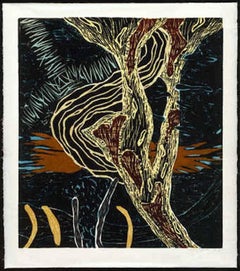
In the Fifth Season
Located in New York, NY
Gregory Amenoff is a painter who lives in New York City and Ulster County, New York. He is the recipient of numerous awards from organizations including the American Academy of Arts ...
Category
Late 20th Century Contemporary Art by Medium: Woodcut
Materials
Woodcut
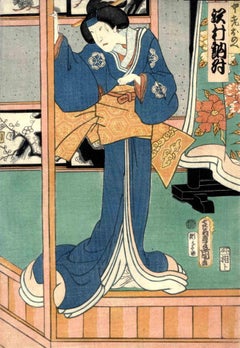
Sawamura Tosho - Woodcut Print by Utagawa Kunisada - 1862
Located in Roma, IT
Sawamura Tosho is an original modern artwork realized by Utagawa Kunisada in 1862.
Woodcut print Oban from a tryptich
Signature Kio Toyokuni ga (77 Toyokuni). Publisher: Soshuya. ...
Category
19th Century Modern Art by Medium: Woodcut
Materials
Woodcut
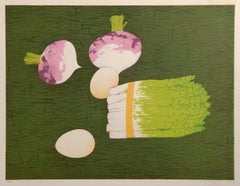
Cutting Board, Modern Woodcut by Shunji Sakuyama
Located in Long Island City, NY
Shunji Sakuyama, Japanese (1940 - ) - Cutting Board, Year: 1975, Medium: Woodcut on Arches, signed, numbered and dated in pencil, Edition: 47/50, Image Size: 13 x 17 inches, Size...
Category
1970s Modern Art by Medium: Woodcut
Materials
Woodcut
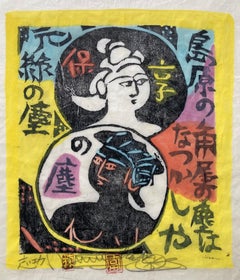
Untiled Faces
Located in Santa Monica, CA
SHIKO MUNAKATA (1903 – 1975)
UNTITLED FACES ca 1960. -- Color woodcut on thin Japan paper. Signed in pencil. with Chops, printed image 15 x 12 ¾”, Sheet 19 7/8 x 15 7/8” $1,...
Category
1960s Modern Art by Medium: Woodcut
Materials
Woodcut, Color
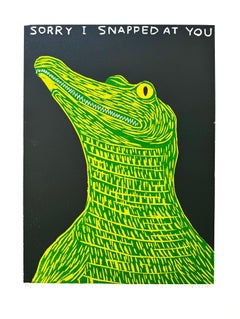
David Shrigley - Sorry I Snapped At You - Edition of 30
Located in London, GB
David Shrigley
Sorry I Snapped At You, 2025
Woodcut
53 x 40 cm
Edition of 30
hand-signed and numbered by the artist
published by Shäfer Editions and comes with COA from the publisher...
Category
2010s Contemporary Art by Medium: Woodcut
Materials
Woodcut
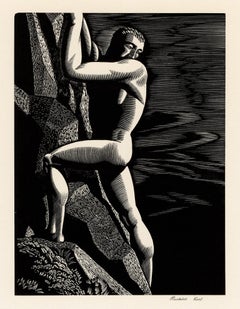
Mountain Climber
— American Modernism
Located in Myrtle Beach, SC
Rockwell Kent, 'Mountain Climber', wood engraving, 1933, edition 250, Burne Jones 93. Signed in pencil. A brilliant, black impression, on cream, wove Japan paper; the full sheet with margins (2 9/16 to 3 5/8 inches); slight skinning at the top sheet edge verso, where previously hinged; otherwise, in excellent condition. Archivally matted to museum standards, unframed.
Image size 7 7/8 x 5 7/8 inches (200 x 149 mm); sheet size 14 x 11 1/8 inches (356 x 283 mm).
Printed by Pynson Printers, New York. Distributed by The Print Club of Cleveland, Publication No. 11, 1933.
Literature: 'Rockwellkentiana,' Harcourt, Brace and Company, New York, 1933. '101 of The World’s Greatest Books', edited by Spencer Armstrong, 1950.
Impressions of this work are held in the following museum collections: Akron Art Institute, Burne Jones Collection, IL; Cincinnati Art Museum; Cleveland Museum of Art; Columbus Gallery of Fine Arts; Crystal Bridges Museum of American Art; Davis Museum at Wellesley College; Fine Art Museums of San Francisco; H. M. de Young Museum; Hermitage Museum; Kent Collection, NY; Library of Congress; Memorial Art Gallery, University of Rochester; Metropolitan Museum of Art; New York Public Library; Philadelphia Museum of Art; Princeton University Library; Smithsonian American Art Museum, Spector Collection, NY; SUNY, Plattsburg.
ABOUT THE ARTIST
Rockwell Kent (1882-1971), though best known as a painter, graphic artist, and illustrator, pursued many careers throughout his life, including architect, carpenter, explorer, writer, dairy farmer, and political activist. Born in Tarrytown, New York, Kent was interested in art from a young age. These ambitions were encouraged by his aunt Jo Holgate, an accomplished ceramicist. Jo came to live with the family after Kent’s father passed away in 1887 and took him to Europe as a teenager, undoubtedly kindling his interest in exploring the world.
Kent attended the Horace Mann School in New York City, where he excelled at mechanical drawing. His family’s financial circumstances prevented him from pursuing a career in the fine arts; however, after graduating from Horace Mann in 1900, Kent decided to study architecture at Columbia University.
Before matriculating at Columbia, Kent spent the first of three consecutive summers studying painting at William Merritt Chase’s art school in Shinnecock Hills, Long Island. There he found a community of mentors and fellow students who encouraged him to pursue his interest in art. At the end of Kent’s third summer at Shinnecock, Chase offered him a full scholarship to the New York School of Art, where he was a teacher. Kent began taking night classes at the art school in addition to his architecture studies but soon left Columbia to study painting full-time. In addition to Chase, Kent took classes with Robert Henri and Kenneth Hayes Miller, where his classmates included the artists George Bellows and Edward Hopper.
Kent spent the summer of 1903 assisting the eccentric painter Abbott Handerson Thayer at his studio in Dublin, New Hampshire—a position he secured through the recommendation of his Aunt Jo. Thayer’s naturalist lifestyle and almost mystical appreciation for natural phenomena greatly influenced Kent; he returned to Dublin for many years to visit Thayer and his family. Thayer gave the young artist time to pursue his work, and that summer Kent painted several views of the New Hampshire landscape, including Mount Monadnock. In 1905 Kent moved from New York to Monhegan Island in Maine, home to a summer art colony, where he continued to find inspiration in nature. Kent soon found success exhibiting and selling his paintings in New York, and in 1907, he was given his first solo show at Claussen Galleries. The following year he married his first wife, Kathleen Whiting (Thayer’s niece), with whom he had five children. The couple divorced in 1924, and Kent married Frances Lee the following year. They divorced after 15 years of marriage, and the artist married Sally Johnstone.
For the next several decades, Kent lived a peripatetic lifestyle, settling in several locations in Connecticut, Maine, and New York. During this time he took several extended voyages to remote, often ice-filled, corners of the globe, including Newfoundland, Alaska, Tierra del Fuego, and Greenland, to which he made three separate trips. For Kent, exploration and artistic production were twinned endeavors, and his travels to these rugged, elemental locations inspired his visual art and his writings. He developed a stark, realist landscape style in his paintings and drawings that revealed both nature’s harshness and its sublimity. Kent’s human figures, which appear sparingly in his work, often allude to the mythic themes of isolation, individualism, heroism, and the quest for self-connection. Important exhibitions of works from these travels include the Knoedler Gallery’s shows in 1919 and 1920, featuring Kent’s Alaska drawings...
Category
1930s American Modern Art by Medium: Woodcut
Materials
Woodcut
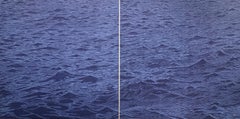
Seascape Diptych Six, Cobalt Blue Horizontal Seascape, Waves Woodcut Print
By Eve Stockton
Located in Kent, CT
This large, horizontal diptych woodcut print on paper evokes the peacefulness of ocean waves depicted in shades of cobalt blue with purple undertones and the artist's addition of wat...
Category
2010s Contemporary Art by Medium: Woodcut
Materials
Archival Ink, Watercolor, Archival Paper, Color Pencil, Woodcut
Gargantua - Rare Book Illustrated by Gustave Dorè - 1854
By Gustave Doré
Located in Roma, IT
Gargantua is an original modern rare book by François Rabelais illustrated for the first time by Gustave Doré (Strasbourg, 1832 – 23 January 1883) in 1854...
Category
1850s Modern Art by Medium: Woodcut
Materials
Woodcut
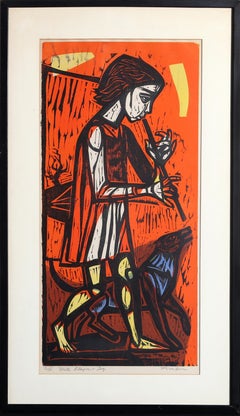
Flute Player and Dog, Modern Woodblock by Irving Amen
By Irving Amen
Located in Long Island City, NY
Irving Amen, American (1918 - 2011) - Flute Player and Dog, Year: circa 1965, Medium: Woodblock, signed and numbered in pencil, Edition: 74/100, Image Size: 29 x 14 inches, Size:...
Category
1960s Modern Art by Medium: Woodcut
Materials
Woodcut
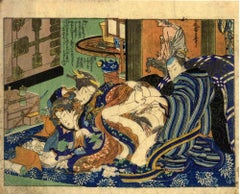
Shunga, Love Plays - Woodcut by Utagawa Kunisada - 1850s
Located in Roma, IT
Shunga, Love plays is an original artwork realized in the 1850s by Utagawa Kunisada (1786-1865).
Good print with gold. Backed, restored wormholes and missing oarts, glued at upper ...
Category
1850s Modern Art by Medium: Woodcut
Materials
Woodcut
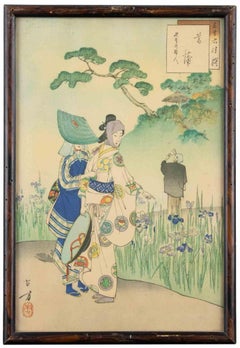
Sanjûroku Kasen ... - Woodcut by Mizuno Toshikata - 1893
Located in Roma, IT
Nishiki-e (woodcut print), in vertical oban format (31x20.5) realized by Mizuno Toshikata in 1893 (Meiji 26).
Belongs to the Series "Sanjûroku Kasen" (Thirty-Six Beauties in Compari...
Category
1890s Modern Art by Medium: Woodcut
Materials
Woodcut
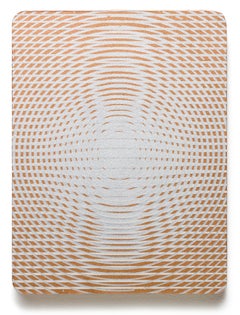
"Portalito", Abstract Patterns, Geometric Abstraction, Woodcut Monoprint
Located in Philadelphia, PA
This piece titled "Portalito" is an original piece by Alexis Nutini and is made from a woodcut monoprint mounted on panel. This piece measures 7.25"h x 9.5"w.
Born in Mexico City, ...
Category
21st Century and Contemporary Contemporary Art by Medium: Woodcut
Materials
Panel, Monoprint, Woodcut
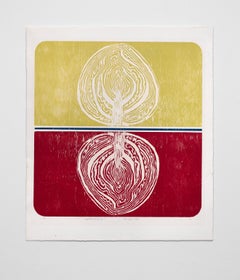
Joyce T. Nagel Woodcut "Vegetable Forms No. 1" Signed Dated Ltd Ed
Located in Detroit, MI
"Vegetable Forms No. 1" is a bright fresh woodcut print of a mirrored halved cabbage. Nature's intricate design is fully appreciated and apparent in the captured tight crinkled and folded leaves. #7/7 Signed and Dated
Joyce Tilley Nagel...
Category
1970s American Modern Art by Medium: Woodcut
Materials
Woodcut
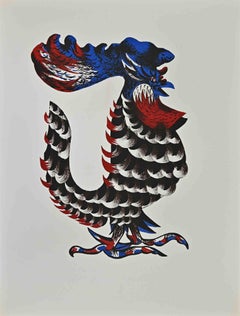
Rooster - Woodcut by Jean Lurçat - 1948
By Jean Lurçat
Located in Roma, IT
Rooster is a vintage woodcut print realized by Jean Lucrat in 1948.
Good condition on a cream colored paper.
No signature, on the back the title in french language.
Jean Lurçat (French: 1 July 1892 – 6 January 1966) was a French artist noted for his role in the revival of contemporary tapestry. In order to fully appreciate and understand the works of Jean Lurçat, one must view them in the context of the history of tapestry, in particular, the downfall of its existence during the rise of the Renaissance. It was during this time that tapestry was somewhat re-invented, where by traditional techniques were misplaced in the likening of tapestry to paintings by artists of the likes of Raphael. Jean Lurçat is largely responsible for its revival in the 20th century when he redefined the importance of designing tapestry in a way that embraced the integrity of authentic tapestry...
Category
Mid-20th Century Modern Art by Medium: Woodcut
Materials
Woodcut
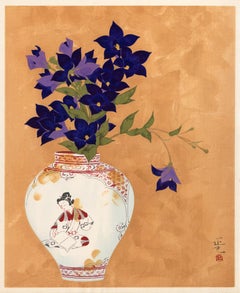
Flowers and Ko-Imari
— Taisho/Showa Shin Hanga Woodblock Print
Located in Myrtle Beach, SC
Masami Iwata, 'Flowers and Ko-Imari', color woodblock print, c. 1960, edition 250. Signed, and with the artist’s seal, lower right. A superb, painterly impression, with fresh colors,...
Category
1960s Modern Art by Medium: Woodcut
Materials
Woodcut
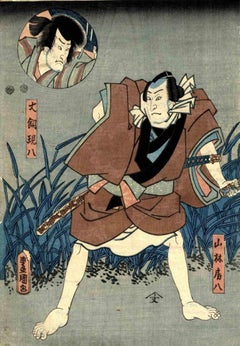
Yamabayashi Fusahachi - Woodcut Print by Utagawa Kunisada - 1860s
Located in Roma, IT
Yamabayashi Fusahachi is an original modern artwork realized by Utagawa Kunisada in 1861.
Woodcut print Oban from a multi-heet, 1861
Actor in the role of Yamabayashi Fusahachi sta...
Category
19th Century Modern Art by Medium: Woodcut
Materials
Woodcut
Wakeby Island, Conceptual Art Woodcut Print by Michael Mazur
Located in Long Island City, NY
Artist: Michael Mazur, American (1935 - 2009)
Title: Wakeby Island
Year: circa 1990
Medium: Color woodcut with chine collé, signed and numbered in pencil
Edition: 15
Image Size: 15 x...
Category
Late 20th Century Contemporary Art by Medium: Woodcut
Materials
Woodcut
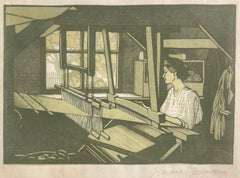
THE RUG WEAVER
Located in Santa Monica, CA
GUSTAVE BAUMANN (1881 – 1971)
THE RUG WEAVER, 1910 (Chamberlain 26)
Color woodcut signed in pencil. Unnumbed from an edition 100 as published in the Hills o’ Brown...
Category
1910s American Modern Art by Medium: Woodcut
Materials
Woodcut
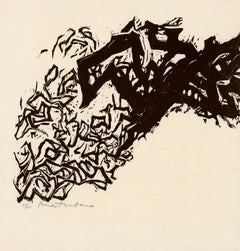
Winter Serenity
—from
Solitude
for Henry David Thoreau
s
Walden
Located in Myrtle Beach, SC
Naoko Matsubara, 'Winter Serenity' for the portfolio 'Solitude', woodcut, 1971, edition 100. Signed and numbered '58/100' in pencil. A fine, richly-inked impression, on cream laid J...
Category
1970s Modern Art by Medium: Woodcut
Materials
Woodcut
Victor Hugo Nuñez, ¨Los Enamorados I¨, 2013, Woodcut, 29.5x44.1 in
Located in Miami, FL
Victor Hugo Nuñez (Chile, 1943)
'Los Enamorados I', 2013
woodcut on paper Guarro Biblos 250g.
29.6 x 44.1 in. (75 x 112 cm.)
Edition of 33
ID: HUV-10...
Category
2010s Contemporary Art by Medium: Woodcut
Materials
Paper, Woodcut
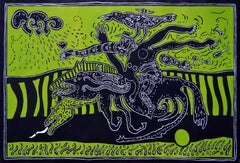
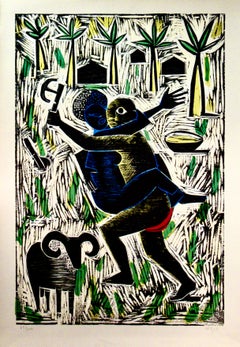
"Lendas Africanas Da Bahia" from the suite.
Located in San Francisco, CA
This artwork titled " Lendas Africanas Da Bahia" from the suite, 1978, is an original colors woodcut by renown Brazilian/Argentinian artist Hector Julio Paride Barnabo Carybe, 1911-1997. It is hand signed and numbered 83/200 in pencil by the artist. The Wood block mark (image) is 23.65 x 15.75 inches, sheet size is 26.75 x 19 inches. It is in excellent condition, has never been framed. It will be shipped in a 8 inches diameter heavy duty tube.
About the artist:
Héctor Julio Páride Bernabó (7 February 1911 – 2 October 1997) was an Argentine-Brazilian artist, researcher, writer, historian and journalist. His nickname and artistic name, Carybé, a type of piranha, comes from his time in the scouts. He died of heart failure after the meeting of a candomblé community's lay board of directors, the Cruz Santa Opô Afonjá Society, of which he was a member.
Quick Facts Born, Died ...
Carybé
Born
Héctor Julio Páride Bernabó
7 February 1911
Lanús, Argentina
Died
2 October 1997 (aged 86)
Salvador, Bahia, Brazil
Nationality
Brazilian
Known for
Painter, engraver, draughtsman, illustrator, potter, sculptor, mural painter, researcher, historian and journalist
Close
He produced thousands of works, including paintings, drawings, sculptures and sketches. He was an Obá de Xangô, an honorary position at Ilê Axé Opô Afonjá.
Orixá Panels in the Afro-Brazilian Museum in Salvador
Some of Carybé's work can be found in the Afro-Brazilian Museum in Salvador: 27 cedar panels representing different orixás or divinities of the Afro-Brazilian religion candomblé. Each panel shows a divinity with their associated implements and animal. The work was commissioned by the former Banco da Bahia S.A., now Banco BBM S.A., which originally installed them in its branch on Avenida Sete de Setembro in 1968.
Murals at Miami International Airport
American Airlines, Odebrecht and the Miami-Dade Aviation Department partnered to install two of Carybé's murals at Miami International Airport. They have been displayed in the American Airlines terminal at John F. Kennedy International Airport in New York since 1960. The 16.5 x 53-foot murals were accredited when Carybé won the first and the second prize in a contest of public art pieces for JFK airport.
As its terminal at that airport was due for demolition, American Airlines donated the murals to Miami-Dade County, and Odebrecht invested in a project to remove, restore, transport and install the murals at Miami International Airport.
The mural "Rejoicing and Festival of the Americas" portrays colorful scenes from popular festivals throughout the Americas, and "Discovery and Settlement of the West" depicts the pioneers’ journey into the American West.
Carybé's Woodcuts in Gabriel García Márquez's Books
Carybé illustrated four books by the Colombian writer Gabriel García Márquez, including One Hundred Years of Solitude, The Autumn of the Patriarch, Chronicle of a Death Foretold, and Love in the Time of Cholera "Carybé: um mestre da cultura baiana". ArqBahia Arquitetura, design, arte e lifestyle (in Brazilian Portuguese). 26 April 2023.. In particular, the woodcuts in One Hundred Years of Solitude are well-known for providing a visual image of the fictional town of Macondo, where the story takes place. The illustrations depict the colorful and winding houses, the railway bridge, and the hot and humid climate of the region, contributing to the reader's immersion in the story.
Carybé's woodcuts are, therefore, an important part of Gabriel García Márquez's literary legacy, bringing a visual dimension to his stories that further enriches the reader's experience.
Timeline
1911 — Birth in Lanús, Argentina.
1919 — Moved to Brazil.
1921 — The name Carybé is first given to him by the Clube do Flamengo scouts group, in Rio de Janeiro.
1925 — Beginning of his artistic endeavours, going to the pottery workshop of his elder brother, Arnaldo Bernabó, in Rio de Janeiro.
1927–1929 — Studies at the National School of Fine Arts, in Rio de Janeiro.
1930 — Worked for the newspaper Noticias Gráficas, in Buenos Aires, Argentina.
1935–1936 — Works with the writer Julio Cortázar and as a draughtsman for the El Diario newspaper.
1938 — Sent to Salvador by newspaper Prégon.
1939 — First collective exhibition, with the artist Clemente Moreau, at the Buenos Aires City Museum of Fine Arts, Argentina; illustrates the book Macumba, Relatos de la Tierra Verde, by Bernardo Kardon, published by Tiempo Nuestro.
1940 — Illustrates the book Macunaíma, by Mário de Andrade.
1941 — Draws the Esso Almanach, the payment for which allows him to set on a long journey through Uruguay, Brazil, Bolivia, and Argentina.
1941–1942 — Study trip around several South American countries.
1942 — Illustration for the book La Carreta by Henrique Amorim, published by El Ateneo (Buenos Aires, Argentina).
1943 — Together with Raul Brié, translates the book Macunaíma, by Mário de Andrade, into Spanish; produces the illustrations for the works Maracatu, Motivos Típicos y Carnavalescos, by Newton Freitas, published by Pigmaleon, Luna Muerta, by Manoel Castilla, published by Schapire, and Amores de Juventud, by Casanova Callabero; also publishes and illustrates Me voy al Norte, for the quarterly magazine Libertad Creadora; awarded First Prize by the Cámara Argentina del Libro (Argentine Book Council) for the illustration of the book Juvenília, by Miguel Cané (Buenos Aires, Argentina).
1944 — Illustrates the books The Complete Poetry of Walt Whitmann and A Cabana do Pai Tomás, both published by Schapire ; as well as and Los Quatro Gigantes del Alma by Mira y Lopez, Salvador BA; attends capoeira classes, visits candomblé meetings and makes drawings and paintings.
1945 — Does the illustrations for Daniel Defoe's Robinson Crusoe, for the Viau publishing house.
1946 — Helps in setting up the Tribuna da Imprensa newspaper, in Rio de Janeiro.
1947 — Works for the O Diário Carioca newspaper, in Rio de Janeiro.
1948 — Produces texts and illustrations for the book Ajtuss, Ediciones Botella al Mar (Buenos Aires, Argentina).
1949–1950 — Invited by Carlos Lacerda to work at the Tribuna da Imprensa, in Rio de Janeiro.
1950 — Invited by the Education Secretary Anísio Teixeira, moves to Bahia, and produces two panels for the Carneiro Ribeiro Education Center (Park School), in Salvador, Bahia.
1950–1997 — Settles in Salvador, Bahia.
1950–1960 — Actively participate in the plastic arts renewal movement, alongside Mário Cravo Júnior, Genaro de Carvalho, and Jenner Augusto.
1951 — Produces texts and illustrations for the works of the Coleção Recôncavo, published by Tipografia Beneditina and illustrations for the book, Bahia, Imagens da Terra e do Povo, by Odorico Tavares, published by José Olímpio in Rio de Janeiro; for the latter work he receives the gold medal at the 1st Biennial of Books and Graphic Arts.
1952 — Makes roughly 1,600 drawings for the scenes of the movie O Cangaceiro, by Lima Barreto; also works as the art director and as an extra on the film (São Paulo, SP).
1953 — Illustrations for the book A Borboleta Amarela, by Rubem Braga, published by José Olímpio (Rio de Janeiro, RJ).
1955 — Illustrates the work O Torso da Baiana, edited by the Modern Art Museum of Bahia.
1957 — Produces etchings, with original designs, for the special edition of Mário de Andrade's Macunaíma, published by the Sociedade dos 100 Bibliófilos do Brasil.
1958 — Makes an oil painting mural for the Petrobras Office in New York, USA; illustrates the book As Três Mulheres de Xangô, by Zora Seljan, published by Editora G. R. D. (Rio de Janeiro, RJ); Receives a scholarship grant in New York, USA.
1959 — Takes part in the competition for the New York International Airport panels project, in New York, USA, winning first and second prizes.
1961 — Illustrates the book Jubiabá, by Jorge Amado, published by Martins Fontes (São Paulo, SP).
1963 — Awarded the title of Honorary Citizen of Salvador, Bahia.
1965 — Illustrates A Muito Leal e Heróica Cidade de São Sebastião do Rio de Janeiro, published by Raymundo Castro Maya (Rio de Janeiro, RJ).
1966 — With Jorge Amado, co-authors Bahia, Boa Terra Bahia, published by Image (Rio de Janeiro, RJ); writes and illustrates the book Olha o Boi, published by Cultrix (São Paulo, SP).
1967 — Receives the Odorico Tavares Prize – Best Plastic Artist of 1967, in a competition ran by the state government to stimulate the development of plastic arts in Bahia; makes the Orixás Panels for the Banco da Bahia (currently at the UFBA Afro-Brazilian Museum) (Salvador, BA).
1968 — Illustrates the books Carta de Pero Vaz de Caminha ao Rei Dom Manuel, published by Sabiá (Rio de Janeiro) and Capoeira Angolana, by Waldeloir Rego, published by Itapoã (Bahia).
1969 — Produces the illustrations for the book Ninguém Escreve ao Coronel, by Gabriel Garcia Marquez, published by Sabiá (Rio de Janeiro, RJ).
1970 — Illustrates the books O Enterro do Diabo and Os Funerais de Mamãe Grande, published by Sabiá (Rio de Janeiro, RJ), Agotimé her Legend, by Judith Gleason, published by Grossman Publishers (New York, USA).
1971 — Illustrates the books One Hundred Years of Solitude, by Gabriel Garcia Marquez and A Casa Verde by Mario Vargas Llosa, both published by Sabiá (Rio de Janeiro, RJ); produces texts and illustrations for the book Candomblé da Bahia, published by Brunner (São Paulo, SP).
1973 — Illustrations for Gabriel Garcia Marquez's A Incrível e Triste História de Cândida Erendira e sua Avó Desalmada (Rio de Janeiro, RJ); paints the mural for the Legislative Assembly and the panel for the Bahia State Secretary of the Treasury.
1974 — Produces woodcuts for the book Visitações da Bahia, published by Onile.
1976 — Illustrates the book O Gato Malhado e a Andorinha Sinhá: uma história de amor, by Jorge Amado (Salvador, BA); receives the title of Knight of the Order of Merit of Bahia.
1977 — Certified with the Honor for Afro-Brazilian Cult Spiritual Merit, Xangô das Pedrinhas ao Obá de Xangô Carybé (Magé, RJ).
1978 — Makes the concrete sculpture Oxóssi, in the Catacumba Park; illustrates the book A Morte e a Morte de Quincas Berro D´Água, by Jorge Amado, published by Edições Alumbramento (Rio de Janeiro, RJ).
1979 — Produces woodcuts for the book Sete Lendas Africanas da Bahia, published by Onile.
1980 — Designs the costumes and scenery for the ballet Quincas Berro D´Água, at the Teatro Municipal in Rio de Janeiro.
1981 — Publication of the book Iconografia dos Deuses Africanos no Candomblé da Bahia (Ed. Raízes), following thirty years of research.
1982 — Receives the title of Honorary Doctor of the Federal University of Bahia.
1983 — Makes the panel for the Brazilian Embassy in Lagos, Nigeria.
1984 — Receives the Jerônimo Monteiro Commendation – Level of Knight (Espírito Santo); receives the Castro Alves Medal of Merit, granted by the UFBA Academy of Arts and Letters; makes the bronze sculpture Homenagem à mulher baiana (Homage to the Bahian woman), at the Iguatemi Shopping Center (Salvador, BA).
1985 — Designs the costumes and sets for the spectacle La Bohème, at the Castro Alves Theater; illustrates the book Lendas Africanas dos Orixás, by Pierre Verger, published by Currupio.
1992 — Illustrates the book O sumiço da santa: uma história de feitiçaria, by Jorge Amado (Rio de Janeiro, RJ).
1995 — Illustration of the book O uso das plantas na sociedade iorubá, by Pierre Verger (São Paulo, SP).
1996 — Making of the short film Capeta Carybé, by Agnaldo Siri Azevedo, adapted from the book O Capeta Carybé, by Jorge Amado, about the artist Carybé, who was born in Argentina and became the most Bahian of all Brazilians.
1997 — Illustration of the book Poesias de Castro Alves.
Exhibitions
ммIndividual Exhibitions:
1943 — Buenos Aires (Argentina) — First individual exhibition, at the Nordiska Gallery
1944 — Salta (Argentina) — at the Consejo General de Educacion
1945 — Salta (Argentina) — Amigos del Arte, Buenos Aires (Argentina) — Motivos de América, at the Amauta Gallery, Rio de Janeiro RJ — individual exhibition at the IAB/RJ
1947 — Salta (Argentina) — Agrupación Cultural Femenina
1950 — Salvador BA — First individual exhibit in Bahia, at the Bar Anjo Azul; São Paulo SP — MASP.
1952 — São Paulo SP — MAM/SP
1954 — Salvador BA — Oxumaré Gallery
1957 — New York (USA) — Bodley Gallery; Buenos Aires (Argentina) — Bonino Gallery * 1958 - New York (USA) — Bodley Gallery
1962 — Salvador BA - MAM/BA
1963 — Rio de Janeiro RJ — Bonino Gallery
1965 — Rio de Janeiro RJ — Bonino Gallery
1966 — São Paulo SP — Astrea Gallery
1967 — Rio de Janeiro RJ — Santa Rosa Gallery
1969 — London (England) — Varig Airlines
1970 — Rio de Janeiro RJ — Galeria da Praça
1971 — Rio de Janeiro RJ — MAM/RJ, São Paulo SP — A Galeria; Belo Horizonte MG, Brasília DF, Curitiba PR, Florianopolis SC, Porto Alegre RS, Rio de Janeiro RJ and São Paulo SP — The Orixás Panel (exhibition tour), at the Casa da Cultura in Belo Horizonte, MAM/DF, the Public Library of Paraná, the Legislative Assembly of Santa Catarina State, the Legislative Assembly of Rio Grande do Sul, MAM/RJ and MAM/SP
1972 — The Orixás Panel in Fortaleza CE — at the Ceará Federal University Art Museum, and in Recife PE — at the Santa Isabel Theater
1973 — São Paulo SP — A Galeria
1976 — Salvador BA — at the Church of the Nossa Senhora do Carmo Convent
1980 — São Paulo SP — A Galeria
1981 — Lisbon (Portugal) — Cassino Estoril
1982 — São Paulo SP — Renot Art Gallery, São Paulo SP — A Galeria
1983 — New York (USA) — Iconografia dos Deuses Africanos no Candomblé da Bahia, The Caribbean Cultural Center
1984 — Philadelphia (USA) — Art Institute of Philadelphia; Mexico — Museo Nacional de Las Culturas; São Paulo SP — Galeria de Arte André
1986 — Lisbon (Portugal) — Cassino Estoril; Salvador BA — As Artes de Carybé, Núcleo de Artes Desenbanco
1989 — Lisbon (Portugal) — Cassino Estoril; São Paulo SP — MASP
1995 — São Paulo SP — Documenta Galeria de Arte, São Paulo SP — Casa das Artes Galeria, Campinas SP — Galeria Croqui, Curitiba PR — Galeria de Arte Fraletti e Rubbo, Belo Horizonte MG — Nuance Galeria de Arte, Foz do Iguaçu PR — Ita Galeria de Arte, Porto Alegre RS — Bublitz Decaedro Galeria de Artes, Cuiabá MT — Só Vi Arte Galeria, Goiânia GO — Época Galeria de Arte, São Paulo SP — Artebela Galeria Arte Molduras, Fortaleza CE — Galeria Casa D'Arte, Salvador BA — Oxum Casa de Arte
Collective Exhibitions:
1939 — Buenos Aires (Argentina) — Carybé and Clemente Moreau Exhibition, at the Museo Municipal de Belas Artes
1943 — Buenos Aires (Argentina) — 29th Salon de Acuarelistas y Grabadores — first prize
1946 — Buenos Aires (Argentina) — Drawings by Argentine Artists, at the Kraft Gallery
1948 — Washington (USA) — Artists of Argentina, at the Pan American Union Gallery
1949 — Buenos Aires (Argentina) — Carybé and Gertrudis Chale, at the Viau Gallery; Salvador BA — Bahian Showroom of Fine Arts, at the Hotel Bahia
1950 — Salvador BA — 2nd Bahian Showroom of Fine Arts; São Paulo SP — MAM/SP
1951 — São Paulo SP — 1st São Paulo Art Biennial, Trianon Pavilion.
1952 — Salvador BA — 3rd Bahian Showroom of Fine Arts, at Belvedere da Sé; São Paulo SP — MAM/SP
1953 — Recife PE — Mario Cravo Júnior and Carybé, at the Santa Isabel Theater; São Paulo SP — 2nd São Paulo Art Biennial, at MAM/SP
1954 — Salvador BA — 4th Bahian Showroom of Fine Arts, at the Hotel Bahia. — Bronze medal
1955 — São Paulo SP — 3rd São Paulo Art Biennial, at MAM/SP — first prize for drawing
1956 — Salvador BA — Modern Artists of Bahia, at the Oxumaré Gallery; Venice (Italy) — 28th Venice Biennial
1957 — Rio de Janeiro RJ — 6th National Modern Art Show — exemption from the jury; São Paulo SP — Artists from Bahia, at the MAM/SP
1958 — San Francisco (USA) — Works by Brazilian Artists, at the Fine Arts Museums of San Francisco, Washington and New York (USA) — Works by Brazilian Artists, at the Pan American Union and the MoMA
1959 — Seattle (USA) — 30th International Exhibition, at the Seattle Art Museum; Salvador BA — Modern Artists of Bahia, at the Dentistry School.
1961 — São Paulo SP — 6th São Paulo Art Biennial, at MAM/SP — special room
1963 — Lagos (Nigeria) — Brazilian Contemporary Artists, at the Nigerian Museum; São Paulo SP — 7th São Paulo Art Biennial Bienal, at the Fundação Bienal
1964 — Salvador BA — Christmas Exhibition, at the Galeria Querino
1966 — Baghdad (Iraq) — collective exhibition sponsored by the Calouste Gulbenkian Foundation; Madrid (Spain) — Artists of Bahia, at the Hispanic Culture Institute; Rome (Italy) — Piero Cartona Palace; Salvador BA — 1st National Biennial of Plastic Arts (Bienal da Bahia) — special room; Salvador BA — Draughtsmen of Bahia, at the Convivium Gallery
1967 — Salvador BA — Christmas Exhibition at the Panorama Art Gallery; São Paulo SP — Artists of Bahia, at the A Gallery
1968 — São Paulo SP — Bahian Artists, at the A Gallery
1969 — London (England) — Tryon Gallery; São Paulo SP — 1st Panorama of Current Brazilian Art at the MAM/SP; São Paulo SP — Carybé, Carlos Bastos...
Category
Late 20th Century Modern Art by Medium: Woodcut
Materials
Woodcut
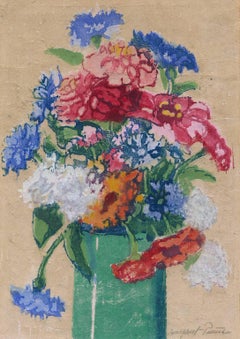
Zinnias and Bachelor Buttons.
Located in New York, NY
Margaret Patterson created this color woodcut print circa 1920. It is signed in pencil at the paper edge, lower right. Printed in areas to the paper edge -sheet size 10 1/16 x 7 1/...
Category
Early 20th Century American Modern Art by Medium: Woodcut
Materials
Woodcut
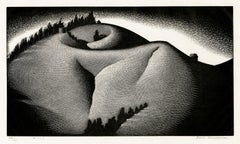
Hill
— American Modernism, California
Located in Myrtle Beach, SC
Paul Landacre, 'Hill', wood engraving, 1936, edition 60 (only 54 printed); only 2 impressions printed in a second edition of 150. Signed, titled, and numbered '49/60' in pencil. Wien...
Category
1930s American Modern Art by Medium: Woodcut
Materials
Woodcut
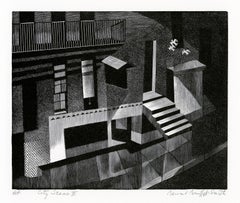
City Scene II — Mid-Century Modernism, Precisionism
Located in Myrtle Beach, SC
Bernard Brussel-Smith, 'City Scene II', wood engraving, 1949, artist's proof, edition 100. Signed, titled, and annotated 'A.P.' in pencil. A superb, richly-inked impression, on whit...
Category
1940s American Modern Art by Medium: Woodcut
Materials
Woodcut
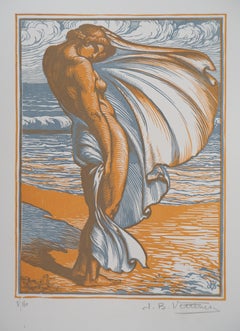
On the Beach : Bather in the Wind - Original wooodcut, Handsigned
Located in Paris, IDF
Jean Baptiste VETTINER (1871-1935)
On the Beach : Bather in the Wind, 1928
Original woodcut
Handsigned in pencil
Numbered /160
On vellum 32.5 x 25.5 cm (c. 13 x 10 in)
Bears the bli...
Category
1920s Art Deco Art by Medium: Woodcut
Materials
Woodcut
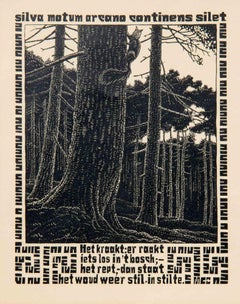
Squirrel - Woodcut by Maurits Cornelis Escher - 1931
Located in Roma, IT
Woodcut print realized by Escher in 1931.
It belongs to the series "Emblemata".
Signed with initials in the plate lower right.
Ref. F.H. Bool, J.R. Kist, J.L. Locher and F. Wierda...
Category
1930s Modern Art by Medium: Woodcut
Materials
Woodcut
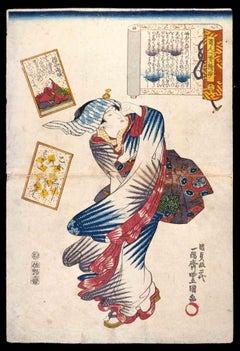
Bijinga - Woodcut by Utagawa Kunisada - 1844
Located in Roma, IT
Bijinga is an original artwork realized in the half of the 19th Century by Utagawa Kunisada (1786-1865).
From the series "SHyakunin isshu esho" (Girl's pictures and 100 poets' card...
Category
1840s Modern Art by Medium: Woodcut
Materials
Woodcut
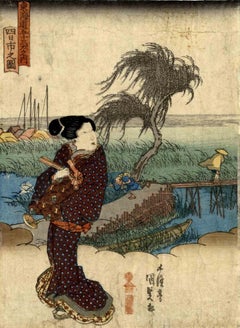
Bijinga - Woodcut by Utagawa Kunisada - 1830s
Located in Roma, IT
Bijinga is an original artwork realized in 1833-1835 by Utagawa Kunisada (1786-1865).
Chuban. From the series "Tokaido gojusan tsugi no uchi" (The 53 Tokaido Stations). Courtesan i...
Category
1830s Modern Art by Medium: Woodcut
Materials
Woodcut
EARLY JACOULET - A DOWNPOUR AT METALANIM PONOPE EAST CAROLINAS
Located in Santa Monica, CA
EARLY JACOULET
PAUL JACOULET (1896 – 1960)
UNE AVERSEA METALANIM, PONAPE , EST CAROLINES, 1935
A DOWNPOUR AT METALANIM PONOPE EAT CAROLINAS (Miles 29)
Color woodcut, with metallic ...
Category
1930s Modern Art by Medium: Woodcut
Materials
Color, Woodcut
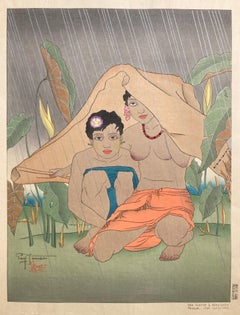
Untitled
Located in Kansas City, MO
HAP Grieshaber
Untitled
Wood block print in two colors
Year: 1977
Size: 21 x 14 in
Edition: 1,500
Signed in the plate
Publisher: HMK Fine Arts, New Yor...
Category
1970s Modern Art by Medium: Woodcut
Materials
Woodcut
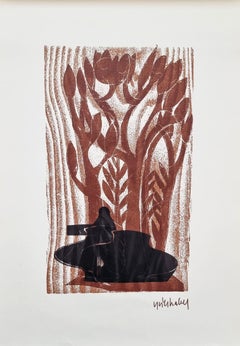

$198 Sale Price
75% Off
Madman
s Drum (Brothel) —
Story Without Words
Graphic Modernism
By Lynd Ward
Located in Myrtle Beach, SC
Lynd Ward, 'Madman's Drum, Plate 41', wood engraving, 1930, edition small. Signed in pencil. A fine, richly-inked impression, on off-white tissue-thin Japan paper; the full sheet with margins (1 5/8 to 2 1/2 inches); a small paper blemish in the upper right margin, away from the image, otherwise in excellent condition. A scarce, artist-printed, hand-signed proof impression before the published edition. Matted to museum standards, unframed.
Image size 5 1/2 x 3 3/4 inches (140 x 95 mm); sheet size 9 5/8 x 7 1/8 inches (244 x 181 mm).
From Lynd Ward’s book of illustrations without words, 'Madman’s Drum', Jonathan Cape and Harrison Smith, New York, 1930.
Reproduced in 'Storyteller Without Words, the Wood Engravings of Lynd Ward', Harry N. Abrams, New York, 1974.
ABOUT THE ARTIST
Lynd Ward is acknowledged as one of America’s foremost wood engravers and book illustrators of the first half of the twentieth century. His innovative use of narrative printmaking as a stand-alone storytelling vehicle was uniquely successful in reaching a broad audience. The powerful psychological intensity of his work, celebrated for its dynamic design, technical precision, and compelling dramatic content, finds resonance in the literature of Poe, Melville, and Hawthorne. Like these classic American writers, Ward was concerned with the themes of man’s inner struggles and the role of the subconscious in determining his destiny. An artist of social conscience during the Great Depression and World War II, he infused his graphic images with his unique brand of social realism, deftly portraying the problems that challenged the ideals of American society.
The son of a Methodist preacher, Lynd Ward, moved from Chicago to Massachusetts at an early age. He graduated from the Teachers College of Columbia University, New York, in 1926, where he studied illustration and graphic arts. He married May Yonge McNeer in 1936 and left for Europe for their honeymoon in Eastern Europe. After four months, they settled in Leipzig, where Ward studied at the National Academy of Graphic Arts and Bookmaking. Inspired by Belgian expressionist artist Frans Masereel's graphic novel ‘The Sun,’ and another graphic novel by the German artist Otto Nückel, ‘Destiny,’ he determined to create his own "wordless" novel. Upon his return to America, Ward completed his first book, ‘God's Man: A Novel in Woodcuts,’ published in 1929. ‘Gods’ Man’ was a great success for its author and publisher and was reprinted four times in 1930, including a British edition. This book and several which followed it, ‘Madman’s Drum,’ 1930, ‘Wild Pilgrimage...
Category
1930s American Modern Art by Medium: Woodcut
Materials
Woodcut
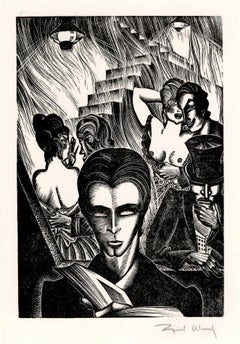
Bathing - Woodcut by Aristide Maillol - Early 20th Century
Located in Roma, IT
Bathing is a print realized by Aristide Maillol in the early 20th Century.
Woodcut on paper.
Good conditions.
Aristide Maillol, (born December 8, 1861, Banyuls-sur-Mer, France—die...
Category
Early 20th Century Modern Art by Medium: Woodcut
Materials
Woodcut
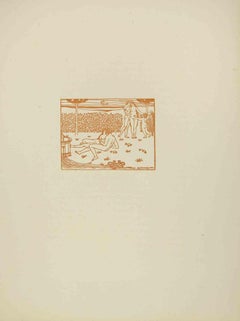
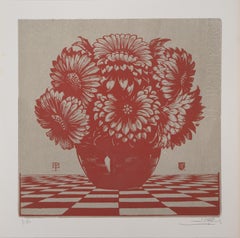
Red Bouquet of Flowers - Original woodcut, Handsigned
Located in Paris, IDF
Edward PELLENS
Red Bouquet of Flowers, 1929
Original woodcut
Handsigned in pencil
Numbered /160
On vellum 32.5 x 25.5 cm (c. 13 x 10 in)
Bears the blind stamp of the editor 'Imagier...
Category
1920s Art Deco Art by Medium: Woodcut
Materials
Woodcut
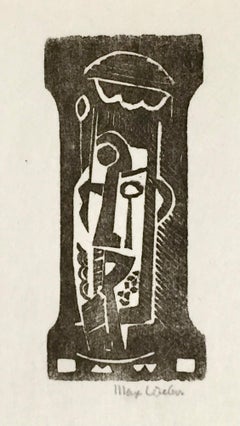
Max Weber, Figure
By Max Weber
Located in New York, NY
One of America's great modernist innovators, Max Weber carved Figure, 1919-20, on the end piece of a wooden cigar box. This Cubist image is composed o...
Category
Early 20th Century Modern Art by Medium: Woodcut
Materials
Woodcut
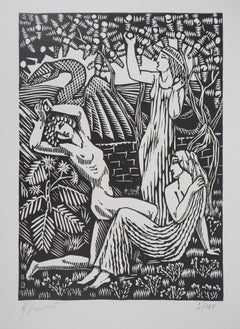
Mythology : The Hesperides Nymphs - Original Wooodcut, Handsigned
Located in Paris, IDF
Raphaël DROUART
Mythology : The Hesperides Nymphs, 1921
Original woodcut
Handsigned in pencil
Numbered /125
On vellum 32.5 x 25 cm (c. 12,7 x 9,5 in)
Edited for the 'Imagier de la ...
Category
1920s Modern Art by Medium: Woodcut
Materials
Woodcut
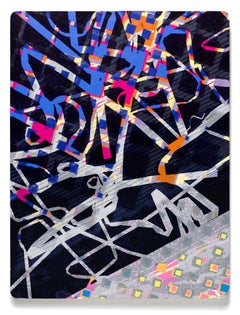
"J.P.
s Trip", Abstract Patterns, Geometric Abstraction, Woodcut Monoprint
Located in Philadelphia, PA
This piece titled "J.P.'s Trip" is an original piece by Alexis Nutini and is made from a woodcut and and found object stencil monoprint mounted on panel ...
Category
21st Century and Contemporary Contemporary Art by Medium: Woodcut
Materials
Found Objects, Panel, Monoprint, Woodcut, Paper
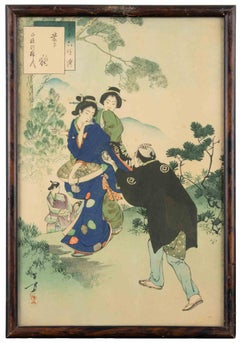
Sanjûroku Kasen... - Woodcut by Mizuno Toshikata - 1893
Located in Roma, IT
Nishiki-e (woodcut print), in vertical oban format (31x20.5) realized by Mizuno Toshikata in 1893 (Meiji 26).
Belongs to the Series "Sanjûroku Kasen" (Thirty-Six Beauties in Compari...
Category
1890s Modern Art by Medium: Woodcut
Materials
Woodcut
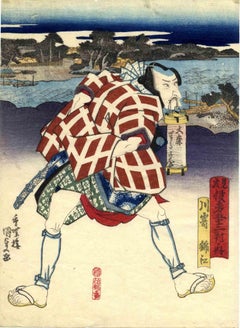
Kabukie - Woodcut by Utagawa Kunisada - 1840
Located in Roma, IT
Kabukie is an original artwork realized in 1840 by Utagawa Kunisada (1786-1865).
From the series "Mitate Yakusha gojusan tsui no uchi" (juxtaposition of actors and the 53 Tokaido s...
Category
1840s Modern Art by Medium: Woodcut
Materials
Woodcut
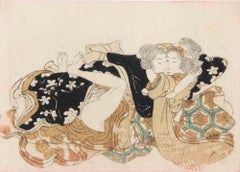
Shunga - Woodcut attr. Keisai Eisen - Mid-19th Century
By Keisai Eisen
Located in Roma, IT
Woodcut shunga print attributed to Keisai Eisen and realized in the early 19th century.
Good condition except for some signs of time.
Category
Mid-19th Century Modern Art by Medium: Woodcut
Materials
Woodcut
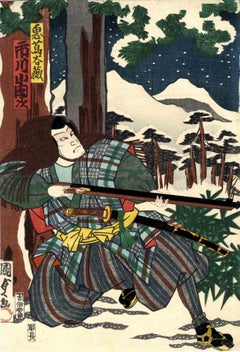
Kabuki - Woodcut by Utagawa Kunisada II - 1840
Located in Roma, IT
Kabuki is an original artwork realized in 1864 by Utagawa Kunisada II (1823 1880).
Scene at night in a snowy forest, the actor Ichikawa Kodanji in the ro...
Category
1850s Modern Art by Medium: Woodcut
Materials
Woodcut
El Mercado de Pátzcuaro II
Located in Palm Springs, CA
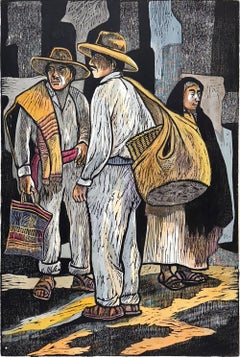
El Mercado de Pátzcuaro II captures a glimpse of daily life in the highland town of Pátzcuaro, Michoacán. The scene shows three Indigenous figures, rendered with bold lines and earthy tones, standing amid the bustle of the market. Two men in traditional white cotton clothing and wide-brimmed straw hats stand in conversation, their woven baskets and bundles suggesting they are either arriving to sell goods or preparing to return home with their purchases. Beside them, a woman cloaked in a dark rebozo gazes outward, her expression reflective and steady, grounding the composition with a quiet dignity. The strong woodcut textures emphasize folds of fabric, rough straw, and woven fiber, reminding the viewer of the handmade traditions that sustain the culture.
The marketplace of Pátzcuaro has long been a hub of commerce and cultural exchange, and Oñate’s print conveys both the social energy and the rooted traditions of this setting. The figures are depicted not as anonymous passersby but as individuals whose posture, clothing, and belongings tell stories of community, resilience, and labor. The muted yet warm palette, accented with yellows and reds, suggests early morning light spilling across the plaza’s cobblestones, while the abstracted background blocks provide rhythm and structure without distracting from the human presence.
Francisco Rodríguez Oñate (1940–2019) was a distinguished Mexican post-war and contemporary artist whose career extended over several decades throughout Mexico, the United States, and Latin America. Born in Michoacán, he received his education at the Escuela Popular de Bellas Artes at the University of Michoacán, where he studied under esteemed artists such as Alfredo Zalce, Roberto Martínez, and Javier Arévalo...
Category
1990s Contemporary Art by Medium: Woodcut
Materials
Watercolor, Woodcut
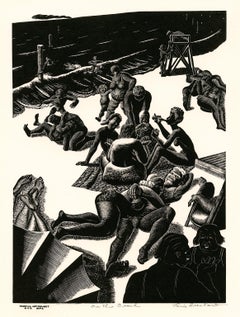
On the Beach (Coney Island, New York) — 1930s Graphic Modernism, WPA
By Lou Barlow
Located in Myrtle Beach, SC
Lou Barlow (Louis Breslow), 'On the Beach' (Coney Island) wood engraving, c. 1937, edition c. 25. Signed and titled in pencil. Stamped 'FEDERAL ART PROJECT NYC WPA' in the bottom left margin. A fine, richly-inked impression, with all the fine lines printing clearly, on cream wove paper, with full margins (1 1/2 to 3 inches), in excellent condition. Matted to museum standards, unframed. Scarce.
Image size 11 x 8 1/8 inches; sheet size 16 x 11 3/8 inches.
Created during the Great Depression for the Works Progress Administration (WPA), Federal Art Project, New York City.
Impressions of this work are in the permanent collections of the Amon Carter Museum of Art, Illinois State Museum, and the New York Public Library.
ABOUT THE IMAGE
Due to Coney Island's proximity to Manhattan, Brooklyn, and other New York boroughs, it began attracting vacationers in the 1830s and 1840s. Most of the vacationers were wealthy and went by carriage roads and steamship services that reduced travel time from a formerly half-day journey to two hours. By the late 1870s, the development of Coney Island's amusement park attractions and hotels drew people from all social classes. When the Brooklyn Rapid Transit Company electrified the steam railroads and connected Brooklyn to Manhattan via the Brooklyn Bridge at the beginning of the 20th century, Coney Island turned rapidly from a resort to an accessible location for day-trippers seeking to escape the summer heat in New York City's tenements. In 1915, the Sea Beach Line was upgraded to a subway line, and the opening of the Stillwell Avenue station in 1919 ushered in Coney Island's busiest era. On the peak summer days, over a million people would travel to Coney Island. In 1937, New York City purchased a 400-foot-wide strip of land along the shoreline to allow the boardwalk to be moved 300 feet inland. At this point, Coney Island was so crowded on summer weekends that parks commissioner Robert Moses...
Category
1930s American Modern Art by Medium: Woodcut
Materials
Woodcut
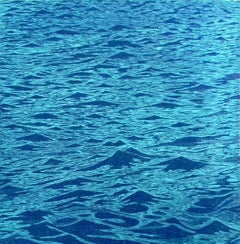
Big Seascape XII Left - Ocean Waves Woodcut Print in Shades of Blue, 2015
By Eve Stockton
Located in Kent, CT
This contemporary woodcut print on paper evokes the peacefulness of ocean waves depicted in bright, cerulean blue and vibrant cobalt. The woodcut print brings to mind the tradition o...
Category
2010s Contemporary Art by Medium: Woodcut
Materials
Archival Ink, Archival Paper, Woodcut
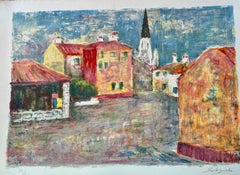
Village of Montmarte, Paris
Located in Belgrade, MT
This piece is part of my private collection since the 1970's. It is an original color lithograph signed and numbered by the Japanese artist Shungo Sekiguchi. In 1935 Shungo Sekiguchi...
Category
Mid-20th Century Modern Art by Medium: Woodcut
Materials
Woodcut, Lithograph
$400 Sale Price
20% Off
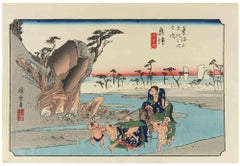
Okitsu-gawa - Woodcut by Utagawa Hiroshige - 1832
Located in Roma, IT
Okitsu-gawa is a woodcut print realized by Utagawa Hiroshige in 1832.
It is part of the suite "The Fifty-three Stations of the Tokaido - Okitsu".
Very good condition.
Category
1830s Modern Art by Medium: Woodcut
Materials
Woodcut
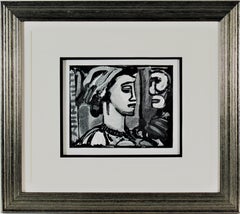
From the suite La Passion
Located in San Francisco, CA
This artwork from the suite "La Passion" 1932, published 1939 is a wood engraving by French artist Georges Rouault, 1871-1958. (Block engraved by Georges Aubert) It is signed and dat...
Category
Early 20th Century Modern Art by Medium: Woodcut
Materials
Woodcut
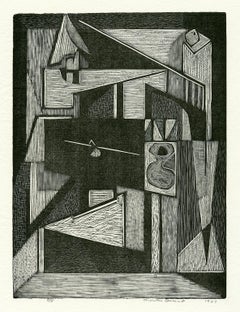
Still Life — Mid-century Modern
Located in Myrtle Beach, SC
Charles Quest, 'Still Life', 1947, wood engraving, edition 8. Signed, dated, and numbered '3/8' in pencil. Titled and annotated 'wood engraving' in the bottom left margin. A fine impression, on off-white wove paper, with full margins (1 to 2 inches), in excellent condition. Scarce. Matted to museum standards, unframed.
ABOUT THE ARTIST
Charles Quest, painter, printmaker, and fine art instructor, worked in various mediums, including mosaic, stained glass, mural painting, and sculpture. Quest grew up in St. Louis, his talent evident as a teenager when he began copying the works of masters such as Michelangelo on his bedroom walls. He studied at the Washington University School of Fine Arts, where he later taught from 1944 to 1971. He traveled to Europe after his graduation in 1929 and studied at La Grande Chaumière and Academie Colarossi, Paris, continuing to draw inspiration from the works of the Old Masters.
After returning to St. Louis, Quest received several commissions to paint murals in public buildings, schools, and churches, including one from Joseph Cardinal Ritter, to paint a replica of Velasquez's Crucifixion over the main altar of the Old Cathedral in St. Louis. Quest soon became interested in the woodcut medium, which he learned through his study of J. J. Lankes' A Woodcut Manual (1932) and Paul Landacre's articles in American Artist magazine ‘since no artists in St. Louis were working in wood’ at that time. Quest also revealed that for him, wood cutting and engraving were ‘more enjoyable than any other means of expression.’
In the late 1940s, his graphic works began attracting critical attention—several of his woodcuts won prizes and were acquired by major American and European museums. His wood engraving entitled ‘Lovers’ was included in the American Federation of Art's traveling print exhibition in 1947. Two years later, Quest's two prize-winning prints, ‘Still Life with Grindstone’ and ‘Break Forth into Singing’, were exhibited in major American museums in a traveling show organized by the Philadelphia Print Club. His work was included in the Chicago Art Institute's exhibition, ‘Woodcut Through Six Centuries’, and the print ‘Still Life with Vise’ was purchased by the Museum of Modern Art in New York.
In 1951 he was invited by artist-Curator Jacob Kainen to exhibit thirty wood engravings and color woodcuts in a one-person show at the Smithsonian's National Museum (now known as the American History Museum). Kainen's press release praised the ‘technical refinement’ of Quest's work: ‘He obtains a great variety of textural effects through the use of the graver, and these dense or transparent grays are set off against whites or blacks to achieve sparkling results. His work has the handsome qualities characteristic of the craftsman and designer.’
At the time of the Smithsonian exhibition, Quest's work was represented by three New York galleries in addition to one in his home town. He had won 38 prizes, and his prints were in the collections of the Library of Congress, the Chicago Art Institute, the Metropolitan Museum, and the Philadelphia Museum of Art. In cooperation with the Art in Embassies program, his color woodcuts were displayed at the American Embassy in Paris in 1951.
Recognition at home came in 1955 with his first solo exhibition in St. Louis. Press coverage of the show heralded the ‘growth of graphic arts toward rivaling painting and sculpture as a major independent medium’.
An exhibition of his prints at the Bethesda Art Gallery in 1983 attracted Curator Emeritus Joseph A. Haller, S.J., who began purchasing his work for Georgetown University's collection. In 1990 Georgetown University Library's Special Collections Division was the recipient of a large body of Quest's work, including prints, drawings, paintings, sculpture, stained glass, and his archive of correspondence and professional memorabilia. These extensive holdings, including some 260 of his fine prints, provide a rich opportunity for further study and appreciation of this versatile and not-to-be-forgotten mid-Western American artist...
Category
1940s American Modern Art by Medium: Woodcut
Materials
Woodcut
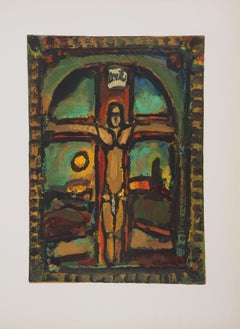
Easter : Crucifixion - Woodcut on Arches vellum - Printed signature
Located in Paris, IDF
Georges Rouault
Crucifixion
Woodcut and embossing (Raymond Jacquet workshop)
Printed signature in the plate
On Arches vellum
15 x 11" (38 x 28 cm)
INFORMATION : Woodcut published i...
Category
Mid-20th Century Modern Art by Medium: Woodcut
Materials
Woodcut
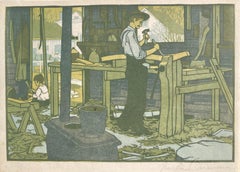
THE WAGON SHOP
Located in Santa Monica, CA
GUSTAVE BAUMANN (1881 – 1971)
THE WAGON SHOP, 1910 (Chamberlain 24)
Color woodcut signed in pencil. Unnumbed from an edition 100 as published in the Hills o’ Brown...
Category
1910s Modern Art by Medium: Woodcut
Materials
Woodcut
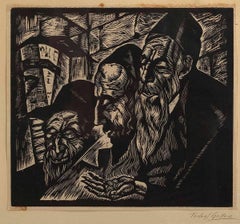
$1,800 Sale Price
20% Off
3 Jewish Men Judaica Woodblock Woodcut Engraving Print Chicago 1930s WPA Artist
Located in Surfside, FL
Todros Geller (1889 – 1949) was a Jewish American artist and teacher best known as a master printmaker and a leading artist among Chicago’s art community.Geller was born in Vinnytsia, the Russian Empire (now Ukraine) in 1889.[2] He studied art in Odessa and continued his studies after moving to Montreal in 1906 where he immigrated to Canada. He married and moved to Chicago in 1918, where he studied at the School of the Art Institute of Chicago until 1923.
Geller produced paintings, woodcuts, woodcarvings, and etchings. His work focused on Jewish tradition, often including moralistic themes and social commentary, shtetl, ghetto life, and the intersection of Jewish tradition with modern-day Chicago. He regarded art as a tool for social reform and he spent a large part of his career teaching art. His work was commissioned for stained glass windows, bookplates, community centers and Yiddish and English books. He was regarded as a leader in the field of synagogue and religious art. He designed stained glass window for synagogues in Omaha, Fort Worth, Dayton, Stamford, and Chicago Heights. Over the course of his career he illustrated more than 40 books.
In addition to conducting classes in his studio, Geller was head of art at the Jewish People’s Institute (JPI), supervisor of art for the Board of Jewish Education and director of art for the College of Jewish Studies (which became the Spertus Institute for Jewish Learning and Leadership) and taught at Hull House. Many prominent Chicago artists studied drawing and painting under Geller. Geller was a source of inspiration to Aaron Bohrod and Mitchell Siporin...
Category
Early 20th Century Modern Art by Medium: Woodcut
Materials
Paper, Woodcut
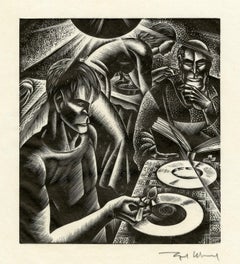
Wild Pilgrimage
(Contemplation) —
Story Without Words
Graphic Modernism
By Lynd Ward
Located in Myrtle Beach, SC
Lynd Ward, 'Wild Pilgrimage', No. 26, wood engraving, 1932, edition not stated but very small. Signed in pencil. A fine, black impression, with full margins (1 1/16 to 3 3/16 inches), on tissue-thin cream Japan paper, in very good condition. A scarce, artist-printed, hand-signed proof impression before the published edition. Matted to museum standards, unframed.
Created by Lynd Ward for his narrative book of illustrations without words, 'Wild Pilgrimage', published by Harrison Smith...
Category
1930s American Modern Art by Medium: Woodcut
Materials
Woodcut
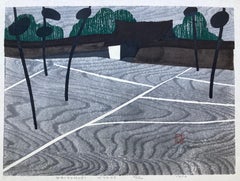
DAITOKUJI KYOTO
Located in Santa Monica, CA
KIYOSHI SAITO (Japanese 1907 - 1997)
DAITIKUJI KYOTO, 1957
Color woodcut, signed, titled, dated and no. 42/100 in pencil. Edition 100. Image 15 x 20 5/8 inches. Full margins with de...
Category
1950s Modern Art by Medium: Woodcut
Materials
Woodcut
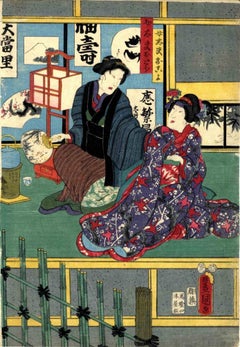
Yakushae - Woodcut Print by Utagawa Kunisada - 1856
Located in Roma, IT
Yakushae is an original modern artwork realized by Utagawa Kunisada in 1856.
Woodcut print Oban from a tryptich.
An elderly lady has a worried conversation with a pretty young woma...
Category
19th Century Modern Art by Medium: Woodcut
Materials
Woodcut
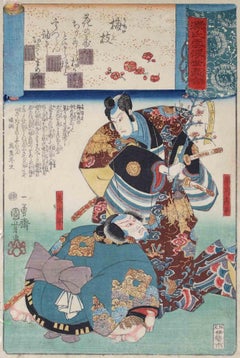
Umegaye. Hayakawa Takakage in... - Woodcut by Utagawa Kuniyoshi - 19th century
Located in Roma, IT
Woodcut print realized by Utagawa Kuniyoshi in 19th century.
Good condition.
Category
Mid-19th Century Modern Art by Medium: Woodcut
Materials
Woodcut
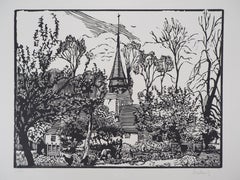
The Old Church - Original wooodcut, Handsigned
Located in Paris, IDF
Georges LE MEILLEUR (1861-1945)
The Old Church, 1922
Original woodcut
Handsigned in pencil
Numbered /160
On vellum 32.5 x 25.5 cm (c. 13 x 10 in)
Bears the blind stamp of the editor...
Category
1920s Art Deco Art by Medium: Woodcut
Materials
Woodcut
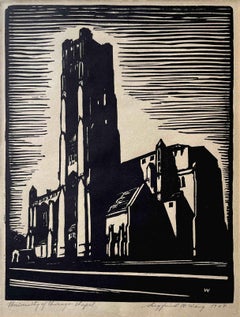
A Handsome Woodcut on Paper of the Univ. of Chicago Chapel by Siegfried Weng
Located in Chicago, IL
A handsome woodcut on paper of the University of Chicago Chapel by artist Siegfried Weng. A perfect gift for your U of C grad! Arwork size:
9 3/4" x 7 1/2". Archivally matted to...
Category
1920s American Modern Art by Medium: Woodcut
Materials
Paper, Woodcut
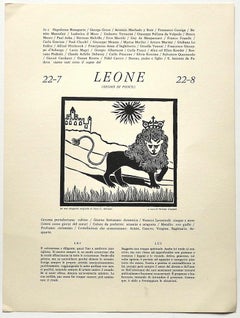
Lion - Original Woodcut Print by P. C. Antinori - 20th Century
Located in Roma, IT
Zodiac Signs - Lion is original Black and white woodcut print, realized by Italian artist Piero C. Antinori.
Excellent condition.
Written on the lower left; Original woodcut by Pie...
Category
20th Century Contemporary Art by Medium: Woodcut
Materials
Woodcut
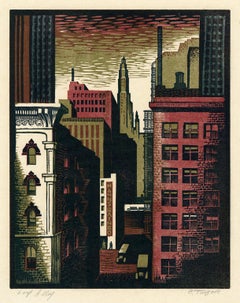
Loop Alley
— Modernist Chicago Cityscape, WPA
Located in Myrtle Beach, SC
Charles Turzak, 'Loop Alley (Chicago)', color woodcut, edition c. 25, c. 1935. Signed and titled in pencil. A fine, richly-inked impression, with fresh colors, on cream wove Japan pa...
Category
1930s American Modern Art by Medium: Woodcut
Materials
Woodcut
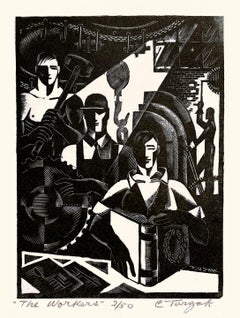
The Workers (No. 2)
— 1930s WPA Modernist Woodcut
Located in Myrtle Beach, SC
Charles Turzak, 'The Workers (No. 2)', woodcut, edition 50, c. 1935. Signed and numbered 2/50 in pencil. A fine, richly-inked impression, on cream wove Japan paper, with full margin...
Category
1930s American Modern Art by Medium: Woodcut
Materials
Woodcut
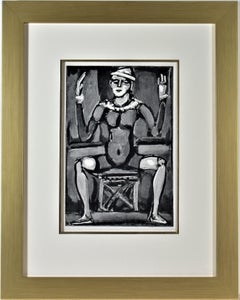
Clown Assis, from Cirque de l
Etoile Filante
Located in San Francisco, CA
This artwork "Clown Assis, from Cirque de l'Etoile Filante" 1932, is a wood engraving by French artist Georges Rouault 1871-1958 (Block engraved by Georges Aubert) It is signed in t...
Category
Early 20th Century Modern Art by Medium: Woodcut
Materials
Woodcut
Woodcut art for sale on 1stDibs.
Find a wide variety of authentic Woodcut art available on 1stDibs. While artists have worked in this medium across a range of time periods, art made with this material during the 21st Century is especially popular. If you’re looking to add art created with this material to introduce a provocative pop of color and texture to an otherwise neutral space in your home, the works available on 1stDibs include elements of orange, yellow, purple, blue and other colors. There are many well-known artists whose body of work includes ceramic sculptures. Popular artists on 1stDibs associated with pieces like this include Mino Maccari, Utagawa Kunisada (Toyokuni III), Eric Gill, and Utagawa Hiroshige. Frequently made by artists working in the Modern, Contemporary, all of these pieces for sale are unique and many will draw the attention of guests in your home. Not every interior allows for large Woodcut art, so small editions measuring 0.04 inches across are also available