1 of 3
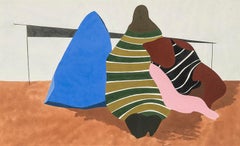
Clyde Follett SeaveyPetite Surrealist Mixed Media on Newsprint 19461946
1946
$235List Price
About the Item
- Creator:Clyde Follett Seavey (1904 - 1991, American)
- Creation Year:1946
- Dimensions:Height: 2 in (5.08 cm)Width: 5.5 in (13.97 cm)
- Medium:
- Movement Style:
- Period:
- Framing:Framing Options Available
- Condition:Age toning/ minor wear.
- Gallery Location:San Francisco, CA
- Reference Number:Seller: 34321stDibs: LU29826529522
Authenticity Guarantee
In the unlikely event there’s an issue with an item’s authenticity, contact us within 1 year for a full refund. DetailsMoney-Back Guarantee
If your item is not as described, is damaged in transit, or does not arrive, contact us within 7 days for a full refund. Details24-Hour Cancellation
You have a 24-hour grace period in which to reconsider your purchase, with no questions asked.Vetted Professional Sellers
Our world-class sellers must adhere to strict standards for service and quality, maintaining the integrity of our listings.Price-Match Guarantee
If you find that a seller listed the same item for a lower price elsewhere, we’ll match it.Trusted Global Delivery
Our best-in-class carrier network provides specialized shipping options worldwide, including custom delivery.You May Also Like
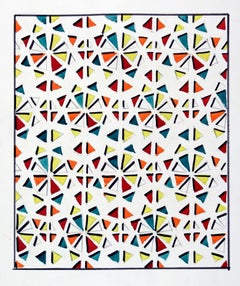
A Cheerful 1950s Textile Design by Artist Andre Delfau
By Andre Delfau
Located in Chicago, IL
A colorful textile design in orange, blue, red and yellow tones depicting an abstract polychrome Wedge Star pattern by set and costume designer Andre ...
Category
1950s American Modern Abstract Drawings and Watercolors
Materials
Ink, Gouache, Graphite, Paper
$385 Sale Price
54% Off
H 14 in W 12 in
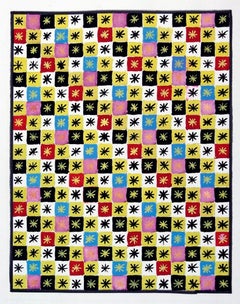
Brightly Colored 1950s Textile Design by Artist Andre Delfau
By Andre Delfau
Located in Chicago, IL
A colorful 1950s textile design (Black, yellow, blue, pink, red tones) by noted set and costume designer Andre Delfau.
Born in Paris, France in 1914, Andre Delfau became an internationally acclaimed stage, set and costume designer who worked world-wide from the 1930s to the 1980s. Delfau was a life long artist and painted independently of his noted design career. His artwork is recognized for it’s vibrant color and form, and a particularly keen use of line. He was highly influenced by the French Modern trends of Cubism and Surrealism, and his artwork is often infused with a dramatic sense of architecture and perspective.
Delfau created fashion designs for such major Paris couture houses as Balmain, Jean Patou and Balenciaga. He completed noteworthy set designs and costumes for numerous international operatic and ballet productions, including those at the Royal Danish Ballet, the Royal Ballet of Great Britain, the Paris Opera, the Dance Theater of Harlem, the Ruth Page International Ballet, the Civic Ballet of Chicago, the Chicago Opera Ballet and the Lyric Opera of Chicago, among others. Most notably, Delfau designed the elaborate stage sets and costumes for the 1986 PBS television production of the Viennese operetta, "Die Fledermaus...
Category
1950s American Modern Abstract Drawings and Watercolors
Materials
Ink, Gouache, Graphite, Paper
$385
H 15.25 in W 12 in
A 1950s Red, White
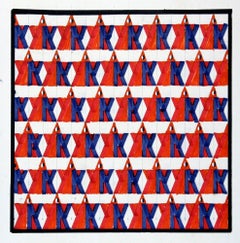
Blue Textile Design by Artist Andre Delfau
By Andre Delfau
Located in Chicago, IL
A 1950s bright, geometric textile design (In red, white & blue) by stage and costume designer Andre Delfau.
Born in Paris, France in 1914, Andre Delf...
Category
1950s American Modern Abstract Drawings and Watercolors
Materials
Ink, Gouache, Graphite, Paper
$385
H 12.25 in W 12 in
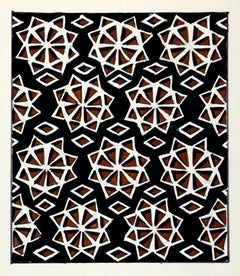
A Captivating 1950s Textile Design by Artist Andre Delfau
By Andre Delfau
Located in Chicago, IL
A captivating 1950s textile design in black and brown ochre tones with wedge star pattern by noted set and costume designer Andre Delfau.
Born in Par...
Category
1950s American Modern Abstract Drawings and Watercolors
Materials
Ink, Gouache, Graphite, Paper
$385
H 13.5 in W 12 in
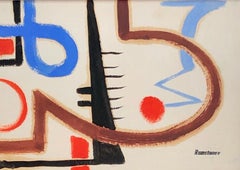
MODERNIST DRAWING New Hope Mid-Century WPA Abstract Non-Objective Jazz Modern
By Ramstonev (Ramsey/Stone/Evans co-operative)
Located in New York, NY
MODERNIST DRAWING New Hope Mid-Century WPA Abstract Non-Objective Jazz Modern. Signed with a "Ramstonev" stamp lower right.
RAMSTONEV Cooperative Art Project (1937-1939). In the late 1930s, Charles Ramsey became close friends with Charles Evans and Louis Stone. He persuaded them to join him teaching his New Hope summer classes in non-objective painting. Soon, a history-making collaboration began. In 1937, meeting in Evans' studio at the rear of Cryer's Hardware store on Main Street in New Hope, a decision was made to establish the Co-Operative Painting Project. They were intrigued by the cooperative ad-lib process by which jazz musicians created their music. Believing this to be the quintessential American contribution to music, they theorized that a similar result might be obtainable with art, a "visual jam session." This particlarly fascinated Ramsey, who was a jazz buff and had a large collection of jazz records.
The objective was to jointly collaborate in the creation of a painting as well as applying collective criticism during its creation. By creating forward movement by general consent, they believed they could produce a higher level of beauty. By consensus it was decided that subject matter would be non-objective. Up to eight people would participate and stop when the painting "felt" finished by common agreement.
These co-operative works were done in several different mediums- the majority in pastel, but some in watercolor, gouache, graphite or cut paper collage. On occasion, the group would create a series, as opposed to a single work, created in steps by three or four artists. One of the occasional participants was famed New Hope poet, Stanley Kunitz. These series could range in number from four to sixteen paintings in each. The first of a series would be very basic and the last a fully finished work.
In the scope of importance among the New Hope Modernist...
Category
1930s American Modern Abstract Drawings and Watercolors
Materials
Paper, Watercolor, Gouache
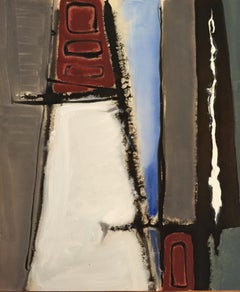
1950s "Rectangle" Mid Century Abstract Gouache Painting
Located in Arp, TX
Opper Estate
Maroon Abstract
c. 1940-1950's
Gouache on Paper
15" x 18" Unframed
From the estate of Ruth Friedmann Opper & Jerry Opper. Ruth was the daughter of Bauhaus artist, Gustav Friedmann.
San Francisco Abstract Expression
A free-spirited wave of creative energy swept through the San Francisco art community after World War II. Challenging accepted modes of painting, Abstract Expressionists produced highly experimental works that jolted the public out of its postwar complacency.
Abstract Expressionism resulted from a broad collective impulse rather than the inspiration of a small band of New York artists. Documenting the interchanges between the East and West Coasts, she cites areas of mutual influence and shows the impact of San Francisco on the New York School, including artists such as Mark Rothko and Ad Reinhardt. San Francisco's Beat poets...
Category
Mid-20th Century American Modern Abstract Paintings
Materials
Paper, Gouache
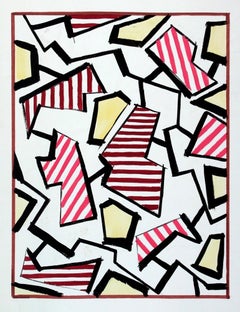
1950s Geometric Pink and Yellow Textile Design by Artist Andre Delfau
By Andre Delfau
Located in Chicago, IL
A 1950s geometric textile design in brown, yellow and pink tones by notable stage and set designer Andre Delfau.
Born in Paris, France in 1914, Andre Delfau became an internationally acclaimed stage, set and costume designer who worked world-wide from the 1930s to the 1980s. Delfau was a life long artist and painted independently of his noted design career. His artwork is recognized for it’s vibrant color and form, and a particularly keen use of line. He was highly influenced by the French Modern trends of Cubism and Surrealism, and his artwork is often infused with a dramatic sense of architecture and perspective.
Delfau created fashion designs for such major Paris couture houses as Balmain, Jean Patou and Balenciaga. He completed noteworthy set designs and costumes for numerous international operatic and ballet productions, including those at the Royal Danish Ballet, the Royal Ballet of Great Britain, the Paris Opera, the Dance Theater of Harlem, the Ruth Page International Ballet, the Civic Ballet of Chicago, the Chicago Opera Ballet and the Lyric Opera of Chicago, among others. Most notably, Delfau designed the elaborate stage sets and costumes for the 1986 PBS television production of the Viennese operetta, "Die Fledermaus...
Category
1950s American Modern Abstract Drawings and Watercolors
Materials
Gouache, Graphite, Paper
$385 Sale Price
54% Off
H 19 in W 14.5 in
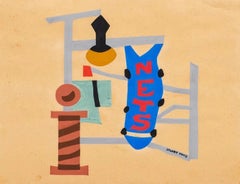
"NY Street Signs" Mid-20th Century WPA 1938 Modernist Abstract Realism Pop Art
By Stuart Davis
Located in New York, NY
"NY Street Signs" Mid-20th Century WPA 1938 Modernist Abstract Realism Pop Art
Stuart Davis (American, 1892-1964) "Street Signs" Modernist gouache and traces of pencil on paper in the proto-pop art style Davis is celebrated for, 1938, signed to lower right, framed. Image: 11 1/4 x 15 1/4 inches. Frame by Bark: 18 1/2 x 22 inches.
LITERATURE: A, Boyajian, M. Rutkowski, Stuart Davis, A Catalogue Raisonne, Vol. 2, New Haven, Connecticut, 2007, vol. II, p. 632, no. 1232, illustrated.
EXHIBITIONS: ACA Galleries, New York American Artists' Congress: Group Exhibition of Paintings and Sculpture, Dec. 3-16, 1939 (SDAB I, 12/3/39, p. 129). Outlines Gallery, Pittsburgh, Stuart Davis, Mar. 3-16, 1946. Coleman Art Gallery, Philadelphia, 5 Prodigal Sons: Former Philadelphia Artists: Ralston Crawford, Stuart Davis, Charles Demuth, Julian Levi, Charles Sheeler, Oct 4 - 30, 1947 (pamphlet), no. 12.
PROVENANCE: The artist; Mr. and Mrs. Frank Bowles, New York, Apr. 3, 1956; thence by descent, Private Collection, New York.
NOTES: According to the Catalogue Raissonne, "the title 'Street Signs' is recorded in the artist's account books...
Category
1930s American Modern Abstract Drawings and Watercolors
Materials
Paper, Gouache, Pencil
$125,000
H 18.5 in W 22 in D 1 in
Untitled
By Charles Houghton Howard
Located in New York, NY
Charles Houghton Howard was born in Montclair, New Jersey, the third of five children in a cultured and educated family with roots going back to the Massachusetts Bay colony. His father, John Galen Howard, was an architect who had trained at M.I.T. and the École des Beaux-Arts in Paris and apprenticed in Boston with Henry Hobson Richardson. In New York, the elder Howard worked for McKim, Mead and White before establishing a successful private practice. Mary Robertson Bradbury Howard, Charles’s mother, had studied art before her marriage. John Galen Howard moved his household to California in 1902 to assume the position of supervising architect of the new University of California campus at Berkeley and to serve as Professor of Architecture and the first Dean of the School of Architecture (established in 1903). The four Howard boys grew up to be artists and all married artists, leaving a combined family legacy of art making in the San Francisco Bay area that endures to this day, most notably in design, murals, and reliefs at the Coit Tower and in buildings on the Berkeley campus.
Charles Howard graduated from the University of California at Berkeley in 1921 as a journalism major and pursued graduate studies in English at Harvard and Columbia Universities before embarking on a two-year trip to Europe. Howard went to Europe as a would-be writer. But a near-religious experience, seeing a picture by Giorgione in a remote town outside of Venice, proved a life-altering epiphany. In his own words, “I cut the tour at once and hurried immediately back to Paris, to begin painting. I have been painting whenever I could ever since” (Charles Howard, “What Concerns Me,” Magazine of Art 39 [February 1946], p. 63). Giorgione’s achievement, in utilizing a structured and rational visual language of art to convey high emotion on canvas, instantly convinced Howard that painting, and not literature, offered the best vehicle to express what he wanted to say. Howard returned to the United States in 1925, confirmed in his intent to become an artist.
Howard settled in New York and supported himself as a painter in the decorating workshop of Louis Bouché and Rudolph Guertler, where he specialized in mural painting. Devoting spare time to his own work, he lived in Greenwich Village and immersed himself in the downtown avant-garde cultural milieu. The late 1920s and early 1930s were the years of Howard’s art apprenticeship. He never pursued formal art instruction, but his keen eye, depth of feeling, and intense commitment to the process of art making, allowed him to assimilate elements of painting intuitively from the wide variety of art that interested him. He found inspiration in the modernist movements of the day, both for their adherence to abstract formal qualities and for the cosmopolitan, international nature of the movements themselves. Influenced deeply by Surrealism, Howard was part of a group of American and European Surrealists clustered around Julien Levy. Levy opened his eponymously-named gallery in 1931, and rose to fame in January 1932, when he organized and hosted Surrealisme, the first ever exhibition of Surrealism in America, which included one work by Howard. Levy remained the preeminent force in advocating for Surrealism in America until he closed his gallery in 1949. Howard’s association with Levy in the early 1930s confirms the artist’s place among the avant-garde community in New York at that time.
In 1933, Howard left New York for London. It is likely that among the factors that led to the move were Howard’s desire to be a part of an international art community, as well as his marriage to English artist, Madge Knight...
Category
20th Century American Modern Abstract Drawings and Watercolors
Materials
Paper, Gouache, Graphite
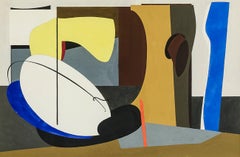
Untitled
By Charles Houghton Howard
Located in New York, NY
Charles Houghton Howard was born in Montclair, New Jersey, the third of five children in a cultured and educated family with roots going back to the Massachusetts Bay colony. His father, John Galen Howard, was an architect who had trained at M.I.T. and the École des Beaux-Arts in Paris and apprenticed in Boston with Henry Hobson Richardson. In New York, the elder Howard worked for McKim, Mead and White before establishing a successful private practice. Mary Robertson Bradbury Howard, Charles’s mother, had studied art before her marriage. John Galen Howard moved his household to California in 1902 to assume the position of supervising architect of the new University of California campus at Berkeley and to serve as Professor of Architecture and the first Dean of the School of Architecture (established in 1903). The four Howard boys grew up to be artists and all married artists, leaving a combined family legacy of art making in the San Francisco Bay area that endures to this day, most notably in design, murals, and reliefs at the Coit Tower and in buildings on the Berkeley campus.
Charles Howard graduated from the University of California at Berkeley in 1921 as a journalism major and pursued graduate studies in English at Harvard and Columbia Universities before embarking on a two-year trip to Europe. Howard went to Europe as a would-be writer. But a near-religious experience, seeing a picture by Giorgione in a remote town outside of Venice, proved a life-altering epiphany. In his own words, “I cut the tour at once and hurried immediately back to Paris, to begin painting. I have been painting whenever I could ever since” (Charles Howard, “What Concerns Me,” Magazine of Art 39 [February 1946], p. 63). Giorgione’s achievement, in utilizing a structured and rational visual language of art to convey high emotion on canvas, instantly convinced Howard that painting, and not literature, offered the best vehicle to express what he wanted to say. Howard returned to the United States in 1925, confirmed in his intent to become an artist.
Howard settled in New York and supported himself as a painter in the decorating workshop of Louis Bouché and Rudolph Guertler, where he specialized in mural painting. Devoting spare time to his own work, he lived in Greenwich Village and immersed himself in the downtown avant-garde cultural milieu. The late 1920s and early 1930s were the years of Howard’s art apprenticeship. He never pursued formal art instruction, but his keen eye, depth of feeling, and intense commitment to the process of art making, allowed him to assimilate elements of painting intuitively from the wide variety of art that interested him. He found inspiration in the modernist movements of the day, both for their adherence to abstract formal qualities and for the cosmopolitan, international nature of the movements themselves. Influenced deeply by Surrealism, Howard was part of a group of American and European Surrealists clustered around Julien Levy. Levy opened his eponymously-named gallery in 1931, and rose to fame in January 1932, when he organized and hosted Surrealisme, the first ever exhibition of Surrealism in America, which included one work by Howard. Levy remained the preeminent force in advocating for Surrealism in America until he closed his gallery in 1949. Howard’s association with Levy in the early 1930s confirms the artist’s place among the avant-garde community in New York at that time.
In 1933, Howard left New York for London. It is likely that among the factors that led to the move were Howard’s desire to be a part of an international art community, as well as his marriage to English artist, Madge Knight...
Category
20th Century American Modern Abstract Drawings and Watercolors
Materials
Paper, Watercolor, Gouache, Graphite