Want more images or videos?
Request additional images or videos from the seller
1 of 18

Jiri Kolar
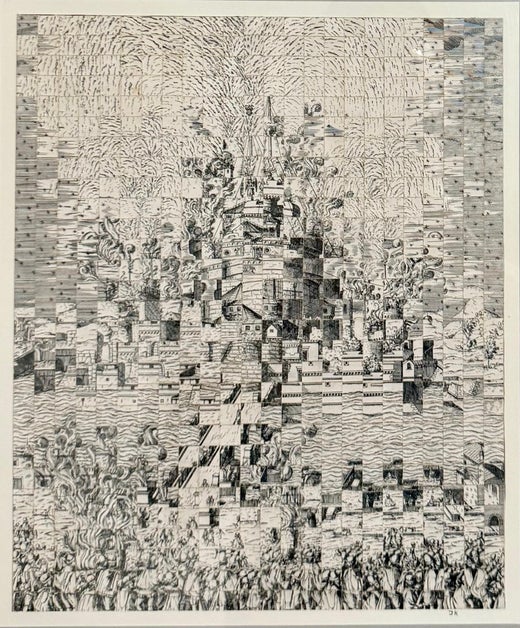
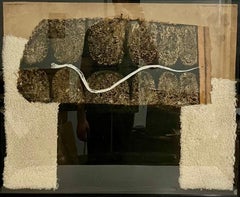
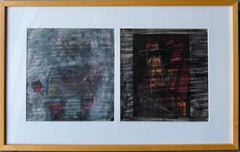
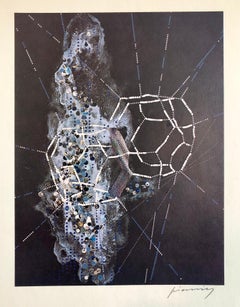
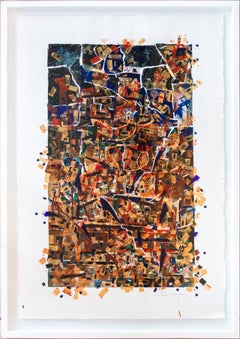
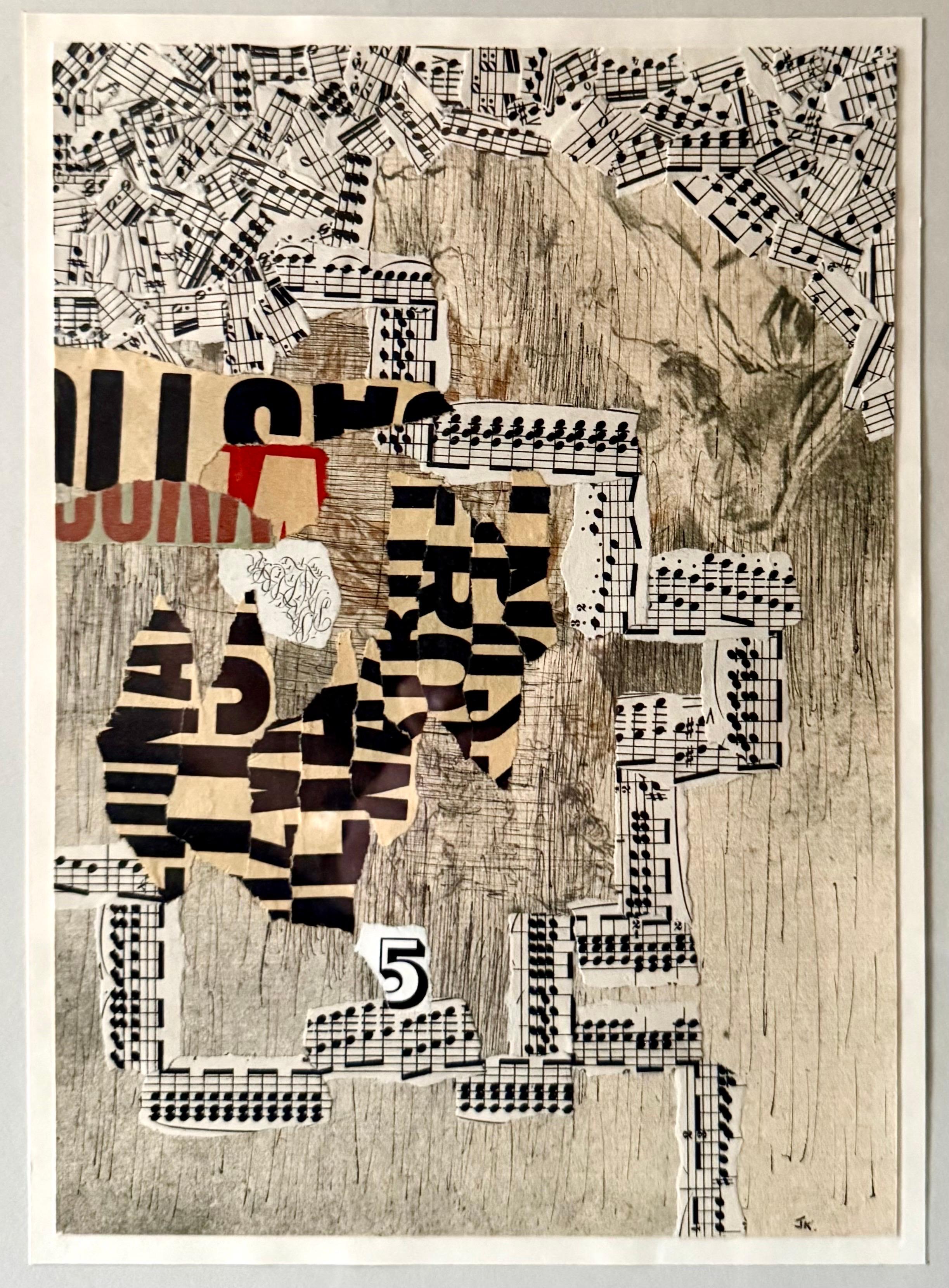
Original Guggenheim Museum Exhibited Jiri Kolar Collage Tower of Babel

c.1960 s-1970 s

$4,600
£3,484.07
€4,001.34
CA$6,446.10
A$7,008.22
CHF 3,715.76
MX$84,010.73
NOK 47,225.45
SEK 43,264.93
DKK 29,904.93

About the Item

Jiri Kolar, Czech (1914-2002) Tower of Babel Paper Collage Hand signed with Initials Lower Right. Dimensions: Sight-11.25" x 9.5". Frame-20" x 17" Circa 1970's Provenance: bears label from Guggenheim Museum. Handwritten inscription from the Herbert Lust collection. (His important collection included Painting by Robert Indiana and Frank Stella as well as sculpture by Alexander Calder, Alberto Giacometti and more). Jiří Kolář (1914 – 2002) was a Czech poet, writer, painter and translator. His work included both literary and visual art. Kolář was born on 24 September 1914 in Protivín, Bohemia, Austria-Hungary, in a working-class environment. His father was a baker and his mother a seamstress, and he himself trained early in life as a cabinet maker (which cost him a finger). He later changed trades several times, working as a construction worker, security guard, and bartender, among other jobs. In 1943 he became a full-time writer while living and working in Kladno. He moved to Prague in 1945 to work as an editor of the publishing house Družstvo Dílo. Kolář joined the Communist Party in 1945 but left the Party the same year. Because of his critical stance towards the regime he was not allowed to publish after communists took control in Czechoslovakia in 1948. He married Běla Helclová in 1949. When in 1952 police found his manuscript, Prométheova játra, in the property of Václav Černý he was arrested and spent several months in prison. Kolář was one of a group of several artists, among whom Václav Havel, Václav Černý, Jan Vladislav and Josef Hiršal, who met and discussed in Café Slavia, both during the period leading up to the Prague Spring when the communist regime grew more permissive, and in the period of normalization after the Prague Spring. Kolář's wild behavior lost him former friends (e.g. he threw coffee on Josef Hiršal's shirt and had his soda water poured on him in return).Kolář signed Charter 77 and while on a scholarship to West Berlin, the government decided to force him to emigrate; he was therefore not allowed to return home. From 1980 on he lived in Paris. After 1989 he visited his homeland more and more often. In 1999 Kolář injured his spine and he spent his last years in a Prague hospital. Kolář's poetry was first published in 1938 in a private edition; these early poems are not included in his complete work, probably because they are openly erotic, Thus Křestný list (Baptism Certificate, 1941) is considered his debut. Křestný list and Kolář's three other collections of poems from the 1940s (Sedm kantát, Limb a jiné básně, Ódy a variace) belong stylistically to the existentialist artistic movement of Skupina 42 of which Kolář was a member; other members included Jindřich Chalupecký, Ivan Blatný, Josef Kainar, Jiřina Hauková and Kamil Lhoták. During the years of Stalinism in Czechoslovakia (1948–1953) Kolář wrote poetic diaries – Očitý svědek (Eyewitness, 1949), Prométheova játra (Prometheus' Liver, 1950). In 1957 he wrote a creative re-interpretation of Sun Zi's The Art of War, an ancient Chinese classic on the art of warfare, under the name Mistr Sun o básnickém umění (Master Sun on the Poetic Arts). In 1964 Náhodný svědek (Accidental Witness), a selection of his work from the 1940s was published, and in 1966 a censored selection from his 1950s work came out under the name Vršovický Ezop (Aesop from Vršovice). In the 1960s he started writing experimental poetry, creating new forms of poetry which he gave names such as analfabetogram and cvokogram. In these new forms of poetry the line between the literary and the visual increasingly started to blur, which ultimately led to his experiments in visual art. His first exhibitions in 1937 focused on his assemblage collages. In the 1960s Kolář first combined painting and poetry but he gradually turned completely to experiments in visual art. His work bears a relationship with fluxus art and concrete poetry. In his work he used a scalpel to cut pictures out of magazines. He produced colors in his decoupage collages by gluing on printed fragments of paper from various different sources. His work was influenced by Dada and Bauhaus artists Max Ernst and Man Ray as well as Kurt Schwitters. His collages were intended to influence the viewer's outlook on life; the technique of using fragments of text and images from various different sources was well suited to achieve the effect Kolář wanted, by showing the destruction and fragmentation of the world Kolář inhabited. Simultaneously, by juxtaposition and contrasting of these different fragments the technique of the collage served to create surprising and visually striking new combinations; for instance, the combination of astronomical maps with Braille writing. Kolář invented or helped to develop new techniques of collage – confrontage, froissage, rollage, chiasmage and others. He was included in the landmark 1967 exhibition Serielle Formationen (Serial Formations), held at the University of Frankfurt's Studio Galerie. The exhibition was a pioneering presentation of international tendencies in Minimalism and serial art in Germany. It brought together diverse movements like European Zero, Nouveau Réalisme, Pop Art, Op Art, and American Minimal and Conceptual Art. Kolář was included among 48 artists, including major figures like Carl Andre, Arman, Bridget Riley, Vasarely, Christo, Sol LeWitt, Donald Judd, Agnes Martin, Andy Warhol, and Yayoi Kusama. From the 1960s Kolář's visual artwork was featured regularly in exhibitions by galleries and museums. Some of the more prominent exhibitions of his work were in the New York Guggenheim museum in 1975, in Prague in 1994 in Dům U Černé Matky Boží, in Madrid in 1996 in the Museo Nacional Centro de Arte Reina Sofia.
  • Creator:
    Jiri Kolar (1914 - 2002, Czech)
  • Creation Year:
    c.1960 s-1970 s
  • Dimensions:
    Height: 20 in (50.8 cm)Width: 17 in (43.18 cm)
  • Medium:
  • Movement Style:
  • Period:
  • Condition:
    frame has some wear.
  • Gallery Location:
    Surfside, FL
  • Reference Number:
    1stDibs: LU38217174892

More From This Seller

View All
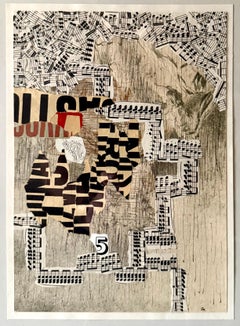
Original Guggenheim Museum Exhibited Jiri Kolar Collage Art Abstract Music Notes
By Jiri Kolar
Located in Surfside, FL
Jiri Kolar, Czech (1914-2002) "Musical Notes" Paper Collage Ink on Paper Hand signed with Initials Lower Right. Dimensions: Sight-7.5" x 11". Frame-17" x 21" Circa: 1960's-1...
Category

20th Century Contemporary Mixed Media

Materials

Paper, Mixed Media

"Untitled"
By Dan Reisinger
Located in Surfside, FL
Reisinger was born in Kanjiža, Serbia, into a family of painters and decorators active in Austria-Hungary and the Balkans. Most family members died in the Holocaust, including his father. As a teenager, he became active in the Partisan Pioneer Brigade and, with his mother and stepfather, immigrated to Israel in 1949. Reisinger initially lived in a transit camp and then worked as a house painter in order to earn money from almost any source. In 1950 at age 16, he was accepted as a student—its youngest up to the time—at the Bezalel Academy of Art and Design in Jerusalem, there to 1954. During mandatory service in the Israeli Air Force from 1954, he was the art director of its books and other publications. While there, he attended a class on postage-stamp design taught by Abram Games, who became his mentor and friend. Subsequently, he traveled, studied, and worked in Europe: from 1957 in Brussels and then onto London where, 1964–66, studied stage and three-dimensional design at the Central School of Art and Design, designed posters for Britain's Royal Mail, and worked for other clients while making intermittent visits to Israel. Then in 1966, he returned permanently to Israel and established a studio in Tel Aviv and today in Giv'atayim. His work has been included in numerous international group and one-person exhibitions. A large number of social-, political-, and cultural-theme posters and other graphic design, such as calendars, packaging, and more than 150 logos are superior to much of his fine art. He designed a new logo for El Al airlines (1972), and the 50-meter-long aluminum-cast relief (1978) of a biblical quotation in Hebrew on the exterior of the Yad Vashem, Israel's official museum/memorial to Holocaust victims, in Jerusalem. He has also designed logos for the Tel Aviv Museum of Arts, Tefen Museum of Arts, and Habima Theater (הבימה - התיאטרון הלאומי) and the symbol and posters of the 9th-15th Maccabiah Games (מַכַּבִּיָּה). His widely published self-produced “Again?” poster (1993) features a Nazi swastika (which Reisinger incorrectly made to face left) breaks apart to 5 pointed red Star of soviet union in reference to the possible dreaded repeat of the Holocaust. The influences on his work—itself more widely focused than solely on social and political issues—have come from colorists, Minimalists, Constructivists, and humorists. He claims one of his more significant contributions has been to stretch the visual and communicative possibilities of Hebrew letters through his symbols and logos. Reisinger is one of Israel's most-accomplished graphic designers; the others include Franz Kraus...
Category

20th Century Contemporary Abstract Prints

Materials

Screen

Horst Kalinowski Abstract Collage Assemblage Mixed Media Sculpture Painting
Located in Surfside, FL
Horst Egon Kalinowski (German, 1924-2013). Mixed media assemblage collage Divan Ophidian. Hand signed in marker upper right and dated 82 Bagnols-en-Foret, Titled upper left. Additionally titled and dated on verso. Dimensions: 30" x 24 1/4" (with frame 27" x 32 3/4") inches. Born in 1924 in Dusseldorf, From 1945 to 1948, he studied at the Academy of Fine Arts in Düsseldorf. In 1949-1950, he stayed in Rome and Venice, Italy. From 1950 to 1952, in Paris, France he studied in the abstract art workshop of Jean Dewasne and Edgard Pillet...
Category

20th Century Modern Abstract Paintings

Materials

Fabric, Textile, Paint, Mixed Media, Board

Bay Area Figurative Abstract Gouache Painting "Video Tower" John Hultberg
By John Hultberg
Located in Surfside, FL
John Hultberg (1922-2005) Gouache (mixed media ) "Video Tower" 1991 Hand initialed lower right Measurements: 18.75" W x 11.75" H (framed); 6.75" W x 7.25" H (visible area of each ...
Category

1990s Abstract Abstract Paintings

Materials

Gouache, Mixed Media

Original Rollage Michelangelo Sculpture, Bruegel Painting, Jiri Kolar Collage
By Jiri Kolar
Located in Surfside, FL
UNTITLED (ROLLAGE) Jiri Kolar Mixed Media, 1967 Rollage of a sculpture by Michelangelo and a painting by Bruegel Medium: Mixed Media, Collage Surface: Photographic Paper Country: Cz...
Category

20th Century Contemporary Mixed Media

Materials

Mixed Media

Pencil Signed Abstract Geometric Graphic Design Lithograph Print, Bauhaus Artist
By M. Peter Piening
Located in Surfside, FL
M. Peter Piening was born on March 14, 1908 in Grabow, Germany. He began his education at a private school in Italy, studied at the Jesuit school of Kloster Ettal in Bavaria, and attended the German Stettin Gymnasium, where he graduated in 1926. Between 1926 and 1928 Piening studied design at the Bauhaus in Dessau, Germany. There he was taught by multiple famous twentieth-century artists, including Joseph Albers, Paul Klee and Mies van der Rohe. After receiving his master’s degree from the Bauhaus in 1929, Piening enrolled at the University of Berlin and obtained his PhD in philosophy in 1931. Piening spent his early career free-lancing as an illustrator and artist for various publishing companies, eventually settling in Paris to work for Condé-Nast’s French publication of Vogue. In 1934 he moved to the United States to work in Condé-Nast’s New York City office. For the next two decades, Piening worked for many important advertising agencies and magazine publishers, including the N. W. Ayer and J. Walker Thompson agencies and Life and Fortune magazines. As art director for Life in the 1930s and for Fortune in the 1940s, Piening completely redesigned the layout of each magazine. He also redesigned the layouts for thirty-four other major American magazines, including Town & Country and Cosmopolitan. Through his design work, Piening had a great impact on the American public, although the millions who encountered his work most likely never knew his name. Between 1934 and 1964, Piening designed over sixty logos and trademarks for internationally-known products and companies. His most widely-recognized logo may have been the three interlocking rings of Ballantine beer. Piening’s other trademark designs include the Lincoln Zephyr...
Category

1960s Abstract Geometric Abstract Prints

Materials

Lithograph

You May Also Like

Tower of Babel
Located in Colorado Springs, CO
Original painting done by the artist, signed.
Category

21st Century and Contemporary Abstract Paintings

Materials

Acrylic

Tower
By Dionisios Fragias
Located in New York, NY
Dionisios Fragias is a New York -based artist born on the Greek island of Kefalonia and raised in New York City. He is the protege of the artist Jeff Koons whose years-long mentorshi...
Category

2010s Abstract Mixed Media

Materials

Steel, Stainless Steel

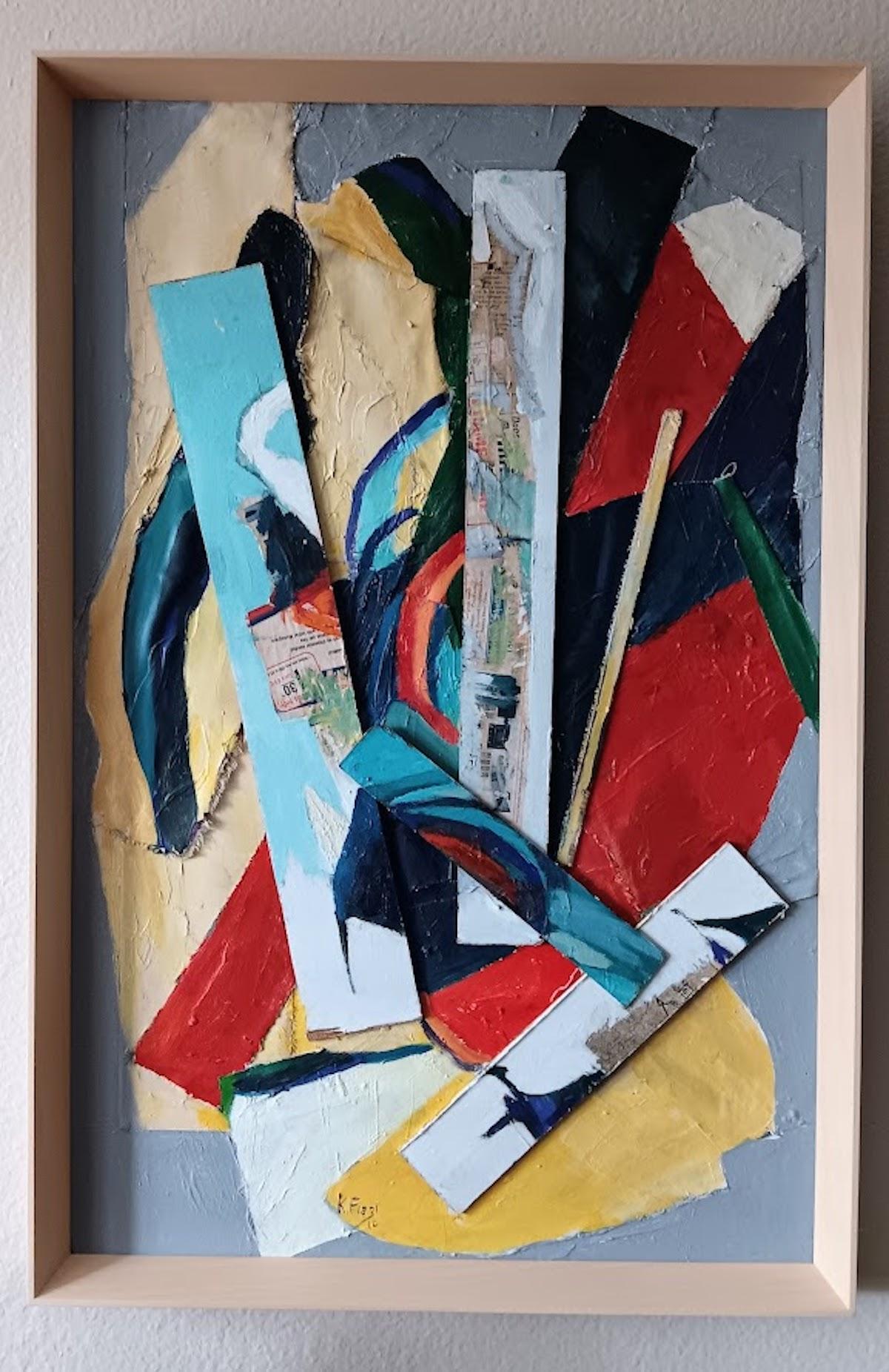
Post Cubist Composition by Eric K. Fiazi, Collage, Framed
Located in Pasadena, CA
Eric K. Fiazi, Post Cubist Compostion, Collage and Oil on Canvas, Signed, dated 2010. Size is framed. Natural wood frame. Excellent condition of use. About : In Eric Fiazi's maste...
Category

Early 2000s Cubist Abstract Paintings

Materials

Oil, Mixed Media

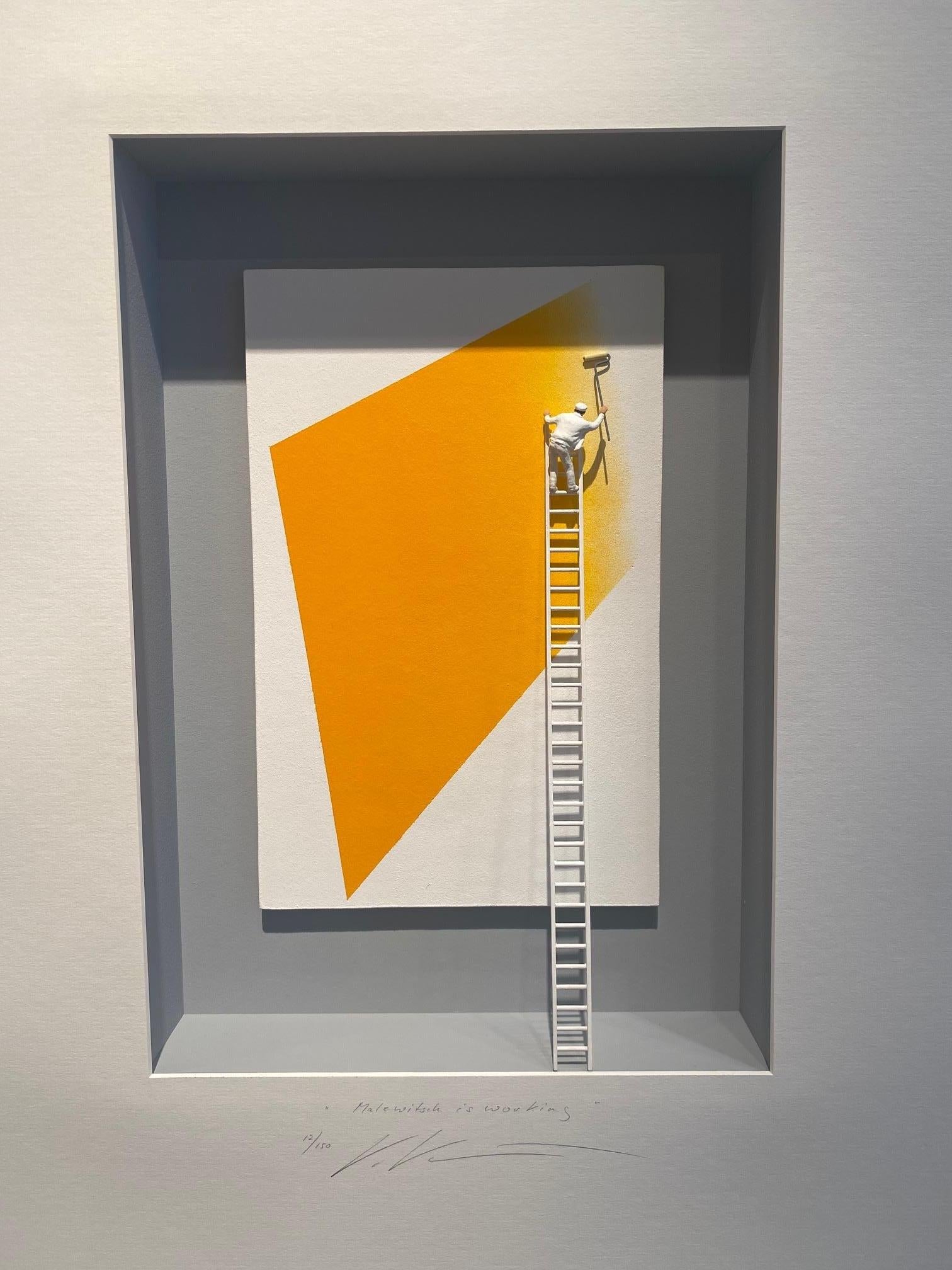
Malewitsch is Working - contemporary abstract art work, homage to Malewitsch
By Volker Kuhn
Located in Hamburg, DE
"Homage to Malewitsch - Malewitsch is Working" is an original mixed media artwork by Volker Kuhn. The work is hand-signed and numbered by the artist below the artwork on the mat. It ...
Category

21st Century and Contemporary Assemblage Mixed Media

Materials

Wood, Mixed Media, Acrylic

Cubist abstract composition
Located in Wilton Manors, FL
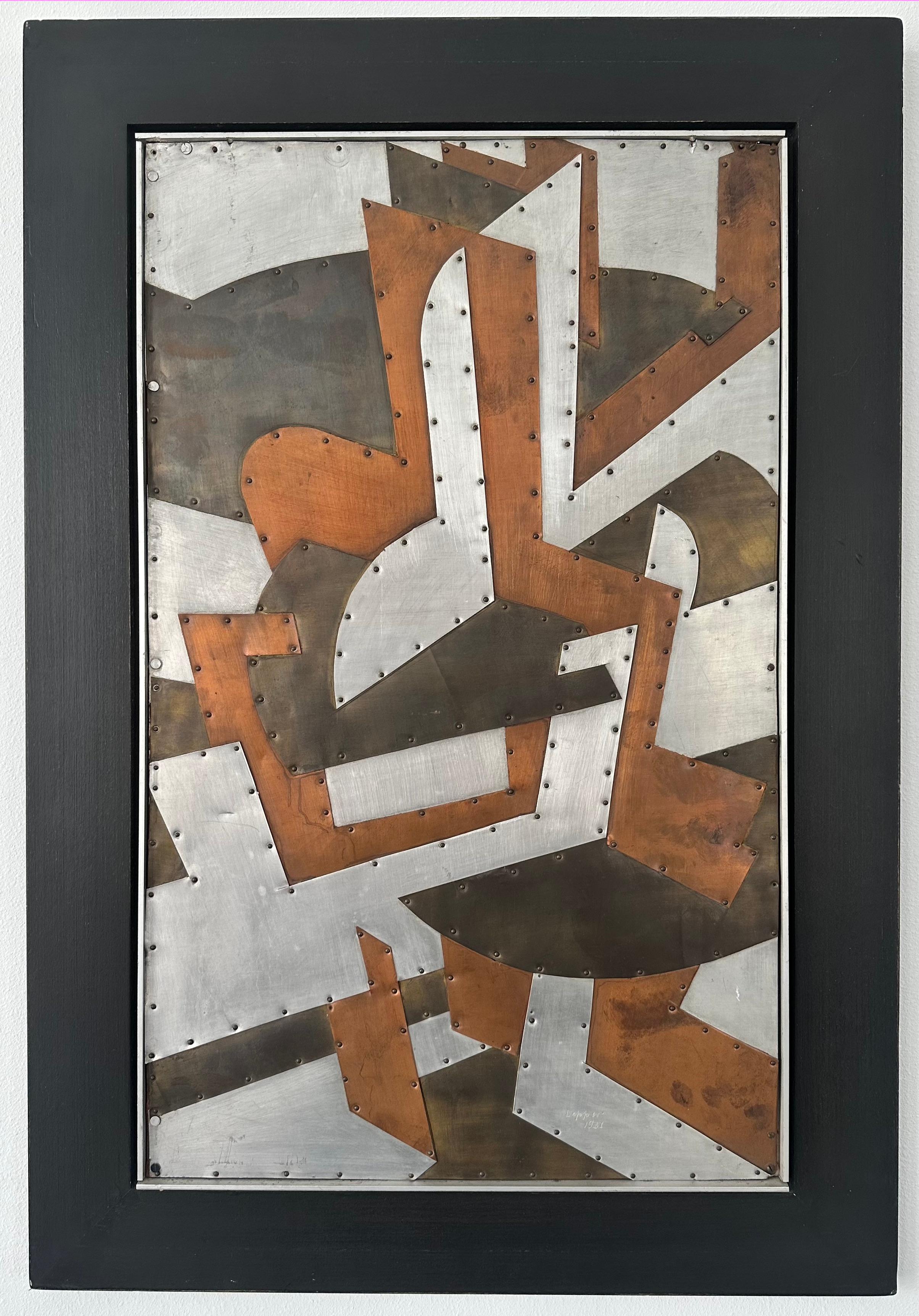
Robert Lepper (1906-1991) . Cubist composition, 1931. Cut copper, brass and steel sheeting tacked to masonite panel. Panel measures 14.5 x 24 inches. Total framed measurement 20 x 29...
Category

1930s Cubist Mixed Media

Materials

Brass, Copper, Stainless Steel

Vintage, collage by mystery artist
Located in San Francisco, CA
Vintage, collage by mystery artist Possibly 1970's 22x28 framed
Category

20th Century More Art

Materials

Paper