Want more images or videos?
Request additional images or videos from the seller
1 of 21
Edward H. BohlinEDWARD BOHLIN 1930S SILVER MOUNTED PARADE SADDLE HOLLYWOOD WESTERN ARTISTCirca 1930S
Circa 1930S
$18,850List Price
About the Item
- Creator:Edward H. Bohlin (1895 - 1980, American)
- Creation Year:Circa 1930S
- Dimensions:Height: 36 in (91.44 cm)Width: 54 in (137.16 cm)Depth: 30 in (76.2 cm)
- Medium:
- Movement Style:
- Period:
- Condition:Silver has been polished. Great looking decorator piece.
- Gallery Location:San Antonio, TX
- Reference Number:1stDibs: LU76932967851
About the Seller
5.0
Vetted Professional Seller
Every seller passes strict standards for authenticity and reliability
Established in 1974
1stDibs seller since 2017
104 sales on 1stDibs
Authenticity Guarantee
In the unlikely event there’s an issue with an item’s authenticity, contact us within 1 year for a full refund. DetailsMoney-Back Guarantee
If your item is not as described, is damaged in transit, or does not arrive, contact us within 7 days for a full refund. Details24-Hour Cancellation
You have a 24-hour grace period in which to reconsider your purchase, with no questions asked.Vetted Professional Sellers
Our world-class sellers must adhere to strict standards for service and quality, maintaining the integrity of our listings.Price-Match Guarantee
If you find that a seller listed the same item for a lower price elsewhere, we’ll match it.Trusted Global Delivery
Our best-in-class carrier network provides specialized shipping options worldwide, including custom delivery.You May Also Like
Pecheur / - Full of anticipation -
Located in Berlin, DE
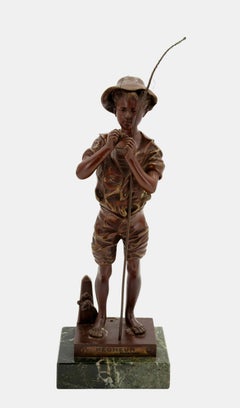
Adolphe Jean Lavergne (1863-1928), Pecheur, c. 1900. Brown patinated bronze with rectangular cast plinth on a green marble base (3 cm high), total height with hinge 37 cm, width 9 cm, depth 8 cm, weight 2.9 kg, signed “Lavergne” on the plinth.
- Base with old drilling and a few oxidized areas, patina occasionally rubbed, somewhat stained in the folds.
- Full of anticipation -
This bronze is the larger, highly detailed version of the fisherman that made Parisian artist Adolphe Jean Lavergne famous. In preparation for fishing, the boy prepares his rod before heading out to sea. The attachment of the iron ring and the rope behind him suggest a quay wall and a boat moored there. However, the depiction is entirely focused on the actual action of the young fisherman: With equal skill and concentration, he bends a hook to connect it to the fishing line. The contrast with his casual clothing, the loose-fitting trousers, the open shirt with its "wild" folds, and, last but not least, the sun hat boldly perched on his neck, reinforces the impression of the attentive care with which he goes about his work. His gaze makes him appear absorbed, as if he has forgotten the world around him and yet he is visibly filled with anticipation of fishing.
GERMAN VERSION
Adolphe Jean Lavergne (1863-1928), Pecheur, um 1890. Braun patinierte Bronze mit rechteckiger gegossener Plinthe auf grünem Marmorsockel (3 cm Höhe), Gesamthöhe mit Angel 37 cm, Breite 9 cm, Tiefe 8 cm, Gewicht 2,9 kg, auf der Plinthe mit „Lavergne“ signiert.
- Sockel mit alter Bohrung und wenigen oxidierten Stellen, Patina mitunter berieben, in den Falten vereinzelt etwas fleckig.
- Voller Vorfreude -
Die Bronzefigur ist die größere äußerst detaillierte Ausführung des Fischers, mit dem der Pariser Künstler Adolphe Jean Lavergne bekannt geworden ist. In Vorbereitung auf das Fischen präpariert der Junge die Angel...
Category
1890s Realist Figurative Sculptures
Materials
Bronze
Florentine singer / - The Renaissance of the Renaissance -
By Paul Dubois
Located in Berlin, DE
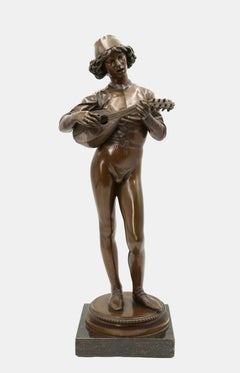
Paul Dubois (1829 Nogent-sur-Seine - 1905 Paris), Florentine singer, 1865. Light brown patinated bronze with cast round plinth mounted on a square marble base (3.5 cm high). Total height 53 cm. Bronze dimensions: 49.5 cm (height) x 20 cm (length) x 10 cm (width), weight 5.6 kg. Inscribed on the plinth "P.[aul] DUBOIS", dated "1865", with the foundry's mark "F. BARBEDIENNE FONDEUR" and the signet "REDUCTION MECANIQUE A. COLLAS".
- Patina very occasionally darkened, lute with loss of one tuning peg, otherwise in excellent condition.
- The renaissance of the Renaissance -
The bronze is a precisely executed and masterfully cast contemporary reduction of Paul Dubois 155 cm tall masterpiece "Florentine Singer", which is exhibited in the Musée d'Orsay and for which the artist was awarded the Medal of Honor at the Paris Salon in 1865. The work acted as a beacon, and was followed by a plethora of depictions of juveniles.
Inspired by Donatello and Luca della Robbia, but also by painters such as Piero della Francesca, Benozzo Gozzoli, and Pinturicchio, the "Florentine Singer" is not an epigonal work that pays homage to a vanished era, but a successful attempt to draw vitality from the art of the past and thus give it new life.
The effect of vitality is the core of Italian Renaissance art theory. In order to fulfill itself as art, art had to appear like nature. This naturalism also characterizes the "Florentine Singer". The young man appears to have been taken from life, which is reinforced by the momentary nature of his action. He has just struck a now fading chord. In addition, the natural appearance is enhanced by the detailed shaping of the figurative details, such as the laces with the slightly curved leather of the shoes, the belt buckle, or the ornamentation on the body of the lute. Even the fingernails are clearly defined. Unlike the Renaissance, however, the effect of liveliness here is not based on the "discovery" of nature and the human body, but primarily on the rediscovery of the art of the Quattrocento. The liveliness of the artwork is therefore at the same time a revitalization of this art, so that we can speak of a Renaissance of the Renaissance, just as the Pre-Raphaelites in England at the same time transferred the Quattrocento to contemporary art.
Dubois takes on the most difficult of all subjects, the depiction of singing through silent sculpture. He was preceded in this by Luca della Robbia and Donatello with their pulpits of singers created in the 1430s in the Museo dell'Opera del Duomo in Florence. Compared to these works, the physiognomy of Dubois singer is far less animated, yet he also depicts singing in a convincing manner. He uses the whole body. He takes the ancient contrapposto, which was essential to Renaissance sculpture, and transforms the standing leg-playing posture into a late medieval S-swing, giving the body an elegant beauty and at the same time setting it in melodic motion. In the equally elegant finger position, the music is expressed in a much more literal way with the beating of the lute. Finally, the musicality of the sculpture culminates in the face with the mouth open to sing.
Through the act of singing, which is a great challenge to the artistic will to depict perfect beauty, the gracefulness of the classical face is not diminished, but enhanced. Starting from the face with the singing mouth and the gaze absorbed by the sounds, the inner vitality spreads, giving the bronze sculpture an intense aura, enhanced by the music. Dubois transfers the beauty of the Renaissance to the musical, sublimating the visible sculpture to the invisible of music.
He took up the challenge of transcending the Renaissance with the Renaissance, thus responding to the Querelle des Anciens et des Modernes, which arose at the end of the 17th century around the French Academy and remained virulent into the 19th century, in which antiquity was regarded either as an unattainable ideal or as a standard to be surpassed. With his work, Dubois proved that the Renaissance, which had championed the art of the ancients, could lead to a new renaissance of art.
About the artist
Paul Dubois' great-uncle was the famous French Baroque sculptor Jean-Baptiste Pigalle, in whose footsteps the talented great-nephew followed. When he debuted at the Paris Salon in 1858, he signed his work "Dubois-Pigalle". At his father's request, however, he first studied law before devoting himself to sculpture under the tutelage of François Christophe Armand Toussaint in 1856 and entering the École des Beaux-Arts in 1858. From 1859 to 1863, he lived in Rome and traveled to Naples and Florence. Inspired by Florentine art of the quattrocento, Dubois initiated a school-forming neo-Florentine style that combined the elegantly simple forms of youthful grace with a precise wealth of detail.Two purchases by the French state (“envois de Rome”) were made during his stay in Rome, which brought him recognition in Paris. After his return there, he quickly became an internationally sought-after artist.
Dubois was also active as a creator of monuments. His most famous work is the equestrian statue of Joan of Arc (1896) on the forecourt of Reims Cathedral. He was also a sought-after portraitist who produced around 50 busts and - Dubois was also a passionate painter - around 100 portraits in oil.
From 1873 to 1878 he was curator of the Museum du Luxembourg, in 1876 he became a member of the Institut de France and from 1878 to 1905 he was director of the École des Beaux-Arts.
In 1865, Dubois was awarded the Paris Salon Medal of Honor for his “Florentine Singer”. In 1867 he became Chevalier, in 1874 Officier, in 1886 Commandeur of the Légion d'honneur, which awarded Dubois the Grande Croix in 1896.
Selected Bibliography
Stole, Elmar: Paul Dubois. In: Saur. Allgemeines Künstlerlexikon, vol. 30, Munich - Leipzig 2001, pp. 677-678.
GERMAN VERSION
Paul Dubois (1829 Nogent-sur-Seine - 1905 Paris), Florentinischer Sänger, 1865. Hellbraun patinierte Bronze mit gegossener runder Plinthe auf quadratischem Marmorsockel montiert (3,5 cm Höhe). Gesamthöhe 53 cm. Maße der Bronze: 49,5 cm (Höhe) x 20 cm (Länge) x 10 cm (Breite), Gewicht 5,6 kg. Auf der Plinthe mit „P.[aul] DUBOIS“ bezeichnet, auf „1865“ datiert, mit dem Gießereistempel „F. BARBEDIENNE FONDEUR“ und dem Signet „REDUCTION MECANIQUE A. COLLAS“ versehen.
- Patina sehr vereinzelt nachgedunkelt, Laute mit Verlust eines Stimmwirbels, ansonsten ausgezeichnet erhalten.
- Die Renaissance...
Category
1860s Realist Figurative Sculptures
Materials
Bronze
$5,408
H 20.87 in W 7.88 in D 3.94 in
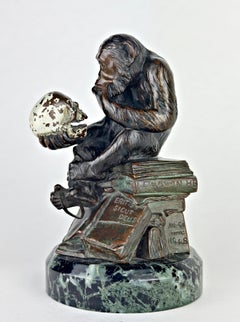
Bronze, Monkey With Skull, 1900, German, Signed
Located in Eltville am Rhein, DE
Hugo Wolfgang Reinhard
Oberlahnstein 1853 - 1900 Berlin
Monkey with Skull, circa 1900
Bronze, signed
Foundry: Gladenbeck "HG"
Size: approx. 12.5 x 6 x 8 cm, plus 2 cm base
Rare cas...
Category
Early 1900s Realist Figurative Sculptures
Materials
Bronze
$4,567
H 4.93 in W 2.37 in D 3.15 in
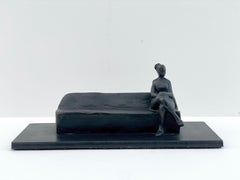
Commute (woman)
By Jim Rennert
Located in Greenwich, CT
Edition of 9
American, b. 1958
National Sculpture Society Fellow
Jim Rennert was born in 1958, and grew up in Las Vegas, Nevada, and Salt Lake City, Utah. After ten trying years o...
Category
2010s Realist Figurative Sculptures
Materials
Bronze
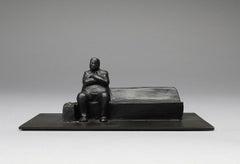
Commute (man)
By Jim Rennert
Located in Greenwich, CT
Edition of 9
American, b. 1958
National Sculpture Society Fellow
Jim Rennert was born in 1958, and grew up in Las Vegas, Nevada, and Salt Lake City, Utah. After ten trying years o...
Category
2010s Realist Figurative Sculptures
Materials
Bronze
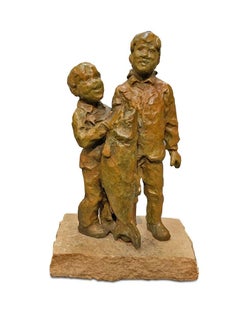
Big Fish Story
By Jane DeDecker
Located in Greenwich, CT
Sculpture of two boys displaying a sizeable catch.
Edition of 50
Category
1990s Realist Figurative Sculptures
Materials
Bronze
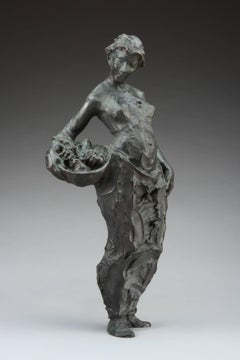
Earth, midsize
By Jane DeDecker
Located in Greenwich, CT
Sculpture of a woman representing the element of earth.
Category
Early 2000s Realist Figurative Sculptures
Materials
Bronze
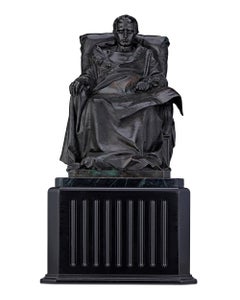
THE LAST DAYS OF NAPOLÉON BY
Located in New Orleans, LA
This highly evocative bronze by Vincenzo Vela captures the deposed Emperor Napoléon on his deathbed, holding a map of Europe and lost in thought about what might have been. Remarkable among most portrayals of the exiled leader, this highly detailed sculpture depicts Napoléon at his most vulnerable. Nonetheless, Vela perfectly captures his still-heroic bearing, which imparts to this work a monumental quality and quiet dignity. The mate to this figure is the colossal marble at the Musée du Château de Malmaison, which was shown at the Paris Salon of 1867.
The founder of the verismo movement in Italy, Vela was one of the great exponents of realism in sculpture. Born in Ligornetto, Switzerland in 1820, he studied under celebrated sculptor, Benedetto Cacciatori. He was also influenced both by the work of Tuscan sculptor Lorenzo Bartolini, who seamlessly combined neoclassicism with naturalism and the romantic painting of Francesco Hayez...
Category
19th Century Realist Figurative Sculptures
Materials
Marble, Bronze
Soaring Eagle / - With eagle eyes -
Located in Berlin, DE
Anonymous, Soaring Eagle, mid-20th century Patinated cast metal mounted on quartz block. 24 cm (total height) x 29 cm (width) x 12 cm (depth).
- Patina heavily rubbed in places, screw connections between sculpture and stone...
Category
Mid-20th Century Realist Figurative Sculptures
Materials
Metal

Troubetzkoy Paulo (1866 - 1938)+ Bronze Cowboy Sculpture
Located in Gent, VOV
This striking bronze cowboy sculpture by renowned artist Paolo Troubetzkoy depicts a cowboy riding a bucking bronco. Cast in bronze and featur...
Category
Late 19th Century Realist Figurative Sculptures
Materials
Bronze
$10,817
H 12.6 in W 14.18 in D 7.88 in
More From This Seller
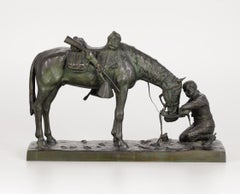
View All" THE LAST DROP " Charles Schreyvogel (1861-1912) BRONZE SCULPTURE 1903 WESTERN
Located in San Antonio, TX
Charles Schreyvogel
(1861-1912)
New York / New Jersey Artist
Image Size: 12" x 18.50" x 5"
Medium: Bronze Sculpture
1903
"The Last Drop"
Charles Schreyvogel (1861-1912) New York / Ne...
Category
Early 1900s Realist Figurative Sculptures
Materials
Bronze
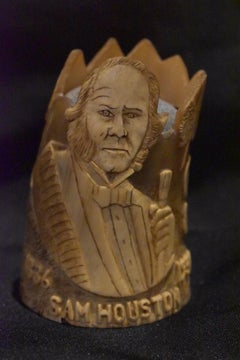
"SAM HOUSTON" HORN CARVING 1936 TEXAS CENTENNIAL AMAZING WORK
Located in San Antonio, TX
Dan Super "SAM HOUSTON"
(1873-1953)
Houston Artist
Image Size: 3 3/4 inches tall
Medium: Carved Horn of Sam Houston to celebrate the Texas Centennial.
Texas Centennial 1936
"Sam Houston Pin Cushion Holder"
Biography
Dan Super (1873-1953)
Dan E. Super, Jr. (1873 – 1953) Dan Super had the eye of a sculptor, envisioning and then creating hundreds of objects from the elongated form of a Texas Longhorn’s tusk. At the age of six, Dan Super carved his first drawing into a piece of the horn of a Texas Longhorn. Over the next 56 years, he made utilitarian pieces like pencil cups, pin cushions, and backscratchers, realistic replicas of animals and birds, and imaginative carvings of elegant nudes. While these carvings resemble the traditional art of scrimshaw, carvings from whale bone, we’ve not been able to identify another carver who used the Texas Longhorn as his material. “My work is done with an ordinary pocketknife, hacksaw file and rasp,” Super wrote in 1937. He used the horn in every way conceivable; whole, allowing the shape to define the object he was making, flattened to make mosaic or inlay work. He incised and pierced it and carved in the round. His own hands polished the horn to a sheen. Daniel Super, Jr. was born in Houston on August 22, 1873. His father owned stock years, D. Super and Brothers Co., providing the young Super with ready access to his raw material. Throughout his life, he worked in the businesses key to the identity and success of young, booming Houston, cattle, oil, real estate and rail. In 1896 he married Lula, and took over the family business, expanding it to include a grocery. He closed the company in 1912 and got into the oil business...
Category
1930s Realist Figurative Sculptures
Materials
Other Medium
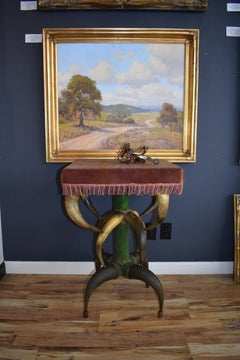
Charles B Fletcher St. Louis Horn Furniture Maker Rare Horn Table Original 1880s
Located in San Antonio, TX
Charles B. Fletcher Has original upholstery
St. Louis Horn Furniture Maker
Rare Horn Table Original upholstery
Top is 20 x 20
Height is 30 inches
Details
Made from Buffalo and Cattle Horns. It is extremely difficult to find Horn Tables. Circa 1880s
Horn Furniture
Biography
Charles B. Fletcher St. Louis Horn Furniture Maker
Charles Fletcher and John Crane, both of St. Louis, made furniture as a business. Makers, such as Wenzel Friedrich...
Materials
Animal Skin
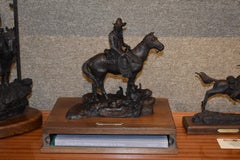
"TAKING STOCK" WESTERN G. HARVEY SCULPTURE W/BOOK BRONZE 1986
By G. Harvey
Located in San Antonio, TX
G. Harvey (Gerald Harvey Jones)
(1933-2017)
San Antonio, Austin, and Fredericksburg Artist
Image Size: Overall size: 14" x 15" x 11.50"
Medium: Bronze Sculpture Signed & Dated
1986
"...
Category
1980s Impressionist Figurative Sculptures
Materials
Bronze
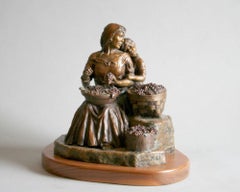
"MORNING MARKET" WOMAN SITTING WITH CHILD
By Scy
Located in San Antonio, TX
Scy Caroselli
Colorado Artist
Image Size: 11 x 10 x 9
Medium: Bronze
"Morning Market"
Scy has been surrounded by fine art throughout her entire life. She grew up beside the easel and sculpting stand...
Category
2010s Impressionist Figurative Sculptures
Materials
Bronze
"FIESTA SONG" ACCORDION PLAYER BRONZE SCULPTURE
Located in San Antonio, TX
John Bennett
(Born 1952)
Fredericksburg, Texas Artist
Image Size: 19 x 13 x 9
Medium: Bronze Sculpture
"Fiesta Song" Accordion Player
John Bennett (Born 1952)
John Bennett was design...
Category
20th Century Modern Figurative Sculptures
Materials
Bronze