Want more images or videos?
Request additional images or videos from the seller
1 of 15

Harry Houdini
Original Houdini Keys from Houdini Museum with Certificate of Authenticity

1926

Price:$768
$900List Price

You May Also Like

Winter Fireworks- Original impressionism seascape oil painting- modern art
Located in London, Chelsea
This exceptional artwork is currently on display and available for sale at Signet Contemporary Art Gallery and online. Experience the magic of the season with "Winter Fireworks," an...
Category

21st Century and Contemporary Realist Landscape Paintings

Materials

Silver

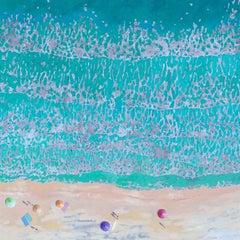
Pastel Umbrellas-original impressionism seascape oil painting-contemporary Art
Located in London, Chelsea
This exceptional artwork is currently on display and available for sale at Signet Contemporary Art Gallery and online. "Pastel Umbrellas" by Lenny Cornforth is a captivating origina...
Category

21st Century and Contemporary Realist Landscape Paintings

Materials

Silver

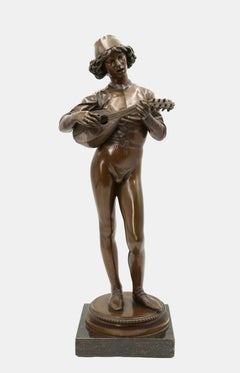
Florentine singer / - The Renaissance of the Renaissance -
By Paul Dubois
Located in Berlin, DE
Paul Dubois (1829 Nogent-sur-Seine - 1905 Paris), Florentine singer, 1865. Light brown patinated bronze with cast round plinth mounted on a square marble base (3.5 cm high). Total height 53 cm. Bronze dimensions: 49.5 cm (height) x 20 cm (length) x 10 cm (width), weight 5.6 kg. Inscribed on the plinth "P.[aul] DUBOIS", dated "1865", with the foundry's mark "F. BARBEDIENNE FONDEUR" and the signet "REDUCTION MECANIQUE A. COLLAS". - Patina very occasionally darkened, lute with loss of one tuning peg, otherwise in excellent condition. - The renaissance of the Renaissance - The bronze is a precisely executed and masterfully cast contemporary reduction of Paul Dubois 155 cm tall masterpiece "Florentine Singer", which is exhibited in the Musée d'Orsay and for which the artist was awarded the Medal of Honor at the Paris Salon in 1865. The work acted as a beacon, and was followed by a plethora of depictions of juveniles. Inspired by Donatello and Luca della Robbia, but also by painters such as Piero della Francesca, Benozzo Gozzoli, and Pinturicchio, the "Florentine Singer" is not an epigonal work that pays homage to a vanished era, but a successful attempt to draw vitality from the art of the past and thus give it new life. The effect of vitality is the core of Italian Renaissance art theory. In order to fulfill itself as art, art had to appear like nature. This naturalism also characterizes the "Florentine Singer". The young man appears to have been taken from life, which is reinforced by the momentary nature of his action. He has just struck a now fading chord. In addition, the natural appearance is enhanced by the detailed shaping of the figurative details, such as the laces with the slightly curved leather of the shoes, the belt buckle, or the ornamentation on the body of the lute. Even the fingernails are clearly defined. Unlike the Renaissance, however, the effect of liveliness here is not based on the "discovery" of nature and the human body, but primarily on the rediscovery of the art of the Quattrocento. The liveliness of the artwork is therefore at the same time a revitalization of this art, so that we can speak of a Renaissance of the Renaissance, just as the Pre-Raphaelites in England at the same time transferred the Quattrocento to contemporary art. Dubois takes on the most difficult of all subjects, the depiction of singing through silent sculpture. He was preceded in this by Luca della Robbia and Donatello with their pulpits of singers created in the 1430s in the Museo dell'Opera del Duomo in Florence. Compared to these works, the physiognomy of Dubois singer is far less animated, yet he also depicts singing in a convincing manner. He uses the whole body. He takes the ancient contrapposto, which was essential to Renaissance sculpture, and transforms the standing leg-playing posture into a late medieval S-swing, giving the body an elegant beauty and at the same time setting it in melodic motion. In the equally elegant finger position, the music is expressed in a much more literal way with the beating of the lute. Finally, the musicality of the sculpture culminates in the face with the mouth open to sing. Through the act of singing, which is a great challenge to the artistic will to depict perfect beauty, the gracefulness of the classical face is not diminished, but enhanced. Starting from the face with the singing mouth and the gaze absorbed by the sounds, the inner vitality spreads, giving the bronze sculpture an intense aura, enhanced by the music. Dubois transfers the beauty of the Renaissance to the musical, sublimating the visible sculpture to the invisible of music. He took up the challenge of transcending the Renaissance with the Renaissance, thus responding to the Querelle des Anciens et des Modernes, which arose at the end of the 17th century around the French Academy and remained virulent into the 19th century, in which antiquity was regarded either as an unattainable ideal or as a standard to be surpassed. With his work, Dubois proved that the Renaissance, which had championed the art of the ancients, could lead to a new renaissance of art. About the artist Paul Dubois' great-uncle was the famous French Baroque sculptor Jean-Baptiste Pigalle, in whose footsteps the talented great-nephew followed. When he debuted at the Paris Salon in 1858, he signed his work "Dubois-Pigalle". At his father's request, however, he first studied law before devoting himself to sculpture under the tutelage of François Christophe Armand Toussaint in 1856 and entering the École des Beaux-Arts in 1858. From 1859 to 1863, he lived in Rome and traveled to Naples and Florence. Inspired by Florentine art of the quattrocento, Dubois initiated a school-forming neo-Florentine style that combined the elegantly simple forms of youthful grace with a precise wealth of detail.Two purchases by the French state (“envois de Rome”) were made during his stay in Rome, which brought him recognition in Paris. After his return there, he quickly became an internationally sought-after artist. Dubois was also active as a creator of monuments. His most famous work is the equestrian statue of Joan of Arc (1896) on the forecourt of Reims Cathedral. He was also a sought-after portraitist who produced around 50 busts and - Dubois was also a passionate painter - around 100 portraits in oil. From 1873 to 1878 he was curator of the Museum du Luxembourg, in 1876 he became a member of the Institut de France and from 1878 to 1905 he was director of the École des Beaux-Arts. In 1865, Dubois was awarded the Paris Salon Medal of Honor for his “Florentine Singer”. In 1867 he became Chevalier, in 1874 Officier, in 1886 Commandeur of the Légion d'honneur, which awarded Dubois the Grande Croix in 1896. Selected Bibliography Stole, Elmar: Paul Dubois. In: Saur. Allgemeines Künstlerlexikon, vol. 30, Munich - Leipzig 2001, pp. 677-678. GERMAN VERSION Paul Dubois (1829 Nogent-sur-Seine - 1905 Paris), Florentinischer Sänger, 1865. Hellbraun patinierte Bronze mit gegossener runder Plinthe auf quadratischem Marmorsockel montiert (3,5 cm Höhe). Gesamthöhe 53 cm. Maße der Bronze: 49,5 cm (Höhe) x 20 cm (Länge) x 10 cm (Breite), Gewicht 5,6 kg. Auf der Plinthe mit „P.[aul] DUBOIS“ bezeichnet, auf „1865“ datiert, mit dem Gießereistempel „F. BARBEDIENNE FONDEUR“ und dem Signet „REDUCTION MECANIQUE A. COLLAS“ versehen. - Patina sehr vereinzelt nachgedunkelt, Laute mit Verlust eines Stimmwirbels, ansonsten ausgezeichnet erhalten. - Die Renaissance...

Category

1860s Realist Figurative Sculptures

Materials

Bronze

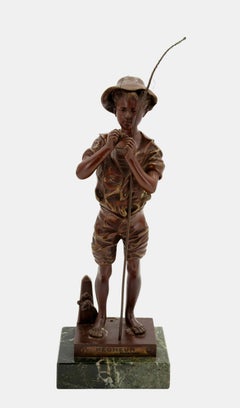
Pecheur / - Full of anticipation -
Located in Berlin, DE
Adolphe Jean Lavergne (1863-1928), Pecheur, c. 1900. Brown patinated bronze with rectangular cast plinth on a green marble base (3 cm high), total height with hinge 37 cm, width 9 cm, depth 8 cm, weight 2.9 kg, signed “Lavergne” on the plinth. - Base with old drilling and a few oxidized areas, patina occasionally rubbed, somewhat stained in the folds. - Full of anticipation - This bronze is the larger, highly detailed version of the fisherman that made Parisian artist Adolphe Jean Lavergne famous. In preparation for fishing, the boy prepares his rod before heading out to sea. The attachment of the iron ring and the rope behind him suggest a quay wall and a boat moored there. However, the depiction is entirely focused on the actual action of the young fisherman: With equal skill and concentration, he bends a hook to connect it to the fishing line. The contrast with his casual clothing, the loose-fitting trousers, the open shirt with its "wild" folds, and, last but not least, the sun hat boldly perched on his neck, reinforces the impression of the attentive care with which he goes about his work. His gaze makes him appear absorbed, as if he has forgotten the world around him and yet he is visibly filled with anticipation of fishing. GERMAN VERSION Adolphe Jean Lavergne (1863-1928), Pecheur, um 1890. Braun patinierte Bronze mit rechteckiger gegossener Plinthe auf grünem Marmorsockel (3 cm Höhe), Gesamthöhe mit Angel 37 cm, Breite 9 cm, Tiefe 8 cm, Gewicht 2,9 kg, auf der Plinthe mit „Lavergne“ signiert. - Sockel mit alter Bohrung und wenigen oxidierten Stellen, Patina mitunter berieben, in den Falten vereinzelt etwas fleckig. - Voller Vorfreude - Die Bronzefigur ist die größere äußerst detaillierte Ausführung des Fischers, mit dem der Pariser Künstler Adolphe Jean Lavergne bekannt geworden ist. In Vorbereitung auf das Fischen präpariert der Junge die Angel...
Category

1890s Realist Figurative Sculptures

Materials

Bronze

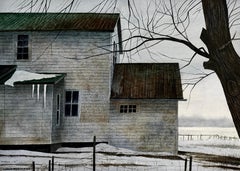
Northern Hush, Original Painting
Located in San Francisco, CA

Artist Comments
In this quietly cinematic winter scene, artist Vic Roschkov captures the faded grace of an old farmhouse beneath drifting snow. Stark trees reach almost lifelik...

Category

21st Century and Contemporary Realist Interior Drawings and Watercolors

Materials

Watercolor

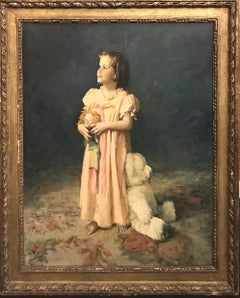
Portrait of Christina Patterson, 5 Years Old
By Aaron Shikler
Located in Milford, NH
A fine portrait of a 5 year old Christina Patterson by American artist Aaron Abraham Shikler (1922-2015). Shikler was born in Brooklyn, New York, studied at the Tyler School of Art at Temple University, then studied in New York with the abstract painter Hans Hofmann, but he remained a committed realist throughout his life, under the sway of artists like Degas, Vuillard, Sickert and Sargent. To make a living, he painted clowns and ballerinas for a wholesale company, signing the work “Phil I. Steen” to register his disgust. When Leroy Davis, an Army friend, opened the Davis Gallery in Manhattan in 1953, he began showing Mr. Shikler’s work, which included figure studies, still lifes and landscapes. A turning point came in 1959 when Jane Engelhard...
Category

Mid-20th Century Realist Figurative Paintings

Materials

Canvas, Oil

Portrait of Christina Patterson, 5 Years Old
$9,800 Sale Price
50% Off
H 43 in W 37 in D 2 in
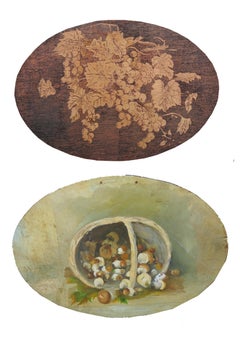
Late 19th Century Grape Vine Pryography Wood Burning Art, Double Sided
Located in Soquel, CA
Very fine late 19th Century depiction of grape cluster pyrography (wood burning), C. 1900, double-sided. Perfect gift for wine enthusiast. Unsigned. Primitive still life on verso. Un...
Category

Late 19th Century Realist More Art

Materials

Wood, Oil

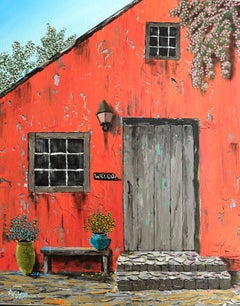
Standing Proud, Original Painting
Located in San Francisco, CA

Artist Comments
A house proudly stands against a fiery sky, its weathered walls and darkened windows hinting at stories left untold. Artist Art Clark drew inspiration from hi...

Category

21st Century and Contemporary Realist Interior Paintings

Materials

Acrylic

Northwest of Heaven, Original Painting
Located in San Francisco, CA

Artist Comments
Time stands still at a derelict farm nestled in a sweeping valley. A meandering stream adds movement and direction to the scene. Towering mountains rise in th...

Category

21st Century and Contemporary Realist Landscape Paintings

Materials

Acrylic

Cuore Della Casa, Original Painting
Located in San Francisco, CA

Artist Comments
An abandoned cottage with chipped stucco and worn paint reveals the passage of time. Despite the worn, weathered architecture, life persists as vibrant flower...

Category

21st Century and Contemporary Realist Interior Paintings

Materials

Acrylic

More From This Seller

View All
Judaica Hand-Written Calendrical Manuscript from Władysławowie, 1837
Located in Boca Raton, FL
Exceedingly rare, one-of-a-kind handwritten Jewish calendrical manuscript from Władysławowie, 1837. This book belongs in a museum. Rebound beautifully by James MacDonald & Co. Photos are the actual photos of the book. See all photos. The history of the Jewish calendar may be divided into three periods—the Biblical, the Talmudic, and the post-Talmudic. The first rested purely on the observation of the sun and the moon, the second on observation and reckoning, the third entirely on reckoning. The study of astronomy was largely due to the need of fixing the dates of the festivals. The command (Deut. xvi. 1), "Keep the month of Abib," made it necessary to be acquainted with the position of the sun; and the command, "Also observe themoon and sanctify it," made it necessary to study the phases of the moon. The oldest term in Hebrew for the science of the calendar is ("fixing of the month"); later ("sanctification of the new moon"); ("sanctification of the new moon by means of observation"); ("sanctification of the new moon by means of reckoning"); ("science of fixing the month"); ("rules for the sanctification of the new moon"). Among other names besides these we find (" the secret of intercalation"). The medieval and modern name is Babylonian Calendar. The Babylonian year, which influenced the French time reckoning, seems to have consisted of 12 months of 30 days each, intercalary months being added by the priests when necessary. Two Babylonian calendars are preserved in the inscriptions, and in both each month has 30 days as far as can be learnt. In later times, however, months of 29 days alternated with those of 30. The method of intercalation is uncertain, and the practise seems to have varied. The Babylonian years were soli-lunar; that is to say, the year of 12 months containing 354 days was bound to the solar year of 365 days by intercalating, as occasion required, a thirteenth month. Out of every 11 years there were 7 with 12 months and 4 with 13 months. Strassmeier and Epping, in "Astronomisches aus Babylon," have shown that the ancient Babylonians...
Category

Early 20th Century Realist Mixed Media

Materials

Paper

Incredible Collection of Original Billy Crystal Mr. Saturday Night Scripts Etc
Located in Boca Raton, FL
Looking for an amazing gift for the Billy Crystal fanatic? Forget about all these supposedy signed cards, baseballs, programs etc. Do you really think he sits around all day signing all those things? Offered here is an incredible collection, consisting of: 1. The original first draft movie script...
Category

1990s Realist Mixed Media

Materials

Paper

Empty Packaging Tiffany Hermes Swarovski MacBook Burj Al Arab Disney Apple Watch
By Tiffany Studios
Located in Boca Raton, FL
Empty Packaging Tiffany Hermes Swarovski MacBook Air Burj Al Arab Disney Secrets de Sothys This consists of the following empty packaging: 1 Tiffany box 10” x 10” x 4” 1 Apple Watch box 8” x 5” x 1” 1 Hermes box 9” x 9” x 1” 1 Hermes bag 12” x 12’ 1 Swarovski bag...
Category

2010s Modern More Art

Materials

Paper, Cardboard

The Jew In The Mosque Coffee Table Book by David J. Muller
Located in Boca Raton, FL
Signed and inscribed copy of “The Jew In The Mosque” by David J. Muller 10” x 8”, 90 pages. Condition: New. See attached photos. The Jew in the Mosque: The Story of How an Orthodox...
Category

2010s Other Art Style More Art

Materials

Paper

Growing Up With Houdini Coffee Table Book by David J. Muller
Located in Boca Raton, FL
Signed and inscribed copy of “Growing Up With Houdini” by David J. Muller 10” x 10”, 90 pages. Condition: New. See attached photos. Prologue On February 17, 1984, I interviewed in the bond trading...
Category

2010s Other Art Style More Art

Materials

Paper

Please Don t Buy This Artwork! Coffee Table Book by David J. Muller
Located in Boca Raton, FL
Signed and inscribed copy of “Please Don’t Buy This Artwork” by David J. Muller 11” x 9”, 450 pages. Condition: New. See attached photos. EXCERPTS FROM PLEASE DON'T BUY THIS ARTWORK! BY DAVID J. MULLER As the owner of Photorealism, a wholesale art dealership, I have visited the front and back rooms of over 300 "art galleries" around North America, and in doing so, I learned a few things: Most art galleries sell original paintings, and they also sell photocopies of paintings. There are many names for these photocopies. They can be called lithographs, serigraphs, giclees, embellished giclees, prints, posters, limited editions...
Category

2010s Other Art Style More Art

Materials

Paper

Still Thinking About These?

All Recently Viewed