Items Similar to Gullivers Reise - Rare Book Illustrated by Lovis Corinth - 1922
Want more images or videos?
Request additional images or videos from the seller
1 of 7
Lovis CorinthGullivers Reise - Rare Book Illustrated by Lovis Corinth - 19221922
1922
$2,871.44
£2,143.73
€2,400
CA$3,955.62
A$4,340.07
CHF 2,286.14
MX$51,629.69
NOK 29,285.17
SEK 26,741.36
DKK 18,288.92
About the Item
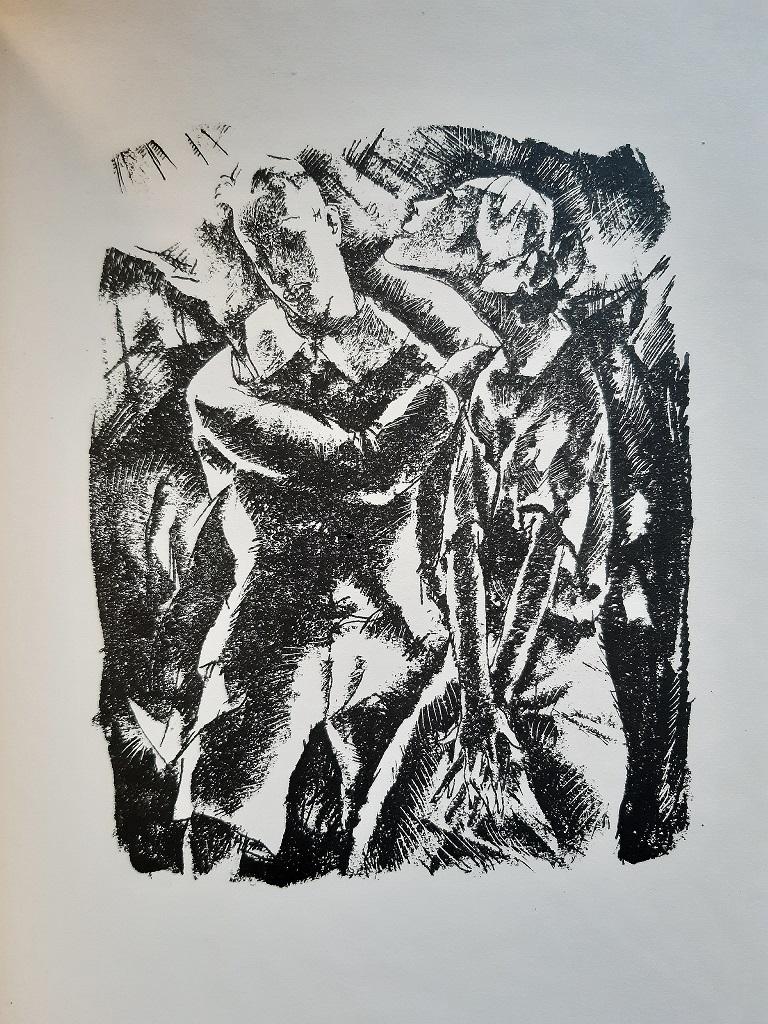
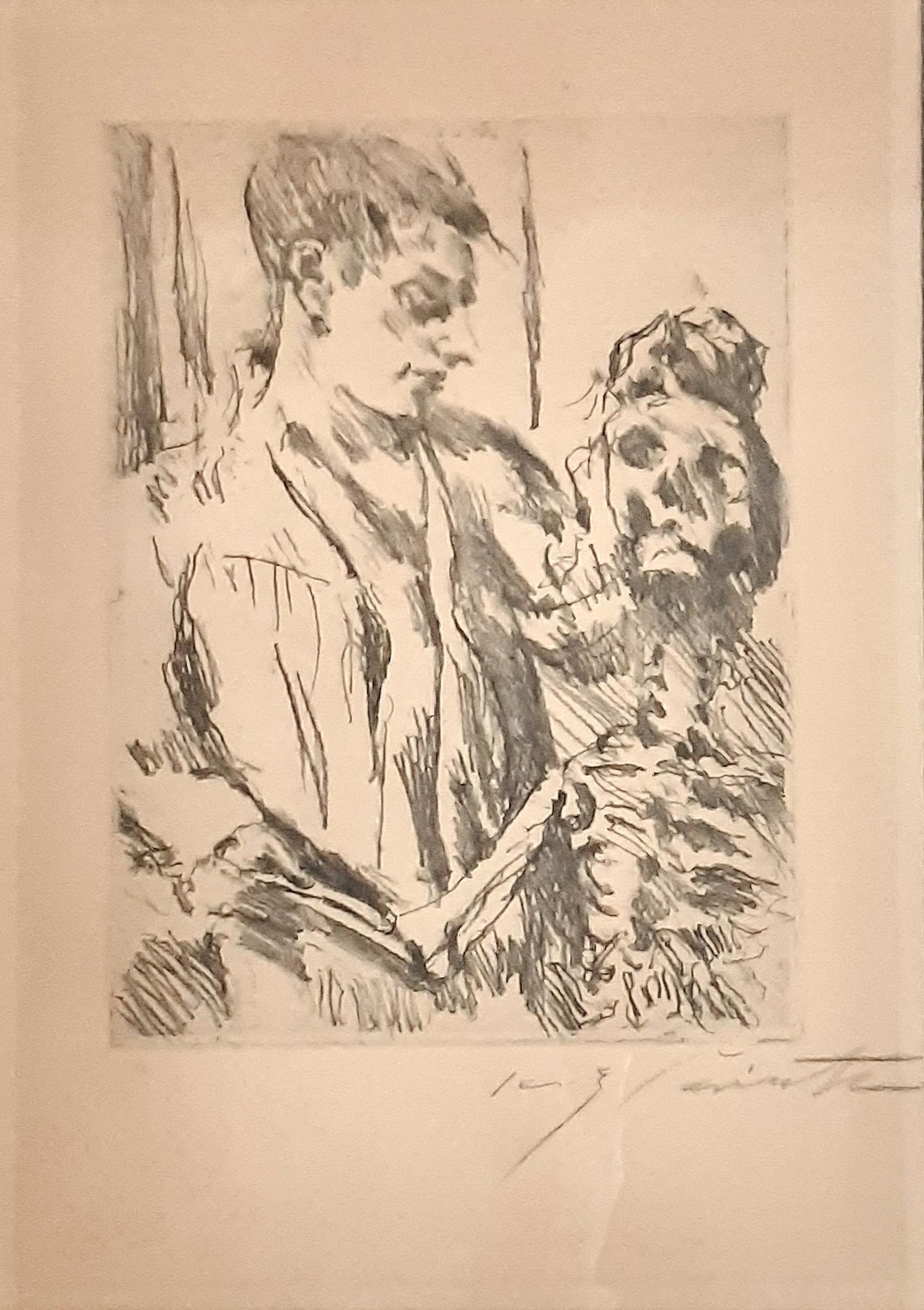
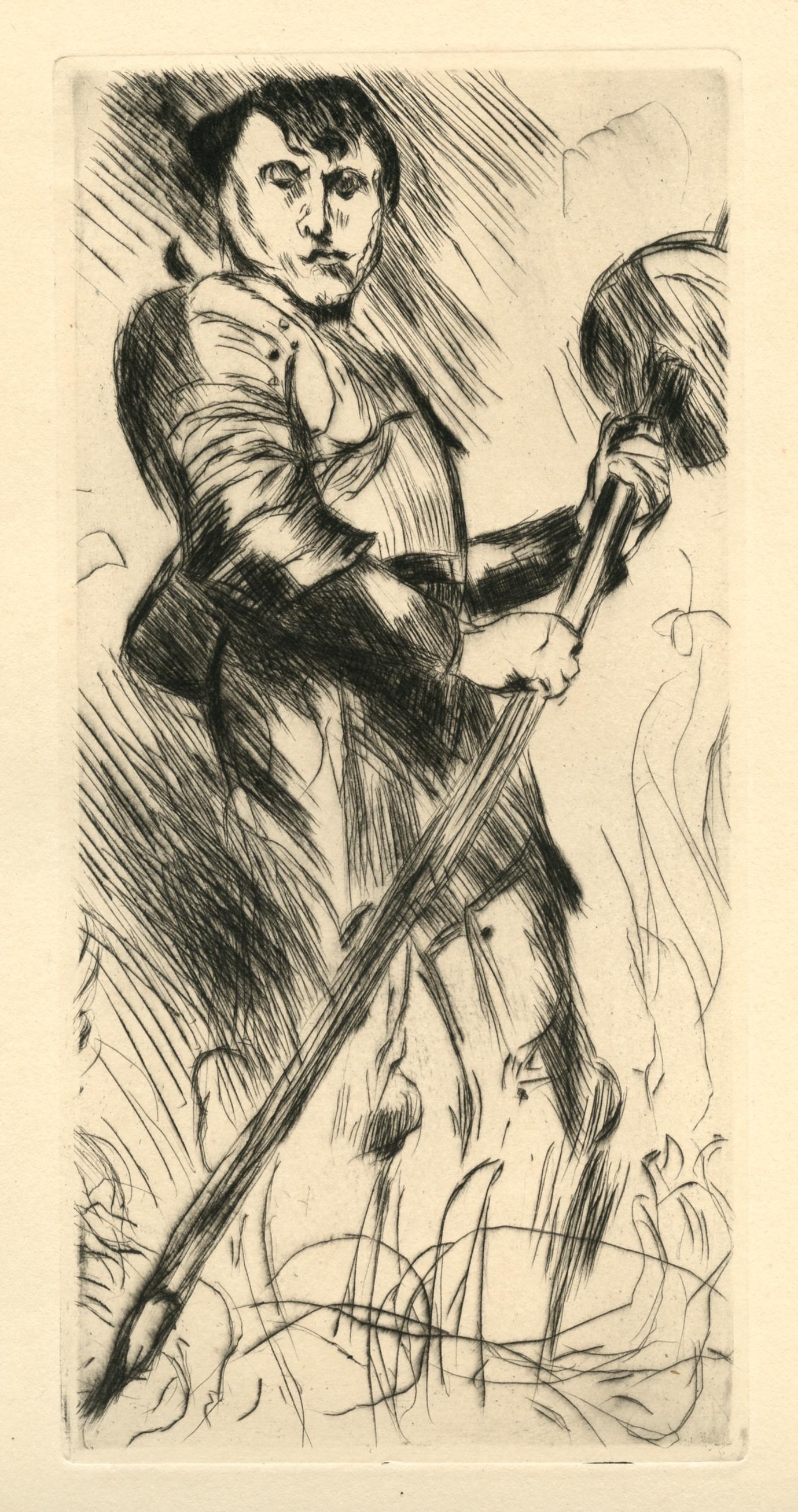
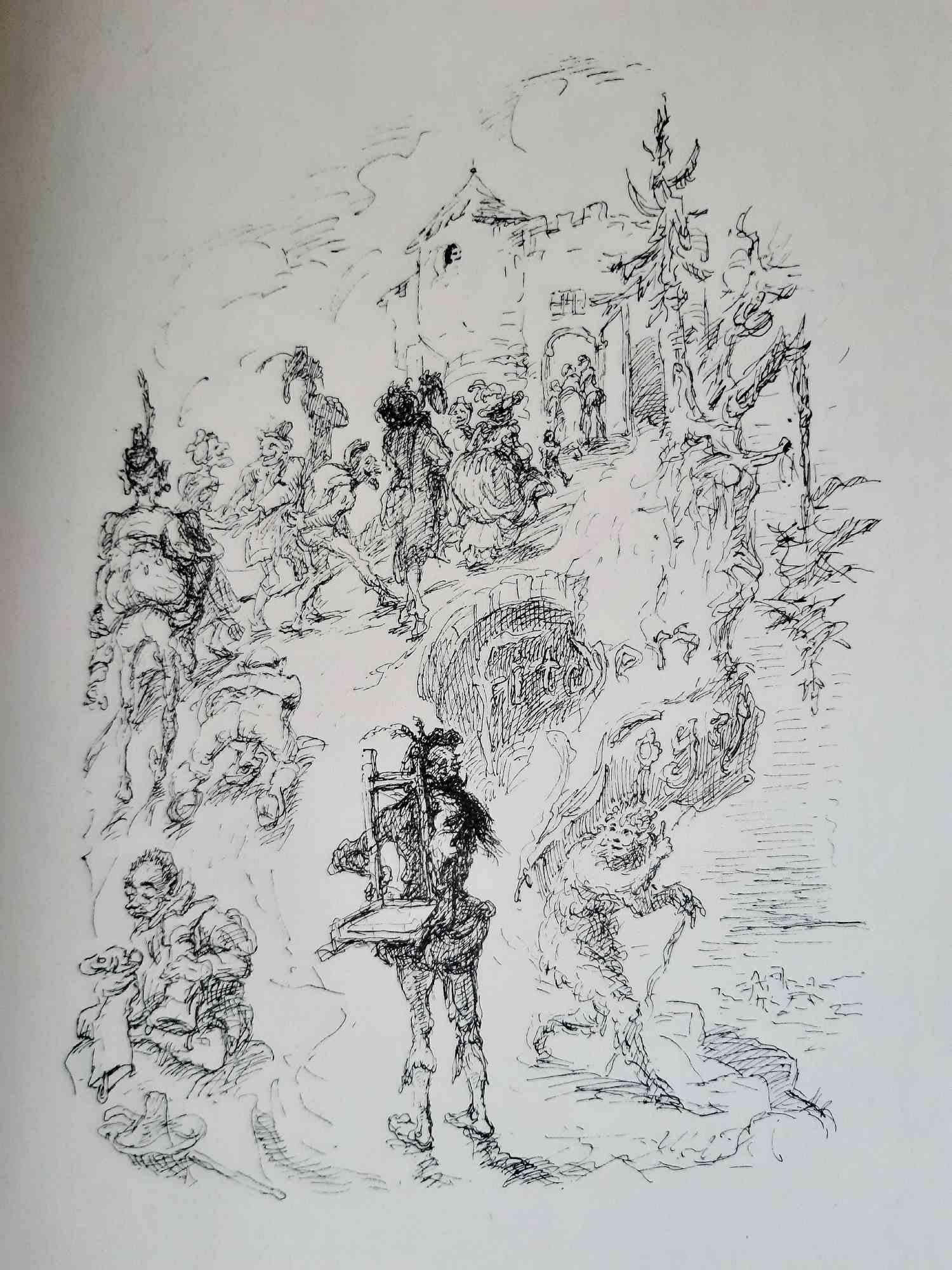
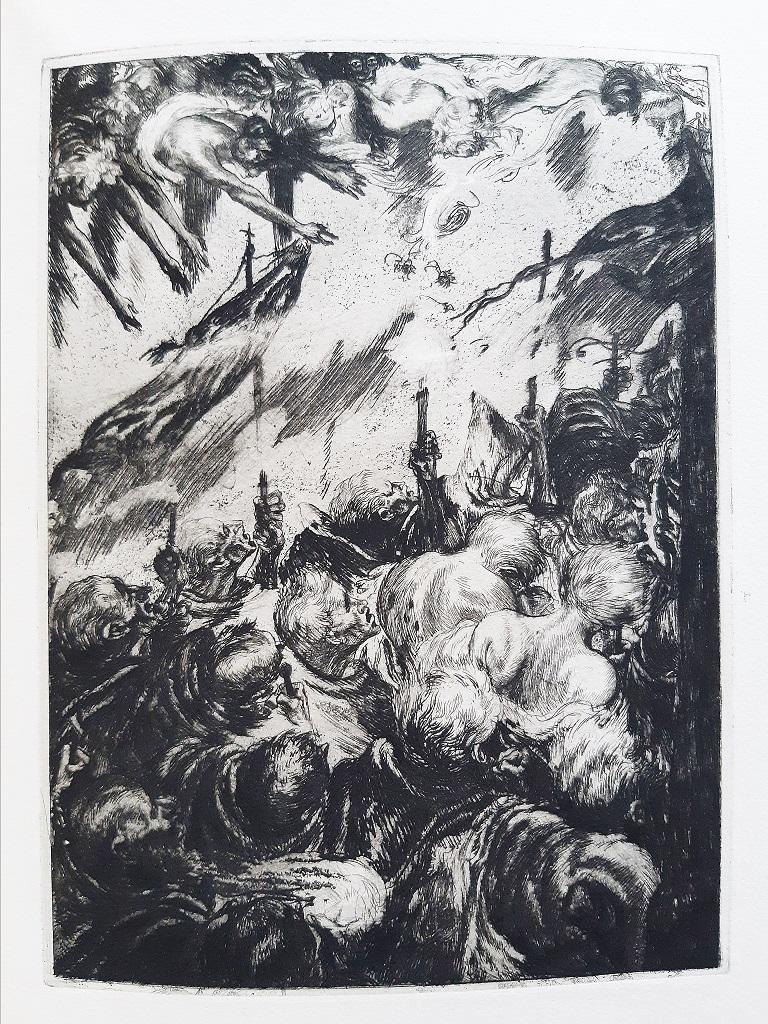
Gullivers Reise is an original modern rare book written by Jonathan Swift (Dublin, 1667 – Dublin, 1745) and illustrated by Lovis Corinth (21 July 1858 – 17 July 1925) in 1922.
Published by Propylaeen, Berlin.
Original First Edition.
400 numbered and signed copies.
Format: in Folio.
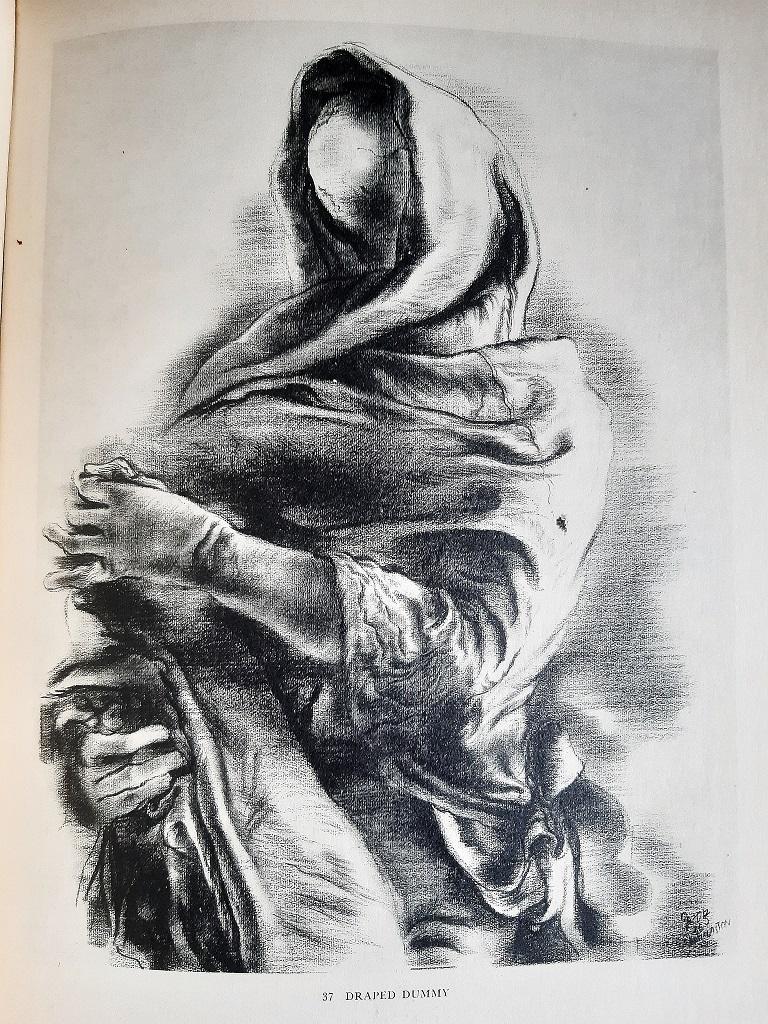
The book includes 77 pages with 25 lithographs (several full page).
Cover and binding are realized by Hugo Steiner-Prag.
Mint conditions.
Lovis Corinth (21 July 1858 – 17 July 1925). Corinth was a German artist and writer whose mature work as a painter and printmaker realized a synthesis of impressionism and expressionism. Corinth studied in Paris and Munich, joined the Berlin Secession group, later succeeding Max Liebermann as the group's president. His early work was naturalistic in approach. Corinth was initially antagonistic towards the expressionist movement, but after a stroke in 1911 his style loosened and took on many expressionistic qualities. His use of color became more vibrant, and he created portraits and landscapes of extraordinary vitality and power. Corinth's subject matter also included nudes and biblical scenes.
Jonathan Swift, pseudonym Isaac Bickerstaff, (Dublin, 1667 – Dublin, 1745) was an Anglo-Irish author, who was the foremost prose satirist in the English language. Besides the celebrated novel Gulliver’s Travels (1726), he wrote such shorter works as A Tale of a Tub (1704) and “A Modest Proposal” (1729).
- Creator:Lovis Corinth (1858 - 1925, German)
- Creation Year:1922
- Dimensions:Height: 13.39 in (34 cm)Width: 11.03 in (28 cm)Depth: 0.08 in (2 mm)
- Medium:
- Movement Style:
- Period:
- Condition:Insurance may be requested by customers as additional service, contact us for more information.
- Gallery Location:Roma, IT
- Reference Number:Seller: M-1181991stDibs: LU65037978362
Lovis Corinth
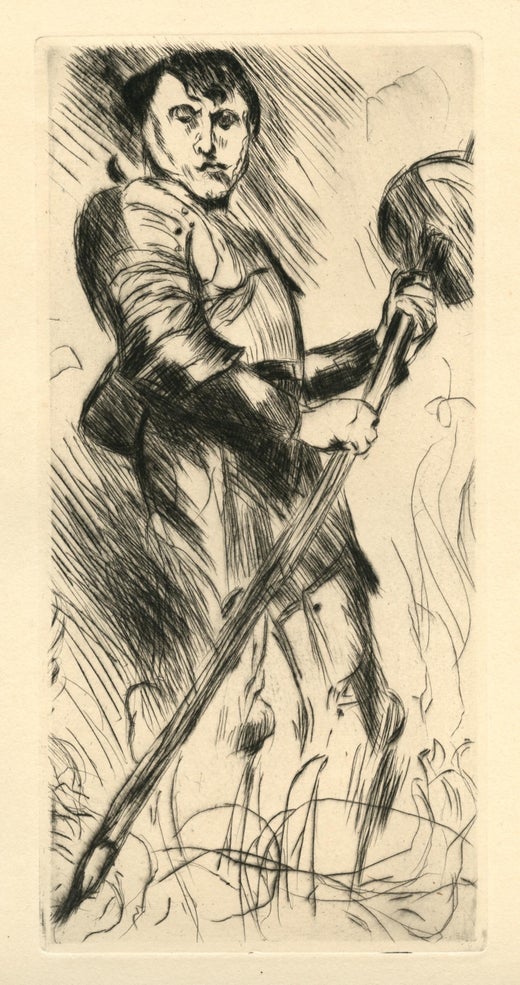
Lovis Corinth was a German artist and writer whose mature work as a painter and printmaker realized a synthesis of impressionism and expressionism, known for his dramatic figurative and landscape paintings also for his landscapes of the Walchensee area of Bavaria and his portraits, Corinth also painted religious scenes, often violent . He also made etchings and lithographs in which he revealed his capacity for Expressionist power.
About the Seller
4.9
Platinum Seller
Premium sellers with a 4.7+ rating and 24-hour response times
1stDibs seller since 2017
7,858 sales on 1stDibs
Typical response time: 1 hour
- ShippingRetrieving quote...Shipping from: Roma, Italy
- Return Policy
More From This Seller
View AllFruhlingsErwachen - Rare Book Illustrated by Willi Geiger - 1920
By Willi Geiger
Located in Roma, IT
FruhlingsErwachen is an original modern rare book written by Benjamin Franklin Wedekind (1864 – 1918) and illustrated by Willi Geiger (Landshut, 1878 ...
Category
1920s Expressionist More Art
Materials
Paper, Lithograph
Drawings - Rare Book Engraved by George Grosz - 1944
By George Grosz
Located in Roma, IT
Drawings is an original modern rare book with illustrations by George Grosz (Berlin, 1823 - 1959, Berlin), published in 1944.
Original First Edition.
Published by Bittner and Co., ...
Category
1940s Expressionist More Art
Materials
Paper, Engraving
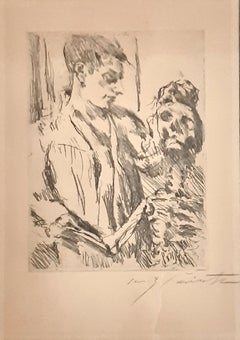
Tod und Jungling - Lithograph by L. Corinth - 1921
By Lovis Corinth
Located in Roma, IT
Tod und Jungling is an original lithograph, realized by Lovis Corinth in 1921, hand-signed and numbered n°33/95.
Included a wooden frame.
In very good conditions.
Here the artworks represented a man with a strong expression of lines drawn, who has caught with his hand a skeleton, interestingly the skeleton has a sense of fear although the man is free of any frightening emotions.
Lovis Corinth (1858-1925) was a German artist and writer whose mature work as a painter and printmaker realized a synthesis of impressionism and expressionism. known for his dramatic figurative...
Category
1920s Figurative Prints
Materials
Lithograph
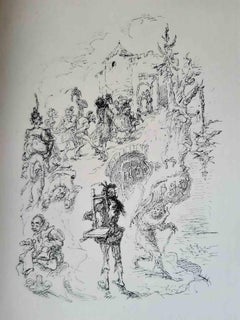
Die Tapferen Zehntausend - Original Rare Book Illustrated by Max Slevogt - 1923
Located in Roma, IT
Die tapferen Zehntausend is an original rare book written by Jacob and Wilhelm Grimm and illustrated by Max Slevogt (Landshut, 8 October 1868 – Leinsweiler...
Category
1920s Symbolist More Art
Materials
Paper, Lithograph
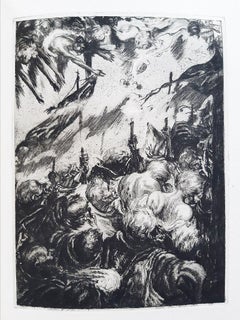
Die Pest in Bergamo - Rare book Illustrated by Alois Kolb - 1922
Located in Roma, IT
Die Pest in Bergamo is an original modern rare book illustrated by Alois Kolb (Wien, 1875 - Leipzig, 1942) and written by Jens Peter Jacobsen (Thisted, 1847...
Category
1920s Symbolist More Art
Materials
Paper, Etching
Die sage von Sankt Julian dem Gastfreien - Rare book by Max Kaus - 1919
By Max Kaus
Located in Roma, IT
Die sage von Sankt Julian dem Gastfreien is an original modern rare book written by Gustave Flaubert and illustrated by Max Kaus (1891 - 1977) in 1919.
Original First Edition / Seco...
Category
1910s Expressionist More Art
Materials
Paper, Lithograph
You May Also Like
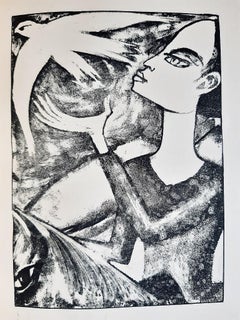
"Der Heilige Georg" original etching
By Lovis Corinth
Located in Henderson, NV
Medium: original etching and drypoint. The English translation of the German title is "The Hug". Published in Leipzig, Germany by Zeitschrift fur bildende Kunst in 1915. The plate me...
Category
1910s Prints and Multiples
Materials
Etching
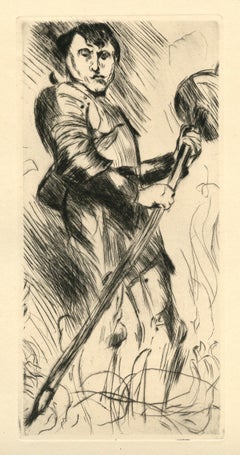
Lovis Corinth, Badeanstalt 1920, Lithograph, Hand-Signed , German Impressionist
By Lovis Corinth
Located in Eltville am Rhein, DE
Lovis Corinth
Tapiau 1858 - 1925 Zandvoort
Bathing Establishment, 1920
Lithograph on handmade paper
Signed in pencil lower right
Marked "Probedruck" (proof print) lower left
Image size: 32 x 36.8 cm
Frame: 57 x 60 cm
Good original condition, under passe-partout (additional photos available upon request)
Rare proof print prior to the original edition of 115 copies
Published by Fritz Gurlitt, Berlin
Catalogue raisonné Schwarz 442
Handcrafted model frame, museum glass
Viewing and pickup possible by appointment
Authenticity confirmed in writing.
Lovis Corinth was born on July 21, 1858, in the town of Tapiau in East Prussia (now Gwardejsk, Russia). While attending high school in Königsberg, he developed an interest in Greek and Roman mythology as well as the Christian stories of the Bible. From 1876, Lovis Corinth attended the art academy in Königsberg, where he studied under Otto Günther, who introduced him to Weimar plein air painting. In 1880, he transferred to the Munich Academy. Works from his Munich period demonstrate his orientation towards the naturalistic painting style of Wilhelm Leibl's circle.
In 1883, Lovis Corinth traveled to Italy with his father, and in 1884 he spent three months in Antwerp, where he took painting lessons from Paul Eugène Gorge. From 1884 to 1887, Corinth studied at the Académie Julian in Paris. The artist then traveled to Berlin, where he probably painted his first self-portrait in 1887/88, which was followed by numerous others over the years.
From 1891 to 1899, Corinth lived as a freelance painter in Munich, where he belonged to the Secession. After meeting Max Liebermann and Walter Leistikow in the winter of 1898/99, he decided to move to Berlin, where he settled in 1901. Prior to this, his work "Salomé with the Head of John the Baptist...
Category
1920s Impressionist Figurative Prints
Materials
Lithograph
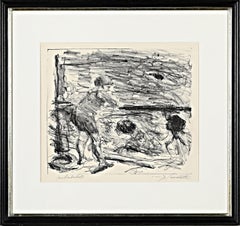
Rudolf v. Rittner as Florian Geyer - Last man standing -
By Lovis Corinth
Located in Berlin, DE
Lovis Corinth (1858 Tapiau - 1925 Zandvoort), Rudolf von Rittner as Florian Geyer, 1924 (Müller 854), drypoint signed in pencil. 20.4 × 14.2 (plate size), 37.7 × 30.6 cm (sheet size). Published by Karl Nierendorf, Berlin. Framed in a passepartout.
- Strong, precise impression. Frame a little bit rubbed and with two small damages.
About the artwork
The knight is a leitmotif in Lovis Corinth's work, culminating in his Self-Portrait in Armour of 1914. Of all the paintings on this theme, Corinth most often depicted Florian Geyer. Descended from a Franconian noble family, he fought for the freedom of the peasants during the peasant wars of the Reformation, first diplomatically and then militarily, leading the legendary Schwarzen Haufen (Black Troops). The name derives from the black uniforms with which Geyer dressed the peasants willing to fight.
During the Napoleonic occupation, the freedom fighter Florian Geyer was sung about by the Romantics, and the free corps Die Schwarze Schaar, founded in 1813 by Major von Lützow, succeeded the Schwarzer Haufen. It was against this historical background that Gerhard Hauptmann wrote the revolutionary drama Florian Geyer, which premiered at the Deutsches Theater in Berlin in 1896. While the actor Rudolf Rittner, who would later appear in Fritz Lang's films, initially played the role of Schäferhans, he took over the leading role in the new production at Berlin's Lessing Theatre in 1904, again directed by Emil Lessing, which established his fame as an actor. Hauptmann himself praised the acting. He wrote to Hugo von Hofmannsthal: "It went quite well with Florian Geyer. In any case, I had the great pleasure of seeing the play again in an admirable performance". And Lovis Corinth was so taken with Rittner's performance that he painted an oil portrait of him in the role of Florian Geyer in 1906.
After two further graphic versions in 1915 and 1920/21, Corinth returned to the painting a year before his death and almost twenty years after the oil painting to create this graphic version in 1924. Even the inscription in the picture was taken over. This proves all the more the importance of the knight and freedom fighter for Corinth's self-image.
The oil painting, in particular, proclaims the single-minded determination to fight to the last for the values defended, manifested in the oil painting by the tattered flag held out to the enemy. There is a parallel with Rainer Maria Rilke's 1899 story The Cornet, in which the protagonist goes down with the flag that he first saved at the risk of his life.
Consequently, the portrait is also a self-portrait, and the knight's armour is not an academic costume or an ironic refraction, but an expression of Corinth's self-image, which also includes his self-representation as an artist. The Secession poster...
Category
1920s Expressionist Figurative Prints
Materials
Etching
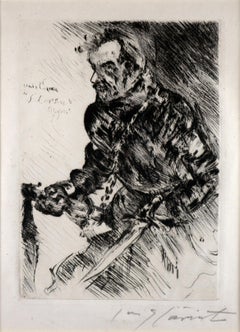
Pierre Bonnard ltd edition Lithograph Printed at Mourlot Paris 1958 Double Page
By Pierre Bonnard
Located in Surfside, FL
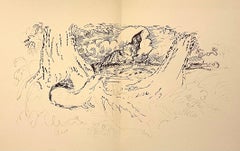
This is from a limited edition portfolio of original lithographs print Fernand Mourlot in Paris in 1958 from work done in collaboration with Bonnard which began in 1928.
This is f...
Category
20th Century Post-Impressionist Animal Prints
Materials
Lithograph
Jakob Steinhardt Jewish German Expressionist Lithograph Israeli Early Bezalel
By Jacob Steinhardt
Located in Surfside, FL
plate signed.
Jacob Steinhardt
1887-1968
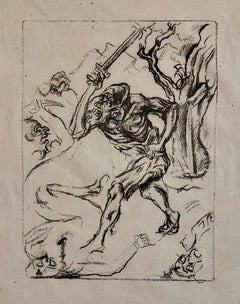
Steinhardt, Jakob, Painter and Woodcut Artist. b. 1887, Yaacov Steinhardt was born in the then remote, largely Polish town of Zerkow in the Posen District of Germany. (poland/german) Immigrated 1933. Studies: 1906 School of Art, 1906 Studied in Berlin Arts and Crafts School. Berlin; 1907 painting with Lovis Corinth and engraving and etching with Hermann Struck; advanced studies, 1908-10 Paris, with Henri Matisse and Steinlen; 1911 Italy. Teaching: Bezalel, Jerusalem, 1953-57 Director. 1910 Participated in the “New Sezession”, Berlin. 1912 together with Ludwig Meidner and Janthur he founded the "Pathetiker" group very early in the German expressionist movement. Running afoul of the Nazis, he fled to Tel-Aviv and then Jerusalem in the early 30s, showing in “Der Sturm” Gallery. 1914 Exhibited with ludwig Meidner at first Expressionist Exhibition in Berlin. Worked mainly in woodcuts depicting biblical and other Jewish subjects. 1955-58 International awards for his woodcuts. receives graphic commissions from Fritz Gurlitt. 1922 Marries Minni Gumpert. Active in organizing Secession exhibits. 1925 Trips to Mark Brandenburg and Holy Land. Turns primarily to painting; stops work on etchings and lithographs. 1933 Emigrates to the Palestine. 1934 Moves to Jerusalem and opens an art school; attempts some etchings. 1948 Closes the art school and becomes Chairman of Graphics Department, Bezalel School for Arts and Crafts. 1954-57 Director of Bezalel School for Arts and Crafts. Taken up by J. B. Neumann who became the agent for his etchings. Exhibited Sturm Gallery, Herbst-salon. 1914 Outbreak of World War I; Steinhardt enlists in German army. 1916-18 First on Eastern Front in Poland and Lithuania, then after short training period in Berlin, sent to Macedonia. 1917 Exhibition of Lithuanian drawings at Berlin Secession in Spring. Elected member of the Secession.
He often used wood-cutting techniques that were popular amongst German Expressionists. Steinhardt was driven to express ideas clearly and decisively through art.
Amongst the themes found in his work the prophets of the Bible, such as Jonah, are noticeable. Steinhardt identified deeply with Jonah due to his attempt to run from God's call to duty.
Additionally, the image of beggars was often found in Steinhardt's works and in his artistic presentation of the less fortunate, the artist's love for his fellow man becomes evident.
Moreover, the grotesque was a theme noticeable in Steinhardt's earliest pieces. These were fantastical images; it was unclear whether or not they were human or demon. In the 1950's, Steinhardt returned to these images upon learning of the Holocaust of Europe's Jews. At that time he resided in New York and there, in the shadow of the skyscrapers, Steinhardt's reaction to WWII was expressed through his art.
A Collection of Works by Artists of the Land of IsraelThe Bezalel National Museum, Jerusalem 1940 Artists: Shemi, Menahem Rubin...
Category
20th Century Expressionist Figurative Prints
Materials
Woodcut
Wide Landscape, 1916
By Lovis Corinth
Located in London, GB
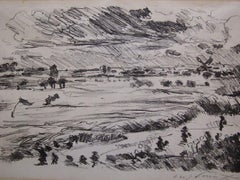
This original lithograph is hand signed in pencil by the artist "Lovis Corinth" at the lower right corner.
It was printed in 1916 in a limited edition of 50 hand signed impressions,...
Category
Early 20th Century Expressionist Landscape Prints
Materials
Lithograph
More Ways To Browse
Large Scale Art Black And White
Fashion Photographer
Los Angeles Black And White Photograph
Lithograph 19th Century
New York City Street Photography
Trees Black And White Photography
New Yorker
Jean Michel Basquiat
Silver Gelatin Signed
Photographs of Children
Pop Art Signed Print
Black And White Photos Dancing
Nude Models
1980s Signed And Numbered Art
Roma Vintage
Black White Landscape Photography
Black And White Paris Photo
Vintage Lithographs