Want more images or videos?
Request additional images or videos from the seller
1 of 5
Unknown19th Century American Federalist Silk Embroidered Flag19th C.
19th C.
About the Item
- Creation Year:19th C.
- Dimensions:Height: 20.5 in (52.07 cm)Width: 25 in (63.5 cm)
- Medium:
- Period:
- Condition:
- Gallery Location:Missouri, MO
- Reference Number:1stDibs: LU74732399583
About the Seller
5.0
Vetted Professional Seller
Every seller passes strict standards for authenticity and reliability
Established in 1970
1stDibs seller since 2017
156 sales on 1stDibs
Typical response time: Several days
Authenticity Guarantee
In the unlikely event there’s an issue with an item’s authenticity, contact us within 1 year for a full refund. DetailsMoney-Back Guarantee
If your item is not as described, is damaged in transit, or does not arrive, contact us within 7 days for a full refund. Details24-Hour Cancellation
You have a 24-hour grace period in which to reconsider your purchase, with no questions asked.Vetted Professional Sellers
Our world-class sellers must adhere to strict standards for service and quality, maintaining the integrity of our listings.Price-Match Guarantee
If you find that a seller listed the same item for a lower price elsewhere, we’ll match it.Trusted Global Delivery
Our best-in-class carrier network provides specialized shipping options worldwide, including custom delivery.You May Also Like
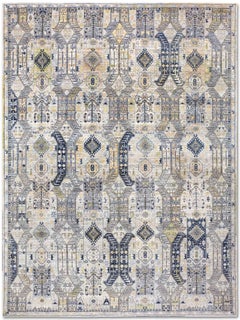
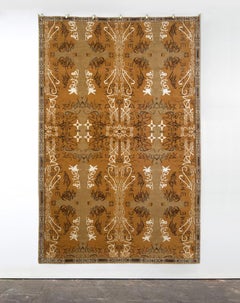
NEWTRIBAL SOUL NO. 19 – Elegant Persian Rug with Intricate Fine Ornaments
Located in Winterswijk, NL
This Rug Star rug comes from Berlin star designer Jürgen Dahlmanns. The RUG STAR brand stands for quality that meets the highest
standards. It combines the most modern cutting edge d...
Category
21st Century and Contemporary Abstract More Art
Materials
Silk
$6,348
H 94.49 in W 66.93 in
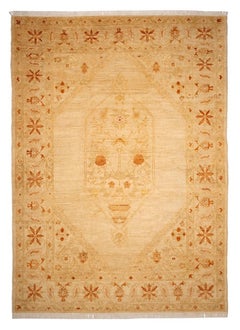
ZIEGLER Persian Rug - elegance in beige with ornate ornaments
Located in Winterswijk, NL
This beautiful Ziegler combines tradition with the best value for money. It suits any interior, as Zieglers are very typical rugs in the best sense of the word. The unusual name coul...
Category
21st Century and Contemporary Abstract More Art
Materials
Silk
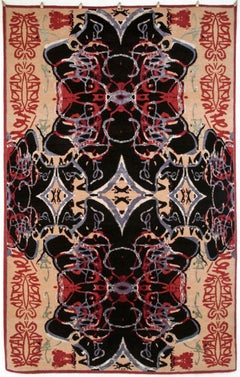
Culture Clash 6
By Dionisios Fragias
Located in New York, NY
Dionisios Fragias is a New York -based artist born on the Greek island of Kefalonia and raised in New York City. He is the protege of the artist Jeff Koons whose years-long mentorshi...
Category
2010s Abstract More Art
Materials
Textile, Wool, Silk
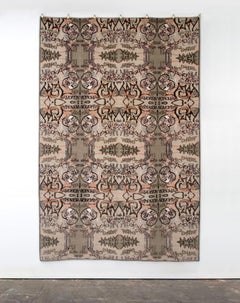
Culture Clash 2
By Dionisios Fragias
Located in New York, NY
Dionisios Fragias is a New York -based artist born on the Greek island of Kefalonia and raised in New York City. He is the protege of the artist Jeff Koons whose years-long mentorshi...
Category
2010s Abstract Mixed Media
Materials
Textile, Wool, Silk
Culture Clash 3
By Dionisios Fragias
Located in New York, NY
Dionisios Fragias is a New York -based artist born on the Greek island of Kefalonia and raised in New York City. He is the protege of the artist Jeff Koons whose years-long mentorshi...
Category
2010s Abstract Mixed Media
Materials
Textile, Wool, Silk
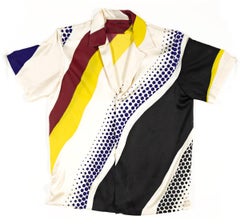
Untitled Shirt
By Roy Lichtenstein
Located in New York, NY
Color screenprint on silk sateen shirt. With the artist's signature and date screenprinted and numbered 3/100 in ink, on the label. Printed by the Fabric Workshop, Philadelphia. Publ...
Category
1970s Pop Art More Art
Materials
Silk, Screen
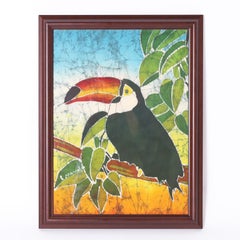
Batik Artwork of a Toucan
Located in Palm Beach, FL
Transporting artwork of a toucan in a tree expertly executed in a batik dying technique on silk and indistinctly signed. Presented under glass in a wood frame.
Category
Late 20th Century Other Art Style More Art
Materials
Silk
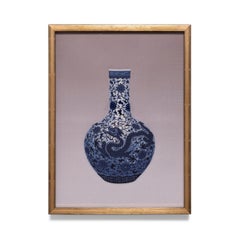
Chinese Forbidden Stitch Embroidery of a Blue and White Vase
Located in Chicago, IL
A wonderful example of Chinese embroidery, this framed silk textile uses the infamous forbidden stitch to depict a fine blue-and-white porcelain vase....
Category
21st Century and Contemporary More Art
Materials
Silk
$480
H 0.5 in W 12.25 in D 16.25 in
Carré Series, Work Carre II, Margo Selby, Handwoven stretched lampas panel
Located in London, GB
Handwoven stretched lampas panel, made on a 32 shaft Leclerc Weavebird loom medium: Cotton and silk, stretched and framed in painted wood
Category
2010s Contemporary More Art
Materials
Cotton, Silk, Wood
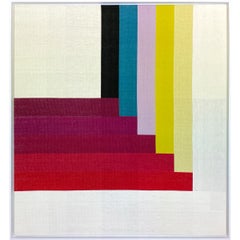
$11,594
H 47.84 in W 44.3 in D 0.79 in
Carré Series, Work V, Margo Selby, 2022, Handwoven stretched lampas panel
Located in London, GB
Handwoven stretched lampas panel, made on a 32 shaft Leclerc Weavebird loom medium: Cotton and silk, stretched and framed in painted wood
Category
2010s Contemporary More Art
Materials
Cotton, Silk, Wood, Panel
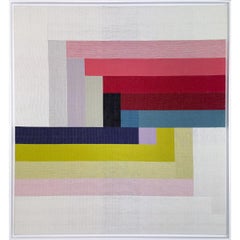
$11,594
H 47.84 in W 44.3 in D 1.38 in
More From This Seller
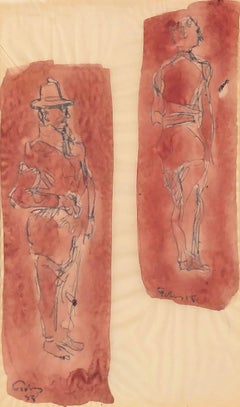
View All"Men at the Seattle Public Market" (Two Figures)
By Mark Tobey
Located in Missouri, MO
Mark Tobey
"Men at the Seattle Public Market" (Two Figures) 1958
Ink and Tempera on Silk
Signed and Dated Lower Left
*This is a rare and important work. See attached images with book...
Category
Mid-20th Century Modern Figurative Paintings
Materials
Silk, Ink, Tempera
Price Upon Request
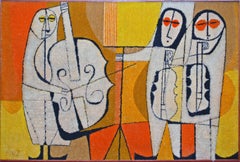
Jazz Players
Located in Missouri, MO
Jazz Players by Bill Hinz (1920-2009)
Signature in Textile Bottom Left
Unframed: 41.5" x 64"
Framed: 42.5" x 64.75"
Unique Piece made entirely out of a s...
Category
20th Century American Modern More Art
Materials
Textile
Price Upon Request
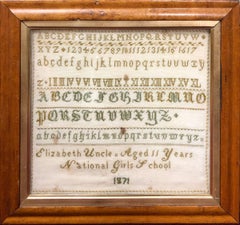
Sampler by Elizabeth Uncle, Aged 11, National Girls School
Located in Missouri, MO
This is a traditional American sampler created in 1871 by Elizabeth Uncle, Aged 11 while attending the National Girls School.
Category
1870s Folk Art More Art
Materials
Textile
Price Upon Request
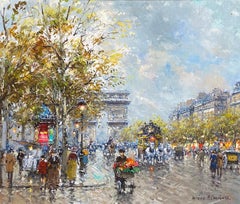
Avenue des Champs-Elysses, Paris
By Antoine Blanchard
Located in Missouri, MO
Antoine Blanchard (French 1910-1988)
"Avenue des Champs-Elysses, Paris"
Oil on Canvas
Signed
approx 18 x 22 (site)
approx 26.5 x 30 (framed)
Antoine Blanchard (c.1910-1988) was a prolific and successful Neo-Impressionist painter who specialized in nostalgic scenes of Fin de Siècle Paris. Inspired by the subjects as well as the success of earlier painters of Parisian life like E. Galien Laloue (1854-1941), Edouard Cortès (1882-1969), Jean Béraud (1849-1935) and Luigi Loir (1845-1916), Blanchard painted hundreds of views of the “City of Light.” In the late 1950s, his street scenes were exported to the United States and the United Kingdom, where they were sold briskly to collectors. By the1960s, Blanchard paintings were bringing several hundred dollars in galleries, so while they were not inexpensive, they were affordable to collectors who loved Parisian scenes but who could not afford the works of Cortes or one of the other French painters known for their views of Paris in Belle Époque. Eventually Blanchard’s more delicate, feathery pastel-toned scenes of rain-swept Paris became sought after in their own right and, when he died, he was considered the last of what the dealers described as the École de Paris or “School of Paris” painters.
The most salient fact about the life and career of the painter Antoine Blanchard was that he was actually born Marcel Masson, the son of a furniture maker who lived in the scenic Loire Valley, south of Paris, where the French nobility had their chateaus. The date that is usually given for Blanchard’s birth is November 15, 1910. However, there has been some speculation that he was born even later, perhaps in 1918, but some of the facts of his life have always been clouded by early biographies that claimed even earlier dates for his birth, so that he would seem to be seen as a contemporary of the famous Belle Époque painters rather than a post-war interpreter of Paris.
Blanchard grew up in the hardscrabble years following the First World War. Because he was artistically talented, he was sent first to the nearby city of Blois, the capital of the Loir-et-Cher Département, for artistic training and then to the École des Beaux-Arts in Rennes, on the Brittany peninsula, where he received a classical art education. By some accounts Blanchard also studied in Paris, where the historic École des Beaux-Arts is located, but the depth of his study and the style of his earliest work will require further research.
Marcel Masson was married in 1939, as war clouds gathered on the French horizon. He was drafted for service in the French Army and participated in the short and futile struggle against the invading German Panzers before returning to his family and his art during the Nazi occupation. A daughter, Nicole, was born in 1944 with a second daughter, Eveline, who eventually came to the United States, following in 1946.
Masson’s early art career was interrupted, first by World War II and later by the necessity of keeping his father’s workshop running in the years after his death. By the late 1940s, though, Masson returned to his art and moved to Paris in order to further his career.
Exactly when Marcel Masson adopted the pseudonym Antoine Blanchard is not known, nor are we aware of his motivations for adopting a nom de plume, but the practice was not unusual for French painters. In most cases a pseudonym was adopted because the artist had contractual obligations with more than one agent or dealer. Another motivation could be to obscure the scope of a sizable artistic production. Dealers in that era also liked to keep an artist under their thumb, so a pseudonym was a way for Blanchard’s dealers to tuck him away, out of the sight of their competitors.
Like many painters before him Masson may have initially painted different subjects under different names. Marcel Masson neé Blanchard would have been well aware that the famous and prolific French painter E. Galien Laloue (1854-1941) painted under no less than four names – three pseudonyms in addition to name he was christened with – and so the adoption of another name was probably not seen as a liability to him.
However, he apparently never took the step to register his pseudonym, which was possible in France, to legally restrict its use. In any event, by the 1950s Marcel Masson had become “Antoine Blanchard,” a painter of Parisian views. With the aging Edouard Cortès (1882-1969) as a model, Blanchard began to specialize in romanticized scenes of la ville des lumières, or the “City of Light.”
However, instead of painting contemporary Paris, the crowded metropolis of his own time, which he may have felt was lacking in romance, he chose to look at the French capital through the rear-view mirror. So Blanchard became known for his depictions of the hurly-burly life of Paris in the Belle Époque. For inspiration, he is said to have collected old sepia-toned postcards of life in La Belle Époque (“The Beautiul Era”), the long period of peace and relative prosperity between the end of the Franco-Prussian War and the horrors of the Paris Commune in 1871 and the start of the mass bloodshed of the First World War in August of 1914. In addition, however, the paintings of Loir, Baraud, Laloue and Cortès could be found and studied in the flea markets of Paris as well as the auctions at the l’Hôtel Drouot.
Reminders of the Belle Epoch were thus all around Blanchard, and of course the architecture that he painted had survived the Second World War intact, because Paris was spared bombing or a siege by the allies. Soon he was painting the horse-drawn omnibuses that took turn-of-the-century Parisians on longer trips throughout the city as well as the tradesmen, children and fashionably dressed ladies that populated Baron Haussmann’s Grand Boulevards.
Blanchard’s early work was clearly modeled after the paintings of Edouard Cortès, but he was always his own man and never a slavish copyist. These paintings were darker in palette than the later Blanchard paintings most American collectors have become familiar with, and his red and blue tones were often bolder than those of Cortès. He never adopted the heavy “impasto,” the build-up of paint on the highlights of Cortes’ work, leaving that artistic trademark to the master. Blanchard’s brushwork was painterly, but the buildings in the paintings were always well rendered, for he had an excellent command of composition and perspective.
By the late 1950s, agents began to purchase Blanchard’s paintings and then to export them to the United States, selling them to commercial galleries in far away Houston, Los Angeles, San Francisco, Chicago and New York. By the early 1960s, his work was already well known enough to be in reproduced by print publishers and the Donald Art Company published a number of popular prints that are now often mistaken for original paintings. By the end of the 1960s, Blanchard had begun to develop his own mature style by employing a lighter, brighter, palette and a deft, almost calligraphic style of brushwork. This helped him step out of Cortès’ shadow and become a sought-after painter in his own right. Blanchard worked through agents, essentially brokers, who purchased his work and created a demand for it in the United States and Canada.
By the 1970s Blanchard’s paintings were being sold by galleries across the United States, and the American market absorbed virtually all of his work. In 1969, with the passing of Edouard Cortès, he became the last of the long series of prolific French painters of Parisian life. Blanchard’s later works were usually daylight scenes, with Paris seen awash in rain or with a mantle of soft snow, and so collectors no longer confused him with Cortes, whose Parisian clock seemed to always be set at twilight. These paintings were rendered in softer, pastel tones and he used his brush with a light touch. These qualities gave Blanchard’s work of the 1970s and 1980s a lighter, more decorative appearance.
In the late 1970s, the French agent Paul Larde published a lavish book that was claimed to be an authorized biography of Antoine Blanchard by his “exclusive” dealer. Today, this book is almost impossible to find, because it was apparently the subject of a lawsuit in France. Some of the information in the Larde book was contested and found to be inaccurate and so it was withdrawn from publication.
One claim that Larde made was that Blanchard’s production was extremely limited. While he was not as prolific as Cortès or Laloue, he was a hard-working painter who managed to supply a long list of galleries with his work. He produced thousands of paintings during his career. When the motivation for a monograph is marketing rather than art history, accuracy and detail can be swept aside by exaggeration, hyperbole and claims of exclusivity that were meant to discourage collectors or galleries from buying Blanchard’s from other representatives. Blanchard’s legitimate paintings were sold by several agents, who dealt directly with the artist, at least one of whom was American, one Austrian and a few French dealers.
The details of Antoine Blanchard’s life are not well known because he never sought the limelight. He was content to work in his studio and ship his paintings to his agents who sold them abroad. Eventually both his daughters – Nicole and Evelyn – followed in his footsteps and became painters themselves. Evelyn (1946-2008) was savvy enough to adopt the Blanchard nom de plume, and she began painting street scenes that closely resembled her father’s later work.
Antoine Blanchard passed away in 1988, leaving hundreds of paintings of Belle Époque Paris– the Notre Dame Cathedral, the Opera, the Arc de Triomphe and Place Concorde – as his lasting legacy.
Notes on the Authentication of Antoine Blanchard’s Paintings:
The vast majority of Blanchard’s paintings were smaller works, which were sent to the United States in tubes and stretched and framed by the galleries that sold them. Virtually all of these Blanchards were painted in European centimeter sizes, which convert to 13” x 18” or 18” x 21 1/2?, but on very rare occasions he painted much larger works in American sizes – such as 24” x 36” – on commission for dealers such as Howard Morseburg in Los Angeles or the dapper Wally Findlay, who had a chain of galleries. The first way to assess the authenticity of a Blanchard...
Category
Mid-20th Century Impressionist Landscape Paintings
Materials
Canvas, Oil
Price Upon Request
Better World Version I
By Peter Max
Located in Missouri, MO
Better World Version I
Peter Max (German, b. 1937)
Acrylic on Canvas
24 x 9.75 inches
36 x 21.5 inches with frame
Signed lower right
Known throughout the world and a household name in America, Max is known for his new age style cosmic imagery and multi-colored blends. During the late 60's and early 70's his colorful art reached millions of people and he won numerous major awards for his work. His paintings, drawings and limited edition graphics have been exhibited in major museums throughout the world. He works in multiple media, including oil, acrylics, water colors, fingerpaints, dyes, pastels, charcoal, pen, multi-colored pencils, etchings, engravings, animation cels, lithographs, serigraphs, ceramics, sculpture, collage, video, xerox, fax, and computer graphics. He also includes mass media as a "canvas" for his creative expression.
Peter Max was born in Berlin, Germany, and spent his childhood in Shanghai. From China, the family went to Tibet for a year, and then on to Israel. His family's odyssey continued to Paris, and finally, at the age of 16, Max arrived in the United States. He began his art studies in New York at the Art Student's League and continued at the Pratt Institute and School of Visual Arts.
Max often uses American symbols in his artwork and has done paintings and projects for presidents Ford...
Category
21st Century and Contemporary Pop Art Landscape Paintings
Materials
Canvas, Acrylic

New Moon Detail
By Peter Max
Located in Missouri, MO
New Moon Detail
Peter Max (German, b. 1937)
Acrylic on Canvas
15 x 30 inches
26 x 41 inches with frame
Signed lower right
"Inspired by the monks and sages the artist saw as a child growing up in Shanghai, China, Peter Max's 'New Moon' is representative of his sensual and energetic Neo-Expressionistic brushwork style, and of his bold, Neo-Fauvist color palette which began to emerge in the 1970s. In the painting, a zen monk, holding his umbrella, contemplates the meaning of a new moon rising - new beginnings and goals, a time when new intentions are made. He seems to float somewhere between the horizon and the clouds and heavens, close to the new moon, and painted in the most daring and vibrant of the artist's color palettes." ©ALP, Inc.
Known throughout the world and a household name in America, Max is known for his new age style cosmic imagery and multi-colored blends. During the late 60's and early 70's his colorful art reached millions of people and he won numerous major awards for his work. His paintings, drawings and limited edition graphics have been exhibited in major museums throughout the world. He works in multiple media, including oil, acrylics, water colors, fingerpaints, dyes, pastels, charcoal, pen, multi-colored pencils, etchings, engravings, animation cels, lithographs, serigraphs, ceramics, sculpture, collage, video, xerox, fax, and computer graphics. He also includes mass media as a "canvas" for his creative expression.
Peter Max was born in Berlin, Germany, and spent his childhood in Shanghai. From China, the family went to Tibet for a year, and then on to Israel. His family's odyssey continued to Paris, and finally, at the age of 16, Max arrived in the United States. He began his art studies in New York at the Art Student's League and continued at the Pratt Institute and School of Visual Arts.
Max often uses American symbols in his artwork and has done paintings and projects for presidents Ford...
Category
21st Century and Contemporary Modern Figurative Paintings
Materials
Canvas, Acrylic

Still Thinking About These?
All Recently ViewedMore Ways To Browse
19th Century American Flag
Embroidered Flag
American Federalist
Lotta Leaves Home
Lowell Hecking
Lynn Boggess
Madison Brimble
Marc Chagall Signed Book
Mario Fernandez
Mario Romero Fernandez
Martha Burkert
Martha Mood Tapestry
Martha Mood
Matt Jordan On Sale
Matthew Russ
Max Ernst Tapestry
Meiji Period Bronze Insect
Mexican Tourist Posters