Want more images or videos?
Request additional images or videos from the seller
1 of 8
UnknownJudaica Folk Art Needlepoint Sabbath Sampler Challah Cover
Price:$500
$650List Price
About the Item
- Dimensions:Height: 17 in (43.18 cm)Width: 20.25 in (51.44 cm)
- Medium:
- Movement Style:
- Condition:wine stains as is typical, minor fraying to edges.
- Gallery Location:Surfside, FL
- Reference Number:1stDibs: LU382108752
About the Seller
4.9
Platinum Seller
Premium sellers with a 4.7+ rating and 24-hour response times
Established in 1995
1stDibs seller since 2014
1,846 sales on 1stDibs
Authenticity Guarantee
In the unlikely event there’s an issue with an item’s authenticity, contact us within 1 year for a full refund. DetailsMoney-Back Guarantee
If your item is not as described, is damaged in transit, or does not arrive, contact us within 7 days for a full refund. Details24-Hour Cancellation
You have a 24-hour grace period in which to reconsider your purchase, with no questions asked.Vetted Professional Sellers
Our world-class sellers must adhere to strict standards for service and quality, maintaining the integrity of our listings.Price-Match Guarantee
If you find that a seller listed the same item for a lower price elsewhere, we’ll match it.Trusted Global Delivery
Our best-in-class carrier network provides specialized shipping options worldwide, including custom delivery.You May Also Like
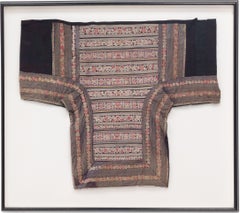
Embroidered Miao Baby Carrier Textile
Located in Chicago, IL
The connection between love and embroidery is nowhere stronger than among the minority peoples of China. Hand-stitched by a mother herself or gifted by the women in her family, the t...
Category
Early 20th Century Folk Art Mixed Media
Materials
Cotton, Silk, Thread
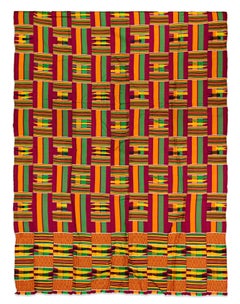
"Kente Cloth Ashanti Tribe, Ghana, " Silk and Cotton Weaving created circa 1970
Located in Milwaukee, WI
This silk and cotton fabric was made by an unknown Ashanti artist. It features green and orange accents. The Ashanti are a major ethnic group of the Akans in Ghana, a fairly new nation, barely more than 50 years old. Ghana, previously the Gold Coast, was a British colony until 1957. It is now politically separated into four main parts. Ashanti is in the center and Kumasi is the capital.
The Ashanti have a wide variety of arts. Bark cloth was used for clothing before weaving was introduced. With weaving, there is cotton and silk. Women may pick cotton...
Category
1970s Folk Art More Art
Materials
Cotton, Silk
$6,500
H 74 in W 41.25 in
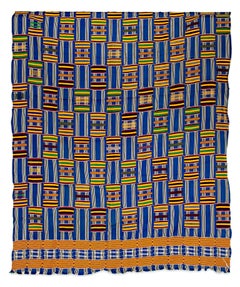
"Fabric - Ashanti Tribal Cloth, " Silk Weaving from Africa circa 1930
Located in Milwaukee, WI
Among the most well-known West African textiles is kente cloth, woven by the Ewe and Asante peoples of Ghana. The word kente is not used by the Asante people; it may be derived from ...
Category
1930s Folk Art More Art
Materials
Silk
$10,875
H 76 in W 46 in
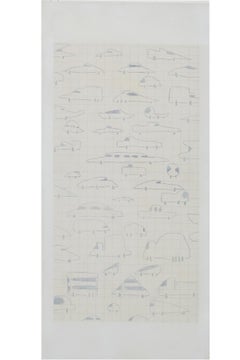
Pencils and Spray Paint on Canvas - Painting by Emerging Artist - "Autofuture"
Located in Vilnius, Vilniaus apskr.
Based on fragments of authentic photographs and notes, Maja creates a reconstruction of a past she never experienced. It is a young artist's visual interpretation of someone else's memory. She reflects on the reliability of images and a melancholic nostalgia — “a longing to return to a place I have never been.” The artist raises questions about the possibilities of conveying memory and the relationship between image and truth, constructing a visual interpretation of a time period she never knew through her paintings.
⬜️
The work is exhibited at Contour Art...
Category
2010s Contemporary Mixed Media
Materials
Canvas, Cotton Canvas, Spray Paint, Pencil, Color Pencil
$1,437
H 23.63 in W 51.19 in D 0.79 in
Portrait Gentleman Armour, Blue Cloak, Diamond Brooch c.1700 French Carved Frame
By Joseph Vivien
Located in London, GB
Portrait of a Gentleman in Armour and Azure Cloak with Diamond Brooch c.1700
Attributed to Joseph Vivienne (1657-1735)
The sitter in this superb portrait, offered by Titan Fine Art...
Category
17th Century Old Masters Portrait Paintings
Materials
Oil, Cotton Canvas
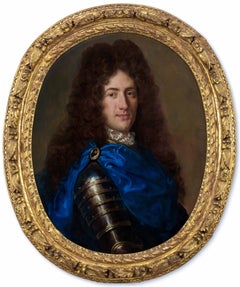
$18,340
H 35.83 in W 29.93 in D 3.15 in
Portrait of Lady, Barbara Herbert, Countess of Pembroke c.1708, Large Painting
Located in London, GB
Portrait of Barbara Herbert, Countess of Pembroke c.1708
Charles d’Agar (1669-1723)
This magnificent large-scale portrait, presented by Titan Fine Art, depicts the British court of...
Category
17th Century Old Masters Portrait Paintings
Materials
Cotton Canvas, Oil
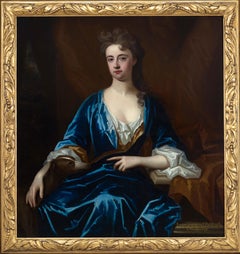
$17,522
H 49.61 in W 46.86 in D 2.76 in
Portrait of Gentleman, Sir Henry Hobart, Blue Cloak
cravat, Wissing oil canvas
By Willem Wissing
Located in London, GB
Portrait of a Gentleman, Sir Henry Hobart Blue Cloak and cravat c.1683-1684
Attributed to Willem Wissing (1656-1687)
This impressive portrait, presented by Titan Fine Art, depicts t...
Category
17th Century Old Masters Portrait Paintings
Materials
Cotton Canvas, Oil
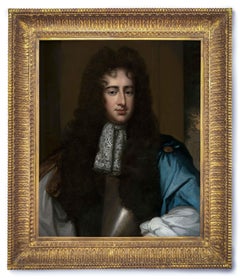
$12,613
H 37.01 in W 31.5 in D 3.94 in
Portrait of a Lady, Mrs Wray in a Silk Dress
Pink Wrap c.1698, Oil on canvas
By Michael Dahl
Located in London, GB
Portrait of a Lady, Mrs Wray in a Silk Dress & Pink Wrap c.1698
Circle of Michael Dahl (1659-1743)
This delightful work, presented by Titan Fine Art, is a fine example of British po...
Category
17th Century Old Masters Portrait Paintings
Materials
Cotton Canvas, Oil
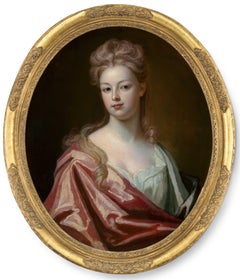
Michael DahlPortrait of a Lady, Mrs Wray in a Silk Dress
Pink Wrap c.1698, Oil on canvas, circa 1698
$14,249
H 34.65 in W 29.93 in D 2.37 in
West 24th NY
Located in New York, NY
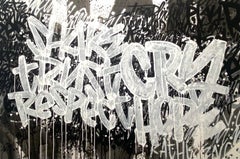
Born in 1979, Denis Meyers is a Belgian urban artist. He studied at the National Superior School of Arts and Visuals of la Cambre, in Brussels, city where he currently lives and wor...
Category
2010s Street Art More Art
Materials
Spray Paint, Acrylic, Permanent Marker, Canvas, Cotton Canvas
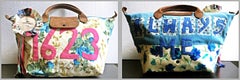
Always Me, limited edition handbag (Uniquely Hand signed
dated by Tracey Emin)
By Tracey Emin
Located in New York, NY
Tracey Emin
Always Me (Hand signed and dated by Tracey Emin), 2004-2016
Limited edition two-sided hand bag of printed cotton canvas, leather trimmings and wool felt patchwork. Uniquely hand signed and dated by Tracey Emin in black marker
10 × 18 1/4 × 8 1/4 inches
Hand signed and dated in black marker by Tracey Emin; also bears plate signature
Produced by Tracey Emin in collaboration with Longchamp
If you're looking for a special Tracey Emin gift that few (if any) people you know would have, and that you are unlikely to find anywhere else in the world - this is it.
Tracey Emin has been internationally acclaimed for her textile work, so it is not surprising that the company Longchamp would have commissioned her to design a bespoke handbag for them.
This is the only Tracey Emin Longchamp...
Category
Early 2000s Contemporary More Art
Materials
Leather, Wool, Cotton Canvas, Mixed Media
$20,000
H 10 in W 18.25 in D 8.25 in
More From This Seller
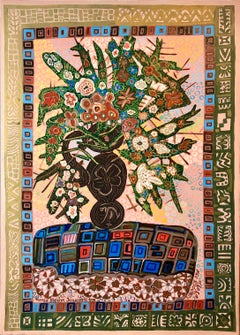
View AllIsraeli Folk Art Bright Colorful Naive Floral Painting, Mod Flowers in Vase
By Menia Litvak
Located in Surfside, FL
A fantastic vase of bold colorful flowers. signed and dated in Hebrew and English, Jerusalem 1989.
Litvak's life as an artist started in 1976 when he left Kishinev (Bessarabia) for Israel...
Category
20th Century Folk Art Figurative Paintings
Materials
Canvas, Oil, Acrylic
Judaica Polish Israeli Folk Art Biblical Modernist Oil Painting
By Pinchas Shaar
Located in Surfside, FL
This painting is iconic of Pichas Shaar's aesthetic, and stylistic influences. A ceramic mosaicist and sculptor as well as a painter, Shaars strong decorative sense was evident in his colorful canvas, with their frequent rectilinear geometry, depicting stylized figures, often mythological or biblical subjects.
Pinchas Shaar (born Szwarc, later Shaar) was born in Lodz, Poland in 1923. already at a young age he drew small graffiti and characters of fairy tales. at sixteeen he met the Polish painter Wladyslaw Strzeminski, a disciple of the Russian painter Kazimir Malevich, who encouraged Pinchas’ artistic education. Strzeminski encouraged Pinchas' artistic education and introduced him to the works of such painters as Picasso, Leger, Matisse, and Mondrian. Pinchas had his first exhibition in 1938 and also completed photomontages for a poetry book by Moshe Broderson that was published in 1939. Then, in September 1939, Nazi Germany invaded Poland. On February 1940 the Jews of Lodz had to move to a ghetto and perform forced labor. The artist experienced the horrors of war and the Nazi holocaust concentration camps. Pinchas worked in a prefabricated furniture factory. However, after his artistic abilities were discovered, he became a draftsman. He also designed decorations for the ghetto's theater. In 1944 the Germans liquidated the Lodz ghetto...
Category
1960s Folk Art Figurative Paintings
Materials
Canvas, Oil
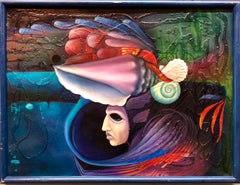
Magic Realist Surrealist Latin American Naive Fantasy Painting
By German Ramon Duron Lanza
Located in Surfside, FL
Magic realist fantasy painting in the manner of Ernst Fuchs and Arik Brauer.
Naïve art is any form of visual art that is created by a person who lacks the formal education and training that a professional artist undergoes (in anatomy, art history, technique, perspective, ways of seeing). Unlike folk art, naïve art does not necessarily evince a distinct cultural context or tradition. Naïve art is recognized, and often imitated, for its childlike simplicity and frankness. Paintings of this kind typically have a flat rendering style with a rudimentary expression of perspective.
One particularly influential painter of "naïve art" was Henri Rousseau (1844–1910), a French Post-Impressionist who was discovered by Pablo Picasso.
Naïve art is often seen as outsider art that is by someone without formal (or little) training or degree. While this was true before the twentieth century, there are now academies for naïve art. Naïve art is now a fully recognized art genre, represented in art galleries worldwide.
Museums devoted to naïve art now exist in Kecskemét, Hungary; Riga, Latvia; Jaen, Spain; Rio de Janeiro, Brasil; Vicq France and Paris. "Primitive art" is another term often applied to art by those without formal training, but is historically more often applied to work from certain cultures that have been judged socially or technologically "primitive" by Western academia, such as Native American, sub saharan African or Pacific Island art (see Tribal art). This is distinguished from the self-conscious, "primitive" inspired movement primitivism. Another term related to (but not completely synonymous with) naïve art is folk art.
There also exist the terms "naïvism" and "primitivism" which are usually applied to professional painters working in the style of naïve art (like Paul Gauguin, Mikhail Larionov, Paul Klee).
At all events, naive art can be regarded as having occupied an "official" position in the annals of twentieth-century art since - at the very latest - the publication of the Der Blaue Reiter, an almanac in 1912. Wassily Kandinsky and Franz Marc, who brought out the almanac, presented 6 reproductions of paintings by le Douanier' Rousseau (Henri Rousseau), comparing them with other pictorial examples. However, most experts agree that the year that naive art was "discovered" was 1885, when the painter Paul Signac became aware of the talents of Henri Rousseau and set about organizing exhibitions of his work in a number of prestigious galleries.
The Earth Group (Grupa Zemlja) were Croatian artists, architects and intellectuals active in Zagreb from 1929 to 1935. The group included the painters Krsto Hegedušić, Edo Kovačević, Omer Mujadžić, Kamilo Ružička, Ivan Tabaković, and Oton Postružnik, the sculptors Antun Augustinčić, Frano Kršinić, and the architect Drago Ibler.
A term applied to Yugoslav (Croatian) naive painters working in or around the village of Hlebine, near the Hungarian border, from about 1930. Some of the best known naive artists are Dragan Gaži, Ivan Generalić, Josip Generalić, Krsto Hegedušić, Mijo Kovačić, Ivan Lacković-Croata, Franjo Mraz, Ivan Večenaj and Mirko Virius.
Camille Bombois (1883–1970) Ferdinand Cheval, known as 'le facteur Cheval' (1836–1924)
Henry Darger (1892–1973) L. S. Lowry (1887–1976) Grandma Moses, Anna Mary Robertson (1860–1961) Nikifor (1895–1968) Poland, Horace Pippin (1888–1946) Jon Serl (1894-1993) United States
Alfred Wallis (1855–1942) Scottie Wilson (1890–1972) Gesner Abelard (b. 1922) Jan Balet (1913–2009) Michel Delacroix (b. 1933) France Howard Finster (1916–2001) Ivan Rabuzin (1921–2008)
Spontaneous Art Museum in Brussels
Art en Marge Museum in Brussels
MADmusée in Liege
International Museum of Naive Art of Brazil in Cosme Velho, Rio de Janeiro
Gallery Jacques Ardies in São Paulo
Musée international d'art naïf de Magog in Magog
Croatian Museum of Naïve Art in Zagreb
Gallery of Croatian Naïve Art...
Category
20th Century Folk Art Figurative Paintings
Materials
Canvas, Acrylic
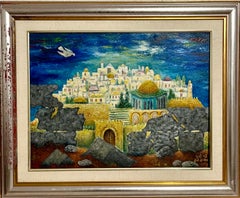
Modernist Old City Jerusalem Israel Landscape Oil Painting Zvi Livni Judaica Art
By Zvi Livni
Located in Surfside, FL
Jerusalem Landscape by Zvi Livni
Frame: 25.5" X 31.5"
Image: 17.5 X 23.5"
Zvi Livni was born in the town of Lodz in Poland, and commenced his artistic education at the Art Academy in Warsaw. He came to Israel as a young man. Here he lived for many years in a kibbutz and was one of the founders of the artist group of the Kibbutz Artzi. He left Israel on several occasions in order to continue his studies and spent much time in the 1930's in Germany, France and Italy. Worked in lithograph printing and oil painting. Paintings at: President's Residence, Jerusalem,Museum of Art, Toronto, Boston University Museum. A founder of the Artists' Quarter, Safed. From 1953 lived in Safed.
He was among the founders of the famous Israeli Artists' Colony in Safed, where he lives and works most of the year and where he exhibits at a permanent one-man show.
He has also achieved a reputation as illustrator of various books and illuminator of Passover Haggadot.
His paintings are to be found in many museums and well-known private collections in Israel, U.S.A., Canada and Europe, including the Residence of the President of the State of Israel, Jerusalem; the Museum of Art in Toronto, Canada; the Museum of Modern Art, Brandeis University, Boston; the Museum of Art, Yale University, New Haven; the Brooklyn Museum, New York.
He was included in the show Art in Israel Tel Aviv Museum of Art, 1951
Artists: Mordechai Avnieli, Aviva Uri...
Category
Mid-20th Century Folk Art Landscape Paintings
Materials
Canvas, Oil
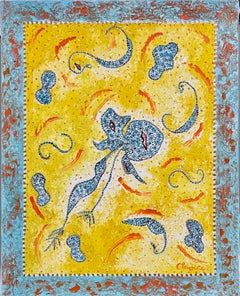
Whimsical French Folk Art, Naive, Oil Painting Madeline Marie Christine Clavier
By Madeline Christine Clavier
Located in Surfside, FL
MADELINE CHRISTINE CLAVIER (1913-2015)
Signature: Signed lower right & titled verso
Medium: Oil on canvas
Provenance: The collection of the artist's family
Marie Christine Clavier ...
Category
20th Century Folk Art Animal Paintings
Materials
Canvas, Oil
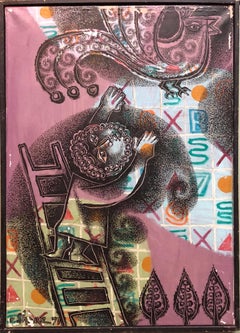
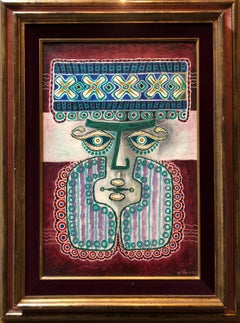
Bearded man, Jewish King or Rabbi Polish Israeli Folk Art Modernist Oil Painting
By Pinchas Shaar
Located in Surfside, FL
This painting is iconic of Pichas Shaar's aesthetic, and stylistic influences. A ceramic mosaicist and sculptor as well as a painter, Shaars strong decorative sense was evident in his colorful canvas, with their frequent rectilinear geometry, depicting stylized figures, often mythological or biblical subjects. 23.75 X15.75 inches without frame.
Pinchas Shaar (born Szwarc, later Shaar) was born in Lodz, Poland in 1923. already at a young age he drew small graffiti and characters of fairy tales. at sixteeen he met the Polish painter Wladyslaw Strzeminski, a disciple of the Russian painter Kazimir Malevich, who encouraged Pinchas’ artistic education. Strzeminski encouraged Pinchas' artistic education and introduced him to the works of such painters as Picasso, Leger, Matisse, and Mondrian. Pinchas had his first exhibition in 1938 and also completed photomontages for a poetry book by Moshe Broderson that was published in 1939. Then, in September 1939, Nazi Germany invaded Poland. On February 1940 the Jews of Lodz had to move to a ghetto and perform forced labor. The artist experienced the horrors of war and the Nazi holocaust concentration camps. Pinchas worked in a prefabricated furniture factory. However, after his artistic abilities were discovered, he became a draftsman. He also designed decorations for the ghetto's theater. In 1944 the Germans liquidated the Lodz ghetto...
Category
1960s Folk Art Figurative Paintings
Materials
Canvas, Oil
Still Thinking About These?
All Recently ViewedMore Ways To Browse
Silk Sampler
Needlepoint Sampler
Needlepoint Canvas
Batman The Animated Series Original Production Drawing
Bugs Bunny
Tiny Toon Adventures
Anna Laetitia Pecci Blunt
Looney Tunes Cels
Vintage Disney Art
Kaws Companion Set
Neon Pop Art
Batman Animated Series Art
Signed Postcards
Country Workshop
Chuck Jones
Disney Pop Art
Vinyl Albums
Tweety Bird