Want more images or videos?
Request additional images or videos from the seller
1 of 14
UnknownRare Palestine or Germany Antique Hebrew Judaica Shviti Mizrach Synagogue Signc. 1890-1920
c. 1890-1920
Price:$650
$950List Price
About the Item
- Creation Year:c. 1890-1920
- Dimensions:Height: 21.5 in (54.61 cm)Width: 17 in (43.18 cm)
- Medium:
- Movement Style:
- Period:
- Condition:Measurements include frame, piece has minor wear, frame has wear. please see photos, in expected condition for its age and history.
- Gallery Location:Surfside, FL
- Reference Number:1stDibs: LU38212147772
About the Seller
4.9
Platinum Seller
Premium sellers with a 4.7+ rating and 24-hour response times
Established in 1995
1stDibs seller since 2014
1,846 sales on 1stDibs
Authenticity Guarantee
In the unlikely event there’s an issue with an item’s authenticity, contact us within 1 year for a full refund. DetailsMoney-Back Guarantee
If your item is not as described, is damaged in transit, or does not arrive, contact us within 7 days for a full refund. Details24-Hour Cancellation
You have a 24-hour grace period in which to reconsider your purchase, with no questions asked.Vetted Professional Sellers
Our world-class sellers must adhere to strict standards for service and quality, maintaining the integrity of our listings.Price-Match Guarantee
If you find that a seller listed the same item for a lower price elsewhere, we’ll match it.Trusted Global Delivery
Our best-in-class carrier network provides specialized shipping options worldwide, including custom delivery.You May Also Like
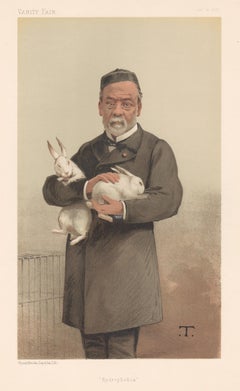
Louis Pasteur, Vanity Fair scientist caricature chromolithograph print, 1887
Located in Melbourne, Victoria
'Hydrophobia'
Vanity Fair medical portrait of Louis Pasteur.
Louis Pasteur (1822 - 1895) was a French chemist and microbiologist born in Dole. He is remembered for his remarkable b...
Category
Late 19th Century Victorian Figurative Prints
Materials
Lithograph
$180
H 14.97 in W 10.24 in
Ira D Sankey, Vanity Fair singer and composer portrait chromolithograph, 1884
Located in Melbourne, Victoria
'Praise and Prayer'
Chromolithograph, 1874, after Ape (Carlo Pellegrini 1839-1889)
Vanity Fair portrait of Ira D. Sankey (1840 -1908), known as The Sweet Singer of Methodism, who w...
Category
Late 19th Century Victorian Portrait Prints
Materials
Lithograph
$95
H 15.36 in W 10.24 in
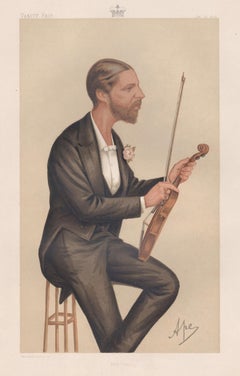
HRH The Duke of Edinburgh, Vanity Fair Royalty portrait chromolithograph, 1874
Located in Melbourne, Victoria
'First Violin'
Chromolithograph, 1884, after Ape (Carlo Pellegrini 1839-1889)
Vanity Fair portrait of Alfred (1844-1900), the second son of Queen Victoria. He was known as the Duke...
Category
Late 19th Century Victorian Portrait Prints
Materials
Lithograph
$165
H 15.75 in W 11.03 in
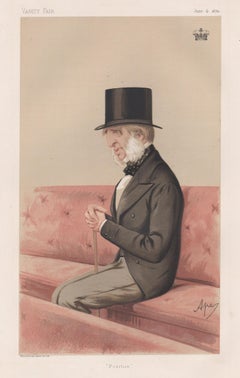
The Duke of Devonshire, Vanity Fair portrait chromolithograph, 1874
Located in Melbourne, Victoria
'Position'
Chromolithograph, 1874, after Ape (Carlo Pellegrini 1839-1889)
Vanity Fair portrait of the Duke of Devonshire.
380mm by 260mm (sheet)
Category
Late 19th Century Victorian Portrait Prints
Materials
Lithograph
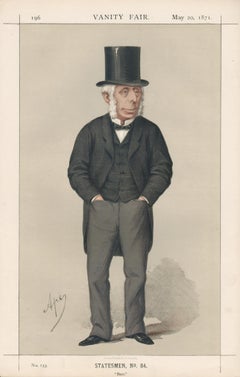
Michael Bass, Vanity Fair beer brewing portrait chromolithograph, 1871
Located in Melbourne, Victoria
'Beer'
Chromolithograph, 1871, after Ape (Carlo Pellegrini 1839-1889)
Vanity Fair portrait of Michael Thomas Bass (1799 -1884) was a British brewer and MP. Under his leadership, Ba...
Category
Late 19th Century Victorian Portrait Prints
Materials
Lithograph
$120
H 13.98 in W 9.06 in
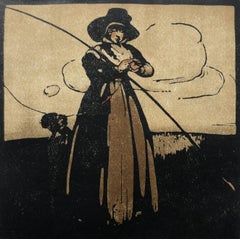
Fishing
By William Nicholson
Located in Bournemouth, Dorset
William Nicholson (1872-1949)
Fishing
1897
Original Colour Lithograph
Image: 21.0 x 21.0 cm
Mount: 39.0 x 36.0 cm
William Nicholson was born at Newark in 1872. He left to study in Paris in his late teens for six months at the Academie Julian before returning to England. In 1893 Nicholson married the painter Mabel Pryde and their first son Ben went on to become the famous painter and sculptor. Nicholson concentrated on printmaking with his brother-in-law James Pryde...
Category
1890s Victorian Figurative Prints
Materials
Lithograph
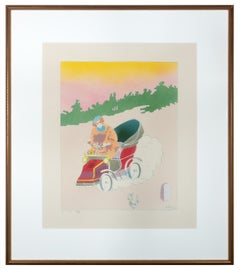
"En Auto, " Original Color Lithograph, Signed
Located in Milwaukee, WI
"En Auto" is an original color lithograph by Singils. The artist signed the piece in stone and wrote the title in the lower left. The edition number, also written lower left, is 46/5...
Category
Early 1900s Victorian Figurative Prints
Materials
Lithograph
20th century lithograph realism figurative female print female subject signed
By Maximilien Luce
Located in Milwaukee, WI
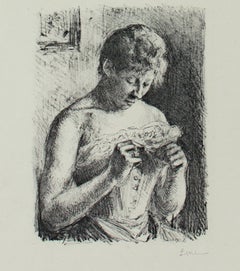
"Woman Manicuring Her Nails" is an original lithograph by Maximilien Luce. The artist signed the piece lower right and it is numbered (#7). It features a woman seated in an interior taking care of her nails.
8 1/4" x 5 3/4" image
14 1/8" x 10 3/4" paper
19 1/4" x 16 1/2" frame
Maximilien Luce (1858 – 1941) was a prolific French Neo-impressionist artist, known for his paintings, illustrations, engravings, and graphic art, and also for his anarchist activism. Starting as an engraver, he then concentrated on painting, first as an Impressionist, then as a Pointillist, and finally returning to Impressionism.
Gausson and Cavallo-Péduzzi introduced Luce in about 1884 to the Divisionist technique developed by Georges Seurat. This influenced Luce to begin painting in the Pointillist style. In contrast to Seurat's detached manner, Luce's paintings were passionate portrayals of contemporary subjects, depicting the "violent effects of light". In addition to Pissarro and Signac, he met many of the other Neo-impressionists, including Seurat, Henri-Edmond Cross, Charles Angrand, Armand Guillaumin, Hippolyte Petitjean, Albert Dubois...
Category
Early 1900s Victorian Figurative Prints
Materials
Lithograph
$2,250
H 19.25 in W 16.5 in
Hand Colored 19th c. Vanity Fair Caricature of an Opera Singer, "Polish Tenor"
By Sir Leslie Ward
Located in Alamo, CA
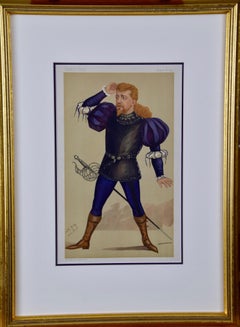
A hand colored Vanity Fair caricature of a 19th century opera singer, M Jean de Reszke, entitled 'Polish Tenor'. The print was created by the most famou...
Category
1890s Victorian Portrait Prints
Materials
Lithograph
$575
H 22.25 in W 16.25 in D 1.5 in
Sir Alexander Mackenzie, composer, Vanity Fair caricature portrait, 1904
By Sir Leslie Ward
Located in Melbourne, Victoria
'R.A.M'
Chromolithograph. 1904.
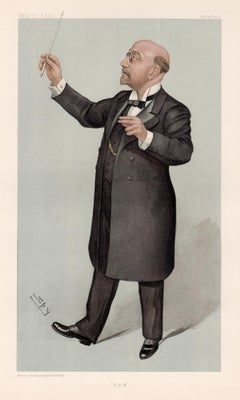
Vanity Fair musician portrait of Sir Alexander Campbell Mackenzie (1847 - 1935) who was a Scottish composer, conductor and teacher best known for h...
Category
Early 20th Century Victorian Figurative Prints
Materials
Lithograph
$120
H 15.56 in W 10.44 in
More From This Seller
View AllRare Palestine Antique Hebrew Judaica Yahrzeit Synagogue Sign Memorial Plaque
Located in Surfside, FL
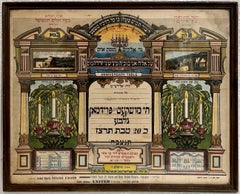
Circa 1890-1920. This Neoclassical, Judaic, Egyptian revival, Orientalist Mizrach sign, was produced in British Mandate Palestine by the chromolithograph process at the beginning of the 20th century. It pictures vignettes of holy places. with a hand written memorial. It was for the Tzedakah charity fund for the century-old institutions in Jerusalem: The great "Torah Center Etz Chaim"; a Free Kitchen for poor children and orphans; the famous Bikur Cholim Hospital with its dispensaries and clinics and the only Home for Incurable Invalids in Eretz Israel. They also worked with Arthur Szyk and Alfred Salzmann.. The A.L. Monsohn Lithographic Press (Monzon Press, Monson Press, דפוס אבן א"ל מאנזאהן, דפוס מונזון) was established in Jerusalem in 1892 by Abraham-Leib (or Avrom-Leyb) Monsohn II (Jerusalem, c.1871-1930) and his brother Moshe-Mordechai (Meyshe-Mordkhe). Sponsored by members of the Hamburger family, the brothers had been sent to Frankfurt, Germany in 1890 to study lithography. Upon returning to Jerusalem in 1892 with a hand press, they established the A.L. Monsohn Lithographic Press in the Old City of Jerusalem. According to the Information Center for Israeli Art A.L. Monsohn "created complex decorations for documents and oriental calendars that combined the tradition of Jewish art with modern printing techniques such as photographic lithography, raised printing and gilding."
The founders of the Monsohn press produced Jewish-themed color postcards, greeting cards, Jewish National Fund stamps, and maps documenting the evolution of the Jewish settlement in Eretz Israel in the nineteenth-twentieth centuries; religious material such as decorative plaques for synagogues, portraits of Old Yishuv rabbis such as Shmuel Salant, Mizrah posters indicating the direction of prayer for synagogues, memorial posters, and posters for Sukkot booths; color frontispieces for books such as Pentateuch volumes and the early song collections of Abraham Zvi Idelsohn (e.g., Shire Zion, Jerusalem 1908); artistic wedding invitations; and labels, packaging and advertisements for the pioneering entrepreneurs of Eretz Israel. The texts appearing in the Monsohn products were in several languages: Hebrew, Arabic, Yiddish, English, German (e.g., a c1920 trilingual Hebrew-English-Arabic "Malaria Danger" broadside warning the public of mosquitoes spreading malaria). Many of the brilliantly colored postcards and maps can be seen online as can the artistic invitations to his children's weddings which Monsohn published in the Jerusalem Hebrew press.
For years, the Monsohn (later, Monson/Monzon) Press was considered the best and most innovative in the country—pioneering in such techniques as gold-embossing and offset printing, among others. Early items for tourists included collections of Flowers of the Holy Land (c. 1910–1918)—pressed local flowers accompanied by scenes from the Eretz Israel countryside and relevant verses from the Bible, edited by Jsac Chagise (or Itzhak Haggis), an immigrant from Vitebsk, and bound in carved olive wood boards. Shortly after World War I Monsohn (now spelled מונזון) used zincography to produce the prints included in the Hebrew Gannenu educational booklets for young children illustrated by Ze'ev Raban of the Bezalel Academy of Art and Design and printed in Jerusalem by Hayim Refael Hakohen (vol. 1, 1919; vols. 2–3, 1920). In 1934 Monsohn moved into the new, western part of Jerusalem, in a shop with four presses and 30 workers, including Abraham-Leib's sons, David, Yosef, Moshe and Shimon, and his daughter Raytse's husband, Abraham Barmacz. The concern did business with all sectors of the city's population, including Arabs, for whom they printed in Arabic. Among their clients were members of the Ginio, Havilio, and Elite families, and Shemen, Dubek, and other renowned national brands, manufacturing products such as wine, candies, oil, and cigarettes. They also printed movie and travel posters, and government posters, postcards and documents, hotel luggage labels...
Category
Early 20th Century Aesthetic Movement More Art
Materials
Lithograph
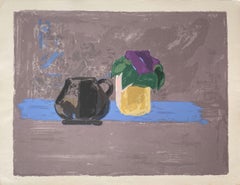
Chinese Israeli Modernist Still Life Lithograph Abstract Flowers in Vase
By Efraim Fima
Located in Surfside, FL
On Arches French art paper.
Fima (born Efraim Roeytenberg) (1914 – 2005) was an Israeli artist born in China. He spent most of his career in France.
Ephraim (Yafim) Roeytenberg, know...
Category
20th Century Abstract Expressionist Interior Prints
Materials
Lithograph
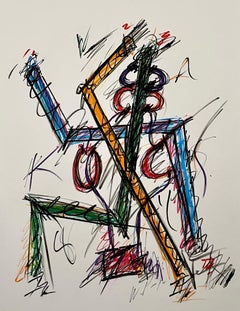
1981 American Post Minimalist Abstract Art Lithograph Neon Series Keith Sonnier
By Keith Sonnier
Located in Surfside, FL
Keith Sonnier, American (1941-2020)
lithograph
From Neon series
circa 1980-1981
Bears the Waterstreet Press watermarks and Arches paper blind stamp to lower right corner. Pub. Edizioni Lucio Amelio
Hand signed with initials in pencil
Dimensions: 30 x 21 3/4 inches
Post minimalist Abstract by Keith Sonnier
Keith Sonnier (1941 – 2020) was a post minimalist sculptor, performance artist, video and light artist. Sonnier was one of the first artists to use light in sculpture in the 1960s. With his use of neon in combination with ephemeral materials he achieved international recognition. Sonnier was part of the Process Art movement.
James Keith Sonnier was born July 31, 1941, in Mamou, Louisiana. His family was Cajun and Roman Catholic. His father was a hardware store owner, Joseph Sonnier, and his mother was a florist and singer, Mae Ledoux. He graduated in 1963 from Southwestern Louisiana Institute (now known as the University of Louisiana at Lafayette). In 1966, he graduated with his MFA degree from Rutgers University, where he studied under Allan Kaprow, Robert Watts, and Robert Morris. After graduation from Rutgers, he moved to New York City with Jackie Winsor and some of his former classmates.
Sonnier died in Southampton, NY on July 18, 2020.
Sonnier began experimenting with neon in 1968. Neon lights became a signature material used in his sculptural works. The common materials Sonnier employed included neon and fluorescent lights; reflective materials; aluminum and copper; and glass and wires. Of the generation of James Turrell and Dan Flavin, He was also associated with the Light and Space movement, a loosely affiliated art movement related to op art, minimalism and geometric abstraction originating in Southern California in the 1960s and influenced by John McLaughlin. It is characterized by a focus on perceptual phenomena, such as light, volume and scale, and the use of materials such as glass, neon, fluorescent lights, resin and cast acrylic, often forming installations conditioned by the work's surroundings. Artists included Ron Cooper...
Category
1980s Post-Minimalist Abstract Prints
Materials
Paper, Lithograph
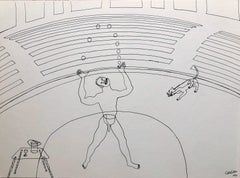
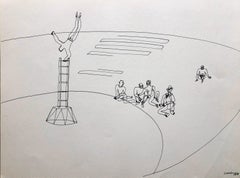
Alexander Calder Circus Reproduction Lithograph After a Drawing
By (after) Alexander Calder
Located in Surfside, FL
(after) Alexander Calder
"Calder's Circus" offset lithograph on wove paper after drawings by the artist
Published by Art in America and Perls gallery in 1964 (from drawings done in the 1930's)
these range slightly in size but they are all about 13 X 17 inches (with minor variations in size as issued.) These have never been framed. The outer folio is not included just the one lithograph.
James Sweeny from the introduction “The fame of Calder’s circus spread quickly between the years 1927 and 1930. All the Paris art world came to know it. It brought him his first great personal success. But what was more important, the circus also provided the first steps in Calder’s development as an original sculptor”
Clive Gray wrote ”A visit to the studio of Alexander Calder led to the chance discovery of some hundred masterful circus drawings completed over thirty years ago. We publish, for the first time, a choice of sixteen from that group.” With signed introduction by Miro.
These whimsical drawings, done in the style of wire sculpture, include acrobats, clowns, jugglers, trapeeze artists, an elephant, dog and lion. they are great.
Alexander Calder is widely considered to be one of the most important American sculptors of the 20th century. He is best known for his colorful, whimsical abstract public sculptures and his innovative mobiles, kinetic sculptures powered by motors or air currents, which embraced chance in their aesthetic. Born into a family of accomplished artists, Calder's work first gained attention in Paris in the 1930s and was soon championed by the Museum of Modern Art in New York, resulting in a retrospective exhibition in 1943. Major retrospectives were also held at the Solomon R. Guggenheim Museum (1964) and the Museum of Contemporary Art, Chicago (1974). Calder’s work is in many permanent collections, most notably in the Whitney Museum of American Art, but also the Guggenheim Museum; the Museum of Modern Art; the National Gallery of Art, Washington, D.C.; and the Centre Georges Pompidou. He produced many large public works, including .125 (at JFK Airport, 1957), Pittsburgh (Carnegie International prize winner 1958, Pittsburgh International Airport) Spirale (UNESCO in Paris, 1958), Flamingo and Universe (both in Chicago, 1974), and Mountains and Clouds (Hart Senate Office Building, Washington, D.C., 1976). Although primarily known for his sculpture, Calder was a prodigious artist with a restless creative spirit, whose diverse practice included painting and printmaking, miniatures (such as his famous Cirque Calder), children’s book illustrations, theater set design, jewelry design, tapestry and rug works, and political posters. Calder was honored by the US Postal Service with a set of five 32-cent stamps in 1998, and received the Presidential Medal of Freedom, posthumously in 1977, after refusing to receive it from Gerald Ford one year earlier in protest of the Vietnam War.
Calder moved to New York and enrolled at the Art Students League, studying briefly with Thomas Hart Benton, George Luks, Kenneth Hayes Miller, and John Sloan. While a student, he worked for the National Police Gazette where, in 1925, one of his assignments was sketching the Ringling Bros. and Barnum & Bailey Circus. Calder became fascinated with the action of the circus, a theme that would reappear in his later work.
In 1926, Calder moved to Paris, enrolled in the Académie de la Grande Chaumière, and established a studio at 22 rue Daguerre in the Montparnasse Quarter. In June 1929, while traveling by boat from Paris to New York, Calder met his future wife, Louisa James (1905-1996), grandniece of author Henry James and philosopher William James. They married in 1931. While in Paris, Calder met and became friends with a number of avant-garde artists, including Fernand Léger, Jean Arp, and Marcel Duchamp. Cirque Calder (on view at the Whitney Museum of American Art at present) became popular with the Parisian avant-garde. He also invented wire sculpture, or "drawing in space," and in 1929 he had his first solo show of these sculptures in Paris at Galerie Billiet. Hi! (Two Acrobats) in the collection of the Honolulu Museum of Art is an early example of the artist's wire sculpture. The painter Jules Pascin, a friend of Calder's from the cafes of Montparnasse, wrote the preface to the catalog. A visit to Piet Mondrian's studio in 1930, where he was impressed by the environment-as-installation, "shocked" him into fully embracing abstract art, toward which he had already been tending.
Dating from 1931, Calder’s sculptures of discrete movable parts powered by motors were christened “mobiles” by Marcel Duchamp, a French pun meaning both "motion" and "motive." At the same time, Calder was also experimenting with self-supporting, static, abstract sculptures, dubbed "stabiles" by Jean Arp in 1932 to differentiate them from mobiles.
Public commissions increasingly came his way in the 1960s. Notable examples are .125 for JFK Airport in 1957, Spirale for UNESCO in Paris 1958 and Trois disques, commissioned for Expo 67 in Montreal, Quebec, Canada. Calder's largest sculpture at 25.7 meters high was El Sol Rojo, constructed outside the Aztec Stadium for the 1968 Summer Olympics "Cultural Olympiad" events in Mexico City. Many of his public works were commissioned by renowned architects; I.M. Pei commissioned his La Grande Voile (1966), a 25-ton, 40-foot high stabile for the Massachusetts Institute of Technology.
Part of Calder's repertoire includes pivotal stage sets for more than a dozen theatrical productions, including Nucléa, Horizon, and most notably, Martha Graham’s Panorama (1935), a production of the Erik Satie symphonic drama Socrate (1936), and later, Works in Progress (1968).
In addition to sculptures, Calder painted throughout his career, beginning in the early 1920s. He picked up his study of printmaking in 1925, and continued to produce illustrations for books and journals.As Calder’s professional reputation expanded in the late 1940s and 1950s, so did his production of prints. Masses of lithographs based on his gouache paintings hit the market, and deluxe editions of plays, poems, and short stories illustrated with fine art prints by Calder became available for sale.
One of Calder's most celebrated and unconventional undertakings was a commission from Dallas-based Braniff International Airways to paint a full-size Douglas DC-8-62 four-engined jet as a "flying canvas."
Calder created over 2,000 pieces of jewelry over the course of his career, many of them as gifts for friends and relatives. For his lifelong friend Joan Miró, he set a shard of a broken porcelain vessel in a brass ring. Peggy Guggenheim received enormous silver mobile earrings and later commissioned a hammered silver headboard...
Category
1930s American Modern Animal Prints
Materials
Lithograph
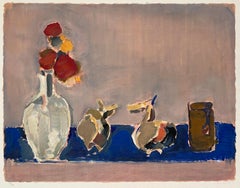
Chinese Israeli Modernist Still Life Lithograph Abstract Flowers in Vase
By Efraim Fima
Located in Surfside, FL
Fima (born Efraim Roeytenberg) (1914 – 2005) was an Israeli artist born in China. He spent most of his career in France.
Ephraim (Yafim) Roeytenberg, known as "Fima" or "Pima", was b...
Category
Mid-20th Century Abstract Expressionist Interior Prints
Materials
Lithograph
Alexander Calder Circus Reproduction Lithograph After a Drawing
By (after) Alexander Calder
Located in Surfside, FL
(after) Alexander Calder
"Calder's Circus" offset lithograph on wove paper after drawings by the artist
Published by Art in America and Perls gallery in 1964 (from drawings done in the 1930's)
these range slightly in size but they are all about 13 X 17 inches (with minor variations in size as issued.) These have never been framed. The outer folio is not included just the one lithograph.
James Sweeny from the introduction “The fame of Calder’s circus spread quickly between the years 1927 and 1930. All the Paris art world came to know it. It brought him his first great personal success. But what was more important, the circus also provided the first steps in Calder’s development as an original sculptor”
Clive Gray wrote ”A visit to the studio of Alexander Calder led to the chance discovery of some hundred masterful circus drawings completed over thirty years ago. We publish, for the first time, a choice of sixteen from that group.” With signed introduction by Miro.
These whimsical drawings, done in the style of wire sculpture, include acrobats, clowns, jugglers, trapeeze artists, an elephant, dog and lion. they are great.
Alexander Calder is widely considered to be one of the most important American sculptors of the 20th century. He is best known for his colorful, whimsical abstract public sculptures and his innovative mobiles, kinetic sculptures powered by motors or air currents, which embraced chance in their aesthetic. Born into a family of accomplished artists, Calder's work first gained attention in Paris in the 1930s and was soon championed by the Museum of Modern Art in New York, resulting in a retrospective exhibition in 1943. Major retrospectives were also held at the Solomon R. Guggenheim Museum (1964) and the Museum of Contemporary Art, Chicago (1974). Calder’s work is in many permanent collections, most notably in the Whitney Museum of American Art, but also the Guggenheim Museum; the Museum of Modern Art; the National Gallery of Art, Washington, D.C.; and the Centre Georges Pompidou. He produced many large public works, including .125 (at JFK Airport, 1957), Pittsburgh (Carnegie International prize winner 1958, Pittsburgh International Airport) Spirale (UNESCO in Paris, 1958), Flamingo and Universe (both in Chicago, 1974), and Mountains and Clouds (Hart Senate Office Building, Washington, D.C., 1976). Although primarily known for his sculpture, Calder was a prodigious artist with a restless creative spirit, whose diverse practice included painting and printmaking, miniatures (such as his famous Cirque Calder), children’s book illustrations, theater set design, jewelry design, tapestry and rug works, and political posters. Calder was honored by the US Postal Service with a set of five 32-cent stamps in 1998, and received the Presidential Medal of Freedom, posthumously in 1977, after refusing to receive it from Gerald Ford one year earlier in protest of the Vietnam War.
Calder moved to New York and enrolled at the Art Students League, studying briefly with Thomas Hart Benton, George Luks, Kenneth Hayes Miller, and John Sloan. While a student, he worked for the National Police Gazette where, in 1925, one of his assignments was sketching the Ringling Bros. and Barnum & Bailey Circus. Calder became fascinated with the action of the circus, a theme that would reappear in his later work.
In 1926, Calder moved to Paris, enrolled in the Académie de la Grande Chaumière, and established a studio at 22 rue Daguerre in the Montparnasse Quarter. In June 1929, while traveling by boat from Paris to New York, Calder met his future wife, Louisa James (1905-1996), grandniece of author Henry James and philosopher William James. They married in 1931. While in Paris, Calder met and became friends with a number of avant-garde artists, including Fernand Léger, Jean Arp, and Marcel Duchamp. Cirque Calder (on view at the Whitney Museum of American Art at present) became popular with the Parisian avant-garde. He also invented wire sculpture, or "drawing in space," and in 1929 he had his first solo show of these sculptures in Paris at Galerie Billiet. Hi! (Two Acrobats) in the collection of the Honolulu Museum of Art is an early example of the artist's wire sculpture. The painter Jules Pascin, a friend of Calder's from the cafes of Montparnasse, wrote the preface to the catalog. A visit to Piet Mondrian's studio in 1930, where he was impressed by the environment-as-installation, "shocked" him into fully embracing abstract art, toward which he had already been tending.
Dating from 1931, Calder’s sculptures of discrete movable parts powered by motors were christened “mobiles” by Marcel Duchamp, a French pun meaning both "motion" and "motive." At the same time, Calder was also experimenting with self-supporting, static, abstract sculptures, dubbed "stabiles" by Jean Arp in 1932 to differentiate them from mobiles.
Public commissions increasingly came his way in the 1960s. Notable examples are .125 for JFK Airport in 1957, Spirale for UNESCO in Paris 1958 and Trois disques, commissioned for Expo 67 in Montreal, Quebec, Canada. Calder's largest sculpture at 25.7 meters high was El Sol Rojo, constructed outside the Aztec Stadium for the 1968 Summer Olympics "Cultural Olympiad" events in Mexico City. Many of his public works were commissioned by renowned architects; I.M. Pei commissioned his La Grande Voile (1966), a 25-ton, 40-foot high stabile for the Massachusetts Institute of Technology.
Part of Calder's repertoire includes pivotal stage sets for more than a dozen theatrical productions, including Nucléa, Horizon, and most notably, Martha Graham’s Panorama (1935), a production of the Erik Satie symphonic drama Socrate (1936), and later, Works in Progress (1968).
In addition to sculptures, Calder painted throughout his career, beginning in the early 1920s. He picked up his study of printmaking in 1925, and continued to produce illustrations for books and journals.As Calder’s professional reputation expanded in the late 1940s and 1950s, so did his production of prints. Masses of lithographs based on his gouache paintings hit the market, and deluxe editions of plays, poems, and short stories illustrated with fine art prints by Calder became available for sale.
One of Calder's most celebrated and unconventional undertakings was a commission from Dallas-based Braniff International Airways to paint a full-size Douglas DC-8-62 four-engined jet as a "flying canvas."
Calder created over 2,000 pieces of jewelry over the course of his career, many of them as gifts for friends and relatives. For his lifelong friend Joan Miró, he set a shard of a broken porcelain vessel in a brass ring. Peggy Guggenheim received enormous silver mobile earrings and later commissioned a hammered silver headboard...
Category
1930s American Modern Animal Prints
Materials
Lithograph