Items Similar to 1960s Corrado Cagli Italian Signed Abstract Painting
Want more images or videos?
Request additional images or videos from the seller
1 of 12
Corrado Cagli1960s Corrado Cagli Italian Signed Abstract Painting1965 ca.
1965 ca.
$9,467.46
£7,074.76
€8,000
CA$13,182.96
A$14,166.48
CHF 7,601.14
MX$166,872.43
NOK 95,575.86
SEK 87,307.93
DKK 60,984.62
About the Item
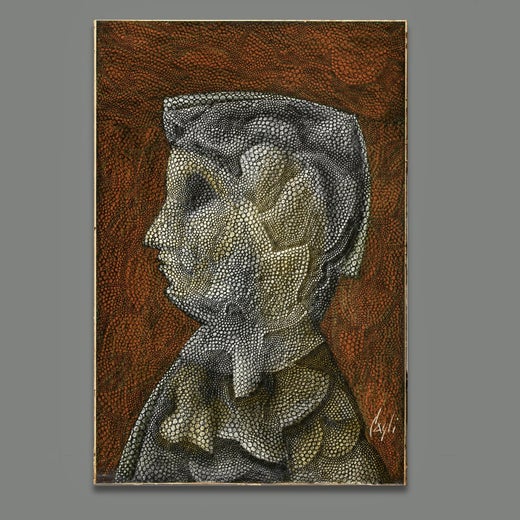
Corrado Cagli (Ancona 1910 – Rome 1976) oil pastel on canvas paper.
The work is signed “Cagli” in the lower right corner.
The work is in excellent condition, with a natural patina and slight craquelure consistent with its age; the canvas paper is well preserved, with no obvious restoration.
With this profile portrait, with its dotted texture that fragments the outline of the face into a mosaic of greys, yellows and shadows on a deep red background, Cagli intends to symbolise the complexity of human identity in the post-war chaos.
The technique of oil wax pastel on canvas paper, typical of the painter Corrado Cagli, consists of applying wax and oil-based pastels to high-quality paper that is then stretched onto a rigid support.
Cagli used this method to create textural and luminous effects, with dotted layers reminiscent of mosaics or engravings, allowing for smooth transitions between colours and a unique tactile rendering. This technique was frequently used in his works from the 1950s and 1960s, allowing him to combine the spontaneity of pastels with the durability of oil.
Purchasing a work by Corrado Cagli means investing in a piece of Italian modern art history. Cagli's work combines wild instinctiveness with a rational Western culture, making him an unmistakable artist. His works are at once a lyrical message, a psychoanalytical test and an ethnographic document, offering a depth that few artists achieve.
Corrado Cagli (Ancona, 1910 – Rome, 1976) was an Italian painter of Jewish origin, a key figure in the Roman School in the 1930s, influenced by Futurism, Cubism and Metaphysical Art.
This artwork, never before on the market, comes from an important Italian private collection
Every item of our Gallery, upon request, is accompanied by a certificate of authenticity issued by Sabrina Egidi official Expert in Italian furniture for the Chamber of Commerce of Rome and for the Rome Civil Courts.
Our company has been present on this platform for many years, with numerous sales made and just as many excellent reviews received that you can under our Furniture account.
Corrado Cagli (Ancona 1910 – Rome 1976)
Corrado Cagli was born in Ancona on February 23, 1910, to Alfredo and Ada Della Pergola, a Jewish family.
Five years later, he and his family moved to Rome, where he studied classical studies and attended the Academy of Fine Arts.
As early as 1925-1926, Cagli illustrated the covers and some inside pages of "La Croce Rossa Italiana Giovanile," a magazine for Italian primary and secondary schools.
In 1927, he created a tempera for the ceiling of a club on Via Sistina, a work that was later destroyed. In the spring of the following year, he debuted with a handcrafted work, a "hearth coffin," at the 104th Exhibition of Fine Arts of the Society of Amateurs and Cultivators of Fine Arts in Rome.
Also in 1928, he created a mural in "lean tempera" for the theater hall of the Campo Marzio – Trevi – Colonna district group of the PNF, on Via del Vantaggio in Rome.
Of the lost work, no trace remains except for a testimony by Dario Sabatello who evokes its themes in a writing: “They are scenes of life in the fields, in the workshops, in the gyms; plastic, sincere and heartfelt”.
In April 1932 Cagli inaugurated a personal exhibition with Adriana Pincherle at the Galleria in Rome, directed by Pier Maria Bardi, in which he exhibited La Fortuna and various portraits - including the Portrait of Sclavi and Igino - studies, drawings, some ceramics and the sculpture Portrait of Serena.
He subsequently founded, together with Giuseppe Capogrossi and Emanuele Cavalli, the Group of New Roman Painters.
By the end of the year he had already decorated some walls at the Roman Building Exhibition and executed Preparativi alla guerra (an egg tempera on a 30 square metre wall) in the vestibule of the V Triennale in Milan when, at the invitation of the Archaeological Commission of Salerno, he went to Paestum and probably also visited Naples and Pompeii.
The trip, during which he executed paintings and drawings, was important for his knowledge of Pompeian painting.
In December 1933, Cagli traveled to Paris, where he exhibited alongside Capogrossi, Cavalli, and Sclavi at the Galerie Jacques Bonjean.
Organized by Count Emmanuele Sarmiento, the exhibition was presented in the catalog by critic Waldemar George, who grouped the four young artists under the label of Ecole de Rome.
Cagli exhibited Portrait of the Painter Prieto, Oedipus, The Dove, Still Life, and Composition.
The exhibition received numerous reviews, both in Italy and France.
The Second Quadrennial of National Art, commissioned by C.E. Oppo, opened in February 1935 at the Palazzo delle Esposizioni in Rome. Cagli exhibited four removable wall panels for the rotunda designed by Piero Aschieri.
The panels, nearly 4 meters high, depict the theme of the reclamation of the Pontine Marshes (consisting of a Protasis and three Chronicles of the Time).
He also presented a significant number of works: La Romana, The Neophyte, The Palatine, Portrait of Afro, L'Angelica, The Savoyards, The Night of San Giovanni, The Neophytes, Composition, Battle, Seven Brushes, and Six Drawings. He was awarded a prize of 10,000 lire.
In 1932/33, he was commissioned to create polychrome decorations on Venetian glass for the Zodiac Fountain in Terni, which was damaged during the Second World War.
He was commissioned to create two murals for the Castel De'Cesari building (now the National Academy of Dance) in Rome, renovated by the rationalist architect Gaetano Minnucci as the headquarters of the Opera Nazionale Balilla.
One of the two murals depicts The Race of the Barbary Horses, a reenactment of the famous race of wild horses through the Corso to Piazza del Popolo. Renato Ricci, Undersecretary of the Ministry of Education, ordered the frescoes to be destroyed after they were censored for their thematic inappropriateness. Hidden by a false wall, built by Cagli himself, the mural in the library was preserved, having been uncovered in 1945 at the initiative of Mirko Basaldella.
1935 was an important year for the young artist, as between April and May he held his first solo exhibition of fifty drawings at the Galleria La Cometa of Countess Anna Laetitia (Mimi) Pecci Blunt, directed by Libero De Libero and Cagli himself, which was inaugurated on that occasion.
The gallery carried out an important work of cultural diffusion with an anti-twentieth-century slant until 1938, largely thanks to Cagli's influence.
The catalogue contains an essay by Massimo Bontempelli, Cagli's uncle, on drawing.
In 1936, the VI International Triennial opened at the Palazzo dell'Arte in Milan. On the back wall of the Sala delle Priorita Italiche, created by the BBPR group, Cagli displayed a large 6x6 meter painting, The Battle of San Martino and Solferino, in encaustic tempera on honeycomb panel.
This large mural, created in separate panels in his Roman studio and then assembled only in Milan, has no surviving cartoons or drawings, only a sketch made for the presentation.
On May 26, 1937, the "Exposition Internationale des Arts et des Techniques" opened in Paris. Cagli, assisted by his collaborator Afro Basaldella, created a series of large paintings (approximately 200 linear meters) in encaustic tempera on honeycomb panel to decorate the vestibule of the Italian Pavilion.
The paintings depict monumental images of Rome and portraits of great Italians from the Roman era to the Risorgimento.
The 21st Venice Biennale opened in June 1938. Cagli participated with a fresco on plaster, Orpheus Charming the Beasts, for which a preparatory cartoon exists.
At the end of 1938, he was forced into exile, as a homosexual and a Jew, following the proclamation of the racial laws and the intensification of anti-Semitic attacks against him and his work.
He first settled in Paris, where he continued to exhibit, and at the end of 1939, from Cherbourg, he embarked for New York. In the "Big Apple," his art did not go unnoticed, and some time after his arrival he exhibited at the renowned Julien Levy Gallery.
In January 1941, he held a solo exhibition at the Civic Center Museum in San Francisco, but two months later, Cagli enlisted in the U.S. Army.
However, he did not cease his artistic activity, producing a significant number of paintings and drawings and participating in exhibitions such as a solo exhibition at the Shaeffer Gallery in Los Angeles and a solo exhibition of drawings at the Wadsworth Atheneum in Hartford.
In 1943, he moved to Great Britain to join the army and the following year took part in the campaigns in France, including the Normandy Landings, Belgium, and Germany.
During these years, he created the famous series of drawings on the theme of war, among which stand out the images portrayed at the Buchenwald concentration camp, in whose liberation he took part among the Allied troops.
At the end of the war, he returned to New York where he continued his activity, experimenting with ever-changing techniques and styles and was among the founders of The Ballet Society (now the New York City Ballet) together with George Balanchine and Lincoln Kirstein. Within the company, Cagli was the one who created the sets and costumes.
In 1948, he decided to return to Italy permanently and settled in a studio on Via del Circo Massimo.
The stability and tranquility allowed him to continue his analytical research in painting and to participate in exhibitions both in Italy and abroad.
Numerous artists gravitated around him, including Mirko Basaldella, Capogrossi, Alberto Burri, and Renato Guttuso.
In 1949-1950, he participated in the creation of the important Verzocchi collection, on the theme of work, sending, along with a self-portrait, The Potter; the collection is now held in the Pinacoteca Civica in Forlì.
Between the late 1950s and early 1960s, he was commissioned, along with other artists, to decorate the Leonardo da Vinci turboship. Cagli contributed by decorating some areas of the ocean liner with Leonardo da Vinci's designs (such as the Flight of Birds, etc.) and with six tapestries made with the contribution of the Arazzeria Scassa of Asti.
In 1963-64, he exhibited at the exhibition Peintures italiennes d'aujourd'hui, organized in the Middle East and North Africa.
In the early 1970s, he created the graffiti for the Museum of the Monument to the Political and Racial Deportees in Carpi (Modena): the work depicts the lifeless body of a naked deportee next to the camp fence.
The original barbed wire beneath Cagli's graphic reminds the visitor of the symbolic meaning of oppression and deprivation of freedom that barbed wire holds in relation to the camp system.
Today, barbed wire has become the universal emblem of violence against humanity.
Then, in those years, with his student and collaborator Annibale Casabianca, a Roman painter and cartoonist, he created stage sets, illustrations, and paintings.
However, he did not abandon his activity as a set and costume designer, participating in numerous theatrical performances such as: Tancredi by Rossini, 1952; Macbeth by Bloch, 1960; Estri by Petrassi, 1968; Persephone by Stravinsky, 1970; Agnese di Hohenstaufen by Spontini, 1974; Missa Brevis by Stravinsky, 1975.
He died in Rome, in his home on the Aventine Hill, on March 28, 1976.
Under existing legislation, any artwork created over 70 years ago by an artist who has died can requires a license for export regardless of the work’s market price. The shipping may require additional handling days to require the license according to the destination of the artwork.
- Creator:Corrado Cagli (1910 - 1976, Italian)
- Creation Year:1965 ca.
- Dimensions:Height: 28.35 in (72 cm)Width: 18.9 in (48 cm)Depth: 1.19 in (3 cm)
- Medium:
- Movement Style:
- Period:
- Framing:Framing Options Available
- Condition:
- Gallery Location:Roma, IT
- Reference Number:1stDibs: LU2883217469202
Corrado Cagli
Corrado Cagli was an Italian painter of Jewish heritage, who lived in the United States during World War II. He was born in Ancona, but he moved with his family to Rome in 1915 at the age of five. In 1927, Cagli made his artistic debut, with a mural painted on a building in Via Sistina. The following year, he made another mural painting in a hall in Via Vantaggio. In 1932, Cagli held his first personal exhibition at the Gallery of Art of Rome.
About the Seller
No Reviews Yet
Vetted Professional Seller
Every seller passes strict standards for authenticity and reliability
Established in 1990
1stDibs seller since 2025
8 sales on 1stDibs
Typical response time: <1 hour
- ShippingRetrieving quote...Shipping from: Roma, Italy
- Return Policy
More From This Seller
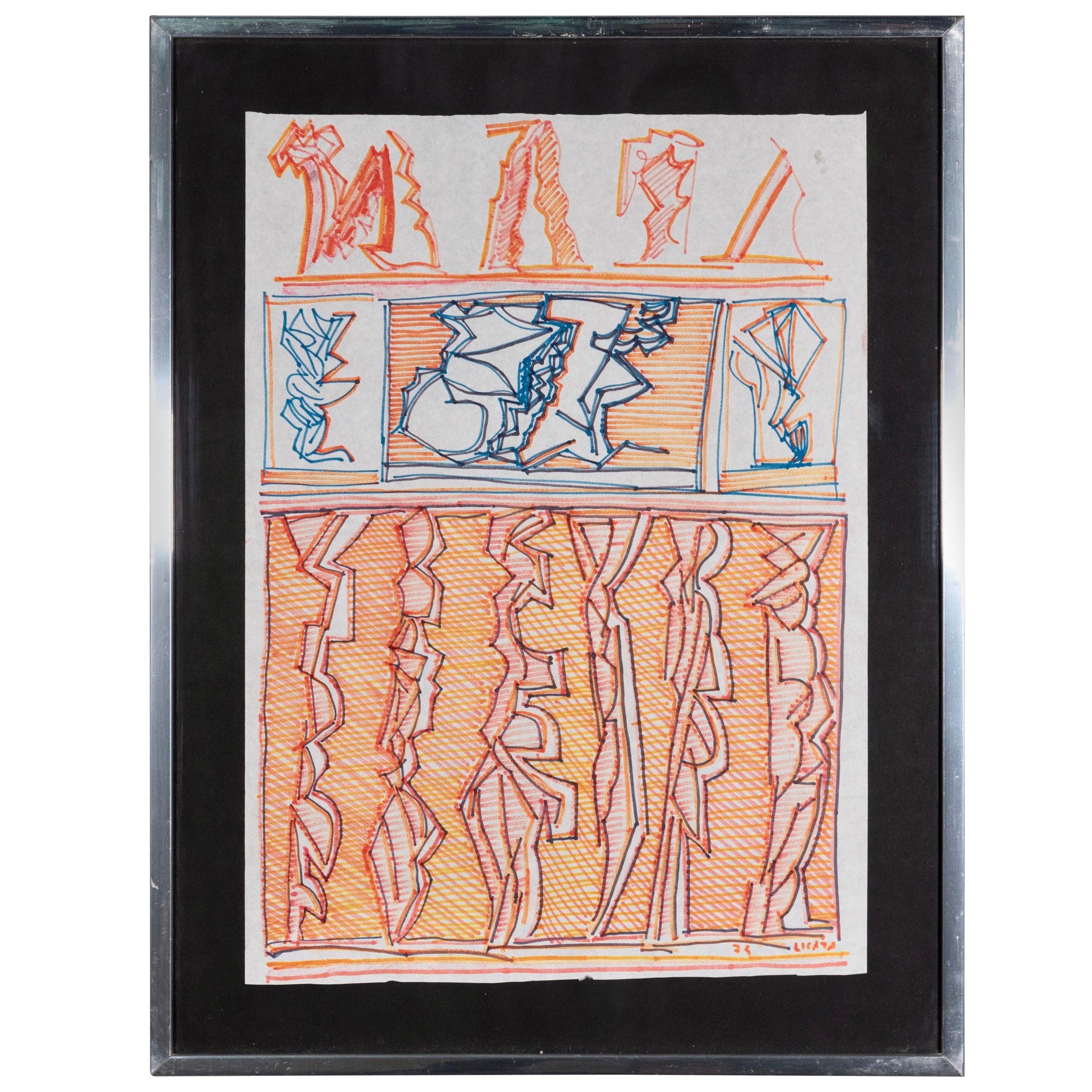
View All1970s Italian Signed Modern Abstract Painting by Riccardo Licata
By Riccardo Licata
Located in Roma, IT
Important watercolour on paper 'Untitled' by the great Italian artist Riccardo Licata.
Dated and signed at lower right "74 Licata".
This work is representative at the highest level ...
Category
Mid-20th Century Abstract Abstract Paintings
Materials
Paper, Watercolor
$1,491 Sale Price
30% Off
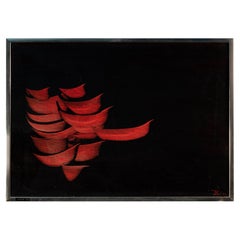
1970s Modern Abstract Italian Painting by Claudio Cazzola
By Claudio Cazzola
Located in Roma, IT
Beautiful modern painting from the 1970s by the artist Claudio Cazzola.
An abstract motif of rare intensity and originality, this very elegant painting has two exhibition stamps on t...
Category
1970s Abstract Abstract Paintings
Materials
Canvas, Oil
$1,041 Sale Price
20% Off
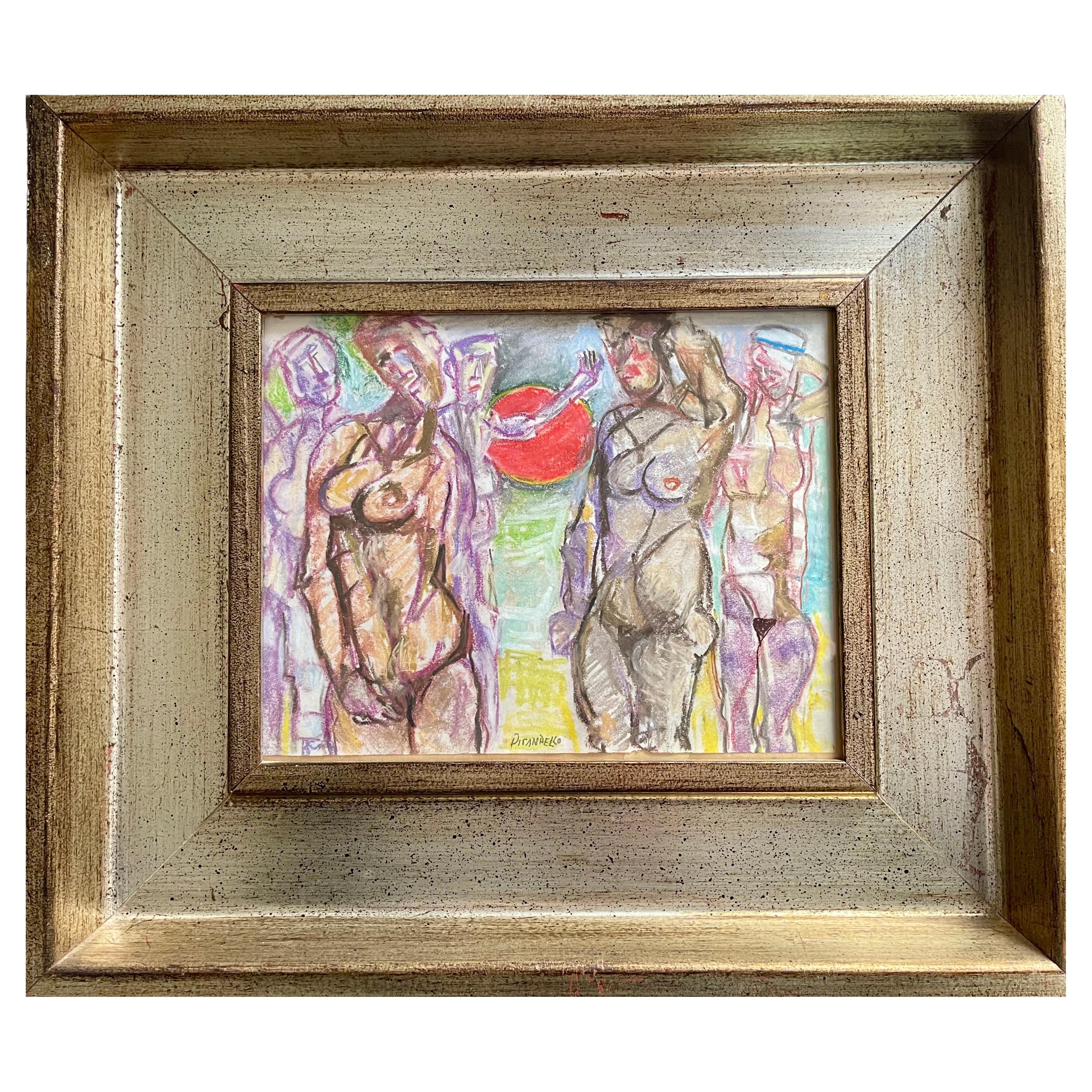
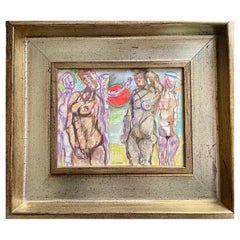
Period Italian Fausto Pirandello Signed Abstract Artwork
By Fausto Calogero Pirandello
Located in Roma, IT
Important work by one of the greatest artists of the Italian artistic avant-garde Fausto Pirandello
It depicts one of his iconic subjects ‘Bathers’ with five characters depicted in ...
Category
Mid-20th Century Abstract Abstract Paintings
Materials
Paper, Pastel
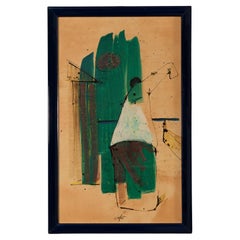
1960s Italian Signed Abstract Painting
By Nino Caffè
Located in Roma, IT
Important signed Nino Caffè, painting on paper, mixed media.
“Vestizione di un pretino” (Vestments of a Young Priest)
Signed bottom center: Caffè.
Young ...
Category
1960s Modern Abstract Paintings
Materials
Paper, Watercolor
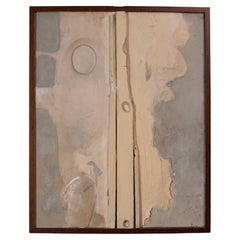
Josep Guinovart Signed Modern Abstract Painting
By Josep Guinovart Bertrán
Located in Roma, IT
Important painting by the great Spanish artist Josep Guinovart.
Signed and inscribed in the back with is a label from an exhibition at Fiamma Vigo's Galleria Numero, one of the most...
Category
1960s Abstract Abstract Paintings
Materials
Plaster, Wood
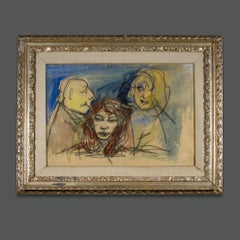
1960s Italian Signed Dated and Autenticated Painting
By Mino Maccari
Located in Roma, IT
1960s Italian Signed Dated and Autenticated Painting
Mino Maccari work
Three stylized figures
Work by the Sienese artist Mino Maccari, signed at the bottom right Maccari 1969. Mixed ...
Category
1960s Abstract Expressionist Figurative Paintings
Materials
Paper, Watercolor
You May Also Like
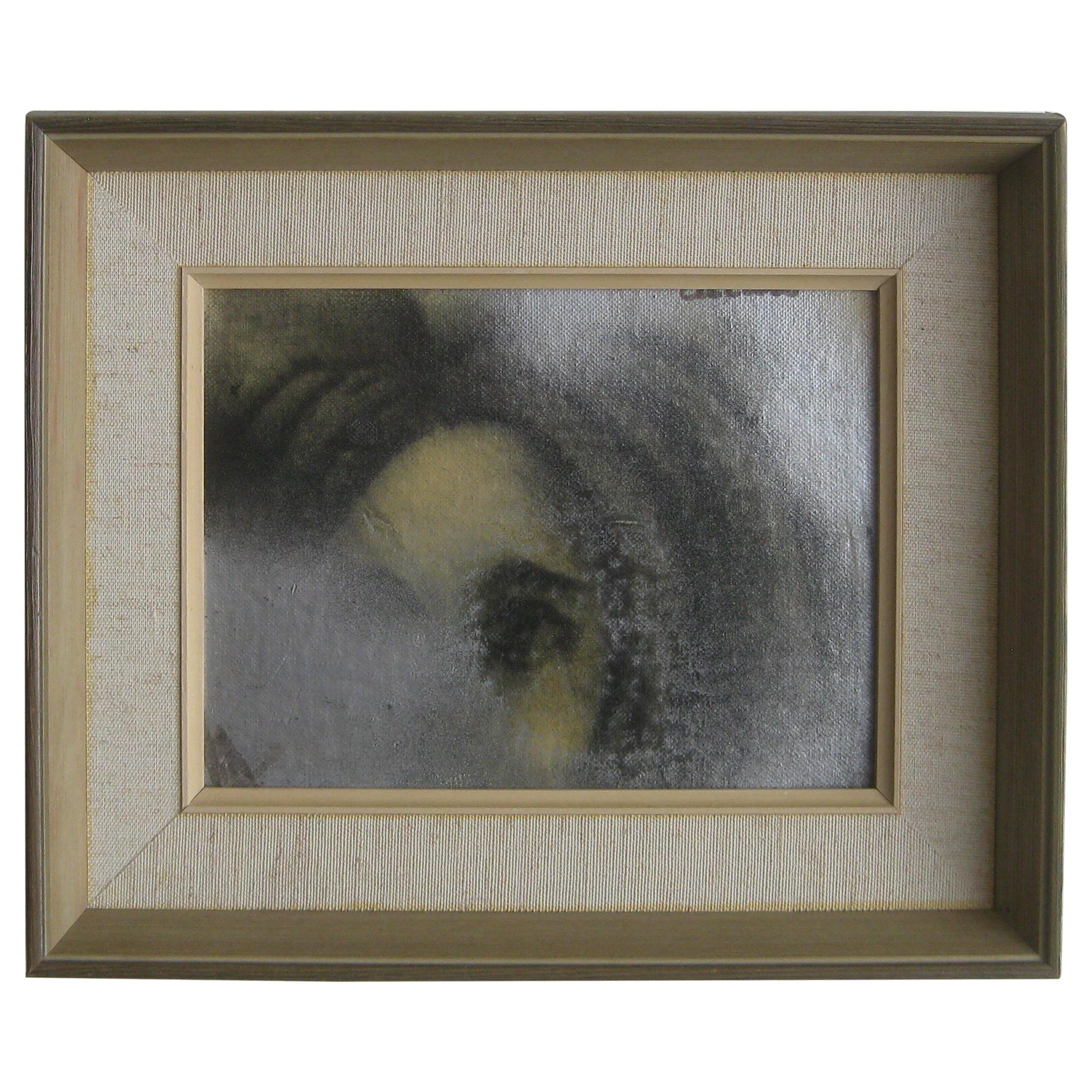
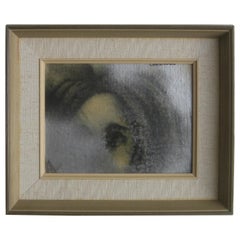
1960s Pascal "Pablo" Cucaro Mixed-Media Pop Art Abstract Painting Listed Artist
By Pascal Cucaro, 1915-2003
Located in San Diego, CA
Wonderful mixed-media painting by listed artist Pascal "Pablo" Cucaro and dates from the 1960s. The painting is of the face of a woman and is covered over with silver spray paint by ...
Category
Mid-20th Century Paintings
Materials
Acrylic
$600 Sale Price
20% Off
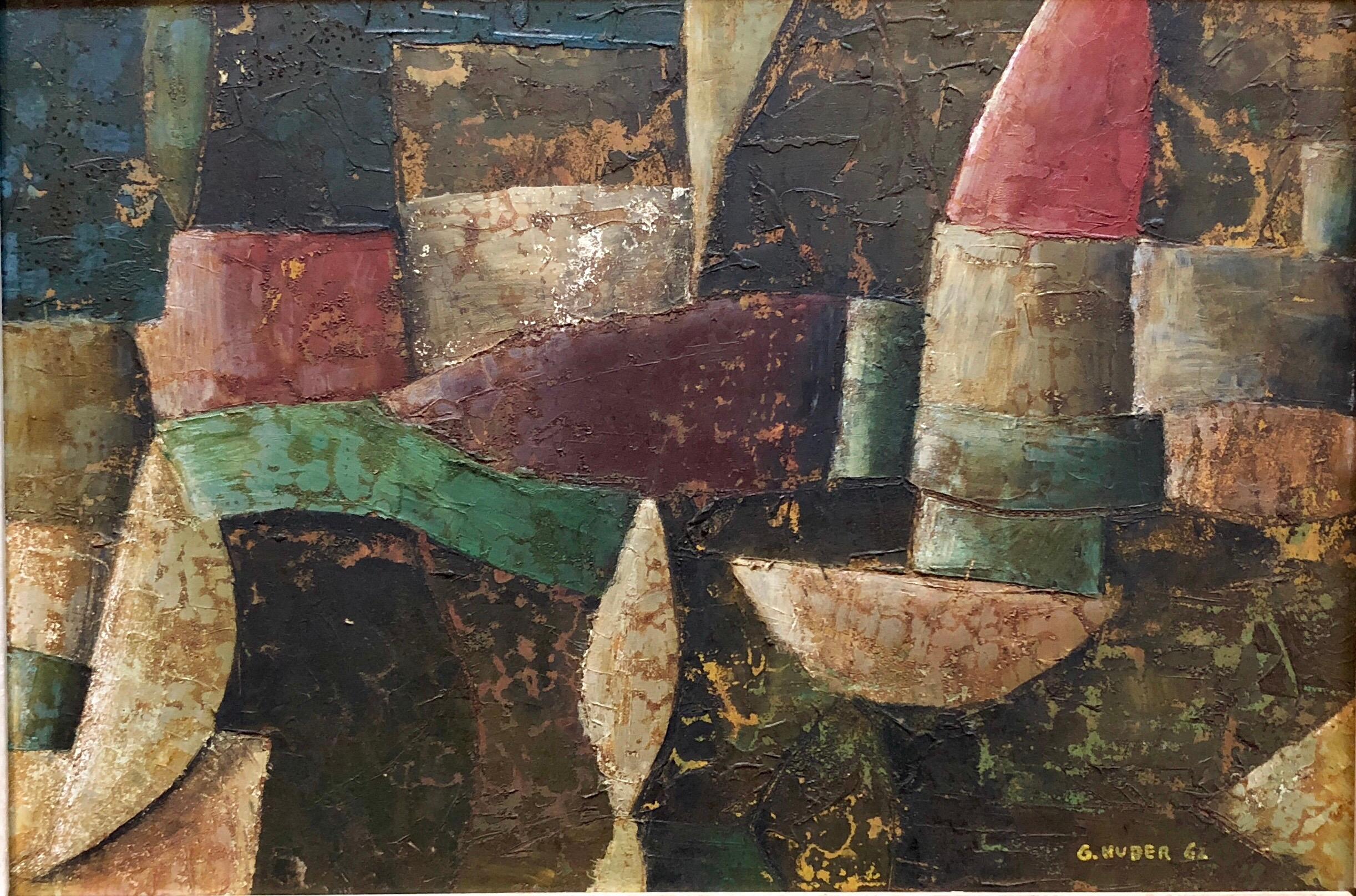
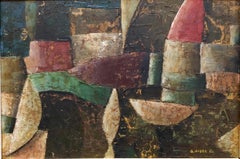
1960s Italian Futurist Abstract Oil Painting
By Giovanni Huber
Located in Surfside, FL
This painting has been authenticated by the artist and was sold in St Gallen.
Born in Italy in 1939, attended the textile and arts and crafts school of St. Gallen from 1956 to 1959. ...
Category
1960s Futurist Abstract Paintings
Materials
Oil
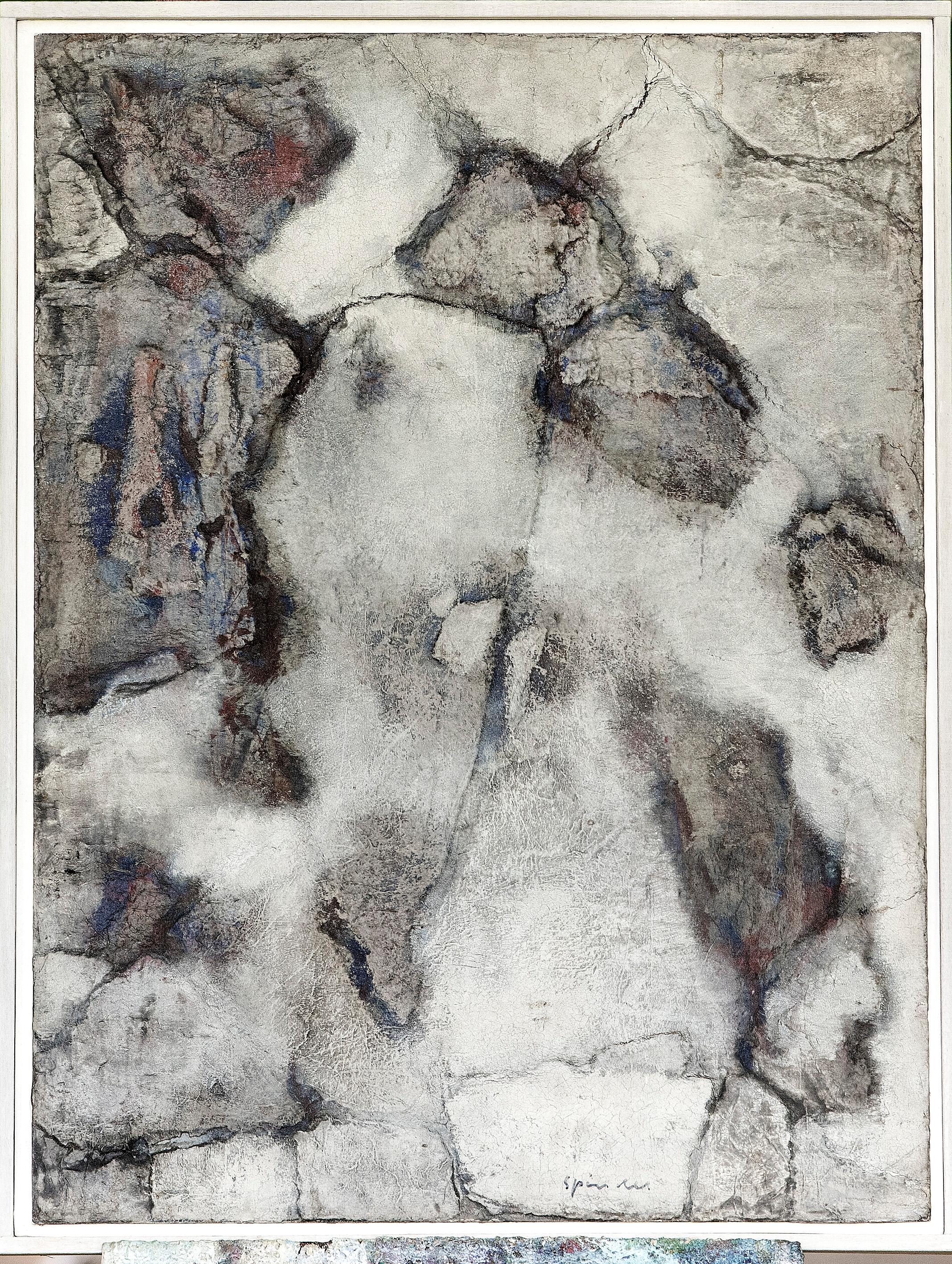
1963 Post-War Grey Modern Abstract Painting By Ferdinand Spindel
Located in Frederiksberg C, DK
Introducing a captivating post-war modern painting by German artist Ferdinand Spindel. In a stunning abstract composition, this piece features a harm...
Category
Mid-20th Century Post-War Abstract Paintings
Materials
Oil, Wood Panel, Mixed Media
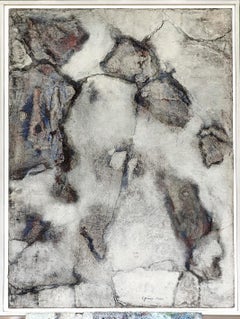
Mid-Century Modernist Textural Abstract Mixed Media Painting on Board
Located in New York, NY
This substantial and sculptural Mid-Century Modernist Textural Abstract Mixed Media Painting on Board signed Juan Almoril originates from Spain, C.1967. This piece features a square ...
Category
1960s Mixed Media
Materials
Acrylic
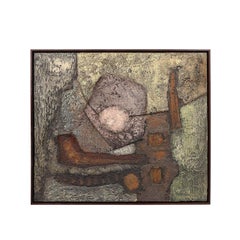
Vintage Finely Framed 1959 Abstract Expressionist Painting
Located in Buffalo, NY
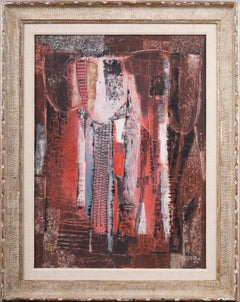
Very nicely painted mid century modernist abstract oil painting. Framed. Oil on board. Signed. Image size, 26H by 19L.
Category
1950s Abstract Abstract Paintings
Materials
Canvas, Oil
$1,020 Sale Price
20% Off
Vintage American Modernist Abstract Expressionist Framed Oil Painting
Located in Buffalo, NY
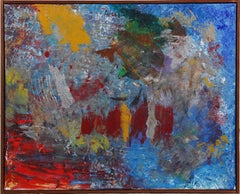
Antique American modernist abstract oil painting. Oil on canvas. Framed.
Category
1970s Abstract Abstract Paintings
Materials
Canvas, Oil
$396 Sale Price
20% Off