Want more images or videos?
Request additional images or videos from the seller
1 of 5
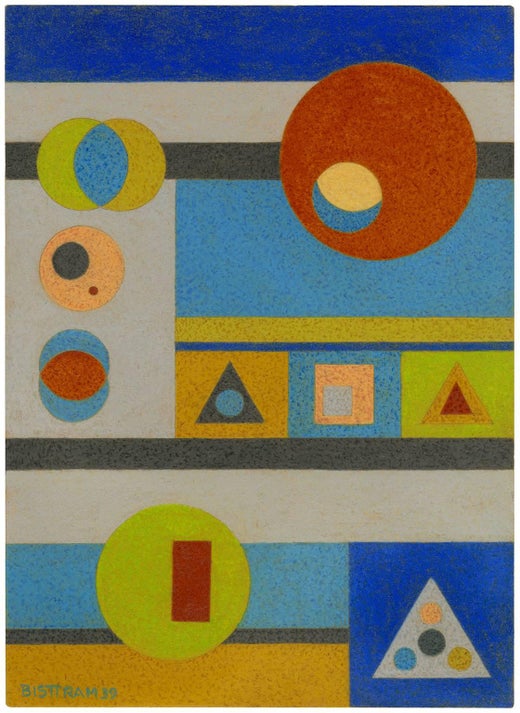
Emil BisttramGeometric Abstraction1939
1939
$8,500
£6,472.57
€7,452.99
CA$12,045.25
A$12,956.39
CHF 6,924.27
MX$152,718.89
NOK 87,298.82
SEK 79,807.69
DKK 55,686.44
About the Item
A unique, beautifully composed, large-scale geometric abstraction encaustic, with fresh colors, on fibrous buff, wove paper; the image extending to the sheet edges, in excellent condition. Signed and dated '39, lower left; estate stamped lower right, verso. The artist’s delicately stippled rendering in contrasting values produces the effect of shimmering color.
Image size/sheet size 12 3/8 x 9 inches (314 x 229 mm).
Archivally matted to museum standards, unframed.
ABOUT THE ARTIST AND THIS WORK
In 1938, Emil Bisttram was one of the founding members of the Transcendental Painting Group in New Mexico. Seeking to emphasize the spiritual in art and its value as a positive force in society, the group's member artists contributed to the early development of non-objective modernism in the Southwestern United States. Bisttram held that the spiritual beliefs of native cultures like the American Indian had a link to the divine that had been lost by Western religions.
Bisttram's encaustic geometric works are precisely crafted, meditative explorations of his connection to these inner spiritual realities—his personal 'mandalas.' Created between 1936 and 1947, the artist never exhibited his encaustic works and only showed them privately toward the end of his life. A unique and relatively unexplored genre in the artist's highly acclaimed and otherwise well-documented oeuvre, they stand as essential and seminal works of the Transcendental Painting Group.
Bisttram was extremely active in the artistic growth of New Mexico throughout his life in Taos. In 1952, he co-founded the Taos Art Association, and in 1959, he won the Grand Prize for painting at the New Mexico State Fair. In 1975, the state honored him by declaring April 7 (the artist's birthday) 'Emil Bisttram Day', a state holiday. Bisttram received numerous awards and is represented in many major US museums, including the Joslyn Art Museum, Los Angeles County Museum of Art, Metropolitan Museum of Art, Smithsonian American Art Museum, and the Whitney Museum of American Art.
THE ENCAUSTIC MEDIUM
Encaustic painting, also known as hot wax painting, dates back to ancient Greece. Traditionally, colored pigments were added to heated beeswax, the oldest known pigment binder, to create the paint medium. The encaustic medium, similar in appearance to oil painting, can be applied to any number of surfaces, from paper to stone. It allows for a great variety of texture and has the advantage of not yellowing, weathering well, and being unaffected by moisture. The final surface may be polished with a soft cloth to create a luminous sheen.
- Creator:Emil Bisttram (1895 - 1976, American, Hungarian)
- Creation Year:1939
- Dimensions:Height: 12.375 in (31.44 cm)Width: 9 in (22.86 cm)
- Medium:
- Movement Style:
- Period:
- Condition:
- Gallery Location:Myrtle Beach, SC
- Reference Number:Seller: 985681stDibs: LU53232414313
Emil James Bisttram Born Hungary, 1895
Died New Mexico, 1976 Emil Bisttram was born in Hungary in 1895 and emigrated with his parents when he was eleven to America. Bisttram choose a more economically promising career in commercial art design due to his economic conditions. Bisttram opened his own art agency at the young age of twenty and during this time took classes with Leon Kroll at the Art Student League and with Jay Hambidge, an advocate of Dynamic Symmetry, at the New York School of Fine and Applied Art (renamed the Parsons School of Design). Dynamic Symmetry is a system of spacial balances and had a lifelong impact on Bisttram. Bisttram taught at Parsons from 1920 to 1925 and at the New York Master Institute of United Arts at the Roerich Museum from 1925-1930. The Institute was a spiritual inspiration to Bisttram because it advocated linking the fine arts together. His style of painting however was more influenced by Kandinsky and he began to experiment in non-objective art. Bisttram received many awards including a Guggenheim fellowship in 1931 to study mural painting. However, he decided to go to Mexico study with the great Mexican Muralist Diego Rivera. After returning from Mexico, Bisttram participated in an exhibition at the Whitney Museum for Guggenheim fellows in 1933 and received a commission to create a mural for the Taos, New Mexico courthouse. The Taos School of Art (renamed Bisttram School of Fine Art) which explored spiritualism and meditation was opened by Bisttram in 1932 where he taught some famous painters including Florence Miller Pierce. Together with Raymond Jonson and Lauren Harris, the Transcendental Painting Group was formed in Santa Fe, New Mexico from 1938-1942. This group was considered very radical for the time and the community reacted with much disdain. Bisttram continued to teach and paint and it is thought that Bisttram’s art truly represents transcendental ideas.
About the Seller
5.0
Recognized Seller
These prestigious sellers are industry leaders and represent the highest echelon for item quality and design.
Platinum Seller
Premium sellers with a 4.7+ rating and 24-hour response times
Established in 1995
1stDibs seller since 2016
337 sales on 1stDibs
Typical response time: 1 hour
Associations
International Fine Print Dealers Association
- ShippingRetrieving quote...Shipping from: Myrtle Beach, SC
- Return Policy
More From This Seller
View All
Composition # 4
— Mid-Century Modernism
By Thomas A. Robertson
Located in Myrtle Beach, SC
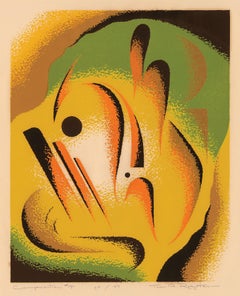
Thomas Robertson, 'Composition #4,' color serigraph, edition 47, c. 1940. Signed, titled, and annotated 'Ed/47' in pencil. A superb, painterly impression, with fresh colors, on buff wove paper, the full sheet with margins (1 to 2 inches), in excellent condition. Matted to museum standards, unframed.
Image size: 10 9/16 x 8 1/2 inches (268 x 216 mm); sheet size 13 x 12 1/2 inches (330 x 318 mm).
An impression of this work is represented in the collection of the National Gallery of Art.
ABOUT THE ARTIST
Born in Little Rock, Arkansas, Thomas Arthur Robertson (1911-1976) was the son of an attorney. Although his father, a co-owner of the Arkansas Law School, insisted that his son study there, after graduating, Robertson enrolled at the Adrian Brewer...
Category
1940s Abstract Abstract Prints
Materials
Screen
Constructivist Abstraction — Precisionism / Spatial Illusionism
By Paul Kelpe
Located in Myrtle Beach, SC
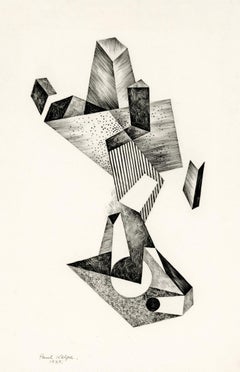
Paul Kelpe, Untitled (Abstract Composition), lithograph, 1937, edition unknown but small. Signed and dated in pencil. A fine, richly-inked impression, with all the nuanced texture an...
Category
1930s Abstract Geometric Abstract Prints
Materials
Lithograph
Variation 4, Vol. I
By Katherine Sophie Dreier
Located in Myrtle Beach, SC
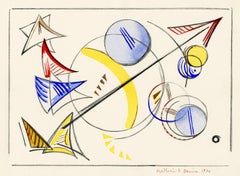
Katherine S. Dreier, 'Variation 4, Vol. I' from '1 to 40 Variations', lithograph with pochoir and hand-coloring, 1934, edition 65. Stenciled signature and date, lower right. Annotate...
Category
Mid-20th Century American Modern Abstract Prints
Materials
Watercolor, Lithograph, Stencil
#5 — Modernist Abstraction — African American Artist
Located in Myrtle Beach, SC
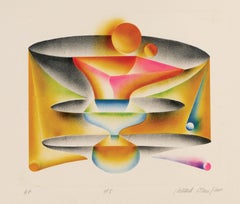
Hilliard Dean, '#5', color lithograph, 1970, edition not stated but small. Signed, titled, and annotated 'AP' in pencil. Dated 'June 11, 70' in pencil in...
Category
1970s Contemporary Abstract Prints
Materials
Lithograph
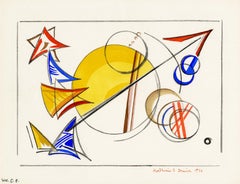
Variation 30, Vol. II
— from the series
1 to 40 Variations
By Katherine S. Dreier
Located in Myrtle Beach, SC
Katherine S. Dreier, 'Variation 30, Vol. II' from '1 to 40 Variations', lithograph with pochoir and hand-coloring, 1934, edition 65. Stenciled signature and date, lower right. Annota...
Category
1930s American Modern Abstract Prints
Materials
Lithograph
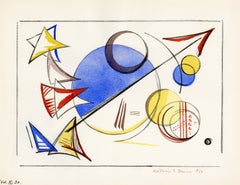
Variation 8, Vol. I
— from the series
1 to 40 Variations
By Katherine S. Dreier
Located in Myrtle Beach, SC
Katherine S. Dreier, 'Variation 8, Vol. 1' from '1 to 40 Variations', lithograph with pochoir and hand-coloring, 1934, edition 65. Stenciled signature and date, lower right. Annotate...
Category
1930s American Modern Abstract Prints
Materials
Lithograph
You May Also Like
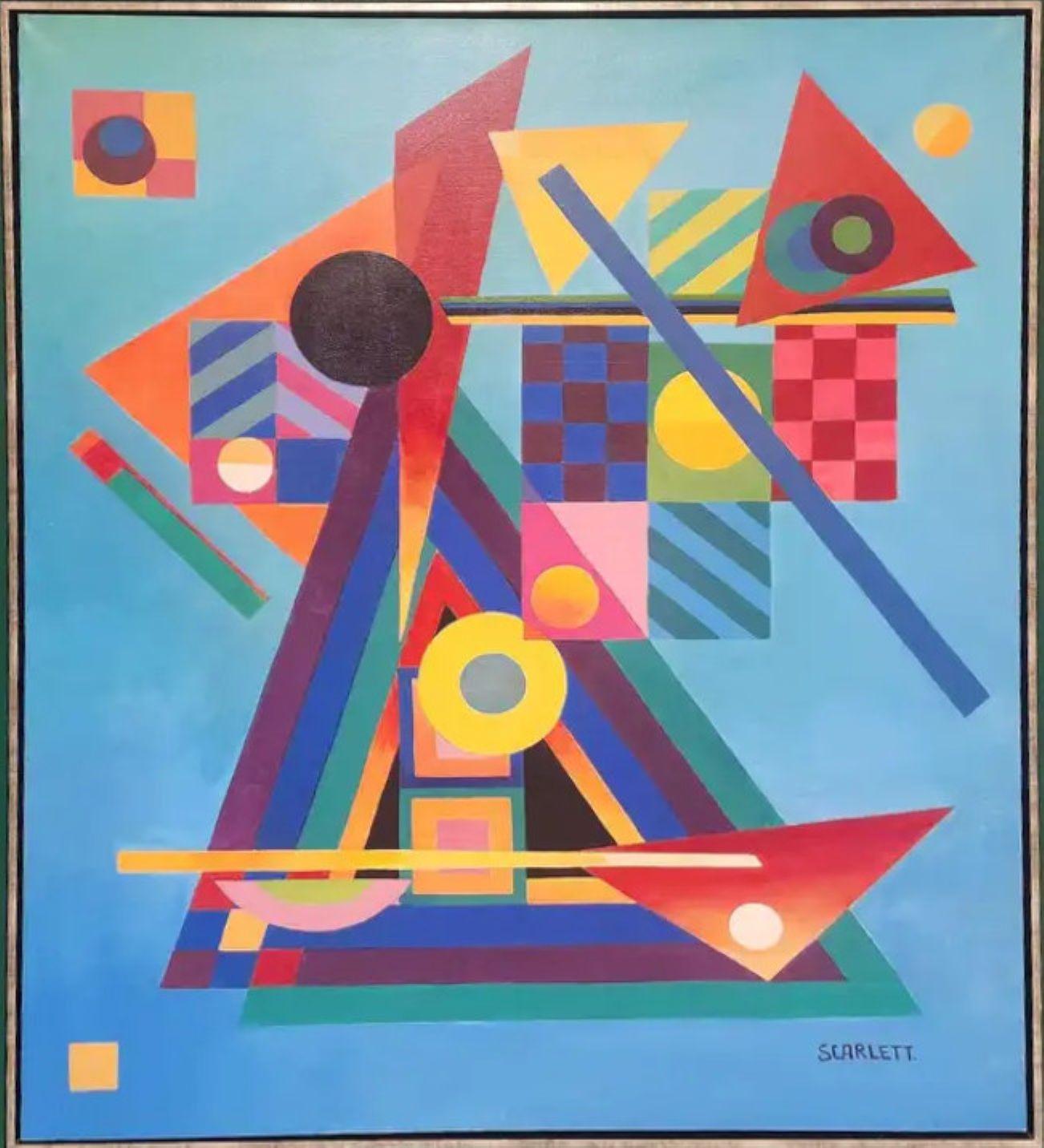
Geometric Abstract
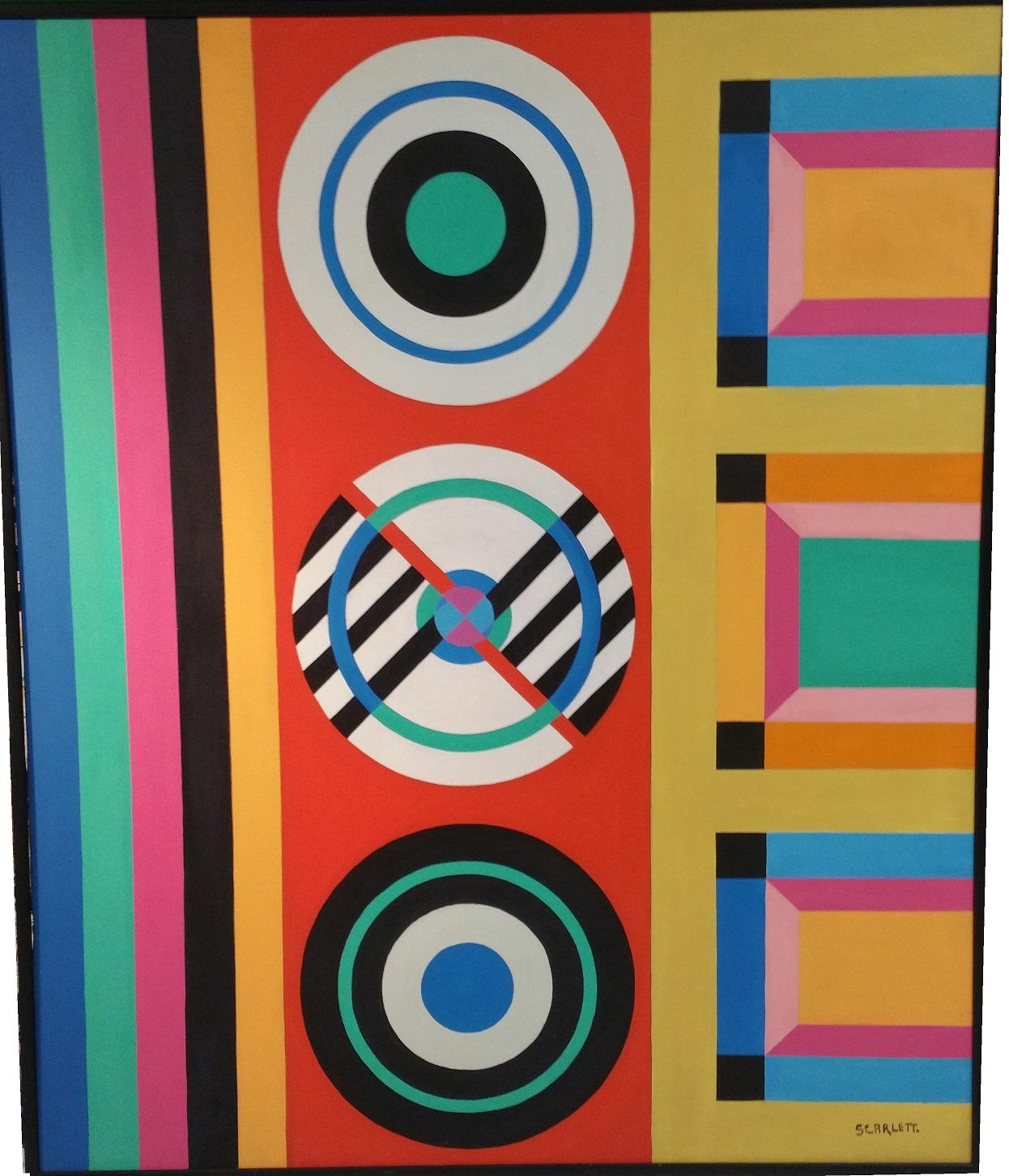
By Rolph Scarlett
Located in Saratoga Springs, NY
Signed lower right.
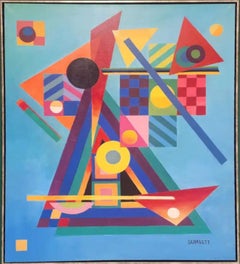
The composition is a tightly organized geometric abstraction on a deep blue ground. A large, centrally placed triangular form asserts the vertical axis and is an...
Category
1960s Abstract Geometric Abstract Paintings
Materials
Oil, Canvas
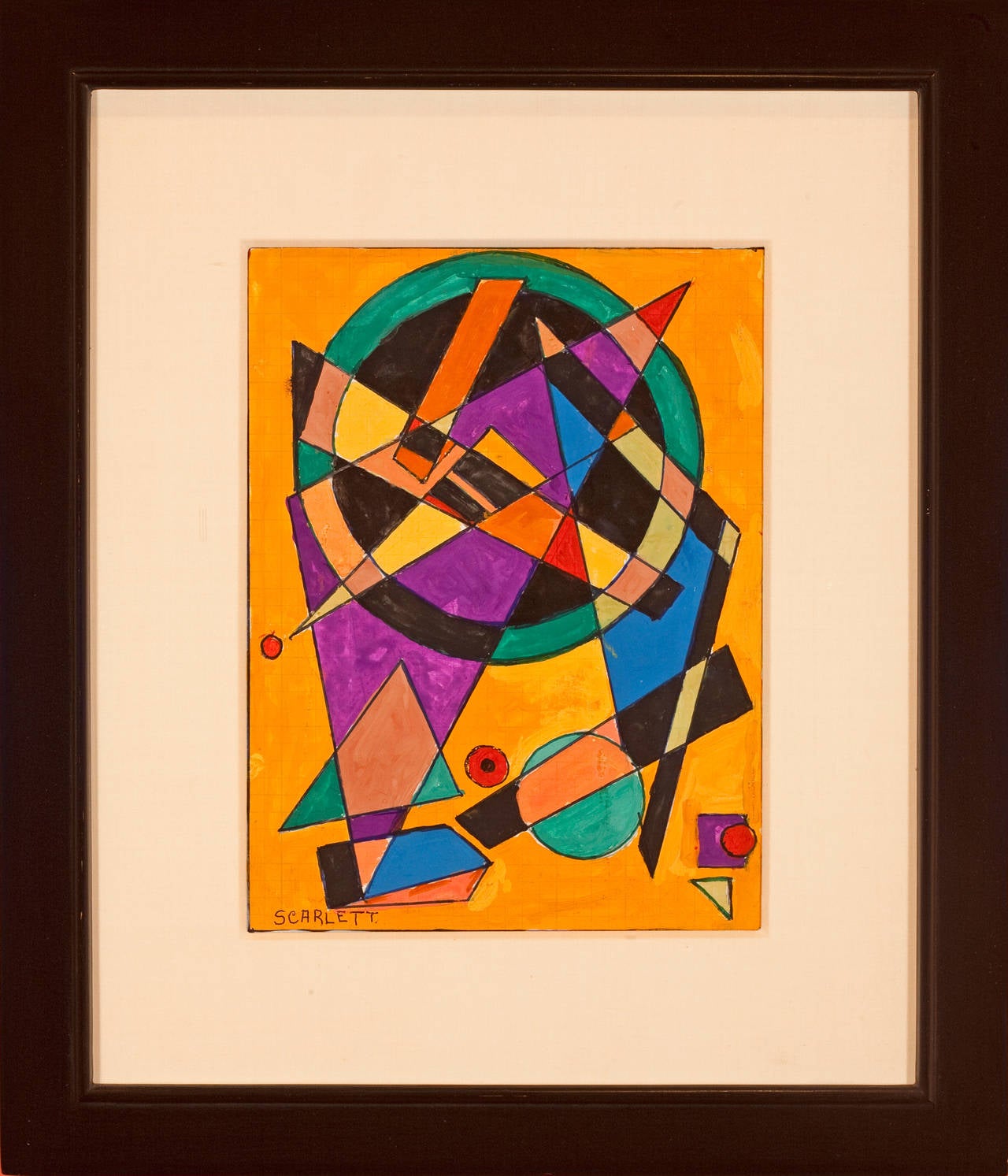
"Geometric Design"
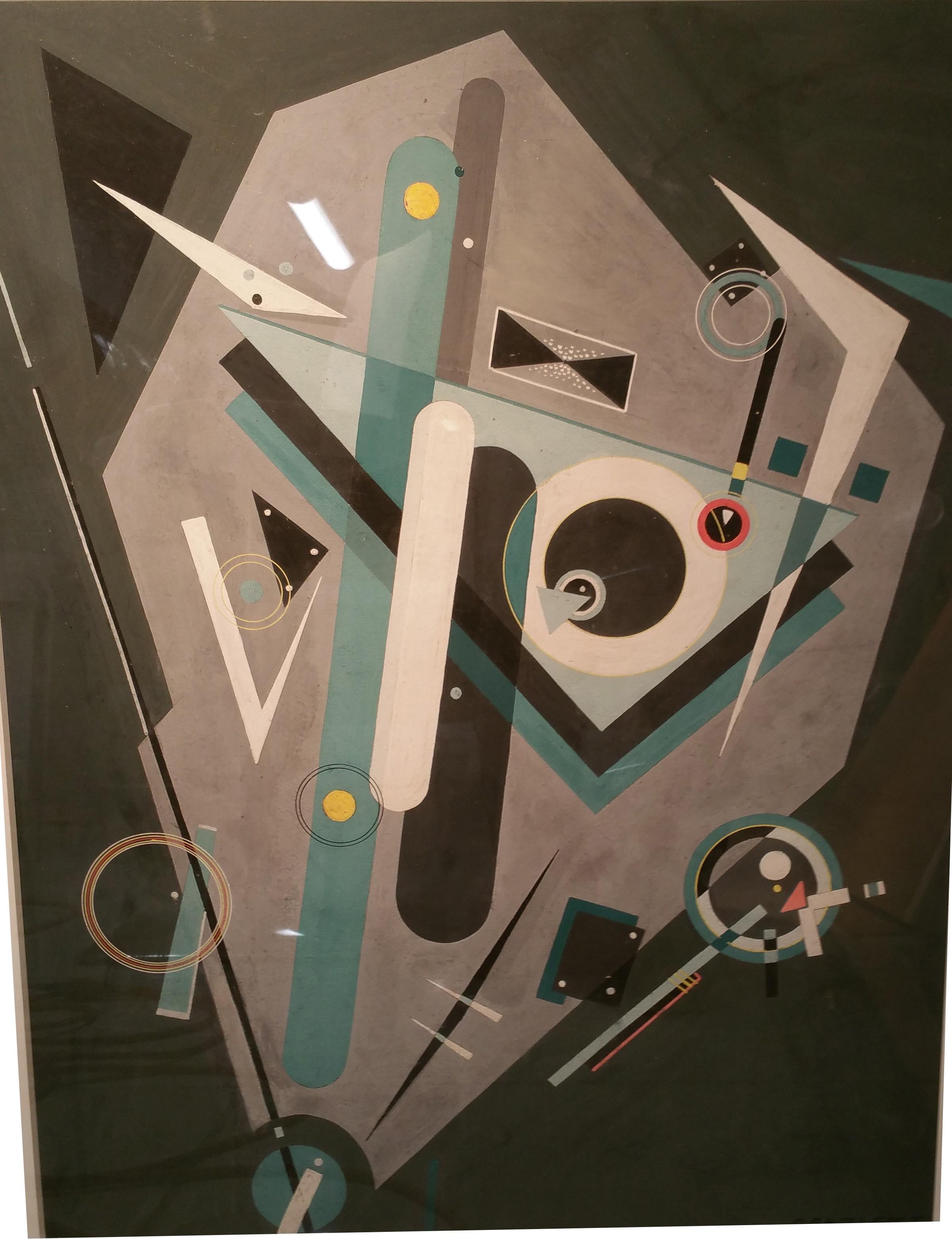
By Rolph Scarlett
Located in Lambertville, NJ
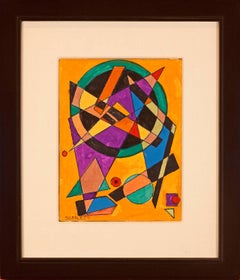
Jim’s of Lambertville is proud to offer this artwork.
Signed lower left.
Rolph Scarlett (1889 - 1984)
A major exponent of non-objective painting, Rolph Scarlett's career and art...
Category
20th Century Abstract Geometric Abstract Paintings
Materials
Paper, Gouache
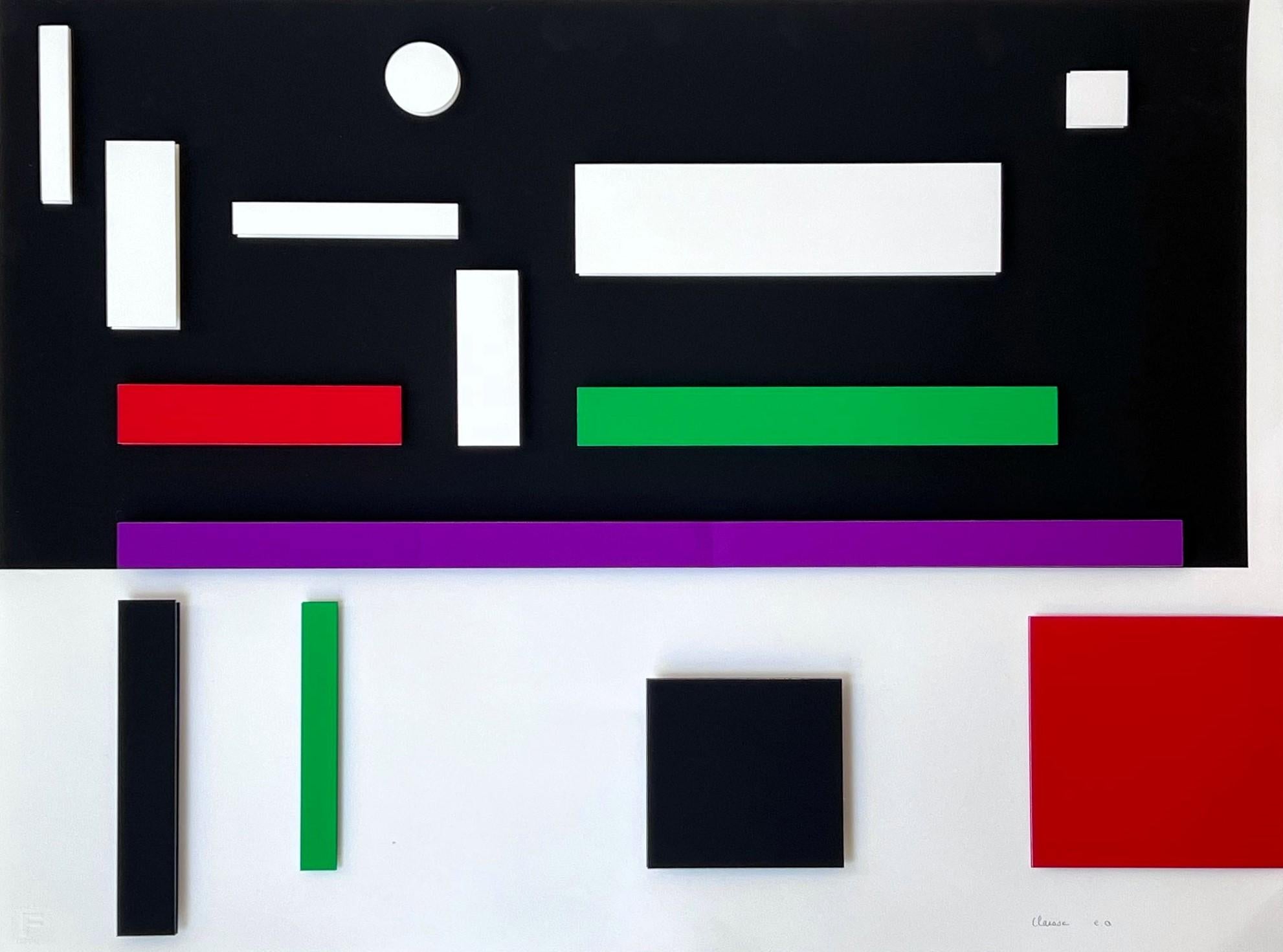
Geometric composition
By Geneviève Claisse
Located in Paris, FR
Silkscreen and relief collage
Handsigned by the artist in pencil and annotated EA
Edition : 30 ex.
61.00 cm. x 78.00 cm. 24.02 in. x 30.71 in. (paper)
61.00 cm. x 78.00 cm. 24.02 i...
Category
1980s Abstract Abstract Prints
Materials
Silk
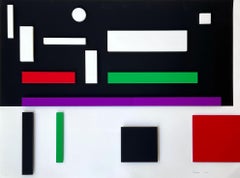
Geometric Abstract
By Rolph Scarlett
Located in Saratoga Springs, NY
Signed lower left.
About the artist:
Rolph Scarlett was a painter of geometric abstraction during the American avant-garde movement of the 1930s and 1940s. Born in Guelph, Ontario,...
Category
1960s Abstract Geometric Abstract Paintings
Materials
Canvas, Oil
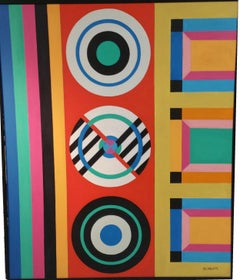
Geometric Composition
By Rolph Scarlett
Located in Saratoga Springs, NY
Rolph Scarlett (Canadian/American, 1889 - 1984)
“Geometric Composition”
Signed lower right, circa late 1930’s early 1940’s
19 ½ x 26 inches
Mixed media, Price on request
About
Rolph Scarlett was a painter of geometric and linear forms, an industrial designer, and a pioneer in helping establish non-objective art as an aesthetic in America. He also worked in an abstract art style during the American avant-garde movement which extended into the 1940s. He was born in Guelph, Ontario, Canada and travelled to New York City as an 18-year-old. By 1924 he made New York City his home.
In 1939, Scarlett was one of the founding members and forces which steered the development of the Museum of Non-Objective Painting in New York. (later, the Solomon R. Guggenheim Museum). Guggenheim was the sponsor behind the Avant Garde and pioneering, philosophy of Baroness Hilla Rebay who founded the early museum. She was both the founding curator and director of the museum, as well as an abstract artist. She encouraged and worked with Scarlett in the early museum years, together promoting the concepts of non-objective painting. In Scarlett’s aesthetic these where geometric elements intuitively placed in non-descript flat and three-dimensional space.
Any discussion of the history of the Guggenheim Museum must include four key figures: Hilla Rebay (1890-1967), Wassily Kandinsky (1866-1944), Rudolf Bauer (1889-1953), and Rolf Scarlett...
Category
1930s Abstract Geometric Abstract Paintings
Materials
Mixed Media, Board
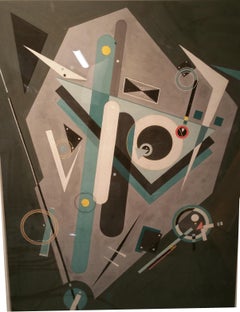
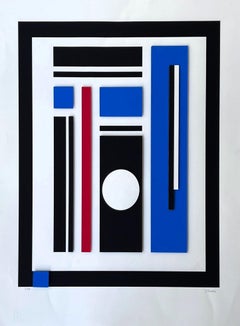
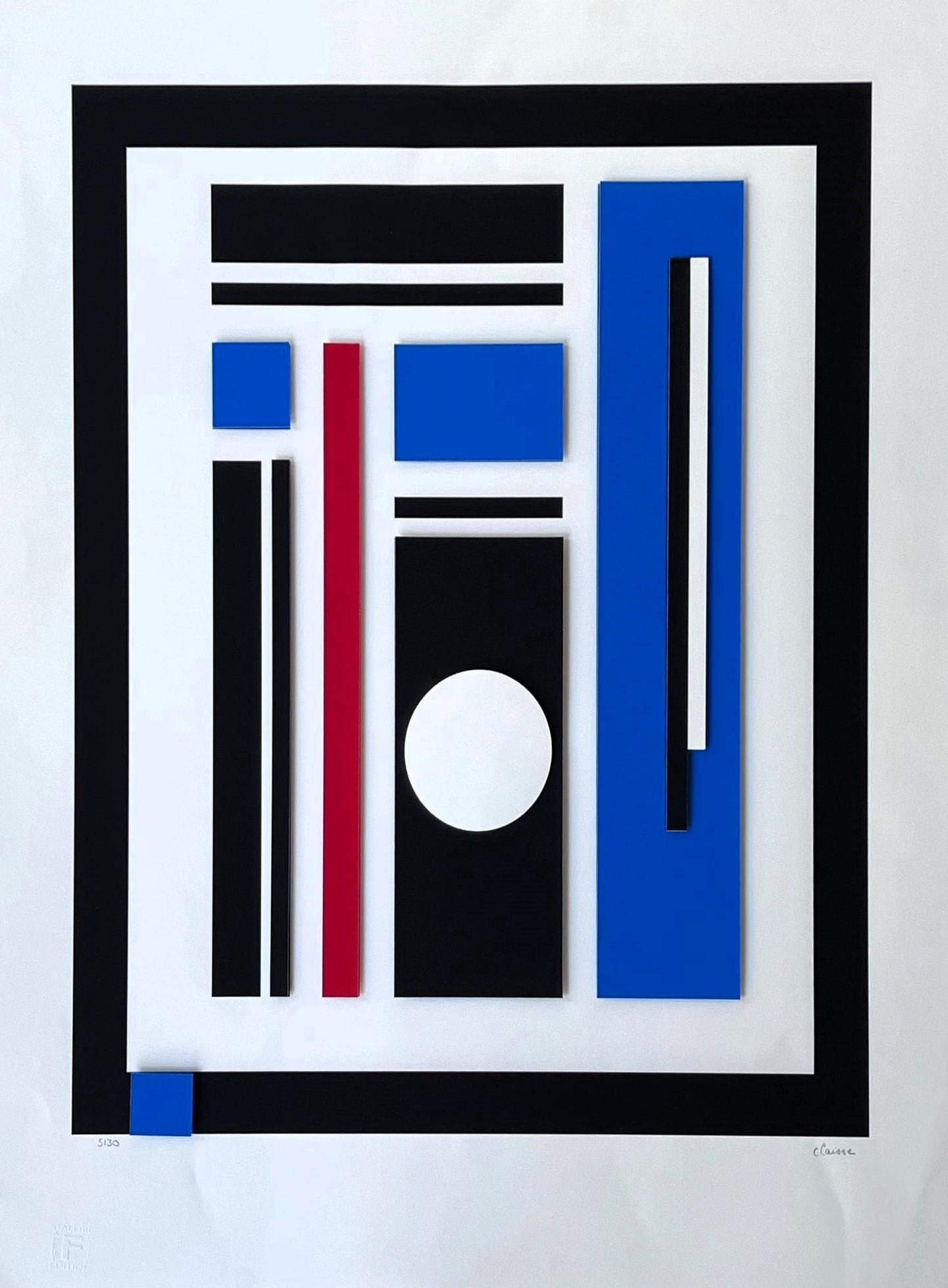
Geometric composition
By Geneviève Claisse
Located in Paris, FR
Silkscreen and relief collage
Handsigned by the artist in pencil and annotated "5130"
Edition : 30 ex.
74.00 cm. x 60.50 cm. 29.13 in. x 23.82 in. (paper)
74.00 cm. x 60.50 cm. 29....
Category
1980s Abstract Abstract Prints
Materials
Silk