1 of 5
FPA Francis Pavy ArtistSwamp house on Fire ( Earth tone colors)2000
2000
$3,400List Price
About the Item
- Creator:FPA Francis Pavy Artist (1954, American)
- Creation Year:2000
- Dimensions:Height: 22 in (55.88 cm)Width: 20 in (50.8 cm)Depth: 0.5 in (1.27 cm)
- Medium:
- Movement Style:
- Period:
- Condition:
- Gallery Location:Lafayette, LA
- Reference Number:1stDibs: LU1906212800532
Authenticity Guarantee
In the unlikely event there’s an issue with an item’s authenticity, contact us within 1 year for a full refund. DetailsMoney-Back Guarantee
If your item is not as described, is damaged in transit, or does not arrive, contact us within 7 days for a full refund. Details24-Hour Cancellation
You have a 24-hour grace period in which to reconsider your purchase, with no questions asked.Vetted Professional Sellers
Our world-class sellers must adhere to strict standards for service and quality, maintaining the integrity of our listings.Price-Match Guarantee
If you find that a seller listed the same item for a lower price elsewhere, we’ll match it.Trusted Global Delivery
Our best-in-class carrier network provides specialized shipping options worldwide, including custom delivery.You May Also Like
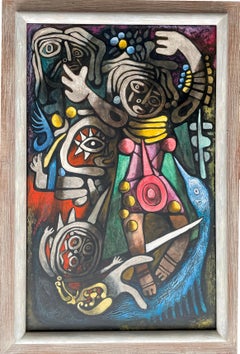
Ceremonial Dancers oil and tempera painting by Julio De Diego
By Julio de Diego
Located in Hudson, NY
Artwork measures 48" x 30" and framed 56 ¼" x 38 ¼" x 3"
Provenance:
John Heller Gallery, NYC, circa 1975 (label verso)
The artist's daughter
Corbino Galleries, Sarasota, FL (1990)...
Category
1940s Modern Abstract Paintings
Materials
Masonite, Oil, Tempera
$26,000
H 48 in W 30 in
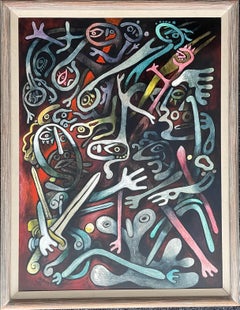
The Magician oil and tempera painting by Julio de Diego
By Julio de Diego
Located in Hudson, NY
Julio De Diego’s Atomic Series paintings made an extraordinary statement regarding the shock and fear that accompanied the dawn of the nuclear age. In the artist’s own words, “Scientists were working secretly to develop formidable powers taken from the mysterious depths of the earth - with the power to make the earth useless! Then, the EXPLOSION! . . . we entered the Atomic Age, and from there the neo-Atomic war begins. Explosions fell everywhere and man kept on fighting, discovering he could fight without flesh.”
To execute these works, De Diego developed a technique of using tempera underpainting before applying layer upon layer of pigmented oil glazes. The result is paintings with surfaces which were described as “bonelike” in quality. The forms seem to float freely, creating a three-dimensional visual effect. In the 1954 book The Modern Renaissance in American Art, author Ralph Pearson summarizes the series as “a fantastic interpretation of a weighty theme. Perhaps it is well to let fantasy and irony appear to lighten the devastating impact. By inverse action, they may in fact increase its weight.”
Exhibited
1964 Marion Koogler McNay Art Institute, San Antonio, Texas
This work retains its original frame which measures 54" x 42" x 2"
About this artist: Julio De Diego crafted a formidable persona within the artistic developments and political struggles of his time. The artist characterized his own work as “lyrical,” explaining, “through the years, the surrealists, the social-conscious painters and the others tried to adopt me, but I went my own way, good, bad or indifferent.” [1] His independence manifested early in life when de Diego left his parent’s home in Madrid, Spain, in adolescence following his father’s attempts to curtail his artistic aspirations. At the age of fifteen he held his first exhibition, set up within a gambling casino. He managed to acquire an apprenticeship in a studio producing scenery for Madrid’s operas, but moved from behind the curtains to the stage, trying his hand at acting and performing as an extra in the Ballet Russes’ Petrouchka with Nijinsky. He spent several years in the Spanish army, including a six-month stretch in the Rif War of 1920 in Northern Africa. His artistic career pushed ahead as he set off for Paris and became familiar with modernism’s forays into abstraction, surrealism, and cubism.
The artist arrived in the U.S. in 1924 and settled in Chicago two years later. He established himself with a commission for the decoration of two chapels in St. Gregory’s Church. He also worked in fashion illustration, designed magazine covers and developed a popular laundry bag for the Hotel Sherman. De Diego began exhibiting through the Art Institute of Chicago in 1929, and participated in the annual Chicago Artists Exhibitions, Annual American Exhibitions, and International Water Color Exhibitions. He held a solo exhibition at the Art Institute of Chicago in the summer of 1935. Though the artist’s career was advancing, his family life had deteriorated. In 1932 his first marriage dissolved, and the couple’s young daughter Kiriki was sent to live with friend Paul Hoffman.
De Diego continued to develop his artistic vocabulary with a growing interest in Mexican art. He traveled throughout the country acquainting himself with the works of muralists such as Carlos Merida, and also began a collection of small native artifacts...
Category
1940s American Modern Abstract Paintings
Materials
Masonite, Oil, Tempera
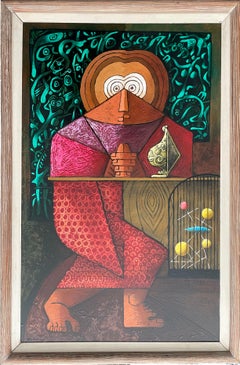
St. Atomic oil and tempera painting by Julio de Diego
By Julio de Diego
Located in Hudson, NY
Julio De Diego’s Atomic Series paintings made an extraordinary statement regarding the shock and fear that accompanied the dawn of the nuclear age. In the artist’s own words, “Scientists were working secretly to develop formidable powers taken from the mysterious depths of the earth - with the power to make the earth useless! Then, the EXPLOSION! . . . we entered the Atomic Age, and from there the neo-Atomic war begins. Explosions fell everywhere and man kept on fighting, discovering he could fight without flesh.”
To execute these works, De Diego developed a technique of using tempera underpainting before applying layer upon layer of pigmented oil glazes. The result is paintings with surfaces which were described as “bonelike” in quality. The forms seem to float freely, creating a three-dimensional visual effect. In the 1954 book The Modern Renaissance in American Art, author Ralph Pearson summarizes the series as “a fantastic interpretation of a weighty theme. Perhaps it is well to let fantasy and irony appear to lighten the devastating impact. By inverse action, they may in fact increase its weight.”
Exhibited
1950 University of Illinois at Urbana "Contemporary American Painting"
1964 Marion Koogler McNay Art Institute, San Antonio, Texas
This work retains its original frame which measures 54" x 36" x 2".
About this artist: Julio De Diego crafted a formidable persona within the artistic developments and political struggles of his time. The artist characterized his own work as “lyrical,” explaining, “through the years, the surrealists, the social-conscious painters and the others tried to adopt me, but I went my own way, good, bad or indifferent.” [1] His independence manifested early in life when de Diego left his parent’s home in Madrid, Spain, in adolescence following his father’s attempts to curtail his artistic aspirations. At the age of fifteen he held his first exhibition, set up within a gambling casino. He managed to acquire an apprenticeship in a studio producing scenery for Madrid’s operas, but moved from behind the curtains to the stage, trying his hand at acting and performing as an extra in the Ballet Russes’ Petrouchka with Nijinsky. He spent several years in the Spanish army, including a six-month stretch in the Rif War of 1920 in Northern Africa. His artistic career pushed ahead as he set off for Paris and became familiar with modernism’s forays into abstraction, surrealism, and cubism.
The artist arrived in the U.S. in 1924 and settled in Chicago two years later. He established himself with a commission for the decoration of two chapels in St. Gregory’s Church. He also worked in fashion illustration, designed magazine covers and developed a popular laundry bag for the Hotel Sherman. De Diego began exhibiting through the Art Institute of Chicago in 1929, and participated in the annual Chicago Artists Exhibitions, Annual American Exhibitions, and International Water Color Exhibitions. He held a solo exhibition at the Art Institute of Chicago in the summer of 1935. Though the artist’s career was advancing, his family life had deteriorated. In 1932 his first marriage dissolved, and the couple’s young daughter Kiriki was sent to live with friend Paul Hoffman.
De Diego continued to develop his artistic vocabulary with a growing interest in Mexican art. He traveled throughout the country acquainting himself with the works of muralists such as Carlos Merida, and also began a collection of small native artifacts...
Category
1940s American Modern Abstract Paintings
Materials
Masonite, Oil, Tempera
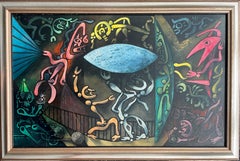
Inevitable Day – Birth of the Atom oil and tempera painting by Julio De Diego
By Julio de Diego
Located in Hudson, NY
Julio De Diego’s Atomic Series paintings made an extraordinary statement regarding the shock and fear that accompanied the dawn of the nuclear age. In the artist’s own words, “Scientists were working secretly to develop formidable powers taken from the mysterious depths of the earth - with the power to make the earth useless! Then, the EXPLOSION! . . . we entered the Atomic Age, and from there the neo-Atomic war begins. Explosions fell everywhere and man kept on fighting, discovering he could fight without flesh.”
To execute these works, De Diego developed a technique of using tempera underpainting before applying layer upon layer of pigmented oil glazes. The result is paintings with surfaces which were described as “bonelike” in quality. The forms seem to float freely, creating a three-dimensional visual effect. In the 1954 book The Modern Renaissance in American Art, author Ralph Pearson summarizes the series as “a fantastic interpretation of a weighty theme. Perhaps it is well to let fantasy and irony appear to lighten the devastating impact. By inverse action, they may in fact increase its weight.”
Bibliography
Art in America, April 1951, p.78
About this artists: Julio De Diego crafted a formidable persona within the artistic developments and political struggles of his time. The artist characterized his own work as “lyrical,” explaining, “through the years, the surrealists, the social-conscious painters and the others tried to adopt me, but I went my own way, good, bad or indifferent.” [1] His independence manifested early in life when de Diego left his parent’s home in Madrid, Spain, in adolescence following his father’s attempts to curtail his artistic aspirations. At the age of fifteen he held his first exhibition, set up within a gambling casino. He managed to acquire an apprenticeship in a studio producing scenery for Madrid’s operas, but moved from behind the curtains to the stage, trying his hand at acting and performing as an extra in the Ballet Russes’ Petrouchka with Nijinsky. He spent several years in the Spanish army, including a six-month stretch in the Rif War of 1920 in Northern Africa. His artistic career pushed ahead as he set off for Paris and became familiar with modernism’s forays into abstraction, surrealism, and cubism.
The artist arrived in the U.S. in 1924 and settled in Chicago two years later. He established himself with a commission for the decoration of two chapels in St. Gregory’s Church. He also worked in fashion illustration, designed magazine covers and developed a popular laundry bag for the Hotel Sherman. De Diego began exhibiting through the Art Institute of Chicago in 1929, and participated in the annual Chicago Artists Exhibitions, Annual American Exhibitions, and International Water Color Exhibitions. He held a solo exhibition at the Art Institute of Chicago in the summer of 1935. Though the artist’s career was advancing, his family life had deteriorated. In 1932 his first marriage dissolved, and the couple’s young daughter Kiriki was sent to live with friend Paul Hoffman.
De Diego continued to develop his artistic vocabulary with a growing interest in Mexican art. He traveled throughout the country acquainting himself with the works of muralists such as Carlos Merida, and also began a collection of small native artifacts...
Category
1940s American Modern Abstract Paintings
Materials
Masonite, Oil, Tempera
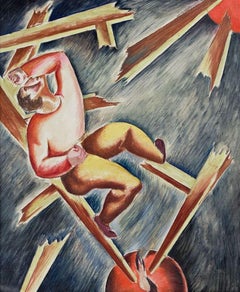
"Shattered" WPA Mid 20th Century Modernism American Scene Surrealism Figurative
By Leon Bibel
Located in New York, NY
"Shattered" WPA Mid 20th Century Modernism American Scene Surrealism Figurative
Estate stamp on the stretcher, verso. Provenance: Estate of the artist. 20 x 24 inches.
Look at the last two photos in the listing. A new book about Leon Bibel was just published and there's a photo of the artist taken in front of the painting. Amazingness.
BIO
Leon Bibel continued painting through 1941 and resumed work in both painting and especially wood sculpture by 1960. He worked until his very last day in 1995. His last series of large wood sculptures were modeled on spice boxes, which were miniature buildings...
Category
1930s American Modern Figurative Paintings
Materials
Canvas, Oil
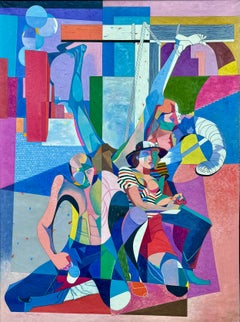
Figurative Cubist Surrealist Abstraction Mid 20th Century American Modern Large
By O. Louis Guglielmi
Located in New York, NY
Figurative Cubist Surrealist Abstraction Mid 20th Century American Modern Large
O. Louis Guglielmi (1906 - 1956)
OBSESSIVE THEME
44 x 33 inches
Oil on canvas
Signed and dated '48 lo...
Category
1940s American Modern Abstract Paintings
Materials
Canvas, Oil
$50,000
H 47 in W 36 in D 2 in
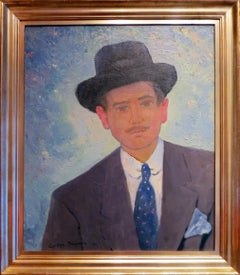
"Pinky"
By Gershon Benjamin
Located in Lambertville, NJ
Ashley John is proud to offer this artwork by:
Gershon Benjamin (1899 - 1985)
Gershon Benjamin is a painter of portraits, landscapes, still lives, and the urban scene. He had a pro...
Category
20th Century Modern Abstract Paintings
Materials
Canvas, Oil
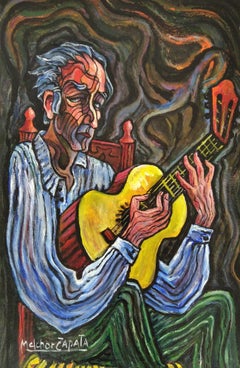
Tikkun
By Noé Katz
Located in Greenwich, CT
Noé Katz is a multi-media Mexican artist creating paintings, sculptures, and murals that reflect concepts of humanity in his signature modernist style.
Category
2010s Modern Abstract Paintings
Materials
Linen, Oil

Untitled
Located in Barcelona, BARCELONA
The painting is being offered with a work and authenticity certificate
Category
2010s Modern Abstract Paintings
Materials
Oil
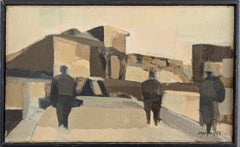
Vintage Modernist Abstract Figurative City Framed Oil Painting- Spanish Walks
Located in Bristol, GB
SPANISH WALKS
Size: 24 x 37 cm (including frame)
Oil on Board
An outstanding semi-abstract oil composition, painted in 1958 by the established Swedish artist Ivar Morsing (1919-2009...
Category
Mid-20th Century Modern Figurative Paintings
Materials
Oil, Board
$1,473
H 9.45 in W 14.57 in
Still Thinking About These?
All Recently ViewedMore Ways To Browse
Swamp Art
Swamp Painting
Large Cubist Paintings
Paint By Number
Red Gold Acrylic Paintings
This End Up
Vintage Drip Painting
Abstract Metallic Painting
Anne Truitt
Gradient Acrylic
Hawaii Abstract Art
Primary Colors Painting
Richard Grey
Sci Fi Art
Vintage Scaffolding
Water Splash
Art Painting Brazil
Colombia Art Bogota