Items Similar to Franco Angeli 1960s Italian Pop Art Signed Painting
Want more images or videos?
Request additional images or videos from the seller
1 of 13
Franco AngeliFranco Angeli 1960s Italian Pop Art Signed Painting1965
1965
$11,272.29
£8,415.31
€9,500
CA$15,660.62
A$16,845.23
CHF 9,002.58
MX$198,557.31
NOK 113,501.47
SEK 103,761.88
DKK 72,400.67
About the Item
Franco Angeli's Half Dollar
Giuseppe Franco Angeli (14 May 1935 – 12 November 1988) was one of the best modern Italian artist.
Half Dollar (1965) is an emblematic work of Franco Angeli's pop style, created using a stencil technique on canvas.
It reproduces the reverse side of the American half-dollar coin, with two overlapping eagles – one in vivid red and the other in deep blue – surrounded by stars, rays and fragmented inscriptions such as ‘UNITED STATES OF AMERICA’ and ‘HALF DOLLAR’.
The symmetrical design and colour contrast of Franco Angeli's work evoke the US flag, in an aura of ironic criticism of consumerism and power. On the back of the canvas is a handwritten dedication: “Omaggio a Mirella AMGCV” (Tribute to Mirella AMGCV), which adds a personal and intimate touch to the work.
Franco Angeli (Rome, 1935–1988), a self-taught painter with socialist roots, was a leading figure in Italian Pop Art and the Piazza del Popolo School. Using stencils and enamels, he explored symbols of power, consumerism and contemporary history, influenced by American culture. In Franco Angeli's art, the eagle – taken from the reverse side of the US coin – symbolises imperial power...
This artwork, never before on the market, comes from an important Italian private collection
Every item of our Gallery, upon request, is accompanied by a certificate of authenticity issued by Sabrina Egidi official Expert in Italian furniture for the Chamber of Commerce of Rome and for the Rome Civil Courts.
Our company has been present on this platform for many years, with numerous sales made and just as many excellent reviews received that you can under our Furniture account.
Giuseppe Franco Angeli, the son of Erminia Angeli and Gennaro Gennarini, was born in Via dei Piceni in the Quartiere San Lorenzo district of Rome on May 14, 1935.
Like his brothers Omero and Othello, he took his mother's surname.
At the age of nine, following his father's death, Angeli began working as a storeroom boy. He also worked in a car body repair shop and was an upholsterer for a time.
All these aspects of his early life affected his art career and style. Later in life, his style included the use of fabrics, templates, and scraps of cloth reminiscent of his past upholstery work
From 1955 to 1957, Angeli was a self-taught artist.
Though Angeli had never taken formal art classes, he began painting in 1957 during military service in Orvieto.
He justified his position by stating that "when you feel a deep malaise, you must look for a way not to be lonely. In short, you need to end an interest that will accompany you in life."
While stationed in Rome, Angeli met a sculptor named Edgardo Mannucci.
Mannucci had connections with a painter called Alberto Burri and Angeli found the painter's work fascinating.
He adapted Burri's techniques in his own work, eventually borrowing the worn-out materiality of the Catrami (Tars).
In fact, the overall aesthetic of broken or ruined things became a key aspect of his work.
Significantly, the aesthetic appeared in the subject of his painting E da una ferita scaturì la bellezza (Out of a Wound, Beauty Pours Forth; 1957), a work based on his memories of the bombing of San Lorenzo on 19 July 1943.
In his opinion, "matter for me is a fragment of this huge wound that devastated Europe; my first paintings were like that—like a wound from which I removed pieces of a bandage.
From this inherently political groundwork, Angeli's art found its own political charge.
His membership in the Italian Communist Party left marks in his initial approaches to painting.
These marks faded after he departed the party and drew closer to the more radical leftist and Maoist movements.
In March 1959, in a joint exhibition at the Galleria La Salita with Tano Festa and Giuseppe Uncini, Angeli exhibited his works for the first time.
The magazine Azimuth, founded by Piero Manzoni and Enrico Castellani, featured him alongside Agostino Bonalumi, Jasper Johns, Yves Klein, Robert Rauschenberg, and Mimmo Rotella.
In January 1960, the Galleria La Salita gave him his first solo exhibit. His featured works consisted of veils of oil paints and nylon stockings stretched tight and covered with gauze.
A critic called Cesare Vivaldi described the effects of those evoked memories and absences as the "tears of things".
In 1960, Angeli took part in a collective show, again at the Galleria La Salita, entitled 5 pittori. Roma 60 (5 Painters. Rome 60).
The artists were Angeli, Festa, Lo Savio, Schifano, Uncini; the show was curated by Pierre Restany.
In 1962, Angeli took part in "New Perspectives of Italian Painting", an exhibition at the Galleria Comunale d'Arte Moderna in Bologna. Angeli showed a series of works with symbols of power—initially swastikas, crosses, and half-moons.
For instance, the series entitled Cimiteri (Cemeteries) from the early 1960s used sequences of white crosses, which recall the power of Mauri's Schermi (Screens) and the Achrome (Achromes) by Manzoni, with whom he was in close contact.
As time went on, Angeli began to portray fragments of history and recorded traces of contemporary events.
One work, called O.A.S. (1961), alluded to the illegal paramilitary French organization during the Algerian war.
Another work, Cuba (1960), drew from the United States embargo shortly after Fidel Castro's revolutionary forces had overthrown Batista's dictatorship. Further, 25 Luglio (1963), which means 25 July, commemorates the fall of Italy's fascist regime in 1943.
In February 1963, Angeli showed his works along with a poem by Nanni Balestrini in an art exhibition of 13 pittori a Roma ("13 painters"), in the Galleria La Tartaruga.
In May of the same year, he presented at the Galerie J in Paris with Christo, Conner, Kudo, Todd, and Mauri in an exhibition curated by Restany - L'Object Pressenti.
Shortly afterward in June, he held a solo show at the Galleria La Tartaruga with a series of works focusing on the value of the symbol to acquire a different dimension.
This allowed him to go beyond the legacy of Arte informale. In 1963, he collaborated with Mario Diacono and Elio Pagliarani to produce limited editions of books with handwritten texts and original drawings.
For a solo show at the Galleria dell'Ariete, Milan in January 1964, Angeli resorted to stereotypical ideological urban symbols emblematic of the rhetorical, celebratory character of Rome's archaeological ends.
These works became the "Capitoline Fragments", which he presented in a Roman exhibition at the Studio d'arte Arco d'Alibert in October 1964\
In March, he featured in a show with Umberto Bignardi, Festa, Giosetta Fioroni, Jannis Kounellis, Sergio Lombardo, Renato Mambor, and Cesare Tacchi at the Galleria La Tartaruga.
In June, he showed his work for the first time at the Venice Biennale (32nd International Art Exhibition). In the two works he selected for that show, La Lupa (She-Wolf) and Quarter Dollar, his use of the veil obscured the significance of the underlying symbol.
Those two paintings faded from the public's memory with little impact.
In April 1965, Galleria Odyssia, Rome presented an exhibition called "A Generation", which featured Angeli as a prominent artist.[citation needed] In the autumn he had two simultaneous solo shows—one at the Galerie J, Paris, and the other at Galleria Zero, Verona—and also presented at the 10th National Art Quadrennial in Rome and in L'art actuel en Italie: semaines italiennes at the Municipal Casino, Cannes.
He produced a series of dazibaos: Compagni, Berlino 1945 (Comrades, Berlin, 1945), Compagno vietnamita (Vietnamese Comrade), Occupazione di un monumento equestre (Occupation of an Equestrian Monument), and Abbraccio eterno (Eternal Embrace).
These works caused the critic Dario Micacchi to describe Angeli's painting approach as "seeing and making reality be seen politically"
Angeli's 1966 solo show Half Dollar at the Studio d'arte Arco d'Alibert exemplified his views on coins, which he saw as "the small symbolic world that he had been seeking for years.
He had previously thought he had found this in bags, coats of arms and stone inscriptions."
In October, the exhibition America America (Half Dollar) opened at the Galleria dell'Ariete with veiled, gilded eagles in hues of blue, white and red.
The same title appeared in a solo show at the Studio d'arte Arco d'Alibert in March (1967).
In April of that year, he took part in the collective show of eight Roman painters at the Galleria De Foscherari, Bologna, and in June he attended as one of "Eleven Italian Artists from the 1960s" in an exhibition at the Spoleto Festival of Two Worlds, where he met Marina Ripa di Meana, with whom he had a long love affair.
In September, he took part in the 9th São Paulo Art Biennial and made his first film, Giornate di lettura (Reading Days), followed by a long period in which he combined video, photography, and the visual arts. This approach appears in films such as Schermi (Screens; 1968), New York (1969), Viva il Primo Maggio (Hurrah for the First of May; 1968), and Souvenir (1984).[citation needed]
In 1966, Sandro Franchina shot a film entitled Morire gratis (Die for Free), which told the story of how Angeli's sculpture, the Lupa capitolina (Capitoline She-Wolf), traveled by car from Rome to Paris.
In March 1968, in a solo exhibition at the Galleria La Tartaruga, Angeli showed a series of works with metal inserts, grids, arrows, and three-dimensional panels that prefigured the lowered ceiling of the installation, Opprimente (Oppressive), that the Galleria La Tartaruga created for "The Theatre of Exhibitions", a landmark event involving a host of artists such as Fioroni, Emilio Prini and Paolo Icaro, Pier Paolo Calzolari, Castellani, Paolo Scheggi, Mario Ceroli, Mambor, Tacchi, Alighiero Boetti, and Mauri.
In 1968, Angeli's preoccupation with the Vietnam war and the student protests caused him to produce works such as Università Americana (American University; 1967) and Corteo (Protest March; 1968), which he created using the technique of social reportage.
In January 1969, he made his first trip to the United States.
He arrived ahead of the collective exhibition entitled Italian Art Show: Franco Angeli, Cesare Tacchi, Tano Festa and Lorri Whiting, which was installed in the Contemporary Arts Gallery of the Loeb Student Center in New York throughout October and November.
Two other exhibitions in Italy, a solo show at the Galleria dell'Ariete in January and Anno '60 (The Year 1960) at the Galleria Christian Stein in April, drew him back to his homeland.
In the early 1970s, Angeli continued to focus on realistic political events.
He produced a series of landscapes, including Canto popolare delle Ande (Andean Folk Song), a geometrically inspired work dedicated to the coup in Chile on 11 September 1973.
He returned to the Vietnam war in Anonimo Euroasiatico (Anonymous Eurasian; 1969) and Compagni (Giap e Ho Chi Minh) (Comrades [Giap and Ho Chi Minh]; 1971), while he also addressed the military coup in Greece.
In 1975, he met Livia Lancellotti, his life partner. The two of them had a daughter, Maria, in 1976.
In the late 1970s and early 1980s, some "childishly joyful toy airplanes, bearing death in Vietnam" began to appear in his landscapes.
His works started to recall the bombings of the Second World War.
Angeli's deep interest in social and popular culture issues continued in his works throughout the 1980s, when he returned to the theme of war in a series of exotic landscapes with pyramids, obelisks, and airplanes that eventually became Esplosioni (Explosions; 1986).
The stylized forms had spires, capitals, and deserted squares as if in "a grandiose, excruciating sense of excavation in which history and life resurface as perfect, intact geometric solids radiating fresh, fragrant pure colors—green, blue, and red."
The theme of "puppets", which he developed in 1984, became a kind of self-portrait that foreshadowed the last stage of his life.
Franco Angeli died in Rome on November 12, 1988
Under existing legislation, any artwork created over 70 years ago by an artist who has died can requires a license for export regardless of the work’s market price. The shipping may require additional handling days to require the license according to the destination of the artwork.
- Creator:Franco Angeli (1935 - 1988)
- Creation Year:1965
- Dimensions:Height: 27.56 in (70 cm)Width: 39.38 in (100 cm)Depth: 1.19 in (3 cm)
- Medium:
- Movement Style:
- Period:
- Framing:Framing Options Available
- Condition:
- Gallery Location:Roma, IT
- Reference Number:1stDibs: LU2883217471672
About the Seller
No Reviews Yet
Vetted Professional Seller
Every seller passes strict standards for authenticity and reliability
Established in 1990
1stDibs seller since 2025
8 sales on 1stDibs
Typical response time: <1 hour
- ShippingRetrieving quote...Shipping from: Roma, Italy
- Return Policy
More From This Seller
View AllBertina Lopez Contemporary Signed Date and Inscribed Painting
By Bertina Lopes
Located in Roma, IT
The painting of Bertina Lopez (Mama B) privileges her maternal Mozambican roots.
Her artistic work, like that of many others of her generation, is steeped in social criticism and Mo...
Category
Early 2000s Contemporary Abstract Paintings
Materials
Paper
Bertina Lopez Contemporary Signed Date and Inscribed Painting
By Bertina Lopes
Located in Roma, IT
Bertina Lopes (Mama B) painting on cardboard entitled ‘Life has many paths, but do you know yours?’.
The painting of Bertina Lopez (Mama B) privileges her maternal Mozambican roots....
Category
Early 2000s Contemporary Abstract Paintings
Materials
Metal
1970s Modern Abstract Italian Painting by Claudio Cazzola
By Claudio Cazzola
Located in Roma, IT
Beautiful modern painting from the 1970s by the artist Claudio Cazzola.
An abstract motif of rare intensity and originality, this very elegant painting has two exhibition stamps on t...
Category
1970s Abstract Abstract Paintings
Materials
Canvas, Oil
$1,044 Sale Price
20% Off
1970s Italian Signed Modern Abstract Painting by Riccardo Licata
By Riccardo Licata
Located in Roma, IT
Important watercolour on paper 'Untitled' by the great Italian artist Riccardo Licata.
Dated and signed at lower right "74 Licata".
This work is representative at the highest level ...
Category
Mid-20th Century Abstract Abstract Paintings
Materials
Paper, Watercolor
$1,495 Sale Price
30% Off
1980s Signed Mario Schifano Artwork on Paper
By Mario Schifano
Located in Roma, IT
Materic silkscreen print “Ondate di gelo” (Frost Waves) by Mario Schifano.
Signature and numbering in pencil on front side.
Dry stamp of the artist on front.
Edition F.C. (Not for...
Category
1980s Modern Abstract Prints
Materials
Paper
$1,518 Sale Price
20% Off
1970s Italian Pop Art Tano Festa Signed and Dated Drawing
By Tano Festa
Located in Roma, IT
1970s Tano Festa Signed and Dated Drawing
Important work in marker on cardboard by the great Roman artist Tano Festa, one of the major exponents, together with Mario Schifano, of th...
Category
Mid-20th Century Conceptual Abstract Paintings
Materials
Paper, Permanent Marker
You May Also Like
Pop Art Silkscreen by Woody Van Amen, 1968
Located in Rotterdam, ZH
Unique Pop Art silkscreen by famous Dutch pop art pioneer Woody van Amen (born 1936), 1968. Van Amen attended the Academy of Fine Arts in Rotterdam in 1...
Category
Vintage 1960s Dutch Other Contemporary Art
Materials
Aluminum
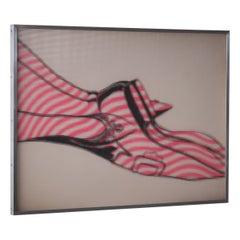
1966 Italy Abstract Collage Painting by Ermete Lancini
Located in Brescia, IT
This stunning abstract Pop artwork was made in 1966, by the well known Italian artist Ermete Lancini.
The artwork is a painting and a collage with newsp...
Category
Mid-20th Century Post-Modern Abstract Paintings
Materials
Paper, Magazine Paper
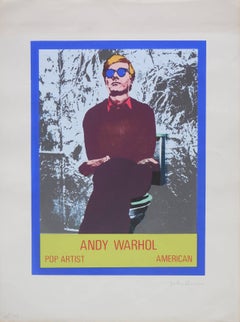
Vintage 1960s Andy Warhol Photo Silkscreen Serigraph Pop Art
By John Brower
Located in Surfside, FL
This is for a Photo Silkscreen Serigraph it is Titled Andy Warhol :Pop Artist American. light creasing to paper outside of image
John Brower worked in Chicago as a billboard designer for 12 years. He taught art at Alverno College of Milwaukee, Wright Junior College in Chicago, the University of Illinois, and the University of Kentucky. A Pop Artist.
In John Browers' work two important things come forward: the design and the image. In the painting Indian...
Category
1960s Pop Art Figurative Prints
Materials
Screen
Untitled
original 1960s signed serigraph silver abstract vintage train pop art
Located in Milwaukee, WI
In this untitled serigraph, Vincent DiMattio combines the aesthetics of the space age with Pop Art sensibilities and techniques. In the postwar era of the 1950s and 1960s, the United States was in the midst of a period of economic growth for the middle class, and so the trappings and imagery of middle class life became the subjects of a number of artists. While figures like Andy Warhol focused on images of celebrities and soup cans, here DiMattio looks to robots and rockets. At the far left, a figure appears with a round green head and a small clamping arm. To the right, a form like a tank with phallic protrusions, one with a head like the form of a space ship. These signs all alight with the space age toys...
Category
1960s Pop Art Abstract Prints
Materials
Foil
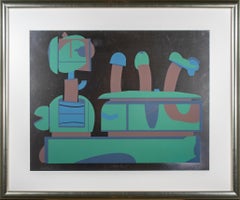
Vintage American Modernist Abstract Surreal Framed Signed Oil Painting
Located in Buffalo, NY
Nicely painted surreal abstract oil painting by Paul Allen Reed (1919 - 2015). Great color and composition. Framed. Signed verso.
Category
Early 2000s Surrealist Abstract Paintings
Materials
Canvas, Oil
$1,020 Sale Price
20% Off
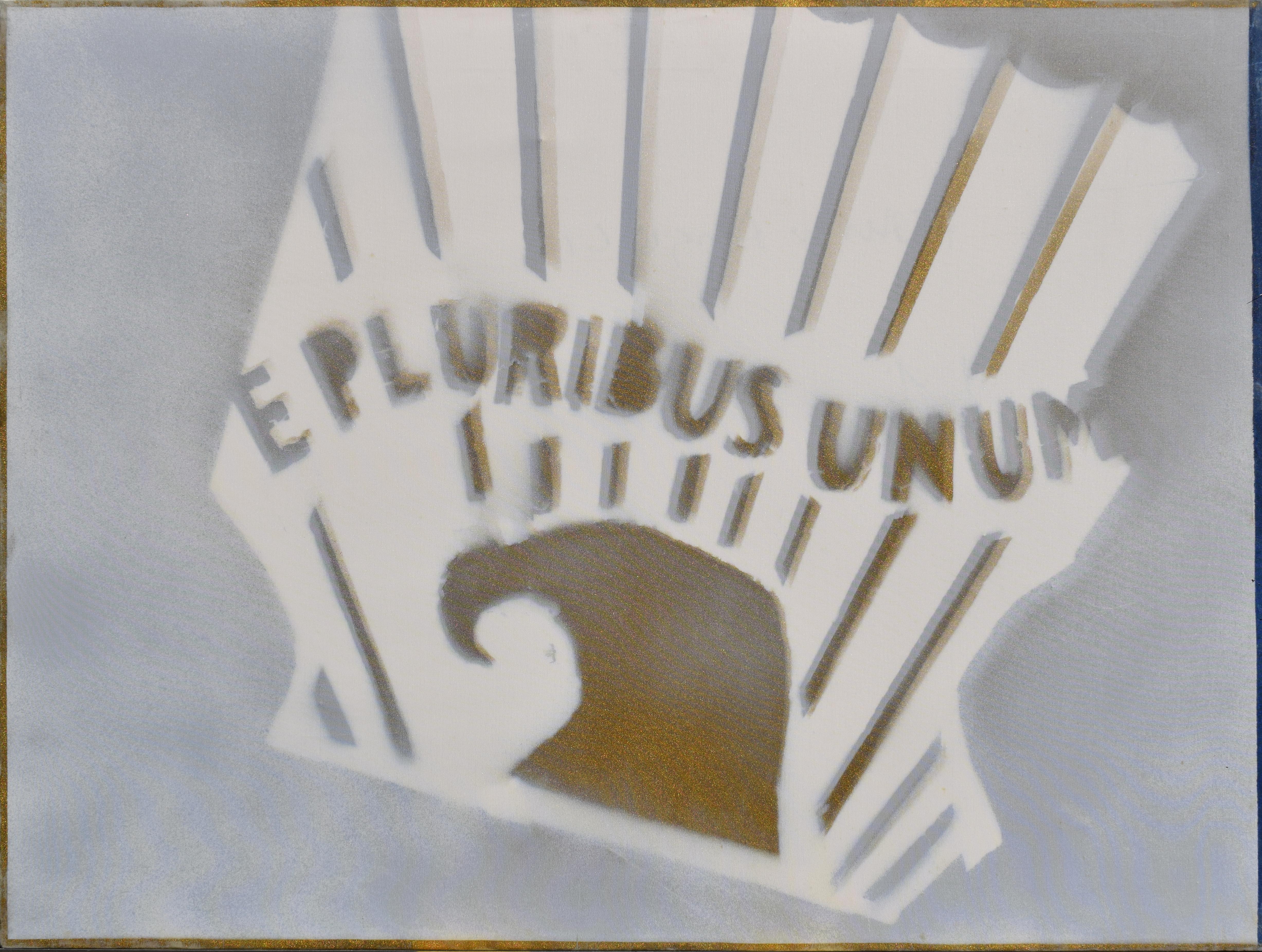
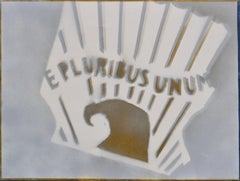
Pluribus Unum
Located in Roma, RM
Franco Angeli (Rome 1935 - 1988), Pluribus Unum (first half of 1970s)
Spray and velatin on canvas 60 x 80 cm, signed on back.
Work registered with the Franco Angeli Archives, under...
Category
1970s Pop Art Abstract Paintings
Materials
Canvas, Spray Paint
$14,238