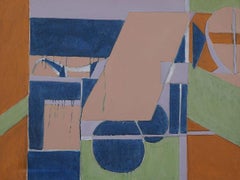
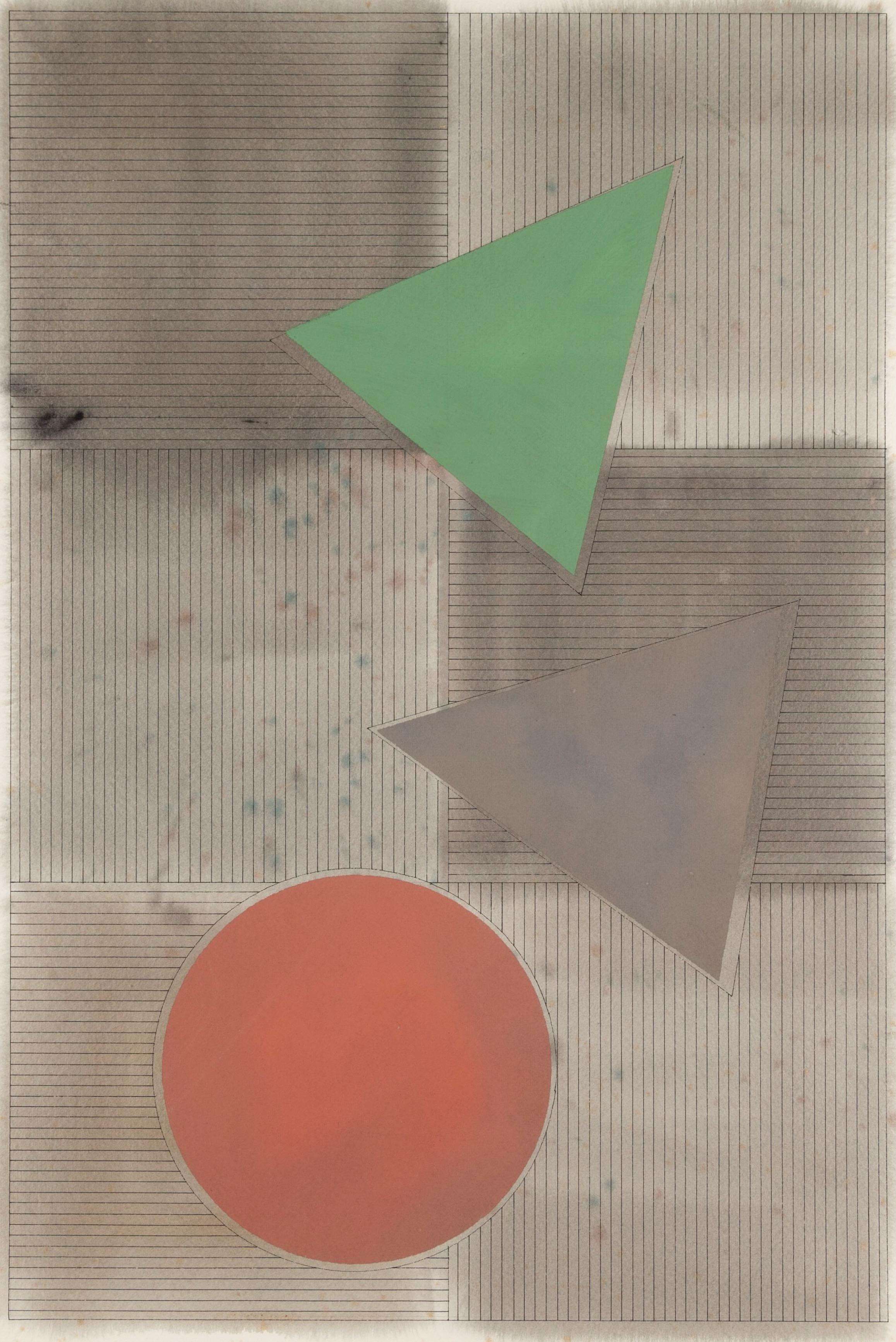
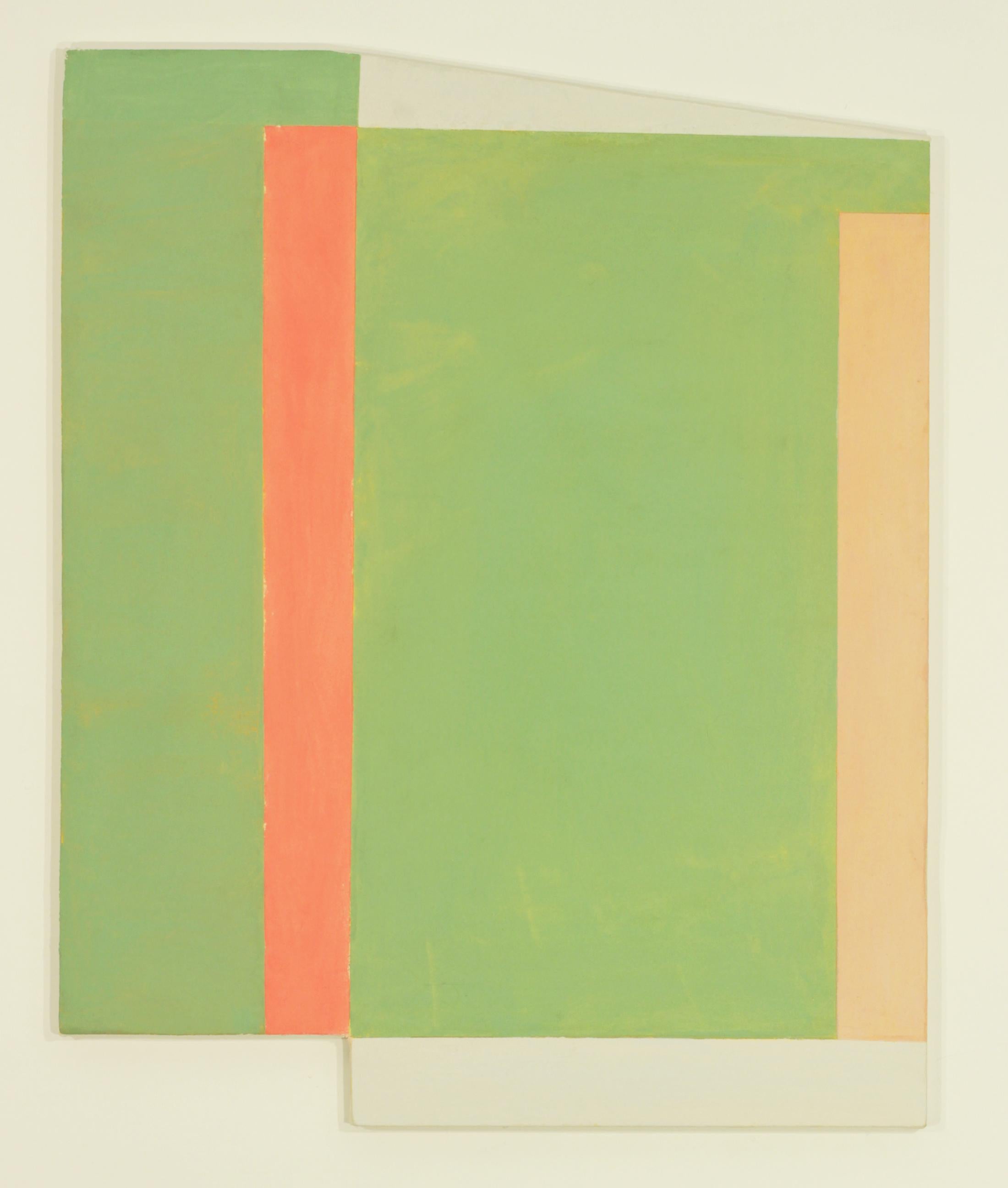
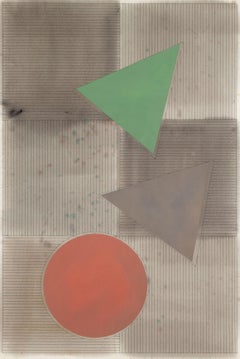
Items Similar to III, from Tri Motifs, 1977 - Bold Shapes, Orange, Green, Gouache and Watercolour
Want more images or videos?
Request additional images or videos from the seller
1 of 5
Gordon HouseIII, from Tri Motifs, 1977 - Bold Shapes, Orange, Green, Gouache and Watercolour1977
1977
$6,545.52
£4,800
€5,598.86
CA$9,043.18
A$9,860.62
CHF 5,232.93
MX$119,211.67
NOK 66,226.54
SEK 60,705.83
DKK 41,817.75
About the Item
Gordon House was born in 1932 in Pontardawe, South Wales. Early exposure to art on trips to the Glynn Vivian Art Gallery as a young boy inspired House towards creative endeavors and at the age of fourteen he was awarded a grant to enter art school which he accepted. From 1947 to 1950 he studied at Luton School of Art, Bedfordshire, and St. Albans School of Art, Hertfordshire. House's contemporaries included Richard Smith and John Plumb with whom he remained close. During the early fifties, after finishing art school, House began work as assistant to the ecclesiastical sculptor Theodore Kern. He also spent time at an advertising studio where he honed his burgeoning skills in typography and graphic design. In 1952 House was offered the position of designer for Imperial Chemical Industries Plastics Division where he stayed until 1959. This was followed by two years spent as graphic designer for the Kynoch Press in London. In 1961 House set out on his own as a self-employed designer and typographer. Initially this was supplemented by part-time teaching at art schools in and around London but by 1964 House was able to devote himself entirely to his design work which freed up valuable time to concentrate on his own artistic output in the studio.
In the late fifties, informed by the new art emerging from America and that of his contemporaries in England, House began to create large-scale abstract works which he was invited to show in 1959 at Dennis Bowen's legendary New Vision Centre in Marble Arch.
House was an active participant in the vibrant London art scene of the sixties, regularly attending lectures, exhibitions and discussions. In 1960 he exhibited in 'Situation' the key abstract exhibition of the decade held at the RBA Galleries. Other participating artists included Robyn Denny, Bernard and Harold Cohen, Gillian Ayres, John Hoyland, Richard Smith and William Turnbull among others. These artists, united by a common admiration for American Abstract Expressionism, were frustrated by the lack of exposure given to large-scale abstract works in commercial galleries so they organised their own exhibition. The name was derived from the participants' idea that an abstract painting that occupied the whole field of vision would involve the spectator in an 'event' or 'situation'. This exhibition was followed by 'New London Situation' in 1961 and a nationwide touring Arts Council presentation in recognition of the significance of the two earlier shows.
In 1961 House began producing his first prints at the Kelpra Studio, run by Chris and Rose Prater, where he made the earliest fine art screenprint ever to be produced in Britain. Artists such as Paolozzi and Hamilton followed in his footsteps and together they started a printmaking revolution in Britain. They cemented the medium of the screenprint in the world of fine art as opposed to the commercial sphere and secured the reputation of Kelpra in the process. Later, together with Cliff White, House set up the White Ink (Ltd.) print studio in London, where he produced etchings and wood engravings on a series of magnificent antique printing presses he had collected. White Ink soon gained a reputation for innovative and high quality printmaking, attracting artists such as R. B. Kitaj, Richard Smith, Joe Tilson, Sidney Nolan, Victor Pasmore, Eduardo Paolozzi, Bernard Cohen and Elizabeth Frink.
Printmaking was to remain a key part of House's oeuvre throughout the rest of his career, whether in the medium of screenprint, etching, woodcut, linocut or lithograph. In 1981 a retrospective exhibition of his graphic works opened at the Carnegie Institute, Pittsburgh, and in 1982 this travelled to the Brooklyn Museum, New York. These shows were instrumental in bringing House's prints to the attention of a wider American audience.
- Creator:Gordon House (1932, British)
- Creation Year:1977
- Dimensions:Height: 30.01 in (76.2 cm)Width: 22.49 in (57.1 cm)
- Medium:
- Period:
- Condition:
- Gallery Location:Kingsclere, GB
- Reference Number:1stDibs: LU2718215410792
Gordon House
The Guardian wrote of Gordon House, upon his death in 2004: Many of the works made during his last years by the painter and graphic designer Gordon House, who has died aged 71, referred back to his birthplace in the Swansea valley. He spent his earliest years in the steel town of Pontardawe. In Tin-pan Valley, the memoir he published earlier this year, he recalled "the clamour of steel mills ... the tinplate works and pithead gear" and "dynamite blasting as coal seams were struck higher up the valley". Unemployment and the depression of the 1930s led Gordon's parents to take him from the valleys of south Wales to the order and designed coherence of Letchworth, "Hertfordshire's first garden city". After leaving school at 14, he went to study, first, at Luton School of Art. For a while after that, he worked in a hospital, before, with the aid of a scholarship, moving on to St Albans School of Art. By 1961, Gordon had become established among a new generation of artists as an independently minded and adventurous painter and designer. The previous year, he had shown his large, bold, hard-edged canvasses at the important London "Situation" exhibition of large-scale abstract painting, and had designed the catalogue for that exhibition. As the 1960s moved on, Gordon designed for the pop world. He worked for the Beatles, designing their White album and the back of the Sergeant Pepper album, for which his longtime friend Peter Blake designed the front. Later, he designed Wings' first album. He delighted in the creative energy of others, and so could respond to the talents of musicians and artists alike. Gordon made paintings throughout his life as a designer. During the 1960s and 70s, his canvasses and prints reflected the dramatic tensions of his graphic design; by the 1980s, Wales had become his constant subject matter. The surface, texture and colour of his paintings softened. No doubt, he needed to pay homage to the places and the people who had shaped him, just as he always paid homage to the artists for whom he designed. His canvasses reduced in size, becoming palm-of-the-hand landscapes. He spent much time in Wales and, in his final years, he used his brush to walk a path through memories of collieries, valleys, smoking stacks, rows of cottages and the people who had first nurtured him.
About the Seller
No Reviews Yet
Vetted Professional Seller
Every seller passes strict standards for authenticity and reliability
Established in 2010
1stDibs seller since 2024
43 sales on 1stDibs
Typical response time: 10 hours
- ShippingRetrieving quote...Shipping from: Kingsclere, United Kingdom
- Return Policy
More From This Seller
View AllRed/Green, from Study for Larger Tri Motif Series, 1977 - Gouache, Watercolour
By Gordon House
Located in Kingsclere, GB
Gordon House was born in 1932 in Pontardawe, South Wales. Early exposure to art on trips to the Glynn Vivian Art Gallery as a young boy inspired House towards creative endeavors and at the age of fourteen he was awarded a grant to enter art school which he accepted. From 1947 to 1950 he studied at Luton School of Art, Bedfordshire, and St. Albans School of Art, Hertfordshire. House's contemporaries included Richard Smith and John Plumb with whom he remained close. During the early fifties, after finishing art school, House began work as assistant to the ecclesiastical sculptor Theodore Kern. He also spent time at an advertising studio where he honed his burgeoning skills in typography and graphic design. In 1952 House was offered the position of designer for Imperial Chemical Industries Plastics Division where he stayed until 1959. This was followed by two years spent as graphic designer for the Kynoch Press in London. In 1961 House set out on his own as a self-employed designer and typographer. Initially this was supplemented by part-time teaching at art schools in and around London but by 1964 House was able to devote himself entirely to his design work which freed up valuable time to concentrate on his own artistic output in the studio.
In the late fifties, informed by the new art emerging from America and that of his contemporaries in England, House began to create large-scale abstract works which he was invited to show in 1959 at Dennis Bowen's legendary New Vision Centre in Marble Arch.
House was an active participant in the vibrant London art scene of the sixties, regularly attending lectures, exhibitions and discussions. In 1960 he exhibited in 'Situation' the key abstract exhibition of the decade held at the RBA Galleries. Other participating artists included Robyn Denny, Bernard and Harold Cohen, Gillian Ayres, John Hoyland, Richard Smith and William Turnbull among others. These artists, united by a common admiration for American Abstract Expressionism, were frustrated by the lack of exposure given to large-scale abstract works in commercial galleries so they organised their own exhibition. The name was derived from the participants' idea that an abstract painting that occupied the whole field of vision would involve the spectator in an 'event' or 'situation'. This exhibition was followed by 'New London Situation' in 1961 and a nationwide touring Arts Council presentation in recognition of the significance of the two earlier shows.
In 1961 House began producing his first prints at the Kelpra Studio, run by Chris and Rose Prater, where he made the earliest fine art screenprint ever to be produced in Britain. Artists such as Paolozzi and Hamilton followed in his footsteps and together they started a printmaking revolution in Britain. They cemented the medium of the screenprint in the world of fine art as opposed to the commercial sphere and secured the reputation of Kelpra in the process. Later, together with Cliff White, House set up the White Ink (Ltd.) print studio in London, where he produced etchings and wood engravings on a series of magnificent antique printing presses...
Category
20th Century Abstract Paintings
Materials
Ink, Watercolor, Gouache
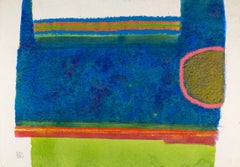
Composition (Blue, Green, Orange and Red) by James Hull, Acrylic, 1987
By James Hull
Located in Kingsclere, GB
Composition (Blue, Green, Orange and Red), 1987
signed and dated
acrylic and watercolour on paper
69 x 92 cm
27 1/8 x 36 1/4 in
Category
20th Century Abstract Paintings
Materials
Acrylic
Composition (Blue, Green, Orange and Red), Acrylic Painting by James Hull, 1987
Located in Kingsclere, GB
Composition (Blue, Green, Orange and Red), Acrylic Painting by James Hull 1921-1990, 1987
Additional information:
Medium: Acrylic and watercolour on paper
...
Category
20th Century Abstract Drawings and Watercolors
Materials
Watercolor
Grey/Pink, from Study for Larger Tri Motif Series, 1977 - Gouache, Watercolour
By Gordon House
Located in Kingsclere, GB
Gordon House was born in 1932 in Pontardawe, South Wales. Early exposure to art on trips to the Glynn Vivian Art Gallery as a young boy inspired House towards creative endeavors and ...
Category
20th Century Abstract Paintings
Materials
Ink, Watercolor, Gouache

Abstract, Gouache and Watercolour Painting by John Hubbard, 1976
By John Hubbard
Located in Kingsclere, GB
Abstract, Gouache and Watercolour Painting by John Hubbard 1931-2017, 1976
Additional information:
Medium: Gouache and watercolour
12.5 x 20 cm
4 7/8 x 7 7/8 in
signed, initialled a...
Category
20th Century Abstract Drawings and Watercolors
Materials
Watercolor, Gouache
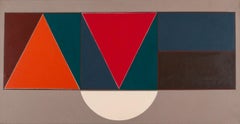
Double Red Triangle, 1974 - Geometric Abstract Acrylic Painting
By Gordon House
Located in Kingsclere, GB
Gordon House was born in 1932 in Pontardawe, South Wales. Early exposure to art on trips to the Glynn Vivian Art Gallery as a young boy inspired House towards creative endeavors and ...
Category
20th Century Abstract Paintings
Materials
Canvas, Acrylic
You May Also Like
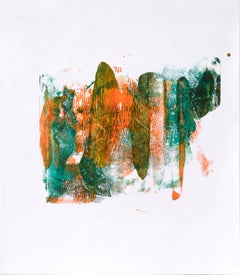
Green and Orange Abstract Composition in Acrylic on Paper
Located in Soquel, CA
Green and Orange Abstract Composition in Acrylic on Paper
A bold abstract painting by California-based artist Ricardo de Silva (American/Brazil, 20th C). Bright orange and green are...
Category
1980s Abstract Expressionist Abstract Paintings
Materials
Paper, Acrylic
$700 Sale Price
20% Off
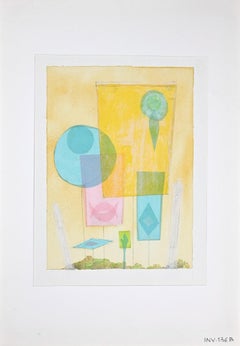
Abstract Color Shape - Watercolor - 1970s
By Leo Guida
Located in Roma, IT
Abstract Color Shape is an original Contemporary artwork realized in the 1970s in Italy.
Original watercolor on paper.
Passepartout is included. Total dimensions: 50 x 35 cm. Imag...
Category
1970s Abstract Abstract Drawings and Watercolors
Materials
Watercolor
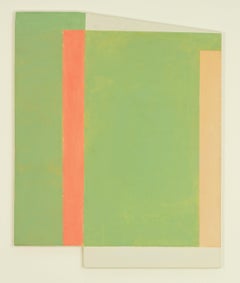
PG 18 - Geometric Abstract Green Coral Orange Beige Shaped Painting, 2021
By Elizabeth Gourlay
Located in Kent, CT
In this contemporary painting in acrylic on canvas mounted on a shaped panel by Elizabeth Gourlay, carefully ordered blocks of color in a luminous, grassy shade of green frame two th...
Category
2010s Contemporary Abstract Paintings
Materials
Canvas, Acrylic, Panel
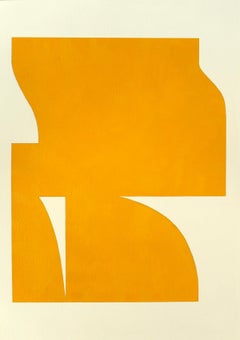
Shape 16 (2019) - Abstract shape, work on paper, minimalist, orange yellow
Located in Jersey City, NJ
Shape 16 (2019) by Ryan Park of Shapes Only
Abstract geometric art, acrylic on 300gsm archival paper. Abstract shape innovated by the artist. Bright oran...
Category
2010s Abstract Abstract Drawings and Watercolors
Materials
Acrylic, Archival Paper
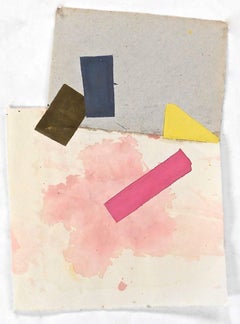
"Untitled" Abstract Expressionist Geometric Bright Colorful Collage Gouache
By Jean Feinberg
Located in Wellesley, MA
Untitled, 2015, 19 x 14 Inches.
Jean Feinberg is a NY based artist whose works on paper (handmade paper, gouache, and collage) are closely linked to her unique constructions of pa...
Category
2010s Abstract Geometric Mixed Media
Materials
Gouache
Naval Occurrence, orange, blue
green mid-century, abstract geometrical work
By Richard Andres
Located in Beachwood, OH
Richard Andres (American, 1927-2013)
Naval Occurrence, c. 1963
oil on canvas
signed and titled verso
24 x 32 inches
Richard Andres was born in Buffalo, New York in 1927. A graduate of the Cleveland Institute of Art in 1950, he was immediately drafted and served for two years in the army as a mural painter. He received his Master of Arts from Kent State in 1961. A frequent exhibitor at galleries and museums and winner of multiple May Show prizes, Andres taught art in the Cleveland Public Schools for 28 years, as well as teaching the University of Buffalo, the Cleveland Institute of Art and the Western Reserve University.
Very little in Richard Andres’ childhood would have predicted his love of classical music, mid-century-modern architecture and certainly not his lifelong passion for art and in particular abstract art. Richard’s father, Raymond, had no more than a third-grade education, and his mother, Clara, was one of thirteen children – only three of whom lived into adulthood and none of whom attended high school.
They lived, when Richard was a boy, in a dingy area of Buffalo, NY in a walk-up apartment situated above a tavern. Raymond and Clara supplemented the income from their factory jobs in the bar downstairs with Raymond playing ragtime on the piano and Clara serving drinks. This often left Richard and his two older brothers at home alone to fend for themselves. The two older boys, Raymond and Russell, were - unlike Richard- rather rough and tumble and entertained themselves with stickball, boxing and the like. Richard, on the other hand, from a very young age liked to draw, or better yet even, to paint with the small set of watercolors he received for Christmas one year. Paper, however, at the height of the depression, was hard to come by. Luckily, Clara used paper doilies as decoration for the apartment and Richard would contentedly paint and then cut up doilies, gluing the pieces together to create collages.
At eight-years-old, he discovered the Albright-Knox Museum (then known as the Albright Art Gallery) and spent several hours a week there studying the paintings. He was particularly fond of Charles Burchfield‘s landscapes, enamored with their ‘messiness’ and thinking that they somehow captured more ‘feeling’ than works he was previously familiar with. For his tenth Christmas, he asked for and received a ‘how-to’ paint book by Elliot O’Hare. Through this self-teaching, he assembled the portfolio needed for acceptance to Buffalo Technical High School where he studied Advertising Arts. In his Junior year, he was encouraged to enter a watercolor painting, “Two Barns,” in the national 1944-45 Ingersoll Art Award Contest and was one of twelve grand prize winners – each one winning one hundred dollars. More importantly the painting was exhibited at the Carnegie Institute Galleries, which resulted in his winning a national scholarship to the Cleveland School of Art (The Cleveland Art Institute).
He flourished at the art school under the tutelage of faculty members such as Carl Gaertner, as well as that of visiting artists such as William Sommer and Henry George Keller. He would say in later years that Gaertner, in particular, influenced his attitude toward life as well as art. “Gaertner,” Andres said, “believed that there was no need to be a ‘tortured artist’, that an artist should rather enjoy beauty, family, and life in general.” Free to spend his days as he chose, he wandered the Cleveland Art Museum for most of the hours he was not attending classes or painting; the remaining time was spent drinking coffee at a local hangout with art school friends – which is where he met fellow Henry Keller scholarship winner, Avis Johnson. Richard was immediately smitten with Avis, but being rather shy, it took him the entire summer of 1948 to build up his courage to ask her out. Over that summer he ‘thought about Avis’ and worked in a diner to save money. He also used the hundred-dollar prize money won in High School to visit the first Max Beckmann retrospective in the United States at the City Art Museum in St. Louis. Over a half century later he spoke of that exhibit with a reverence usually reserved for spiritual matters, “I walked in and it was like nothing I had ever seen before... the color...It just glowed.”
Returning to campus in the Fall, the first thing he did was go to the coffee shop in hopes of finding Avis. He did, and she, upon seeing him, realized that she was also smitten with him. They quickly became known as ‘the couple’ on campus, and a year later, with Richard being drafted for the Korean war, they were quickly married by a Justice of the Peace, celebrating after with family at Avis’s Cleveland home. As a gift, faculty member John Paul Miller designed and made the simple gold wedding ring Avis wore for their 65 years of marriage. During those 65 years neither wavered in their mutual love, nor in the respect they shared for one another’s art.
The couple lived in a converted chicken coop in Missouri while Richard was in boot camp. At the camp, he would volunteer for any job offered and one of those jobs ended up being painting road signs. His commander noticed how quickly and neatly he worked and gave him more painting work to do - eventually recommending him for a position painting murals for Army offices in Panama. Until her dying day, Avis remained angry that “The army got to keep those fabulous murals and they probably didn’t even know how wonderful they were.” In Panama, their first son, Mark, was born. After Richard’s discharge in 1953, they moved back to the Cleveland area and used the GI bill to attend Kent State gaining his BA in education. The small family then moved briefly to Buffalo, where Richard taught at the Albright Art School and the University of Buffalo – and their second son, Peter, was born. Richard had exhibited work in the Cleveland May Show and the Butler Art Museum during his art school years, and during the years in Buffalo, his work was exhibited at the gallery he had so loved as a child, the Albright Art Gallery.
In 1956, the family moved back to the Cleveland area and Richard began teaching art at Lincoln West High School during the day while working toward his MA in art at Kent State in the evenings. Avis and Richard, with the help of an architect, designed their first home - a saltbox style house in Hudson, Ohio, and in 1958, their third son, Max (after Max Beckmann) was born. Richard enjoyed the consistency of teaching high school as well as the time it gave him to paint on the weekends and during the summer months. In 1961, he received his MA and his daughter, Claire, was born. With a fourth child, the house was much too small, and Avis and Richard began designing their second home. An admirer of MCM architecture, Richard’s favorite example of the style was the Farnsworth house – he often spoke of how the concepts behind this architectural style, particularly that of Mies van der Rohe, influenced his painting.
Andres described himself as a 1950’s...
Category
1960s Abstract Geometric Abstract Paintings
Materials
Oil