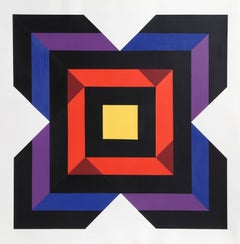
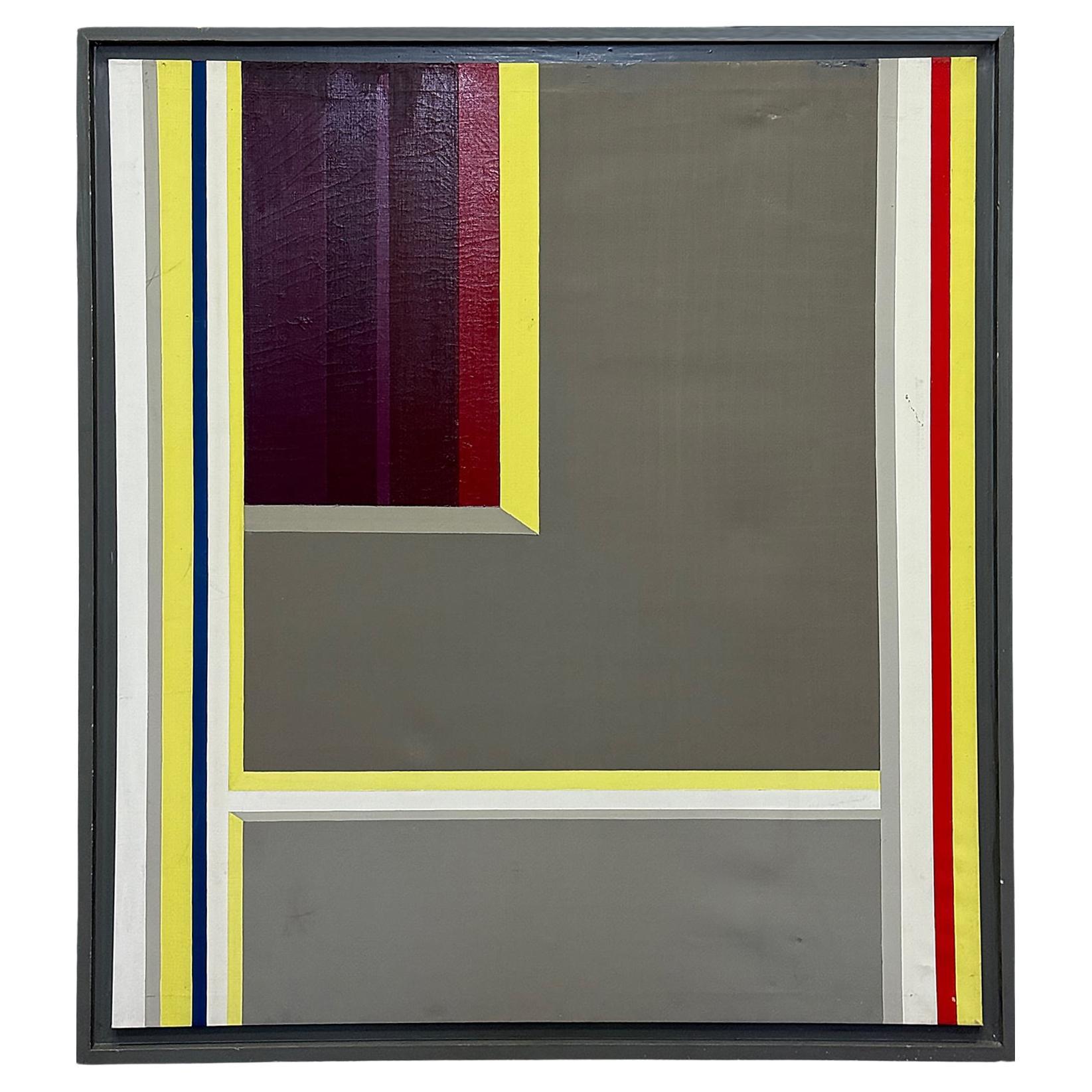
Items Similar to 1972 Abstract Oil Painting Homage to Ilya Bolotowskiy Hard Edged Abstraction
Want more images or videos?
Request additional images or videos from the seller
1 of 12
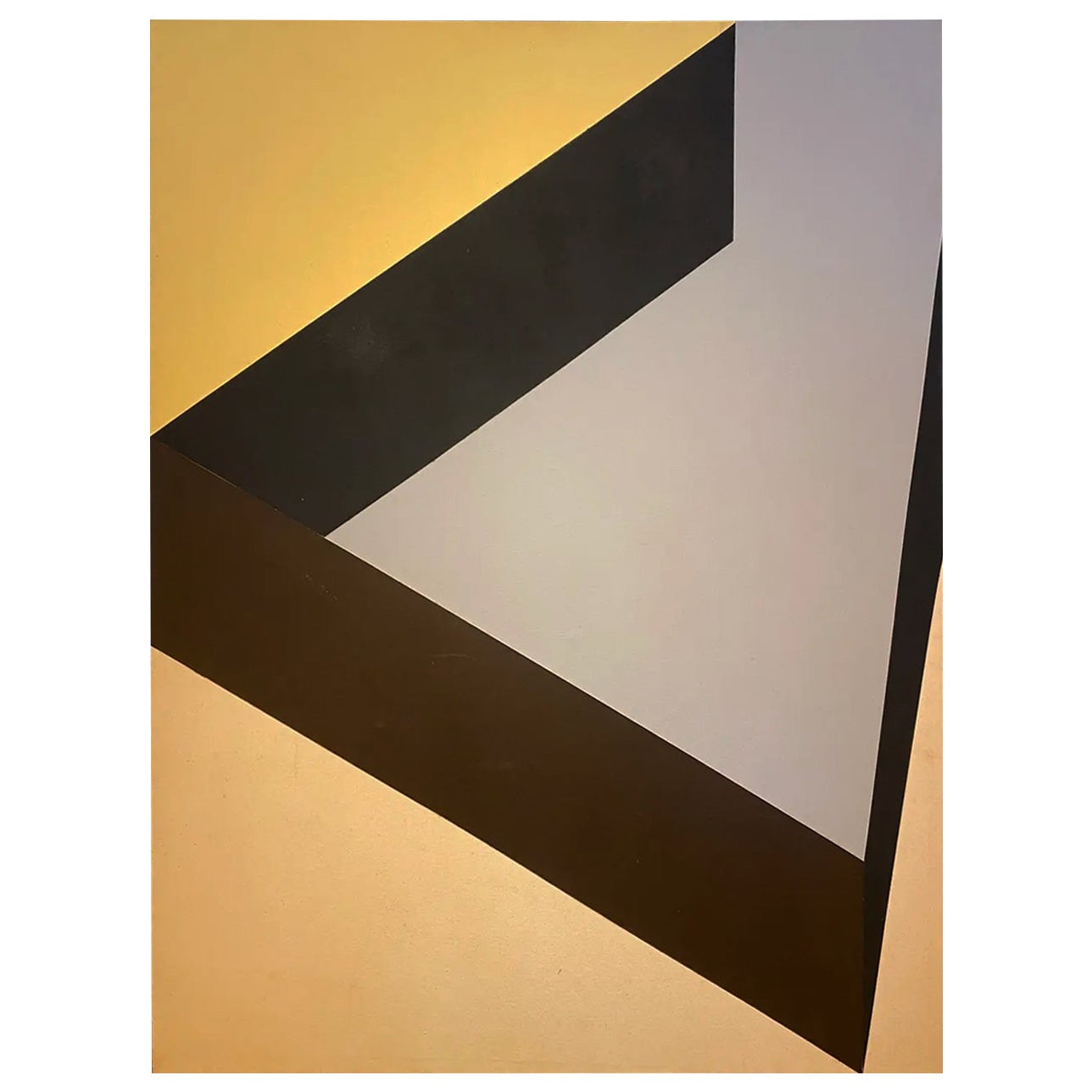
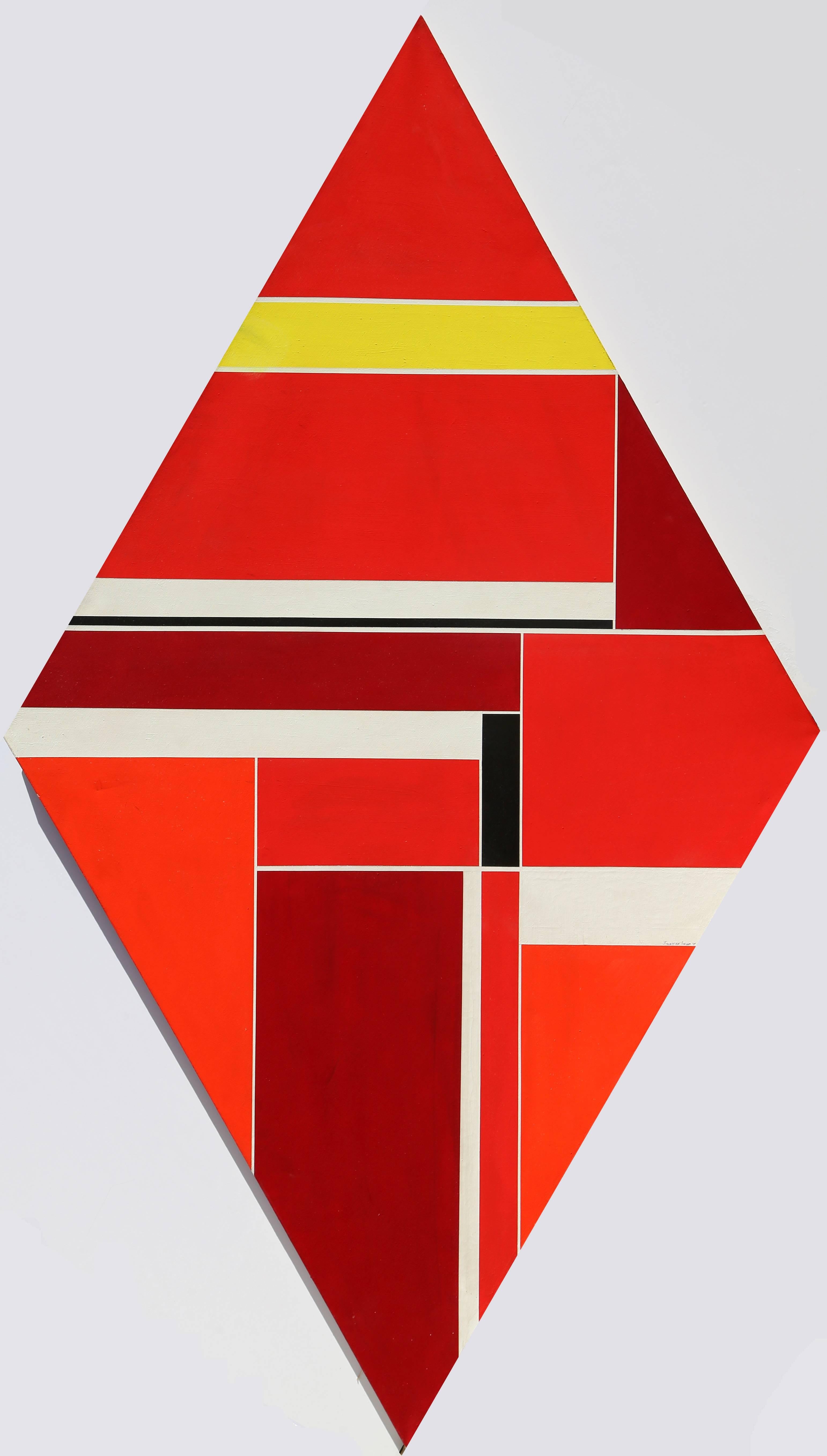
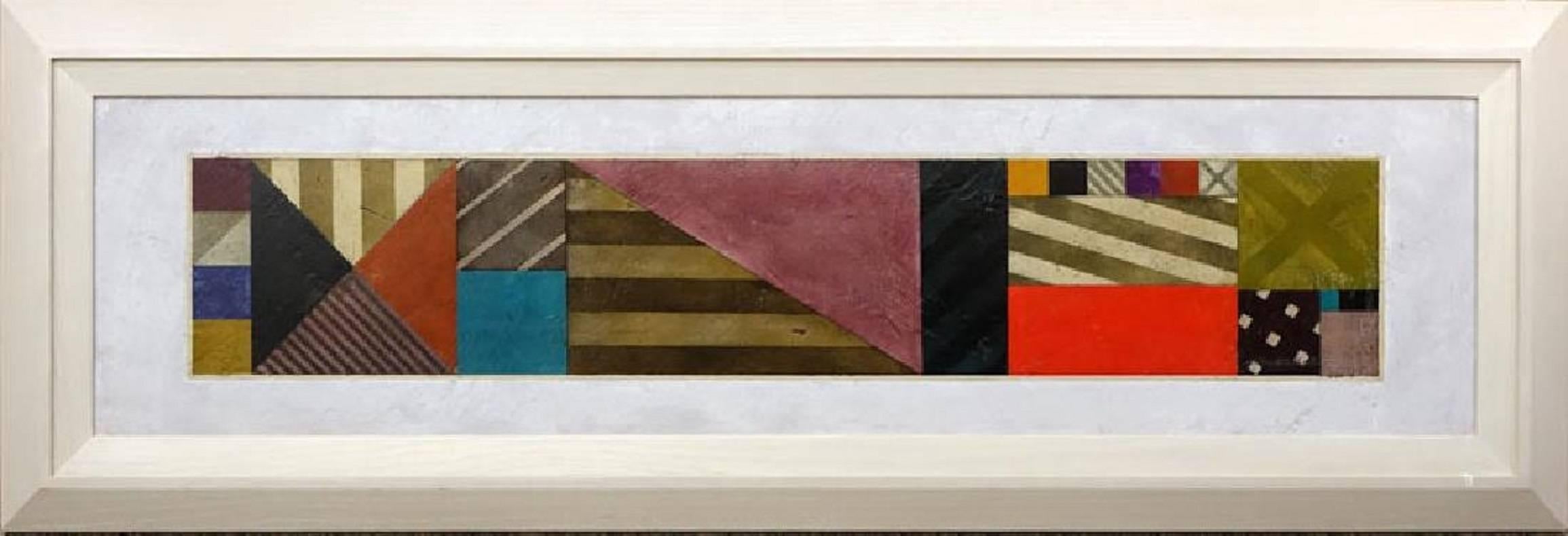
Johnathan Singer1972 Abstract Oil Painting Homage to Ilya Bolotowskiy Hard Edged Abstraction1972
1972
$6,500
£4,951.92
€5,651.31
CA$9,134.04
A$9,954.49
CHF 5,271.33
MX$119,563.96
NOK 66,736.25
SEK 61,357.42
DKK 42,209.04
About the Item
This work takes its cues from Ilya Bolotowsky and Piet Mondrian. A fine example of 1970's hard edged geometric abstraction.
Artist, painter
master photographer Jonathan Singer was born in 1948. As a young man, Singer, a native New Yorker took art classes at the Museum of Modern Ar. As the protégé of Ilya Bolotowski, the painter (a member of "The Ten," a group that included Louis Schanker, Adolph Gottlieb, Mark Rothko, and Joseph Solman), Singer dreamed of becoming an artist, but his Jewish mother got her wish and Singer became a doctor instead but always kept a hand in the realm of art and photography. His two favorite subjects were flowers and graffiti. He’d spent many hours with graffiti writers (some of them famous, such as Lady Pink). In Fort Apache, the Bronx, on Sundays, the cops would marvel at this one tall white man blithely wandering the streets with his camera, a Hasselblad with a price tag of $40,000. This is the push that eventually led Singer to the doors of the Smithsonian, in Washington, D.C., and its chair of botany, Dr. John Kress. Using novel digital camera techniques that did not exist ten years ago, Singer has created masterpieces of photographic art. Inspired by the work of the great botanical artists that came before him, Dr. Singer has developed a style of modern digital photography that possesses both the clarity and the artistry of traditional botanical illustration. Revealing the delicate structures of the plants at a level of detail unachievable with brush and paint. He compiled 250 floral images into a five-volume, hand-pressed, double elephant folio—a printing method not used since Audubon’s Birds of America in the 1840s—and Botanica Magnifica, as it is called, earned a spot in Natural History’s rare book room. work is featured in the permanent collection at the Smithsonian Institution's Museum of Natural History. Singer takes pictures of endangered flowers. His extraordinary photographs have impressed Eileen Ford, the Smithsonian, and a Japanese collector with very deep pockets. Singer’s masterpiece, Botanica Magnifica, was displayed at the National Museum of Natural History at the Center for Botanical Art and Illustration. Singer’s photographs have been compared, at least in style, to the works of Brueghel, Vermeer and Rembrandt—all artists that Singer says Bolotowsky advised him to study because “they handle light better than anyone else ever did.” Somehow every part of Singer’s flowers are properly lit and in focus. Of course, Singer has upgraded from the Polaroid he had as a child, to a $40,000 color-perfect H2D-39 Hasselblad digital camera. He has shown at Elga Wimmer Gallery in New York.
Singer has won the Hasselblad Laureate Award and the 2009 Carl Linnaeus Silver Medal.
- Creator:
- Creation Year:1972
- Dimensions:Height: 32 in (81.28 cm)Width: 32 in (81.28 cm)
- Medium:
- Movement Style:
- Period:
- Condition:
- Gallery Location:Surfside, FL
- Reference Number:1stDibs: LU38215484852
About the Seller
4.9
Platinum Seller
Premium sellers with a 4.7+ rating and 24-hour response times
Established in 1995
1stDibs seller since 2014
1,843 sales on 1stDibs
Typical response time: 1 hour
- ShippingRetrieving quote...Shipping from: Surfside, FL
- Return Policy
More From This Seller
View AllOp Art Hard Edged Abstract Geometric Mod Painting John Pearson
Located in Surfside, FL
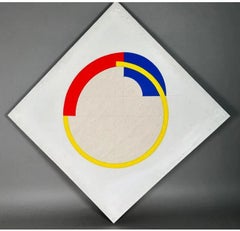
John Pearson (American born 1940)
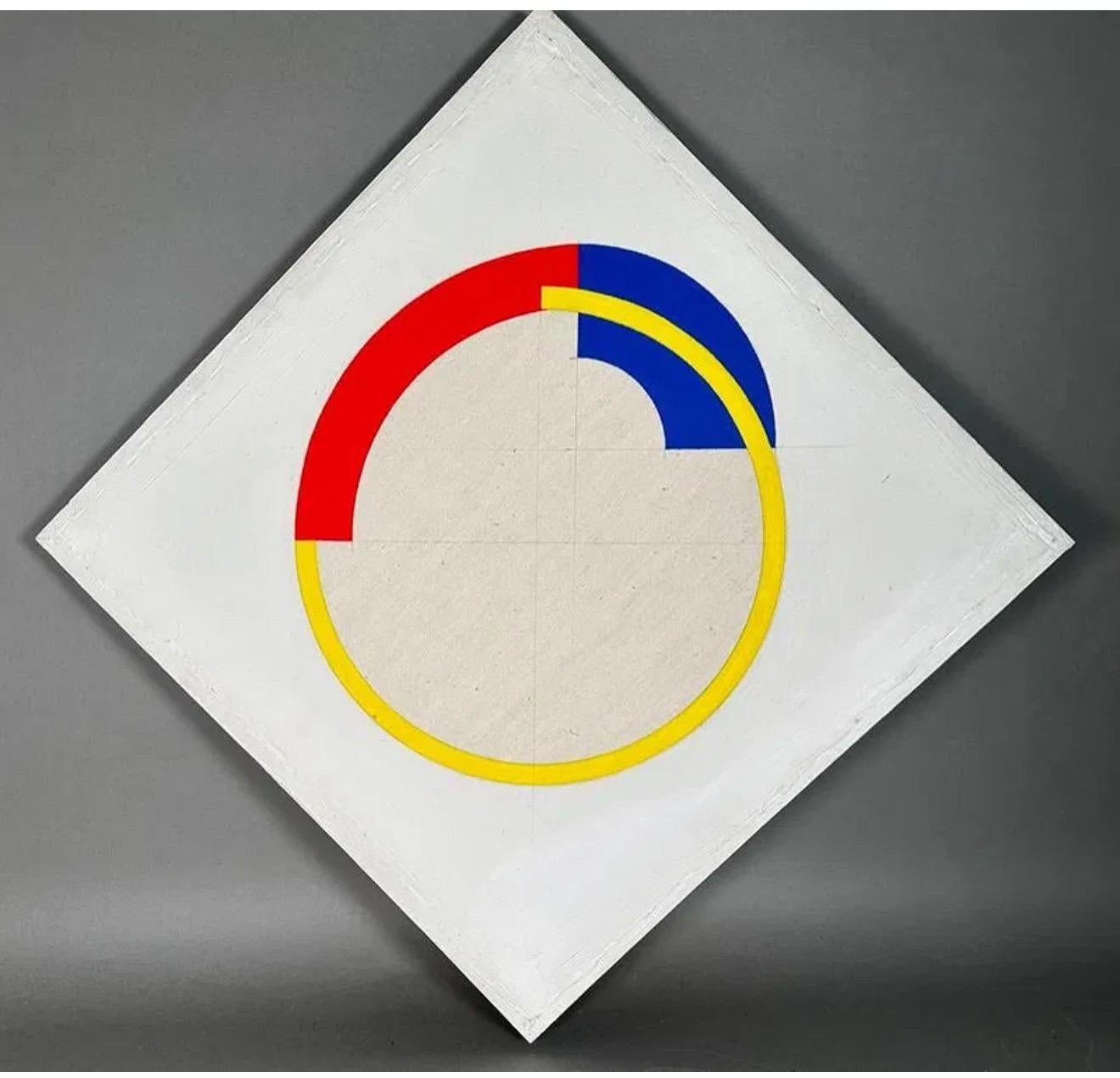
"Study for Circus"
1985
Acrylic on canvas painting
Hand signed verso, hangs from corner of canvas.
Provenance: The New Gallery of Contemporary Art, Cleveland, Ohio. Bearing label verso:
Dimensions: 19 x 19 in (it hangs in diamond shape which measures point to point 26.87 X 26.87 inches)
Red, White, Blue, and Yellow abstract geometric painting. Circle and ellipse.
John Pearson (British, 1940-was born in Yorkshire, England, and studied at the Harrogate School of Art, Yorkshire (National Diploma of Design, 1960), the Royal Academy Schools, London (Certificate, R.A.S 1963), the Akademie der Bildenden Kunst, Munich (1963–64, research fellow), and Northern Illinois University (M.F.A. 1966). He is known for hard edged, mod abstract oil painting on shaped canvas in geometric, curvilinear forms.
For many years, Pearson has made paintings and low-relief sculpture, predominantly wall pieces, which use color, form, and various degrees of abstraction to modify the space of entire rooms. With work exhibited nationally and internationally in both solo and group shows, Pearson has also been sought for many site-specific commissions, both public and private. These are typically highly abstract, simplified, and nuanced; they’re often witty, too.
Pearson early on became a devotee of the Dutch artist Piet Mondrian, a chief proponent of De Stijl (The Style), Pearson’s style has evolved from intense system-based abstract compositions to one more attuned to the spiritual influences of the natural environment. Pearson’s early style reflects the European reaction to expressionism and artistic emotionalism in the form of a rational, systematic approach to art (often called the “New Tendency”). An heir to the tenets of Constructivism, he investigated color within a predetermined linear or grid system that eliminated options after the artist’s initial choices. He was drawn to Cleveland in 1970 because of its reputation at the time for having a rich environment for abstract art, as two of the chief proponents of Kinetic art and op art, Julian Stanczak and Richard Anuszkeiwicz, worked there. Students of Josef Albers, the grand master of color theory who taught these two primary practitioners of the “Color Function” school of abstract art at Yale in the 1950s.
Pearson’s early style reflects a European reaction to abstract expressionism that manifested itself in a rational, systematic approach to art.Since his emergence in 1960s London, John Pearson has been using mathematical systems and computer programs to generate hard-edged geometric compositions. His work is of the same genre as the artists of the Denise Rene Gallery in Paris, similar to Vasarely, Agam, Cruz Diez and Soto. His most recent work, with its circles and ellipses superimposed on patterns of wavy lines, brings a more easygoing approach to his particular breed of rule-based art. Pearson has received grants from the National Endowment for the Arts and the Canada Council, and has had solo exhibitions at institutions including the Akron Art Museum, the Cleveland Center for Contemporary Art, and the Museum of Modern Art in Rijeka, Croatia. Pearson was born in Yorkshire (Britain) and studied art at the Royal Academy Schools in London, did advanced work in Munich (Germany), and earned the M.F.A. (Master of Fine Arts) degree from Northern Illinois University. Before arriving to teach at Oberlin College in 1972, he taught at the University of New Mexico, the Nova Scotia College of Art and Design, and the Cleveland Institute of Art. At Oberlin, he served as the Young-Hunter Professor of Art. John retired from teaching in 2014 but still occasionally works with students and lives in Oberlin where he educated several generations of appreciative liberal arts students. He also served as department chair and held the Young-Hunter endowed professorship from 1987 onward, until his retirement. Pearson travelled widely to paint, exhibit, and teach and received support from the Ohio Arts Council and the National Endowment for the Arts, among others. His career received recognition via the Cleveland Arts Prize in 1975, while most recently he was recognized as a Special Honoree by the same organization.
His paintings and sculptures are held in many public and private collections in the U.S., Canada, Europe, China, and Japan, as well as by museums, such as the Allen Art Museum (Oberlin), the Cleveland Museum of Art, the Museum of Modern Art (New York), and the Art Institute of Chicago. Hard-Edged
Select Group Exhibitions
Abstract, Constructive, Concrete Mondrian huis, Amersfoort, Holland
Chronologic Planet Art...
Category
1980s Abstract Geometric Abstract Paintings
Materials
Acrylic, Canvas
Large Modernist Abstract Painting (1of 2 available)
By Gregg Robinson
Located in Surfside, FL
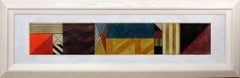
Gregg Robinson, American (born 1948) "Cipher Bar 20" Oil on Canvasboard Panel. Artist signed, title and dated 1990 far right. Very minor rubbing to paint. Panel measures 15-1/4" H x 63-1/2" W, frame measures 24-1/4" H x 72-1/4"
GREGG ROBINSON
The universe of visual art encompasses a huge spectrum of motivation and means of expression. Examples range from the most syrupy sentimentality to extremes of moral and intellectual confrontation. For me, the creative process is, on the simplest level, an aesthetic puzzle. Elements of the puzzle include contrast, color, visual texture, graphic pattern, and in some recent work, a simple cryptic symbolism.
I have never been particularly interested in lyric or pictorial content, and though some of my work does contain undeniable spatial illusion, even that tends to be a by-product rather than a goal of the primary pursuit: the balance of light and dark, pure color and organic neutrals, energy and calm, strong pattern and subtle field. Having grown up in an environment of contemporary architecture, I have always valued the classic modern synthesis of form and function exemplified by the Bauhaus movement of the early 20th century. Hence, the simplest solutions are often the most satisfying. Obviously, the modernist ideal of efficiency in form and function requires that method of execution be as well adapted to the aesthetic goal as the visual language itself.
The media before you is the result of many years of experimentation that came to its current form in early 1992. I work with dry pigment over a plaster surface. My tools are broad knives, sponges, rags and masking. The finish is a high gloss alkyd resin.
CORPORATE COLLECTIONS:
Allstate Insurance
NBC Productions
Alaska...
Category
1990s Contemporary Abstract Paintings
Materials
Canvas, Mixed Media, Oil, Board
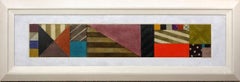
Large Modernist Geometric Abstract Painting
By Gregg Robinson
Located in Surfside, FL
Gregg Robinson, American (born 1948) "Cipher Bar 19" Oil on Canvasboard Panel. Artist signed, title and dated 1990 far right. Very minor rubbing to paint. Panel measures 15-1/4" H x 63-1/2" W, frame measures 24-1/4" H x 72-1/4" W
GREGG ROBINSON
The universe of visual art encompasses a huge spectrum of motivation and means of expression. Examples range from the most syrupy sentimentality to extremes of moral and intellectual confrontation. For me, the creative process is, on the simplest level, an aesthetic puzzle. Elements of the puzzle include contrast, color, visual texture, graphic pattern, and in some recent work, a simple cryptic symbolism.
I have never been particularly interested in lyric or pictorial content, and though some of my work does contain undeniable spatial illusion, even that tends to be a by-product rather than a goal of the primary pursuit: the balance of light and dark, pure color and organic neutrals, energy and calm, strong pattern and subtle field. Having grown up in an environment of contemporary architecture, I have always valued the classic modern synthesis of form and function exemplified by the Bauhaus movement of the early 20th century. Hence, the simplest solutions are often the most satisfying. Obviously, the modernist ideal of efficiency in form and function requires that method of execution be as well adapted to the aesthetic goal as the visual language itself.
The media before you is the result of many years of experimentation that came to its current form in early 1992. I work with dry pigment over a plaster surface. My tools are broad knives, sponges, rags and masking. The finish is a high gloss alkyd resin.
CORPORATE COLLECTIONS:
Allstate Insurance
NBC Productions
Alaska...
Category
1990s Contemporary Abstract Paintings
Materials
Canvas, Mixed Media, Oil, Board
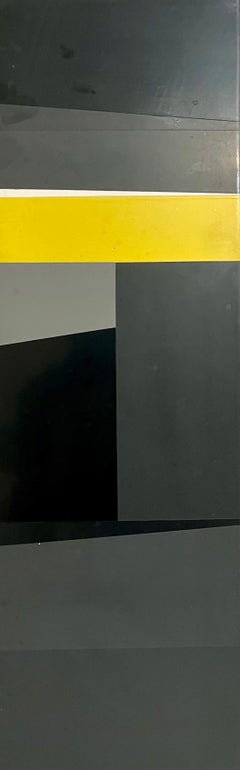
1960s Swiss Postwar Contemporary Geometric Abstract Painting on Metal Jean Baier
By Jean Baier
Located in Surfside, FL
Jean Baier (Swiss, 1932-1999)
"Composition"
1960
An original enamel composition on metal wall mount art. This post war contemporary work features geometric abstract designs character...
Category
1960s Abstract Geometric Abstract Paintings
Materials
Metal
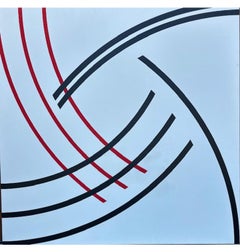
Large Oil Painting Oleg Sohanievich Non Conformist Art Avant Garde Ukrainian
Located in Surfside, FL
Red, White and Black
Oil on canvas
1989
Dimensions: 39.5 X 39.5
This came from an important collection of Russian and Ukrainian art.
Oleg Sohanievich (1935, Tulchin, Ukraine – 2017...
Category
1980s Constructivist Abstract Paintings
Materials
Canvas, Oil
Large Budd Hopkins Modernist Hard Edged Abstract Expressionist Oil Painting 1965
Located in Surfside, FL
Budd Hopkins, American (1931-2011)
'City Sun II',
1969
Oil painting on canvas.
Hand signed and dated lower left.
Verso: Artist, title, and year in pencil on stretcher. Dimensions: 36" H x 52" w. Frame: 37.25" h x 53.25" w.
Budd Hopkins was one of the leading proponents of the "hard-edge" abstract minimalist school of painting in the 1950s and 1960s, Budd Hopkins (born 1931) created works that show the strong influence of Jackson Pollock and other leading painters of the Abstract Expressionism movement. Hopkins' paintings are now in numerous major collections, including the San Francisco Museum of Art, the Guggenheim Museum in New York, and the Hirshhorn Collection in Washington, DC.
Recently, he has also been recognized for his research into the matter of UFOs and one of his books, "The Intruders", printed by Random House, was on the New York Times best-seller list and was the basis for a television show on CBS.
Born in 1931, he is a graduate of Linsly Military Institute (now Linsly School) in 1949 and Oberlin College in 1953. He first displayed artistic abilities when, as a child recovering from a long-term illness, he began to create sculptures of ships made out of modeling clay. But it wasn't until he arrive at Oberlin that he made a serious study of art. Later, Hopkins included abstracted figures in his sculptural pieces. While moving away from Abstract Expressionism, Hopkins retained in his work the use of intense colors and hard-edged forms. His works of the 1980s, including Temples and Guardians, featured these "sentinels" who were, according to Hopkins, "participating in a frozen ritual, fixed – absolutely – within a privileged space..." Though Hopkins denied any connection, some critics viewed these ritualistic pieces as an extension of Hopkins' fascination with alien beings. Hopkins viewed his sculpted guardians not as human per se, but as magical, fierce, noble robots of the unconscious.
He settled in New York after obtaining his degree and has had a residence there ever since. He and his wife, April Kingsley, and their daughter, Grace, divide their time between their home at Cape Cod, Mass., and that in New York City. In his work, he travels widely. He has exhibited in England, Finland, Italy and Switzerland.
In 1963, Hopkins was selected by the Columbia Broadcasting System as one of the 15 painters featured in the network's first television special on American art. In 1958, Art News picked him as one of 12 Americans for exhibition in Spoleto, Italy, in the "Festival of Two Worlds."
His brilliance has won him a number of fellowships and awards. In 1972, the West Virginia Arts and Humanities Council awarded him its Commission Prize. In 1976, he received the John Simon Guggenheim Fellowship for Painting and in '79 he received a fellowship from the National Endowment of the Arts. He also won a special project grant from the New York State Council on the Arts in 1982. He was friends with Robert Ryman and many of the other 10th street avant garde artists. He was an original member of March Gallery which showed Alice Baber, Elaine de Kooning, Mark di Suvero, Lester Johnson, Matsumi Kanemitsu.
His work was handled by Poindexter Gallery. (a major gallery founded in 1955 in New York City by Elinor Poindexter. The gallery specialized in sculpture, abstract, and figurative art and featured the works of such artists as Richard Diebenkorn, Jules Olitski, Nell Blaine, Al Held, Willem de Kooning, Franz Kline, Earl Kerkam, Milton Resnick and Robert De Niro, among others.
His art has been featured in the Metropolitan Museum of Art, Museum of Modern Art, Bronx Museum of Art, Brooklyn Museum, Whitney Museum, Corcoran Gallery, Guggenheim Museum, Queens Museum in New York, and the Public Library of New York. He was included in Young America 1960: Thirty American Painters Under Thirty-Six buy Lloyd Goodrich at the Whitney Museum of American Art in NYC. Artists included: Sonia Gechtoff, Edward Giobbi, Ron Gorchov, James Harvey, Budd Hopkins, Wolf Kahn, Alex Katz, Robert Natkin, Rudy Pozzatti, Dean Richardson, Frank Roth, William Wiley, and Noriko Yamamoto...
Category
1960s Abstract Expressionist Abstract Paintings
Materials
Canvas, Oil
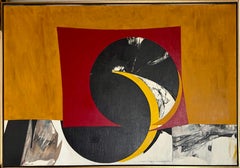
You May Also Like
Overscale Hard-Edge Abstract Painting after Ilya Bolotowsky, Signed Whiniak
By Ilya Bolotowsky
Located in Miami, FL
Overscale Hard-Edge Abstract Painting after Ilya Bolotowsky, Signed Whiniak
Offered for sale is a bold and graphic hard edge painting created in the style of Ilya Bolotowsky. The...
Category
Vintage 1970s American Modern Paintings
Materials
Canvas, Wood, Paint
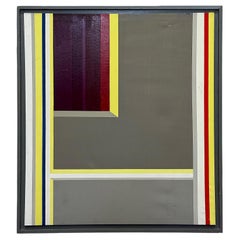
1970
S French Geometric Abstract Painting Bold Modern Colours
By Arlette Martin
Located in Cirencester, Gloucestershire
"Abstract Design"
signed by Arlette Martin (French, b.1924)
dated 76'
gouache/watercolour painting on card, unframed
painting: 19 x 20 inches
Stunning original painting by the pop...
Category
Late 20th Century Abstract Abstract Paintings
Materials
Gouache
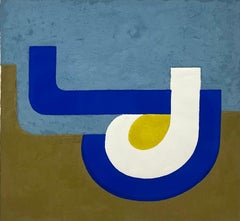
1960s Large Mid-century Modern Abstract Hard Edge Painting
Located in Miami, FL
Large 1960s Mid-century Modern Abstract Hard Edge Painting
Offered for sale is a striking 1960s vintage hard edge abstract painting with great movement. The painting is unsigned an...
Category
Mid-20th Century Paintings
Materials
Canvas, Paint
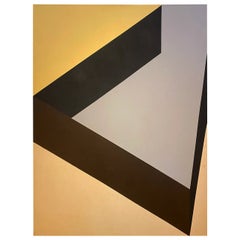
Homage to Bolotowsky, Geometric Abstract Acrylic Painting by Jonathan Singer
Located in Long Island City, NY
Artist: Jonathan Singer, American (1949 - 2019)
Title: Homage to Ilya Bolotowsky
Year: 1979
Medium: Acrylic on Canvas, signed and dated lower right
Size: 78 x 45.5 in. (198.12 x 11...
Category
1970s De Stijl Abstract Paintings
Materials
Canvas, Acrylic
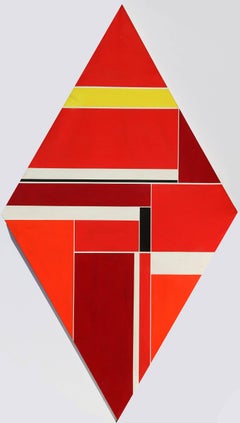
Geometric Composition - Oil Painting by Aldo Moriconi - 1967
Located in Roma, IT
Geometric Composition is an original contemporary artwork realized by Aldo Moriconi in 1967.
Mixed colored enamel on wood.
Hand signed and dated on th...
Category
1960s Abstract Abstract Paintings
Materials
Paint, Oil
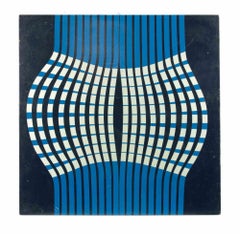
Geometric Flower, Abstract Acrylic Painting on Paper by Jules Engel
By Jules Engel
Located in Long Island City, NY
Artist: Jules Engel, Hungarian/American (1909 - 2003)
Title: Untitled 3
Year: circa 1970
Medium: Acrylic on Paper
Size: 21 x 21 inches
Category
1970s Abstract Geometric Abstract Prints
Materials
Paper, Acrylic