Want more images or videos?
Request additional images or videos from the seller
1 of 8
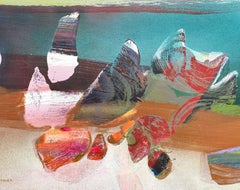
Juan SuarezLarge Spanish Contemporary Juan Suarez Abstract Bold Painting Triptych Group1988
1988
$7,500List Price
About the Item
About the Seller
4.9
Platinum Seller
Premium sellers with a 4.7+ rating and 24-hour response times
Established in 1995
1stDibs seller since 2014
1,861 sales on 1stDibs
Authenticity Guarantee
In the unlikely event there’s an issue with an item’s authenticity, contact us within 1 year for a full refund. DetailsMoney-Back Guarantee
If your item is not as described, is damaged in transit, or does not arrive, contact us within 7 days for a full refund. Details24-Hour Cancellation
You have a 24-hour grace period in which to reconsider your purchase, with no questions asked.Vetted Professional Sellers
Our world-class sellers must adhere to strict standards for service and quality, maintaining the integrity of our listings.Price-Match Guarantee
If you find that a seller listed the same item for a lower price elsewhere, we’ll match it.Trusted Global Delivery
Our best-in-class carrier network provides specialized shipping options worldwide, including custom delivery.You May Also Like
Blue Yonder-Monroe Hodder, American, Abstract, Bold, Modern, Red, Blue, Oil
By Monroe Hodder
Located in Knowle Lane, Cranleigh
Blue Yonder is an original oil over acrylic on canvas painting by American artist Monroe Hodder. Hodder’s abstract paintings are gloriously bold. Inspired by the urban backdrops of h...
Category
2010s Abstract Abstract Paintings
Materials
Oil, Canvas, Acrylic
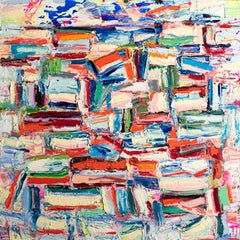
$11,602
H 36 in W 36 in D 2 in
Gdynia 2. Contemporary Figurative
Abstract Oil Painting Black
White, Polish
By Lukasz Fruczek
Located in Warsaw, PL
Contemporary abstract mixed media painting on canvas by Polish artistLukasz Fruczek. Artist used oil, acrylic and collage as his mediums. Painting depicts Polish industrial city at t...
Category
2010s Abstract Abstract Paintings
Materials
Canvas, Paper, Oil, Acrylic
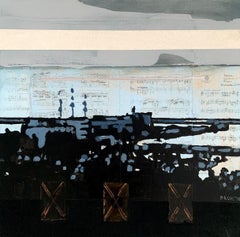
$1,538
H 23.63 in W 23.63 in
“Gulfside”
By Syd Solomon
Located in Southampton, NY
Original, oil paint and acrylic paint on canvas by the well known American artist, Syd Solomon. Signed bottom middle by the artist. Titled and dated verso 1983. Condition is excellent. Original gallery floating frame. Overall framed measurements are 38 by 42 inches. Provenance: A Sarasota, Florida collector.
SYD SOLOMON BIOGRAPHY
Written by Dr. Lisa Peters/Berry Campbell Gallery
“Here, in simple English, is what Syd Solomon does: He meditates. He connects his hand and paintbrush to the deeper, quieter, more mysterious parts of his mind- and he paints pictures of what he sees and feels down there.”
--Kurt Vonnegut Jr. from Palm Sunday, 1981
Syd Solomon was born near Uniontown, Pennsylvania, in 1917. He began painting in high school in Wilkes-Barre, where he was also a star football player. After high school, he worked in advertising and took classes at the Art Institute of Chicago. Before the attack on Pearl Harbor, he joined the war effort and was assigned to the First Camouflage Battalion, the 924th Engineer Aviation Regiment of the US Army. He used his artistic skills to create camouflage instruction manuals utilized throughout the Army. He married Ann Francine Cohen in late 1941. Soon thereafter, in early 1942, the couple moved to Fort Ord in California where he was sent to camouflage the coast to protect it from possible aerial bombings. Sent overseas in 1943, Solomon did aerial reconnaissance over Holland. Solomon was sent to Normandy early in the invasion where his camouflage designs provided protective concealment for the transport of supplies for men who had broken through the enemy line. Solomon was considered one of the best camoufleurs in the Army, receiving among other commendations, five bronze stars. Solomon often remarked that his camouflage experience during World War II influenced his ideas about abstract art. At the end of the War, he attended the École des Beaux-Arts in Paris.
Because Solomon suffered frostbite during the Battle of the Bulge, he could not live in cold climates, so he and Annie chose to settle in Sarasota, Florida, after the War. Sarasota was home to the John and Mable Ringling Museum of Art, and soon Solomon became friends with Arthur Everett “Chick” Austin, Jr., the museum’s first Director. In the late 1940s, Solomon experimented with new synthetic media, the precursors to acrylic paints provided to him by chemist Guy Pascal, who was developing them. Victor D’Amico, the first Director of Education for the Museum of Modern Art, recognized Solomon as the first artist to use acrylic paint. His early experimentation with this medium as well as other media put him at the forefront of technical innovations in his generation. He was also one of the first artists to use aerosol sprays and combined them with resists, an innovation influenced by his camouflage experience.
Solomon’s work began to be acknowledged nationally in 1952. He was included in American Watercolors, Drawings and Prints at the Metropolitan Museum of Art, New York. From 1952–1962, Solomon’s work was discovered by the cognoscenti of the art world, including the Museum of Modern Art Curators, Dorothy C. Miller and Peter Selz, and the Whitney Museum of American Art’s Director, John I. H. Baur. He had his first solo show in New York at the Associated American Artists Gallery in 1955 with “Chick” Austin, Jr. writing the essay for the exhibition. In the summer of 1955, the Solomons visited East Hampton, New York, for the first time at the invitation of fellow artist David Budd...
Category
1980s Abstract Expressionist Abstract Paintings
Materials
Canvas, Oil, Acrylic
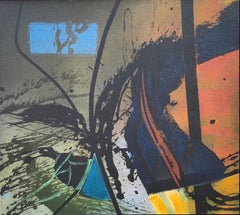
“Lightride”
By Syd Solomon
Located in Southampton, NY
Here for your consideration is a great example of the artwork of the well known American artist, Syd Solomon. Signed top left. Titled and dated verso 1978. The painting is oil and acrylic paint on mounted synthetic canvas. Condition is excellent. Overall framed measurements are 44.75 by 24.5 inches. Provenance: A Sarasota, Florida collector.
SYD SOLOMON BIOGRAPHY American 1917-2004
Written by Dr. Lisa Peters/Berry Campbell Gallery
“Here, in simple English, is what Syd Solomon does: He meditates. He connects his hand and paintbrush to the deeper, quieter, more mysterious parts of his mind- and he paints pictures of what he sees and feels down there.”
--Kurt Vonnegut Jr. from Palm Sunday, 1981
Syd Solomon was born near Uniontown, Pennsylvania, in 1917. He began painting in high school in Wilkes-Barre, where he was also a star football player. After high school, he worked in advertising and took classes at the Art Institute of Chicago. Before the attack on Pearl Harbor, he joined the war effort and was assigned to the First Camouflage Battalion, the 924th Engineer Aviation Regiment of the US Army. He used his artistic skills to create camouflage instruction manuals utilized throughout the Army. He married Ann Francine Cohen in late 1941. Soon thereafter, in early 1942, the couple moved to Fort Ord in California where he was sent to camouflage the coast to protect it from possible aerial bombings. Sent overseas in 1943, Solomon did aerial reconnaissance over Holland. Solomon was sent to Normandy early in the invasion where his camouflage designs provided protective concealment for the transport of supplies for men who had broken through the enemy line. Solomon was considered one of the best camoufleurs in the Army, receiving among other commendations, five bronze stars. Solomon often remarked that his camouflage experience during World War II influenced his ideas about abstract art. At the end of the War, he attended the École des Beaux-Arts in Paris.
Because Solomon suffered frostbite during the Battle of the Bulge, he could not live in cold climates, so he and Annie chose to settle in Sarasota, Florida, after the War. Sarasota was home to the John and Mable Ringling Museum of Art, and soon Solomon became friends with Arthur Everett “Chick” Austin, Jr., the museum’s first Director. In the late 1940s, Solomon experimented with new synthetic media, the precursors to acrylic paints provided to him by chemist Guy Pascal, who was developing them. Victor D’Amico, the first Director of Education for the Museum of Modern Art, recognized Solomon as the first artist to use acrylic paint. His early experimentation with this medium as well as other media put him at the forefront of technical innovations in his generation. He was also one of the first artists to use aerosol sprays and combined them with resists, an innovation influenced by his camouflage experience.
Solomon’s work began to be acknowledged nationally in 1952. He was included in American Watercolors, Drawings and Prints at the Metropolitan Museum of Art, New York. From 1952–1962, Solomon’s work was discovered by the cognoscenti of the art world, including the Museum of Modern Art Curators, Dorothy C. Miller and Peter Selz, and the Whitney Museum of American Art’s Director, John I. H. Baur. He had his first solo show in New York at the Associated American Artists Gallery in 1955 with “Chick” Austin, Jr. writing the essay for the exhibition. In the summer of 1955, the Solomons visited East Hampton, New York, for the first time at the invitation of fellow artist David Budd...
Category
1970s Abstract Expressionist Abstract Paintings
Materials
Canvas, Oil, Acrylic, Board
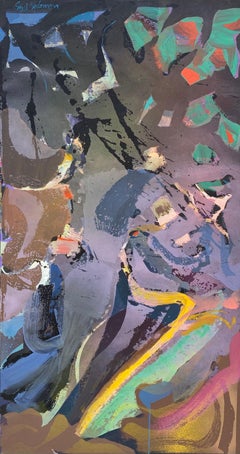
“Sandscape 2”
By Syd Solomon
Located in Southampton, NY
Original oil and acrylic painting on canvas titled “Sandscape 2” by the well known American artist, Syd Solomon. Signed Syd Solomon lower left. Signed and dated Syd Solomon 1972 and inscribed as titled on the reverse. 22 × 30 inches. Overall very good to excellent condition. No notable issues detected during inspection. No signs of restoration under UV inspection. The painting is in its original wood with silver reveal floating frame. Overall framed measurements are 24.25 by 32.25 inches. Provenance: A private collector.
Syd Solomon was born near Uniontown, Pennsylvania, in 1917. He began painting in high school in Wilkes-Barre, where he was also a star football player. After high school, he worked in advertising and took classes at the Art Institute of Chicago. Before the attack on Pearl Harbor, he joined the war effort and was assigned to the First Camouflage Battalion, the 924th Engineer Aviation Regiment of the US Army. He used his artistic skills to create camouflage instruction manuals utilized throughout the Army. He married Ann Francine Cohen in late 1941. Soon thereafter, in early 1942, the couple moved to Fort Ord in California where he was sent to camouflage the coast to protect it from possible aerial bombings. Sent overseas in 1943, Solomon did aerial reconnaissance over Holland. Solomon was sent to Normandy early in the invasion where his camouflage designs provided protective concealment for the transport of supplies for men who had broken through the enemy line. Solomon was considered one of the best camoufleurs in the Army, receiving among other commendations, five bronze stars. Solomon often remarked that his camouflage experience during World War II influenced his ideas about abstract art. At the end of the War, he attended the École des Beaux-Arts in Paris.
Because Solomon suffered frostbite during the Battle of the Bulge, he could not live in cold climates, so he and Annie chose to settle in Sarasota, Florida, after the War. Sarasota was home to the John and Mable Ringling Museum of Art, and soon Solomon became friends with Arthur Everett “Chick” Austin, Jr., the museum’s first Director. In the late 1940s, Solomon experimented with new synthetic media, the precursors to acrylic paints provided to him by chemist Guy Pascal, who was developing them. Victor D’Amico, the first Director of Education for the Museum of Modern Art, recognized Solomon as the first artist to use acrylic paint. His early experimentation with this medium as well as other media put him at the forefront of technical innovations in his generation. He was also one of the first artists to use aerosol sprays and combined them with resists, an innovation influenced by his camouflage experience.
Solomon’s work began to be acknowledged nationally in 1952. He was included in American Watercolors, Drawings and Prints at the Metropolitan Museum of Art, New York. From 1952–1962, Solomon’s work was discovered by the cognoscenti of the art world, including the Museum of Modern Art Curators, Dorothy C. Miller and Peter Selz, and the Whitney Museum of American Art’s Director, John I. H. Baur. He had his first solo show in New York at the Associated American Artists Gallery in 1955 with “Chick” Austin, Jr. writing the essay for the exhibition. In the summer of 1955, the Solomons visited East Hampton, New York, for the first time at the invitation of fellow artist David Budd. There, Solomon met and befriended many of the artists of the New York School, including Jackson Pollock, Franz Kline, Willem de Kooning, James Brooks, Alfonso Ossorio, and Conrad Marca-Relli. By 1959, and for the next thirty-five years, the Solomons split the year between Sarasota (in the winter and spring) and the Hamptons (in the summer and fall).
In 1959, Solomon began showing regularly in New York City at the Saidenberg Gallery with collector Joseph Hirshhorn buying three paintings from Solomon’s first show. At the same time, his works entered the collections of the Whitney Museum of American Art, the Solomon R. Guggenheim Museum, and the Wadsworth Athenaeum in Hartford, Connecticut, among others. Solomon also began showing at Signa Gallery in East Hampton and at the James David Gallery in Miami run by the renowned art dealer, Dorothy Blau.
In 1961, the Guggenheim Museum’s H. H. Arnason bestowed to him the Silvermine Award at the 13th New England Annual. Additionally, Thomas Hess of ARTnews magazine chose Solomon as one of the ten outstanding painters of the year. At the suggestion of Alfred H. Barr, Jr., the Museum of Modern Art’s Director, the John and Mable Ringling Museum in Sarasota began its contemporary collection by purchasing Solomon’s painting, Silent World, 1961.
Solomon became influential in the Hamptons and in Florida during the 1960s. In late 1964, he created the Institute of Fine Art at the New College in Sarasota. He is credited with bringing many nationally known artists to Florida to teach, including Larry Rivers, Philip Guston, James Brooks, and Conrad Marca-Relli. Later Jimmy Ernst, John Chamberlain, James Rosenquist, and Robert Rauschenberg settled near Solomon in Florida. In East Hampton, the Solomon home was the epicenter of artists and writers who spent time in the Hamptons, including Alfred Leslie, Jim Dine, Ibram Lassaw, Saul Bellow, Barney Rosset, Arthur Kopit, and Harold Rosenberg.
In 1970, Solomon, along with architect Gene Leedy, one of the founders of the Sarasota School of Architecture, built an award-winning precast concrete and glass house and studio on the Gulf of Mexico near Midnight Pass in Sarasota. Because of its siting, it functioned much like Monet’s home in Giverny, France. Open to the sky, sea, and shore with inside and outside studios, Solomon was able to fully solicit all the environmental forces that influenced his work. His friend, the art critic Harold Rosenberg, said Solomon’s best work was produced in the period he lived on the beach.
During 1974 and 1975, a retrospective exhibition of Solomon’s work was held at the New York Cultural Center and traveled to the John and Mable Ringling Museum in Sarasota. Writer Kurt Vonnegut, Jr. conducted an important interview with Solomon for the exhibition catalogue. The artist was close to many writers, including Harold Rosenberg, Joy Williams, John D. McDonald, Budd Schulberg, Elia Kazan, Betty Friedan...
Category
1970s Abstract Expressionist Abstract Paintings
Materials
Acrylic, Oil, Canvas
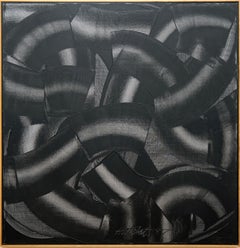
Large Mid Century Modern Texas Artist Abstract Expressionist Action Painting
By Duanye Hatchett
Located in Buffalo, NY
An abstract expressionist painting by Duayne Hatchett . Oil on canvas, circa 1990. Signed verso. Framed. I
Duayne Hatchett was a visual artist whose work included prints, pain...
Category
1990s Abstract Abstract Paintings
Materials
Canvas, Oil, Acrylic
$3,746 Sale Price
25% Off
H 51 in W 49 in D 2 in
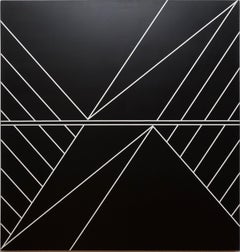
Monumental Mid Century Modern Abstract Minimalist Sleek Design Oil Painting
By Duanye Hatchett
Located in Buffalo, NY
An abstract mid century painting by Duayne Hatchett . Oil on canvas, circa 1973. Signed verso. Framed.
Duayne Hatchett was a visual artist whose work included prints, painting...
Category
1970s Abstract Abstract Paintings
Materials
Canvas, Oil, Acrylic
$5,200 Sale Price
20% Off
H 58 in W 54 in D 2 in
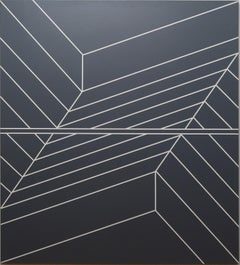
Monumental Mid Century Modern Abstract Minimalist Sleek Design Oil Painting
By Duanye Hatchett
Located in Buffalo, NY
An abstract mid century painting by Duayne Hatchett . Oil on canvas, circa 1973. Signed verso.
Duayne Hatchett was a visual artist whose work included prints, paintings, sculpt...
Category
1970s Abstract Abstract Paintings
Materials
Canvas, Oil, Acrylic
$5,200 Sale Price
20% Off
H 60 in W 54 in D 2 in
Monumental Mid Century Modern Abstract Minimalist Sleek Design Oil Painting
By Duanye Hatchett
Located in Buffalo, NY
An abstract mid century painting by Duayne Hatchett . Oil on canvas, circa 1973. Signed verso. Framed.
Duayne Hatchett was a visual artist whose work included prints, painting...
Category
1990s Abstract Abstract Paintings
Materials
Canvas, Oil, Acrylic
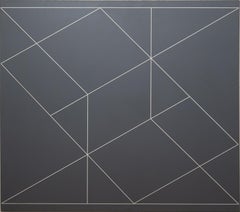
$5,200 Sale Price
20% Off
H 54 in W 57 in D 2 in
Large Mid Century Modern Textural Abstract Expressionist Action Oil Painting
By Duanye Hatchett
Located in Buffalo, NY
An abstract expressionist painting by Duayne Hatchett . Oil on canvas, circa 1991. Signed verso.
Duayne Hatchett was a visual artist whose work included prints, paintings, scul...
Category
1990s Abstract Abstract Paintings
Materials
Canvas, Oil, Acrylic
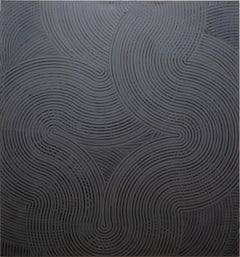
$4,400 Sale Price
20% Off
H 60 in W 55 in D 2 in
More From This Seller
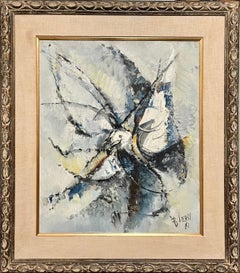
View AllLarge Modernist French Abstract Expressionist Colorful Bird Painting Roger Lersy
By Roger Lersy
Located in Surfside, FL
Roger Lersy, French (1920 - 2004)
Oil on canvas
Signed, R. Lersy, dated 1961 lower right
Measuring 35 X 31 Matted and framed. sight 26 X 21.5
Roger Lersy was born in Paris, France ...
Category
1960s Abstract Expressionist Abstract Paintings
Materials
Canvas, Oil, Acrylic
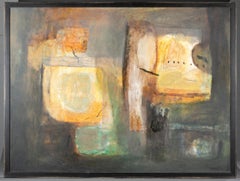
Large Rigoberto Mena Contemporary Cuban Abstract Expressionist Oil Painting
By Rigoberto Mena
Located in Surfside, FL
"Yellow/Green"
2004. Oil/Acrylic on Canvas. Signed lower right
Image: 34.5" x 47". Framed: 49" x 37".
Rigoberto Mena Santana (Cuban, born 1961) was born in Artemisia, Havana in 1961, where he currently lives and works. He attended the Instituto Politecnico de Diseno Industrial, La Habana, and continued his studies at San Alejandro Fine Art Academy, Havana. He traveled extensively throughout Europe to study the great masters. Mena has had Solo Exhibitions in China, Germany, Netherlands, Mexico, Cuba, Spain, France, and Holland, and in the U.S. in Miami, Massachusetts, Washington, D.C, and California. Following the inauguration of his exhibition “Hablando en Lenguas”. In 2011, Rigoberto’s work was chosen to be a part of the permanent collection of the National Museum of Fine Art in Havana, Cuba. Through the eyes of an abstract expressionist, he draws inspiration from his home’s urban landscapes and the spirit of the people and the city. The start of the Cuban Abstract movement was through a group called Los Once or The eleven. Though Mena was not an original member the influence by this new outlet began to spread ideals that put his own practice into fashion. Rigoberto is considered an important painter of his generation. He is one of the few artists in Cuba who has to have a private art gallery. Mena's private gallery at the Plaza de Armas is adjacent to the neighboring government art gallery. His work has been exhibited in Mexico, Belgium, Germany, France, Spain, and Holland.
Contemporaneous with the controversial, "La Generacion de los 80s" - The 80s Generation of Contemporary Cuban Art also referred to as New Cuban Art. This new Cuban plastic arts movement, with an expression of conceptual and non specific conscience manifestation, addressed many burning issues of the time and unveiled what these artists felt was the true reality of Cuba. It was more than a moment of artistic inspiration; it was a reflection of critical self-awareness and the new social role of art - the fundamental essence of the movement. They included Rubén Torres Llorca, Jose Bedia Valdes, Ricardo Rodriguez Brey, Juan Francisco Elso, Rogelio López Marín (Gory), Gustavo Pérez Monzón, José Manuel Fors, Leandro Soto Ortiz, Israel León, Tomás Sánchez and Carlos Alfonzo. In the second half of the decade, other artistic groups were formed, including 4 x 4, Grupo Hexágono, Arte Calle, Grupo Provisional, the duet René Francisco Rodríguez and Eduardo Ponjuán González and ABTV. Grupo Puré, another new wave of young artists, graduates of the Instituto Superior de Arte (ISA) included Ana Albertina Delgado Álvarez, Adriano Buergo, Ciro Quintana, Ermi Taño and Lázaro Saavedra, all greatly influenced by the German Kitsch art movement. Additionally, a large number of talented creators excelled independently, such as Florencio Gelabert (sculptor), Arturo Cuenca Sigarreta, Rigoberto Mena, Humberto Castro, Gustavo Acosta, Kcho, Antonio Eligio Fernandez (Tonel), Adriano Buergo, Flavio Garciandía, Tania Bruguera, Juan Francisco Elso, Carlos Rodríguez Cárdenas, Quisqueya Henríquez, Glexis Novoa, José Toirac, Carlos García, Heriberto Mora, Segundo Planes and Pedro Vizcaíno, among others.
Select Personal Exhibitions
2015 RBK 4200 ,La Cabaña,fortress. Bienal de La Habana,
2014 The shape without shape. Visual Arts Development Center, Bayamo, Cuba
2013 Allegro Ma Non Troppo. Lloyd’s Register, Havana.
2012 Spirit. Dennis Rosenthal Gallery, Chicago, U.S.A.
2011 Speaking in languages. Fine Arts National Museum, Havana.
2010 The places of time (with Alan Kleinmann). Orígenes Gallery, Havana’s Great Theater.
2009 The writing and the limit. 23 y 12 Gallery, Havana.
2007 The pleasure of absorb yourself. RAC Gallery, Veracruzan University, Xalapa, México.
2006 Coexistence. Public space, during the Ninth Havana’s Biennale.
2005 Ball change. La Casona Gallery, Havana, Cuba
Das Unbestimmbare Selbst. Refugium Gallery, Berlin.
2004 From the nothing to the infinite. La Casona Gallery, Havana, Cuba
2003 The visual poetry of life. Refugium Gallery, Berlin.
Rigoberto Mena. Recent Work. Habana Gallery, México DF.
Recent graphic work (with Jo Ann Rothschild). Graphic workshop, Havana.
Rigoberto Mena. Recent Work, Boston Art Institute, Lesley Boston University,
2001 Two plus one doesn’t make three (with Julio Girona and Angel Rivero), L Gallery,
2000 Cuba I, Space 12 Gallery, Boston, Massachusetts, United States.
Three abstract painters (with Jo Ann Rothschild and Julia Valdes...
Category
20th Century Abstract Expressionist Abstract Paintings
Materials
Canvas, Oil, Acrylic
Large Spanish Contemporary Art Juan Suarez Abstract Bold Painting Triptych Group
Located in Surfside, FL
Juan Suarez (Spanish, b. 1946)
Naturaleza Muerta,
Mixed media painting on three assembled canvases, (triptych)
It is either oil or acrylic paint. it seems like oil to me. A label ve...
Category
1980s Abstract Abstract Paintings
Materials
Canvas, Oil, Acrylic
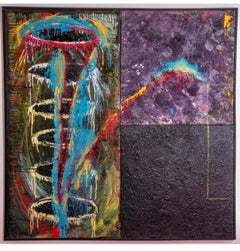
Large New York School Abstract Expressionist Colorful Mixed Media Painting
By Taro Yamamoto
Located in Surfside, FL
Taro Yamamoto, (American, 1919-1994)
"La Gatta Miso"
Oil or Acrylic/Canvas
32" x 50"
Hand signed lower right, dated 1990,
Titled on the stretcher verso, unframed.
Taro Yamamoto (...
Category
1950s Abstract Expressionist Abstract Paintings
Materials
Canvas, Oil, Acrylic
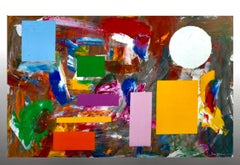
Angular Revelation, Abstract Geometric Day Glo Street Art Graffiti Painting
Located in Surfside, FL
Illegibly signed, titled and dated verso. angular abstract geometric painting in a graffiti, street art stye.
Category
Early 2000s Abstract Geometric Abstract Paintings
Materials
Canvas, Acrylic
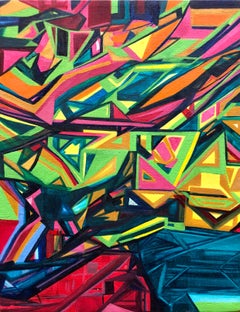
Bold Gestural Figurative Abstract Painting
Located in Surfside, FL
Genre: Modern
Subject: Abstract colorful
Medium: Acrylic
Surface: Canvas
Dimensions: 24" x 18" x 3/4"
Dimensions w/Frame: 27 1/2" x 21 1/2"
in the style of Cobra artists or rhino horn artists...
Category
Late 20th Century Abstract Expressionist Abstract Paintings
Materials
Canvas, Acrylic
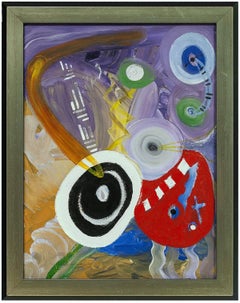
Still Thinking About These?
All Recently ViewedMore Ways To Browse
Basque Art
Joan Miro 1976
Seville Art
Joan Miro 1973
Virgen De
Large Painting Spain
Spanish Castle
Madrid Spain Painting
Chagall Mourlot Print
Reims Cathedral
Still Life Oil Painting Peaches
Train Prints
Joan Miro Original
Marina Picasso Collection Limited Edition Lithographs
Red Flower Painting
Vintage Posters With Green And Blue
Dali Signed
Judaica Prints