Want more images or videos?
Request additional images or videos from the seller
1 of 13

Larry Zox
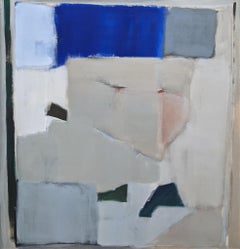
Larry Zox, original Red, White and Blue acrylic painting, signed, dated, framed

1963

$18,000
£13,729.15
€15,634.18
CA$25,295.49
A$27,588.29
CHF 14,614.41
MX$330,744.38
NOK 186,122.66
SEK 170,195.36
DKK 116,802.65

About the Item

Larry Zox Red, White and Blue painting, 1963 Original acrylic painting on board Signed and dated upper right front; Signed, titled and dated on the back as well Unique This work was originally sold by Jill Kornblee of the legendary Kornblee Gallery, with the back of the panel bearing Kornblee's original Upper East Side address before the gallery moved to West 57th Street Frame included: Elegantly double framed. Measurements: Outer Frame 13.5 inches vertical by 13.5 horizontal by 2.5 inches Original Frame: 10 inches vertical by 9.75 inches horizontal Painting 9.25 inches vertical x 9 inches horizontal Larry Zox Biography: A PAINTER who played an essential role in the Color Field discourse of the 1960s and 1970s, Larry Zox is best known for his intensely and brilliantly colored geometric abstractions that question and violate symmetry.1 Zox stated in 1965: “Being contrary is the only way I can get at anything.” To Zox, this position was not necessarily arbitrary, but instead meant “responding to something in an examination of it [such as] using
a mechanical format with X number of possibilities.”2 What he sought was to “get at the specific character and quality of each painting in and for itself,” as James Monte stated in his introductory essay in the catalogue for Zox’s 1973–1974 solo exhibition at the Whitney Museum of American Art.3 Zox’s robust paintings reveal
a celebrated artist and master of composition who is explored and challenged the possibilities of Post-Painterly Abstraction and Minimalist pictorial conventions. Zox began to receive attention in the 1960s when he was included in several groundbreaking exhibitions of Color Field and Minimalist art, including Shape and Structure (1965), organized by Henry Geldzahler and Frank Stella for Tibor de Nagy, New York, and Systemic Painting (1966), organized by Lawrence Alloway for the Solomon R. Guggenheim Museum, New York. In 1973–1974, the Whitney’s solo exhibition of Zox’s work gave recognition to his significance in the art scene of the preceding decade. In the following year, he was represented in the inaugural exhibition of the Hirshhorn Museum and Sculpture Garden, Wahsington, DC, which acquired fourteen of his works.
 Zox was born in Des Moines, Iowa in 1937. He attended the University of Oklahoma and Drake University, Des Moines, Iowa, and then studied under George Grosz at the Des Moines Art Center. In 1958, Zox moved to New York, joining the downtown art scene. His studio on 20th Street became a gathering place for artists, jazz musicians, bikers, and boxers, and he occasionally sparred with visiting fighters. He later established a studio in East Hampton, a former black smithy used previously by Jackson Pollock. In his earliest works, such as Banner (1962) Zox created
collages consisting of pieces of painted paper stapled onto sheets of plywood. He then produced paintings that were illusions of collages, including both torn- and trued-edged forms, to which he added a wide range of strong hues that created ambiguous surfaces. In paintings such as For Jean (1963), he omitted the collage aspect of his work and applied flat color areas to create more complete statements of pure color and shape. He then replaced these torn and expressive edges with clean and impersonal lines that would define his work for the next decade. From 1962 to 1965, he produced his Rotation series, at first creating plywood and Plexiglas reliefs, which turned squares into dynamic polygons. He used these shapes in his paintings as well, employing white as a foil between colors to produce negative spaces that suggest that the colored shapes had only been cut out and laid down instead of painted. The New York Times in 1964 wrote of the works in show such as Rotation B (1964) and of the artist: “The artist is hip, cool, adventurous, not content to stay with the mere exercise of sensibility that one sees in smaller works.”4 In 1965, he began the Scissor Jack series, in which he arranged opposing triangular shapes with inverted Vs of bare canvas at their centers that threaten to split their compositions apart. In several works from this series, Zox was inspired by ancient Chinese water vessels. With a mathematical precision and a poetic license, Zox flattened the three dimensional object onto graph paper, and later translated his interpretation of the vessel’s lines onto canvas with masking tape, forming the structure of the painting. The Diamond Cut and Diamond Drill paintings followed. In these, he used regularized formats as a means of revealing how color can change our perception of shape. In a single work he often combined industrial epoxy paints with acrylic to set up tensions between colors that would not exist otherwise. Writing about works like Cordova (1967) and Esso Lexington (1968), Peter Schjeldahl observed in the New York Times: “[Zox] is one painter who
shows an ability to play by the rules without cramping at all an essentially romantic and exuberant sensibility.”5 In an essay for
an exhibition at Dartmouth College Schjeldahl elaborated: “Zox has clearly adapted Post-Painterly procedures and Minimal pictorial conventions to the demands of a free-wheeling, lyrical sensibility.”6 His art of the period is equated with that of Frank Stella and Kenneth Noland. In the late 1960s, Zox’s paintings, such as in his Gemini series (1969–1972), became brushier; he often incorporated powdered mica into his paints to increase their visual effect. He explored a variety of new means of applying paint early in the following decade, including using squeegees and other large tools. With these means, he moved away from preconception, while introducing a drawing procedure in which the outside limits of a painting were determined by cutting or cropping the canvas. In the mid-1970s, Zox created a series of paintings in which he explored lateral tensions, leaving the centers of his works blank. He continued to stretch Color Field limits in the 1980s, combining the detachment of paint staining with gestural brushwork balanced between intuition and intentionality. He created more fluid yet still rigorous paintings in the early 2000s that were receiving critical praise when he died in 2006 from cancer. Zox taught at the School of Visual Arts, New York, in 1967, 1968, 1977, and 1980. He was artist in residence or guest artist at many universities such as Yale, Syracuse, Cornell, and Dartmouth. His honors include a Guggenheim Fellowship (1967) and awards from the National Council of the Arts (1969) and the Adolph Gottlieb Foundation (1985). Throughout his career, Zox had annual solo shows in galleries in New York City and around the world. In addition to the Whitney exhibition of 1973 and 1974, he had solo shows at the Hopkins Center, Dartmouth College, Hanover, New Hampshire (1970), the Akron Art Institute, Ohio (1971), the Des Moines Art Center, Iowa (1974), and the Marsh Gallery, University of Richmond, Virginia (1993). He participated in many notable museum and college gallery exhibitions at venues including the Whitney Museum of American Art, New York; Vassar College, Poughkeepsie, New York; the Palm Springs Art Museum; the Solomon R. Guggenheim Museum, New York; the Charles H. MacNider Museum, Mason City, Iowa; the Des Moines Art Center; the Blanden Memorial Art Museum, Fort Dodge, Iowa; and the Muscatine Art Center, Iowa. Zox is represented in over one hundred museum collections.
In addition to the Hirshhorn, his work is included in the Museum
of Modern Art, New York; the Whitney Museum of American Art, New York; the Metropolitan Museum of Art New York; the Solomon R. Guggenheim Museum, New York; the Tate Modern, London;
the Weserburg Museum, Bremen, Germany; the Museum of Fine Arts, Boston; the Fogg Art Museum, Harvard University, Cambridge, Massachusetts; The Museum of Fine Arts, Houston; and the Dallas Museum of Art.
  • Creator:
    Larry Zox (1936-2006, American)
  • Creation Year:
    1963
  • Dimensions:
    Height: 13.5 in (34.29 cm)Width: 13.5 in (34.29 cm)Depth: 2.5 in (6.35 cm)
  • Medium:
  • Movement Style:
  • Period:
  • Condition:
    Very good original condition with no apparent issues.
  • Gallery Location:
    New York, NY
  • Reference Number:
    1stDibs: LU1745217353562

More From This Seller

View All
Target acrylic on paper geometric Color Field painting signed inscribed Framed
By Kenneth Noland
Located in New York, NY
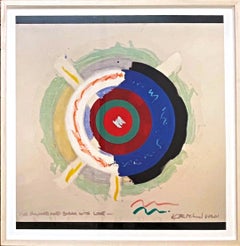
Kenneth Noland Untitled Target, 2001 Acrylic paint on offset lithograph paper Signed, dated, and dedicated along lower edge: For Howard and Susan with Love Kenneth Noland 6.10.01 Fra...
Category

1990s Color-Field Abstract Paintings

Materials

Acrylic, Permanent Marker, Lithograph, Offset

Dexter s Choice State II, signed mixed media watercolor (unique variant), Framed
By Larry Zox
Located in New York, NY
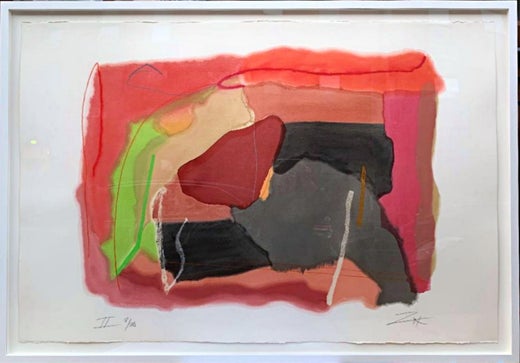
Larry Zox Dexter's Choice, State II, ca. 1990 Mixed media, Watercolor pochoir, and Oil stick Wax, Water-Based Crayons, on heavy Arches museum watercolor rag paper with deckled edges ...
Category

1990s Color-Field Abstract Drawings and Watercolors

Materials

Crayon, Mixed Media, Oil, Watercolor, Graphite, Monoprint

Larry Poons, Midget Racer, unique Color Field Abstract Geometric drawing, signed
By Larry Poons
Located in New York, NY
Larry Poons Midget Racer, 1963 Colored Pencil on Graph Paper Signed, titled, and dated by the artist on the lower right front Original frame with gallery label included Provenance: H...
Category

1960s Color-Field Abstract Drawings and Watercolors

Materials

Mixed Media, Color Pencil

Abstract Expressionist work on paper, unique, signed by renowned American artist
By David Humphrey
Located in New York, NY
David Humphrey Untitled, 2015 Acrylic on paper Hand signed and dated 2015 on the lower left front 11 × 8 1/2 inches Unframed This original painting was created by David Humphrey in 2...
Category

2010s Abstract Expressionist Abstract Drawings and Watercolors

Materials

Acrylic, Photographic Paper

Nightfall, Acrylic oil landscape painting, signed, framed, Museum provenance
By Thelma Appel
Located in New York, NY
Thelma Appel Nightfall (Dusk), 1973 Acrylic and Oil on Canvas. Hand Signed. Framed. Hand signed and titled on the back Unique Provenance: Jill Kornblee Gallery, NYNEX Corporation Frame included Museum Provenance. This work was originally sold in 1973 by the prestigious Jill Kornblee Gallery to a corporate collection (NYNEX) and, in 2019, it was featured in the Thelma Appel 50 year career survey at the Brattleboro Museum in Vermont – so the provenance is superb. It is reproduced in the exhibition catalogue. The collector who acquires this beautiful painting will be furnished with several copies of the limited edition museum catalogue Measurements: Framed 38.5 x 89.5 inches Artwork 36.5 x 87.5 inches Thelma Appel Biography: A co-founder of the Bennington College Summer Painting Workshop, Thelma Appel is a representational and abstract painter who has been practicing art for more than six and a half decades. In the 1980s, Thelma Appel was represented by the renowned Jill Kornblee Gallery and, after Ms. Kornblee retired, Appel joined the legendary Fischbach Gallery, (the gallery of record for Alex Katz for many decades,) also on West 57th Street, before they shuttered. After leaving Manhattan, she retreated from the art world for several decades; however, in recent years, her work is being rediscovered by a generation of new collectors. A beloved and popular teacher, at 87 years of age, Thelma could still be found teaching “The Art of Painting” at Artsplace in Cheshire, CT. and at the Osher Life Long Learning Institute (OLLI) At the University of Connecticut, near her home during the 2024-5 Fall/Winter Semester. In 2019, she was subject of a 50-year career survey (October, 2019 -February 2020) at the Brattleboro Museum in Vermont, entitled Thelma Appel: Abstract/Observed curated by Mara Williams. She has also exhibited at the Mattatuck Museum in Connecticut, which acquired one of her fabric collages for their permanent collection, the Bennington Museum in Vermont and the Police Museum in Lower Manhattan. Thelma Appel was born in Tel Aviv, Israel, but following her parents’ divorce, her father remained in Israel, but her mother emigrated to London to pursue a career as a journalist. However, she soon became ill, and Thelma was sent alone to be educated in a Protestant missionary schools in Darjeeling, India, a geographical displacement that would impact her life and her work. Thelma returned to London, England, to study art at the legendary St. Martin's School of Art (later Central St. Martins) and Hornsey College of Art, under such renowned teachers as Joe Tilson and Eduardo Paolozzi, before emigrating to the United States in the 1960s. Her work has been exhibited in numerous venues, including the Bennington Museum, the Berkshire Museum in North Adams, Mass., the Children's Museum of the Arts in New York City, the Mattatuck Museum, the Brattleboro Museum, the Milwaukee Art Museum, the Robert Hull Fleming Museum at the University of Vermont and the University of Pennsylvania Fine Arts Gallery. In 1974 she was awarded a YADDO Fellowship, and in 1975, Thelma Appel, along with the painter Carol Haerer, co-founded the Bennington College Summer Painting Workshop, where many distinguished painters of the day, both abstract and representational, conducted master classes. Among them were Neil Welliver, John Button, Alice Neel, Larry Poons, Friedel Dzubas, Stanley Boxer, Elizabeth Murray and Doug Ohlson – a program that continued until 1980. (One of Thelma’s students was the renowned art dealer Matthew Marks.) She has also taught drawing at Parsons School of Design, painting at Southern Vermont College and at the University of Connecticut. Appel’s work has been presented at Art on Paper, Texas Contemporary, Market Art & Design in Bridgehampton and Art New York art fair, which selected Appel’s Times Square series of paintings for their invitational public Project Space sponsored by Absolut Vodka. She was one of the winning artists of the juried exhibition “Pets of the Pandemic” juried by art historian and critic David Cohen, publisher and editor of artcritical, who cited it for special commendation as a “masterful portrait”. In recent years, Thelma’s work has been exhibited in both one-person and group shows at Alpha 137 Gallery in New York, Sager Reeves (now Sager Braudis) Gallery in Missouri, the Chashama Foundation in New York City, as well as the Five Points Gallery and Center for the Visual Arts in Torrington Connecticut, the David M. Hunt Gallery in Falls Village, CT and Wisdom House in Litchfield Ct...
Category

1970s Contemporary Landscape Paintings

Materials

Canvas, Oil, Acrylic

Val Wong Worm, dazzling, unique signed Painting (framed) with superb provenance
By Kenny Scharf
Located in New York, NY
Kenny Scharf Val Wong Worm, 2006 Oil, acrylic, silkscreen and rhinestones on paper Signed, dated and titled by the artist on the die-cut window on the back Frame Included: elegantly ...
Category

Early 2000s Pop Art Abstract Paintings

Materials

Mixed Media, Oil, Acrylic, Screen

You May Also Like

Untitled, 1974
By Claudia Sisemore
Located in Salt Lake City, UT
"Untitled, 1974" by Claudia Sisemore, acylic on canvas, 58 x 56 inches, $7,200. Unframed. "I have a vague idea of what I am going to paint. I read that many artists are inspired by an idea before they begin their work and plan their approach and process based on that idea or muse. Others become inspired after they have begun working and watching colors, shapes and designs form. I basically belong the second group. Usually, after painting begins in a loose, free manner, I become excited by certain colors and patterns and continue from there." -Claudia Sisemore -- Caudia Sisemore says she was teaching English when artist David Chaplin (an equally popular and influential teacher) was at Weber and initially got her into landscape painting. “Then he took me to a show at the Art Barn and Lee [Deffebach] was showing there [with Don Olsen...
Category

1970s Color-Field Abstract Paintings

Materials

Canvas, Acrylic

Blue and Green Abstract
By Claudia Sisemore
Located in Salt Lake City, UT
"Blue and Green Abstract" by Claudia Sisemore, acylic on canvas, 43.5 x 46 inches, $4,800. "I have a vague idea of what I am going to paint. I...
Category

1970s Color-Field Abstract Paintings

Materials

Canvas, Acrylic

Untitled, 1975
By Claudia Sisemore
Located in Salt Lake City, UT
"Untitled, 1975" by Claudia Sisemore, acylic on canvas, 41.5 x 50 inches, $4,800. "I have a vague idea of what I am going to paint. I read that many artists are inspired by an idea before they begin their work and plan their approach and process based on that idea or muse. Others become inspired after they have begun working and watching colors, shapes and designs form. I basically belong the second group. Usually, after painting begins in a loose, free manner, I become excited by certain colors and patterns and continue from there." -Claudia Sisemore -- Caudia Sisemore says she was teaching English when artist David Chaplin (an equally popular and influential teacher) was at Weber and initially got her into landscape painting. “Then he took me to a show at the Art Barn and Lee [Deffebach] was showing there [with Don Olsen...
Category

1970s Color-Field Abstract Paintings

Materials

Canvas, Acrylic

Moon Rising - Abstract stain painting acrylic on raw canvas
Located in Philadelphia, PA
'Moon Rising' acrylic painting by contemporary artist Elisa Niva, Acrylic on raw canvas 42 inches x 30 inches. This moon rise painting uses the soak- method created by Helen Franke...
Category

2010s Color-Field Abstract Paintings

Materials

Cotton Canvas, Acrylic

Earthen Tantric Painting #3- tantric soak stain meditation painting
Located in Philadelphia, PA
Earthen Tantric Painting #3- tantric soak stain meditation painting by abstract artist Elisa Niva 30”x40” Acrylic on cotton canvas. One of the main inspirations of this soak-stain ...
Category

2010s Color-Field Abstract Paintings

Materials

Cotton Canvas, Acrylic

Summer solstice moon - Abstract color field stain painting
Located in Philadelphia, PA
'summer solstice moon' 26"x24" acrylic and oil pigment stick on raw cotton canvas by Abstract painter Elisa Niva. This earthy and soft painting uses the soak- method created by He...
Category

2010s Color-Field Abstract Paintings

Materials

Oil Crayon, Cotton Canvas, Acrylic