Want more images or videos?
Request additional images or videos from the seller
1 of 11
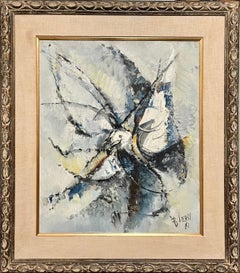
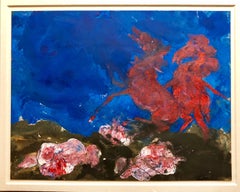
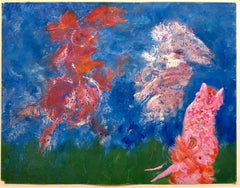
Robert BeauchampAmerican Neo Expressionist "Wild Horses" Modernist Oil Painting
$2,800List Price
About the Item
- Creator:Robert Beauchamp (1923 - 1995, American)
- Dimensions:Height: 26.5 in (67.31 cm)Width: 33 in (83.82 cm)
- Medium:
- Movement Style:
- Period:
- Condition:size includes mat. mounted to matting.
- Gallery Location:Surfside, FL
- Reference Number:1stDibs: LU3823013763
About the Seller
4.9
Platinum Seller
Premium sellers with a 4.7+ rating and 24-hour response times
Established in 1995
1stDibs seller since 2014
1,862 sales on 1stDibs
Authenticity Guarantee
In the unlikely event there’s an issue with an item’s authenticity, contact us within 1 year for a full refund. DetailsMoney-Back Guarantee
If your item is not as described, is damaged in transit, or does not arrive, contact us within 7 days for a full refund. Details24-Hour Cancellation
You have a 24-hour grace period in which to reconsider your purchase, with no questions asked.Vetted Professional Sellers
Our world-class sellers must adhere to strict standards for service and quality, maintaining the integrity of our listings.Price-Match Guarantee
If you find that a seller listed the same item for a lower price elsewhere, we’ll match it.Trusted Global Delivery
Our best-in-class carrier network provides specialized shipping options worldwide, including custom delivery.You May Also Like
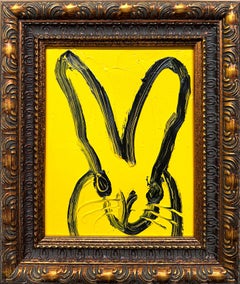
"Yellow Moon" Black Outlined Bunny on Royal Yellow Oil Painting on Wood Framed
By Hunt Slonem
Located in New York, NY
A wonderful composition of one of Slonem's most iconic subjects, Bunnies. This piece depicts a gestural figure of a black bunny on a royal yellow background with thick use of paint. ...
Category
2010s Neo-Expressionist Animal Paintings
Materials
Oil, Wood Panel
$8,000
H 14 in W 12 in D 1.25 in
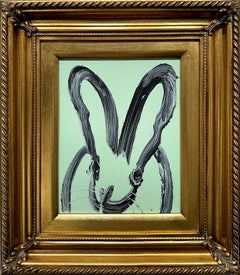
"Lee" Black Outline Bunny on Aqua Mist Blue Oil Painting on Wood Panel Framed
By Hunt Slonem
Located in New York, NY
A wonderful composition of one of Slonem's most iconic subjects, Bunnies. This piece depicts a gestural figure of a black bunny on an Aqua Mist blue background with thick use of pain...
Category
2010s Neo-Expressionist Animal Paintings
Materials
Wood Panel, Oil
$8,000
H 16 in W 14 in D 1.5 in
"Heart Felt" Heart Shaped Diamond Dust Turquoise Bunny Oil Painting White Framed
By Hunt Slonem
Located in New York, NY
A wonderful composition of one of Slonem's most iconic subjects, Bunnies. This piece depicts a double bunny on a turquoise blue gradient background with thick use of paint and diamon...
Category
2010s Neo-Expressionist Animal Paintings
Materials
Resin, Wood Panel, Oil, Glass

$11,500
H 20 in W 19 in D 1 in
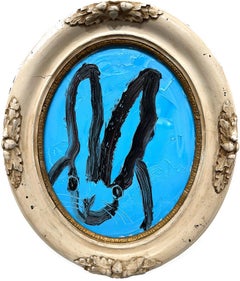
"Margo" Black Outlined Bunny on French Blue Background Oil Painting - Oval Frame
By Hunt Slonem
Located in New York, NY
A wonderful composition of one of Slonem's most iconic subjects, Bunnies. This piece depicts a gestural figure of a black bunny on French Blue background with thick use of paint. It ...
Category
2010s Neo-Expressionist Animal Paintings
Materials
Oil, Wood Panel
$8,000
H 13.5 in W 11.5 in D 1.5 in
"Cause of Our Joy" Black Outline Bunny on Silver Background Oil Painting Framed
By Hunt Slonem
Located in New York, NY
A wonderful composition of one of Slonem's most iconic subjects, Bunnies. This piece depicts a gestural figure of a black bunny on a silver background with thick use of paint. Inspir...
Category
2010s Neo-Expressionist Animal Paintings
Materials
Wood Panel, Mixed Media, Oil
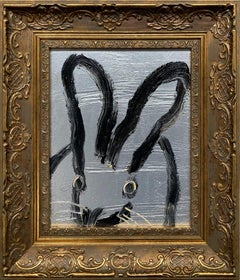
$8,000
H 14.5 in W 12.5 in D 1.25 in
"Jeffrey" White Outline Bunny on Black Background Diamondust Oil Painting Framed
By Hunt Slonem
Located in New York, NY
A wonderful composition of one of Slonem's most iconic subjects, Bunnies. This piece depicts a gestural figure of a white bunny on a black background with thick white paint and then ...
Category
2010s Neo-Expressionist Animal Paintings
Materials
Wood Panel, Glass, Resin, Oil
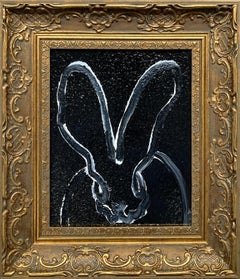
$8,000
H 14.5 in W 12.5 in D 1.25 in
"Lavender Fog 2" Bunny on Lavender Diamond Dust Background Oil Painting Framed
By Hunt Slonem
Located in New York, NY
A wonderful composition of one of Slonem's most iconic subjects, Bunnies. This piece depicts a gestural figure of a black bunny on a Light Lavender background with thick use of paint...
Category
2010s Neo-Expressionist Animal Paintings
Materials
Wood Panel, Oil, Resin, Glass
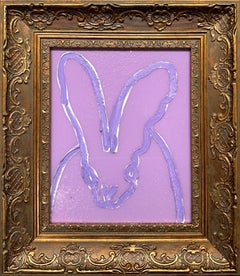
$8,000
H 14.5 in W 12.5 in D 1.25 in
"Banded" Bunny on Colorful Stripes Diamond Dust Background Oil Painting Framed
By Hunt Slonem
Located in New York, NY
A wonderful composition of one of Slonem's most iconic subjects, Bunnies. This piece depicts a gestural figure of a white bunny on a colorful striped background with thick use of pai...
Category
2010s Neo-Expressionist Animal Paintings
Materials
Wood Panel, Oil, Resin, Glass
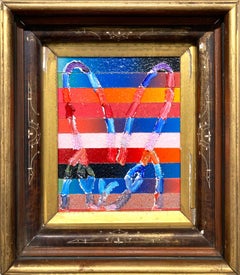
$8,000
H 15 in W 13 in D 3.25 in
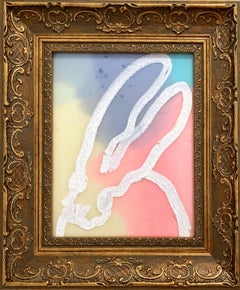
"Glisten Series" Bunny on Colorful Diamond Dust Background Oil Painting Framed
By Hunt Slonem
Located in New York, NY
A wonderful composition of one of Slonem's most iconic subjects, Bunnies. This piece depicts a gestural figure of a white bunny on a colorful background with thick use of paint. Insp...
Category
2010s Neo-Expressionist Animal Paintings
Materials
Wood Panel, Oil, Resin, Glass
$8,000
H 14.5 in W 12.5 in D 1.25 in
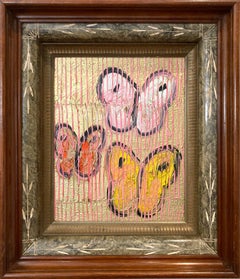
"Good News" Three Colorful Butterflies on Gold Background with Scoring Framed
By Hunt Slonem
Located in New York, NY
A wonderful composition of one of Slonem's most iconic subjects, Butterflies. This piece depicts three delicate butterflies in ascension placed in a wonderful golden landscape. Slone...
Category
2010s Neo-Expressionist Animal Paintings
Materials
Oil, Wood Panel, Mixed Media
$8,000
H 14.25 in W 12.25 in D 2.75 in
More From This Seller
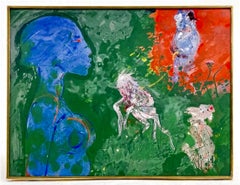
View AllAmerican Neo Expressionist Woman with Monkeys Abstract Modernist Oil Painting
By Robert Beauchamp
Located in Surfside, FL
Robert Beauchamp, American (1923-1995)
Untitled
Hand signed lower right, titled verso.
MIxed media oil painting on heavy art paper
sight: 22 3/4 x 29 1/2 inches
frame dimensions: 23 ...
Category
20th Century Neo-Expressionist Abstract Paintings
Materials
Paper, Oil
American Neo Expressionist "Wild Horses" Modernist Oil Painting
By Robert Beauchamp
Located in Surfside, FL
Robert Beauchamp (1923 – March 1995) was an American figurative painter and arts educator. Beauchamp's paintings and drawings are known for depicting dramatic creatures and figures with expressionistic colors. His work was described in the New York Times as being "both frightening and amusing,". He was a Guggenheim Fellow and a student of Hans Hofmann.
Robert Beauchamp was born in Denver, Colorado in 1923. He had three brothers and three sisters, and the children were orphaned by both parents by the time Beauchamp was three. The family grew up impoverished due to the Great Depression, living in a community house with other families. As a child he dabbled in art but it wasn't until high school that he began taking art classes. When not creating art he also played sports; football and basketball, and enjoyed chemistry and geology.
He was told he was good at drawing, and replaced study hall classes with art classes, receiving instruction and inspiration from a Welsh teacher named R. Idris Thomas. While in high school Beauchamp would go, every Monday, to the public library and a local museum where he would read books about art; specifically French painting, as assigned by Thomas. Beauchamp absorbed the tenets of European Modernism and American Abstract Expressionism—with which he eventually broke. While abstraction, with its focus on color and form, underlies his compositions, he filled canvas and paper with psychologically acute portraits of himself and others, nudes, animals, and objects of all kinds. Beauchamp would spend upwards of four hours a day in the art room and eventually won the Carter Memorial Prize, which provided a scholarship to the Colorado Springs Fine Arts Center. At Colorado Springs he studied under Boardman Robinson, painting landscapes in nature.
Beauchamp eventually joined the Navy and then returned to Colorado Springs to continue his studies. Traveling the world as an Armed Guard, he spent a year and a half at sea and the rest of the three years in San Francisco. Seeking to make money, and to follow his love for a girl, Beauchamp decided to attend Cranbrook Academy of Art from 1947–1948. There he studied pottery, believing one could "make more money selling pots than you could selling paintings." He described his experience at Cranbrook as intimidating and claustrophobic, and eventually switched to sculpture before switching to painting.
Beauchamp moved to New York City in the early 1950s and was involved in the Tenth Street galleries, which provided outlets for more experimental artists and the second generation of abstract expressionists. Despite his involvement with 10th Street and friendships with abstract artists, abstract art never interested in him. He showed at numerous galleries in New York and Provincetown, socializing with gallery owners, artists and collectors. His first exhibition was at the Tanager Gallery in New York, he also showed during the 1950s at the Hansa Gallery. In New York and Provincetown he studied under Hans Hofmann Eventually he felt that abstract expressionism became dull and stalemated.
During the 1960s he showed at the Green Gallery. C. 1960 he was awarded a Fulbright Award allowing him to travel to La Romola, Italy. He traveled frequently to cities such as Rome and worked constantly. Beauchamp returned to the states and lived in Provincetown at Walter Gutman's house, who awarded Beauchamp a grant. That year he met his future wife, Nadine Valenti, whom he married in 1967. Beauchamp taught at a variety of schools during his lifetime including Brooklyn College, School of Visual Arts, Cooper Union and the Art Students League of New York during the last fifteen years of his life.
Beauchamp described his drawings as painterly, seeking the spontaneity in an image. He would develop a drawing then a painting, and vice versa. His heavily impastoed paintings, often described as sculptures themselves, came from the pouring of paint from a can, with little planning and constant evolution in the medium upon the canvas. He preferred little planning to his creations, believing that an artists work would become stale and repetitive with constant planning.
He also created large scale works, at times 70 inches long. Beauchamp had little intention of ever selling his large works, preferring to create them due to the slow and intense experience he received from the process. The large drawings he created on the floor, and the smaller works were created on a table. Paintings were created on either the floor or wall and he described his painting process as "splattering", "pushing the paint around," and sponging.
Animals often appear in his paintings, despite a dislike for domestic animals outside of his artistic creations. He called the characters in his paintings as Beauchamps. Some Beauchamps hold meaning, with Beauchamp rarely sharing the meaning behind the symbols and characters. He made up the creatures himself, seeking to emphasize the character of each.
In 2006 the University of Massachusetts Amherst College of Visual & Performing Arts hosted an exhibition of Beauchamp's pieces from the 1960s, curators stated that Beauchamp's work: "effortlessly blends innovative style elements with narrative, descriptive images. One senses equal enjoyment in the manipulation of, and interaction with, color and paint, and the often sudden and unexpected presence of a wasp or a lump of sugar."
included in the important exhibit "Twelve New York Painters." New York: David Findlay Jr. Fine Art with Mary Abbott, Alcopley, Robert Beauchamp, Byron Browne, Charles Cajori, Jim Forsberg, Carl Heidenreich, Angelo Ippolito, Emily Mason, Robert Natkin, Robert Richenburg and Nina Tryggvadottir...
Category
20th Century Neo-Expressionist Abstract Paintings
Materials
Paper, Oil
American Neo Expressionist "Wild Horses" Modernist Oil Painting
By Robert Beauchamp
Located in Surfside, FL
Signed lower left.
Robert Beauchamp (1923 – March 1995) was an American figurative painter and arts educator. Beauchamp's paintings and drawings are known for depicting dramatic creatures and figures with expressionistic colors. His work was described in the New York Times as being "both frightening and amusing,". He was a Guggenheim Fellow and a student of Hans Hofmann.
Robert Beauchamp was born in Denver, Colorado in 1923. He had three brothers and three sisters, and the children were orphaned by both parents by the time Beauchamp was three. The family grew up impoverished due to the Great Depression, living in a community house with other families. As a child he dabbled in art but it wasn't until high school that he began taking art classes. When not creating art he also played sports; football and basketball, and enjoyed chemistry and geology.
He was told he was good at drawing, and replaced study hall classes with art classes, receiving instruction and inspiration from a Welsh teacher named R. Idris Thomas. While in high school Beauchamp would go, every Monday, to the public library and a local museum where he would read books about art; specifically French painting, as assigned by Thomas. Beauchamp absorbed the tenets of European Modernism and American Abstract Expressionism—with which he eventually broke. While abstraction, with its focus on color and form, underlies his compositions, he filled canvas and paper with psychologically acute portraits of himself and others, nudes, animals, and objects of all kinds. Beauchamp would spend upwards of four hours a day in the art room and eventually won the Carter Memorial Prize, which provided a scholarship to the Colorado Springs Fine Arts Center. At Colorado Springs he studied under Boardman Robinson, painting landscapes in nature.
Beauchamp eventually joined the Navy and then returned to Colorado Springs to continue his studies. Traveling the world as an Armed Guard, he spent a year and a half at sea and the rest of the three years in San Francisco. Seeking to make money, and to follow his love for a girl, Beauchamp decided to attend Cranbrook Academy of Art from 1947–1948. There he studied pottery, believing one could "make more money selling pots than you could selling paintings." He described his experience at Cranbrook as intimidating and claustrophobic, and eventually switched to sculpture before switching to painting.
Beauchamp moved to New York City in the early 1950s and was involved in the Tenth Street galleries, which provided outlets for more experimental artists and the second generation of abstract expressionists. Despite his involvement with 10th Street and friendships with abstract artists, abstract art never interested in him. He showed at numerous galleries in New York and Provincetown, socializing with gallery owners, artists and collectors. His first exhibition was at the Tanager Gallery in New York, he also showed during the 1950s at the Hansa Gallery. In New York and Provincetown he studied under Hans Hofmann Eventually he felt that abstract expressionism became dull and stalemated.
During the 1960s he showed at the Green Gallery. C. 1960 he was awarded a Fulbright Award allowing him to travel to La Romola, Italy. He traveled frequently to cities such as Rome and worked constantly. Beauchamp returned to the states and lived in Provincetown at Walter Gutman's house, who awarded Beauchamp a grant. That year he met his future wife, Nadine Valenti, whom he married in 1967. Beauchamp taught at a variety of schools during his lifetime including Brooklyn College, School of Visual Arts, Cooper Union and the Art Students League of New York during the last fifteen years of his life.
Beauchamp described his drawings as painterly, seeking the spontaneity in an image. He would develop a drawing then a painting, and vice versa. His heavily impastoed paintings, often described as sculptures themselves, came from the pouring of paint from a can, with little planning and constant evolution in the medium upon the canvas. He preferred little planning to his creations, believing that an artists work would become stale and repetitive with constant planning.
He also created large scale works, at times 70 inches long. Beauchamp had little intention of ever selling his large works, preferring to create them due to the slow and intense experience he received from the process. The large drawings he created on the floor, and the smaller works were created on a table. Paintings were created on either the floor or wall and he described his painting process as "splattering", "pushing the paint around," and sponging.
Animals often appear in his paintings, despite a dislike for domestic animals outside of his artistic creations. He called the characters in his paintings as Beauchamps. Some Beauchamps hold meaning, with Beauchamp rarely sharing the meaning behind the symbols and characters. He made up the creatures himself, seeking to emphasize the character of each.
In 2006 the University of Massachusetts Amherst College of Visual & Performing Arts hosted an exhibition of Beauchamp's pieces from the 1960s, curators stated that Beauchamp's work: "effortlessly blends innovative style elements with narrative, descriptive images. One senses equal enjoyment in the manipulation of, and interaction with, color and paint, and the often sudden and unexpected presence of a wasp or a lump of sugar."
included in the important exhibit "Twelve New York Painters." New York: David Findlay Jr. Fine Art with Mary Abbott, Alcopley, Robert Beauchamp, Byron Browne, Charles Cajori, Jim Forsberg, Carl Heidenreich, Angelo Ippolito, Emily Mason, Robert Natkin, Robert Richenburg and Nina Tryggvadottir...
Category
20th Century Neo-Expressionist Abstract Paintings
Materials
Paper, Oil
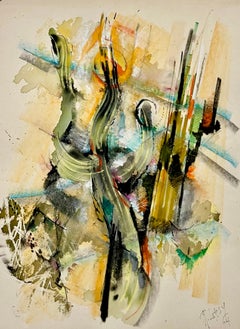
Large Modernist Art French Abstract Expressionist Colorful Painting Roger Lersy
By Roger Lersy
Located in Surfside, FL
Roger Lersy, French (1920 - 2004)
Painting on paper (not sure if this is watercolor, acrylic or oil, the paper has a velvet finish and texture to it and there is some texture to the ...
Category
1960s Abstract Expressionist Abstract Paintings
Materials
Paint, Paper
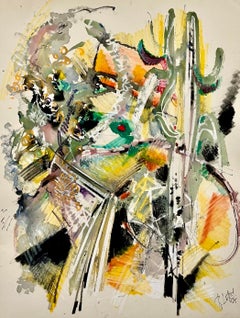
Large Modernist Art French Abstract Expressionist Colorful Painting Roger Lersy
By Roger Lersy
Located in Surfside, FL
Roger Lersy, French (1920 - 2004)
Painting on paper (not sure if this is watercolor, acrylic or oil, the paper has a velvet finish and texture to it and there is some texture to the ...
Category
1960s Abstract Expressionist Abstract Paintings
Materials
Paint, Paper
Large Modernist French Abstract Expressionist Colorful Bird Painting Roger Lersy
By Roger Lersy
Located in Surfside, FL
Roger Lersy, French (1920 - 2004)
Oil on canvas
Signed, R. Lersy, dated 1961 lower right
Measuring 35 X 31 Matted and framed. sight 26 X 21.5
Roger Lersy was born in Paris, France ...
Category
1960s Abstract Expressionist Abstract Paintings
Materials
Canvas, Oil, Acrylic