Items Similar to Abstract Expressionist Industrial River Landscape (Cuban American artist)
Want more images or videos?
Request additional images or videos from the seller
1 of 15
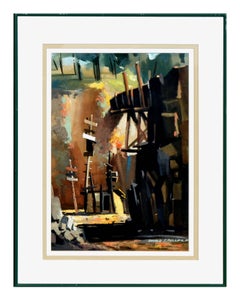
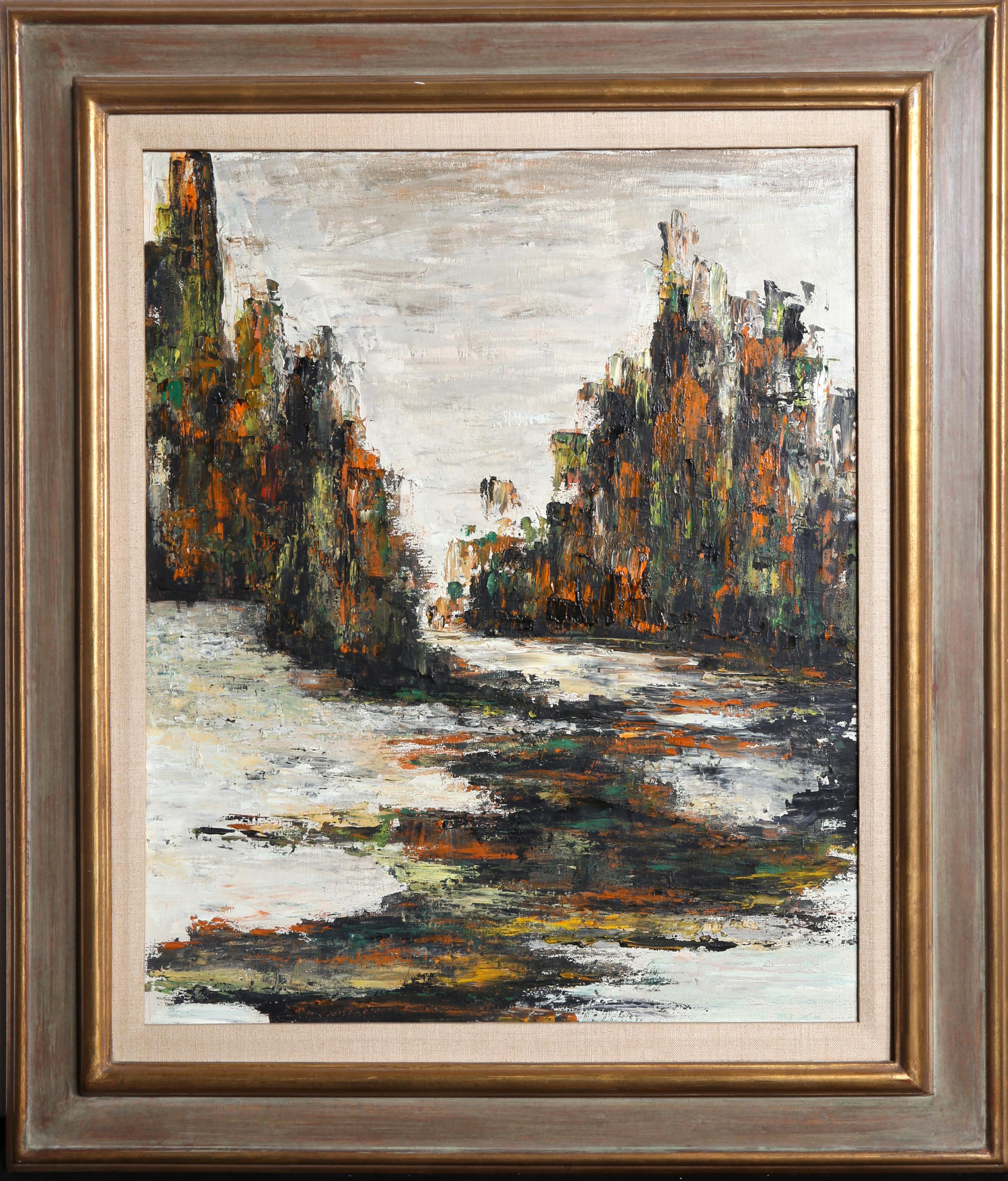
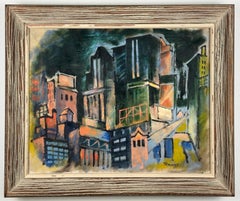
Robert BorgattaAbstract Expressionist Industrial River Landscape (Cuban American artist)1960
1960
$1,500
£1,142.25
€1,304.38
CA$2,107.69
A$2,312.53
CHF 1,218.13
MX$27,510.01
NOK 15,604.11
SEK 14,248.68
DKK 9,744.94
About the Item
Roberto Eduardo Biagio Borgatta y Ruiz (1921–2009).
Industrial River Landscape, 1960.
Tempera and pastel on illustation board. Image measuring 10.5 x 13.5 inches. Meauring 17.75 x 20.75 inches framed.
Known professionally as Robert Edward Borgatta, he was an American artist and foremost a nature painter whose style evolved from abstractions and later became more representational.
Childhood
Robert was born in Havana, Cuba and had a peripatetic childhood. His father, Carlos Borgatta, worked for Marconi Communications as a communications engineer, designing and installing telegraph systems throughout Latin America (Cuba, Brazil, Mexico and Argentina). Robert's father was of Northern Italian and Mexican Indian descent, fluent in both Spanish and Italian, and an Italian citizen. He worked with David Sarnoff at Marconi Communications and Sarnoff would then later found RCA. Prior to the outbreak of WWII when Italy became allied with Germany, Sarnoff offered Carlos a job at RCA and facilitated the visas for his immediate family to immigrate to the US from Italy.
Onorio Ruotolo of the Leonardo da Vinci Art School in New York recognized Robert's talents as a child painter and accepted him as the youngest student in the school at nine years of age. Robert traveled alone daily to the school via the elevated subway from Maspeth, Queens then back home nine hours later. Carlos located the school through his acquaintance with Ruotolo, also from northern Italy. The School emphasized traditional European art training with extensive time spent drawing life size plaster casts of classical Greco Roman sculptures and extensive instruction on human anatomy. Robert was trained as Italian artists are trained as in the tradition of the Renaissance, where emphasis is first placed on drawing from classical Greek and Roman sculpture, before graduating to life model drawing and the study of perspective and then on to art history.
The School marked Robert's introduction to and lifelong admiration of Vesalius' anatomical drawings, and he would return to this reference book throughout his career, especially when he was sculpting. At the school, Robert developed a friendship with the sculptor Isamu Noguchi and the two maintained contact for many years thereafter. Noguchi had a long relationship with the School and like Robert, was a favorite of Ruotolo. Also like Robert, Noguchi was obviously very different and stood apart from the other teachers and students: he was Japanese American and the oldest teacher at the time, Robert was the youngest student and still learning English. Noguchi enabled "Robbie" to attend the life drawing classes where subjects were nude models. (Robert's young age was the reason he wasn't allowed in these classes—the older students found his advanced skill level upsetting.). Robert attended life modeling classes throughout his career and found the experience of life drawing an important resource that helped him resolve technical issues when developing new works.
In 1931 at the age of eleven, Robert was a recipient of a Wannamaker Prize bestowed upon the best child artist in New York City. The individual prizes were commemorative medals in the likeness of Rutherford B. Hayes the nineteenth President of the United States. This was one of his most cherished possessions and he carried it with him as an army intelligence officer during World War II.
Education
Leonardo da Vinci School, (1930 - 1938)
New York University School of Architecture and Allied Arts. Bachelor of Fine Arts, magna cum laude, 1940
Yale University School of Art, MFA, 1942
Robert received his bachelor's degree from New York University School of Architecture and Allied Arts graduating magna cum laude in 1940, and a Masters of Fine Arts from Yale University School of Fine Arts in 1942. His masters thesis was on the Italian painter and sculptor Modigliani.
Robert was working on abstractions, portraits, cityscapes and representational works simultaneously during his years as a student at NYU and Yale.
Military service
United States Army Rangers, Military Intelligence (1943-1946)
In September 1945 as an officer in U.S. Army Intelligence, Master Sergeant Robert Borgatta (along with Corporal Nunzio Barbaro of Brooklyn and Lester J. McDonnell of Cleveland, Ohio) testified in the trial of Rita Louisa Zucca also known as “Axis Sally.” Zucca who had renounced her American citizenship in 1941 was broadcasting Nazi propaganda to U.S. troops in the Mediterranean. The tribunal would sentence her to four years for conspiring with the enemy with the intent of demoralizing U.S. soldiers. Robert was also featured again on the front page of the Times for a more light-hearted piece regarding his liberation of a small Italian village. The Office of Strategic Services (OSS) was a precursor to the CIA and Robert performed his duties through his Army Rangers attachment as an interrogator of Axis prisoners in Italy and North Africa. His fluency in five languages: French, Spanish, Italian, German and English, along with charm and presence, made him an effective interrogator. Despite these skills and his college degree, he refused officer commissions and stayed at the rank of Master Sergeant. His first hand experiences at Monte Cassino changed him into a lifelong pacifist and an anti-war activist during the Viet Nam era.
Early career
Robert had returned to New York a World War II veteran having spent three years overseas (1943–46), and prior to that having completed his MFA at Yale (1942). His paintings in this period are mostly moody, dense urban landscapes and abstractions.
Upon his return, Robert received an important commission from the prizefighter Joe Louis to produce a mural for Joe Louis’ nightclub and restaurant in Harlem: a fifty by eight foot mural (400 sq. ft.) depicting black contributions to American culture. Among the historic figures he portrayed were Booker T. Washington, Dr. George Washington Carver, Paul Robeson, Bill “Bojangles” Robinson and Marian Anderson. Robert's objective was to “represent most of the distinguished black personalities in American history”. Joe Louis was also a war veteran and like Robert, an outsider in America. They were to remain lifelong friends. A wonderful Times Magazine photo shows Robert visiting Joe in the hospital, shortly before his announced retirement from his boxing career.
1940-1960—Waterscapes
The waterscapes form a large collection ranging from the abstract to impressionistic. Promontories and the meeting of the land and sea are prevalent themes, and perspective takes on a full range of expression.
1940-1960—Landscapes
An extensive collection, the landscapes include alpine scenes, cliffs, ravines and the Palisades. There are numerous panoramic paintings, including ‘From St. Michaels’, ‘Andalusia’ and ‘038’. These works were produced completely from sketches and recalled visits.
1970's
For the first half of his life, Robert craved being American with a capital A: acceptance, admiration, acquiring things, and ambition. This was reflected in his position as a young tenured professor, the large number of solo gallery exhibitions, executing mural commissions, and advertising graphics work. His ability to routinely sell his work, coupled with his salary as an art professor and other art-related income was a source of pride that he made his living and supported his family solely as an artist. Robert was also instrumental in obtaining jobs for his peers including Phillip Pearlstein among others.
Robert served on the board of directors of the National Society of Painters of Casein and was affiliated with the National Arts Club
Mid to later works
1970-1980—Creation Series
The Creation Series marked departures in previous painting styles. During this period, he was sculpting simultaneously while painting. Similar to the Babcock disapproving of his evolving away from genres they preferred, years earlier John Canaday the art critic voiced similar frustration is several of his reviews of Robert's works. The issue of being pigeon-holed irked Robert and the dictum that one could only be defined as a painter for one style was not acceptable to him. Continuing to venture into new genres, he created during the early seventies “slide triptychs” where each panel of a painting would represent a greater magnification of his subject. In the egg and slide triptychs, the preliminary studies or smaller works would contain more depth of detail then the larger final works. The smaller water colors completed his output during this period.
These significant changes in the direction of his work in terms of his paintings and his new direction into sculpting caused Robert's falling out with the Babcock Galleries—they would not show his sculpture because he was associated with their gallery as a painter and they wouldn't show the new creation paintings because these were too different from the mystical, moody abstractions and landscapes he was known for. Although he missed exhibiting, separating from the Babcock Galleries freed him from producing with exhibitions and sales in mind and coincided with a new direction in his work, one that proved ultimately more introspection and brought him great personal satisfaction. A counterbalance to reduced exhibiting was the ability to work as he wished.
Influences
In sculpture, Robert greatly admired and was influenced by the styles of Henry Moore, Barbara Hepworth, and the Cycladic period of art in Greece, as well as Constantin Brancusi and Giacometti, as he was to favor pure, essential forms. He often said that he would trade all of his possessions for the Benin court ivory mask at the Metropolitan Museum of Art.
Robert often referred to anatomical drawings by Vesalius when composing his works, and the themes of bones and muscles were characteristic of his sculpture. His sculpture is mindful of negative space or a minimalist perspective and this theme is pervasive in compositions in his landscapes and later flower paintings. Cézanne’s use of perspective in composition to draw the viewer through the journey of the painting was a great influence on Robert's landscape painting technique. In painting, he admired and studied a wide range of artists. The murals of the Renaissance were constant lessons in composition that he revisited because of their skill in combining large scale work that kept the viewer engaged and the eye moving. Of this period, he greatly admired Tintoretto, Michelangelo and Raphael. Of Michelangelo, he thought of his unfinished Pieta as the most perfect expression of love and empathy, and as a technical achievement in the ability to see the evidence of the artist's journey in his chisel marks.
He took many trips to Italy and Venice to see the Scuola Grande di San Rocco murals by Tintoretto. It was frequently closed for various reasons, and it took five years of visits before he could view the entire works. This was the most intimate, mysterious way to experience murals; unlike other great mural works, the scuola San Rocco is hard to find, is always dim light at best, but the viewer is rewarded with a spectacular narrative of Christ's life. For Robert, this was Christ painted to be accessible by Everyman. This is how he interpreted the somewhat less finished aspect of these murals. Tintoretto, like Robert and like Modigliani were outsiders.
His all around favorite painter in terms of skill, vision and humanism was Turner who was for landscapes as Rembrandt was for portraits. Rembrandt self portrait represented for Robert what his goals were as an artist: first an unflinching representation of what was beautiful in painting, and as with Michelangelo the hand of the artist is evident in the brush strokes as well as the thought process. Robert made museum guards very nervous in always going as close to a work as he could to see details of the work. Van der Weyden's Portrait of a Lady was the first work he would look for at the National Gallery, and thought the work transcended portraiture. Hiroshige and his multiple views and perspectives influenced Robert in his preliminary studies for painting.
Chinese landscape drawings were a constant source of inspiration. He was most drawn by the synthesis of the artist's internal monologue and the depiction of the subject, and these were great examples of spiritual and intellectual unity. A very happy day for him came when the Met opened the Brook Astor Chinese court.
Robert Mapplethorpe and Andy Warhol were, for Robert, highly original and always compelling. In particular, Mapplethorpe's images of decaying flowers were of great interest, the idea that decaying dying things could be so beautiful, so spiritual. Regarding Warhol, early on Robert thought Warhol was important and original and made a point of keeping up with his work.
Robert had an enormous range as an artist and mastered the technical aspects of many media. He loved the challenge of mastering a particular style and the intellectual skills brought to bear. His classical training and art history studies gave him an extensive artistic vocabulary that allowed him to articulate his visions.
Technical Virtuosity
Relative to his peers, Robert seldom employed studio assistants and when he did, for limited purposes. He was well versed on technical aspects of creating art and he stretched and primed his own canvases and mixed his paints from dry pigment. He worked primarily in oil for painting and charcoal for drawings. In addition to his oil and acrylic paintings, Robert's works in pastel, water color, tempera and wood canvas are still in excellent un-restored condition. The same holds true for his approach to sculpture; works are mostly in marble and granite and small figures in jade and serpentine. He would begin a painting with gesture drawings, blocking out the large movements and composition. Paintings started as cartoons, followed by the primer color which was often cerulean—the base color beneath the snapdragons, or alizarin crimson for the gladioli.
Exhibition history
One-man exhibitions
Village Art Center, N.Y. 1953
Wellons Gallery, N.Y. 1954
City College, N.Y. 1958, 1964
Hudson River Museum, Yonkers, N.Y. 1960
Ringwood Museum, N.J. 1966, 1972
Park College, Kansas City, MO. 1970
Babcock Galleries, N.Y. 1964, 1968, 1970
Southern Vermont Arts Center 1977
Fine Arts Gallery, Harmon, N.Y. 1979
Select group exhibitions
Weyhe Gallery, N.Y. 1945
Roko Gallery, N.Y. 1950, 1979
Associated Gallery of Art, Detroit, MI. 1955
Riverside Museum 1956, 1958, 1960
Schettini Gallery, Milan, Italy 1957
New School, N.Y. 1958
Glassboro College, N.J. 1961
M.I.T., Cambridge, MA. 1962
Corcoran Gallery, Washington 1966, 1968, 1970
Whitney Museum 1954, 1966, 1968
Museum of Modern Art (Penthouse) 1968
Pennsylvania Academy 1957
Loeb Center, N.Y.U. 1965, 1968
Mansfield State College 1972
Hudson River Museum 1972, 1974
Bass Museum of Art, 1964
Collections
Chrysler Museum, Norfolk, VA
Ford Foundation
Yale University Art Gallery
Mansfield State College
Standard Motors Products Corporation
Connecticut Mutual Life Insurance Co.
Miller Associates
Globus Travel, US Headquarters, Colorado
Pfizer corporate art collection
Grants and awards
Tiffany Fellowship 1942
Emily Lowe Foundation 1957
MacDowell Colony Fellowship 1972, 1973
Silvermine Guild 1954, 1958
Audubon Artist Annuals 1955, 1958, 1969
American Watercolor Society 1961, 1962
National Society Painters In Casein and Acrylic 1961, 1970
- Creator:Robert Borgatta (1921 - 2009, American, Cuban)
- Creation Year:1960
- Dimensions:Height: 17.75 in (45.09 cm)Width: 20.75 in (52.71 cm)Depth: 1.5 in (3.81 cm)
- Medium:
- Movement Style:
- Period:
- Condition:
- Gallery Location:Wilton Manors, FL
- Reference Number:1stDibs: LU245217194172
About the Seller
4.9
Platinum Seller
Premium sellers with a 4.7+ rating and 24-hour response times
Established in 2007
1stDibs seller since 2015
441 sales on 1stDibs
Typical response time: 4 hours
- ShippingRetrieving quote...Shipping from: Wilton Manors, FL
- Return Policy
More From This Seller
View AllUntitled (Abstract Expressionist Painting)
By Jesse Redwin Bardin
Located in Wilton Manors, FL
Jesse Redwin Bardin (1923-1997). Untitled, ca. 1960.
Oil on canvas, 18 x 31 inches; 21.5 x 36.5 inches framed. Signed lower right.
Provenance: Private collection, Philadelphia; F...
Category
Mid-20th Century Abstract Expressionist Abstract Paintings
Materials
Canvas, Oil
#38 After the Rains
By Douglas M. Olsen
Located in Wilton Manors, FL
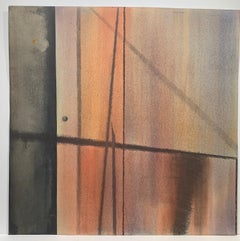
Douglas M. Olsen (b. 1960). #38, After the Rains, 1980. Watercolor on rag paper, 22 x 22 inches. Signed lower margin and on verso.
Category
20th Century Abstract Expressionist Abstract Paintings
Materials
Watercolor, Rag Paper
$200 Sale Price
50% Off
Untitled (Abstract Expressionist)
By Murray Hantman
Located in Wilton Manors, FL
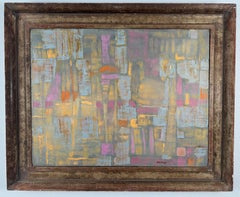
Murray Hantman (1904-1999). Untitled, ca. 1950-55. Oil on canvas measures 20 x 26 inches, 26 x 32 inches in silver leaf vintage frame.. Signed lower right. Excellent condition with ...
Category
Mid-20th Century Abstract Expressionist Abstract Paintings
Materials
Canvas, Oil
$3,000 Sale Price
25% Off
Passaic River NJ Landscape
Located in Wilton Manors, FL
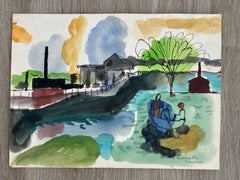
Joseph Kardonne (1911-1985). Passaic River Landscape 1967. 9.5 x 13 inches. Watercolor on paper, sheet measures inches. Signed, dated and titled lower right. Excellent condition.
...
Category
Mid-20th Century Cubist Abstract Paintings
Materials
Ink, Watercolor
Untitled, #36 (abstract expressionist painting)
By Esteban Vicente
Located in Wilton Manors, FL
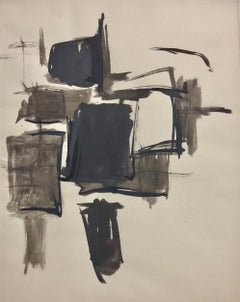
Esteban Vicente (1903-2001). Untitled, #36, 1955. Gouache on paper, image measures 8 x 11 inches, 16.5 x 19.5 inches framed. Signed, dated and numbered on verso. Excellent condition....
Category
Mid-20th Century Abstract Expressionist Abstract Paintings
Materials
Gouache
City at Night (Cityscape)
By Abram Tromka
Located in Wilton Manors, FL
Abram Tromka (1895-1964)
City at Night, ca. 1940.
Oil on canvas, 16 x 20 inches; 20 x 24 inches in antique oak frame. Signed lower right.
Frame is of the period, but probably not ...
Category
1930s American Modern Abstract Paintings
Materials
Canvas, Oil
You May Also Like
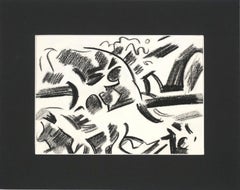
Mid Century Modern East Bay II Abstracted Landscape by Erle Loran
By Erle Loran
Located in Soquel, CA
Mid Century Modern East Bay II Abstracted Landscape by Erle Loran
Dynamic mid century abstracted geometric landscape drawing of the East Bay California lands...
Category
1950s Abstract Expressionist Landscape Drawings and Watercolors
Materials
Charcoal, Laid Paper
$760 Sale Price
20% Off
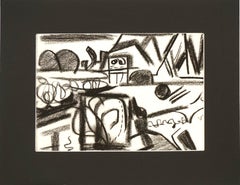
Mid Century Modern East Bay I Abstracted Landscape by Erle Loran
By Erle Loran
Located in Soquel, CA
Mid Century Modern East Bay I Abstracted Landscape by Erle Loran
Dynamic mid century abstracted geometric landscape drawing of the East Bay California landscape by Erle Loran (Ameri...
Category
1950s Abstract Expressionist Landscape Drawings and Watercolors
Materials
Charcoal, Laid Paper
$760 Sale Price
20% Off
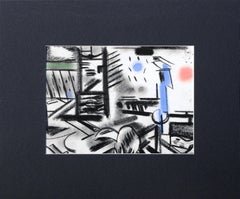
Mid Century Abstracted Industrial Cityscape
By Erle Loran
Located in Soquel, CA
Bold mid century abstracted landscape by Erle Loran (American, 1905-1999). Unsigned, but was acquired from the estate of Ruth Loran (wife of artist). Presented in a new black mat with foam core backing. Provenance: Estate of Earle Loran; David Carlson...
Category
Mid-20th Century Abstract Geometric Landscape Drawings and Watercolors
Materials
Paper, Pastel
$1,440 Sale Price
20% Off
Construction 2 - Abstract Cityscape Landscape Original Painting
By Ivana Milosevic
Located in Los Angeles, CA
Ivana Milosevic was born in Serbia in 1972. In 1998 she graduated from Belgrade University with a Master’s degree in Architecture. Since 2000 she was practicing architecture in Muni...
Category
21st Century and Contemporary Impressionist Landscape Paintings
Materials
Canvas, Oil
$500 Sale Price
20% Off
Cityscape on Water I, Signed Abstract Oil Painting by Miriam
Midge
Karr
Located in Long Island City, NY
Cityscape on Water II by Miriam 'Midge' Karr, American
Date: circa 1965
Oil on Canvas, signed verso
Size: 24 x 20 in. (60.96 x 50.8 cm)
Frame Size: 32 x 27.5 inches
Category
1960s Abstract Abstract Paintings
Materials
Canvas, Oil
Mid Century Modern Boats and Bridge, Abstracted Maritime Landscape Painting
By Donald J. Phillips
Located in Soquel, CA
Mid Century Modern Boats and Bridge, Abstracted Maritime Landscape Painting
Wonderful mid-century modern abstracted maritime seascape by listed San...
Category
1950s Abstract Impressionist Abstract Paintings
Materials
Paper, Oil