Items Similar to Aperture, Op Art Geometric Abstract Oil Painting by Roy Ahlgren

Want more images or videos?
Request additional images or videos from the seller
1 of 7
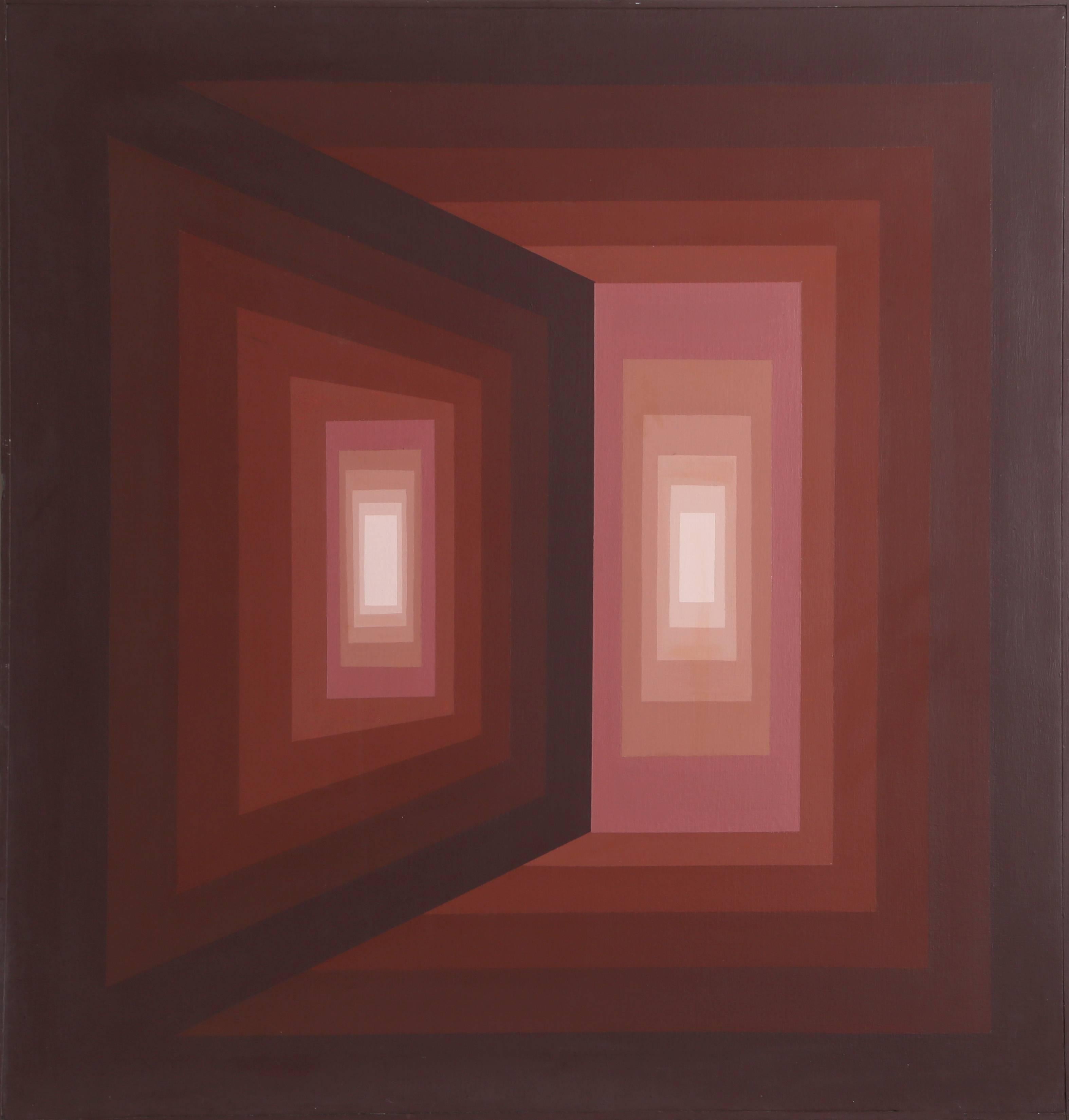
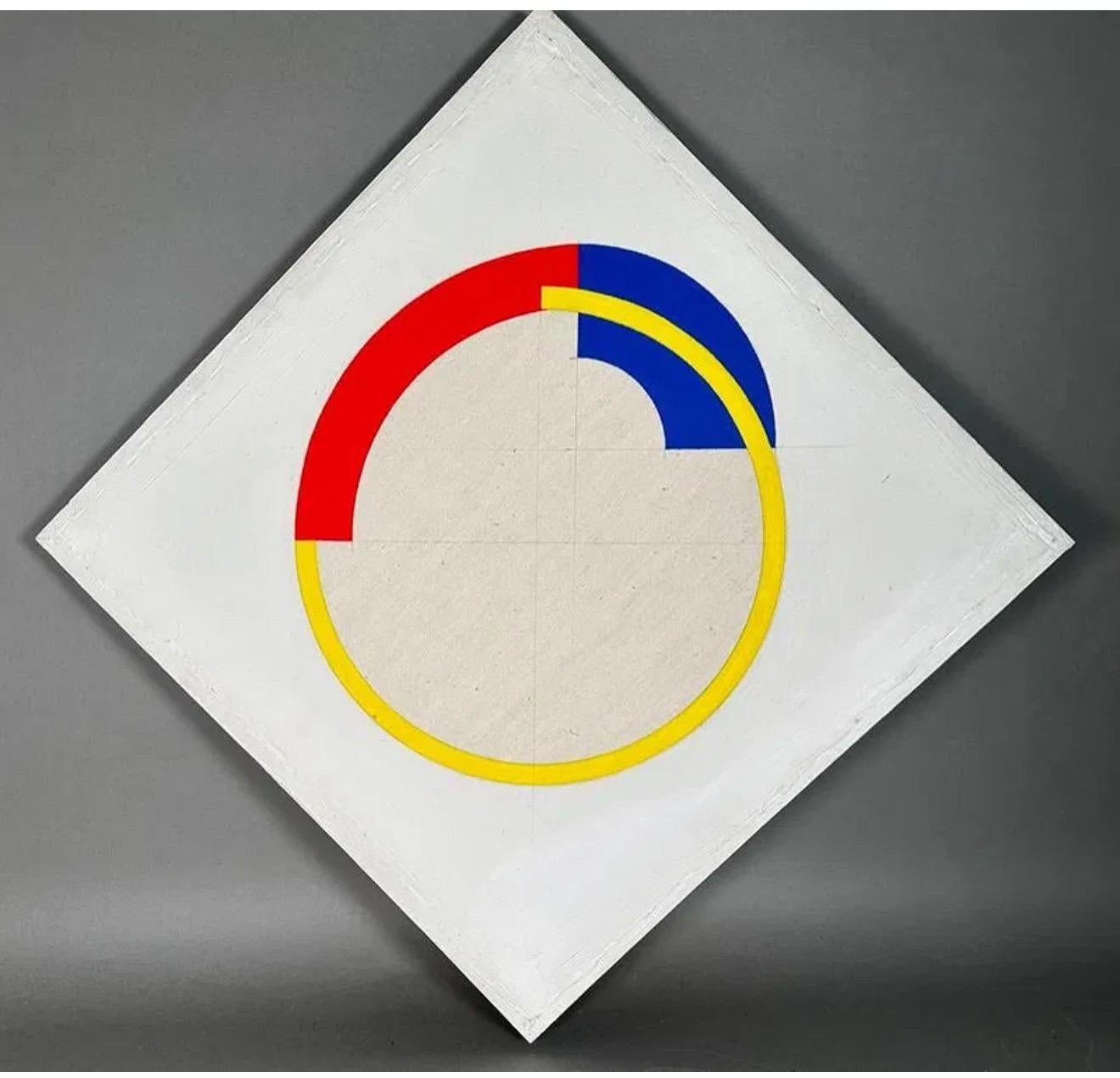
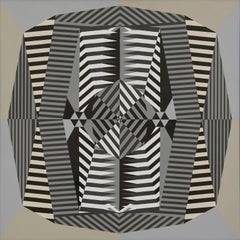
Roy AhlgrenAperture, Op Art Geometric Abstract Oil Painting by Roy Ahlgren1976
1976
$6,000
£4,534.34
€5,208.51
CA$8,439.44
A$8,935.17
CHF 4,835.46
MX$106,791.71
NOK 60,273.39
SEK 55,117.88
DKK 38,900.89
About the Item
Artist: Roy Ahlgren, American (1927 - 2011)
Title: Aperture
Year: 1976
Medium: Acrylic on Canvas, signed verso
Size: 30 x 30 in. (76.2 x 76.2 cm)
- Creator:Roy Ahlgren (1927 - 2011, American)
- Creation Year:1976
- Dimensions:Height: 30 in (76.2 cm)Width: 30 in (76.2 cm)
- Medium:
- Movement Style:
- Period:
- Condition:
- Gallery Location:Long Island City, NY
- Reference Number:Seller: RO691621stDibs: LU4662108453
Roy Ahlgren
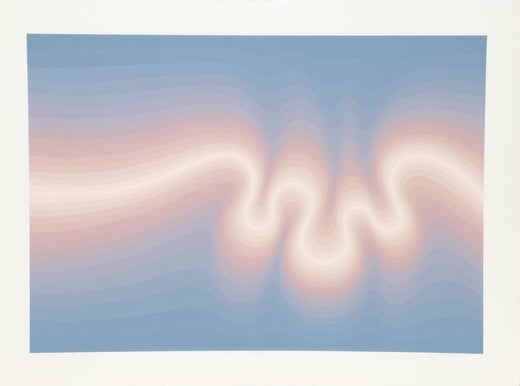
Roy Ahlgren (1927-2011) Algren was born in 1927 in Erie, PA. He is a self-taught painter. In 1964 he began to work in the op and hard edge technique. He received more than 60 prizes, among them purchase awards from the Seattle Art Museum, Minot State College, Texas Tech University Museum and the Mississippi Art Association. He exhibited in many national print shows. (from bio provided by the Associated American Artists, NY.) Roy Ahlgren entered the art world somewhat in reverse. While most artists start by recording realistic subjects and moving to abstract work later in their careers, Ahlgren began creating geometric abstract designs and continued to do so for 23 years. His media was both serigraphy and traditionally brushed pigment onto canvas. His compositions were unique with many being mathematically constructed with considerable precision.
About the Seller
4.9
Platinum Seller
Premium sellers with a 4.7+ rating and 24-hour response times
Established in 1979
1stDibs seller since 2014
3,241 sales on 1stDibs
Typical response time: 2 hours
- ShippingRetrieving quote...Shipping from: Long Island City, NY
- Return Policy
More From This Seller
View AllPassage, Geometric Abstract Acrylic Op Art Painting by Roy Ahlgren
By Roy Ahlgren
Located in Long Island City, NY
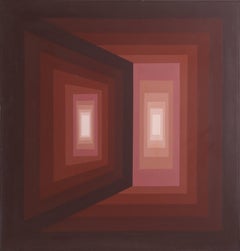
Artist: Roy Ahlgren, American (1927 - 2011)
Title: Passage
Year: 1976
Medium: Acrylic on Canvas, signed and dated verso
Size: 30 x 30 in. (76.2 x 76.2 cm)
Category
1970s Op Art Abstract Paintings
Materials
Acrylic
Portals, Geometric Abstract OP Art Acrylic Painting by Roy Ahlgren
By Roy Ahlgren
Located in Long Island City, NY
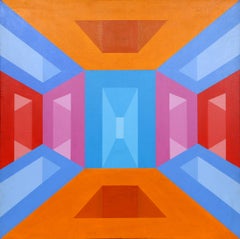
An acrylic painting by Roy Ahlgren from 1971. A geometric abstract painting utilizing bright contrasting color blocks in a modern form. Signed verso, unframed.
Artist: Roy Ahlgre...
Category
1970s Op Art Abstract Paintings
Materials
Cotton Canvas, Acrylic
Sun in Clouds, Large Geometric Abstract Acrylic Painting by Max Epstein
By Max Epstein
Located in Long Island City, NY
Artist: Max Epstein, Canadian (1932 - 2002)
Title: Untitled
Year: 1973
Medium: Acrylic on Canvas, signed and dated verso
Size: 67 x 67 inches
Frame Size: 68 x 68 in. (172.72 x 172.72...
Category
1970s Op Art Abstract Paintings
Materials
Acrylic
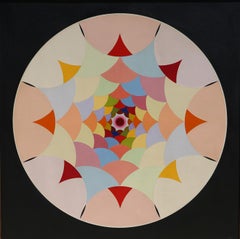
Megalopolis, Geometric OP Art Painting on Canvas by Roy Ahlgren
By Roy Ahlgren
Located in Long Island City, NY
Artist: Roy Ahlgren, American (1927 - 2011)
Title: Megalopolis
Year: 1972
Medium: Acrylic on Canvas, signed and dated verso
Size: 34 x 34 inches
Category
1970s Op Art Abstract Paintings
Materials
Canvas, Acrylic

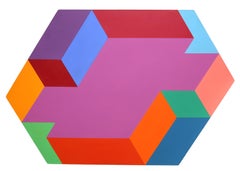
Hexagon, Large Geometric Abstract Acrylic Painting by Arthur Boden
By Arthur Boden
Located in Long Island City, NY
Artist: Arthur Boden, American XXth
Title: Untitled (Hexagon)
Year: 1975
Medium: Acrylic on Canvas, signed verso
Size: 54 x 51.5 (104.14 cm x 152.4 cm)
Category
1970s Op Art Abstract Paintings
Materials
Canvas, Acrylic
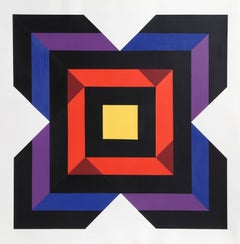
Geometric Flower, Abstract Acrylic Painting on Paper by Jules Engel
By Jules Engel
Located in Long Island City, NY
Artist: Jules Engel, Hungarian/American (1909 - 2003)
Title: Untitled 3
Year: circa 1970
Medium: Acrylic on Paper
Size: 21 x 21 inches
Category
1970s Abstract Geometric Abstract Prints
Materials
Paper, Acrylic
You May Also Like
Monumental Geometric Op Art Oil Painting c.1970s
Located in San Francisco, CA
Monumental Geometric Op Art Oil Painting c.1970s
Fantastic original Op Art oil painting. The large size will ensure it's the centerpiece of any r...
Category
Mid-20th Century Abstract Abstract Paintings
Materials
Oil
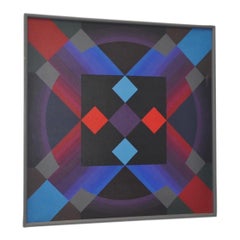
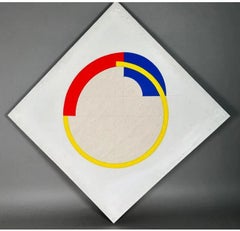
Op Art Hard Edged Abstract Geometric Mod Painting John Pearson
Located in Surfside, FL
John Pearson (American born 1940)
"Study for Circus"
1985
Acrylic on canvas painting
Hand signed verso, hangs from corner of canvas.
Provenance: The New Gallery of Contemporary Art, Cleveland, Ohio. Bearing label verso:
Dimensions: 19 x 19 in (it hangs in diamond shape which measures point to point 26.87 X 26.87 inches)
Red, White, Blue, and Yellow abstract geometric painting. Circle and ellipse.
John Pearson (British, 1940-was born in Yorkshire, England, and studied at the Harrogate School of Art, Yorkshire (National Diploma of Design, 1960), the Royal Academy Schools, London (Certificate, R.A.S 1963), the Akademie der Bildenden Kunst, Munich (1963–64, research fellow), and Northern Illinois University (M.F.A. 1966). He is known for hard edged, mod abstract oil painting on shaped canvas in geometric, curvilinear forms.
For many years, Pearson has made paintings and low-relief sculpture, predominantly wall pieces, which use color, form, and various degrees of abstraction to modify the space of entire rooms. With work exhibited nationally and internationally in both solo and group shows, Pearson has also been sought for many site-specific commissions, both public and private. These are typically highly abstract, simplified, and nuanced; they’re often witty, too.
Pearson early on became a devotee of the Dutch artist Piet Mondrian, a chief proponent of De Stijl (The Style), Pearson’s style has evolved from intense system-based abstract compositions to one more attuned to the spiritual influences of the natural environment. Pearson’s early style reflects the European reaction to expressionism and artistic emotionalism in the form of a rational, systematic approach to art (often called the “New Tendency”). An heir to the tenets of Constructivism, he investigated color within a predetermined linear or grid system that eliminated options after the artist’s initial choices. He was drawn to Cleveland in 1970 because of its reputation at the time for having a rich environment for abstract art, as two of the chief proponents of Kinetic art and op art, Julian Stanczak and Richard Anuszkeiwicz, worked there. Students of Josef Albers, the grand master of color theory who taught these two primary practitioners of the “Color Function” school of abstract art at Yale in the 1950s.
Pearson’s early style reflects a European reaction to abstract expressionism that manifested itself in a rational, systematic approach to art.Since his emergence in 1960s London, John Pearson has been using mathematical systems and computer programs to generate hard-edged geometric compositions. His work is of the same genre as the artists of the Denise Rene Gallery in Paris, similar to Vasarely, Agam, Cruz Diez and Soto. His most recent work, with its circles and ellipses superimposed on patterns of wavy lines, brings a more easygoing approach to his particular breed of rule-based art. Pearson has received grants from the National Endowment for the Arts and the Canada Council, and has had solo exhibitions at institutions including the Akron Art Museum, the Cleveland Center for Contemporary Art, and the Museum of Modern Art in Rijeka, Croatia. Pearson was born in Yorkshire (Britain) and studied art at the Royal Academy Schools in London, did advanced work in Munich (Germany), and earned the M.F.A. (Master of Fine Arts) degree from Northern Illinois University. Before arriving to teach at Oberlin College in 1972, he taught at the University of New Mexico, the Nova Scotia College of Art and Design, and the Cleveland Institute of Art. At Oberlin, he served as the Young-Hunter Professor of Art. John retired from teaching in 2014 but still occasionally works with students and lives in Oberlin where he educated several generations of appreciative liberal arts students. He also served as department chair and held the Young-Hunter endowed professorship from 1987 onward, until his retirement. Pearson travelled widely to paint, exhibit, and teach and received support from the Ohio Arts Council and the National Endowment for the Arts, among others. His career received recognition via the Cleveland Arts Prize in 1975, while most recently he was recognized as a Special Honoree by the same organization.
His paintings and sculptures are held in many public and private collections in the U.S., Canada, Europe, China, and Japan, as well as by museums, such as the Allen Art Museum (Oberlin), the Cleveland Museum of Art, the Museum of Modern Art (New York), and the Art Institute of Chicago. Hard-Edged
Select Group Exhibitions
Abstract, Constructive, Concrete Mondrian huis, Amersfoort, Holland
Chronologic Planet Art...
Category
1980s Abstract Geometric Abstract Paintings
Materials
Acrylic, Canvas
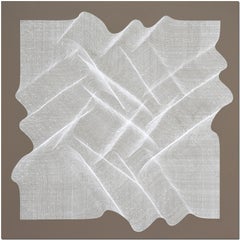
Trama - geometric abstract painting
By Roberto Lucchetta
Located in New York, NY
This hand painted piece by Lucchetta is part of the op art series where he is able to catch movement with his unique technique. Lucchetta is challenging himself. His precise stable h...
Category
2010s Op Art Abstract Paintings
Materials
Paper, Ink, Acrylic
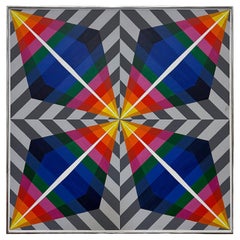
Gabe Silverman 1980s Abstract Op Art Painting on Canvas, Original Frame
Located in Miami, FL
Gabe Silverman 1980s Abstract Op Art Painting on Canvas, Original metal frame.
Offered for sale is an oversized original and exceptional Op Art painting recently discovered in a ti...
Category
Vintage 1980s Paintings
Materials
Metal
Geometric Modern Painting "From the Center"
Located in Washington, DC
Geometric abstraction painting by Brazilian-born artist Elizabeth Freire. Painting is acrylic on canvas. Signed on reverse and titled "From the Center". B&W photo is of Ms. Freire with renowned sculptor Etienne Martin at the Ecole Nationals des Beaux-Arts in Paris.
Elizabeth Freire is a Brazilian-born, contemporary American artist. At the age of eighteen, she left Rio de Janeiro and moved to Paris to study sculpture at l’Ecole Nationale Superieure des Beaux-Arts, receiving her Diploma there in 1979 under the direction of Claude Viseux, Etienne Martin, and Cesar. During that time she worked as an apprentice at the Fonderie de France where she learned bronze technique and she also attended etching courses at l’Ecole de Montparnasse.
In 1976, she won a commission to make three life-size figures representing the printing company, “Les Imprimeries de Boulogne,” at the International Printing Fair in Paris. She spent 1977 in Aix-en-Provence where she carved the local stone of Rogne.
Returning to Paris, the painter Lutka Pink introduced her to Otero, Frans Krajcberg and Hajdu from whom she received valuable lessons. In 1978, she traveled to Brazil where she was invited to participate in the exhibit ‘A Century of Sculpture in Brazil’. She also met with the sculptor Sergio Camargo and the architect Oscar Niemeyer. She then traveled extensively throughout Europe and North Africa.
In 1983, the sculptor Cardenaz advised her to go to Carrara in Italy to develop her carving skills. She spent the following two years at the Studio Nicoli where she met the sculptors Knutt Steen, Gigi Guadagnucci...
Category
21st Century and Contemporary Abstract Geometric Abstract Paintings
Materials
Canvas, Acrylic
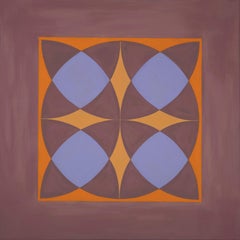
Curved Dimensions, Abstract OpArt Geometrical, Mid-Century Cleveland Artist
By Edwin Mieczkowski
Located in Beachwood, OH
Edwin Mieczkowski (American, 1929-2017)
Curved Dimensions, 1965
Acrylic on board
Signed, dated and titled verso
30 x 29.75 inches
Edwin Mieczkowski, born in Pittsburgh, was a leader of geometric and perceptual abstraction during the latter part of the 20th century. Mieczkowski's work first came to prominence in "The Responsive Eye" exhibition, the nation's first major exhibition of perceptual art, held at the Museum of Modern Art in New York in 1965.
Mieczkowski was also featured in the 1964 article in Timemagazine that first used the term "Op Art" to describe paintings that manipulated visual cues in order to reorder and excite viewers' perceptual responses.
With a complex aesthetic that over time has transcended mere tricks of optical art, Mieczkowski has spent nearly four decades producing geometrically paintings, drawings and sculptures, a genre of modern art that is known broadly as perceptual abstraction.
His output of static and dynamic forms create a body of work, still largely intact, that uses visually disorienting, meticulously arranged lines, dazzling kaleidoscopic colors, and alluring juxtapositions of hue and tone, to playfully and seductively present new challenges for the viewer's eyes. The desired result is an optical effect of perpetual motion, harmonics and rhythm. . . .
Along with Frank Hewitt and Ernst Benkert, Mieczkowski was a co-founder in 1959 of the Anonima* group that worked together in Cleveland and New York and declared itself free from the pressures of the art market and the pursuit of personal fame. Members of Anonima often left their works unsigned and vowed to shun the usual art market venues such as commercial galleries, biennials and competitions. Instead, they engaged in a rigorous, self-imposed program of painting exercises to explore the effects of geometry and color on visual perception.
Although Mieczkowski's work hung side-by-side in the MOMA "Responsive Eye" exhibition with such colleagues as Josef Albers, Victor Vasarely, Richard Anuszkiewicz, Morris Louis, Kenneth Noland, Carlos Cruz...
Category
1960s Op Art Abstract Paintings
Materials
Acrylic
Read More
Romare Bearden’s Humanity Infuses His Bright, Bold Art
Through collage, painting and printmaking, the artist foregrounded Black life in America in revolutionary new ways.
Chryssa’s 1962 Neon Sculpture Was Way ahead of the Art-World Curve
By working with lettering, neon and Pop imagery, Chryssa pioneered several postmodern themes at a time when most male artists detested commercial mediums.