Want more images or videos?
Request additional images or videos from the seller
1 of 14
André BrasilierLe Cadre Noir de Saumur - Expressionist Oil, Figures on Horse by André Brasilierc.1965
c.1965
$40,237.44List Price
About the Item
- Creator:André Brasilier (1929, French)
- Creation Year:c.1965
- Dimensions:Height: 28 in (71.12 cm)Width: 32 in (81.28 cm)
- Medium:
- Movement Style:
- Period:
- Condition:Very good original condition.
- Gallery Location:Marlow, GB
- Reference Number:Seller: LFA03011stDibs: LU415311507502
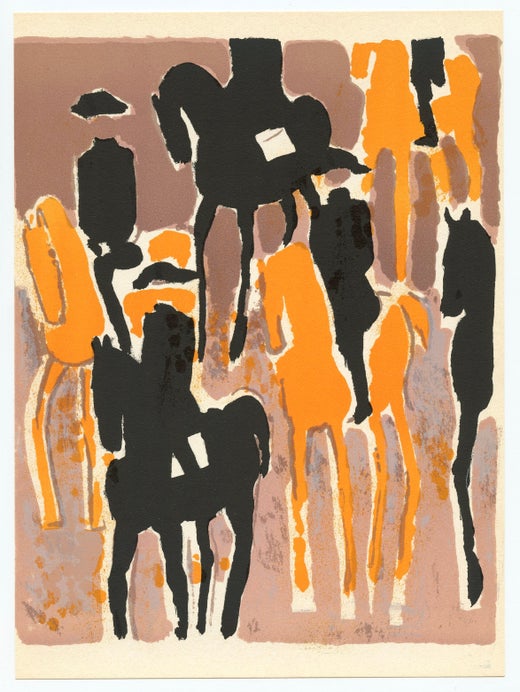
André Brasilier
Born to two accomplished artists, Brasilier was naturally drawn to painting, and at the age of 20, he moved to Paris to study at the École des Beaux-Arts. Brasilier has received several prestigious awards, including the 1952 Prix Florence Blumenthal and the 1953 Prix de Rome. He is also one of only two artists (the other being Pablo Picasso) honored with a retrospective at Saint Petersburg’s Hermitage Museum during their lifetime. He has exhibited works alongside legends such as Picasso, Braque, Chagall and Miro, and he is represented in the permanent collection of the Metropolitan Museum of Art (New York).
About the Seller
5.0
Gold Seller
Premium sellers maintaining a 4.3+ rating and 24-hour response times
Established in 2001
1stDibs seller since 2016
712 sales on 1stDibs
Typical response time: 5 hours
Authenticity Guarantee
In the unlikely event there’s an issue with an item’s authenticity, contact us within 1 year for a full refund. DetailsMoney-Back Guarantee
If your item is not as described, is damaged in transit, or does not arrive, contact us within 7 days for a full refund. Details24-Hour Cancellation
You have a 24-hour grace period in which to reconsider your purchase, with no questions asked.Vetted Professional Sellers
Our world-class sellers must adhere to strict standards for service and quality, maintaining the integrity of our listings.Price-Match Guarantee
If you find that a seller listed the same item for a lower price elsewhere, we’ll match it.Trusted Global Delivery
Our best-in-class carrier network provides specialized shipping options worldwide, including custom delivery.You May Also Like
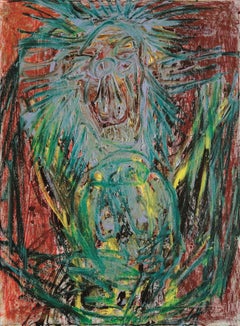
A monkey in green Julien Wolf Contemporary art painting expressionnist animal
By Julien Wolf
Located in Paris, FR
OIl paint on canvas
Hand-signed on the back by the artist
“At first glance, we are invited to a colorful carnival. Everything is movement here! As if Julien Wolf had tried to captur...
Category
2010s Expressionist Figurative Paintings
Materials
Canvas, Oil
$4,661
H 28.75 in W 21.26 in D 1.97 in
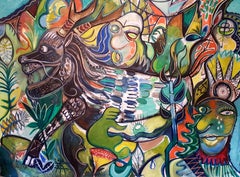
Qilin - Timothy Archer 21st Century Painting Contemporary Figurative
By Timothy Archer
Located in Paris, FR
Oil paint and pastel on canvas
Signed and dated by the artist
Category
2010s Expressionist Figurative Paintings
Materials
Canvas, Oil
$13,147
H 63 in W 82.68 in D 1.97 in
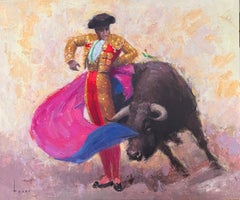
Cape Maneuver bullfighter oil painting
Located in Sitges, Barcelona
Title: Cape Maneuver
Artist: José María Tuser Vázquez (Barcelona, 1919 – 1986)
Technique: Oil on canvas mounted on board
Dimensions: 19.7 x 23.6 in (50 x 60 cm)
Date: Circa 1980s
Signature: Signed "Tuser" in the lower left corner
Condition: Excellent; thick, vibrant brushwork and vivid colors well preserved.
📝 Description
This painting captures a dramatic moment in the bullfight — the classic verónica — as the matador gracefully halts the bull’s charge with a sweeping motion of the cape. The vivid contrast of magentas, blues, and golds intensifies the theatrical tension between man and beast. The composition is dynamic yet controlled, emphasizing the poise of the torero against the raw force of the bull.
The expressive brushstrokes and thick impasto enhance the sense of movement, while the abstracted background ensures focus remains on the central figures. The piece is a striking blend of figuration and emotional energy, characteristic of Tuser’s taurine works.
👤 About the Artist: José María Tuser Vázquez
José María Tuser Vázquez was a Spanish painter born in Barcelona in 1919. He studied at the Barcelona School of Arts and Crafts and began exhibiting in the 1940s. By 1947, he had fully devoted his career to bullfighting scenes, developing a distinctive figurative expressionist style with impressionist influences.
He collaborated with the magazine El Ruedo, creating numerous illustrations and covers, and designed collectible postcards for Editorial Artigas. His work became well-known in Spanish artistic circles and is now part of both private and institutional collections, including the Club Taurino of London.
His paintings have been auctioned internationally, reaching up to $3,000 depending on size and subject. His legacy is that of a painter who masterfully captured the emotion, tradition, and drama of the Spanish corrida.
🎨 Similar Artists
José María Tuser Vázquez’s work shares thematic and stylistic elements with:
Roberto Domingo – A pioneer of bullfighting art...
Category
1970s Expressionist Figurative Paintings
Materials
Canvas, Oil, Board
$1,015 Sale Price
43% Off
H 19.69 in W 23.63 in
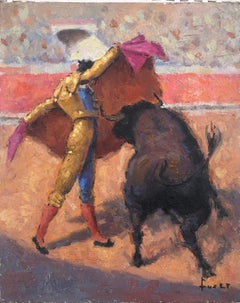
Bullfighting Scene oil on canvas painting
Located in Sitges, Barcelona
Title: Bullfighting Scene
Artist: José María Tuser Vázquez (1919-1986)
Technique: Oil on canvas
Dimensions: 16.1 x 13 inches (unframed)
Date: c. 1950-1960
Condition: Good
Provenance:...
Category
1960s Expressionist Animal Paintings
Materials
Oil, Canvas
$717 Sale Price
50% Off
H 16.15 in W 13 in
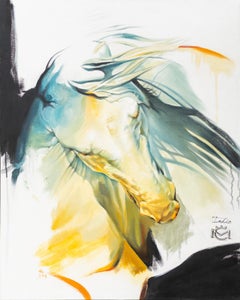
Contemporary Expressionist Horse in Blue and Yellow
Located in Austin, TX
Artist: Daniela Nikolova
Medium: Oil on Canvas
Size: 39.3" x 31.5"
Category
21st Century and Contemporary Expressionist Animal Paintings
Materials
Canvas, Oil
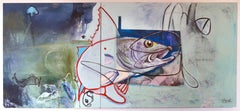
They found the pike but it wasn’t alone
By Dorothy Fitzgerald
Located in Buffalo, NY
An original oil, oil stick and charcoal diptych painting on canvas by Contemporary female artist Dorothy Fitzgerald.
This monumental work measures 60" (h) x 120" (w)
This work was featured in the recent exhibition of The Corridors Gallery at Hotel Henry...
Category
2010s Expressionist Figurative Paintings
Materials
Canvas, Mixed Media, Oil
$10,800 Sale Price
20% Off
H 60 in W 120 in
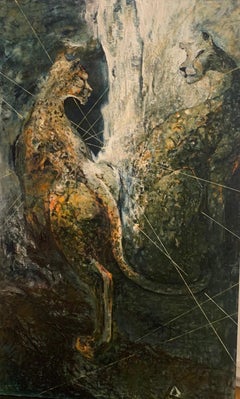
The Leopards
by Byron Z. Tripp - Large Striking Wildlife Leopard Painting
Located in Carmel, CA
‘The Leopards’ is a striking masterpiece that captivates the viewer with its dynamic interplay of black, white, and yellow. The artist’s exceptional use of color and line work transp...
Category
21st Century and Contemporary Expressionist Animal Paintings
Materials
Canvas, Oil
$8,000
H 60 in W 36 in D 2 in
"Snooze" (2024) By Jill Soukup, Original Oil Painting on Board
By Jill Soukup
Located in Denver, CO
Jill Soukup's "Snooze" (2024) is an original, handmade oil painting that depicts two horses resting side by side.
About the artist:
Jill Soukup was born in Buffalo, New York. Short...
Category
2010s Expressionist Animal Paintings
Materials
Canvas, Oil
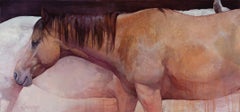
$15,000
H 28 in W 60 in
A Bronx Wedding, colorful dancing celebration w musicians blue sky butterflies
By Stephen Basso
Located in Brooklyn, NY
*ABOUT Stephen Basso
Stephen Basso's highly original pastels and oil paintings are romantic, yet thought provoking fantasies. His whimsical works are alive with boundless imagina...
Category
2010s Expressionist Figurative Paintings
Materials
Canvas, Oil

$15,000
H 78 in W 52 in D 2 in
Berries. 2016, oil on canvas, 46.5x55 cm
By Igor Maikov
Located in Riga, LV
Igor Maikov (1966)
Education:
1981 - 1984 The Art Academy of Latvia
1973 - 1983 Salaspils Primary and Secondary School
Exhibitions:
1994 - Group Exhibition «Rol-Art», Latvia
...
Category
2010s Expressionist Figurative Paintings
Materials
Canvas, Oil
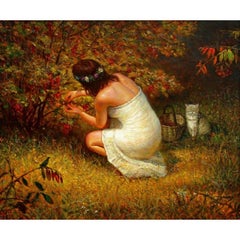
$1,338 Sale Price
20% Off
H 18.31 in W 21.66 in
More From This Seller
View AllL
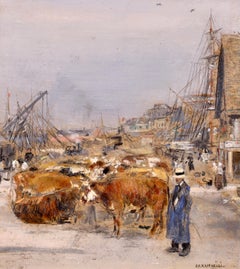
embarquement de boeufs - Impressionist Oil, Cattle by Jean Francois Raffaelli
By Jean-Francois Raffaelli
Located in Marlow, Buckinghamshire
Wonderful signed oil on panel cattle and figures in landscape by French impressionist painter Jean-Francois Raffaelli. The work depicts oxen being loaded onto ships in Honfleur, France en route to England.
Signature:
Signed lower right
Dimensions:
Framed: 18"x16"
Unframed: 9"x8"
Provenance:
Exhibition Jean Francois Raffaélli held at Galerie Simonson, 19 Rue Caumartin Paris - October 1929 (number 44)
Jean-François Raffaëlli's father was a failed Italian businessman and Raffaëlli himself was, among other things, a church chorister, actor and theatre singer. He then studied under Gérôme at the École des Beaux-Arts in Paris. He travelled to Italy, Spain and Algeria and on his return to France settled in Asnières.
In 1876, on a trip to Brittany, he first saw the potential of realist subject matter, if treated seriously. He became involved in meetings of artists at the Café Guerbois, where the Impressionist painters used to gather. As a result, Degas, contrary to the advice of the group, introduced Raffaëlli to the Impressionist exhibitions - according to one uncertain source as early as the very first exhibition, at the home of Nadar, and certainly to those of 1880 and 1881.
In 1904, Raffaëlli founded the Society for Original Colour Engraving. He first exhibited at the Salon de Paris in 1870 and continued to exhibit there until he joined the Salon des Artistes Français in 1881, where he earned a commendation in 1885, was made Chevalier of the Légion d'Honneur in 1889 and in the same year was awarded a gold medal at the Exposition Universelle. In 1906 he was made Officier of the Légion d'Honneur. He was also a member of the Société Nationale des Beaux-Arts. In 1884, a private exhibition of his work cemented his reputation.
He contributed to several newspapers such as The Black Cat (Le Chat Noir) in 1885 and The French Mail (Le Courrier Français) in 1886 and 1887. He published a collection entitled Parisian Characters, which captured his favourite themes of the street, the neighbourhood and local people going about their lives. In 1880 he participated, with Forain, on the illustration of Joris Karl Huysmans' Parisian Sketches (Croquis Parisiens). He also illustrated Huysman's Works. As well as working as an illustrator, he also made etchings and coloured dry-points.
His early attempts at painting were genre scenes, but once he was settled in Asnières he started to paint picturesque views of Parisian suburbs. From 1879 onwards, his subject matter drew on the lives of local people. These popular themes, which he treated with humanity and a social conscience, brought him to the attention of the social realist writers of the time such as Émile Zola. In addition to his realist style, Raffaëlli's dark palette, which ran contrary to the Impressionist aesthethic, helped to explain the opposition of those painters to his participation in their exhibitions. More concerned with drawing than colour, he used black and white for most of his paintings. Towards the end of his life, he lightened his palette, but without adopting any other principles of the Impressionist technique.
After painting several portraits, including Edmond de Goncourt and Georges Clémenceau, he returned to genre painting, particularly scenes of bourgeois life. Later in his career, he painted mainly Breton-inspired sailors and views of Venice. His views of the Paris slums and the fortifications, sites which have almost completely disappeared, went some way towards establishing a genre in themselves and perpetuated the memory of the area: The Slums, Rag-and-Bone Man, Vagabond, Sandpit, In St-Denis, Area of Fortifications. His realistic and witty portrayal of typical Parisian townscapes accounts for his enduring appeal.
Born in Paris, he was of Tuscan descent through his paternal grandparents. He showed an interest in music and theatre before becoming a painter in 1870. One of his landscape paintings was accepted for exhibition at the Salon in that same year. In October 1871 he began three months of study under Jean-Léon Gérôme at the École des Beaux-Arts in Paris; he had no other formal training.
Raffaëlli produced primarily costume pictures until 1876, when he began to depict the people of his time—particularly peasants, workers, and ragpickers seen in the suburbs of Paris—in a realistic style. His new work was championed by influential critics such as J.-K. Huysmans, as well as by Edgar Degas.
The ragpicker became for Raffaëlli a symbol of the alienation of the individual in modern society. Art historian Barbara S. Fields has written of Raffaëlli's interest in the positivist philosophy of Hippolyte-Adolphe Taine, which led him to articulate a theory of realism that he christened caractérisme. He hoped to set himself apart from those unthinking, so-called realist artists whose art provided the viewer with only a literal depiction of nature. His careful observation of man in his milieu paralleled the anti-aesthetic, anti-romantic approach of the literary Naturalists, such as Zola and Huysmans.
Degas invited Raffaëlli to participate in the Impressionist exhibitions of 1880 and 1881, an action that bitterly divided the group; not only was Raffaëlli not an Impressionist, but he threatened to dominate the 1880 exhibition with his outsized display of 37 works. Monet, resentful of Degas's insistence on expanding the Impressionist exhibitions by including several realists, chose not to exhibit, complaining, "The little chapel has become a commonplace school which opens its doors to the first dauber to come along."An example of Raffaëlli's work from this period is Les buveurs d'absinthe (1881, in the California Palace of Legion of Honor Art Museum in San Francisco). Originally titled Les déclassés, the painting was widely praised at the 1881 exhibit.
After winning the Légion d'honneur in 1889, Raffaëlli shifted his attention from the suburbs of Paris to city itself, and the street scenes that resulted were well received by the public and the critics. He made a number of sculptures, but these are known today only through photographs.[2] His work was also part of the painting event in the art competition at the 1912 Summer Olympics. In the later years of his life, he concentrated on color printmaking. Raffaëlli died in Paris on February 11, 1924
Museum and Gallery Holdings:
Béziers: Peasants Going to Town
Bordeaux: Bohemians at a Café
Boston: Notre-Dame; Return from the Market
Brussels: Chevet of Notre-Dame; pastel
Bucharest (Muz. National de Arta al României): Market at Antibes; Pied-à-terre
Copenhagen: Fishermen on the Beach
Douai: Return from the Market; Blacksmiths
Liège: Absinthe Drinker...
Category
1880s Impressionist Animal Paintings
Materials
Oil, Panel
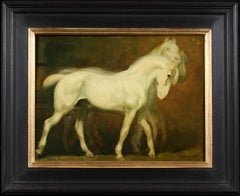
Les Trois Chevaux - Modernist Animal Oil Painting by Louis Anquetin
By Louis Anquetin
Located in Marlow, Buckinghamshire
Signed oil on panel circa 1895 by French modernist painter Louis Anquetin. The piece depicts three white horses.
Signature:
Signed lower right
Dimensions:
Framed: 16.5"x20"
Unframe...
Category
1890s Modern Animal Paintings
Materials
Oil, Panel
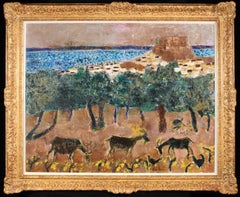
Molyvos, Ile de Lesbos - Expressionist Animal Oil Painting by André Brasilier
By André Brasilier
Located in Marlow, Buckinghamshire
Signed oil on canvas animals in landscape by French expressionist painter Andre Brasilier. The piece depicts goats and birds in front of green trees with a blue sea beyond. This earl...
Category
1960s Expressionist Animal Paintings
Materials
Canvas, Oil
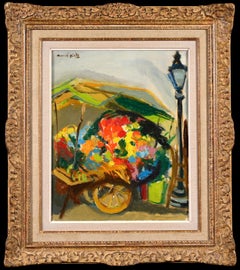
The Flower Cart - Expressionist Landscape Oil Painting by Mane-Katz
By Mane Katz
Located in Marlow, Buckinghamshire
Signed oil on canvas expressionist portrait circa 1935 by Litvak painter Mane-Katz. The piece depicts a cart filled with brightly coloured flowers of red, orange, yellow and blue blo...
Category
1930s Expressionist Landscape Paintings
Materials
Oil, Canvas
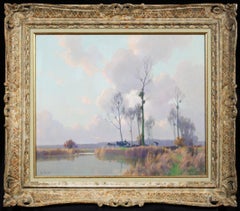
Marecages en Seine et Marne - Impressionist Riverscape Oil by Alexandre Jacob
By Alexandre Louis Jacob
Located in Marlow, Buckinghamshire
Signed oil on canvas landscape circa 1940 by popular French impressionist painter Alexandre Louis Jacob. The piece depicts workers loading wood onto a cart being pulled by a white ho...
Category
1940s Impressionist Landscape Paintings
Materials
Canvas, Oil
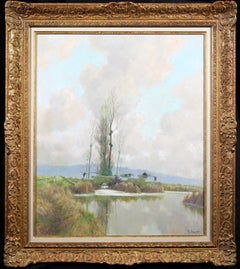
Avant Printemps au Marais - Impressionist Riverscape Oil by Alexandre Jacob
By Alexandre Louis Jacob
Located in Marlow, Buckinghamshire
Signed oil on canvas landscape circa 1950 by popular French impressionist painter Alexandre Louis Jacob. The piece depicts horses and their carts being led across small stone bridges...
Category
1950s Impressionist Landscape Paintings
Materials
Oil, Canvas
Still Thinking About These?
All Recently ViewedMore Ways To Browse
Vintage Bagatelle
Noir Painting
Andre Brasilier
Picasso In Antibes
Chateau Chenonceau
Leopard Art
World Trade Center
Impressionist Paintings Horses
Hunt Slonem Bunnies
Hunt Slonem Bunny Art
19th Century British Paintings Horses
Original Outsider Art
Diamond Dust Art
Antique Oil Paintings Of Animals
Butterfly Oil Paintings
19th Century Bird Oil Painting
Framed Oil Paintings Farm Animals
Antique Dog Oil Painting