Want more images or videos?
Request additional images or videos from the seller
1 of 9

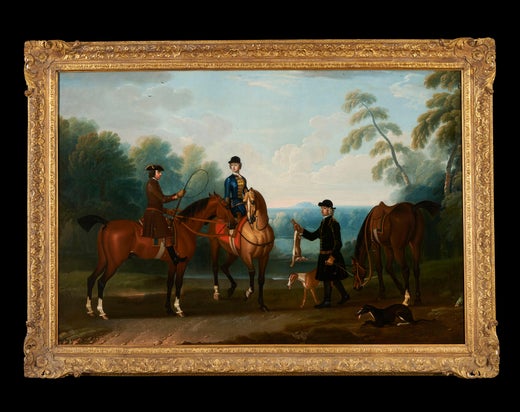
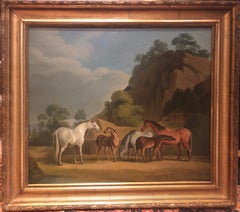
James Seymour
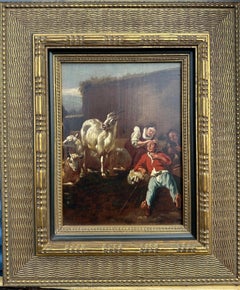
18th Oil Painting Horses Feeding at the Stables

circa 1740

Price:$51,882.20

You May Also Like

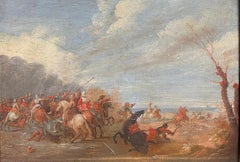
Military Encampment Soldiers on Horseback Dusk Landscape 1700 s Oil Painting
Located in Cirencester, Gloucestershire
The Military Encampment Circle of Carel van Falens (1683-1733, Flemish) oil on canvas, unframed canvas: 8 x 10.5 inches provenance: private collection, UK condition: very good and so...
Category

Early 18th Century Old Masters Figurative Paintings

Materials

Oil, Canvas

Huge 17th Century Italian Old Master painting The Return of the Ark of Covenant
Located in Cirencester, Gloucestershire
Late 17th Century Italian School. The Return of the Ark on the Covenant, Oil on Canvas, in a Fine 17th Century Italian Frame, canvas: 40.25" x 49.75" (102.3 x 126cm) Fine quality and rare 17th century Italian Old Master...
Category

17th Century Old Masters Figurative Paintings

Materials

Canvas, Oil

Romantic Light 18th Century Dutch Oil Pastoral Scene Bergers Cattle by River
Located in Cirencester, Gloucestershire
Pastoral Landscape Dutch painter, 18th century oil on canvas, framed in antique frame framed: 22 x 25 inches canvas: 18.5 x 22 inches Provenance: Private collection, France Condition...
Category

18th Century Old Masters Figurative Paintings

Materials

Oil

17th Century Flemish Old Master Oil on Panel Cavalry Skirmish Soldiers Horses
Located in Cirencester, Gloucestershire
The Cavalry Skirmish Flemish School, mid 17th century circle of Lambert de Hondt (Flemish, 1620-1665) oil on panel, framed Framed: 21 x 27 inches Board: 16 x 22 inches Provenance: private collection, France Condition: very good condition, with old repairs and thinning in places. This painting, attributed to the circle of Lambert de Hondt (Flemish, 17th century), depicts an intense battle scene, typical of Flemish military compositions of the time. Lambert de Hondt was known for his battle scenes, landscapes, and hunting scenes, often filled with dynamic action and fine detail, and this work clearly reflects his influence. The artwork portrays a cavalry skirmish with soldiers in traditional 17th-century military dress, including red tunics...
Category

Mid-17th Century Old Masters Animal Paintings

Materials

Oil

Large 17th Century Dutch Old Master Oil Painting Figures Animals Landscape
Located in Cirencester, Gloucestershire
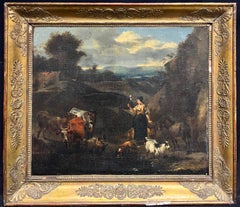
Follower of Dirck van Berghen (Dutch School, 17th Century) Pastoral Landscape with a Shepherdess and Livestock Oil on canvas, framed in a French Empire period gilt frame canvas dimensions: 18 x 22 inches framed dimensions: 22.5 x 26 inches This charming pastoral scene, rendered in oil on canvas, is attributed to a follower of the 17th-century Dutch painter Dirck van Berghen, who was known for his bucolic landscapes featuring cattle and rural life. The composition reflects the influence of van Berghen’s mentor, Adriaen van de Velde...
Category

17th Century Old Masters Figurative Paintings

Materials

Oil

18th century Dutch, with figures goats and sheep outside in a barn yard or farm
Located in Woodbury, CT
Unknown Artist (Dutch School, late 18th century) Pastoral Scene with Goatherds, ca. 1780–1800 Oil on canvas In this lively pastoral composition, a group of figures reclines in rusti...
Category

1790s Old Masters Figurative Paintings

Materials

Oil, Wood Panel

The Inappetent Owl - Grotesque Scene with Owl and Swan - Late 17th Century
Located in Roma, IT
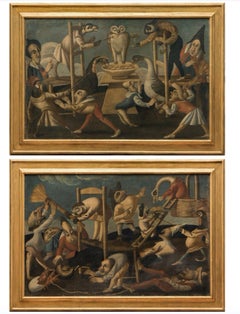
Two masterpieces by the Master of the Fertility of the Egg, nearly impossible to find in homogeneous pairs on the private market, both in terms of style and dimensions. They represen...
Category

Late 17th Century Old Masters Figurative Paintings

Materials

Canvas, Oil

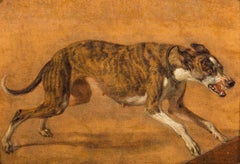
Study of a dog
Located in Amsterdam, NL
Study of a dog Oil on paper laid down on panel, 17.5 x 25.5 cm Provenance Private collection, the Netherlands Note: We are grateful to Mr Fred Meijer for his attribution to Ludolf de Jongh Ludolf de Jongh was the son of a shoemaker. When his father moved to Rotterdam, the young Ludolf decided to learn art rather than shoemaking and became a pupil of Cornelis Saftleven. Later he studied under Anthony Palamedes in Delft and still later with Jan van Bijlert in Utrecht. In 1635 he travelled to France with Francis Bacon. Seven years later, in 1642, he returned to the Netherlands when he heard that his mother had fallen ill. He set up a shop in Rotterdam, and his earliest signed paintings date from that year. According to Houbraken, his travels had caused him to speak French so fluently, that his parents had to learn French in order to speak with him. De Jongh’s work shows a strong influence from the Utrecht school of Caravaggio admirers, especially Jacob Duck...
Category

Mid-17th Century Old Masters Animal Paintings

Materials

Paper, Oil, Wood Panel

Study of a dog
Price Upon Request
Free Shipping
H 6.89 in W 10.04 in D 1.19 in
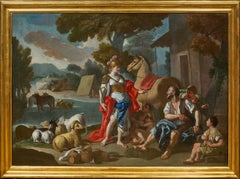
Erminia and the Shepherds, a painting by Francesco de Mura (Napoli 1696 - 1782)
By Francesco de Mura
Located in PARIS, FR
In this masterly painting, Francesco de Mura presents the meeting of Erminia and the shepherds, a famous episode taken from the seventh canto of Torquato Tasso's Jerusalem Delivered....
Category

1760s Old Masters Figurative Paintings

Materials

Canvas, Oil

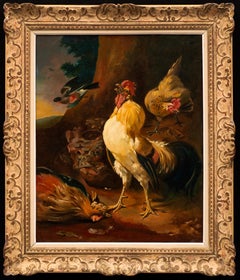
"A Triumphant Cockerel Crowing Over His Victory" Melchior Hondecoeter (after)
Located in SANTA FE, NM
"The Victor (A Triumphant Cockerel Crowing Over His Victory...)" After Melchior de Hondecoeter (Flemish, 1636-1695) Oil on canvas Unsigned 40 1/2 x 34 1/4 (frame) inches This much copied painting is a masterfully executed portrait of a strutting and triumphant rooster painted...
Category

Early 1900s Old Masters Animal Paintings

Materials

Canvas, Oil

More From This Seller

View All
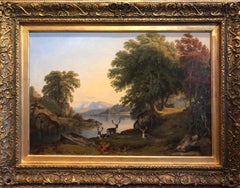
19th Century Landscape Oil Painting - Deer by the Banks of a Lake
By Jacob Thompson
Located in London, GB
Jacob THOMPSON (1806 – 1879) Deer by the Banks of a Lake 1842 oil on canvas 18.9 x 27.6 inches; 22.5 x 31 inches Inc. frame Jacob Thompson (1806–1879) was an English landscape-pa...
Category

1840s Old Masters Figurative Paintings

Materials

Oil

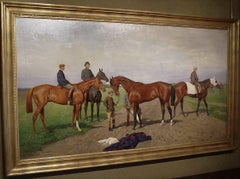
Magnificent early 20th Century Oil Painting of Race horses - At the Gallops
By Julius von Blaas
Located in London, GB
Julius von Blaas (1845-1923) At The Gallops circa 1905 Oil on canvas Signed and dated “Julius von Blass / 1905” (lower left) 110 x 200 cm (140 x 230 cms framed ish) This enormous and grand depiction of horses exercising is an iconic image not only of the edwardien era but also of today’s racing elite. Julius von Blaas was taught by his father Carl von Blaas (1815-1994) and trained in Venice, Florence and Rome. He was also influenced by his celebrated brother Eugen von Blaas...
Category

Early 20th Century Academic Animal Paintings

Materials

Oil

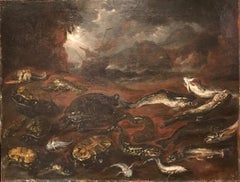
17th Century Oil Painting Still Life: Turtles Fish with a Ship in Stormy Seas
Located in London, GB
A Still Life of Turtles, An Eel, Pike, Lobsters and other Fish on the Shore, A Ship in the Stormy Seas Beyond Signed and dated lower left 1640 Inscribed with inventory number lower right: no. 44 Oil on canvas Framed 29.5 x 37.9 inches Provenance Anonymous sale, London, Sotheby's, 15 April 1999, lot 87, (as 'Circle of Giuseppe...
Category

17th Century Old Masters Animal Paintings

Materials

Oil

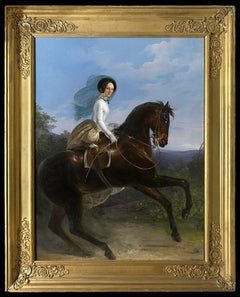
C19th Portrait Princesse de Joinville of Brazil - Spectacular fit for a palace
By Henri d Ainecy Montpezat
Located in London, GB
Portrait of Princess de Joinville riding a Bay Horse Henri d’Aincy, Le Comte Monpezat (French 1817-1859) Painted circa 1837-9 oil on canvas 113 x 92 inches (including frame) 92 x 70 inches (unframed) Provenance – from a private royal collection This magnificent portrait depicts Princess de Joinville, the daughter of Pedro I, Emperor of Brazil and the King of Portugal. Through her illustrious family she was directly related Alexander III and Nicholas II of Russia and the Russian royal family, as well as to many of the great ruling families of Europe. The work clearly confirms Monpezat as one of the most accomplished equestrian portrait painters in France in the early nineteenth century. In terms of scale, quality and dramatic power, it must surely be considered amongst his finest works. The stance of the powerful thoroughbred - in half rear - emphasises the calm nature and courage of the Princess. Francisca of Brazil (1824-98) married a son of Louis Philippe I, the King of the French, and had three children. Born at the Imperial Palace of Saint Christopher, her youngest brother was the future Pedro II...
Category

1830s Old Masters Portrait Paintings

Materials

Oil

19th Century Oil painting of horses - Mares and Foals in a Landscape
By Daniel Clowes
Located in London, GB
Daniel CLOWES (1774-1829) after George Stubbs Mares and Foals in a Landscape oil on canvas 29 x 33 inches, inc.frame Daniel Clowes lived and worked in Chester all his life and ...
Category

19th Century Old Masters Animal Paintings

Materials

Oil

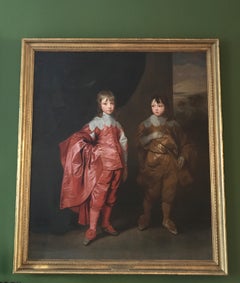
Double Portrait Oil Painting Brothers George, 2nd Duke Buckingham Lord Francis
By (After) Anthony Van Dyck
Located in London, GB
Aftrer Anthony VAN DYCK - maybe Studio (1599, Antwerp – 1641, London) Flemish Double Portrait of George Villiers, 2nd Duke of Buckingham (1628-1687) & Lord Francis Villiers (1629-1648) Oil on Canvas 170 x 147 cm Anthony Van Dyck (1599-1641) No painter has done more to define an era than Anthony van Dyck. He spent only seven and a half years of his short life (1599- 1641) in England. He grew up in Antwerp, where his precocious talent was recognised by Peter Paul Rubens, the greatest painter of his age. He worked in Rubens’s studio and imitated his style as a religious artist, painting biblical scenes redolent of the lush piety of the counter-reformation. But soon he was on the move. In 1620, he visited London for a few months, long enough to paint a history picture, The Continence of Scipio, for the royal favourite, George Villiers, Marquess of Buckingham, and a portrait of his other English patron, the great art collector, Thomas Howard, 2nd Earl of Arundel. After a stint in Italy, making imposing portraits of the wealthy aristocracy and sketching and copying works by Titian, he returned to the Spanish Netherlands in 1627, becoming court artist to Archduchess Isabella before departing for The Hague in 1631 to paint the Dutch ruler Frederick Henry, Prince of Orange. Charles I’s invitation in 1632 led Van Dyck back to London where he was knighted, paid an annual salary of £200 and installed in a house in Blackfriars with a special jetty at which the royal barge might tie up when the King was visiting his studio. By this time Van Dyck was recognised as the leading court painter in Europe, with Velazquez at the court of Philip IV of Spain his only rival. He also excelled as a superbly observant painter of children and dogs. Van Dyck’s notoriety in depicting children led to the introduction of groups of children without their parents as a new genre into English painting (amongst other new genres). For the next 300 years, Van Dyck was the major influence on English portraiture. Nearly all the great 18th Century portraitists, from Pompeo Batoni and Allan Ramsay to Thomas Gainsborough and Joshua Reynolds, copied Van Dyck’s costumes, poses and compositions. George Duke of Buckingham & his brother Francis Villiers Painted in 1635, this double portrait was originally commissioned by Charles I, who raised the two brothers after their father, George Villiers, was assassinated in 1628. Together with their sister, Lady Mary Villiers, they enjoyed the King’s favour absolutely. Francis whose absolute ‘inimitable handsomeness’ was noted by Marvell (who was killed in a skirmish near Kingston upon Thames). The young duke who commanded a regiment of horse at the Battle of Worcester, remained closely associated with Charles II, held a number of high offices after the Restoration and was one of the most cynical and brilliant members of the King’s entourage, immortalised as ‘Zimri’ in Dryden’s Absalom and Achitopbel. As a young man he had sold his father’s great collection of pictures in the Spanish Netherlands, many of them to the Archduke Leopold Willhelm. Painted for Charles I and placed near the portrait of their sister in the Gallery at St James’ Palace. The handling of both costumes is very rich, and the heads are very carefully and sensitively worked. That of the younger boy in particular is more solidly built up than the lower part of the figure. A preparatory drawing for the younger boy is in the British Museum. There are copies at, e.g., Highclere Castle...
Category

17th Century Old Masters Portrait Paintings

Materials

Oil

Still Thinking About These?

All Recently Viewed