1880s Animal Paintings
to
5
7
7
9
7
7
Overall Width
to
Overall Height
to
137
839
1,819
5,786
68
41
49
58
62
100
124
127
135
167
84
7
1
24
10
3
17
14
11
10
9
5
4
4
3
2
2
2
1
1
1
1
1
1
1
1
34
33
9
9
4
1
1
1
1
1
29
3
21
16
Period: 1880s
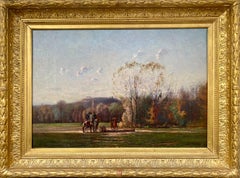
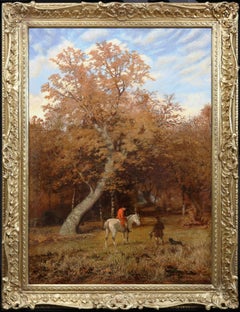
Riders, the autumn meet: equestrian oil by famed French aristocrat and horseman
Located in Norwich, GB
A rare 19th-century oil by the aristocratic painter and distinguished collector, Count Charles Gaston Esmangart de Bournonville de Saint-Maurice. It depicts an equestrian gathering ...
Category
Impressionist 1880s Animal Paintings
Materials
Canvas, Oil
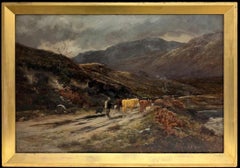
Very Large Antique Scottish Victorian Oil Painting Cattle Highland Pathway
Located in Cirencester, Gloucestershire
'When Heaven descends in Showers"
Cattle in a Dramatic Scottish Highland Landscape
original painting by Henry Hadfield Cubley (1858-1934) British
signed oil on canvas, framed
dated 1...
Category
Victorian 1880s Animal Paintings
Materials
Oil
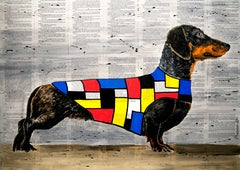
FRENCH SCHOOL Dachshund Fashion Week Mondrian Chut les Barbizons!
Located in Zofingen, AG
☀️Dachshund Fashion Week Mondrian☀️
In the artistic world, animals have always been key protagonists in expressing the power and beauty of the wild.
Artists often use animals as sym...
Category
Tonalist 1880s Animal Paintings
Materials
Mixed Media, Oil, Acrylic, Glue

$1,757 Sale Price
75% Off
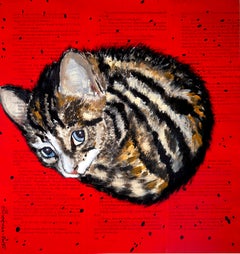
FRENCH SCHOOL Cat Curled up Chut les Barbizons!
Located in Zofingen, AG
☀️Cat curled up☀️
In the artistic world, animals have always been key protagonists in expressing the power and beauty of the wild.
Artists often use animals as symbols to convey dee...
Category
Tonalist 1880s Animal Paintings
Materials
Mixed Media, Glue, Oil, Acrylic, Stretcher Bars
$416 Sale Price
77% Off
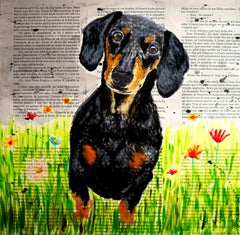
FRENCH SCHOOL Into the wild Dachshund Chut les Barbizons!
Located in Zofingen, AG
⏩Into the Wild⏪
This work blends playful portraiture with an experimental mixed-media approach. At first glance, the image of a dachshund bright-eyed, with an inquisitive head tilti...
Category
Tonalist 1880s Animal Paintings
Materials
Glue, Mixed Media, Oil, Spray Paint, Acrylic
$449 Sale Price
75% Off
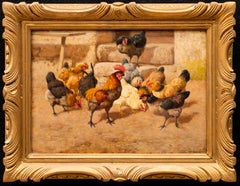
Rooster and Hens in the Barnyard William Baptiste Baird (U.S./France 1847-1917)
Located in SANTA FE, NM
Rooster and Hens in the Barnyard
William Baptiste Baird (U.S./France 1847-1917)
Oil on panel
Signed lower right "W. Baird"
12 1/4 x 9 inches
A stunning example of William Baptiste...
Category
Barbizon School 1880s Animal Paintings
Materials
Oil, Wood Panel
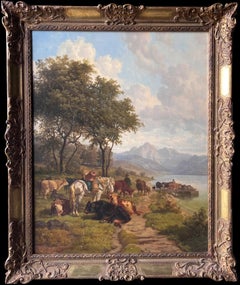
Fine 19th Century Large Austrian Signed Oil Painting Cattle
Horses Pastoral
Located in Cirencester, Gloucestershire
Pastoral Landscape
by Eduard Gotzelmann (1890 - 1903) Austrian
signed lower left and dated 1887
oil on cavas, framed
framed: 37 x 31 inches
canvas: 31 x 24.75 inches
Provenance: priv...
Category
Victorian 1880s Animal Paintings
Materials
Oil
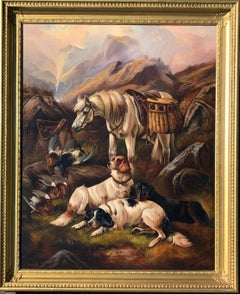
Scottish Highland landscape with pony, setter dogs, Red Grouse, day shooting
Located in Woodbury, CT
Scottish Highland landscape scene with English Setter gun dogs, the day's bag, and Red Grouse, after a day shooting.
M. Fawcett was a pseudo name for Robe...
Category
Victorian 1880s Animal Paintings
Materials
Oil
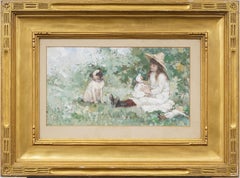
Antique American Impressionist Young Girl and Pug Dog Portrait Framed Painting
Located in Buffalo, NY
Antique American impressionist oil painting by Frederick Stuart Church (1842 - 1924). Gouache and watercolor on board. Framed. Measuring: 17 by 23 inches overall, and 10 by 16 painti...
Category
Impressionist 1880s Animal Paintings
Materials
Watercolor, Gouache, Archival Paper
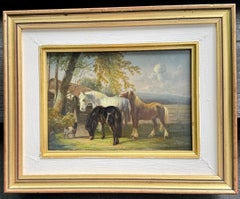
English 19th century English Farm with shire Clydesdale horses in a landscape
Located in Woodbury, CT
English School
Farmyard Scene with Horses and Goat
Oil on panel, unsigned
The Circle of John Frederick Herring Sr.
Circa 1880
Presented in a later gilt and painted frame
This finely rendered 19th-century English farmyard scene captures the quiet dignity of rural life, with a group of three horses—white, chestnut, and black—gathered beneath a tree in the warm light of late afternoon. A small goat stands to one side near a rustic stable, adding a note of charming domesticity to the composition. The surrounding landscape, with its distant hills and careful play of shadow and cloud, speaks to the artist’s sensitivity to atmosphere and detail.
Though unsigned, the painting is executed in a manner closely aligned with the work of John Frederick Herring Senior, one of Britain’s most celebrated animal painters of the Victorian era. The careful modelling of the horses, their distinctive postures and anatomy, and the tranquil farm setting are all hallmarks of Herring’s influence. Painted in oils on a wooden panel, the surface retains a fine, even gloss and a warm palette typical of the period.
The composition is both balanced and lyrical: the interplay of form and gesture among the animals invites the viewer into a moment of repose between work and activity, emblematic of Victorian ideals of harmony between man, beast, and the land.
A delightful example of 19th-century English rural painting...
Category
Victorian 1880s Animal Paintings
Materials
Oil, Wood Panel
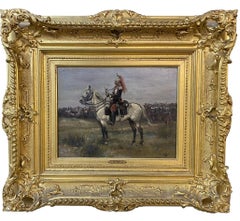
Horse
French Military Rider
Located in Milford, NH
A finely detailed oil painting of a horse and French military rider with bugle by French artist Edouard Jean Baptiste Detaille (1848-1912). Detaille was born in Paris, France into a...
Category
1880s Animal Paintings
Materials
Oil, Panel
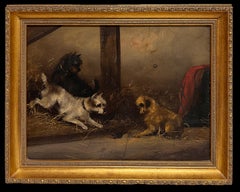
Fine Victorian Dog Oil Painting Terriers chasing Rat in Barn Stable Interior
Located in Cirencester, Gloucestershire
Chasing the Rat!
by Frank Cassell (British 1862-1908)
oil on canvas, framed
framed: 14.75 x 19.75 inches
canvas : 12 x 16 inches
Provenance: private collection, UK
Condition: very go...
Category
Victorian 1880s Animal Paintings
Materials
Oil
Original Oil on Canvas, Margaret Collyer. "Father O
Flynn"
Located in Mere, GB
Margaret Collyer, (1872 - 1945). A London painter of animal scenes, whether horse portraits or dramatic highland scenes such as her "Lord of the Isles". She exhibited at the Royal Ac...
Category
1880s Animal Paintings
Materials
Oil
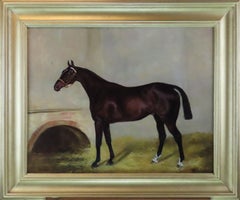
Terrier on a Chair - 19th Century Antique English Oil on Canvas Dog Painting
Located in Sevenoaks, GB
A beautiful signed and dated 1880 oil on canvas portrait of a terrier sitting on a chair, by Rupert Arthur Dent.
Excellent quality work by this noted Victorian animal painter. Signe...
Category
1880s Animal Paintings
Materials
Canvas, Oil
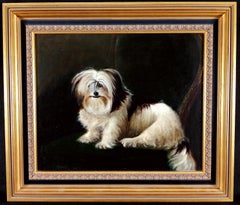
19th century Portrait of a Bulldog Mum with puppies in a barn interior playing
Located in Woodbury, CT
Attributed to Edwin Loder (British, fl. mid–late 19th Century)
Mother Dog and Puppies in a Stable Interior
Oil on canvas, unsigned
English School, circa 1880
Presented in a period-st...
Category
Victorian 1880s Animal Paintings
Materials
Canvas, Oil
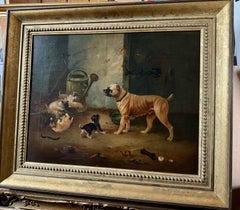
Antique American Realist Horse Portrait Barn Scene Landscape Framed Oil Painting
Located in Buffalo, NY
Vintage American realist barn scene oil painting. Oil on canvas. Signed. Framed. Provenance from a Sag Harbor, NY collection. Measuring: 25 by 29 inches overall. Handsomely framed i...
Category
Realist 1880s Animal Paintings
Materials
Oil
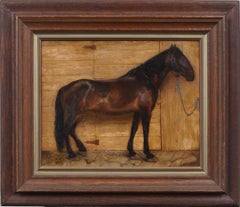
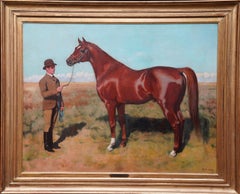
Race Horse Phoenix with Guilermo Kemmis - British 19th century art oil painting
Located in Hagley, England
This superb British 19th century equine oil painting is by noted horse lover, George Gascoyne. Painted in 1889, this French born chestnut horse is Phoenix. While he was essentially a miler, Phoenix (sometimes seen spelled as “Phenix”) came from a family that had produced Classic winners in France at up to 15 furlongs. He proved an excellent sire following his export to Argentina, becoming the foundation stallion for Guillermo Kemmis' breeding program at Haras Las Rosas. This painting is from his time in Argentina with Kemmis. Phoenix is depicted in a flat landscape against a vivid blue sky. A gentleman, possibly his owner, Guillermo Kemmis, stands smiling in front of him holding his reigns and gives perspective to how tall Phoenix is. Although in profile, Phoenix is turning to look at the viewer, his chestnut coat gleaming and his anatomy perfectly portrayed. This is a superb Victorian equine portrait of a noted horse in the 19th century and is a lovely example of Gascoyne's work as a horse lover.
Signed with initials and dated GG 1889 lower right.
Provenance. Inscribed "Phenix" (Cymbal -- Belle-Etoile) by George Gascoyne, Sittingbourne, Kent to reverse.
Condition. Oil on canvas, 36 inches by 28 inches and in good condition.
Frame. Housed in a wooden frame, 44 inches by 36 inches and in good condition.
HORSE BIOGRAPHY
Phoenix (FR) 1875 – 1893? Chestnut horse.
Cymbal (GB) x Belle Etoile (FR), by First Born (FR)
Family 25. While he was essentially a miler, Phoenix (sometimes seen spelled as “Phenix”) came from a family that had produced Classic winners in France at up to 15 furlongs. He proved an excellent sire following his export to Argentina, becoming the foundation stallion for Guillermo Kemmis' breeding program at Haras Las Rosas.
Race record. Complete record unavailable but as follows:
1878: Won Prix de la Forêt (FR, 1600mT, Longchamp)
1879: Won July Cup (ENG, 6FT, Newmarket July). Won Rous Memorial Stakes (ENG, 8FT, Ascot). Won Bunbury Stakes (ENG, Newmarket). 2nd Rosebery Handicap (ENG, Epsom)
1880: Won Lennox Stakes (ENG, Goodwood)
As a stallion: Phoenix was the Argentine champion sire six times, reaching the top in 1887-1890, 1892 and 1895.
Notable progeny: Hawk Eye (ARG), Lenape (ARG), Marinera (ARG), Osiris (ARG), San Martín (ARG), Surplice (ARG)
Connections: Phoenix was owned by Comte Frédéric de Lagrange. After being exported to Argentina, he stood at Haras Las Rosas, the stud farm of leading Argentine breeder Guillermo Kemmis. His last known foals were born in 1894.
Pedigree notes: Phoenix is outcrossed through five generations. Sired by Cymbal, a son of 1861 Derby Stakes winner Kettledrum, he is out of Belle Etoile, whose half sister Garenne (by Gladiator or Ethirion or Freystrop) is the second dam of 1894 Prix Royal-Oak (French St. Leger) winner Gouvernail and the third dam of 1894 Prix du Jockey Club (French Derby...
Category
Realist 1880s Animal Paintings
Materials
Oil
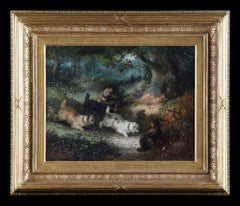
Five Terriers in the Forest. Signed D. Griffin
Located in St. Albans, GB
D. GRIFFIN
This is a pseudonym of George Armfield.
Picture Size: 14 x 18" (36 x 46cm
Outside Frame Size: 21 x 25" (54 x 64cm)
Signed and dated bottom left
Free Shipping
He was bor...
Category
Victorian 1880s Animal Paintings
Materials
Oil
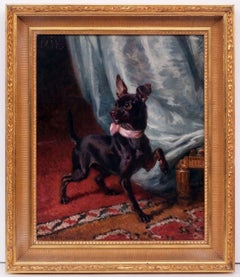
HERMMANN LEON - Painting 19th Century - Portrait of a Dog in Interior
By Charles Herrmann-Léon 1
Located in Saint-Ouen, FR
HERRMANN LEON Charles (1838-1908)
Portrait of a Dog in interior
Oil on canvas signed low left
Old frame re-gilded with gold leaves
Dim canvas : 56 X 46 cm
Dim frame : 69 X 59 cm
HERRMANN LEON Charles (1838-1908)
French painter 19th century
Born 22 july 1838 in Le Havre. Died 1...
Category
Academic 1880s Animal Paintings
Materials
Oil
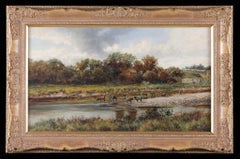
Cattle Grazing Near Rhyl, North Wales
Located in St. Albans, GB
A stunning, showpiece example of William Henry Mander's painted in Rhys, North Wales. The size is unusual and perfect for a mantlepiece as a statement piece.
Picture Size: 22 x 36" ...
Category
Victorian 1880s Animal Paintings
Materials
Oil
Oil on canvas English Romanticism Landscape with Tiger
Located in Valladolid, ES
One of a kind large-format English Romantic landscape. This is a very powerful work, with a melancholic and contemplative character, in which nature takes center stage, characterist...
Category
Pre-Raphaelite 1880s Animal Paintings
Materials
Canvas
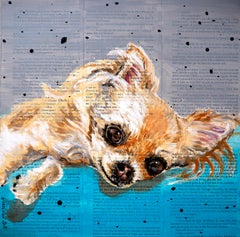
FRENCH SCHOOL Neverending dream Chihuahua Chut les Barbizons!
Located in Zofingen, AG
☀️Neverending DrealChihuhua☀️
In the artistic world, animals have always been key protagonists in expressing the power and beauty of the wild.
Artists often use animals as symbols t...
Category
Tonalist 1880s Animal Paintings
Materials
Glue, Mixed Media, Oil, Acrylic, Stretcher Bars
$458 Sale Price
75% Off
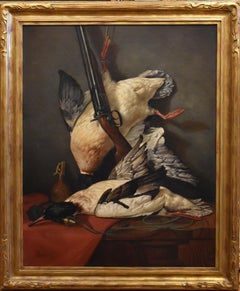
"DUCK HUNT" MERGANSERS, DUCK CALL, SHOTGUN DATED 1889 FRAME 43 X 35 NEWCOMB
Located in San Antonio, TX
Edward Chalmers Leavitt
(1842 - 1904)
Rhode Island Artist
Image Size: 36 x 28
Frame Size: 42.5 x 34.5 Newcomb Macklin Frame.
Medium: Oil
Dated 1889
"Duck Hunt" Mergansers
Edward Chalmers Leavitt (1842 - 1904)
Edward Chalmers Leavitt, artist, was born in Providence, Rhode Island, March 9, 1842, the son of Rev. Jonathan and Charlotte Esther (Stearns) Leavitt. His paternal ancestor was John Leavitt, who came to Massachusetts Bay in the first ship and settled in Hingham. On the maternal side, he is descended from John Alden and Priscilla Mullens, who came to Plymouth in the Mayflower.
Leavitt was educated in private schools in Providence, and at Kimball Union Academy, Meriden, New Hampshire. During the Civil
War in 1862 and 1863, he served in the navy on the U.S.S. Galena. In his profession of artist, Mr. Leavitt is especially noted as a painter of fruit, flowers and still life.
He exhibited in the National Academy for several years and has made many successful exhibitions in Providence and Boston. He was a member of the Boston and Providence art clubs, and the Providence Press Club. He was also a member of the Grand Army of the Republic. In politics his proclivities are mainly Republican. He has been twice married: first, May 19, 1877, to Ellen M. Fuller; and second, April 22, 1880, to Elizabeth S. Chace.
Submitted November 2004 by Edward Bentley, Art Collector and Researcher from Lansing, Michigan.
Source is the publication "Men of Progress: Biographical Sketches and Portraits of Leaders in Business and Professional Life from the State of Rhode Island." New England magazine. 1896.
Edward C. Leavitt, born in 1842, has been described as "Providence, Rhode Island's leading still-life painter" in the late 19th Century. (Zellman 324) His teacher, James Morgan Lewin, was a prominent still-life painter in Fall River, Massachusetts, a neighboring town.
Leavitt, a detailed, sharp-focused, realistic painter, was in love with texture and light, and was prolific and successful, painting a variety of still life subjects including flowers, fruit and even fish and dead game animals. His objects, including costly antiques and household decorative items, were often placed on ornamental, gleaming surfaces.
He was a frequent exhibitor at the National Academy of Design in the 1870s and 1890s. The artist, who died in 1904, moved from a position of success and popularity to being ignored for many years until the publication of William H. Gerdts and Russell Burke's American Still-Life Painting in 1971. It is uncertain whether this disastrous loss of respect took place because Leavitt's work declined in quality during the last decade of his life, or because he was a victim of the periodic shifts in taste and fashion that afflict the arts.
Sources:
Michael David Zellman, 300 Years of American Art
Peter Hastings Falk, Editor, Who Was Who in American Art
Biography from Roger King Fine Art
Edward Leavitt was one of the leading still life artists of nineteenth century New England. He lived and worked in Providence, and studied with James Morgan Lewin, a leading painter of the Fall River School, which, in the late 19th Century, was one of the most important centers of still life painting.
While Lewin branched out into other types of painting, Leavitt remained devoted to the art of the still life. His paintings are sharply focused, realistic, and carefully finished. Ornate objects such as urns, ewers, platters, cut glassware...
Category
Realist 1880s Animal Paintings
Materials
Oil
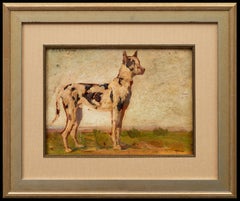
Dog Portrait of a Great Dane by Jules Chardigny (1842-1892)
Located in SANTA FE, NM
Dog Portrait of a Great Dane
Jules Chardigny (1842-1892)
Circa 1870
Oil on cardboard
Signed upper left
9 1/2 x 12 3/4 (17 1/2 x 20 1/2 frame) inches
Jules Chardigny was born in L...
Category
Realist 1880s Animal Paintings
Materials
Oil, Cardboard
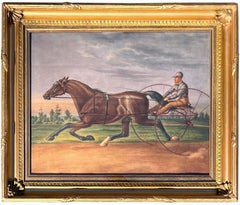
Harness Racer at Belmont Park 1884, Philadelphia
Located in Wiscasett, ME
Watercolor on paper, signed lower right Agustus Knoller and dated 1884. Inscribed on the reverse in pencil "This trotting came off Aug 15th 1884 at Belmont Park...
Category
Folk Art 1880s Animal Paintings
Materials
Oil
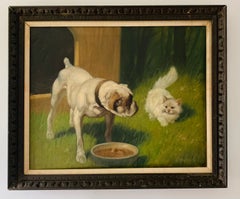
Dog Guarding Food Bowl From a Fluffy White Cat
By Arthur Heyer
Located in New York, NY
Arthur Heyer, 1871-1932
Oil on canvas, 22" x 27"
Signed on the front.
A bulldog is depicted guarding his bowl of food from a fluffy white cat, who keeps ...
Category
Impressionist 1880s Animal Paintings
Materials
Canvas, Oil
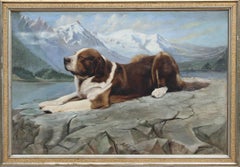
St. Bernard, Realist Oil on Canvas Painting by J. Bowker
By J. Bowker (XIXct.)
Located in Long Island City, NY
Artist: J. Bowker
Title: St. Bernard
Year: 1887
Medium: Oil on Canvas, signed and dated l.r.
Size: 30 in. x 48 in. (76.2 cm x 121.92 cm)
Category
Realist 1880s Animal Paintings
Materials
Canvas, Oil
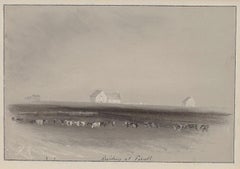
"Residence At Terrell" Date 1881 TEXAS CATTLE SCENE GRANDFATHER TEXAS ART
By Frank Reaugh
Located in San Antonio, TX
Frank Reaugh
(1860-1945)
Dallas Artist
Image Size: 3 3/4 x 5 1/2
Frame Size: 15 x 18
Medium: Pastel on paperboard
Circa 1881
"Residence At Terrell" From the collection of Lucretia Coke. Signed F.R. Lower Left & S7
On Verso 1881 or 2, 2 or 3 miles from next house.
Frank Reaugh (1860-1945)
Charles Franklin Reaugh.
THE FRANK REAUGH GALLERY AT THE PANHANDLE-PLAINS HISTORICAL MUSEUM
by Michael R. Grauer, Curator of Art, Panhandle-Plains Historical Museum
Called the pejorative "Rembrandt of the Longhorn" and "Longhorn Leonardo," and the gentler "Painter to the Longhorns," Charles Franklin "Frank" Reaugh was a master pastellist unparalleled in Texas and the greater Southwest. While he advertised himself as a "landscape and cattle painter" and insisted he was the historian of the Texas longhorn, he has effectively, and unfortunately, pigeonholed his art.
More appropriately, Frank Reaugh is often called the "Dean of Texas Painters." His name is synonymous with the "old guard" of Texas art history, along with Robert Onderdonk, Hermann Lungkwitz, William Henry Huddle, Henry McArdle, and others.
Reaugh's paintings focused on the landscape of the American West generally, and the American Southwest, specifically. He captured subtleties in a land of high contrast where others only saw the rawness. He painted the overwhelmingly blue sky, the illimitable plains, and the great gashes in the land that are called canyons, arroyos, or breaks in the West. And he painted the Texas longhorn, or Texas cattle, as he referred to them.
Usually no more important than the mesquite, yucca, sagebrush, and cholla that also populate his compositions of the Western landscape, the Texas longhorn became his recognized symbol. Today, some commercial galleries even insist that one of his works is more valuable if it has a cow in it! These commercial zealots in their search for a longhorn often overlook the beauty of his landscapes; they cannot see the landscape for the longhorns.
Born near Jacksonville, Illinois in 1860, Reaugh first came to Texas in a wagon in 1876 at the age of fifteen. He moved with his parents to a farm near Terrell, Texas, until 1890 when they moved to Dallas and settled in what is now the Oak Cliff area.
Reaugh had no formal education but fared well without it for his mother, Clarinda Reaugh, was his teacher in all things. The daughter of a Presbyterian minister, his mother instilled in her only child an appreciation of nature, grounded in her own readings in zoology, botany, and natural history. Her teachings were infused with the philosophies of the famed Swiss zoologist Louis Agassiz and John Burroughs, supporter and contemporary of Walt Whitman, who wrote extensively on his symbiotic relationship with nature. Clarinda Reaugh also encouraged her son's interest in drawing through her own interest in the fine arts.
Reaugh's father, George Washington Reaugh, was a mechanic, carpenter, cabinetmaker, and farmer, who had participated in the Gold Rush of 1849. It was from his father that Reaugh learned to be extremely adept with his hands, and later made his own picture frames and patented several inventions. George Reaugh's sense of adventure may have spurred his son's annual trips to West Texas and beyond, which began in the early 1880s.
Reaugh's first exposure to art came through reproductions in popular magazines such as Harper's, Scribner's, and Century Illustrated. Rosa Bonheur's Horsefair, the Dutch painter Paulus Potter's Young Bull, and the landscapes of Frederic Edwin Church and J. M. W. Turner were favorites of his. (In fact, his late works are often especially reminiscent of Church and Turner.) From these early reproductions in black and white, Reaugh learned well the lessons of value and composition.
While he studied and copied magazine reproductions, Reaugh also became interested in bovine anatomy. Using a "two-bit" book on cattle and sheep anatomy as his text, the young artist collected bones near the Reaugh farm and made measurements from family livestock. He supplemented his scientific studies with sketches made from longhorn cattle brought up from South Texas to fatten on grass nearby.
In the early 1880s, Reaugh met two cattlemen, Frank and Romeo Houston, who had interests throughout North Texas, and accompanied them on cattle drives and roundups near present-day Wichita Falls and in Indian Territory (now Oklahoma). His first documented trip to Western Texas came in 1883; probably near present day Wichita Falls and Henrietta, Texas.
Reaugh made numerous sketches during these trips, often from the saddle, and later enlarged and composed them in the studio. His field sketches resulted in his first two pastel masterpieces, Watering the Herd (1889) and The One-O Roundup (1894). and his oil The Approaching Herd (1902). These trips with the Houstons, begun as early as 1883, spurred a wanderlust for West Texas that lured Reaugh until he was nearly eighty.
Reaugh took his first formal art training at the Saint Louis Museum and School of Fine Arts during the winter of 1884-85. He spent most of his time there drawing from plaster casts of Greek, Roman, and Italian sculpture and possibly live models. Reaugh also met Halsey C. Ives, director of the school, who lectured on avant-garde art trends in Europe, particularly French Impressionism. Later, Ives was instrumental in the acceptance of Reaugh's work for display at the Louisiana Purchase Exposition, held in Saint Louis in 1904.
Following his studies at Saint Louis, Reaugh returned to Terrell and began teaching art to young ladies in the area. He supplemented his art classes with a stint at teaching public school, and by November 1888 had saved enough money for a trip to Europe.
Upon arriving at Paris, Reaugh enrolled at the Academie Julian, a school very popular with international students, especially Americans. He drew and painted from the figure while at the Academie under Jules Lefebvre, John-Joseph Benjamin Constant, and Henri-Lucien Douciet, all members of the "juste milieu" in France. Reaugh studied at the Academie for half of each day then supplemented his formal instruction by making copies of or studying paintings in the Louvre and the Luxembourg Palace.
Logically he was especially drawn to the pastels in what he later called the 'pastel room' in the Louvre. In his 1927 pamphlet, Pastel, Reaugh wrote of the pastel painters he saw in the gallery: "[John] Russell, of England, and [Maurice-Quentin de] La Tour, [Jean Etienne] Liotard, [Jean Simeon] Chardin, and [Madame Vigee] Le [sic] Brun. These were great painters. . .the work of all of them may be seen in the pastel room of the Louvre, as fresh and bright, apparently, as on the day it was done." In addition to the pastellists he mentioned, Reaugh also saw pastels in the Louvre by Rosalba Carriera, Francois Boucher, and Pierre Paul Prudhon.
At the end of March 1889, Reaugh traveled through Belgium and Holland, studying paintings of the Flemish and Dutch schools, and particularly those of The Hague School, of which Anton Mauve was a part. He returned to Paris in time to see the Exposition Universelle, at which paintings by French Impressionists Cezanne, Manet, Monet, and Pissarro were exhibited. This may have been Reaugh's initial exposure to Impressionism. Reaugh returned to Texas at the end of May 1889.
Between 1890 and 1915, Frank Reaugh enjoyed his greatest success as an artist. He exhibited works at two world's fairs: the World's Columbian Exposition at Chicago in 1893 and the Louisiana Purchase Exposition in 1904. He also exhibited at the prestigious National Academy of Design at New York, the Pennsylvania Academy of the Fine Arts at Philadelphia, and the Art Institute of Chicago. Moreover, Reaugh became a member of the Society of Western Artists and exhibited with that group all over the United States. Finally, Reaugh toured his pastels with much success, especially in the upper Midwest.
Simultaneously, Reaugh continued his trips to the West and, beginning in the 1890s, he started using a camera as a sketching tool. He photographed the landscape as well as cattle, and in 1893 photographed in Palo Duro Canyon; perhaps his first trip to the 'Grand Canyon of Texas'.
After 1900, Reaugh turned his genius to inventing and patented several devices including a folding lap easel, a water pump, and a cooling mechanism for internal combustion engines, among other things. He also patented Reaugh Pastels, using a formula he developed and shaped into an octagonal-shape stick for easier gripping. Allegedly, either John Singer Sargent or William Merritt Chase used Reaugh Pastels.
Reaugh also became more active in Dallas art and civic circles. After first offering private art lessons, he organized the Dallas School of Fine Arts in 1899. He urged Dallas to build the city's first art gallery in 1900, to which he donated a painting, and helped found the Dallas Art Association in 1903. Furthermore, Reaugh arranged the loan of paintings from then-contemporary American artists in the East and Midwest for the State Fair of Texas. An vocational naturalist, Reaugh also organized a popular nature study club in Dallas, members of which were young ladies who grew to be influential Dallas civic leaders. Nevertheless, despite his ground-level work to bring art to Dallas, as the Dallas Art Association grew Reaugh was pushed aside by socialites and his contributions forgotten.
Around 1910 and possibly earlier, he began taking students with him on his trips West. Among them were Texas artists Edward G. Eisenlohr, Florence McClung, Lloyd Goff...
Category
Impressionist 1880s Animal Paintings
Materials
Pastel
Scion of a Noble - 19th Century Exhibition Oil Painting English Forest Landscape
Located in Gerrards Cross, GB
‘A Scion of a Noble’ by Andrew MacCallum (1821-1902). The painting is signed by the artist and dated 1889, in which year it was exhibited at the Grosvenor Gallery in London.
At fir...
Category
Victorian 1880s Animal Paintings
Materials
Oil
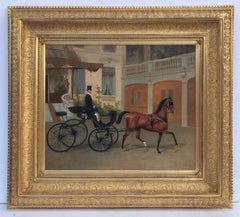
Horse Carriage in the Bourgeoise Yard
Located in Saint-Ouen, FR
James Thomas Wheeler (1849 - 1888)
Horse Carriage in the Yard
Oil on canvas signed low right
Old original frame gilded with leaves
Canvas size : 55 X 65 cm
Frame size : 85 X 95 cm
Category
Academic 1880s Animal Paintings
Materials
Oil
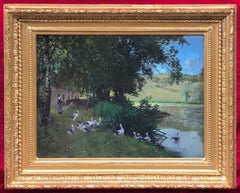
Landscape with pond and gooses
By Edouard Pail
Located in Saint-Ouen, FR
PAIL Edouard (1851-1916) Landscape with pond and gooses. Oil on canvas signed lower left and dated 1884 Old frame gilded with leaf Frame size: 50 X 65 cm Dim frame: 70 X 85 cm.
PAIL Edouard (1851-1916) School of Crozant - Post-Impressionist. French painter born in Corbigny, October 17, 1851 and died in Villeneuve-le-Roi on December 6, 1916. Student of local painter and engraver Hippolyte Lavoignat at the School of Fine Arts in Nevers. He exhibited at the Paris Salon in 1870, at the age of nineteen, two landscape paintings: Le Ruisseau de Varennes near Corbigny and Les Chaumes de Corbigny. In 1877, he became a professor at the School of Fine Arts in Nevers. Then he abandoned this position to join Paris in 1880. He then undertook trips to England, Egypt, Palestine and Algeria. He exhibits every year at the Paris Salon. In 1888, he was a member of the Salon des Artistes Français. He obtained a medal in 1893. In 1896, he was appointed Academy Officer. In 1903, he became an Officer of Public Instruction. In 1912, he exhibited at the Salon Le soir at Mont Sabot and in 1914 L'Éang aux bruyères. His favorite subjects are pastures and heather, backyards, shaded rivers, pink and misty panoramas. They are treated in clean tones and a palette dominated by greens and browns. Museums : Brest, Clamecy, Clermont-Ferrand, Nevers, Perpignan, Cannes. Bibliography : Bellier and Auvray, General Dictionary of Artists of the French School, Paris, Renouard, 1885. - E. Bénézit, Dictionary of painters, sculptors, designers and engravers, Paris, Grund - C. Rameix, L'École de Crozant: The painters of Creuse and Gargilesse. 1850-1950, - Marion Vidal...
Category
Post-Impressionist 1880s Animal Paintings
Materials
Oil
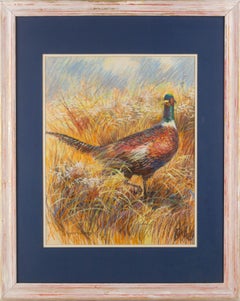
John Appleton Brown ( American, 1844-1902 ) Animal Pastel
Located in New York, NY
Medium: Pastel
Style: Animal
Painting Size: 19.5 x 15.5 inches
Frame Size: 31.5 x 25.5 inches
Condition: This artwork is in good condition for its age.
Signature: Hand-signed
Artis...
Category
1880s Animal Paintings
Materials
Pastel
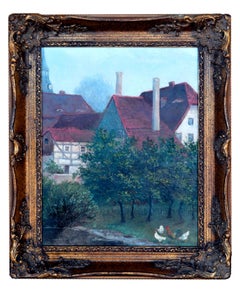
19th Century Sussex Landscape with Chickens
Located in Soquel, CA
Charming late 19th century landscape of English country Tudor style houses and chickens in style of Edward Wilkens Waite (English, 1854-1924) and...
Category
Impressionist 1880s Animal Paintings
Materials
Canvas, Oil
$1,280 Sale Price
28% Off
L
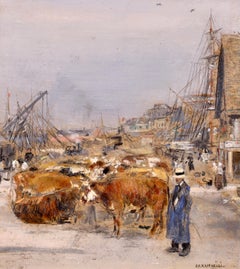
embarquement de boeufs - Impressionist Oil, Cattle by Jean Francois Raffaelli
Located in Marlow, Buckinghamshire
Wonderful signed oil on panel cattle and figures in landscape by French impressionist painter Jean-Francois Raffaelli. The work depicts oxen being loaded onto ships in Honfleur, France en route to England.
Signature:
Signed lower right
Dimensions:
Framed: 18"x16"
Unframed: 9"x8"
Provenance:
Exhibition Jean Francois Raffaélli held at Galerie Simonson, 19 Rue Caumartin Paris - October 1929 (number 44)
Jean-François Raffaëlli's father was a failed Italian businessman and Raffaëlli himself was, among other things, a church chorister, actor and theatre singer. He then studied under Gérôme at the École des Beaux-Arts in Paris. He travelled to Italy, Spain and Algeria and on his return to France settled in Asnières.
In 1876, on a trip to Brittany, he first saw the potential of realist subject matter, if treated seriously. He became involved in meetings of artists at the Café Guerbois, where the Impressionist painters used to gather. As a result, Degas, contrary to the advice of the group, introduced Raffaëlli to the Impressionist exhibitions - according to one uncertain source as early as the very first exhibition, at the home of Nadar, and certainly to those of 1880 and 1881.
In 1904, Raffaëlli founded the Society for Original Colour Engraving. He first exhibited at the Salon de Paris in 1870 and continued to exhibit there until he joined the Salon des Artistes Français in 1881, where he earned a commendation in 1885, was made Chevalier of the Légion d'Honneur in 1889 and in the same year was awarded a gold medal at the Exposition Universelle. In 1906 he was made Officier of the Légion d'Honneur. He was also a member of the Société Nationale des Beaux-Arts. In 1884, a private exhibition of his work cemented his reputation.
He contributed to several newspapers such as The Black Cat (Le Chat Noir) in 1885 and The French Mail (Le Courrier Français) in 1886 and 1887. He published a collection entitled Parisian Characters, which captured his favourite themes of the street, the neighbourhood and local people going about their lives. In 1880 he participated, with Forain, on the illustration of Joris Karl Huysmans' Parisian Sketches (Croquis Parisiens). He also illustrated Huysman's Works. As well as working as an illustrator, he also made etchings and coloured dry-points.
His early attempts at painting were genre scenes, but once he was settled in Asnières he started to paint picturesque views of Parisian suburbs. From 1879 onwards, his subject matter drew on the lives of local people. These popular themes, which he treated with humanity and a social conscience, brought him to the attention of the social realist writers of the time such as Émile Zola. In addition to his realist style, Raffaëlli's dark palette, which ran contrary to the Impressionist aesthethic, helped to explain the opposition of those painters to his participation in their exhibitions. More concerned with drawing than colour, he used black and white for most of his paintings. Towards the end of his life, he lightened his palette, but without adopting any other principles of the Impressionist technique.
After painting several portraits, including Edmond de Goncourt and Georges Clémenceau, he returned to genre painting, particularly scenes of bourgeois life. Later in his career, he painted mainly Breton-inspired sailors and views of Venice. His views of the Paris slums and the fortifications, sites which have almost completely disappeared, went some way towards establishing a genre in themselves and perpetuated the memory of the area: The Slums, Rag-and-Bone Man, Vagabond, Sandpit, In St-Denis, Area of Fortifications. His realistic and witty portrayal of typical Parisian townscapes accounts for his enduring appeal.
Born in Paris, he was of Tuscan descent through his paternal grandparents. He showed an interest in music and theatre before becoming a painter in 1870. One of his landscape paintings was accepted for exhibition at the Salon in that same year. In October 1871 he began three months of study under Jean-Léon Gérôme at the École des Beaux-Arts in Paris; he had no other formal training.
Raffaëlli produced primarily costume pictures until 1876, when he began to depict the people of his time—particularly peasants, workers, and ragpickers seen in the suburbs of Paris—in a realistic style. His new work was championed by influential critics such as J.-K. Huysmans, as well as by Edgar Degas.
The ragpicker became for Raffaëlli a symbol of the alienation of the individual in modern society. Art historian Barbara S. Fields has written of Raffaëlli's interest in the positivist philosophy of Hippolyte-Adolphe Taine, which led him to articulate a theory of realism that he christened caractérisme. He hoped to set himself apart from those unthinking, so-called realist artists whose art provided the viewer with only a literal depiction of nature. His careful observation of man in his milieu paralleled the anti-aesthetic, anti-romantic approach of the literary Naturalists, such as Zola and Huysmans.
Degas invited Raffaëlli to participate in the Impressionist exhibitions of 1880 and 1881, an action that bitterly divided the group; not only was Raffaëlli not an Impressionist, but he threatened to dominate the 1880 exhibition with his outsized display of 37 works. Monet, resentful of Degas's insistence on expanding the Impressionist exhibitions by including several realists, chose not to exhibit, complaining, "The little chapel has become a commonplace school which opens its doors to the first dauber to come along."An example of Raffaëlli's work from this period is Les buveurs d'absinthe (1881, in the California Palace of Legion of Honor Art Museum in San Francisco). Originally titled Les déclassés, the painting was widely praised at the 1881 exhibit.
After winning the Légion d'honneur in 1889, Raffaëlli shifted his attention from the suburbs of Paris to city itself, and the street scenes that resulted were well received by the public and the critics. He made a number of sculptures, but these are known today only through photographs.[2] His work was also part of the painting event in the art competition at the 1912 Summer Olympics. In the later years of his life, he concentrated on color printmaking. Raffaëlli died in Paris on February 11, 1924
Museum and Gallery Holdings:
Béziers: Peasants Going to Town
Bordeaux: Bohemians at a Café
Boston: Notre-Dame; Return from the Market
Brussels: Chevet of Notre-Dame; pastel
Bucharest (Muz. National de Arta al României): Market at Antibes; Pied-à-terre
Copenhagen: Fishermen on the Beach
Douai: Return from the Market; Blacksmiths
Liège: Absinthe Drinker...
Category
Impressionist 1880s Animal Paintings
Materials
Oil, Panel
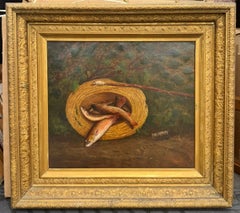
Antique Sporting Art Realist Southern Trout Fishing Pole
Located in New York, NY
Asa Coolidge Warren (1819 - 1904)
Oil on Canvas
Sight Size: 18x20
Overall frame size: 26x28
Signed and Dated left: 1884
Housed in original gold gilded frame
Overall very good conditi...
Category
American Realist 1880s Animal Paintings
Materials
Oil
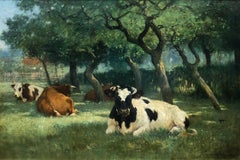
Made in the Shade
By William Henry Howe
Located in Missouri, MO
William Henry Howe (1846-1929)
"Made in the Shade" 1887
Oil on Canvas
Signed and Dated
Site Size: approx. 14.5 x 21.5 inches
Frames Size: approx. 17.5 x 24.5 inches
Provenance: Private Collection, St. Louis, Missouri thence by descent
William Henry Howe was born in Ravenna, Ohio in 1846. Of him it was written: "In the late nineteenth century no American artist was more thoroughly identified with the painting of cows than William Henry Howe." (Richter 128). In a style that combined Tonalism and Realism, he was a painter of light-filled pastoral landscapes that sometimes had sheep as well as cattle tended by their shepherds and herders.
He began a career as a businessman in St. Louis, and in his mid-thirties, changed course and went to Dusseldorf Germany to study art at the Royal Academy. In 1881, he went to Paris and studied with animal painters Felix Vuillefroy and Otto de Thoren. He also exhibited his work at the Paris Salons and the Paris Universal Exposition of 1889.
Travels in Holland in the 1880s with other artists inspired his interest in pastoral subjects, and during that time he began his cattle paintings...
Category
American Impressionist 1880s Animal Paintings
Materials
Canvas, Oil
Price Upon Request
Sunset
Located in Missouri, MO
James Fairman
"Sunset" c. 1880
Oil on Canvas
Signed Lower Left
Site: 32.5 x 29.5 inches
Framed: 46 x 42 inches
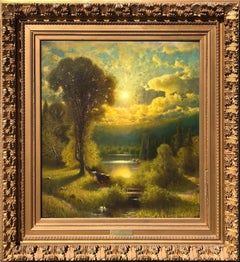
James Fairman worked as a landscape painter, critic, lecturer, musicia...
Category
American Realist 1880s Animal Paintings
Materials
Canvas, Oil
Price Upon Request
Still Thinking About These?
All Recently ViewedMore Ways To Browse
Alexander Koester
Beagle Portrait
Black Labrador Painting
Boston Terrier Painting
Canadian Goose Painting
Chihuahua Painting
Frances Mabel Hollams
Hunt Slonem Finches
Hunting Painting 1900
J Langlois
Joanne Bird
John Barber
Joseph Dixon
Josh Brown Giraffe
Jules Chardigny
Jumping Horse Painting
Lion Cub Painting
Louis Eugene Lambert