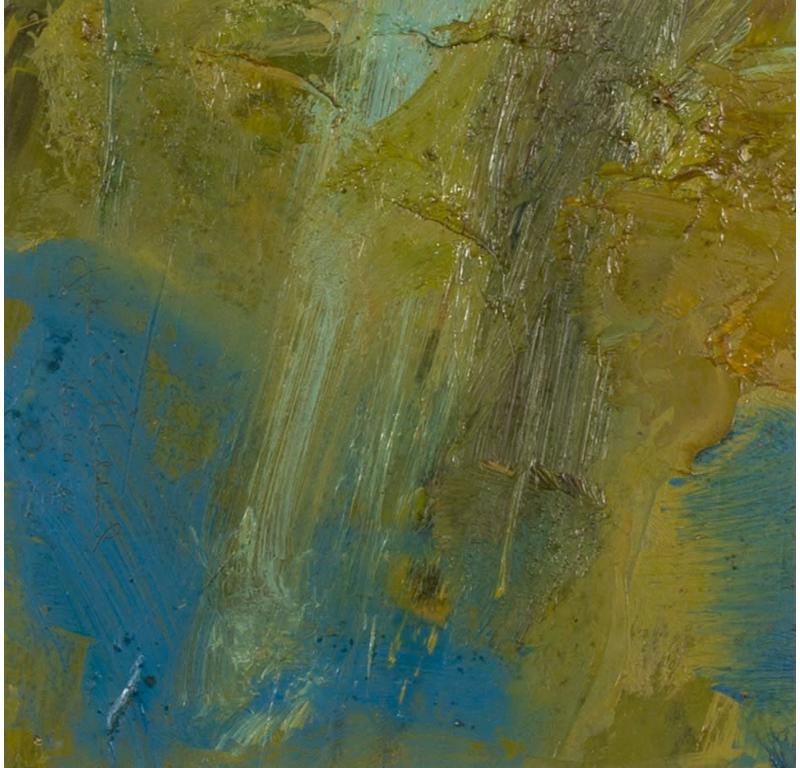
Items Similar to Green Parakeet II, Oil on Paper Abstract Bird Painting, Pink and Green, 1977
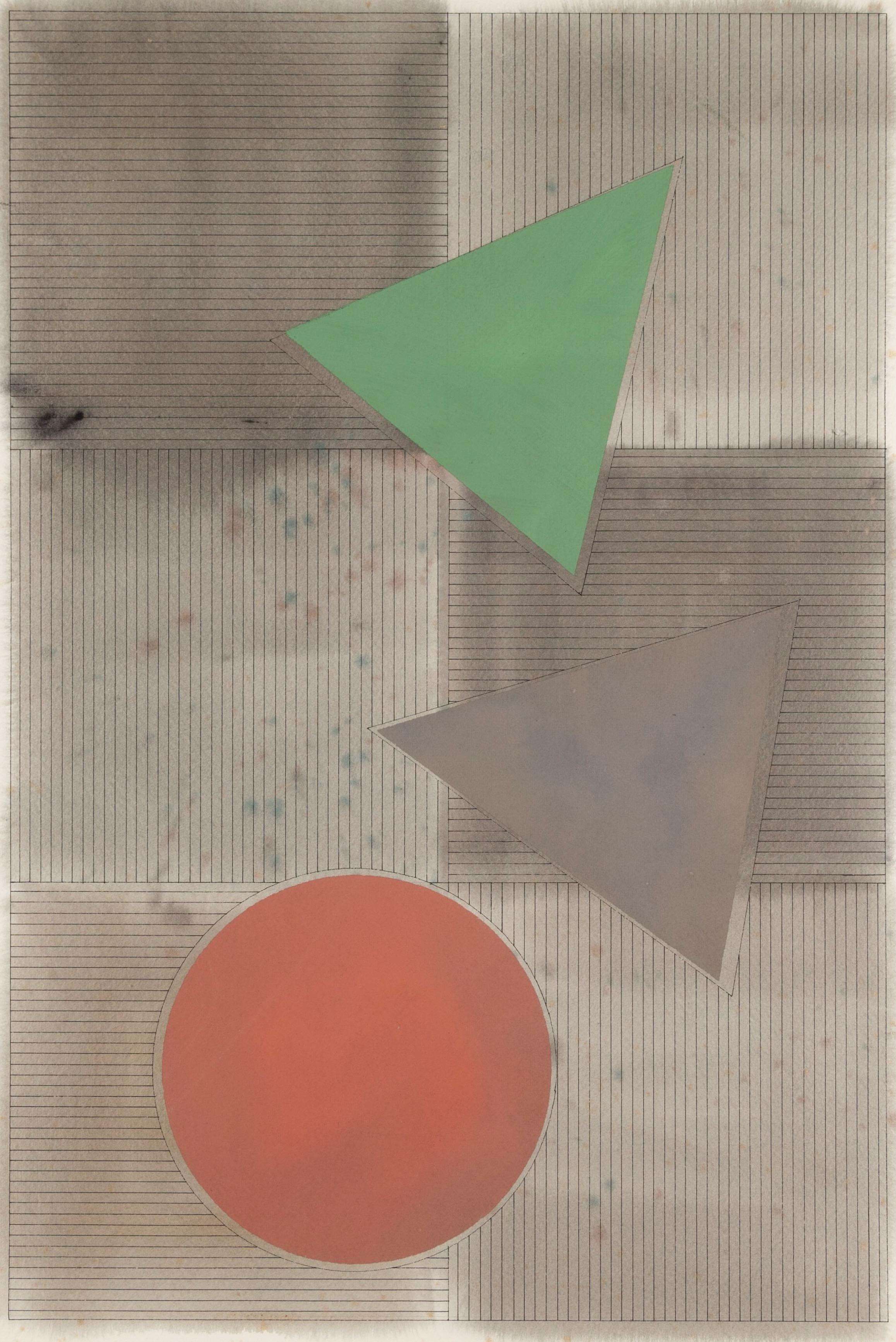
Want more images or videos?
Request additional images or videos from the seller
1 of 8
Peter KinleyGreen Parakeet II, Oil on Paper Abstract Bird Painting, Pink and Green, 19771977
1977
$6,583.96
£4,800
€5,611.72
CA$9,036.64
A$9,870.78
CHF 5,224.90
MX$118,662.20
NOK 66,415.96
SEK 60,748.06
DKK 41,914.80
About the Item
Green Parakeet II, Oil on Paper Painting by Peter Kinley 1926-1988, 1977
Provenance
Collection of an American Corporation, Virginia
Additional information:
Signed
Oil on paper
Dimensions: 61 x 71.1 cm
24 x 28 in
(PKI015)
- Creator:Peter Kinley (1926 - 1967, Austrian, British)
- Creation Year:1977
- Dimensions:Height: 24 in (60.96 cm)Width: 28 in (71.12 cm)
- Medium:
- Period:
- Condition:
- Gallery Location:Kingsclere, GB
- Reference Number:Seller: PKI0151stDibs: LU2718215006462
About the Seller
No Reviews Yet
Vetted Professional Seller
Every seller passes strict standards for authenticity and reliability
Established in 2010
1stDibs seller since 2024
44 sales on 1stDibs
Typical response time: 7 hours
- ShippingRetrieving quote...Shipping from: Kingsclere, United Kingdom
- Return Policy
More From This Seller
View AllUntitled (Green), Oil on Paper Painting by John Hubbard, 1962
By John Hubbard
Located in Kingsclere, GB
Untitled (Green), Oil on Paper Painting by John Hubbard 1931-2017, 1962
Additional information:
Medium: Oil on paper
21 x 21 cm
8 1/4 x 8 1/4 in
Signed and dated '22-VII-62'; furthe...
Category
20th Century Abstract Paintings
Materials
Paper
Red/Green, from Study for Larger Tri Motif Series, 1977 - Gouache, Watercolour
By Gordon House
Located in Kingsclere, GB
Gordon House was born in 1932 in Pontardawe, South Wales. Early exposure to art on trips to the Glynn Vivian Art Gallery as a young boy inspired House towards creative endeavors and at the age of fourteen he was awarded a grant to enter art school which he accepted. From 1947 to 1950 he studied at Luton School of Art, Bedfordshire, and St. Albans School of Art, Hertfordshire. House's contemporaries included Richard Smith and John Plumb with whom he remained close. During the early fifties, after finishing art school, House began work as assistant to the ecclesiastical sculptor Theodore Kern. He also spent time at an advertising studio where he honed his burgeoning skills in typography and graphic design. In 1952 House was offered the position of designer for Imperial Chemical Industries Plastics Division where he stayed until 1959. This was followed by two years spent as graphic designer for the Kynoch Press in London. In 1961 House set out on his own as a self-employed designer and typographer. Initially this was supplemented by part-time teaching at art schools in and around London but by 1964 House was able to devote himself entirely to his design work which freed up valuable time to concentrate on his own artistic output in the studio.
In the late fifties, informed by the new art emerging from America and that of his contemporaries in England, House began to create large-scale abstract works which he was invited to show in 1959 at Dennis Bowen's legendary New Vision Centre in Marble Arch.
House was an active participant in the vibrant London art scene of the sixties, regularly attending lectures, exhibitions and discussions. In 1960 he exhibited in 'Situation' the key abstract exhibition of the decade held at the RBA Galleries. Other participating artists included Robyn Denny, Bernard and Harold Cohen, Gillian Ayres, John Hoyland, Richard Smith and William Turnbull among others. These artists, united by a common admiration for American Abstract Expressionism, were frustrated by the lack of exposure given to large-scale abstract works in commercial galleries so they organised their own exhibition. The name was derived from the participants' idea that an abstract painting that occupied the whole field of vision would involve the spectator in an 'event' or 'situation'. This exhibition was followed by 'New London Situation' in 1961 and a nationwide touring Arts Council presentation in recognition of the significance of the two earlier shows.
In 1961 House began producing his first prints at the Kelpra Studio, run by Chris and Rose Prater, where he made the earliest fine art screenprint ever to be produced in Britain. Artists such as Paolozzi and Hamilton followed in his footsteps and together they started a printmaking revolution in Britain. They cemented the medium of the screenprint in the world of fine art as opposed to the commercial sphere and secured the reputation of Kelpra in the process. Later, together with Cliff White, House set up the White Ink (Ltd.) print studio in London, where he produced etchings and wood engravings on a series of magnificent antique printing presses...
Category
20th Century Abstract Paintings
Materials
Ink, Watercolor, Gouache
The Dragon
s Wing, 1990 - Bold Green Abstract Painting with Red and Blue
By Gordon House
Located in Kingsclere, GB
Gordon House was born in 1932 in Pontardawe, South Wales. Early exposure to art on trips to the Glynn Vivian Art Gallery as a young boy inspired House towards creative endeavors and ...
Category
1990s Paintings
Materials
Canvas, Oil
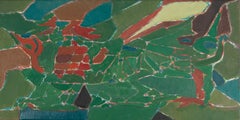
Lilac Recession, Abstract Acrylic Painting in Purple and Green, 1976
By Thomas Nathaniel Davies
Located in Kingsclere, GB
Lilac Recession
Category
20th Century Abstract Paintings
Materials
Acrylic
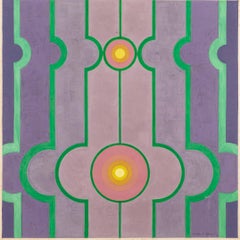
Grey/Pink, from Study for Larger Tri Motif Series, 1977 - Gouache, Watercolour
By Gordon House
Located in Kingsclere, GB
Gordon House was born in 1932 in Pontardawe, South Wales. Early exposure to art on trips to the Glynn Vivian Art Gallery as a young boy inspired House towards creative endeavors and ...
Category
20th Century Abstract Paintings
Materials
Ink, Watercolor, Gouache

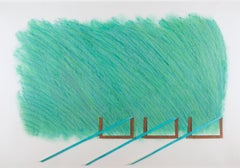
Drawing (Green with Three Tongues) Pastel on Cutout Paper by Richard Smith, 1970
By Richard Smith
Located in Kingsclere, GB
Drawing (Green with Three Tongues), Pastel on CutOut Paper by Richard Smith, 1970
Additional information:
Medium: Pastel on Cut-out Paper with Staples
99 x 143 cm
39 x 56 1/4 in
Signed and dated
Smith was a key figure in the British development of Pop Art. By 1970 when this work was executed, Smith was primarily concerned with the examination of the two-dimensional nature of painting and was experimenting in both his oils and his works on paper with extending the paint surface out into a three-dimensional space. In this work we see the added extensions in collage (the ‘three tongues’) to the normal rectangular format. The large scale is testament to the influence of advertising in Smith's late 60s and early 70s works. This work was made in the same year that Richard Smith represented Great Britain at the XXXV Venice Biennale, with a solo show in the British Pavilion. Smith was chosen by a committee of art experts, who were Director of Tate Norman Reid, art historian Alan Bowness, art collector David Thompson, the British Council’s Lilian Somerville and art historian Norbert Lynton. It was a hugely defining period in Smith's career, including the creation of his sculpture-cum-paintings 'Waterfall', 'Triangular' (both in the collection of Tate, London) and Sphinx Series (British Council), before he began developments towards his Kite Series in 1971.
Charles Richard "Dick" Smith was an English printmaker and painter.
Smith was born in Letchworth, Hertfordshire, to Doris (née Chandler), a nurse and daughter of a chemical company director. He studied at Hitchin Grammar School and Luton School of Art. After military service with the Royal Air Force in Hong Kong, he attended St Albans School of Art followed by post-graduate studies at the Royal College of Art, London, from 1954-57. Smith shared a flat-cum-studio with Peter Blake in his second year at the RCA, and then again for two years after he left the college in 1957. When Terence Conran's Soup Kitchen opened on Fleet Street in the late 1950s, it featured a letter-collage mural by Smith and Blake. Michael Chow would later commission Smith to design installations for his restaurant in Los Angeles, and Chow and Conran have remained two of his biggest supporters.
In 1959 he moved to New York to teach on a Harkness Fellowship, staying for two years, where he produced paintings combining the formal qualities of many of the American abstract painters which made references to American commercial culture. The artist's first solo exhibition was at the Green Gallery. As his work matured it tended to be more minimal, often painted using one colour with a second only as an accent.
In trying to find ways of transposing ideas, Smith began to question the two-dimensional properties of art itself and to find ways by which a painting could express the shape of reality as he saw it. He began to take the canvas off the stretcher, letting it hang loose, or tied with knots, to suggest sails or kites - objects which could change with new directions rather than being held rigid against a wall, and taking painting close to the realm of sculpture. These principles he carried into his graphic work by introducing cut, folded and stapled elements into his prints; some works were multi-leaved screenprinting, and others printed onto three-dimensional fabricated metal.
Smith returned to England in 1963 - specifically East Tytherton, Wiltshire where Howard Hodgkin was a neighbour - and gained critical acclaim for extending the boundaries of painting into three dimensions, creating sculptural shaped canvases with monumental presence, which literally protruded into the space of the gallery. Evocative titles such as Panatella and Revlon, and cosmetic, synthetic colours alluded to the consumer landscapes of urban America which had proved so influential. He showed at the Kasmin Gallery, a venture between Kas and the Marquess of Dufferin and Ava in New Bond Street, throughout the 60s, more-widely known as David Hockney's first gallery.
After being awarded the Grand Prize at the 9th São Paulo Biennial in 1967 and important exhibitions at Kasmin in 1963, Tate in 1964, and Richard Feigen Gallery in 1966, Smith was invited to exhibit at the XXXV Venice Biennale as the official British artist in 1970. Smith was chosen by a committee of art experts, who were Director of Tate Norman Reid, art historian Alan Bowness, art collector David Thompson, the British Council’s Lilian Somerville and art historian Norbert Lynton. Smith taught with Richard Hamilton at Gateshead in 1965, where he met Mark Lancaster and Stephen Buckley, and again in 2000, becoming close to the artist and his wife, Terry.
By the late 1960s Smith's ambition to produce paintings which shared a common sensibility with other media, such as film and photography, began to wane and he focused on the formal qualities of painting. The freestanding installation Gazebo exhibited at the Architectural League of New York in 1966, and a tent project at the Aspen Design...
Category
20th Century Abstract Paintings
Materials
Pastel
You May Also Like
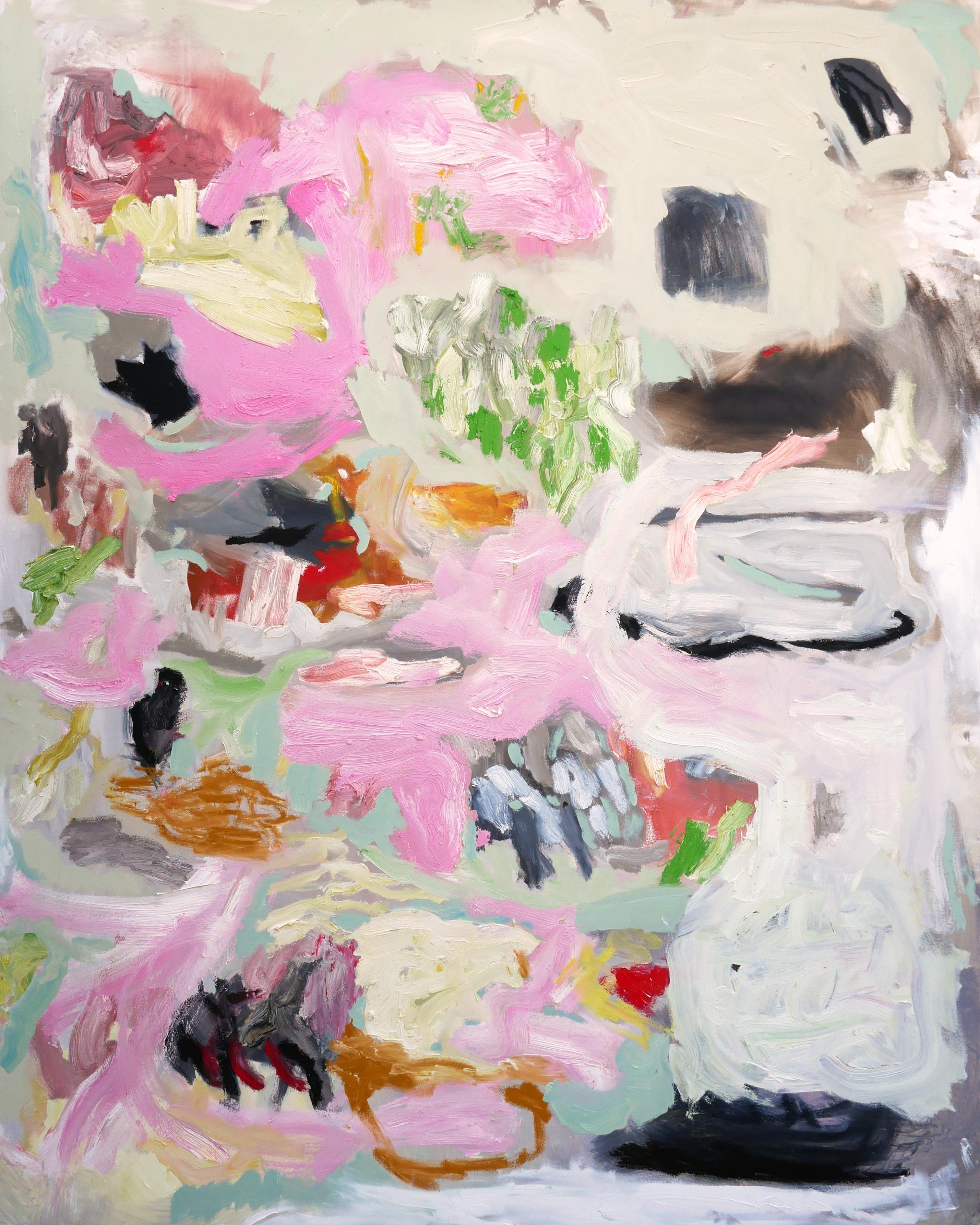
"Untitled (Pink and Green Abstract)" Contemporary Pastel Expressionist Painting
Located in Houston, TX
Abstract expressionist oil painting by contemporary Houston artist Benji Stiles. The work features gestural marks and rounded shapes in pastel pink, green, and orange tones set against a light background. Currently unframed, but options are available.
Artist Biography: Born in New Orleans, Robert Benjamin Stiles (Benji) is a multidisciplinary artist and educator who lives and works in Houston. He holds a B.A. from the University of St. Thomas, with a major in Art History and a minor in Studio Arts, and is currently an MFA candidate at MICA (Maryland Institute College of Art). His work ranges from non-representational painting focusing on diverse mark-making and color theory to conceptual sculpture and assemblage using historical and found objects. Since 2019, Stiles has established a successful art practice at Hardy and Nance studios while exhibiting work throughout the region including three solo shows (Hardy & Nance Gallery 2020, Lonestar College 2021, G-Contemporary 2022). Recent group shows include Collect it For the Culture 2021 (curated by Robert Hodge) where he showed work alongside more than 30 artists including – Rick Lowe...
Category
2010s Contemporary Abstract Paintings
Materials
Canvas, Oil
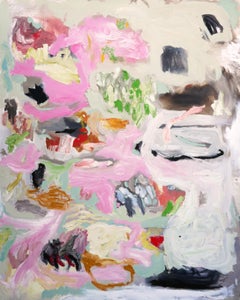
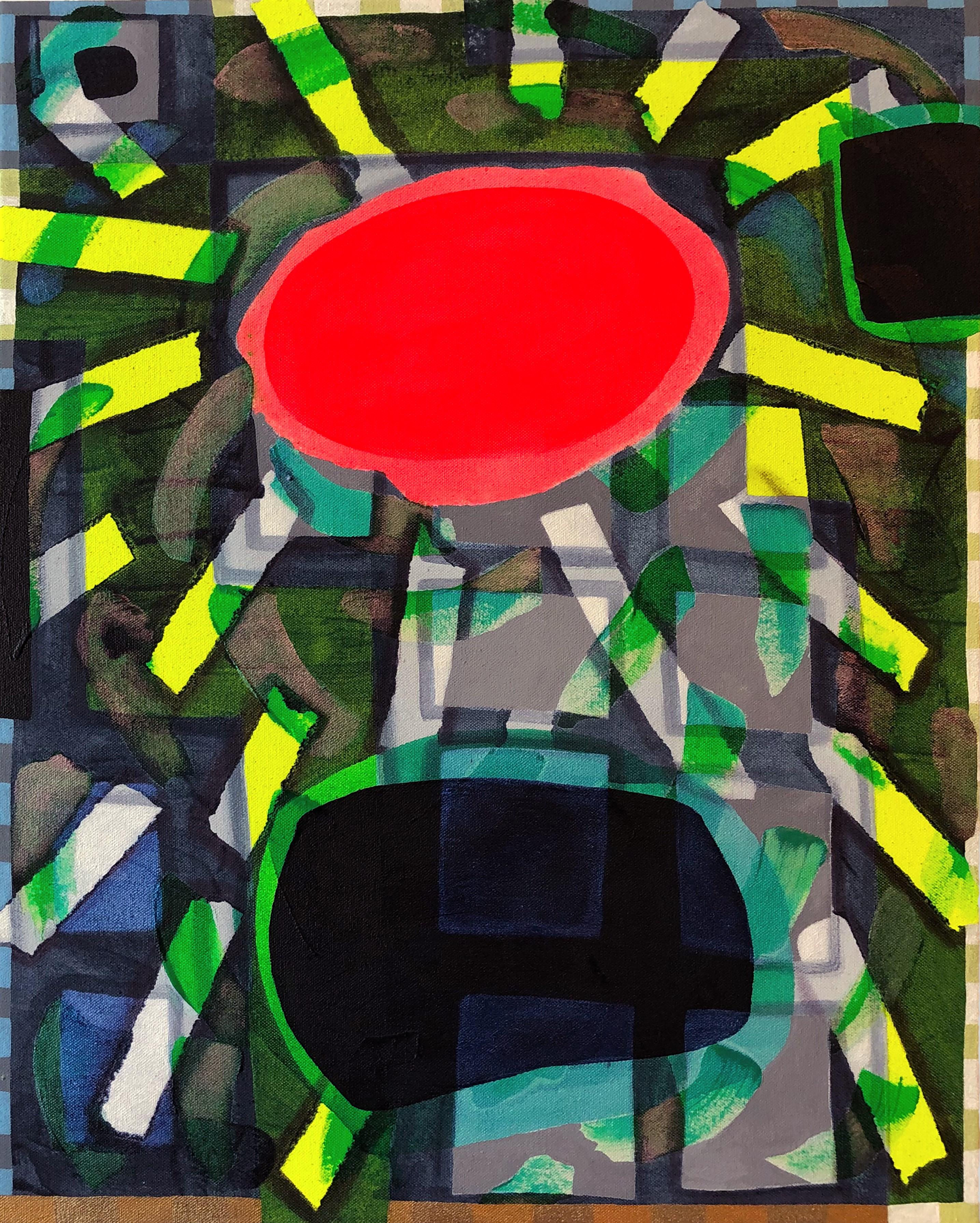
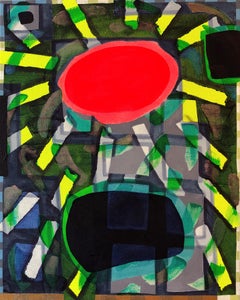
“Untitled (CVS175)” Contemporary Pink, Green,
Teal Geometric Abstract Painting
Located in Houston, TX
Contemporary geometric colorful abstract painting by Texas-based artist Max Manning. The work features organic and geometric shapes in pink, green, and teal tones. Signed, titled, & ...
Category
2010s Contemporary Abstract Paintings
Materials
Canvas, Acrylic
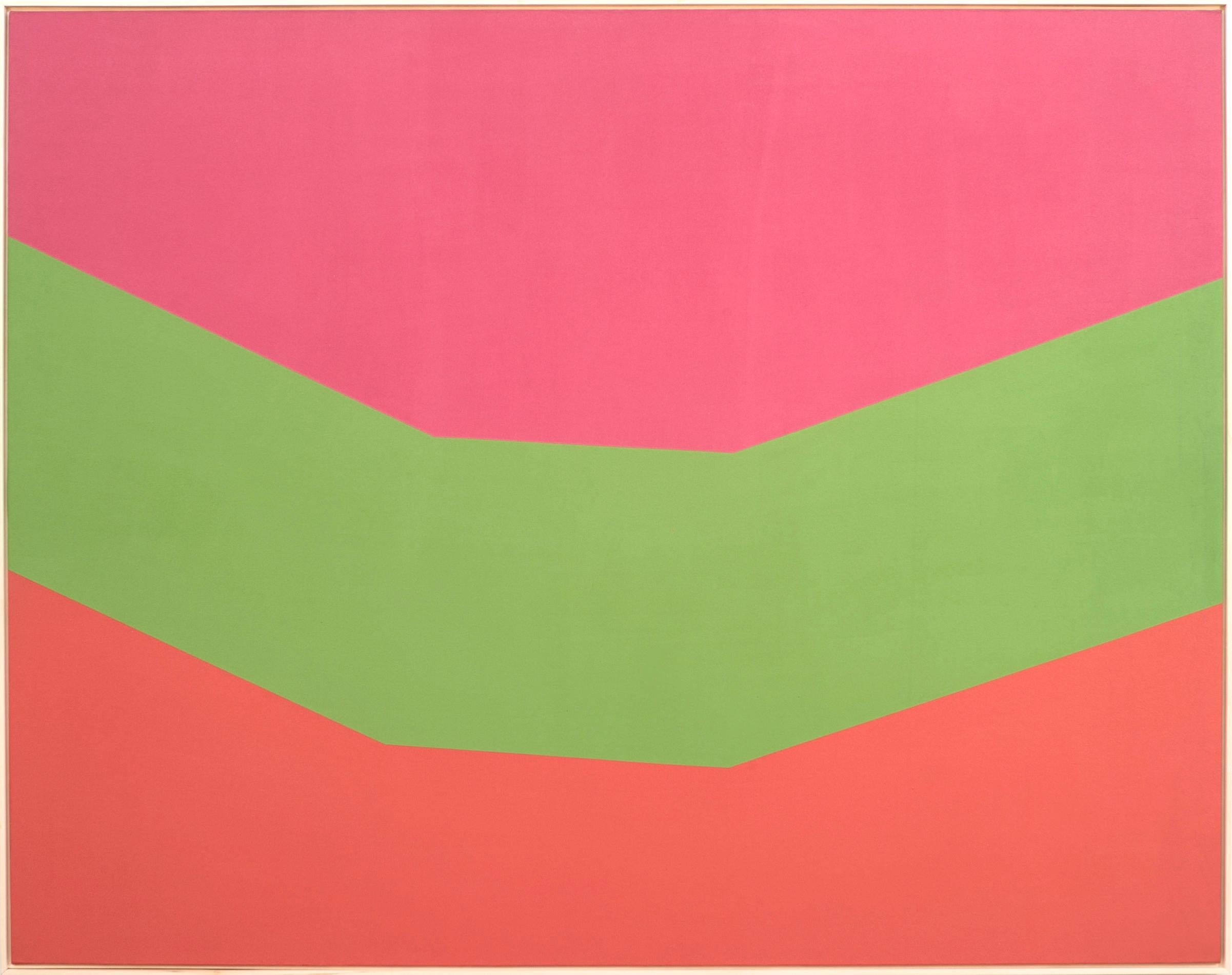
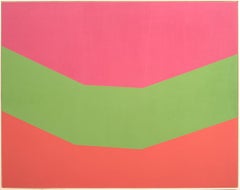
Field Green - large, green, pink, orange, minimal abstract, acrylic on canvas
By Milly Ristvedt
Located in Bloomfield, ON
It makes a bold statement. Field Green is one of a series of colour field paintings created by modernist Milly Ristvedt. Renowned as a master colourist, Ristvedt chose a bright palet...
Category
1960s Abstract Abstract Paintings
Materials
Canvas, Acrylic
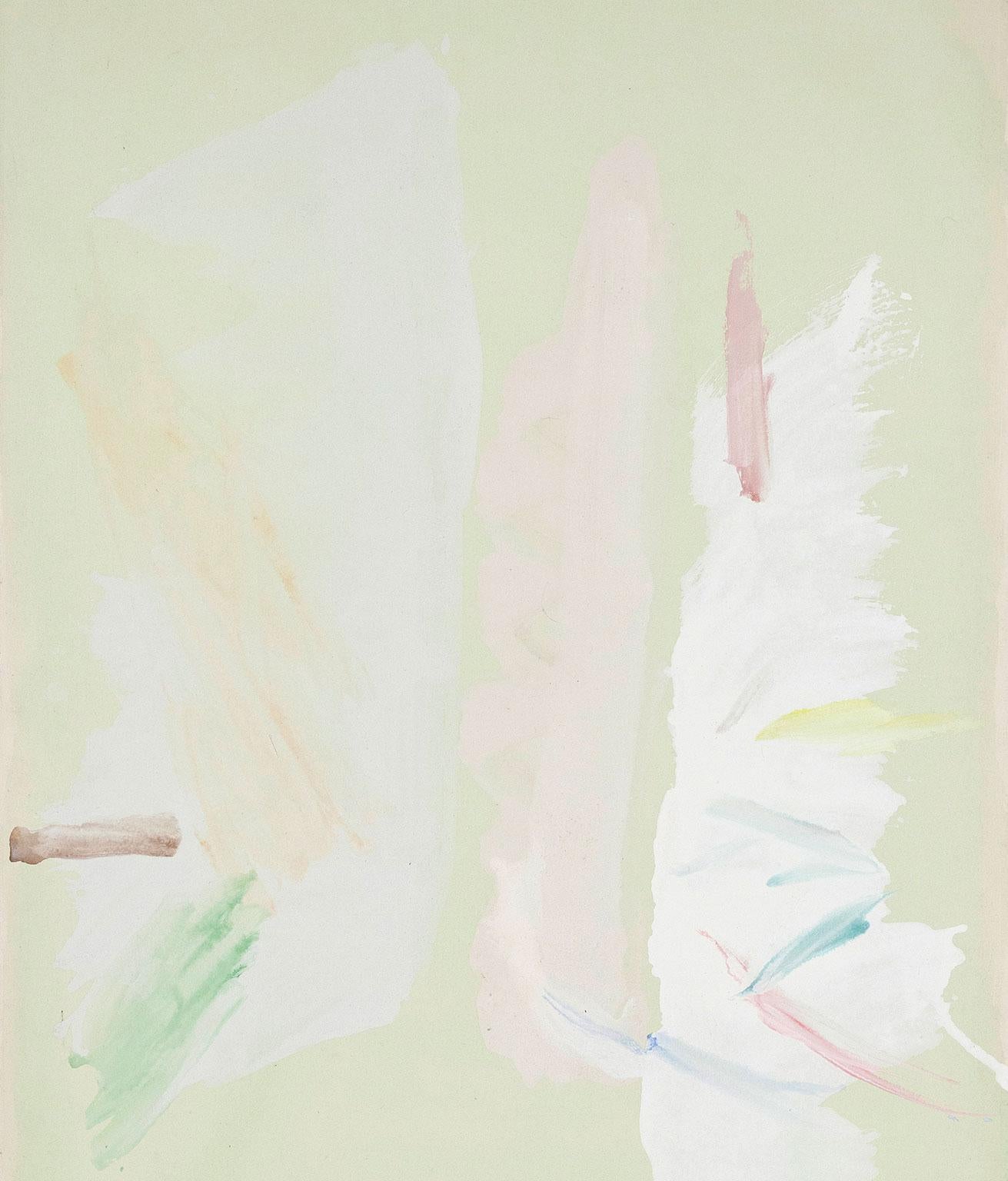
Dan Christensen "Pistachio", 1979
By Dan Christensen
Located in Toronto, Ontario
Dan Christensen (1942-2007) is widely recognized as one of America’s foremost color abstractionists. Over the course his lengthy career, Christensen was devoted to exploring and expa...
Category
1970s Abstract Expressionist Abstract Paintings
Materials
Acrylic

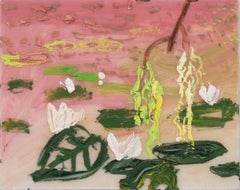
Pink and Green Pond
By Darius Yektai
Located in Sag Harbor, NY
An abstracted landscape of the artist's local pond.
Category
2010s Abstract Expressionist Abstract Paintings
Materials
Linen, Epoxy Resin, Oil
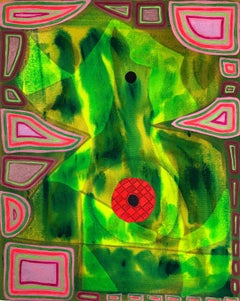
“Untitled (CVS189)” Contemporary Pink and Green Geometric Abstract Painting
Located in Houston, TX
Contemporary geometric colorful abstract painting by Texas-based artist Max Manning. The work features organic and geometric shapes in pink and green tones. Signed, titled, & dated b...
Category
2010s Contemporary Abstract Paintings
Materials
Canvas, Acrylic
More Ways To Browse
Peter Green
1977 Oil Painting
Pink Bird Painting
Oil Painting Horse And Hounds
Donkey Painting
English School Paintings Of Dogs
Jockey Painting
Original Wildlife Paintings
Siamese Cat
Dead Animals
Deer Oil Painting
Framed Rooster
Leopard Painting
Victorian Dog Paintings
19th Century Hunting Dog Painting
Antique Chicken Art
Gold Framed Bunny Oil Painting
Equestrian Horse Painting