Want more images or videos?
Request additional images or videos from the seller
1 of 5
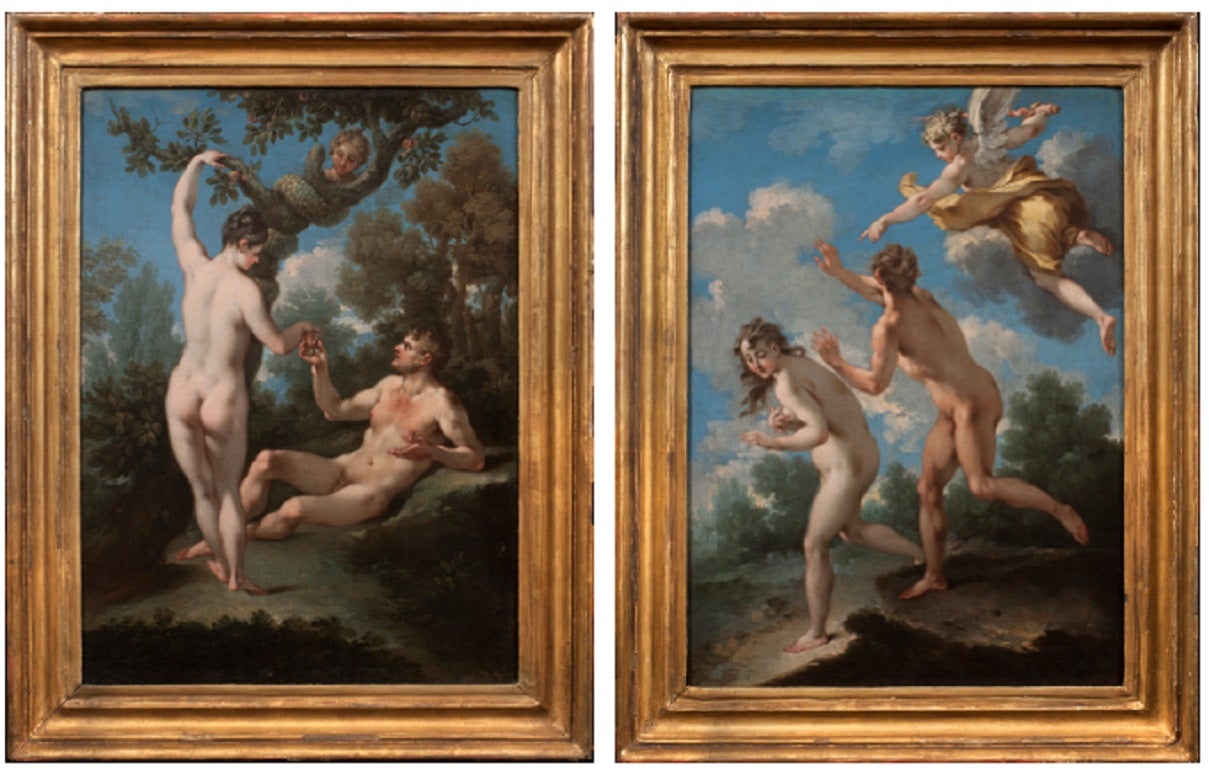
Domenico Beccafumi Allegory of Fortunec. 1510
c. 1510
Price:$50,000
$160,000List Price
About the Item
- Creator:Domenico Beccafumi (1484 - 1551, Italian)
- Creation Year:c. 1510
- Dimensions:Height: 32.75 in (83.19 cm)Width: 20.38 in (51.77 cm)
- Medium:
- Movement Style:
- Period:
- Condition:
- Gallery Location:New York, NY
- Reference Number:1stDibs: LU10212222042
About the Seller
5.0
Recognized Seller
These prestigious sellers are industry leaders and represent the highest echelon for item quality and design.
Established in 1997
1stDibs seller since 2012
24 sales on 1stDibs
Typical response time: 7 hours
Authenticity Guarantee
In the unlikely event there’s an issue with an item’s authenticity, contact us within 1 year for a full refund. DetailsMoney-Back Guarantee
If your item is not as described, is damaged in transit, or does not arrive, contact us within 7 days for a full refund. Details24-Hour Cancellation
You have a 24-hour grace period in which to reconsider your purchase, with no questions asked.Vetted Professional Sellers
Our world-class sellers must adhere to strict standards for service and quality, maintaining the integrity of our listings.Price-Match Guarantee
If you find that a seller listed the same item for a lower price elsewhere, we’ll match it.Trusted Global Delivery
Our best-in-class carrier network provides specialized shipping options worldwide, including custom delivery.You May Also Like
Diana and Actaeon, a Mannerist painting after Joseph Heintz the Elder
Located in PARIS, FR
This painting seduced us with its rich colors. Depicting Diana and her companions surprised by Actaeon, it was inspired by an engraving by Aegidius Sadeler II after a painting by Jos...
Category
17th Century Old Masters Nude Paintings
Materials
Oil, Wood Panel
$21,649
H 20.88 in W 26.07 in
Perseus and Andromeda
By David Teniers the Younger
Located in Paris, Île-de-France
DAVID TENIERS THE YOUNGER (1610–1690)
Perseus and Andromeda
Oil on panel
42.5 × 26.7 cm (16³⁄₄ × 10¹⁄₂ in.)
Unsigned
Provenance
• Possibly Archduke Leopold Wilhelm of Habsburg (16...
Category
1650s Old Masters Nude Paintings
Materials
Oil, Panel, Wood Panel
Gathering in antique Ruins, a monogrammed painting by Jan van Haensbergen
By Jan Van Haensbergen
Located in PARIS, FR
Jan van Haensbergen was a painter of the Dutch Golden Age and a pupil of Cornelius van Poelenburgh (Utrecht 1594 - 1667). The painting we are presenting is inspired by Poelenburgh’s landscapes from his Italian sojourn. The dreamlike atmosphere of this Gathering in antique ruins appealed to us. Against a backdrop of antique ruins, three draped characters (perhaps bathers) are sitting in a circle, greeting a fourth character walking towards them.
Their tranquility contrasts with the bustle of the other characters in the background. They constitute a vivid illustration of otium, this leisure time that allows us to realize our full potential. With this Arcadian landscape, Jan van Haensbergen invites us in turn to leave the hustle and bustle of everyday life behind, to take a break, to enjoy the present moment chatting with close friends…
1. Jan van Haensbergen, a landscape and portrait painter of the Dutch Golden Age
Jan van Haensbergen was born in 1642 in Gorinchem, a town in southern Holland to the east of Rotterdam. He was a pupil of Cornelius van Poelenburgh, and began by painting landscapes inspired by those of his master, in an Italianate style. Between 1668 and 1669, he was registered at the Guild of Saint Luke in Utrecht.
In 1669, he moved to The Hague, where he joined the Confrérie Pictura, an artist society founded in 1656. His portraits, which became his main activity as a painter after settling in The Hague, were strongly influenced by Caspar Netscher (Prague or Heidelberg 1639 - The Hague 1684), whom he met in The Hague and whose son Constantijn became his son-in-law by marrying his daughter Magdalena.
In addition to his work as an artist, Van Haensbergen was also an art dealer, probably helped by his appointment as Dean of the Confrérie Pictura, where he also teached.
2. Description of the artwork and related paintings
This painting seems to us to be a kind of allegory of otium, that quiet bliss promised by Epicurus. It might even evoke an Epicurean proverb: "It is better to lie on the naked ground and be at ease, than to have a golden carriage and a rich table and be worried" .
Three draped young people - two men and a woman in the background - are seated in a circle, greeting a fourth figure walking towards them, hair disheveled and body draped in a towel as if drying off after a bath, indicating the need for prior purification to fully enjoy this rest. Their nonchalance contrasts with the bustle of the various characters in the background.
The composition is punctuated by successive diagonals, and opens onto a landscape on the right, with a succession of mountainous planes. This painting is typical of the Italianate works produced by Van Haensbergen in the 1660s under the influence of Cornelis van Poelenburgh...
Category
17th Century Old Masters Landscape Paintings
Materials
Oak, Oil
$11,426
H 12.63 in W 14.63 in
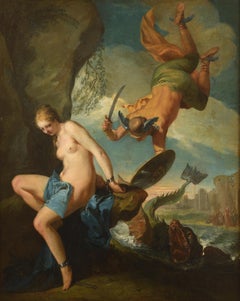
Perseus and Andromeda
Located in Paris, Île-de-France
Carle Vanloo (Nice 1705 – Paris 1765)
Perseus and Andromeda
Oil on canvas. H. 081; W. 065.
Alongside François Boucher (1703-1770) and Charles-Joseph Natoire (1700-1777), Carle Vanlo...
Category
1720s Old Masters Nude Paintings
Materials
Canvas, Oil
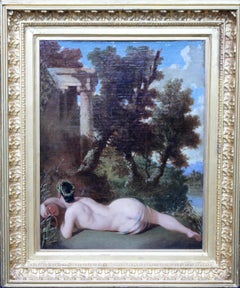
Old Master Dutch Female Nude Arcadian Landscape - 19th century art oil painting
By (Attributed to) Isaac de Mucheron
Located in Hagley, England
An original oil on canvas which is attributed verso to Isaac Mucheron with figure by Vandveldt. The scene depicts a nude in an Arcadia classical landscape with ruins. Fresh colour an...
Category
Early 19th Century Old Masters Landscape Paintings
Materials
Oil
$8,160 Sale Price
20% Off
H 32 in W 28 in D 2 in
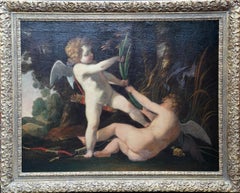
Portrait of Putti Playing - French 17th century art Old Master oil painting
Located in Hagley, England
This stunning French 17th century Old Master oil painting is by Baroque artist Laurent de la Hyre. It was painted circa 1645 and has excellent prove...
Category
17th Century Old Masters Portrait Paintings
Materials
Oil
$37,492 Sale Price
20% Off
H 44 in W 54 in D 2 in
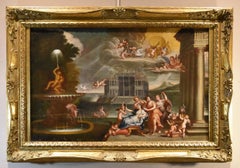
Toilet Venus Albani Mythological 17/18th Century Paint Oil on canvas Old master
Located in Riva del Garda, IT
Toilet of Venus Francesco Albani (Bologna 1578 - 1660) Follower of
Oil on canvas 64 x 96 cm In fine gilded frame 83 x 121 cm.
The painting on offer, depicting ‘Venus’ Toilet',...
Category
17th Century Old Masters Paintings
Materials
Oil
$9,631 Sale Price
20% Off
H 32.68 in W 47.64 in
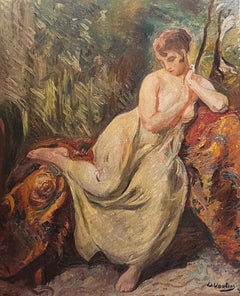
The Reflection of The Model by Otto Vautier - Oil on Canvas 81x65 cm
Located in Geneva, CH
Otto Vautier is a renowned Swiss painter, born in 1863 in Düsseldorf. He was influenced by a family of artists and developed his style during his training in Munich and Paris. Vautie...
Category
Early 20th Century Old Masters Nude Paintings
Materials
Canvas, Oil
$3,400
H 31.89 in W 25.6 in D 0.4 in
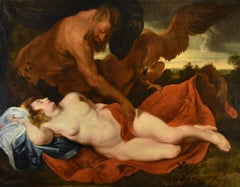
Jupiter Antiope Van Dyck Mythological Paint 17/18th Centuty Oil on canvas Art
Located in Riva del Garda, IT
Anthoon van Dyck (Antwerp 1599 - London 1641) follower
Large canvas depicting ‘The Myth of Jupiter and Antiope’
(Ovid's Meramorphoses, Book VI)
Oil on canvas
116 x 150 cm. - with f...
Category
17th Century Old Masters Paintings
Materials
Oil
$17,512 Sale Price
20% Off
H 52.37 in W 64.97 in
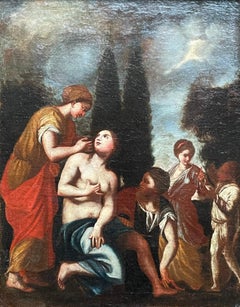
FINE 17TH CENTURY ITALIAN OLD MASTER OIL ON CANVAS - THE BATHING OF BATHSHEBA
Located in Cirencester, Gloucestershire
Artist/ School: Italian School, 17th century
Title: The Bathing of Bathsheba
Medium: oil painting, on canvas
Size: frame: 23 x 19 inches, canvas: 18 x 14 inches
Provenanc...
Category
17th Century Old Masters Figurative Paintings
Materials
Canvas, Oil
$6,064
H 23 in W 19 in D 1 in
More From This Seller
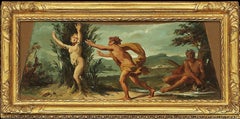
View AllSeven Scenes from the Life of Apollo
By Jacopo Guarana
Located in New York, NY
Attributed to
Jacopo Guarana
(Verona 1720 – 1808 Venice)
Canvas, unsigned
The Deeds of Apollo
Provenance: Suida-Manning Collection
These seven scenes are brilliant evocations o...
Category
18th Century and Earlier Baroque Figurative Paintings
Materials
Oil
Orientale
By Henri Fantin-Latour
Located in New York, NY
Signed, lower right: Fantin
Provenance:
Gustave Tempelaere (1840–1904), Paris; possibly by descent to his son:
Julien Tempelaere (1876–1961) and with F. & J. Tempelaere, Paris, prob...
Category
1890s Romantic Figurative Paintings
Materials
Canvas, Paper, Oil
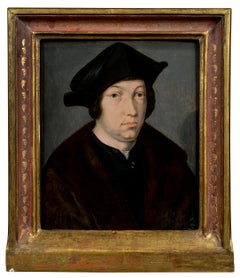
Portrait of a Man
Located in New York, NY
Provenance:
with Leo Blumenreich and Julius Böhler, Munich, 1924
Dr. Frederic Goldstein Oppenheimer (1881-1963), San Antonio, Texas; by whom given to:
Abraham M. Adler, New York, until 1985; thence by descent to the present owners
While old inscriptions on the verso of this panel propose its author to be Hans Holbein and the sitter Sir John More—a lawyer, judge, and the father of Sir Thomas More—this fine portrait has long been recognized to be by a Flemish hand. Max Friedländer gave the painting to Bernard van Orley (1487/1491 – 1541) in 1924, but did not include it in the volume dedicated to the artist in his Early Netherlandish Paintings...
Category
16th Century Old Masters Portrait Paintings
Materials
Oil, Panel
$52,500
Esther in the Women
s House of Ahasuerus
By Artus Wolfort
Located in New York, NY
Born in Antwerp, Artus Wolffordt received his training in Dordrecht where he became a master in 1603 at the age of twenty-two. He returned to his native city in 1615 and initially worked as an assistant to Otto van Veen...
Category
17th Century Old Masters Paintings
Materials
Oil, Panel
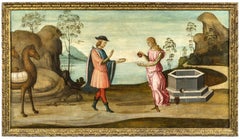
Rebecca at the Well
Located in New York, NY
Provenance:
Dr. James Henry Lancashire, Manchester-by-the-Sea, Massachusetts, by 1925; probably by descent to:
Private Collection, Cumberland Foreside, Maine, until 2018
This unpublished panel is a characteristic work of the Master of the Apollo and Daphne Legend, an anonymous Florentine painter in the circle of Bartolommeo di Giovanni, Domenico Ghirlandaio, and Sandro Botticelli. The artistic personality of the Master of the Apollo and Daphne Legend was independently recognized by Everett Fahy and Federico Zeri at roughly the same moment in time. Fahy originally dubbed this artist the Master of the Ryerson Panels but later adopted Zeri’s name for the artist, which derives from his eponymous works from the Samuel H. Kress collection (Figs. 1-2). Fahy posited that the artist was most likely a pupil of Ghirlandaio active from roughly 1480 to 1510, and that he may be identifiable with one of Ghirlandaio’s documented pupils to whom no works have been securely attributed, such as Niccolò Cieco, Jacopo dell’Indaco, or Baldino Baldinetti. The present painting was first attributed to this master by Everett Fahy in 1989, who became aware of its existence only after publishing his definitive studies on the artist.
The surviving body of work by the Master of the Apollo and Daphne Legend is largely composed of series of panels treating the same theme. In addition to the works illustrating the legend of Apollo and Daphne, there are also series on the themes of Susanna and the Elders and the story of Saint Joseph, among others. The subject of the present panel is drawn from Genesis 24, the story of Isaac. It is possible that our painting relates to another work by the artist depicting the Sacrifice of Isaac formerly in the collection of E. A. McGuire in Dublin, Ireland (Fig. 3), and that these two panels were originally part of a decorative scheme based on the story of Isaac.
Although the Master’s paintings of this type have traditionally been considered painted fronts of wedding chests, known as cassoni, the scale of these paintings and the fact that they are often part of a series indicates that they are more likely spalliera panels—paintings set into furniture or the wainscoting of a room. The biblical episode depicted in this painting centers on the theme of marriage, which suggests that this work was likely commissioned for the domestic interior of a newly married couple. The Master has transcribed into paint even the minute details of this Old Testament story, in which Abraham sends a servant to travel by camel to the land of his father and seek out a wife for his son Isaac. The servant is here shown at the well...
Category
15th Century and Earlier Old Masters Figurative Paintings
Materials
Oil, Tempera, Wood Panel
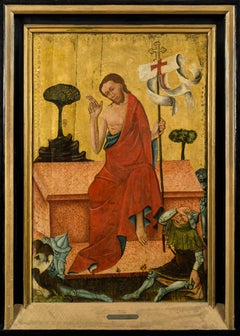
The Resurrection of Christ
Located in New York, NY
Provenance:
with “Mr. Scheer,” Vienna, by July 1918; where acquired by:
Jindřich Waldes, Prague, 1918–1941; thence by descent to:
Private Collection, New York
Literature:
Rudolf Kuchynka, “České obrazy tabulové ve Waldesově obrazárně,” Památky archeologické, vol. 31 (1919), pp. 62-64, fig. 5.
Jaroslav Pešina, “K datování deskových obrazů ve Waldesově obrazárně,” Ročenka Kruhu pro Pěstování Dějin Umění: za rok (1934), pp. 131-137.
Jaroslav Pešina, Pozdně gotické deskové malířství v Čechách, Prague, 1940, pp. 150-151, 220.
Patrik Šimon, Jindřich Waldes: sběratel umění, Prague, 2001, pp. 166, 168, footnote 190.
Ivo Hlobil, “Tři gotické obrazy ze sbírky Jindřicha Waldese,” Umění, vol. 52, no. 4 (2004), p. 369.
Executed sometime in the 1380s or 1390s by a close associate of the Master of the
Třeboň Altarpiece, this impressive panel is a rare work created at the royal court in Prague and a significant re-discovery for the corpus of early Bohemian painting. It has emerged from an American collection, descendants of the celebrated Czech industrialist and collector Jindřich Waldes, who died in Havana fleeing Nazi-occupied Europe.
The distinctive visual tradition of the Bohemian school first began to take shape in the middle of the fourteenth century after Charles IV—King of Bohemia and later Holy Roman Emperor—established Prague as a major artistic center. The influx of foreign artists and the importation of significant works of art from across Europe had a profound influence on the development of a local pictorial style. Early Italian paintings, especially those by Sienese painters and Tommaso da Modena (who worked at Charles IV’s court), had a considerable impact on the first generation of Bohemian painters. Although this influence is still felt in the brilliant gold ground and the delicate tooling of the present work, the author of this painting appears to be responding more to the paintings of his predecessors in Prague than to foreign influences.
This Resurrection of Christ employs a compositional format that was popular throughout the late medieval period but was particularly pervasive in Bohemian painting. Christ is shown sitting atop a pink marble sarcophagus, stepping down onto the ground with one bare foot. He blesses the viewer with his right hand, while in his left he holds a triumphal cross with a fluttering banner, symbolizing his victory over death. Several Roman soldiers doze at the base of the tomb, except for one grotesque figure, who, beginning to wake, shields his eyes from the light and looks on with a face of bewilderment as Christ emerges from his tomb. Christ is wrapped in a striking red robe with a blue interior lining, the colors of which vary subtly in the changing light. He stands out prominently against the gold backdrop, which is interrupted only by the abstractly rendered landscape and trees on either side of him.
The soldiers’ armor is rendered in exacting detail, the cool gray of the metal contrasting with the earth tones of the outer garments. The sleeping soldier set within a jumble of armor with neither face nor hands exposed, is covered with what appears to be a shield emblazoned with two flies on a white field, somewhat resembling a cartouche (Fig. 1). This may be a heraldic device of the altarpiece’s patron or it may signify evil, referencing either the Roman soldiers or death, over both of which Christ triumphs.
This painting formed part of the collection assembled by the Czech industrialist and founder of the Waldes Koh-i-noor Company, Jindřich Waldes, in the early twentieth century. As a collector he is best remembered for establishing the Waldes Museum in Prague to house his collection of buttons (totaling nearly 70,000 items), as well as for being the primary patron of the modernist painter František Kupka. Waldes was also an avid collector of older art, and he approached his collecting activity with the goal of creating an encyclopedic collection of Czech art from the medieval period through to the then-present day. At the conclusion of two decades of collecting, his inventory counted 2331 paintings and drawings, 4764 prints, and 162 sculptures. This collection, which constituted the Waldesova Obrazárna (Waldes Picture Gallery), was first displayed in Waldes’ home in Prague at 44 Americká Street and later at his newly built Villa Marie at 12 Koperníkova Street. This Resurrection of Christ retains its frame from the Waldes Picture Gallery, including its original plaque “173 / Česky malíř z konce 14 stol.” (“Czech painter from the end of the 14th century”) and Waldes’ collection label on the reverse.
The Resurrection of Christ was one of the most significant late medieval panel...
Category
15th Century and Earlier Old Masters Paintings
Materials
Tempera, Panel
Still Thinking About These?
All Recently ViewedMore Ways To Browse
Siena Painting
16th Century Painted Panels
Judith Holofernes
Faith Hope Charity
Antique Hippo
Cassapanca Bench
Original Figurative Oil Paintings
Early 20th Century Impressionist
German Early 20th Century Painting
One Of A Kind Art Collages
Antique English Paintings
Textured Abstract Art
Rose Paintings
Antique American Frames
Room With A View Painting
Armenian Artists
Gray Blue Abstract Art Large
French Street Scene Oil Paintings