Want more images or videos?
Request additional images or videos from the seller
1 of 20
Felice Fortunato Biggi, known as Felice de
Fiori (Parma 1650 - Verona 1700 ca.), cercle ofFlower Still Life Old Master 17th century Italy Paint Oil on canvas Quality Art1670-1720
1670-1720
Price:$5,932.79
$8,561.01List Price
About the Item
- Creator:Felice Fortunato Biggi, known as Felice de Fiori (Parma 1650 - Verona 1700 ca.), cercle of (1650 - 1700)
- Creation Year:1670-1720
- Dimensions:Height: 35.83 in (91 cm)Width: 46.46 in (118 cm)
- Medium:
- Movement Style:
- Period:
- Condition:
- Gallery Location:Riva del Garda, IT
- Reference Number:1stDibs: LU98816998312
About the Seller
4.9
Platinum Seller
Premium sellers with a 4.7+ rating and 24-hour response times
Established in 2017
1stDibs seller since 2018
273 sales on 1stDibs
Authenticity Guarantee
In the unlikely event there’s an issue with an item’s authenticity, contact us within 1 year for a full refund. DetailsMoney-Back Guarantee
If your item is not as described, is damaged in transit, or does not arrive, contact us within 7 days for a full refund. Details24-Hour Cancellation
You have a 24-hour grace period in which to reconsider your purchase, with no questions asked.Vetted Professional Sellers
Our world-class sellers must adhere to strict standards for service and quality, maintaining the integrity of our listings.Price-Match Guarantee
If you find that a seller listed the same item for a lower price elsewhere, we’ll match it.Trusted Global Delivery
Our best-in-class carrier network provides specialized shipping options worldwide, including custom delivery.You May Also Like
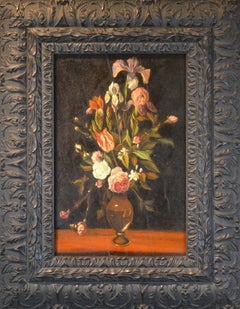
Still Life with Flowers in a Vase
Located in Atlanta, GA
Painted in the style of the 17th century Dutch painter Alexander Andrienssen, this painting is of a glass vase on a wood surface filled with flowers. The artist's careful attention ...
Category
18th Century and Earlier Old Masters Still-life Paintings
Materials
Oil, Wood Panel
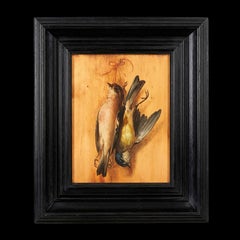
A Tompe l
oeil still life of hanging birds
Located in Stoke, Hampshire
English School, c. 1800
Still life of hanging birds
Oil on panel
Panel size - 8 x 6 in
Framed size - 12 1/2 x 10 1/2 in
This trompe-l'œil still life is a striking example of illusio...
Category
19th Century Old Masters Animal Paintings
Materials
Oil
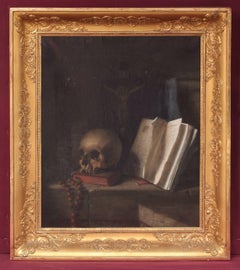
Painting 18th Century Vanitas Still Life Skull Religion Esotericism Occult
Located in Saint-Ouen, FR
Vanitas 18th century
French School
Oil on canvas
Old frame gilded with gold leaves
Dim canvas : 73 X 60 cm
Dim frame : 93 X 80 cm
Certificate of authenticity
Category
Late 18th Century Old Masters Still-life Paintings
Materials
Oil
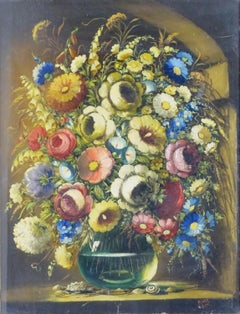
$9,255
H 36.62 in W 31.5 in D 3.94 in
Classical Still Life Study Of Flowers in Vase Elaborate Grand Gilt Frame
Located in Cirencester, Gloucestershire
Rima (English, 20th century) *see notes below
signed oil on board, unframed
board: 31 x 24 inches
provenance: UK collection
The painting has some scuffs and scratches but is essentia...
Category
20th Century Old Masters Still-life Paintings
Materials
Oil
$1,584 Sale Price
76% Off
H 36 in W 29.5 in
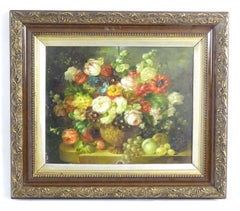
Very Large Classical Oil Still Life Study Of Fruit and Flowers
By Emilio Greco
Located in Cirencester, Gloucestershire
Manner of Emilio Greco, 20th Century
oil on board, framed
framed: 24 x 29 inches
board: 16 x 20 inches
provenance: private collection, England
The painting is in very good and presen...
Category
20th Century Old Masters Still-life Paintings
Materials
Oil
$5,465 Sale Price
20% Off
H 24 in W 29 in
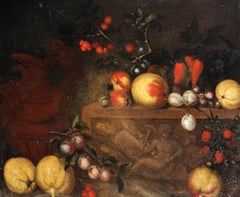
17th Century Italian School Still Life of Fruit on a Marble Ledge with a Ewer
Located in Cirencester, Gloucestershire
17th Century Italian School.
A Still Life of Fruit on a Marble Ledge, with a Ewer to the side,
Oil on Canvas, Unframed,
22" x 26.5" (56 x 67.3cm).
Con...
Category
17th Century Old Masters Still-life Paintings
Materials
Canvas, Oil
$7,651 Sale Price
20% Off
H 22 in W 26.5 in D 1 in
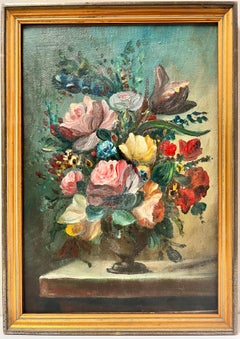
Fine Classical Still Life Oil Painting Ornate Flowers in Vase Gilt Framed Oil
Located in Cirencester, Gloucestershire
Classical Still Life of Flowers
French School, early 20th century
oil on board, framed
framed: 12 x 8.5 inches
board: 11 x 8.5 inches
provenance: private collection, France
condition...
Category
Early 20th Century Old Masters Still-life Paintings
Materials
Oil
$546 Sale Price
20% Off
H 12 in W 8.5 in
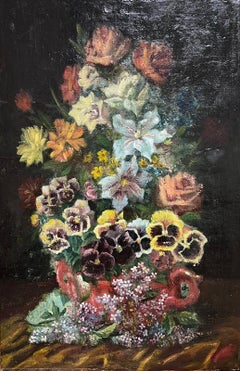
Classical Still Life of Flowers Ornate Display Antique Dutch Oil Painting
Located in Cirencester, Gloucestershire
Profusion of Flowers
Classical Still Life
Dutch School, 19th century
oil on canvas, unframed
canvas : 32 x 21 inches
provenance: private collection
condition: very good and sound con...
Category
Late 19th Century Old Masters Still-life Paintings
Materials
Oil, Canvas
$2,404 Sale Price
20% Off
H 32 in W 21 in
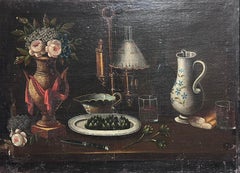
Huge 18th Century Italian Old Master Oil Painting Still Life Fruit Flowers
Jug
Located in Cirencester, Gloucestershire
Classical Still Life of Fruit in Basket with other objects
Italian artist, 18th century
oil on canvas, unframed
canvas: 24.5 x 33 inches
provenance: private collection, UK
condition:...
Category
18th Century Old Masters Still-life Paintings
Materials
Oil
$2,841 Sale Price
20% Off
H 24.5 in W 33 in D 1 in
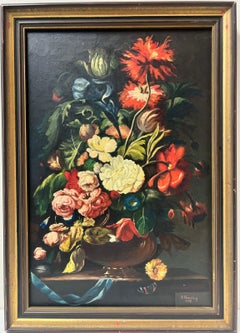
Classical Still Life Ornate Flowers in Vase in the Traditional Old Master style
Located in Cirencester, Gloucestershire
Ornate Classical Flowers
oil painting on canvas, framed
signed and dated 1947
framed: 17.5 x 12.5 inches
canvas: 16 x 10.5 inches
provenance: private collection
condition: very good ...
Category
Mid-20th Century Old Masters Still-life Paintings
Materials
Canvas, Oil
$978 Sale Price
20% Off
H 17 in W 12.5 in
More From This Seller
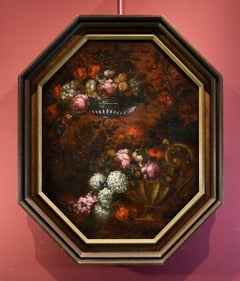
View AllStill-life Flower Paint Oil on canvas Old master 17th Century Lombard school
Located in Riva del Garda, IT
Francesca Volò Smiller, called Vincenzina (Milan, 1657 - 1700) - circle of
Floral composition
Oil on canvas (97 x 72 cm. - in octagonal frame 100 x 84 cm.)
A rich floral compositio...
Category
17th Century Old Masters Paintings
Materials
Oil
$5,553 Sale Price
20% Off
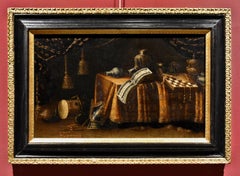
Still Life Vanitas Noletti Paint Oil on canvas Old master 17th Century Italian
Located in Riva del Garda, IT
Francesco Noletti known as the Maltese (Malta 1611-Rome 1654) Workshop/circle of
Still life with musical instruments, toys, armour, textiles and precious objects
Oil on canvas (52 x 78 cm. - in frame 71 x 102)
This painting, of beautiful scenic effect, depicts a still life composed of a rich display of precious objects, arranged with an apparent disorder, one part on a table and the other on the floor, all theatrically behind a hanging drape from which tassels swing.
Among the objects, our author has reproduced we can see parts of a parade armour with gold borders, jugs and plates...
Category
17th Century Old Masters Paintings
Materials
Oil
$9,501 Sale Price
20% Off
Still-Life Flower Landscape Castelli Paint Oil on canvas Old master Italian art
By Giovanni Paolo Castelli detto Spadino
Located in Riva del Garda, IT
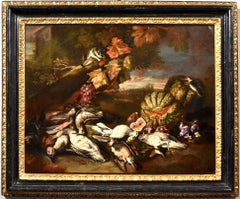
Still life in a landscape with fruit and game
Work of the late Roman Baroque of the late seventeenth / eaarly eighteenth century
attributable to Giovanni Paolo Castelli, known as Spadino (Rome, 1659 - 1730)
oil on canvas
62 x 76 cm., Framed 90 x 109 cm.
An open-air setting, with a hilly landscape gash that opens into the distance in the central part, surrounds our beautiful canvas, which showcases a rich selection of game and fruit, arranged in the foreground near the point of view of the observer, occupying a large part of the visual field with their bright and festive colors.
The style and quality of the work, like the pictorial technique of this still life, characterized by subtle luminous vibrations and a lively chroma, make it attributable to the Roman Giovanni Paolo Castelli, known as Lo Spadino (Rome, 1659 - 1730), one of the most important specialists of this pictorial genre of late Baroque Rome, which had a very successful career between the 17th and 18th centuries.
Analyzing the rich and heterogeneous catalog of the Roman master, in fact, our canvas can be included among his rare works which, alongside a selection of fruit - among which stand out large melons, ripe figs, dark grapes and plums - we see a game advert, presumably as requested by a patron who loves hunting. Next to various birds, spoils of a profitable hunting trip, there is also a small green woodpecker, with the characteristic red spot on the head, and a nice rodent that terminates from behind the trunk.
The painter abandons himself to a skilful and brilliant chromatic texture of the surfaces, through a pictorial material rendered with exceptional vibration in its luminous and 'tactile' body, fully respecting the taste of the full Roman Baroque.
The quality appears excellent, distinguished by a skilful and brilliant chromatic texture of the surfaces, which appear almost vibrant thanks to a skilful drafting of the pictorial material.
Inevitable and evident are the Flemish suggestions, which had influenced the Roman Baroque still life, in particular the work of Abraham Brueghel...
Category
Late 17th Century Old Masters Paintings
Materials
Oil
$13,389 Sale Price
30% Off
Flowers Still-life Scacciati 17th Century Paint Oil on canvas Old master (2/3)
Located in Riva del Garda, IT
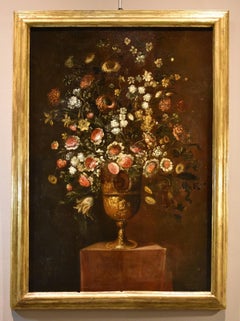
Andrea Scacciati (Florence 1642-1710)
Composition of flowers within embossed vase (2 of 3)
oil on canvas
130 x 90 cm
In antique frame 145 x 105 cm.
Work with expertise by Prof. Emi...
Category
17th Century Old Masters Paintings
Materials
Oil
$13,574 Sale Price
20% Off
Angels Flower Garzi Paint Oil on canvas Old master 17/18th Century Italian Art
By Luigi Garzi (Pistoia 1638– Rome1721)
Located in Riva del Garda, IT
Roman school of the early 18th century
Luigi Garzi (Pistoia 1638– Rome1721) attributed
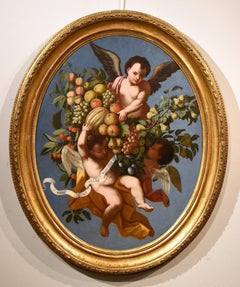
Still life of fruit supported by three angels
Oil on oval canvas
116 x 91 cm., Framed 140 x 119 cm.
Authentication on a photograph by Prof Giancarlo Sestieri, who attributes the work to the sphere of Luigi Garzi
This magnificent canvas, depicting a sumptuous composition of fruit supported by three prosperous winged cherubs, from which comes a parchment bearing the Latin expression "Amor est vitae essentia", is to be placed in the production of a Roman author active between the second half of XVII century and the first of the following century.
The iconography that sees represented cherubs with fruit or flowers is frequent in the Baroque period, especially in the Roman area, starting from the 1600s, with that particular depictional tendency aimed at illusionistic and frivolous images, to a type of paintings or frescoes of strong value decorative, intended for the private context and depicting jubilation of cherubs, angels or cherubs, and of which our canvas represents a perfect example.
We can recall, among the most illustrious iconographic precedents, the elegant mirrors painted by Mario Nuzzi and Carlo Maratta that adorn the hall of Palazzo Colonna in Rome, and again the canvas preserved in the Rouen museum and the similar ones in Palazzo Chigi in Ariccia, with the collaboration for the figurative parts of Filippo Lauri.
The commercial and furnishing success of similar works is also testified by authors such as Guglielmo Cortese known as Borgognone (1628 - 1679), Franz Werner Von Tamm (1658 - 1724), Giovan Battista Gaulli (1639 - 1709), Giovanni Paolo Castelli known as Spadino (Rome 1650 - 1740) and the aforementioned Carlo Maratta (1625 - 1713)
The work, studied by Giancarlo Sestieri, was brought closer to the sphere of the eclectic Pistoian painter Luigi Garzi, one of the protagonists of Roman painting in the decades of transition between the seventeenth and eighteenth centuries. In our painting we can find the typical elements of his painting: the soft and delicately chiaroscuro light, the sculptural classicism of the figures as well as the stupendous luministic and chromatic effects.
Luigi Garzi's training and artistic activity took place in the Eternal City and he was in effect a Roman artist. He moved to Rome from Pistoia, his hometown at a very young age, and joined the atelier of Andrea Sacchi, who directed his studies towards classicism, comparing himself with the works of Raphael, Domenichino and Nicolas Poussin, but also with the Emilian one. , with particular attention to the school of Guido Reni.
But the Emilian examples were undoubtedly preceded, particularly by Giovani Lanfranco, who modeled his taste and style, together with a modulated cortonism, while those pre-eighteenth-century sensibilities are due to the lesson of Carlo Maratta.
However, there is no doubt that the painter oriented his personality without ever bowing to imitation, reaching a refined elegance and autonomy of language, as the canvas in question clearly demonstrates in which the different influences find a refined amalgamation in perfect harmony with the baroque evolution between the seventeenth and eighteenth centuries, indicating a dating to its earliest maturity.
These attitudes led the painter to obtain awards and prestigious commissions as soon as possible, such as the frescoes of Palazzo Borghese...
Category
Late 17th Century Old Masters Paintings
Materials
Oil
$14,808 Sale Price
20% Off
De Wit Flowers Still life Paint Oil on canvas 18th Century Flemish Cupids Art
Located in Riva del Garda, IT
Jacob De Wit (Amsterdam, 1695 - 1754) attributable/ workshop
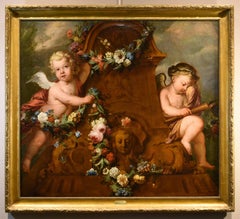
Pair of Cupids with Garland of Flowers
Oil on canvas
91 x 103 cm. - Framed 104 x 115 cm.
Provenance: Christie's (London, Old master Painting 12.12.1996) lot 82
This magnificent composition depicts two cupids holding a garland of flowers, placed on a fine architecture with bas-reliefs and masks, presumably the top of a fountain.
One of the two cupids sympathetically holds a part of it with his hands, while his head turns towards the viewer; the second cupid, on the other hand, must have clumsily broken the thread holding its end, and is sitting sullenly with a torch and a tear streaking his chubby cheek.
The work, given its stylistic features and compositional taste, can be attributed to the Flemish artist Jacob de Wit (Amsterdam, 1695 - 1754), or to an artist from his workshop, with his typical triumphal and opulent style, which reveals clear influences from Rubens and Van Dijck, but also from Gerard de Lairesse...
Category
18th Century Old Masters Paintings
Materials
Oil
$14,808 Sale Price
20% Off
Still Thinking About These?
All Recently ViewedMore Ways To Browse
Old Master Flower Painting
Mario Nuzzi
Painting Verona Italy
Provence Landscape Painting
Vintage Forest Painting
Latvia Painting
Blue Wave Art
Portrait In Blue
Small Dutch Still Life Painting
Wyeth Andrew
Canvas Landscape Paintings By Hunter
Oil Painting Of Girl
Oil Paintings Shadows
Painting Of Skiers
Watercolor New York
Michael Brown Painting
Old Master Flemish
St Louis Mo