Items Similar to The Entombment of Christ
Want more images or videos?
Request additional images or videos from the seller
1 of 5
15th century Italian schoolThe Entombment of Christ
$13,918.91
£10,000
€11,769.30
CA$19,103.01
A$20,184.03
CHF 10,856.65
MX$241,671.25
NOK 136,021.16
SEK 124,575.64
DKK 87,884
About the Item
15th Century Italian School
The Entombment of Christ
15th century
Oil on panel
Image size: 18 x 19 3/4 inches (45.7 x 50.2 cm)
Carved and punched gilt wood frame
Provenance:
The Estate of Dr J Clayton Davie

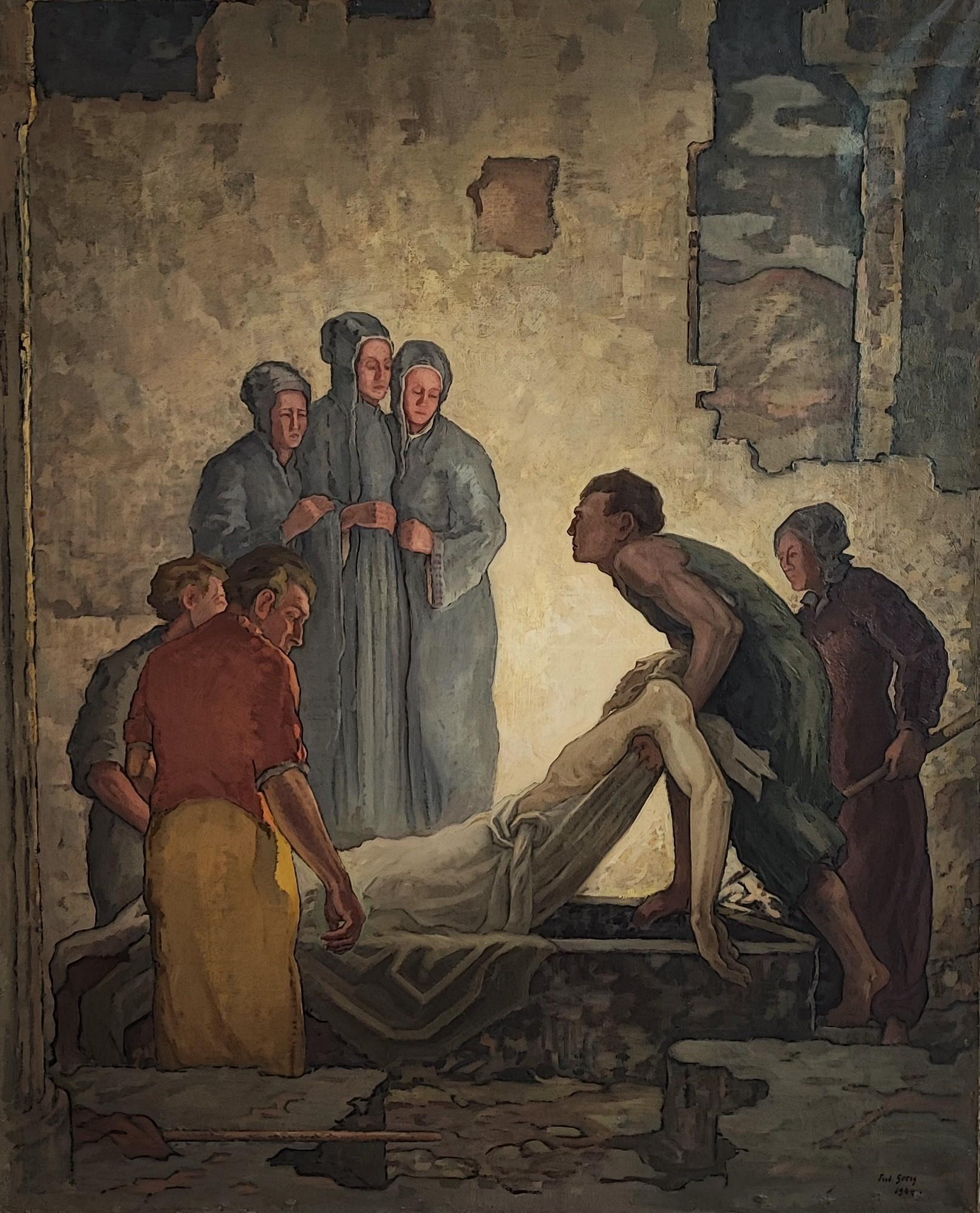
The Entombment of Christ was one of the most important scenes in Italian religious art, characterised by its distinct pictorial language and its focus on the emotions of those involved. As is common in other, similar paintings of the time, this particular Entombment scene takes place outside, with a walled city and two mountains visible in the background. The figures supporting the inert body of Christ are those most strongly associated with the Entombment: Mary Magdalene holds part of the shroud close to Jesus’ head, her other hand pressed closely to her heart; Mary of Bethany stands beside her, her gaze directly addressing a viewer and involving them in the scene; John the Evangelist, the beloved disciple, seems unable to tear his gaze away from the pitiful scene in front of him as he helps lower Jesus’ body into the sarcophagus; the Virgin Mary cradles her son with both arms, reluctant to let go of him, pressing one of his hands to her mouth in a kiss; Joseph of Arimathea stands in the foreground of the painting, clad in his expensive garments, gently supporting Jesus’ body near his wound from the Holy Lance; Nicodemus, despite his age, kneels down to carefully lower Jesus’ bloodied feet into his tomb.
Unlike some scenes of the Entombment, which depict the figures in moments of extreme emotion, the Master of this painting has imbued his work with a considerably more sombre air. The care with which Nicodemus and Joseph of Arimathea handle Jesus’ body portray their respect for him, whilst John the Evangelist’s inability to look away from the body indicates his horror at what is in front of him. The Virgin Mary’s reaction, unusually subtle, is perhaps the most heartbreaking - one last kiss for her son, stolen at too young of an age in a truly barbaric manner. This gesture reminds the viewer - both modern, and contemporary to the painting - that Jesus was human and was not only the son of God, but the son of a young woman called Mary. Whilst this haunting scene takes place, Mary of Bethany meets the gaze of the viewer, involving them directly in the narrative and appealing to their piety and devotion.
The composition and technique of the painting is also outstanding. The tomb, angled towards the viewer and containing a gaping black hole, is foreshortened to display its receding perspective. The shroud and Jesus’ limp hand cast shadows on the otherwise shiny stone surface, with the Master of this scene depicting areas of illumination in a brilliant white. The gore of Jesus’ wounds is disturbingly realistic, emphasising the pathos of the scene. The gilded haloes of the figures in the scene are beautiful and delicate, suggesting an artist who was skilled at mordant gilding. The gold haloes mirror the gold of Joseph of Arimathea’s cloak, a garment that displays the figure’s wealth. Despite its lavishness, the artist has ensured that it does not overshadow the scene by matching the colour of the garment to the sarcophagus and the clothes of Nicodemus. The yellow sleeve of Nicodemus’ tunic - with magnificent folds around the elbow - provides a visual buffer to the gold of Joseph of Arimathea’s cloak. Through these careful choices, the Master of this work has ensured that the scene retains its sombreness and sense of piety, whilst also remaining aesthetically pleasing.
- Creator:15th century Italian school (1400 - 1499, Italian)
- Dimensions:Height: 18 in (45.72 cm)Width: 19.75 in (50.17 cm)
- Medium:
- Period:
- Condition:
- Gallery Location:London, GB
- Reference Number:1stDibs: LU52417445312
About the Seller
5.0
Gold Seller
Premium sellers maintaining a 4.3+ rating and 24-hour response times
Established in 2007
1stDibs seller since 2014
87 sales on 1stDibs
Typical response time: 2 hours
- ShippingRetrieving quote...Shipping from: London, United Kingdom
- Return Policy
More From This Seller
View AllThe Lamentation of Christ, 16th Century Oil Old Master
Located in London, GB
Circle of Ridolfo Ghirlandaio
1483 - 1561
Oil on panel
Image size: 20 ½ x 16 ½ inches (52 x 42 cm)
Handmade contemporary style gilt frame
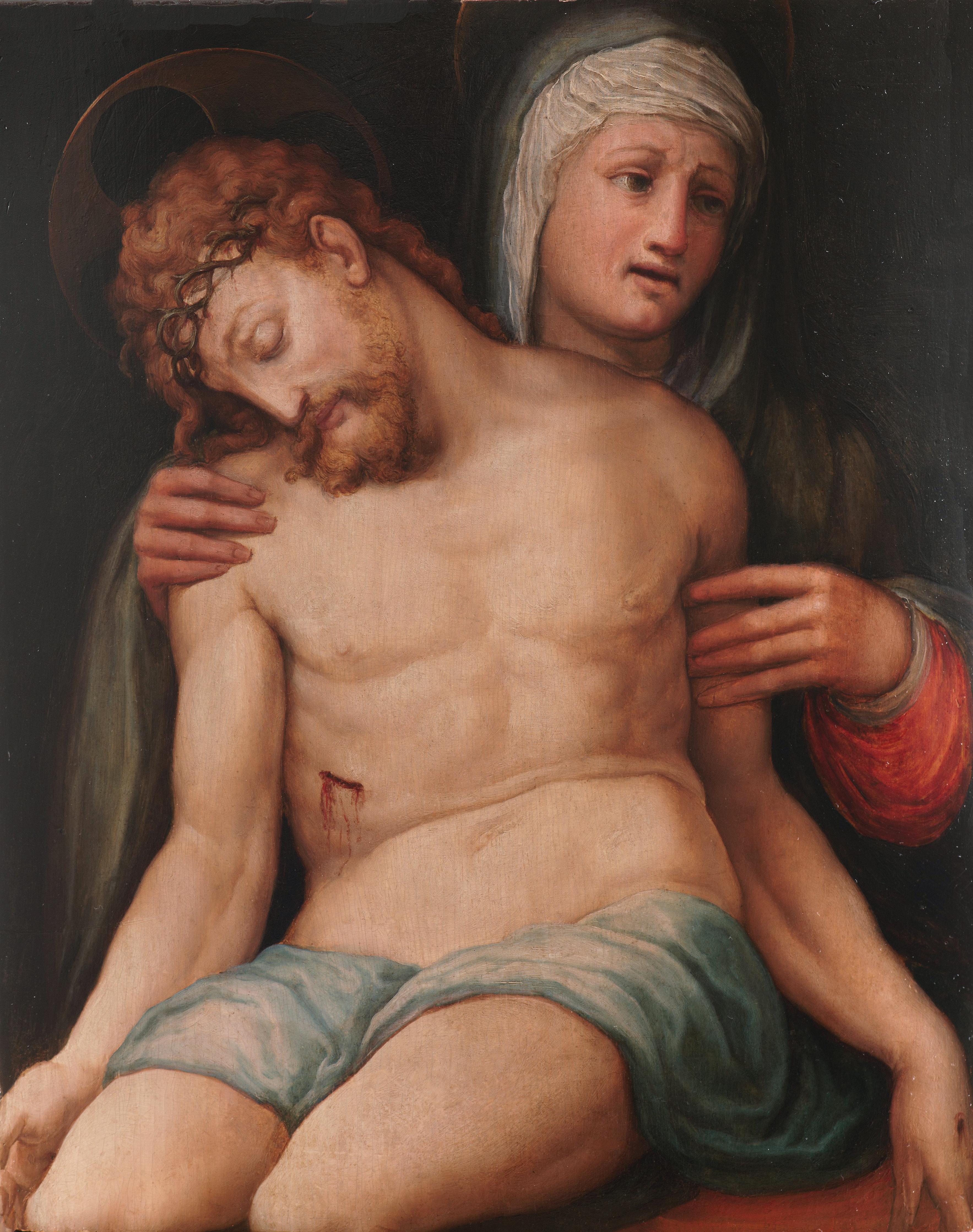
The lamentation of Christ was one of the most popular scenes depicted in European art from the 11th to the 18th century. Depicting the lamentation or pieta from the Italian word for ‘Pity’ of Christ with Jesus’s mother Mary cradling his body.
Christ is depicted nude, wearing only a blueish loincloth around his waist, a horizontal scar marking his rib cage. His head and torso are held upright, and his eyes are closed, his right arm lays to his side as does his left. Standing behind him, is the Virgin Mary, outfitted in her traditional dress of a robe with a white veil. She stands behind Christ and bends slightly, looking looking away from Christ to something that has caught her attention, her right hand holding his shoulder. Her left-hand carefully holds his arm.
This work is quite unusual with Mary . This stunning work jumps out with its dark background and strong flesh colours.
Ridolfo Ghirlandaio was the son of the eminent painter Domenico Ghirlandaio. Following his father’s death in 1494, when he was just eleven years old, Ridolfo is thought to have continued his training with his uncle Davide, who had taken over the Ghirlandaio workshop. Vasari noted that Ridolfo also studied with Fra Bartolommeo...
Category
16th Century Old Masters Figurative Paintings
Materials
Oil
Saint Sebastian, 15th Century Religious Oil Painting on Panel
Located in London, GB
Oil on panel
Image size: 16 x 13 1/4 inches (41 x 34 cm)
Early gilt frame
Saint Sebastian was a Roman centurion who converted to Christianity and, in punishment, the Roman Emperor D...
Category
15th Century and Earlier Italian School Figurative Paintings
Materials
Oil, Panel
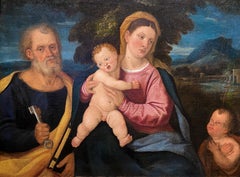
The Holy Family, 16th Century Venetian School, Oil on Canvas, Hand Carved Frame
Located in London, GB
Oil on canvas
Image size: 26 x 37 inches (66 x 94 cm)
Period hand carved gilt frame
The pictorial arrangement of the Holy Family, with various saints in a landscape, was very popular in sixteenth-century Venice, following the prototype of Giovanni Bellini. Possibly intended for private devotion, this picture is a representative example of the compositional type known as the sacra conversazione...
Category
16th Century Figurative Paintings
Materials
Canvas, Oil
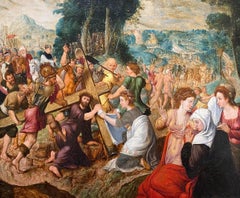
The Road to Calvary, Oil on Oak Panel, 16th Century Painting
Located in London, GB
Oil on oak panel
Image size: 20 1/2 x 23 1/2 inches (52 x 60 cm)
Hand made frame
Herri Met de Bles, also known as Henri Blès, Herri de Dinant and Herry de ...
Category
16th Century Figurative Paintings
Materials
Oak, Oil
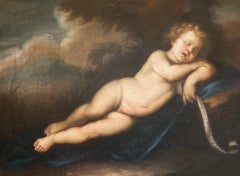
I Sleep but my Heart Waketh
, 18th Century Italian School
Located in London, GB
Oil on canvas
Image size: 12 3/4 x 9 1/2 inches (32.5 x 24.25 cm)
Here, we see a sleeping putti lying underneath a set of trees, holding a ribbon. The text that can be seen on the scroll is from the Song of Solomon, chapter five, verse two; ' I sleep, but my heart waketh: it is the voice of my beloved that knocketh, saying, Open to me, my sister, my love, my dove, my undefiled: for my head is filled with dew, and my locks with the drops of the night'.
This work was created after a well-known painting by the Spanish artist Alonso Cano...
Category
18th Century Figurative Paintings
Materials
Canvas, Oil
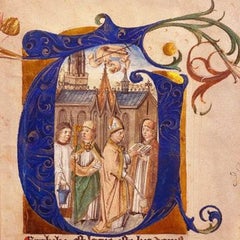
Consecration of a Church 15th Century English School Illuminated Manuscript
Located in London, GB
English School
15th Century
The Consecration of a Church
Illuminated manuscript on Vellum
Image size: 5 ½ x 5 inches (14 x 12.7 cm)
18th century ornate Tabernacle frame
Category
15th Century and Earlier Figurative Drawings and Watercolors
Materials
Ink, Vellum
You May Also Like
The Resurrection of Christ
Located in New York, NY
Provenance:
with “Mr. Scheer,” Vienna, by July 1918; where acquired by:
Jindřich Waldes, Prague, 1918–1941; thence by descent to:
Private Collection, New York
Literature:
Rudolf Kuchynka, “České obrazy tabulové ve Waldesově obrazárně,” Památky archeologické, vol. 31 (1919), pp. 62-64, fig. 5.
Jaroslav Pešina, “K datování deskových obrazů ve Waldesově obrazárně,” Ročenka Kruhu pro Pěstování Dějin Umění: za rok (1934), pp. 131-137.
Jaroslav Pešina, Pozdně gotické deskové malířství v Čechách, Prague, 1940, pp. 150-151, 220.
Patrik Šimon, Jindřich Waldes: sběratel umění, Prague, 2001, pp. 166, 168, footnote 190.
Ivo Hlobil, “Tři gotické obrazy ze sbírky Jindřicha Waldese,” Umění, vol. 52, no. 4 (2004), p. 369.
Executed sometime in the 1380s or 1390s by a close associate of the Master of the
Třeboň Altarpiece, this impressive panel is a rare work created at the royal court in Prague and a significant re-discovery for the corpus of early Bohemian painting. It has emerged from an American collection, descendants of the celebrated Czech industrialist and collector Jindřich Waldes, who died in Havana fleeing Nazi-occupied Europe.
The distinctive visual tradition of the Bohemian school first began to take shape in the middle of the fourteenth century after Charles IV—King of Bohemia and later Holy Roman Emperor—established Prague as a major artistic center. The influx of foreign artists and the importation of significant works of art from across Europe had a profound influence on the development of a local pictorial style. Early Italian paintings, especially those by Sienese painters and Tommaso da Modena (who worked at Charles IV’s court), had a considerable impact on the first generation of Bohemian painters. Although this influence is still felt in the brilliant gold ground and the delicate tooling of the present work, the author of this painting appears to be responding more to the paintings of his predecessors in Prague than to foreign influences.
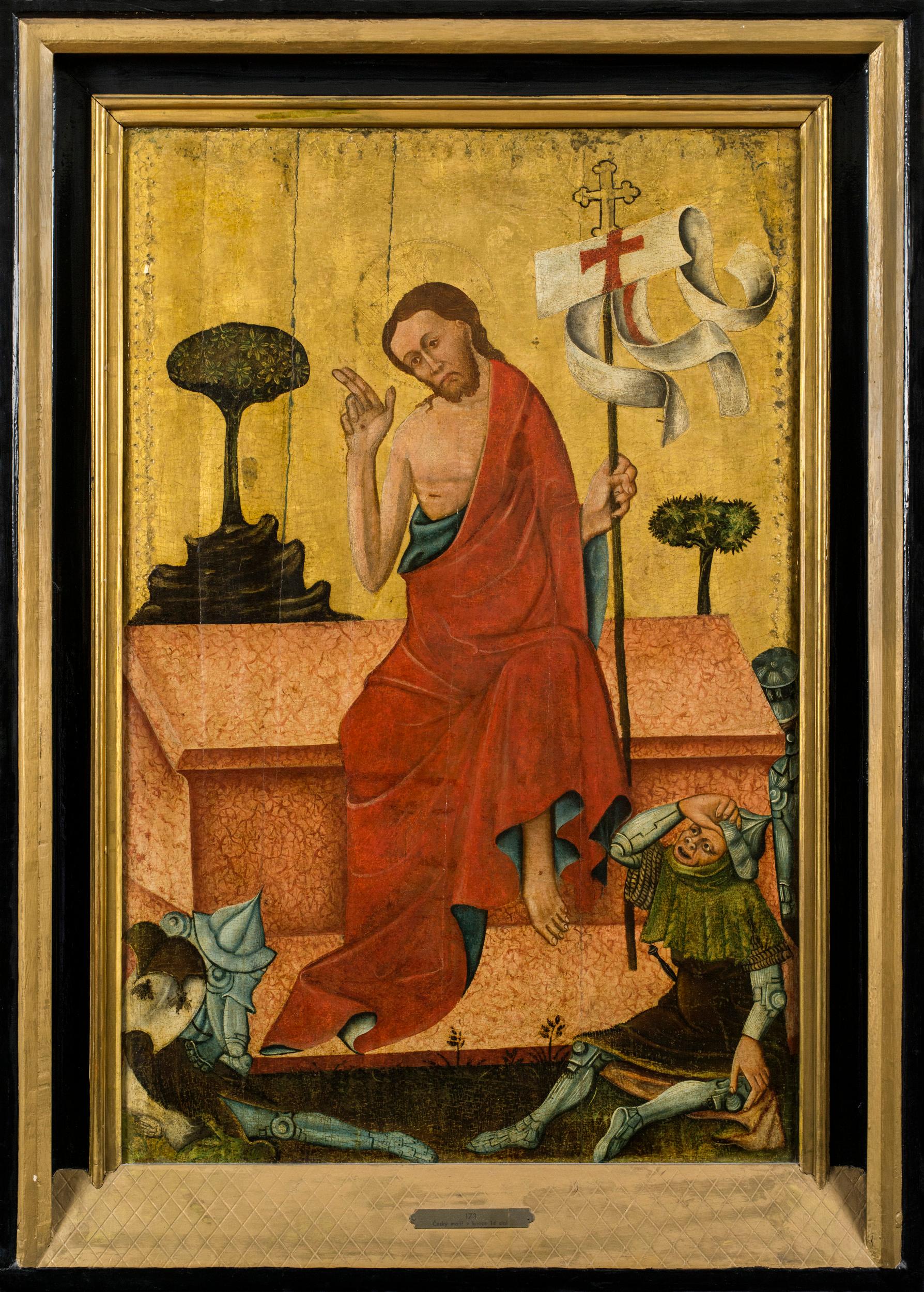
This Resurrection of Christ employs a compositional format that was popular throughout the late medieval period but was particularly pervasive in Bohemian painting. Christ is shown sitting atop a pink marble sarcophagus, stepping down onto the ground with one bare foot. He blesses the viewer with his right hand, while in his left he holds a triumphal cross with a fluttering banner, symbolizing his victory over death. Several Roman soldiers doze at the base of the tomb, except for one grotesque figure, who, beginning to wake, shields his eyes from the light and looks on with a face of bewilderment as Christ emerges from his tomb. Christ is wrapped in a striking red robe with a blue interior lining, the colors of which vary subtly in the changing light. He stands out prominently against the gold backdrop, which is interrupted only by the abstractly rendered landscape and trees on either side of him.
The soldiers’ armor is rendered in exacting detail, the cool gray of the metal contrasting with the earth tones of the outer garments. The sleeping soldier set within a jumble of armor with neither face nor hands exposed, is covered with what appears to be a shield emblazoned with two flies on a white field, somewhat resembling a cartouche (Fig. 1). This may be a heraldic device of the altarpiece’s patron or it may signify evil, referencing either the Roman soldiers or death, over both of which Christ triumphs.
This painting formed part of the collection assembled by the Czech industrialist and founder of the Waldes Koh-i-noor Company, Jindřich Waldes, in the early twentieth century. As a collector he is best remembered for establishing the Waldes Museum in Prague to house his collection of buttons (totaling nearly 70,000 items), as well as for being the primary patron of the modernist painter František Kupka. Waldes was also an avid collector of older art, and he approached his collecting activity with the goal of creating an encyclopedic collection of Czech art from the medieval period through to the then-present day. At the conclusion of two decades of collecting, his inventory counted 2331 paintings and drawings, 4764 prints, and 162 sculptures. This collection, which constituted the Waldesova Obrazárna (Waldes Picture Gallery), was first displayed in Waldes’ home in Prague at 44 Americká Street and later at his newly built Villa Marie at 12 Koperníkova Street. This Resurrection of Christ retains its frame from the Waldes Picture Gallery, including its original plaque “173 / Česky malíř z konce 14 stol.” (“Czech painter from the end of the 14th century”) and Waldes’ collection label on the reverse.
The Resurrection of Christ was one of the most significant late medieval panel...
Category
15th Century and Earlier Old Masters Paintings
Materials
Tempera, Panel
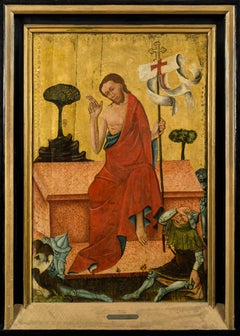
17th Century Oil on Canvas Italian Painting Lamentation over the Dead Christ
Located in Vicoforte, IT
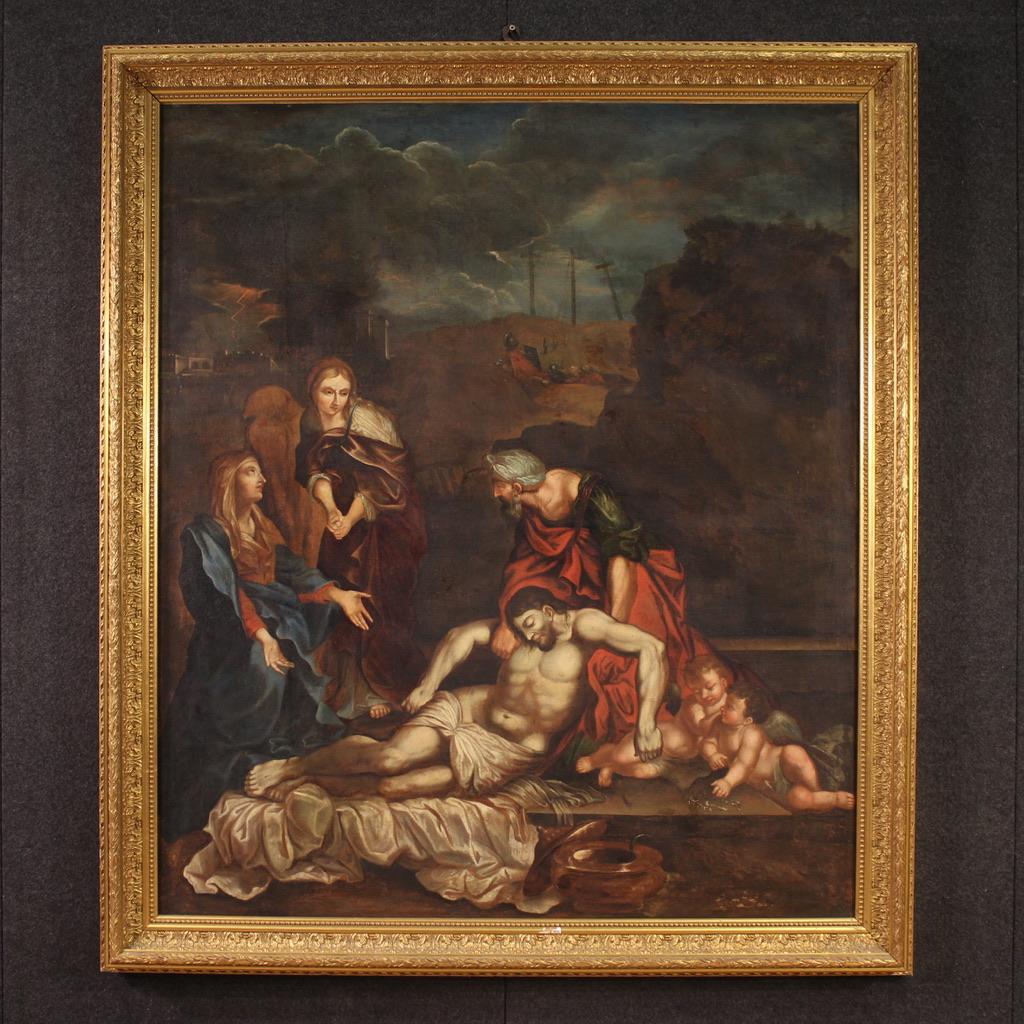
A great 17th-century religious painting. This painting oil on canvas depicts a poignant subject, highly popular in the Baroque era: The Lamentation over the Dead Christ. This intense...
Category
1660s Figurative Paintings
Materials
Canvas, Oil
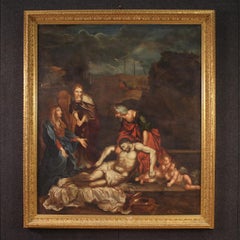
Italian Early 17th Century Renaissance Baroque Oil Painting Entombment of Christ
Located in Portland, OR
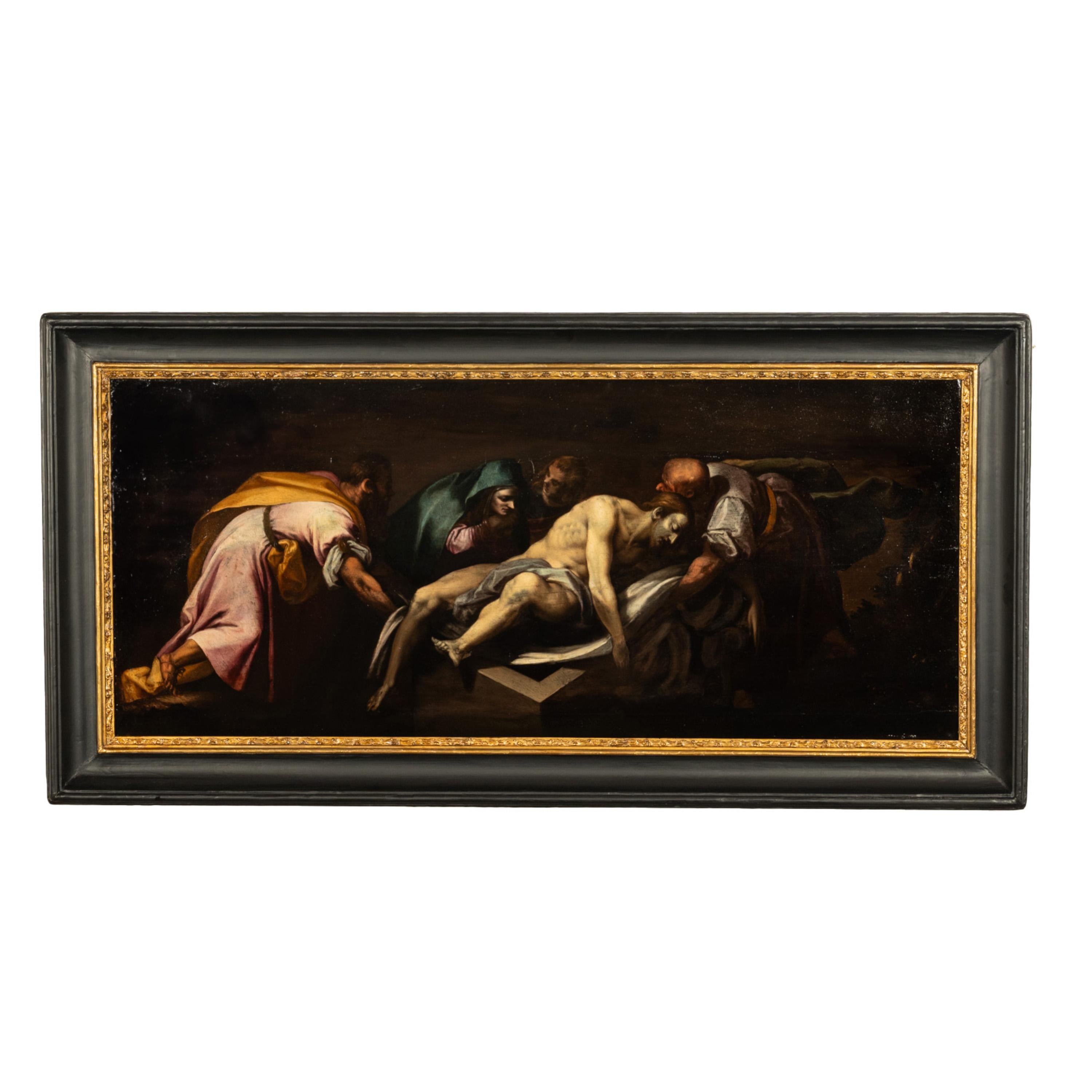
An important & large Italian Baroque period oil painting on panel attributed to Daniele Crespi (1598-1630), "The Entombment of Christ", Milan circa 1620. See artist biography below.
...
Category
1620s Baroque Paintings
Materials
Oil, Panel
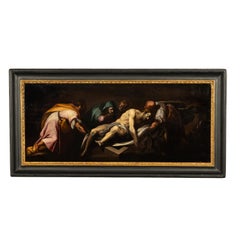
16th Century by Venetian Maestro Deposition of Christ Oil on Panel
Located in Milano, Lombardia
16th Century Venetian Maestro
Title: Deposition of Christ
Medium: Oil on panel
Dimensions: without frame 40 x 25 cm
Painting without frame
Not signed
Previously part of the Canesso Collection, Paris.
Fairs: The International Biennial of Antiques in Florence 2022 (BIAF, Biennale Internazionale dell’Antiquariato di Firenze)
Publications: Bozzetti, modelletti, sketches: dalla collezione di Giorgio Baratti (From the Giorgio Baratti Collection) curated by Anna Orlando, Agnese Marengo and Annalisa Scarpa, Genoa, 2022, pp. 22, 23.
In this precious panel we can admire a lament over the body of Christ by a large group of bystanders among whom we can recognise the Virgin and, in the foreground, St Catherine of Alexandria...
Category
16th Century Old Masters Figurative Paintings
Materials
Oil, Wood Panel
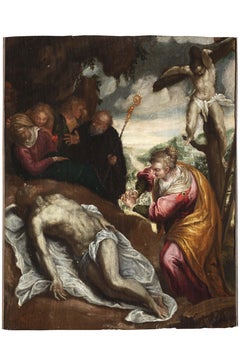
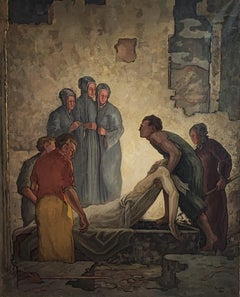
The Entombment of Christ
Located in Genève, GE
Work on canvas
Category
1940s Landscape Paintings
Materials
Oil
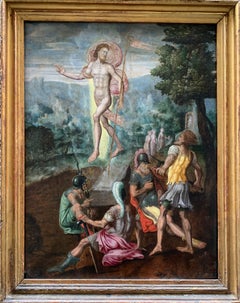
Resurrection of Christ. Study of the Master of the Prodigal Son. Ca. 1550.
Located in Firenze, IT
Resurrection of Christ
Attributed to the Master of the Prodigal Son / Jan Mandyn (1500-1560)
Oil on panel, 73 x 56 cm (without frame), 81 x 63 cm (with frame)
The work was exa...
Category
16th Century Mannerist Landscape Paintings
Materials
Oil, Wood Panel, Board
$9,068 Sale Price
20% Off