Items Similar to Study for "The coronation of Tasso"
Want more images or videos?
Request additional images or videos from the seller
1 of 8
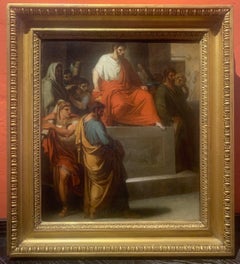
Alexandre MENJAUDStudy for "The coronation of Tasso"Circa 1819
Circa 1819
$6,558.96
£4,883.31
€5,500
CA$9,065.29
A$9,638.27
CHF 5,212.09
MX$114,650.20
NOK 65,288.80
SEK 59,628.10
DKK 41,908.63
About the Item
Alexandre Toussaint MENJAUD
(Paris, 1768 – Paris, 1832)
Study for The coronation of Tasso
Oil on paper mounted on canvas
37.5 x 29.5 cm
Around 1819
Related work: Painting exhibited at the Paris Salon of 1819 under number 819
The scene represents the death of Tasso (1544-1595) at the convent of Saint-Onuphre, the same day on which the famous author of Jerusalem delivered was to be crowned at the Capitol.
The definitive version of this painting was exhibited at the Salon of 1819, n°819, with the following description:
Tasso died in Rome, in the convent of Saint-Onuphre, while preparations for his coronation were being made in the Capitol. The pope had welcomed him a few days having with the greatest destination and had addressed him these memorable words announcing his triumph: You will honor this laurel, which, until now, has honored those who received it. Deeply affected by the loss of this great poet, he instructed Cardinal Cinthio to carry him, on his funeral bed, the crown that he was to receive at the Capitol.
The life of Tasso, a famous poet whose most famous work is Jerusalem delivered, aroused much interest among artists at the beginning of the 19th century. It was the dramatic dimension of Tasso's life that interested the Romantics. For them he embodied the misunderstood artist, the genius persecuted by the mediocre and unjustly accused of madness. Lord Byron's poem The Lament of Tasso dates from 1817, Goethe's play Torquato Tasso was translated into French in 1823. In 1819, Ducis exhibited The death of Tasso at the convent of Saint-Onuphre. The Lyon painter Fleury-Richard presented a Montaigne visiting Tasso in the hospital at the salon of 1822 (Musée des Beaux-Arts de Lyon). Eugène Delacroix painted two paintings on the subject of Tasso in the madhouse, one exhibited at the salon of 1824 (private collection), the other dated 1839 (Oskar Reinhart collection, Winterthur). It is also the 1839 version which inspired Baudelaire's poem The Poet in the dungeon... published in 1844.
Alexandre Toussaint Menjaud was born on November 24, 1768, in Paris. He is the fruit of the union between Jean Menjaud (1745-after 1796), advisor to the king, lawyer in Parliament, notary at the Châtelet de Paris from 1770 to 1787, judge of peace in 1791 and 1792, and Madeleine Dupré (1753- after 1792). His half-brother was Jean Adolphe Menjaud (1795-1864), actor at the Comédie-Française.
Alexandre was a student of Baron Regnault at the Academy of Fine Arts in Paris. He exhibited at the Salon from 1796 until 1834 (posthumous exhibition). Received the first Grand Prix de Rome in 1802 with Éponine and Sabinus ahead of Vespasien, he was also a medalist on two other occasions in 1806 and 1819. The artist died on September 6, 1832, in Paris and was buried in the Montparnasse cemetery.
Museums: Bordeaux, Draguignan, Bayeux, Saint-Germain, Chambord, La Fère, Versailles, Lavaur, Pau, Fontainebleau, Marseille, Montargis…
- Creator:Alexandre MENJAUD (1768 - 1832, French)
- Creation Year:Circa 1819
- Dimensions:Height: 14.97 in (38 cm)Width: 11.82 in (30 cm)
- Medium:
- Movement Style:
- Period:
- Condition:
- Gallery Location:Paris, FR
- Reference Number:1stDibs: LU1954214039822
About the Seller
No Reviews Yet
Vetted Professional Seller
Every seller passes strict standards for authenticity and reliability
Established in 2014
1stDibs seller since 2022
13 sales on 1stDibs
- ShippingRetrieving quote...Shipping from: Paris, France
- Return Policy
More From This Seller
View AllThe adoration of the shepherds
Located in Paris, IDF
Félix COTTRAU
(Paris, 1799 - Paris, 1852)
The adoration of the shepherds
Oil on canvas
Signed and dated lower right
100.5 x 76 cm
1842
Exhibition: Paris Salon of 1842 under number...
Category
Mid-19th Century French School Figurative Paintings
Materials
Oil

Allegory of Geography
Located in Paris, IDF
Marc Joseph Octave Théodule BOISSIN
(Bénévent-l’Abbaye, 1839 - Paris, 1891)
Allegory of Geography
Oil on canvas
Signed lower right
75 x 125 cm without frame
100 x 150 cm with frame...
Category
Late 19th Century French School Still-life Paintings
Materials
Oil
Meditation
By Leon Lhermitte
Located in Paris, IDF
Circle of Léon Lhermitte (1844-1925)
Meditation
Oil on canvas
32 x 24 cm
This painting depicts an old man seated on a chair, his hands clasped in his lap, his gaze lowered, pensiv...
Category
Late 19th Century French School Figurative Paintings
Materials
Oil
$2,146
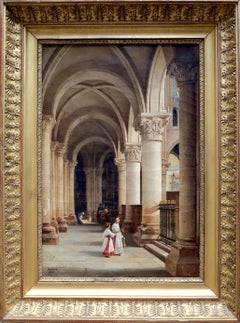
View of one of the aisles of the apse of Saint-Germain-des-Prés, Paris, France
Located in Paris, IDF
Alexis Pierre MILON
(Rouen, 1784 - After 1858)
View of one of the aisles of the apse of Saint-Germain-des-Prés
Oil on canvas
Signed and dated lower left
50.5 x 34.5 cm
1838
Exhibi...
Category
Mid-19th Century French School Interior Paintings
Materials
Oil
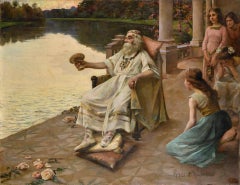
The cup of the king of Thule
Located in Paris, IDF
Camille METRA or METRA-HUBBARD
(Paris, 1864 – Paris, 1936)
The cup of the King of Thule
Oil on canvas
Signed lower right and dated
113.5 x 146 cm
1896
Exhibition: Salon de l'Union des Femmes Peintres et Sculpteurs de 1896 (N°627)
Camille Métra, eldest daughter of the chemist Louis Métra and Rosalie Merny, was born on November 28, 1864 in Paris. We know nothing to this day of her artistic training, however she was recognized in Parisian circles for her qualities as a figure painter and pastellist. Camille married for the first time on January 18, 1887 in Paris with Adolphe Fernand Blayn...
Category
Late 19th Century French School Figurative Paintings
Materials
Oil
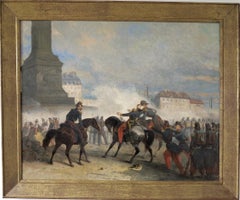
The death of General Négrier on Place de la Bastille, Paris - France
By Nicolas Edward Gabé
Located in Paris, IDF
Nicolas Edward GABE
(Paris, 1814 - Paris, 1865)
The death of General Négrier on Place de la Bastille on June 25, 1848
Oil on canvas
Signed and dated lower right
82 x 101 cm
1849
Nicolas Edward Gabé is a 19th century artist who is still little studied to this day and yet seems to have enjoyed, according to the artistic press of the time, a certain notoriety, in particular for his seascapes.
The few bibliographical elements that we have come from the Salon booklets and tell us that the artist was born in Paris in 1814, therefore shortly before the end of the Empire.
No elements on his artistic training are mentioned in the booklets, we just know that Gabé exhibited at the Paris Salon from 1835 to 1864 where he first practiced miniature then then approached easel painting, risking himself as well in still life that the seascapes, the landscape, the portrait or the hunting.
According to press articles, he also took part in various exhibitions in the provinces such as Boulogne-sur-Mer and Marseille.
Notably, Gabé did not exhibit at the Salon his large historical canvases on the revolution of 1848, which today are of obvious documentary and iconographic interest; probably for political reasons which are easily understandable to us today in view of the historical events of then.
Gabé died in Paris at the age of 51 on January 4, 1865 with a mention in the January 7, 1865 edition of L'Union des Arts: “The death of Mr. Gabé, painter, well known in the export trade in paintings as well as to the auctioneers' hotel, whose sales it supplied through its numerous navies. “
"On June 25, 1848, in front of the barricades erected in the Bastille by the insurgents of the Red Republic, General Négrier fell to death, while he was uttering words of order and conciliation". Here are the opening lines of the tribute paid by Colonel Borgarelli d´Ison, friend of General Négrier.
General Négrier belonged to a family from Maine, brought back by Marshal Lannes from emigration. Born in Le Mans on April 27, 1788, François Marie Casimir de Négrier entered, barely 18, as a volunteer in the 2nd Light Infantry Regiment. He began in 1806 with the campaigns of Prussia and Poland, during which he earned, through his bravery, the rank of sergeant and the decoration of the Legion of Honor. He made the following campaigns in Spain and Portugal, and left, with his regiment, only for the campaign of France, in 1814, after having risen successively, by actions of brilliance and by a serious wound, to the ranks of head of battalion and officer of the Legion of Honor, with which he was provided from October 1813. The Restoration retained his rank in his regiment. After having fought and wounded a second time seriously in Waterloo, Négrier was recalled in 1816 under the second Restoration. He was appointed, in 1825, lieutenant-colonel, then colonel in 1830, brigadier general in 1836, and of division in 1841. From March 1837 he participated in the conquest of Algeria.
The Revolution of 1848 found Negrier in possession of the important command of the 16th Military Division in Lille. Quaestor of the Assembly in these times which promised to be troubled, Négrier reviewed the Place de la Concorde on June 23 at around noon various mobile guard battalions. He then took the head of 2,000 men provided by the 10th and 11th legions of the national guard and bivouacked on the Place du Palais until the next day 24. On Sunday 25 at nine o'clock, the Négrier division resumed the fight towards the Saint suburb. -Antoine. The troop gains continual advantages. At around two o'clock the column of Négrier had seized the Pont Marie: it had removed the barricades from the Quai Saint-Paul, the rue de l'Etoile, the rue des Barres...
Category
Mid-19th Century French School Figurative Paintings
Materials
Oil
You May Also Like
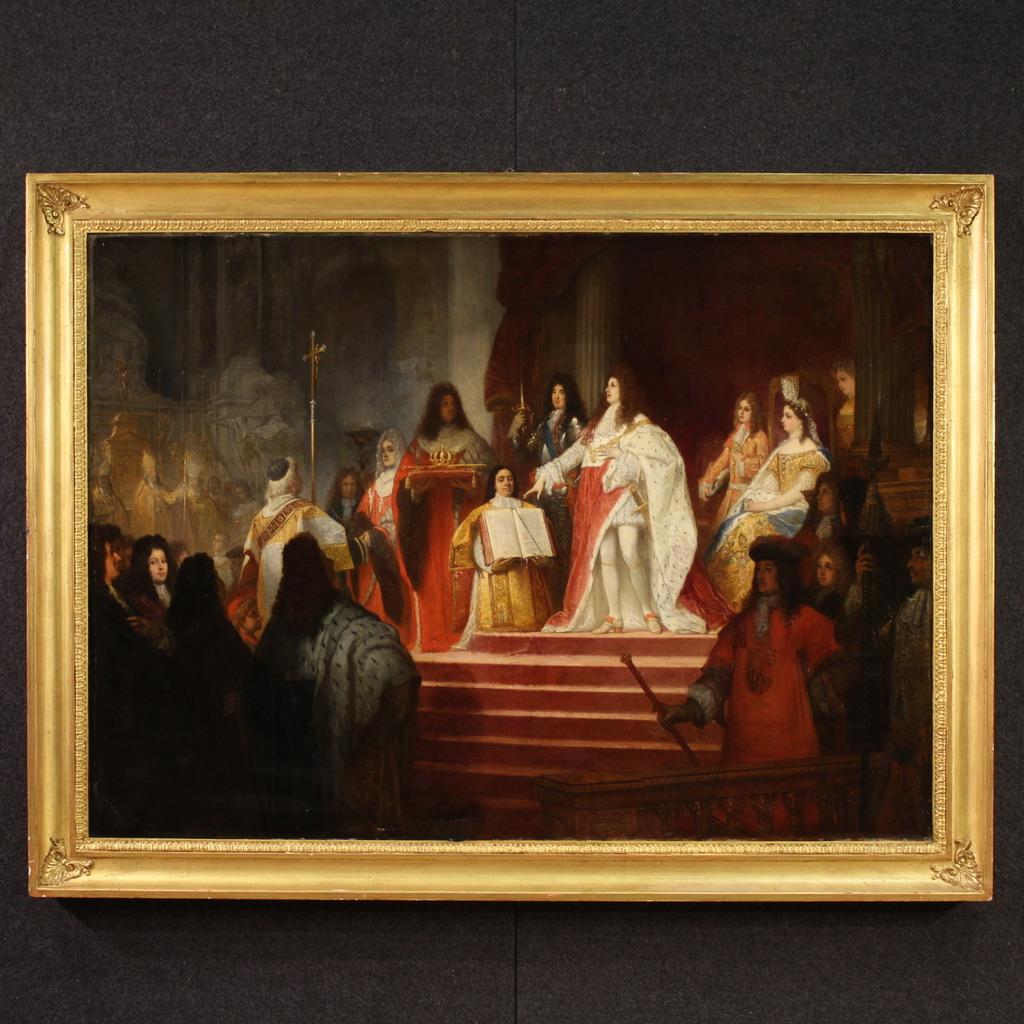
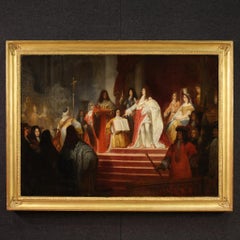
19th Century Oil on Canvas Painting Coronation of Victor Amadeus II, 1866
Located in Vicoforte, IT
A splendid painting dated 1866 and signed Ed. Hamman, attributed to the great Belgian painter Edouard Jean Conrad Hamman (1819-1888). Specializing in historical scenes, with a partic...
Category
1860s Figurative Paintings
Materials
Canvas, Oil
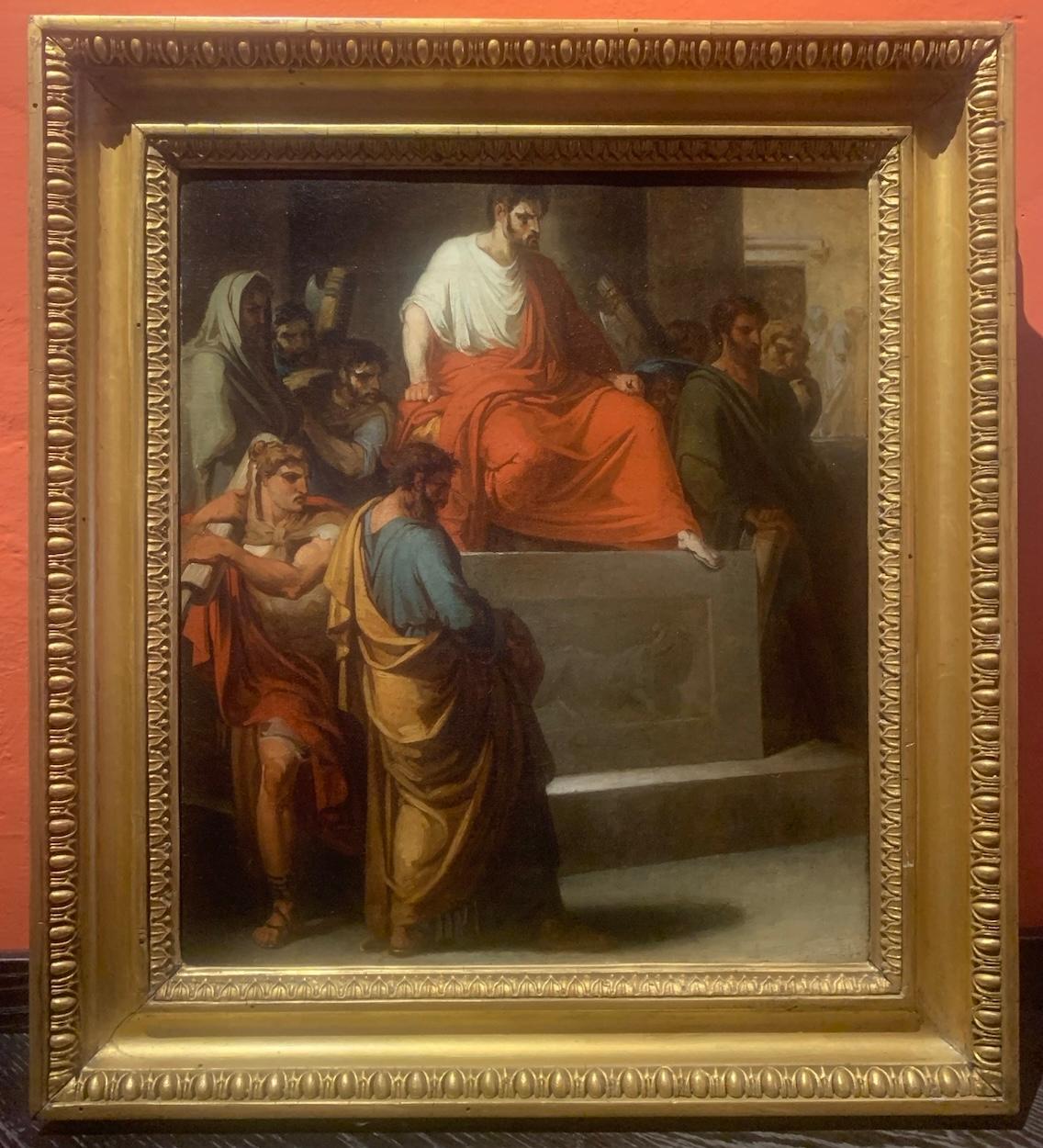
Dipinto neoclassico figurativo storico italiano del XIX secolo
By Vincenzo Camuccini
Located in Florence, IT
Il dipinto è uno studio piuttosto elaborato e finito della figura del decemviro Appio Claudio, e del suo entourage con i littori, che primeggia nella parte sinistra della monumentale...
Category
Early 1800s Other Art Style Figurative Paintings
Materials
Canvas, Oil
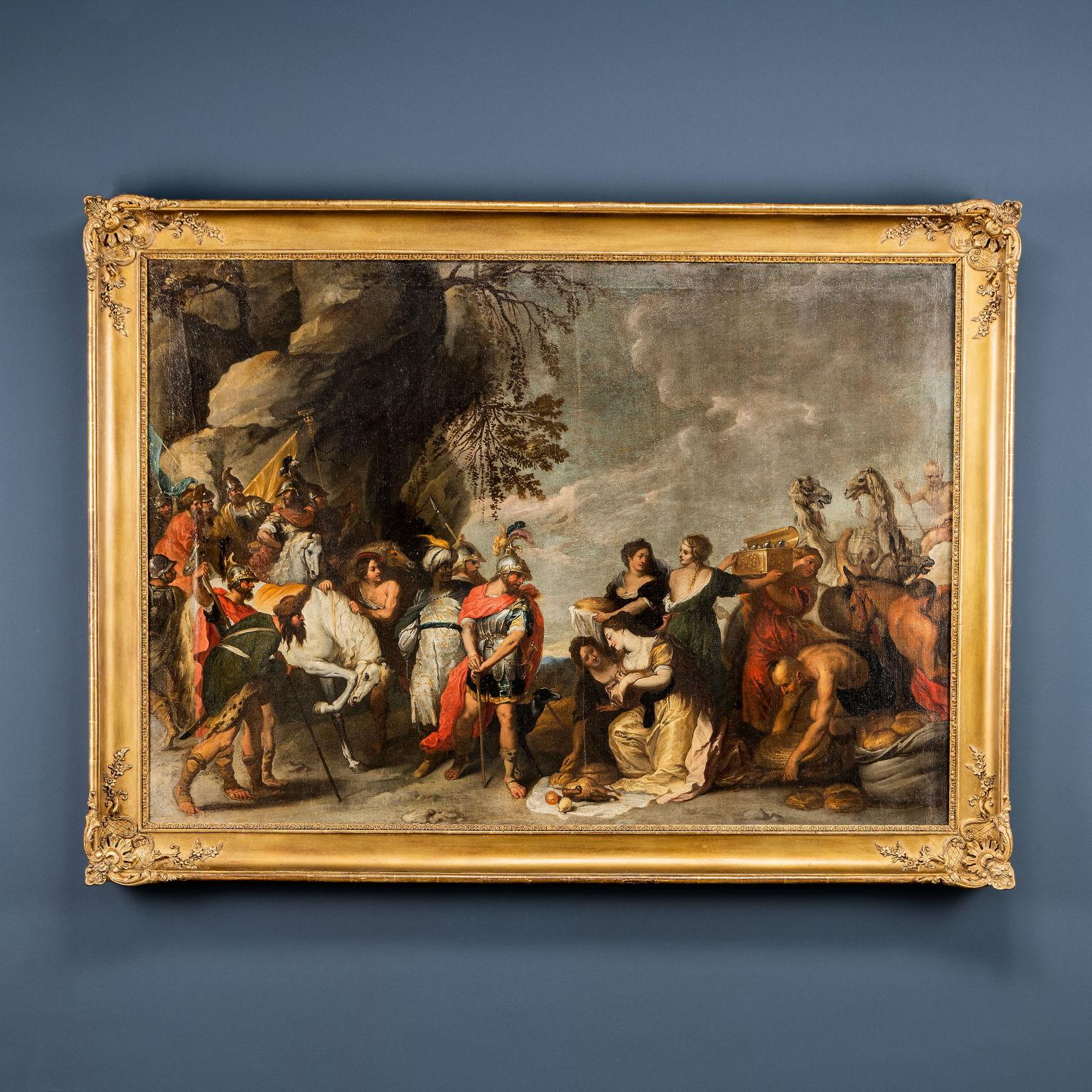
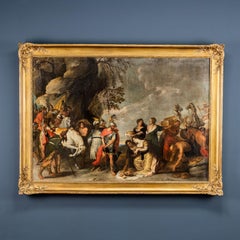
David and Abigail, fourth decade of the 17th century
Located in Milan, IT
The painting, done in oil on canvas, depicts the meeting between King David and Abigail, as narrated in the biblical text from the First Book of Samuel (I Samuel 25:1-34).
David, left without food in the wilderness with his army, seeks relief from the wealthy Nabal, who contemptuously denies him any help, ungrateful of the benevolence he previously received from the king. Upon hearing the rejection, the ruler intends to take revenge by killing his entire lineage. Abigail, Nabal's beautiful and wise wife, decides to right the wrong and bring David plenty of food and gifts. In the king's presence the woman humbles herself, winning his forgiveness and benevolence. Soon afterwards widowed, she will in fact become his bride.
The broad scene depicts the climax of the Old Testament episode, the moment when the woman prostrates herself before David and his servants prepare to deliver the gifts.
The biblical event is here a pretext, as is customary in modern-age painting, for staging the colorful description of a sumptuous procession, which can be divided into two parts, almost two wings of a crowd divided specularly: on the left David with his dignitaries and the army; on the other, Abigail's retinue, handmaids, servants leading dromedaries and donkeys laden with food.
The crowded group of figures is set in a natural proscenium: above a low horizon, barely hinted at by distant blue mountains, rises on the left side a craggy rocky cliff, the shelter of the army led by the ruler.
The 'somatic intonation of the characters, as well as the choice of metallic chromatics and the play of light on the shiny fabrics refer to a clear Flemish matrix, particularly the influence of the frothy and sumptuous painting of Rubens and Van Dyck.
As well set forth in the expert report prepared by Professor Giuseppe Sava, the work is to be attributed to Vincent Malò...
Category
17th Century Other Art Style Figurative Paintings
Materials
Oil
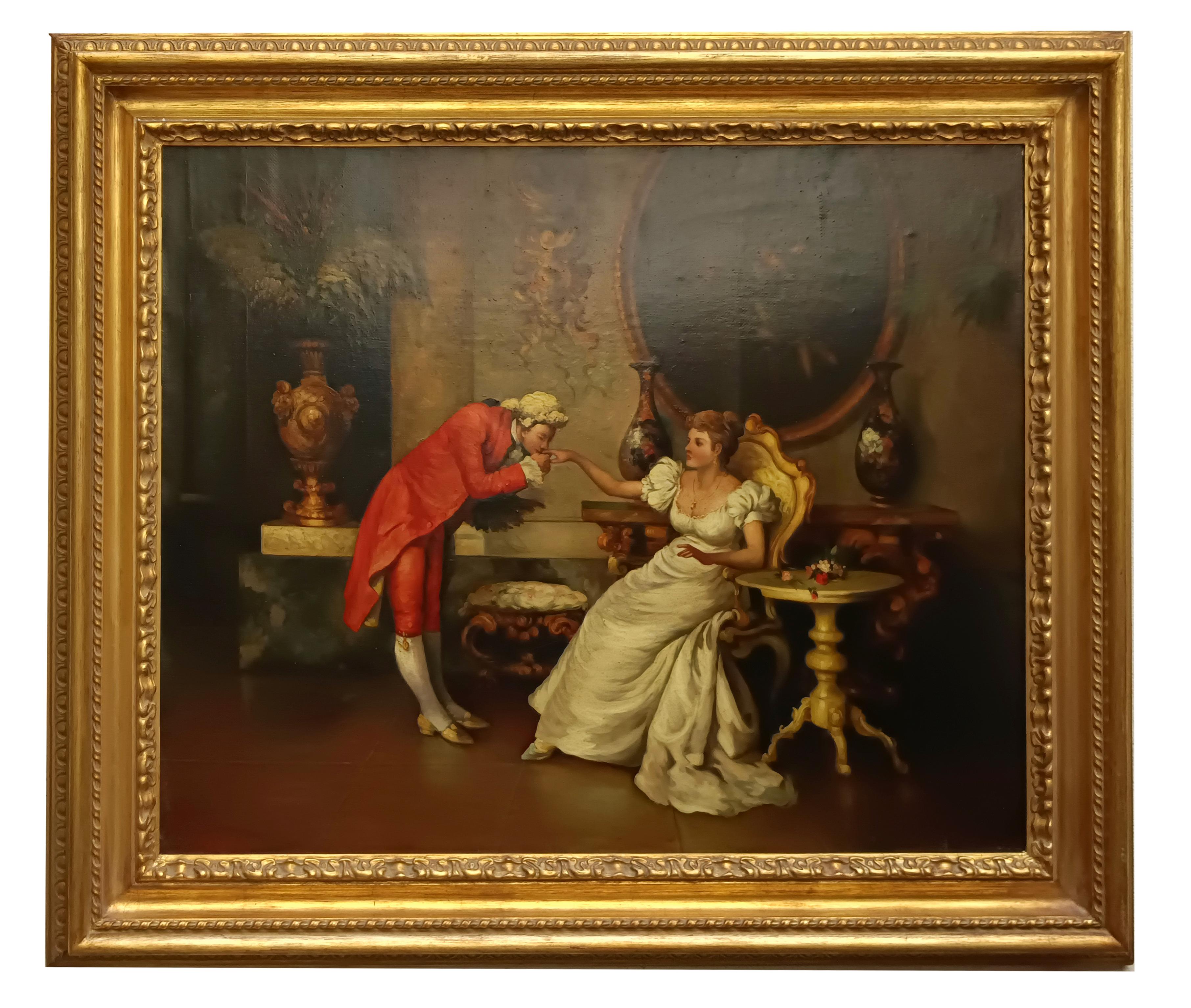
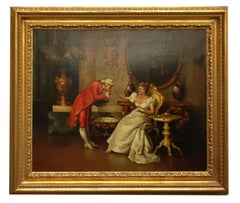
ROMANTIC SCENE - French School - Oil on Canvas Italian Figurative Painting
By Salvatore Testa
Located in Napoli, IT
Romantic Scene - Oil on canvas cm.80x100, Salvatore Testa, Italy, 2008
The painting by Salvatore Testa depicts a beautiful courting scene, the painting is inspired by the French Sch...
Category
Early 2000s French School Figurative Paintings
Materials
Canvas, Oil
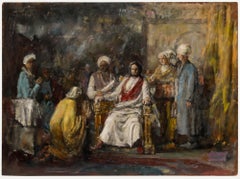
George Weissbort (1928-2013) - 20th Century Oil, Gifts for the King
By George Weissbort
Located in Corsham, GB
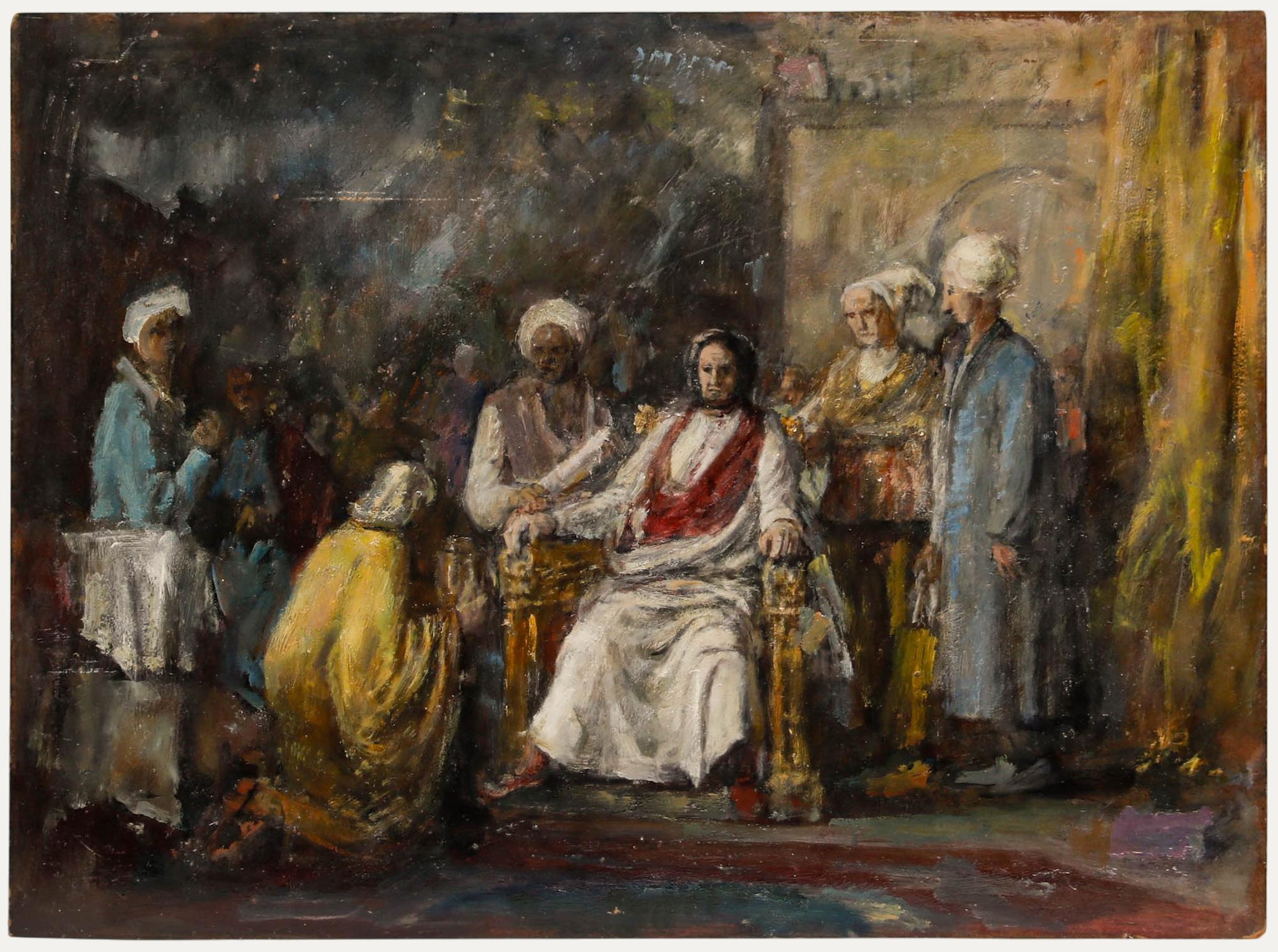
Arabian royalty in a grand palace interior, oil on board. Unsigned. (Provenance: Studio Sale, George Weissbort)
Category
20th Century Figurative Paintings
Materials
Oil
View of Milan Scuola di Brera Sacristy of the Church of San Fedele Novecento
By Cirano Castelfranchi
Located in Pistoia, IT
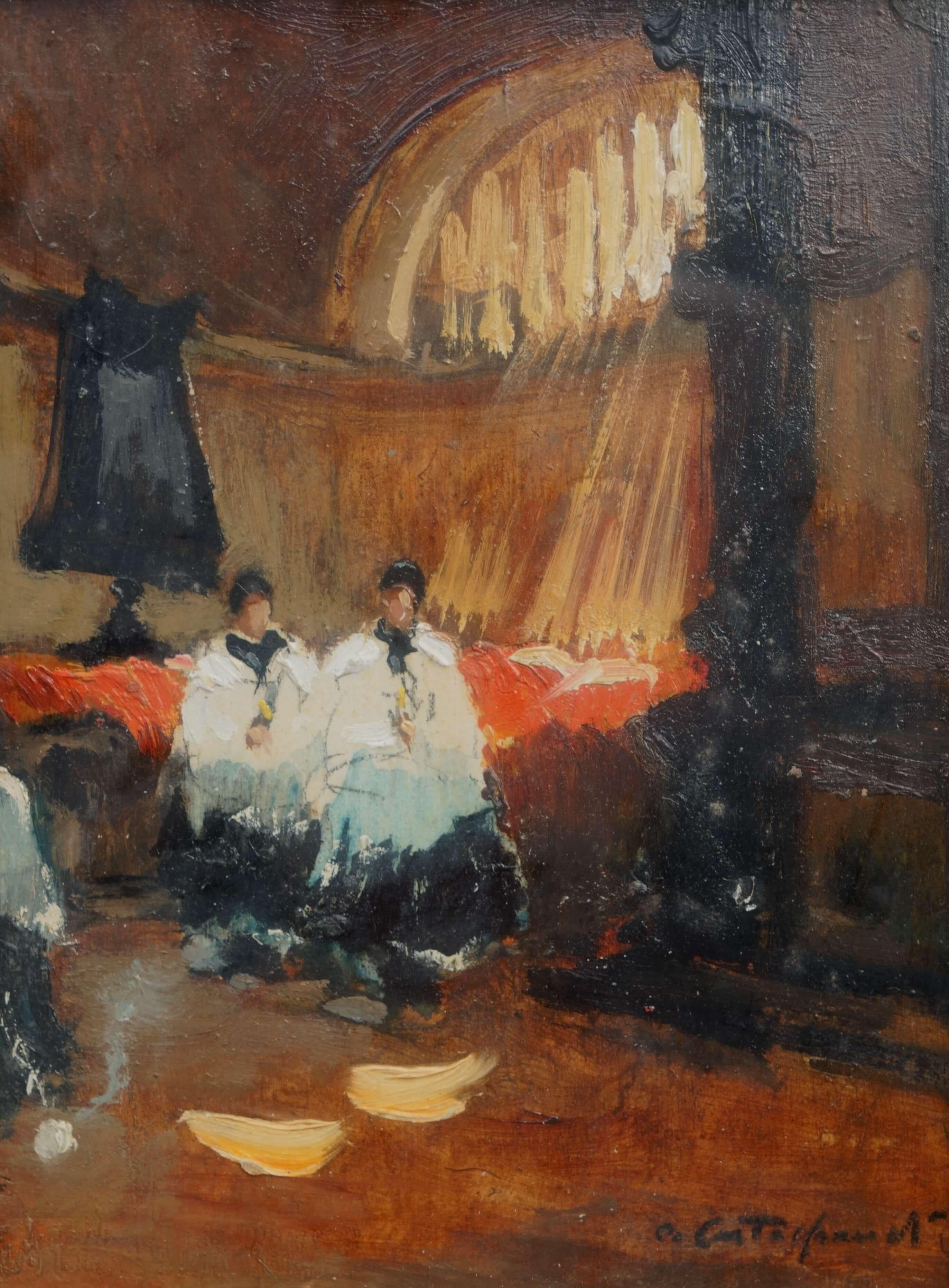
Cirano Castelfranchi (1912-1973) "In the sacristy" oil painting on panel signed lower right depicting the sacristy of the church of San Fedele in Milan in 1966 as indicated on the ba...
Category
1960s Italian School Figurative Paintings
Materials
Oil
More Ways To Browse
Antique Advisor
Lord Byron
King French Painted Frame Bed
Torquato Tasso
Coronation Painting
Bed Crowns
Venezuela Painting
Very Large Antique Oil Painting
Victorian Painting Children
Vintage Clowns Clowns Circuses
Will Street
Circus Clown Art
Clement Oil Painting
German Old Masters
J Manning
Leda And The Swan Painting
Lindy Painted
Modern Paintings Of Women