Items Similar to Sur la Plage - Impressionist Oil, Figures in Coastal Landscape by Alfred Stevens

Want more images or videos?
Request additional images or videos from the seller
1 of 18
Alfred Émile Léopold StevensSur la Plage - Impressionist Oil, Figures in Coastal Landscape by Alfred Stevens1895
1895
$9,515.94
$13,594.2130% Off
£6,965
£9,95030% Off
€8,112.66
€11,589.5130% Off
CA$13,108.90
CA$18,72730% Off
A$14,382.96
A$20,547.0930% Off
CHF 7,576.25
CHF 10,823.2230% Off
MX$171,100.49
MX$244,429.2730% Off
NOK 97,050.89
NOK 138,644.1230% Off
SEK 88,620.71
SEK 126,601.0230% Off
DKK 60,609.36
DKK 86,584.7930% Off
About the Item
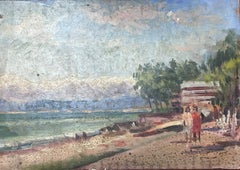
Signed and dated figures in seascape oil on panel by Belgian impressionist painter Alfred Emile Leopold Stevens. The work depicts an elegant woman sat on a stall at the beach as children paddle in the turquoise sea.
Signature:
Signed and dated 1895 lower left
Dimensions:
Framed: 21"x17"
Unframed: 16"x12"
Provenance:
Extensively inscribed as a gift from the artist verso
Private collection - France
Alfred Stevens was the brother of Joseph Stevens. He studied with Navez in Brussels and C. Roqueplan in Paris. His first paintings date from 1848. He spent most of his career in Paris, and exhibited regularly in Paris and Brussels.
He was essentially a painter of women, most particularly Parisian women from the time of the Second Empire. Two of his paintings were to be seen in the former Musée du Luxembourg, when an exhibition of paintings by Belgian artists was held during World War I.
His draughtsmanship is very accurate, his painting clear and luminous, with the paint quite thickly applied. In 1890, he became a member of the Société Nationale des Beaux-Arts and continued exhibiting there regularly. At the time of the 1889 Exposition Universelle, he collaborated with Gervex on a Panorama of the History of the Century, made up of a large number of full-length portraits.
In 1886, he published a work entitled Impressions of Painting ( Impressions sur la Peinture), which was translated into several different languages. Alfred Stevens reacted against the misunderstood grandiloquence inherited from the Romantics and abandoned subjects he had painted at the start of his career, such as A Soldier Pining for his Homeland. He was a friend of Manet, but also a representative of realism, seen from the worldly angle of one who was familiar with the empress's court. He expressed the modern aspects of his time and was also one of the first connoisseurs of 'japonaiserie'. Though he was a friend of the Impressionists, particularly of Manet and Berthe Morisot, he himself cannot really be considered as an Impressionist. Bazille and Manet met at his house and he kept paintings by Manet in his studio in the hope of selling them. It was in his studio that Durand-Ruel saw the first two Manet paintings he bought in 1872.
Stevens was a corresponding member of the royal academies of Belgium and Madrid. In addition to the awards he received at the Salons, he won a large number of medals at the Expositions Universelles, including the Grand Prix in Paris in 1889 and 1900. He was made a Commander of the Légion d'Honneur and a Grand Officer of the Ordre de Léopold II. Solo Exhibitions 2090, Musées Royaux des Beaux-Arts de Belgique, Brussels (retrospective).
Museum and Gallery Holdings:
Antwerp: Woman in Despair; A Parisian Sphinx; Authorised Begging Boston: The Attentive Listener Brussels: Lady in Pink; Ladybird; Salome; Widow and her Children; The Road from Cap St-Martin to Menton; The Studio of Alfred de Knyff; The Studio; Autumn Flowers; Bunch of Flowers with Fallen Petals; Seascape; Female Figure; Every Happiness
Dallas (MA): The Visit (before 1869, oil on canvas)
London (NG): The Present (1866-1871, oil on canvas, on loan to the Hugh Lane Municipal Gallery of Modern Art,
Dublin, since 1979); Storm at Honfleur (1890-1891, oil on canvas)
Munich: In the Boudoir
Nancy: Waiting
Nantes: Seascape
New York (Metropolitan Mus. of Art): The Japanese Robe
Ostend (Mus. voor Schone Kunsten) Pontoise: a pastel
Winchester: Mother
- Creator:Alfred Émile Léopold Stevens (Belgian)
- Creation Year:1895
- Dimensions:Height: 21 in (53.34 cm)Width: 17 in (43.18 cm)
- Medium:
- Movement Style:
- Period:
- Condition:Excellent condition.
- Gallery Location:Marlow, GB
- Reference Number:Seller: LFA06281stDibs: LU41536745122
About the Seller
5.0
Gold Seller
Premium sellers maintaining a 4.3+ rating and 24-hour response times
Established in 2001
1stDibs seller since 2016
712 sales on 1stDibs
Typical response time: 5 hours
- ShippingRetrieving quote...Shipping from: Marlow, United Kingdom
- Return Policy
More From This Seller
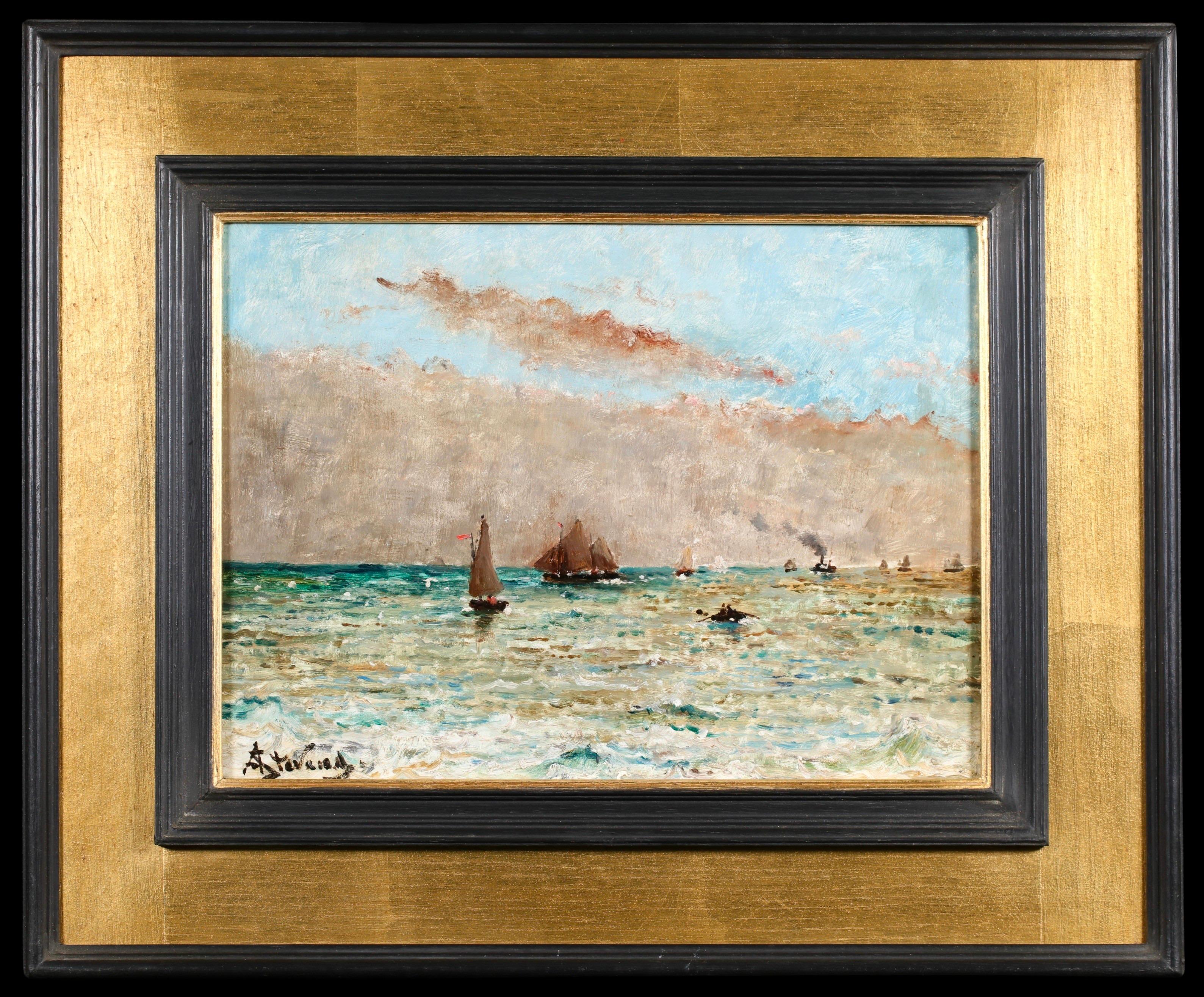
View AllBateaux sur la mer - Ciel nuageux - Realist Seascape Oil by Alfred Stevens
By Alfred Émile Léopold Stevens
Located in Marlow, Buckinghamshire
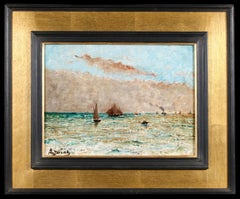
Signed oil on panel seascape circa 1890 by Belgian realist painter Alfred Emile Leopold Stevens. The work depicts sail boats at sea under a cloudy sky.
Signature:
Signed lower left
...
Category
1890s Realist Landscape Paintings
Materials
Oil, Panel
Figures on the Beach - Impressionist Oil, Coastal Landscape by Andre Devambez
By André Devambez
Located in Marlow, Buckinghamshire
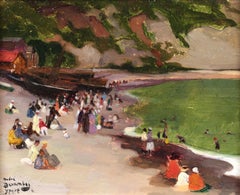
Signed and titled oil on panel figures in landscape circa 1920 by French impressionist painter Andre Devambez. The piece depicts couples and families en...
Category
Early 20th Century Impressionist Figurative Paintings
Materials
Panel, Oil
Le plage de Morgat - Impressionist Seascape Landscape Oil by Maxime Maufra
By Maxime Maufra
Located in Marlow, Buckinghamshire
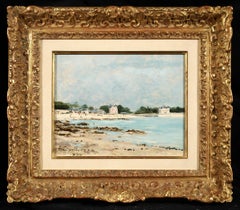
Signed and dated impressionist oil on panel seascape painting by French painter Maxime Maufra. This stunning work depicts the beach at Morgat in Brittany, northwest France. The cryst...
Category
1880s Impressionist Landscape Paintings
Materials
Oil, Panel
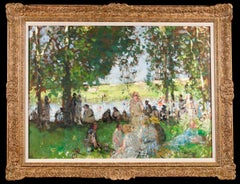
Les Vacances - Post Impressionist Figures in Landscape Oil by Pierre Montezin
By Pierre Eugène Montezin
Located in Marlow, Buckinghamshire
Signed oil on canvas figures in riverscape circa 1910 by sought after French impressionist painter Pierre Eugene Montezin. The work depicts women dressed in summer dresses and sunhat...
Category
1910s Impressionist Figurative Paintings
Materials
Canvas, Oil
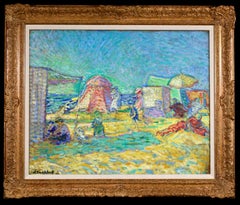
La Plage a Soulac-sur-mer - Post Impressionist Landscape Oil by Nikolai Tarkhoff
Located in Marlow, Buckinghamshire
Signed divisionist style oil on canvas figures in landscape circa 1906 by Russian post impressionist painter Nikolai Aleksandrovich Tarkhoff. This stunning and brightly coloured work depicts bathers enjoying a summer's day at the beach at Soulac-sur-mer on the east coast of France. Many parasols and sun tents are erected on the golden sand and the children are playing beneath the clear blue sky.
Signature:
Signed lower left
Dimensions:
Framed: 35"x41"
Unframed: 26"x32"
Provenance:
Guy Abot, Director of the Nicolas Tarkhoff Committee, confirms the authenticity of this work which will be listed in the CatalogueRaisonné of the painted work in preparation.
A certificate of authenticity can be acquired from the Nicolas Tarkhoff Committee
Nicolas Alexandrovich Tarkhoff (Николай Александрович Тархов) or Tarkhov was born in Moscow on 2nd January 1871 into a family of wealthy merchants. He is three years old on the death of his mother Olga Feodorova and eight years on the death of his father Alexander Ivanov...
Category
Early 1900s Post-Impressionist Figurative Paintings
Materials
Canvas, Oil
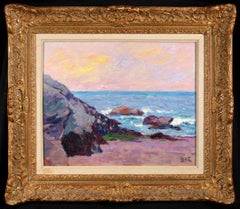
Plage a Belle Ile - Post Impressionist Landscape Oil by Georges D
Espagnat
By Georges d
Espagnat
Located in Marlow, Buckinghamshire
Signed post impressionist landscape oil on panel by popular French painter Georges D'Espagnat. The piece depicts the beach at Belle Ile, an island off the coast of Brittany in France, at sunset. An exceptional early painting by D'Espagnat which shows the precursor influence of Fauvism which was to dominate his paintings in the following few years.
Signature:
Signed lower right
Dimensions:
Framed: 23"x26"
Unframed: 15"x18"
Provenance:
Private French collection
A certificate of authenticity from Mr. Jean-Dominique Jacquemond is available upon request.
This work will be included in the catalogue raisonne of Georges D'Espagnat under preparation by Mr. Jacquemond
From the beginning of his career, it was a constant concern of Georges d'Espagnet to assert his originality. His studies at the École des Arts Décoratifs, Paris, did not last very long, for he wanted immediate independence and decided to follow courses in the private academies of Montparnasse. In about 1900, he became acquainted with Maurice Denis, Bonnard and Vuillard, and his collaboration with Denis led to a renewal of religious art in France.
In 1903, d'Espagnet was one of the founders of the Salon d'Automne, and was appointed professor in charge of studios at the École des Beaux-Arts, Paris, in 1934. He illustrated a number of books: Rémy de Gourmont's Evil Prayers ( Oraisons mauvaises) (1896), The Saints of Paradise ( Les Saintes du paradis) (1898), Simone (1907), Sistine ( Sixtine) (1922); Alphonse Daudet's The Immortal ( L'Immortel) (1930); André Gide's The Pastoral Symphony ( La Symphonie pastorale); Francis Jammes' Clearings in the Sky ( Chairières dans le ciel) (1948).
D'Espagnet belongs to the group of artists who made the Courrier Français so successful. The drawings of his which are published in it are strongly expressive and some bear comparison with the designs of the great Renaissance masters. He also contributed to L'Image. He often placed cheerful nudes in a landscape, reminding us that, though he moved away from the Fauves, he retained their freedom of colour and arabesque. He painted many portraits, including those of Albert André, André Barbier, Victor Boucher, Déodat de Séverac, Albert Marque, André Marty and Albert Roussel. He also painted mural decorations, including a wall for the Palais de la Découverte (1937), the ceiling of the Victor Hugo Room in the Palais du Luxembourg (1939), a decorative panel for the Palais de Justice, Toulouse (1941) and interior decorations for private houses. His landscapes are Impressionist in inspiration, and work for a certain sobriety, an intimacy, both in their composition - one, two or three sketched figures and large open spaces - and in the choice of colours and treatment with the special hazy brushstroke that marks his style.
D'Espagnet took part in a number of annual Parisian exhibitions, including the Salon des Indépendants, the Salon de la Société Nationale des Beaux-Arts, the Salon d'Automne (from 1903 to 1949, except in special circumstances), the Salon de la Libre Ésthétique, Brussels (1899, 1901), the Berlin Secessionists (1940). He also exhibited at the first Salon de la Société de la Gravure sur Bois. Among other exhibitions were 1912, A Century of French Art ( Centenaire de l'art français), St Petersburg; 1916, Kunstverein, Winterthur; 1918, 1926, Galerie M. Bertheim, Paris; 1930, Contemporary French Art...
Category
Early 1900s Post-Impressionist Landscape Paintings
Materials
Oil, Panel
You May Also Like
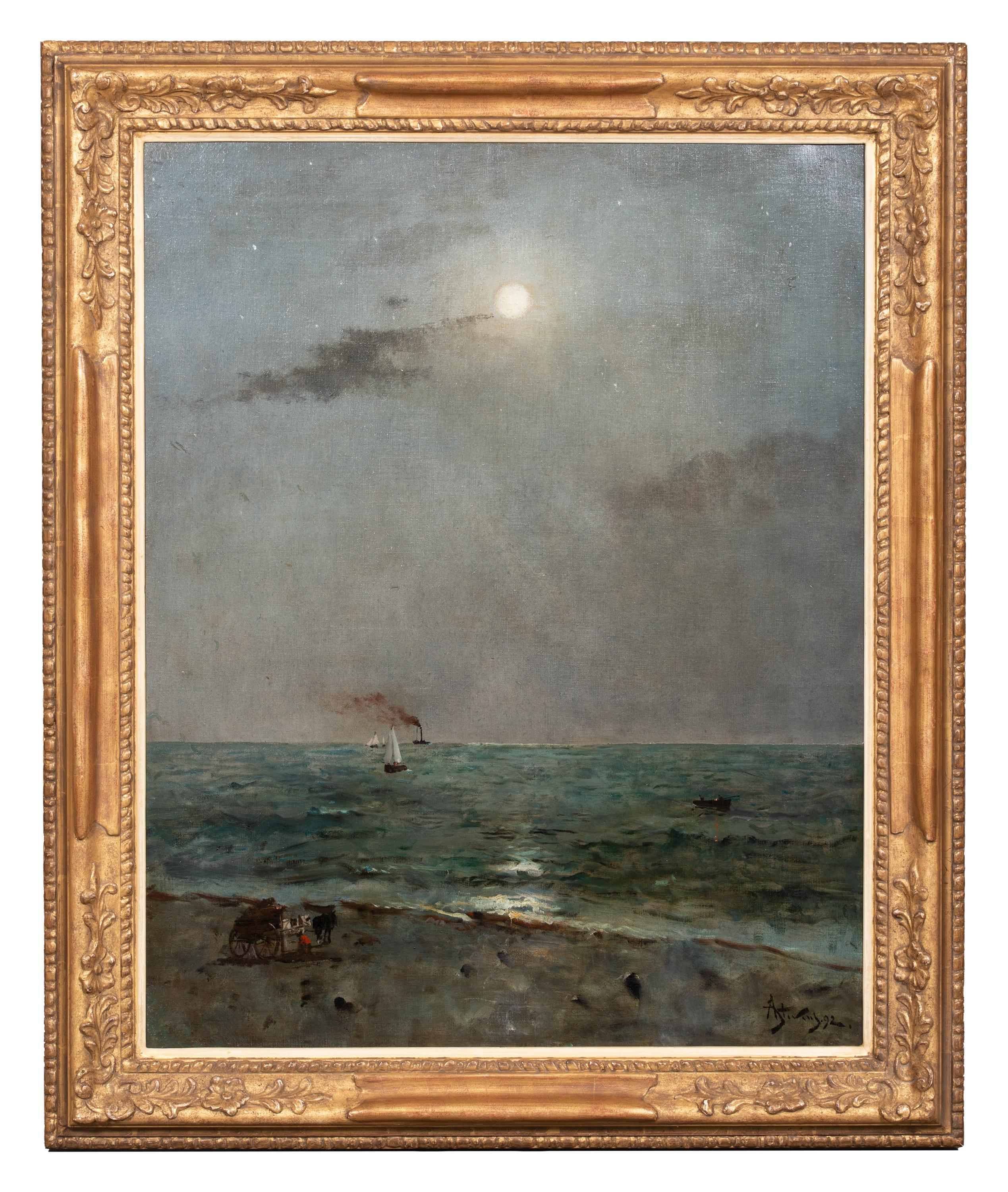
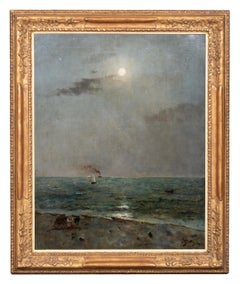
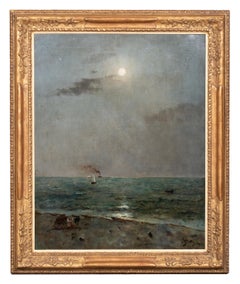
Moonlight on the Sea
by Alfred Stevens ( Brussels 1823 – 1906 Paris )
By Alfred Stevens
Located in Knokke, BE
Alfred Stevens
Brussels 1823 – 1906 Paris
Belgian Painter
'Moonlight on the Sea'
Signature: signed lower right and dated 1892 ‘A Stevens 92'
Medium: oil on canvas
Dimensions: image size 81 x 65 cm, frame size 97,5 x 81,5 cm
Provenance:
Collection M. Klein, 1900
Galerie Petit, Paris, 18 June 1926, no. 22
Private collection, Europe
De Vuyst, Belgium, 1998
Galerie Kupperman, Amsterdam
Private collection, The Netherlands
Exhibitions:
Exposition of the Works of Alfred Stevens, Palais des Beaux-Arts, Brussels, 1928
Retrospective Alfred Stevens, École des Beaux-Arts, Paris, 1900, no. 100
Literature:
A. Stevens, Mercatorfonds, Brussels, p. 100
Alfred Stevens, François Boucher, Ed. Rieder, Paris, 1930, illustrated on p. 36
Documentation by Mrs. Christiane Lefebvre, 1998
Biography: Alfred Émile Léopold Stevens (11 May 1823 – 24 August 1906) was a prominent Belgian painter renowned for his depictions of elegant modern women. His works, characterized by a realistic style and meticulous attention to detail, reveal the influence of 17th-century Dutch genre painting. While he initially gained attention for his social realist portrayal of the hardships faced by impoverished vagrants, he later achieved great critical and popular success with his portrayals of upper-middle class Parisian life. Notably, he often used the same models repeatedly, with some of them being identified in the infamous Book of the Courtesans, a confidential surveillance file maintained by the Paris vice squad, as noted by author Summer Brennan.
Stevens was born in Brussels, into a family deeply connected with the visual arts. His older brother Joseph (1816–1892) and his son Léopold (1866–1935) were both painters, while his other brother Arthur (1825–1899) was an art dealer and critic. His father, a veteran of the Napoleonic wars under the army of William I of the Netherlands, was an art collector with a notable collection of watercolors by Eugène Delacroix and other esteemed artists. Stevens’s upbringing was influenced by the environment of Café de l’Amitié, run by his maternal grandparents in Brussels, which served as a meeting place for prominent figures from the political, literary, and artistic spheres. Following the death of his father in 1837, Stevens left middle school to enroll at the Académie Royale des Beaux-Arts in Brussels. There, he came under the tutelage of François Navez, a Neo-Classical painter and former student of Jacques-Louis David, who was both the director of the academy and an old acquaintance of Stevens’s grandfather. Following a traditional curriculum, he initially drew from casts of classical sculptures and later transitioned to drawing from live models. In 1843, Stevens journeyed to Paris to join his already established brother, Joseph. He gained admission to the École des Beaux-Arts, the preeminent art school in Paris, although claims of him being a student of the director, Jean Auguste Dominique Ingres, are likely unfounded. One of his early works, The Pardon or Absolution (Hermitage, St. Petersburg), signed and dated 1849, showcased his mastery of a conventional naturalistic style influenced by 17th-century Dutch genre painting.
Stevens’s work was first publicly exhibited in 1851, when three of his paintings were featured at the Brussels Salon. He received a third-class medal at the Paris Salon in 1853, followed by a second-class medal at the Universal Exposition in Paris in 1855. His painting Ce qu’on appelle le vagabondage [What is called vagrancy] (Musée d’Orsay, Paris) garnered attention from Napoleon III, leading to a change in policy regarding the use of soldiers to remove the poor from the streets. Two other paintings displayed at the Salon in Antwerp in the same year, Chez soi or At Home and The Painter and his Model, introduced subjects from “la vie moderne” that became characteristic of his oeuvre: elegant young women dressed in contemporary fashion and artists in their studios. In 1857, Stevens made his first significant sale to a private collector when Consolation was purchased for a rumored 6,000 francs by the Berlin collector and dealer Ravéné. He and his brother also became part of the artistic milieu in Paris, frequenting salons hosted by Princess Mathilde and popular cafes, where they mingled with the likes of the Goncourt brothers, Théophile Gautier, and Alexandre Dumas. Stevens married Fanny Juliette Albertine Marie Hortense Blanc (1836-1891), a member of a wealthy Belgian family and a long-time acquaintance of the Stevens family, in 1858. The wedding was witnessed by the renowned painter Eugène Delacroix. The couple had four children: Leopold, Jean, Catherine, and Pierre. Stevens depicted his wife in numerous portraits, including Regrets and Memories. After her passing, he expressed enduring grief at her loss. During the 1860s, Stevens rose...
Category
Late 19th Century Impressionist Landscape Paintings
Materials
Canvas, Oil
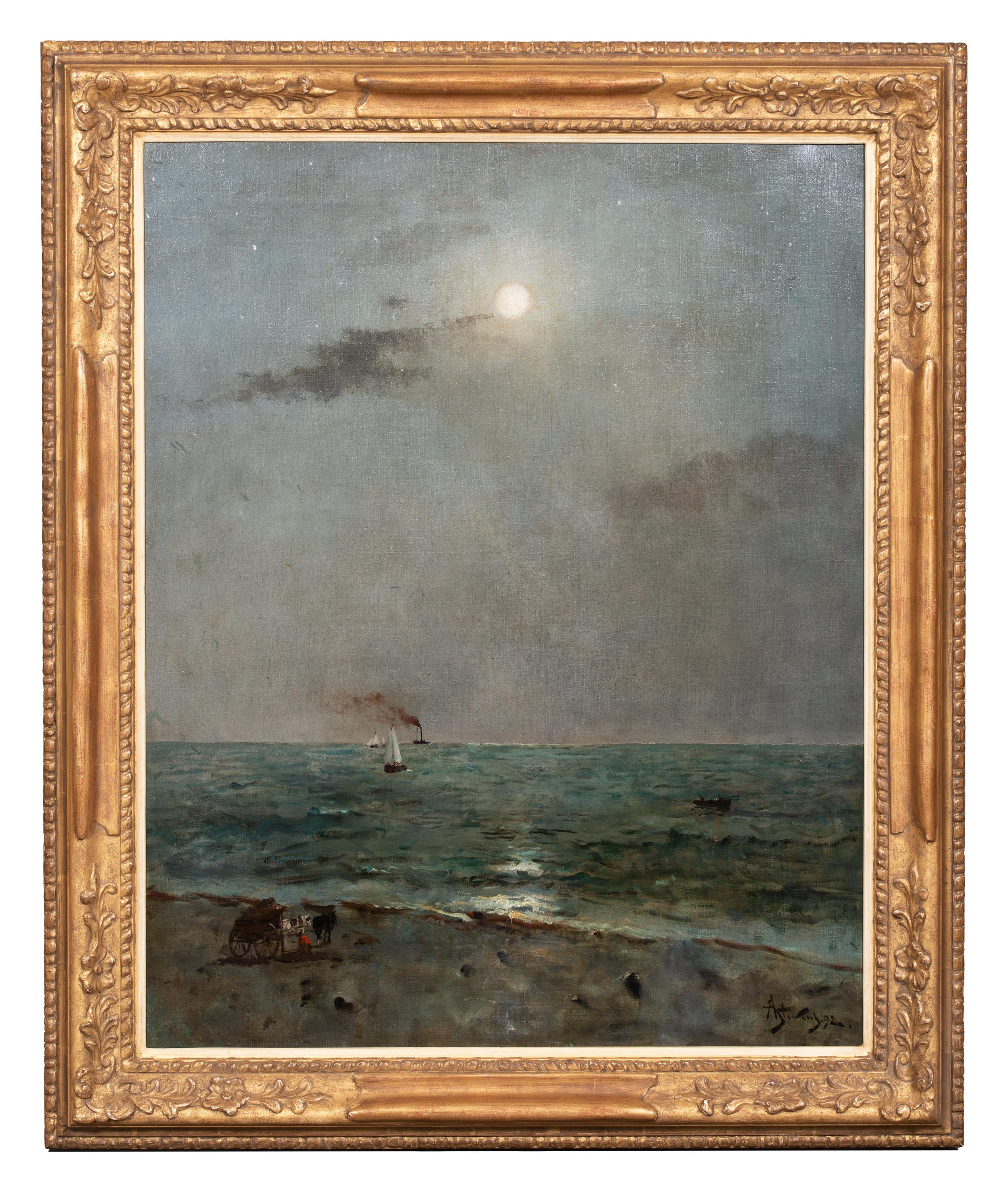
Moonlight on the Sea
by Alfred Stevens (Brussels 1823 – 1906 Paris) dated 1892
By Alfred Stevens
Located in Knokke, BE
Alfred Stevens
Brussels 1823 – 1906 Paris
Belgian Painter
'Moonlight on the Sea'
Signature: signed lower right and dated 1892 ‘A Stevens 92'
Medium: oil on canvas
Dimensions: image size 81 x 65 cm, frame size 97,5 x 81,5 cm
Biography: Alfred Stevens was born in Brussels, into a family deeply connected with the visual arts. His older brother Joseph (1816–1892) and his son Léopold (1866–1935) were both painters, while his other brother Arthur (1825–1899) was an art dealer and critic. His father, a veteran of the Napoleonic wars under the army of William I of the Netherlands, was an art collector with a notable collection of watercolors by Eugène Delacroix and other esteemed artists.
Stevens’s upbringing was influenced by the environment of Café de l’Amitié, run by his maternal grandparents in Brussels, which served as a meeting place for prominent figures from the political, literary, and artistic spheres. Following the death of his father in 1837, Stevens left middle school to enroll at the Académie Royale des Beaux-Arts in Brussels. There, he came under the tutelage of François Navez, a Neo-Classical painter and former student of Jacques-Louis David, who was both the director of the academy and an old acquaintance of Stevens’s grandfather. Following a traditional curriculum, he initially drew from casts of classical sculptures and later transitioned to drawing from live models. In 1843, Stevens journeyed to Paris to join his already established brother, Joseph. He gained admission to the École des Beaux-Arts, the preeminent art school in Paris, although claims of him being a student of the director, Jean Auguste Dominique Ingres, are likely unfounded. One of his early works, The Pardon or Absolution (Hermitage, St. Petersburg), signed and dated 1849, showcased his mastery of a conventional naturalistic style influenced by 17th-century Dutch genre painting.
Stevens’s work was first publicly exhibited in 1851, when three of his paintings were featured at the Brussels Salon. He received a third-class medal at the Paris Salon in 1853, followed by a second-class medal at the Universal Exposition in Paris in 1855. His painting Ce qu’on appelle le vagabondage (Musée d’Orsay, Paris) garnered attention from Napoleon III, leading to a change in policy regarding the use of soldiers to remove the poor from the streets. Two other paintings displayed at the Salon in Antwerp in the same year, Chez soi or At Home and The Painter and his Model, introduced subjects from “la vie moderne” that became characteristic of his oeuvre: elegant young women dressed in contemporary fashion and artists in their studios. In 1857, Stevens made his first significant sale to a private collector when Consolation was purchased for a rumored 6,000 francs by the Berlin collector and dealer Ravéné. He and his brother also became part of the artistic milieu in Paris, frequenting salons hosted by Princess Mathilde and popular cafes, where they mingled with the likes of the Goncourt brothers, Théophile Gautier, and Alexandre Dumas. Stevens married Fanny Juliette Albertine Marie Hortense Blanc (1836-1891), a member of a wealthy Belgian family and a long-time acquaintance of the Stevens family, in 1858. The wedding was witnessed by the renowned painter Eugène Delacroix. The couple had four children: Leopold, Jean, Catherine, and Pierre. Stevens depicted his wife in numerous portraits, including Regrets and Memories. After her passing, he expressed enduring grief at her loss. During the 1860s, Stevens rose...
Category
Late 19th Century Impressionist Landscape Paintings
Materials
Canvas, Oil
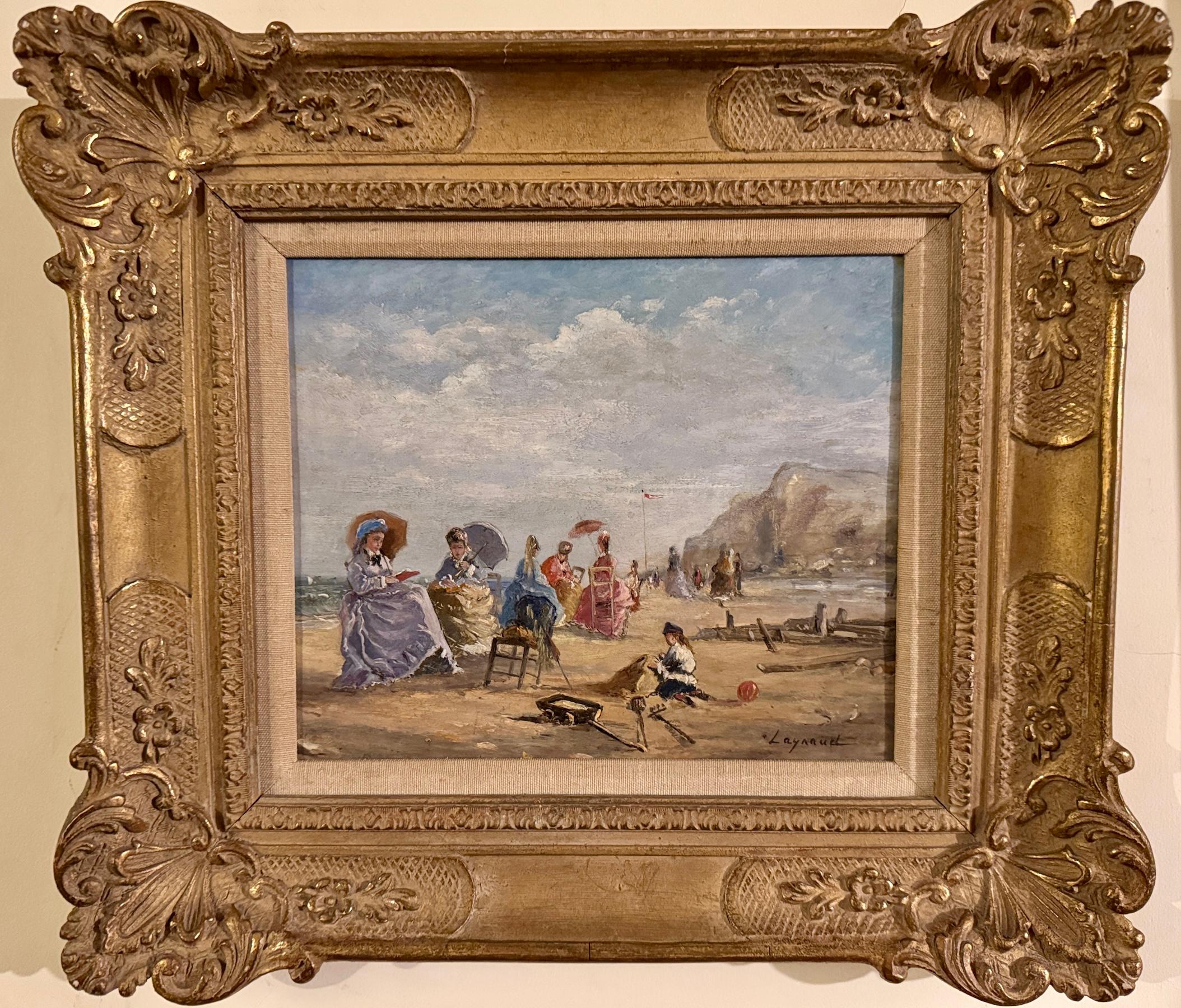
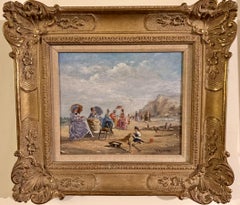
19th C French figures on a Summer beach, with Children building sand castles
Located in Woodbury, CT
Ernest Laynaud (French, fl. late 19th century)
Figures on a Beach, circa 1890
Oil on panel
Signed lower right
Provenance: G. M. Lotinga, New Bond Street, London
⸻
A delightful lat...
Category
1890s Impressionist Figurative Paintings
Materials
Oil, Wood Panel
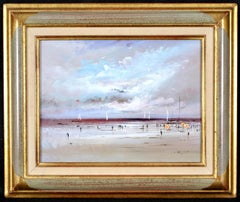
Figures on the Beach - Mid 20th Century French Impressionist Seaside Painting
Located in Sevenoaks, GB
A beautiful 1950's French impressionist oil on board depicting a busy coastal scene with figures on the beach and sailing boats on the sea.
The work is very well painted and atmosp...
Category
Mid-20th Century Impressionist Landscape Paintings
Materials
Oil, Board
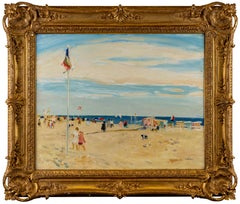
French Beach Scene
By Gaston Sebire
Located in Sheffield, MA
Gaston Sebire
French, 1920-2001
French Beach Scene
Oil on canvas
25 ⅝ by 32 in, w/ frame 35 ½ by 42 in
Signed lower right
Gaston Sebire was born A...
Category
Late 20th Century Impressionist Landscape Paintings
Materials
Oil
French Impressionist Oil Landscape Figures Walking Along The Beach
By Maurice Mazeilie
Located in Cirencester, Gloucestershire
"Landscape"
by Maurice Mazeilie (French)
oil painting on artist paper, unframed
painting: 6.25 x 9.25 inches
A delightful original oil painting by the 20th century French Impressio...
Category
20th Century Impressionist Landscape Paintings
Materials
Oil
More Ways To Browse
In Despair
Manet Paintings
Paintings By Belgian Artists
Grand Prix Paris1900
Alfred Emile Leopold Stevens
Alexander Sharpe Ross
Alice Murphy
Alpay Efe
American Red Cross Posters Vintage
Andre Favory
Anna Kincaide
Antique Spanish Guitars
Aunt Jemima
Bessie Smith
Bethlehem Painting
Black Nativity
Boardwalk Originals
Bouche Frame