Want more images or videos?
Request additional images or videos from the seller
1 of 20
Anna CostaThe Fishermencirca 1970s
circa 1970s
Price:$1,652.60
About the Item
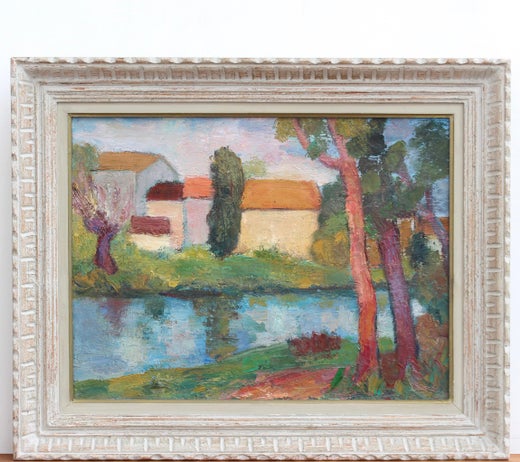
Anna Costa (approx: 1922-2022) painted in her Provençal village in the Cavaillon area from the 1940s until the 1970s. Upon her passing, her estate released her art into the market where dealers around the world are clambering for her works. Costa's art is characterised by its bright colours and strong naive style which make them instantly recognisable. This style is called Provençal Colourism. It is a regional art movement that emerged in the South of France in the early 20th century. It is also characterised by bright and bold colours, as well as strong contracts between light and shadow. The movement drew inspiration from the natural beauty of the region including its landscapes, people and traditions.
About the Seller
5.0
Platinum Seller
Premium sellers with a 4.7+ rating and 24-hour response times
Established in 2016
1stDibs seller since 2017
577 sales on 1stDibs
Authenticity Guarantee
In the unlikely event there’s an issue with an item’s authenticity, contact us within 1 year for a full refund. DetailsMoney-Back Guarantee
If your item is not as described, is damaged in transit, or does not arrive, contact us within 7 days for a full refund. Details24-Hour Cancellation
You have a 24-hour grace period in which to reconsider your purchase, with no questions asked.Vetted Professional Sellers
Our world-class sellers must adhere to strict standards for service and quality, maintaining the integrity of our listings.Price-Match Guarantee
If you find that a seller listed the same item for a lower price elsewhere, we’ll match it.Trusted Global Delivery
Our best-in-class carrier network provides specialized shipping options worldwide, including custom delivery.You May Also Like
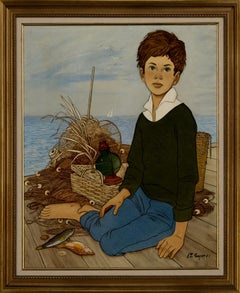
Philippe Noyer "Aldo" 1961 French Modern Oil on Canvas, Portrait, Boy by the Sea
By Philippe Henri Noyer
Located in Miami, FL
PHILIPPE NOYER – "ALDO"
⚜ Oil on Canvas ⚜ Hand Signed and Dated Lower Right; Titled on Verso ⚜ Original Period Frame
PORTRAIT OF A BOY BY THE SEA
Painted in 1961, this rare early wo...
Category
1960s Modern Portrait Paintings
Materials
Canvas, Oil
$7,500
H 29 in W 25 in D 2.5 in
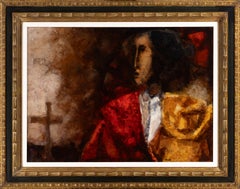
Àlvar Suñol "La prière du torero" 1963 Large Spanish Modernist Oil Painting
By Alvar Sunol Munoz-Ramos
Located in Miami, FL
ÀLVAR SUÑOL – "LA PRIÈRE DU TORERO" (THE BULLFIGHTER'S PRAYER)
⚜ Oil on Canvas ⚜ Hand Signed Lower Left and on Verso; Dated 1963 ⚜ Original Carved Wood Frame
A MASTERWORK OF FAITH A...
Category
1960s Modern Figurative Paintings
Materials
Canvas, Oil
$50,000
H 39.5 in W 50.25 in D 3 in
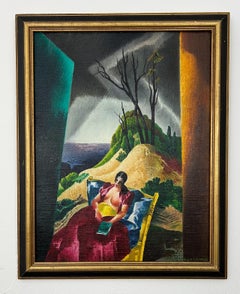
On the Beach. Woman Reading. Mid-Century Chicago Modernist Oil Painting.
Located in Marco Island, FL
Chicago Modernist, William Schwartz, painted this intimate painting of a woman reading titled On the Beach. He studied at the Art Institute of Chicago shortly after emigrating to th...
Category
Mid-20th Century American Modern Figurative Paintings
Materials
Canvas, Oil, Board
$6,500
H 21.88 in W 17.38 in D 2 in
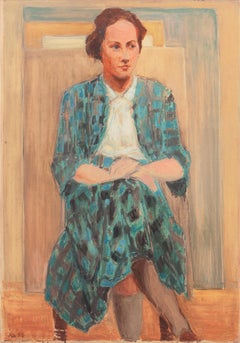
Woman in Blue
, Danish Royal Academy, Brooklyn Museum, Kolding
Located in Santa Cruz, CA
Initialed lower left, 'A.S.' for Anton Schroder (Danish, 1893-1965) and dated 1953.
A substantial, modernist oil painting of a young woman, shown seated and gazing to her left with ...
Category
1950s Modern Portrait Paintings
Materials
Canvas, Oil
$4,500
H 38 in W 26.5 in D 0.5 in
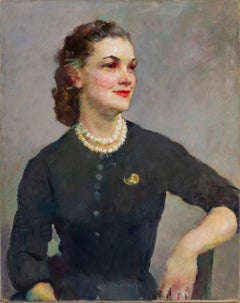
Portrait of a Woman
Located in Astoria, NY
Molly Guion (American, 1910-1982), Portrait of a Woman, Oil on Canvas, depicting woman in dark dress with pearl necklace and gold brooch, signed to reverse, unframed. 30.25" H x 24.2...
Category
Mid-20th Century Modern Portrait Paintings
Materials
Canvas, Oil
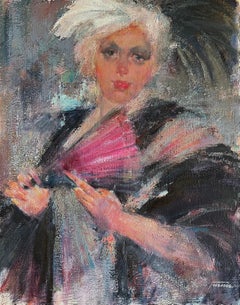
LADY WITH PICK FAN
Located in Los Angeles, CA
Biography from the niece of the artist from during his lifetime. Paintings acquired from the artist.s estate.
Max Turner
1925 - 2019
Max Lamar Turner Painter, Sculptor, Teacher and Author.
Max Turner was born in Omaha, Nebraska on July 28, 1925. His father was Lance Howard Turner and his mother Mary Irene Turner. In 1927, his family moved to Bingham Canyon, Utah where Max's father extracted copper from a creek that he had diverted to pass through his garage. The town was located in a narrow canyon on the eastern face of the Oquirrh Mountains. In 1938, when Max was 13, his family moved to Midvale, Utah. After completing high school, Max went to work laying rail until he was inducted into the U.S. Navy to serve during W.W. II.
There he took an aptitude test and was initially assigned to the medical corp., later transferring to the dental unit. Max was stationed at Port Hueneme, Ventura County, California through the end of the war. When he was discharged in 1946, he remained in Southern California, living in the Los Angeles area. He met a man named Larry Torres and they formed a partnership to do silk screen work primarily for the Colby Poster Printing Company. This lasted about 10 years until the Colby building caught fire and burned down. In 1958, Max began working for Slade Novelty company that made doll parts using a product called plastisol. A year later, Max began producing plastic parts through his own business. One day, a couple of kids brought in a shrunken skull they had made and asked Max if he could reproduce it. Max said he could and he looked around for a business to work with for this task. He ultimately decided he could create his own machine shop to make molds. As a result, Max purchased a lathe, drill press, grinder and other tools to create his own machine shop and went into business making molds. He built a clientele and in 1973, he moved his machine shop to Glendale, California.
Painter, Sculptor, Teacher and Author:
Max recalls the day when his interest in art took a new direction. He happened to be in a paint store to purchase some supplies when he saw a card posted on a wall that read, "Come paint with Connie Marlo". Max had been interested in art since his youth and he was frequently impressed with paintings displayed by local artists at various community events.
Consequently, he decided to go to Connie's Saturday morning art class at a studio on North La Brea Avenue (between Sunset and Hollywood) in Los Angeles. But, as fate would have it, he immediately took a detour from this class when he found a piece of paper on the floor of the studio referencing another art class dealing with compositions, patterns, rhythms and color harmony. The instructor's name was Hal Reed, a former art student of the Russian/American Master, Nicolai Fechin. Hal owned the building (previously the Will Foster Studio) and had founded the Art League of Los Angeles. When Max found Hal, he asked Hal if he could join his class. Hal said "No, the class was full" but he said Max could monitor the class in the back of the classroom. Max took him up on the offer and began observing the weekly class.
During the class, Hal told his students that they should practice what they were learning by going to "live model" classes. Max began attending these classes where he learned how to draw figures. After a few months, Hal and Max became good friends. Hal was so impressed with Max's work that he offered Max the opportunity to teach at another location that Hal was opening in the San Fernando Valley. Max accepted the offer and began teaching his own art class. For Max, it was a quick jump from learning to teaching. Max then found that several of his students had to commute to his art class from the west end of the "Valley". To better serve this group of students, Max decided to relocate to another studio in Calabasas.
Max continued teaching, and at this time he was producing very impressive portraits, both oil paintings and charcoal drawings from live models (Max never worked from photos). Max demonstrated real talent, and the style of his drawings and paintings were being compared to those of Nicolai Fechin. And, like Fechin, Max also had an interest in sculpting. One day, Max decided to design and cast a bronze owl sculpture to put in his Calabasas Fine Art Gallery. Later, someone approached Max when he was at the foundry and asked him about his success selling the owl sculpture. The individual who asked this question was convinced that there was a broader market for these sculptures and he ordered a dozen of the owl sculptures from Max. This encouraged Max to do more castings. Some of the new castings were antique sculptures he found and reproduced. As this new business grew, he decided to establish his own foundry, employing up to 15 workers. The business continued for many years, up until the late 1990's when Max got tired of the foundry business and sold it.
Max, who was now in his 70's, decided to move on to his next venture as an artist, dedicating himself to doing the actual sculpting of original art. He loved the creativity of sculpting and he had his sculptures cast at local foundries, ironically the same ones that used to be his competition. Max was now fully engaged in his new artistic direction and, over time, he produced a large body of work. He created very impressive sculptures, including about 100 full-size sculptures. He sold some of these to high-end clientele, the Foundry at SLS Las Vegas, and to Hollywood studios.
Even though Max now seemed to be totally in his element, he somehow also found time to continue to teach painting classes at the California Art Institute in Westlake Village in Los Angeles. At the institute, he specialized in figure work. Max continued to draw, paint and teach, but he says he stopped sculpting when he turned 90.
Max produced four books showcasing his drawings and paintings. The first is "Faces, The Drawings of Max Turner", copyright 2000, that showcases nearly 100 of his portrait drawings. Within the "Acknowledgements" section, he lists Hal Reed and Joseph Nordmann, two former students of Nicolai Fechin.
In 2006, Max produced his second book titled "Figures and Faces", reflecting not only portraits but also figure drawings and paintings. It is a wonderful book of Max's work, but it is currently difficult to find. The third book is titled "Faces 2, The Paintings and Drawings of Max Turner", copyright 2009, which includes 75 portrait paintings and drawings. In the "Preface" of this book, Max describes growing up in a small and isolated mining town during the Great Depression. He states that as a kid, he had little exposure of any culture or view of what the rest of the world was like. His neighbor was the trash collector and Max would sometimes go through his truck looking for anything of value. Among other things, he found magazines like Cosmopolitan, Good Housekeeping and Red Book, with covers that frequently showed drawings or paintings of faces. Max states that these images were the very first source of inspiration for him. He says that he began looking more carefully at people's faces and if they had character, he would draw them. By drawing them, Max says that he was making them part of his world, his world of "Faces".
In 2018, Max published his newest book showcasing his drawings and paintings. It is titled "Max Turner's Figure Sketches". This softbound book includes 76 pages and over 120 drawings and paintings. In the Introduction, Max explains "I have found that when approaching the figure, one should begin with the gesture. After having captured the essence or feeling of the pose, one can then proceed to build on it." The figure sketches in this wonderful book reflect a Master's work that consistently captures the "gesture"-showing the emotion, movement and expression.
Two more books are on the horizon for Max, both dealing with his passion for sculpting. His first, "The Sculpture of Max Turner" is a compilation of his commercial and noncommercial pieces throughout his career. The second, "Terra Cotta Sculpture by Max Turner" is a complete collection of figures done at the California Art Institute. These much anticipated books should be out later in 2018.
Max now considers himself primarily a sculptor. But others in the art world are more than impressed with his drawings and paintings as well. His portraits are often described as having a Fechin-esque appearance, referring to the style of Nicolai Fechin. When Max observed those first art classes given by Hal Reed, it should be noted that Hal had previously been a student of the Russian/American Master Nicolai Fechin in the early to mid-1950's. In fact, Hal was a student in the last art class that Fechin taught before he unexpectedly died in 1955. Hal was so strongly influenced by Fechin that he later produced two 30-minute art instruction videos as part his Art Video Productions wherein he specifically described Fechin techniques that he learned in Fechin's class. The Fechin style and techniques were in play when Max later met Hal. Over the years, many of Max's art students, art collectors, gallery owners, as well as the Director of the Monterey Museum of Art have commented on the Fechin-esque qualities of Max's wonderful charcoal drawings and paintings. So, while Max may consider himself primarily a sculptor, his drawings and paintings are also impressive and very much sought after.
When Nicolai Fechin died in 1955, three of the nine students in his last art class became life-long friends. Max subsequently became friends with not only Hal Reed, but also with prior Fechin students Joseph Nordmann and Albert Londraville...
Category
1990s Modern Figurative Paintings
Materials
Canvas, Oil
BLONDE WITH ART DECO NECKLACE
Located in Los Angeles, CA
Biography from the niece of the artist from during his lifetime. Paintings acquired from the artist.s estate.
Max Turner
1925 - 2019
Max Lamar Turner Painter, Sculptor, Teacher and Author.
Max Turner was born in Omaha, Nebraska on July 28, 1925. His father was Lance Howard Turner and his mother Mary Irene Turner. In 1927, his family moved to Bingham Canyon, Utah where Max's father extracted copper from a creek that he had diverted to pass through his garage. The town was located in a narrow canyon on the eastern face of the Oquirrh Mountains. In 1938, when Max was 13, his family moved to Midvale, Utah. After completing high school, Max went to work laying rail until he was inducted into the U.S. Navy to serve during W.W. II.
There he took an aptitude test and was initially assigned to the medical corp., later transferring to the dental unit. Max was stationed at Port Hueneme, Ventura County, California through the end of the war. When he was discharged in 1946, he remained in Southern California, living in the Los Angeles area. He met a man named Larry Torres and they formed a partnership to do silk screen work primarily for the Colby Poster Printing Company. This lasted about 10 years until the Colby building caught fire and burned down. In 1958, Max began working for Slade Novelty company that made doll parts using a product called plastisol. A year later, Max began producing plastic parts through his own business. One day, a couple of kids brought in a shrunken skull they had made and asked Max if he could reproduce it. Max said he could and he looked around for a business to work with for this task. He ultimately decided he could create his own machine shop to make molds. As a result, Max purchased a lathe, drill press, grinder and other tools to create his own machine shop and went into business making molds. He built a clientele and in 1973, he moved his machine shop to Glendale, California.
Painter, Sculptor, Teacher and Author:
Max recalls the day when his interest in art took a new direction. He happened to be in a paint store to purchase some supplies when he saw a card posted on a wall that read, "Come paint with Connie Marlo". Max had been interested in art since his youth and he was frequently impressed with paintings displayed by local artists at various community events.
Consequently, he decided to go to Connie's Saturday morning art class at a studio on North La Brea Avenue (between Sunset and Hollywood) in Los Angeles. But, as fate would have it, he immediately took a detour from this class when he found a piece of paper on the floor of the studio referencing another art class dealing with compositions, patterns, rhythms and color harmony. The instructor's name was Hal Reed, a former art student of the Russian/American Master, Nicolai Fechin. Hal owned the building (previously the Will Foster Studio) and had founded the Art League of Los Angeles. When Max found Hal, he asked Hal if he could join his class. Hal said "No, the class was full" but he said Max could monitor the class in the back of the classroom. Max took him up on the offer and began observing the weekly class.
During the class, Hal told his students that they should practice what they were learning by going to "live model" classes. Max began attending these classes where he learned how to draw figures. After a few months, Hal and Max became good friends. Hal was so impressed with Max's work that he offered Max the opportunity to teach at another location that Hal was opening in the San Fernando Valley. Max accepted the offer and began teaching his own art class. For Max, it was a quick jump from learning to teaching. Max then found that several of his students had to commute to his art class from the west end of the "Valley". To better serve this group of students, Max decided to relocate to another studio in Calabasas.
Max continued teaching, and at this time he was producing very impressive portraits, both oil paintings and charcoal drawings from live models (Max never worked from photos). Max demonstrated real talent, and the style of his drawings and paintings were being compared to those of Nicolai Fechin. And, like Fechin, Max also had an interest in sculpting. One day, Max decided to design and cast a bronze owl sculpture to put in his Calabasas Fine Art Gallery. Later, someone approached Max when he was at the foundry and asked him about his success selling the owl sculpture. The individual who asked this question was convinced that there was a broader market for these sculptures and he ordered a dozen of the owl sculptures from Max. This encouraged Max to do more castings. Some of the new castings were antique sculptures he found and reproduced. As this new business grew, he decided to establish his own foundry, employing up to 15 workers. The business continued for many years, up until the late 1990's when Max got tired of the foundry business and sold it.
Max, who was now in his 70's, decided to move on to his next venture as an artist, dedicating himself to doing the actual sculpting of original art. He loved the creativity of sculpting and he had his sculptures cast at local foundries, ironically the same ones that used to be his competition. Max was now fully engaged in his new artistic direction and, over time, he produced a large body of work. He created very impressive sculptures, including about 100 full-size sculptures. He sold some of these to high-end clientele, the Foundry at SLS Las Vegas, and to Hollywood studios.
Even though Max now seemed to be totally in his element, he somehow also found time to continue to teach painting classes at the California Art Institute in Westlake Village in Los Angeles. At the institute, he specialized in figure work. Max continued to draw, paint and teach, but he says he stopped sculpting when he turned 90.
Max produced four books showcasing his drawings and paintings. The first is "Faces, The Drawings of Max Turner", copyright 2000, that showcases nearly 100 of his portrait drawings. Within the "Acknowledgements" section, he lists Hal Reed and Joseph Nordmann, two former students of Nicolai Fechin.
In 2006, Max produced his second book titled "Figures and Faces", reflecting not only portraits but also figure drawings and paintings. It is a wonderful book of Max's work, but it is currently difficult to find. The third book is titled "Faces 2, The Paintings and Drawings of Max Turner", copyright 2009, which includes 75 portrait paintings and drawings. In the "Preface" of this book, Max describes growing up in a small and isolated mining town during the Great Depression. He states that as a kid, he had little exposure of any culture or view of what the rest of the world was like. His neighbor was the trash collector and Max would sometimes go through his truck looking for anything of value. Among other things, he found magazines like Cosmopolitan, Good Housekeeping and Red Book, with covers that frequently showed drawings or paintings of faces. Max states that these images were the very first source of inspiration for him. He says that he began looking more carefully at people's faces and if they had character, he would draw them. By drawing them, Max says that he was making them part of his world, his world of "Faces".
In 2018, Max published his newest book showcasing his drawings and paintings. It is titled "Max Turner's Figure Sketches". This softbound book includes 76 pages and over 120 drawings and paintings. In the Introduction, Max explains "I have found that when approaching the figure, one should begin with the gesture. After having captured the essence or feeling of the pose, one can then proceed to build on it." The figure sketches in this wonderful book reflect a Master's work that consistently captures the "gesture"-showing the emotion, movement and expression.
Two more books are on the horizon for Max, both dealing with his passion for sculpting. His first, "The Sculpture of Max Turner" is a compilation of his commercial and noncommercial pieces throughout his career. The second, "Terra Cotta Sculpture by Max Turner" is a complete collection of figures done at the California Art Institute. These much anticipated books should be out later in 2018.
Max now considers himself primarily a sculptor. But others in the art world are more than impressed with his drawings and paintings as well. His portraits are often described as having a Fechin-esque appearance, referring to the style of Nicolai Fechin. When Max observed those first art classes given by Hal Reed, it should be noted that Hal had previously been a student of the Russian/American Master Nicolai Fechin in the early to mid-1950's. In fact, Hal was a student in the last art class that Fechin taught before he unexpectedly died in 1955. Hal was so strongly influenced by Fechin that he later produced two 30-minute art instruction videos as part his Art Video Productions wherein he specifically described Fechin techniques that he learned in Fechin's class. The Fechin style and techniques were in play when Max later met Hal. Over the years, many of Max's art students, art collectors, gallery owners, as well as the Director of the Monterey Museum of Art have commented on the Fechin-esque qualities of Max's wonderful charcoal drawings and paintings. So, while Max may consider himself primarily a sculptor, his drawings and paintings are also impressive and very much sought after.
When Nicolai Fechin died in 1955, three of the nine students in his last art class became life-long friends. Max subsequently became friends with not only Hal Reed, but also with prior Fechin students Joseph Nordmann and Albert Londraville...
Category
1990s Modern Figurative Paintings
Materials
Canvas, Oil

1950
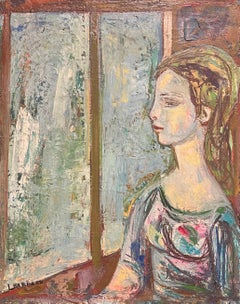
s French Modernist Portrait of Woman by the Window Textured Oil Painting
Located in Cirencester, Gloucestershire
Portrait of a Woman by the Window
French, mid 20th century
signed L. Bernard
oil on canvas, unframed
Canvas : 16 x 13 inches
Provenance: private collection, France
Condition: very go...
Category
Mid-20th Century Modern Portrait Paintings
Materials
Oil, Canvas
1951 Vintage Mid-Century Modern Figurative Portrait Framed Oil Painting - Pose
Located in Bristol, GB
POSE
Size: 80.5 x 41 cm (including frame)
Oil on Canvas
A brilliantly executed modernist style figurative portrait, executed in oil onto canvas and dated 1951.
The composition feat...
Category
Mid-20th Century Modern Portrait Paintings
Materials
Oil, Canvas
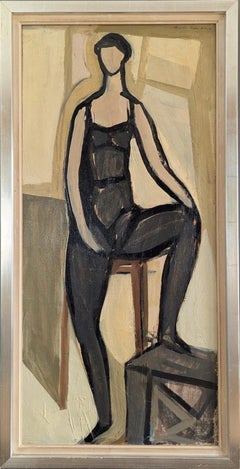
$2,113
H 31.7 in W 16.15 in
1975 Modernist Semi-Abstract Portrait Oil Painting - Figure in the Dark
Located in Bristol, GB
FIGURE IN THE DARK
Size: 49 x 40 cm (including frame)
Oil on canvas
An emotive and expressive semi-abstract figurative portrait, executed in oil onto canvas and dated 1975.
The co...
Category
Mid-20th Century Modern Portrait Paintings
Materials
Oil, Canvas
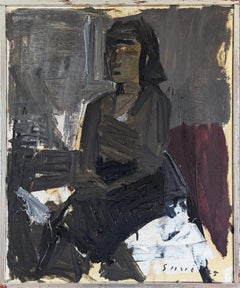
$991
H 19.3 in W 15.75 in
More From This Seller
View AllThe Cyclists Rest Stop in Honfleur
Located in London, GB
'The Cyclists Rest Stop in Honfleur' by Jean-Marie Luc Blanpain, oil on canvas (circa 1970s). The artist's depiction of the terrace of the well known Honfleur restaurant, 'Au Relais ...
Category
1970s Modern Portrait Paintings
Materials
Canvas, Oil
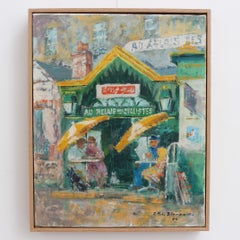
$1,377 Sale Price
20% Off
Portrait of a Man
By Yvonne Guégan
Located in London, GB
'Portrait of a Man', oil on canvas, by Yvonne Guégan (circa 1970s). This is not a portrait of the reclusive billionaire, Howard Hughes. Regrettably, we d...
Category
1970s Modern Portrait Paintings
Materials
Canvas, Oil
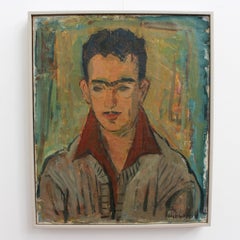
$1,735 Sale Price
40% Off
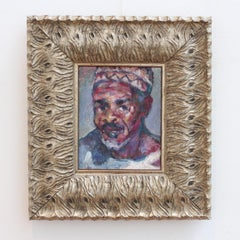
Portrait of Man in Cap
, French School (circa 1960s-70s)
Located in London, GB
'Portrait of Man in Cap', oil on canvas, French School (circa 1960s-70s). This artwork was discovered in the South of France. A splendid portrait it is and is most likely from one of the countries in French-speaking Africa. Most of those countries that speak French are in Western and Central Africa, with others scattered across the continent. Having arrived in Africa from colonial activity, French took on many different forms and maintained use to some degree in nearly two dozen nations. In addition to the continent of Africa, there are many other French speakers...
Category
1960s Portrait Paintings
Materials
Canvas, Oil
$482 Sale Price
50% Off
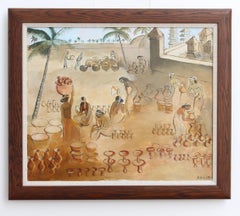
Balinese Pottery Market
Located in London, GB
'Balinese Pottery Market', oil on canvas, by Régine van den Broek d'Obrenan (1931). The artist visited Bali in 1931 (among other islands) with her new husband, Charles. The naive pai...
Category
1930s Figurative Paintings
Materials
Canvas, Oil
$1,349 Sale Price
30% Off
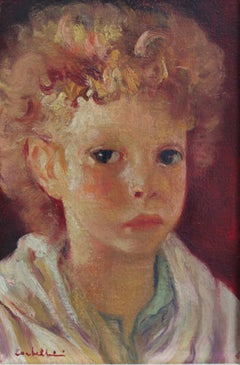
Portrait of Young Boy
By Luigi Corbellini
Located in London, GB
'Portrait of Boy' by Luigi Corbellini (circa 1930s). The artist painted this endearing young boy whose name remains unknown. Perhaps the slightly timid expre...
Category
1930s Portrait Paintings
Materials
Canvas, Oil
$860 Sale Price
50% Off
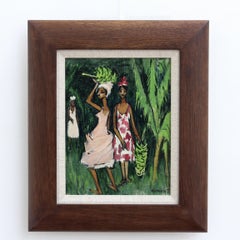
The Banana Plantation Guadeloupe II
Located in London, GB
'The Banana Plantation Guadeloupe II', oil on canvas, by Robert Humblot (1959). The second in a series of artworks completed in 1959 when the artist vis...
Category
1950s Portrait Paintings
Materials
Canvas, Oil
$2,410 Sale Price
30% Off
Still Thinking About These?
All Recently ViewedMore Ways To Browse
Anna Costa
Anna Costa Paintings
Old Master Christ
Shadow Puppets
Social Realism Social Realism Art 1930s And 1940s
Trucks Painting
Vintage Brunette
Hyperrealism Art
Lip Paintings
Michael Golden
Nike Art
Oil Painting Conversation
Oil Paintings Dinner
Oil Paintings Of Children
Roger Dean
African Woman Painting
Ferris Wheel
Jackson Browne