Items Similar to Rare Large Modernist Bronze Sculpture Woman with Bull Bernard Reder
Want more images or videos?
Request additional images or videos from the seller
1 of 14
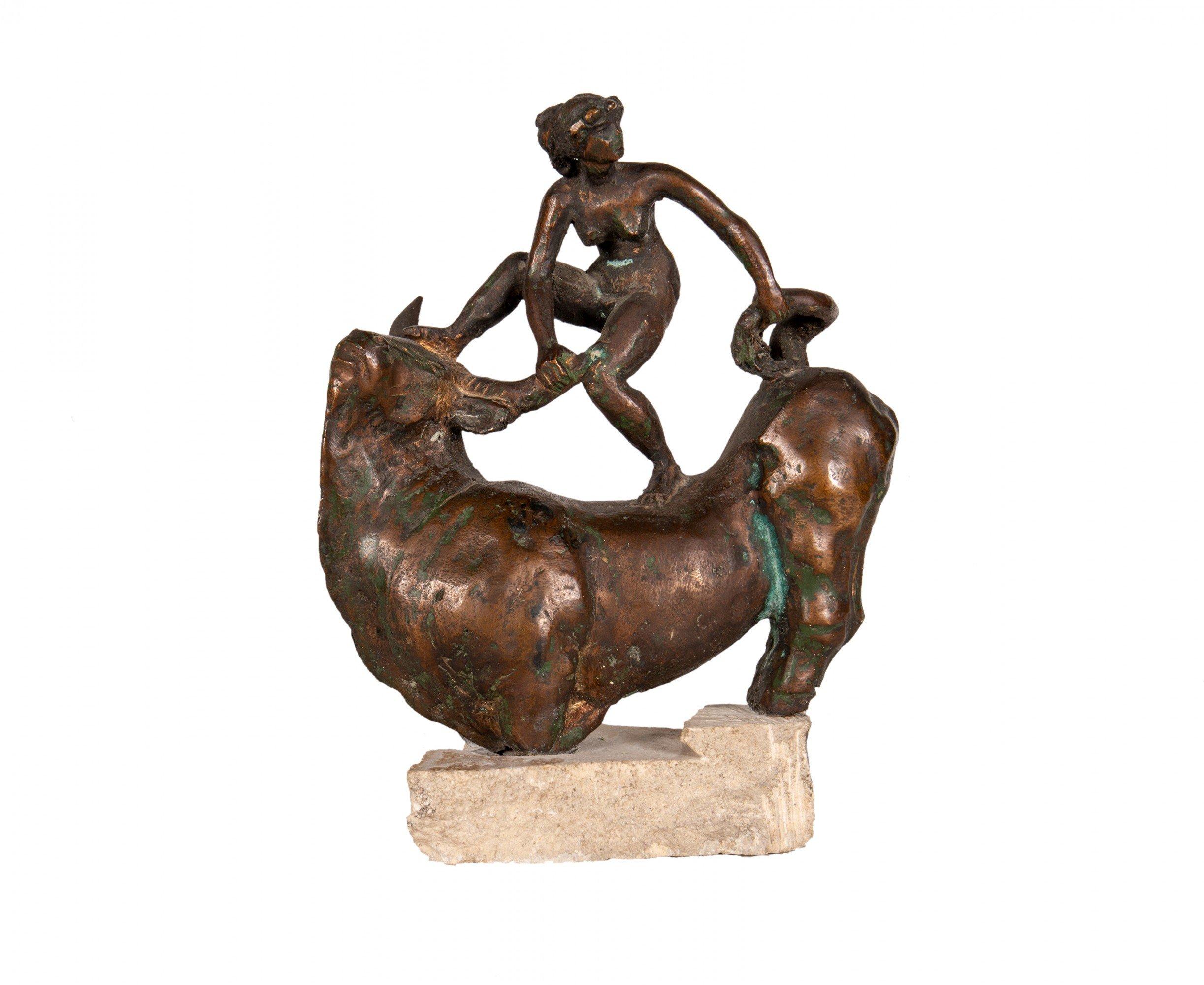
Bernard RederRare Large Modernist Bronze Sculpture Woman with Bull Bernard Reder1957
1957
$6,500
£4,945.55
€5,698.28
CA$9,227.97
A$9,899.96
CHF 5,310.13
MX$119,194.14
NOK 66,940.46
SEK 61,040.42
DKK 42,573.75
About the Item
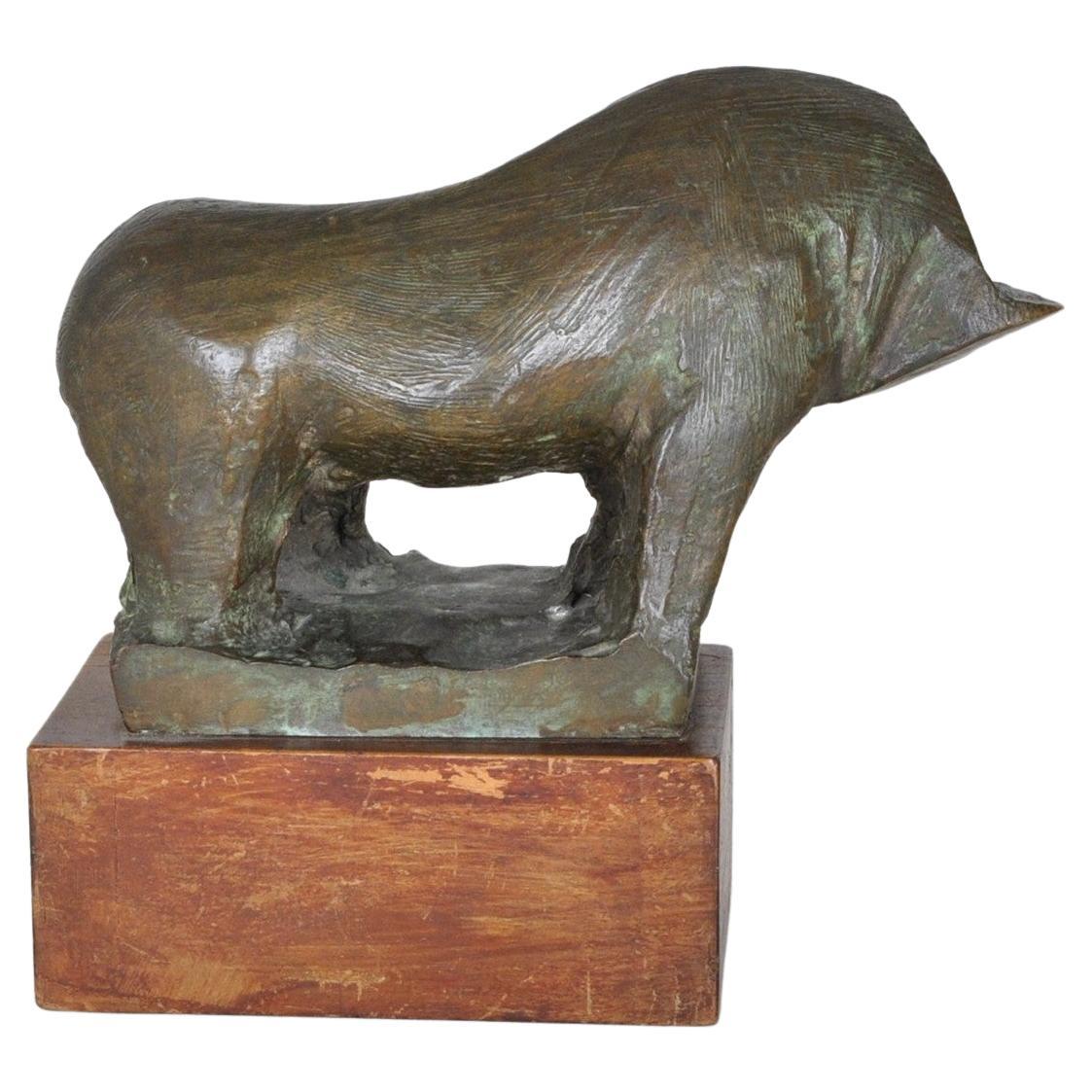
Cow on a trapeze
Signed and dated 1957 marked 2- II (could be from an edition of 2, please see photos)
The sculpture is included in the book titled Sculptures and Woodcuts of Reder by John Rewald.
Bernard Reder (29 June 1897 – 7 September 1963) was an artist, sculptor, etcher, engraver and architect, born in Czernowitz, Bukovina, (Chernivtsi, Bukovina) part of Austria before World War II and a centre of Jewish and Hasidic culture. His subjects were drawn from Jewish folklore, from Greek mythology, the Bible, and also from François Rabelais.
Reder is quoted as having said, "We were born already drunk with fantasy", referring to his early life in Bukovina. The son of a Jewish innkeeper, at 17 he was conscripted into the Austrian army and spend World War I in the trenches. He went on to study at the Academy of Fine Arts in Prague. While working on his sculptures in his spare time, he supported himself by carving cemetery monuments. He moved to Prague in 1930 because of anti-Semitic demonstrations. In 1935 Reder had his first solo exhibition at the gallery of Manes, an association of artists in Prague. This exhibition created a sensation and was widely published by newspapers in Prague, Paris, Wienna and Basel. Most sculptures were sold.
Two years later, in 1937, he moved to Paris and became a good friend of the sculptor and painter Aristide Maillol. In 1940 he exhibited at the Wildenstein Gallery in Paris. Later that year, Reder was forced to flee Paris to escape from the Nazis, and Maillol secured a passage for him and his wife to travel to Spain, where he was imprisoned for illegal entry. On his release, they travelled to Havana, Cuba, where Reder influenced many artists.
All the works in his Paris studio were later destroyed by the Germans. Reder arrived in New York City in 1943, but in 1945 he became partially paralysed by a serious illness, and concentrated more on woodcuts and drawings. He became an American citizen in 1948.
Rader exhibited at the 3rd Sculpture International held in Philadelphia in 1949 and is one of the sculptors in the 70 Sculptors photograph taken there.
He was shown regularly at the Whitney Museum and was shown at the Philadelphia Museum of Art in 1949. In 1954, Reder went to Italy to sculpt in Rome and Florence. In 1956, he was given a one-man exhibition at The Galleria d'Arte Moderno L'Indiano, Florence, which received much attention and acclaim from art historian John Rewald. In 1961 he was given a solo one-man retrospective exhibition show at the Whitney Museum and for the first time in its history the museum devoted three of its floors to a single artist. He is one of the mid century major Jewish artists. A group that included Marc Chagall, Jacques Lipchitz, Ben Shahn, Abraham Rattner, Chaim Gross, Reuven Rubin and Chana Orloff amongst many others. Bernard Reder died in 1963 in New York. His last four years were very productive, producing over thirty-five bronze sculptures. He created many of these directly in wax using a lost-wax casting technique he had learned in Italy.
Galleries
Reder's works are currently held in many collections, including the following:
Whitney Museum of American Art
Museum of Modern Art
National Gallery of Art
Brooklyn Museum
New York Public Library
Art Institute of Chicago
Museu d'Arte Moderna in São Paulo, Brazil
Hofstra University, Long Island, New York
- Creator:Bernard Reder (1897 - 1963)
- Creation Year:1957
- Dimensions:Height: 18 in (45.72 cm)Width: 13 in (33.02 cm)Depth: 12 in (30.48 cm)
- Medium:
- Movement Style:
- Period:
- Condition:
- Gallery Location:Surfside, FL
- Reference Number:Seller: 27891stDibs: LU38212212642
About the Seller
4.9
Platinum Seller
Premium sellers with a 4.7+ rating and 24-hour response times
Established in 1995
1stDibs seller since 2014
1,861 sales on 1stDibs
Typical response time: <1 hour
- ShippingRetrieving quote...Shipping from: Surfside, FL
- Return Policy
More From This Seller
View AllLarge Bronze Modernist Sculpture Acrobats 1/3 French German Artist Gerard Koch
Located in Surfside, FL
Untitled (it depicts acrobats, trapeze artists or gymnasts in mid pose)
bronze cast sculpture
signed and numbered from small edition (1 of 3).
Gerard Koch was a French Post War & C...
Category
20th Century Modern Figurative Sculptures
Materials
Bronze
Large Modernist Bronze Abstract Figural Sculpture "Family" Wolfgang Behl
Located in Surfside, FL
This is a mid 20th century mod abstract large bronze sculpture by Wolfgang Behl (German/American, 1918-1994).
The sculptural group titled "The Family" features a mother and father with two children.
Numbered 20/20. Signed.
21" H x 10 1/4" x 10 1/4
Wolfgang (Johann Wolfgang) Behl (1918 - 1994) was active/lived in Connecticut, Illinois / Germany. Known for Sculpture and as an architectural carver.
A carver,designer, and teacher, Wolfgang Behl was born in Berlin, Germany where he studied at the Berlin Academy of Fine Arts. His teacher was otto Hitzberger, sculptor and architecture carver. I have seen some his work, particularly in carved wood compared to Constantin Brancusi although this one seems way more reminiscent of Alberto Giacometti. In 1939, Behl came to the United States and taught briefly in Pennsylvania at the Perkiomen School and in Rhode Island at the Rhode Island School of Design. There in 1943, he won the Joseph N. Eisendrath prize for sculpture. He also became a friend of Louis Mayer, sculptor from Milwaukee. In 1944, Behl took a job as Art Director at the Lake Forest Academy in Lake Forest, Illinois, and he also began a one-year teaching assignment at the Layton School of Art in Milwaukee.
The last years of his life until his death were in Hartford, Connecticut.
Source: Peter C. Merrill, "German-Immigrant Artists in Early Milwaukee"
Originally from Berlin, Germany, Mr. Behl immigrated to the United States in 1939 and became a citizen in 1947. He studied with Waldemar Raemisch at the Academy of Fine Arts in Berlin, and later at the Rhode Island School of Design.
He began teaching at the Hartford Art School in 1955, retiring in 1983 to devote his time to sculpting. Mr. Behl had exhibitions throughout the United States and Germany. Some of his solo exhibitions include the Arts Exclusive in Simsbury from 1976 to 1981, and the Bertha Schaefer Gallery in New York City from 1950 to 1973. He showed at the New Britain Museum of American Art, in New Britain, Connecticut in 1969. He also had several retrospectives, including one at the Greater Hartford Jewish Community Center in West Hartford until the end of this month. His works in bronze have a German Expressionist quality to them a pathos found in the works of Kathe Kollwitz and the Expressionist movement. He was known for his classically inspired, but often surrealist sculpture. Among his most-well known pieces are a series of sculptures done for the University of Connecticut Health Center. Several examples of Behl’s work are found on the campus of the University of Hartford. He was included in the show Monumentality in Modern Sculpture at the Contemporary Arts Museum Houston, Texas, 1957. Artists featured in the exhibition: Kenneth Armitage, Hans Arp, Ernst Barlach, Wolfgang Behl, Dorothy Dehner, Edgar Degas, José de Rivera, Max Ernst, Alberto Giacometti, Joseph Glasco, Julio González, Paul Granlund...
Category
20th Century Expressionist Figurative Sculptures
Materials
Marble, Bronze
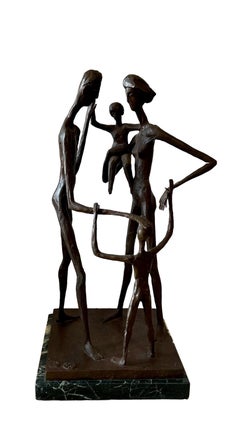
Large Bronze Sculpture "Virtuoso" Figure American Boston Figural Modernist
By David Aronson
Located in Surfside, FL
Aronson, David 1923-
David Aronson, son of a rabbi, was born in Lithuania in 1923 and immigrated to America at the age of five. He settled in Boston, Massachusetts where he studied at the school of the Museum of Fine Arts under Karl Zerbe, a German painter well known in the early 1900s. Aronson later taught at the school of the Museum of Fine Arts for fourteen years and founded the School of Fine Art at Boston University where he is today a professor emeritus. An internationally renowned sculptor & painter, Aronson has won acclaim for his interpretation of themes from the Hebrew Talmud and Kabala. His best known works include bronze castings, encaustic paintings, and pastels. His work is included in many important public and private collections, and has been shown in several museum retrospectives around the country. He is considered to be one of the most important 20th century American artists.
At twenty-two David Aronson had his first one-man show at New York's Niveau Gallery. The next year, six of his Christological paintings were included in the Fourteen Americans exhibition at Manhattan's Museum of Modern Art where Aronson’s work was included alongside abstract expressionists Arshile Gorky, Robert Motherwell and Isamu Noguchi. In the 1950s, Aronson turned more toward his Jewish heritage for the inspiration for his art. Folklore as well as Kabalistic and other transcendental writings influenced his work greatly. The Golem (a legendary figure, brought to life by the Maharal of Prague out of clay to protect the Jewish community during times of persecution) and the Dybbuk (an evil spirit that lodges itself in the soul of a living person until exorcised) frequently appear in his work.
In the sixties, Aronson turned to sculpture. His work during this period is best exemplified by a magnificent 8’ x 4’ bronze door which now stands at the entrance to Frank Lloyd Wright's Johnson Foundation Conference Center for the Arts in Racine, Wisconsin. In the seventies and eighties, Aronson continued his work in pastel drawings, paintings, and sculptures, often exploring religion and the frailties of man's nature. During this time, in addition to a traveling retrospective exhibition and many one-man shows in New York, Los Angeles, Chicago, and Boston at the Pucker-Safrai Gallery on Newbury Street, Aronson won many awards and became a member of the National Academy of Design in New York. Two years ago he retired from teaching to work full-time in his studio in Sudbury, Massachusetts.
included in the catalog
Contemporary Religious Imagery in American Art
Catalog for an exhibition held at the Ringling Museum of Art, March 1-31, 1974.
Artists represented: David Aronson, Leonard Baskin, Max Beckmann, Hyman Bloom, Fernando Botero, Paul Cadmus, Marvin Cherney, Arthur G. Dove, Philip Evergood, Adolph Gottlieb, Jonah Kinigstein, Rico Lebrun, Jack Levine, Louise Nevelson, Barnett Newman, Abraham Rattner, Ben Shahn, Mark Tobey, Max Weber, William Zorach and others.
Selected Awards
1990, Certificate of Merit, National Academy of Design
1976, Purchase Prize, National Academy of Design
1976, Joseph Isidore Gold Medal, National Academy of Design
1976, Purchase Prize in Drawing, Albrecht Art Museum
1975, Isaac N. Maynard Prize for Painting, National Academy of Design
1973, Samuel F. B. Morse Gold Medal, National Academy of Design
1967, Purchase Prize, National Academy of Fine Arts
1967, Adolph and Clara Obrig Prize, National Academy of Design
1963, Gold Medal, Art Directors Club of Philadelphia
1961, 62, 63, Purchase Prize, National Institute of Arts and Letters
1960, John Siimon Guggenheim Fellowship
1958, Grant in Art, National Institute of Arts and Letters
1954, First Prize, Tupperware Annual Art Fund Award
1954, Grand Prize, Third Annual Boston Arts Festival
1953, Second Prize, Second Annual Boston Arts Festival
1952, Grand Prize, First Annual Boston Arts Festival
1946, Traveling Fellowship, School of the Museum of Fine Arts
1946, Purchase Prize, Virginia Museum of Fine Arts
1944, First Popular Prize, Institute of Contemporary Art
1944, First Judge's Prize, Institute of Contemporary Art
Selected Public Collections
Art Institute of Chicago
Virginia Museum of Fine Arts
Bryn Mawr College
Brandeis University
Tupperware Museum, Orlando, Florida
DeCordova Museum
Museum of Modern Art Print Collection, New York
Atlanta University
Atlanta Art...
Category
20th Century Expressionist Figurative Sculptures
Materials
Bronze
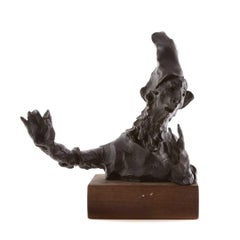
Bronze Sculpture Abstract Brutalist Goat or Ram WPA Artist Mounted on Base
By Benedict Michael Tatti
Located in Surfside, FL
Benedict Tatti (1917-1993) worked in New York city as a sculptor, painter, educator, and video artist. He studied stone and wood carving under Louis Slobodkin at the Roerich Museum. He later attended the Leonardo da Vinci School of Art studying under Attilio Piccirelli. In l939 he taught adult classes with the Teachers Project of the WPA and attended the Art Students League for three and a half years on full scholarship. He studied under William Zorach and Ossip Zadkine and later became Zorach’s assistant. Later in his career, he attended the Hans Hofmann School of Fine Arts. During World War II, Tatti served in the United States Army Air Force, where he spent three years assigned to variety of projects. In 1948, Benedict Tatti married Adele Rosenberg in New York City.
Throughout his career, Tatti continuously experimented with various media. From 1952-1963, Tatti executed sculptural models of architectural and consumer products for the industrial designers, Raymond Loewy Associates; later he became a color consultant for the firm. In the 1960s, influenced by the Abstract Expressionists, Tatti turned from carving directly in wood and stone to creating assemblage architecture sculptures, using bronze metal and other industrial materials.
He was included in the important show "Aspects de la Sculpture Americaine", at Galerie Claude Bernard Paris, France, in October 1960 along with Ibram Lassaw, Theodore Roszak, David Smith, Louise Bourgeois, Danese Corey, Dorothy Dehner, Lin Emery, Lily Ente, David Hayes, Louise Nevelson, Tony Rosenthal, Richard Stankiewicz, Sam Szafran...
Category
Mid-20th Century Abstract Expressionist Abstract Sculptures
Materials
Bronze
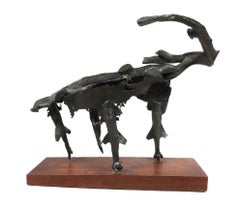
Judaica Bronze Sculpture "Rabbi" Figure Jewish American Boston Figural Modernist
By David Aronson
Located in Surfside, FL
Aronson, David 1923-
David Aronson, son of a rabbi, was born in Lithuania in 1923 and immigrated to America at the age of five. He settled in Boston, Massachusetts where he studied at the school of the Museum of Fine Arts under Karl Zerbe, a German painter well known in the early 1900s. Aronson later taught at the school of the Museum of Fine Arts for fourteen years and founded the School of Fine Art at Boston University where he is today a professor emeritus. An internationally renowned sculptor & painter, Aronson has won acclaim for his interpretation of themes from the Hebrew Talmud and Kabala. His best known works include bronze castings, encaustic paintings, and pastels. His work is included in many important public and private collections, and has been shown in several museum retrospectives around the country. He is considered to be one of the most important 20th century American artists.
At twenty-two David Aronson had his first one-man show at New York's Niveau Gallery. The next year, six of his Christological paintings were included in the Fourteen Americans exhibition at Manhattan's Museum of Modern Art where Aronson’s work was included alongside abstract expressionists Arshile Gorky, Robert Motherwell and Isamu Noguchi. In the 1950s, Aronson turned more toward his Jewish heritage for the inspiration for his art. Folklore as well as Kabalistic and other transcendental writings influenced his work greatly. The Golem (a legendary figure, brought to life by the Maharal of Prague out of clay to protect the Jewish community during times of persecution) and the Dybbuk (an evil spirit that lodges itself in the soul of a living person until exorcised) frequently appear in his work.
In the sixties, Aronson turned to sculpture. His work during this period is best exemplified by a magnificent 8’ x 4’ bronze door which now stands at the entrance to Frank Lloyd Wright's Johnson Foundation Conference Center for the Arts in Racine, Wisconsin. In the seventies and eighties, Aronson continued his work in pastel drawings, paintings, and sculptures, often exploring religion and the frailties of man's nature. During this time, in addition to a traveling retrospective exhibition and many one-man shows in New York, Los Angeles, Chicago, and Boston at the Pucker-Safrai Gallery on Newbury Street, Aronson won many awards and became a member of the National Academy of Design in New York. Two years ago he retired from teaching to work full-time in his studio in Sudbury, Massachusetts.
included in the catalog
Contemporary Religious Imagery in American Art
Catalog for an exhibition held at the Ringling Museum of Art, March 1-31, 1974.
Artists represented: David Aronson, Leonard Baskin, Max Beckmann, Hyman Bloom, Fernando Botero, Paul Cadmus, Marvin Cherney, Arthur G. Dove, Philip Evergood, Adolph Gottlieb, Jonah Kinigstein, Rico Lebrun, Jack Levine, Louise Nevelson, Barnett Newman, Abraham Rattner, Ben Shahn, Mark Tobey, Max Weber, William Zorach and others.
Selected Awards
1990, Certificate of Merit, National Academy of Design
1976, Purchase Prize, National Academy of Design
1976, Joseph Isidore Gold Medal, National Academy of Design
1976, Purchase Prize in Drawing, Albrecht Art Museum
1975, Isaac N. Maynard Prize for Painting, National Academy of Design
1973, Samuel F. B. Morse Gold Medal, National Academy of Design
1967, Purchase Prize, National Academy of Fine Arts
1967, Adolph and Clara Obrig Prize, National Academy of Design
1963, Gold Medal, Art Directors Club of Philadelphia
1961, 62, 63, Purchase Prize, National Institute of Arts and Letters
1960, John Siimon Guggenheim Fellowship
1958, Grant in Art, National Institute of Arts and Letters
1954, First Prize, Tupperware Annual Art Fund Award
1954, Grand Prize, Third Annual Boston Arts Festival
1953, Second Prize, Second Annual Boston Arts Festival
1952, Grand Prize, First Annual Boston Arts Festival
1946, Traveling Fellowship, School of the Museum of Fine Arts
1946, Purchase Prize, Virginia Museum of Fine Arts
1944, First Popular Prize, Institute of Contemporary Art
1944, First Judge's Prize, Institute of Contemporary Art
Selected Public Collections
Art Institute of Chicago
Virginia Museum of Fine Arts
Bryn Mawr College
Brandeis University
Tupperware Museum, Orlando, Florida
DeCordova Museum
Museum of Modern Art Print Collection, New York
Atlanta University
Atlanta Art...
Category
20th Century Expressionist Figurative Sculptures
Materials
Bronze
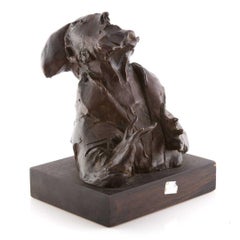
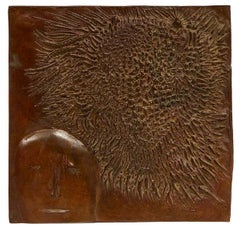
Bronze Sculpture Figure with Beast American Modernist Leonard Baskin Museum Art
By Leonard Baskin
Located in Surfside, FL
Leonard Baskin, American 1922-2000
Homage to the Un-American Activities Committee
Bronze relief sculpture plaque
This is not editioned, nor signed or numbered, on the piece but according to the catalog there was 12 or less.
A number of these are in museum and university art collections and one of them was exhibited at MoMA NY.
This was done to commemorate the communist witch hunts of the Mccarthy era. An important, historic piece.
Leonard Baskin (August 15, 1922 – June 3, 2000) was an American sculptor, illustrator, wood-engraver, printmaker, graphic artist, writer and teacher.
Baskin was born in New Brunswick, New Jersey. While he was a student at Yale University, he founded Gehenna Press, a small private press specializing in fine, small edition, book production. From 1953 until 1974, he taught printmaking and sculpture at Smith College in Northampton, Massachusetts. Subsequently Baskin also taught at Hampshire College in Amherst, Massachusetts.
He lived most of his life in the U.S., but spent nine years in Devon at Lurley Manor, Lurley, near Tiverton, close to his friend Ted Hughes, for whom he illustrated Crow. Sylvia Plath dedicated Sculpto to Leonard Baskin in her famous work, The Colossus and Other Poems (1960).
The Funeral Cortege (1997) bronze, Franklin Delano Roosevelt Memorial, Washington, D.C.
His public commissions include a bas relief for the Franklin Delano Roosevelt Memorial and a bronze statue of a seated figure, erected in 1994 for the Holocaust Memorial in Ann Arbor, Michigan.
His works are owned by many major museums including the Metropolitan Museum of Art, the Museum of Fine Arts, Boston, the Museum of Modern Art, the Art Institute of Chicago, the Boca Raton Museum of Art, the British Museum, the Honolulu Museum of Art, the Udinotti Museum of Figurative Art and the Vatican Museums. The archive of his signed work at the Gehenna Press was acquired by the Bodleian Library at Oxford, England, in 2009. The McMaster Museum of Art in Hamilton, Ontario owns over 200 of his works (some religious and biblical), most of which were donated by his brother Rabbi Bernard Baskin.
Contemporary Religious Imagery in American Art. Catalog for an exhibition held at the Ringling Museum of Art, March 1-31, 1974. Artists represented: David Aronson, Leonard Baskin, Max Beckmann, Hyman Bloom, Fernando Botero, Paul Cadmus, Marvin Cherney, Arthur G. Dove, Philip Evergood, Adolph Gottlieb, Jonah Kinigstein, Arman, Rico Lebrun, Jack Levine, Louise Nevelson, Barnett Newman, Abraham Rattner, Ben Shahn, Mark Tobey, Max Weber, William Zorach and others.In 1955, he was one of eleven New York artists featured in the opening exhibition at the Terrain Gallery, they showed many great artists, Chaim Koppelman, for many years, headed the gallery's Print Division; printmakers such as Will Barnet, Leonard Baskin, Robert Conover...
Category
1950s Modern Figurative Sculptures
Materials
Bronze
You May Also Like
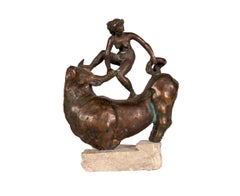
20th Century Continental School Bronze Figure of Europa and the Bull
Located in Beachwood, OH
20th Century Continental School
Europa
Bronze on stone base
11 in. h. x 8.5 in. w. x 4.5 in. d., overall
Inspired by the Greek myth Europa and the Bull
Phoenician princess abducted to Crete by Zeus...
Category
20th Century Figurative Sculptures
Materials
Stone, Bronze
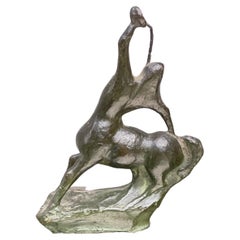
Europa en de Stier 1 Europ and the Bull Mythology Bronze Sculpture In Stock
By Evert den Hartog
Located in Utrecht, NL
Europa en de Stier 1 Europ and the Bull Mythology Bronze Sculpture In Stock
Evert den Hartog (born in Groot-Ammers, The Netherlands in 1949) followed...
Category
21st Century and Contemporary Contemporary Figurative Sculptures
Materials
Bronze
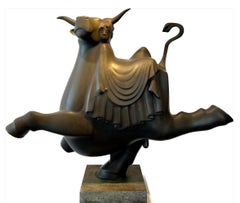
Scultura Bronzo Raffigurazione Minotauro, Artista Ignoto, 1940, 40s, Bronzo
Located in Milano, MI
Scultura bronzo raffigurazione minotauro - artista ignoto - 1940 - 40s - bronzo
Descrizione :
Scultura in bronzo rappresentante un Minotauro
Ar...
Category
Vintage 1940s Italian Animal Sculptures
Materials
Bronze
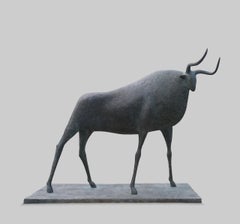
Monumental Bull I by Pierre Yermia - Animal bronze art, outdoor sculpture
By Pierre Yermia
Located in Paris, FR
Monumental Bull I is a bronze sculpture by French contemporary artist Pierre Yermia, dimensions are 197 × 250 × 120 cm (77.6 × 98.4 × 47.2 in).
The sculpture is signed and numbered,...
Category
2010s Contemporary Figurative Sculptures
Materials
Bronze
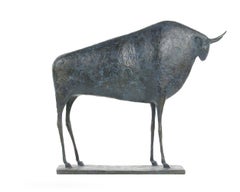
Bull VI by Pierre Yermia - contemporary bronze, animal sculpture
By Pierre Yermia
Located in Paris, FR
Bull VI (Taureau VI) by French contemporary artist Pierre Yermia. Bronze sculpture, 54 × 47 × 15 cm.
Signed and numbered. Limited edition of 8 copies and 4 artist's proofs.
"The bull...
Category
2010s Contemporary Figurative Sculptures
Materials
Bronze
Headless Animal, Bronze Sculpture, 50s/60s
Located in MARSEILLE, FR
Curious patinated bronze sculpture of a headless animal
Wooden base
Good condition
Sculpture from the 1950s/1960s
Height 22cm
22 x 10.5cm.
Category
Mid-20th Century French Modern Animal Sculptures
Materials
Bronze