Items Similar to 1947 Expressionist Oil Painting Flute Player Musician Boris Deutsch WPA Artist
Want more images or videos?
Request additional images or videos from the seller
1 of 15
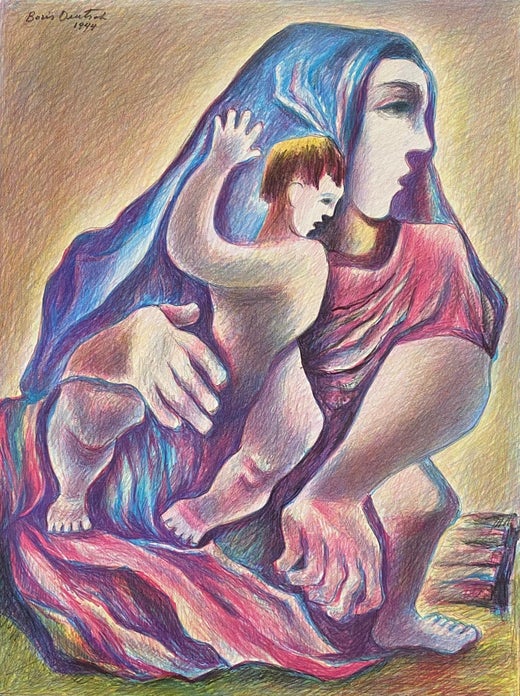
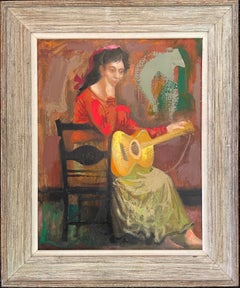
Boris Deutsch1947 Expressionist Oil Painting Flute Player Musician Boris Deutsch WPA Artist1947
1947
$5,500
£4,192.20
€4,835.26
CA$7,811.64
A$8,394.43
CHF 4,504.10
MX$98,881.30
NOK 56,634.07
SEK 51,734.86
DKK 36,136.82
About the Item
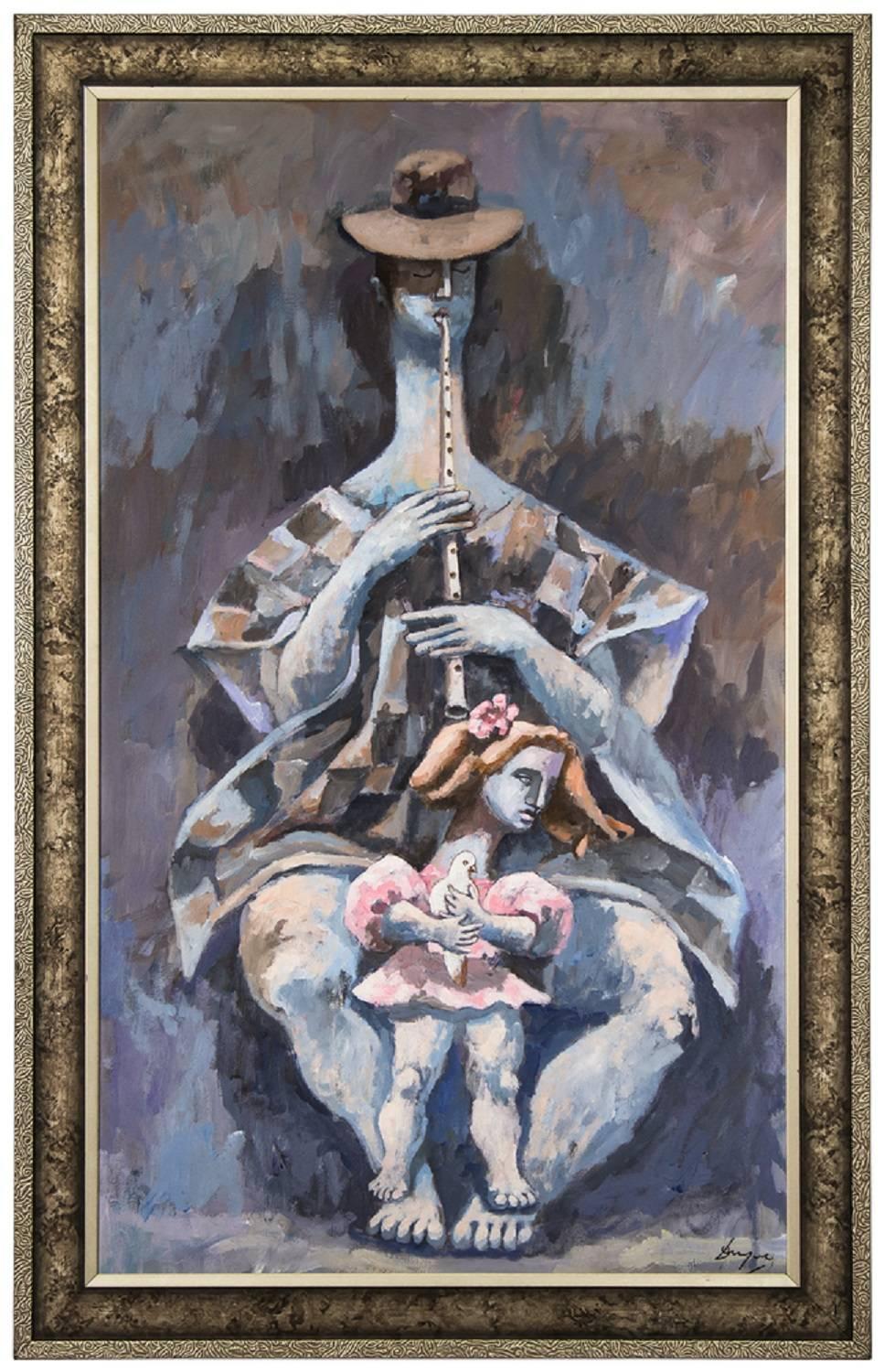
Boris Deutsch (American Lithuanian Russian, 1892-1978)
"The Flute Player," 1947
Oil paint on canvas,
Hand signed and dated upper left,
Provenance: gallery label (Pasadena Art Museum) verso, (deaccessioned)
Dimensions overall (with frame): 36"h x 31"w (canvas is about 24 X 20)
Expressionist portrait painting of flute player.
Boris Deutsch was a modernist figurative painter important in Southern California during the 1930s and 1940s. Before immigrating from Russia, he studied briefly in Riga, Lithuania at the art academy and with a commercial artist, and in 1912 he attended the Kunstgewerbemuseum, Berlin. After coming to the United States he spent three years in Seattle before settling in Los Angeles. He began exhibiting in 1922 and was one of the four organizers of the Group of Independent Artists exhibition in 1923 at the MacDowell Women’s Club in Los Angeles, the West Coast equivalent of the Armory Show. Deutsch was given his first solo exhibition in 1926 by the Los Angeles Museum and thereafter had numerous exhibitions in other cities, including a solo exhibition in New York in 1933. At times he supported himself by working as a commercial artist and set designer for motion pictures. He received numerous mural commissions sponsored by the New Deal projects, winning in 1941 the large competition to decorate the Terminal Annex Post Office in Los Angeles.
Boris Deutsch was born in Krasnogorsk Lithuania june 4 1892 died in Los Angeles, California 1978. His work marries the social protest of Pablo Picasso to the humanism of Georges Rouault. Deutch entered the polytechnic school in Riga, Latvia in 1905. School of applied arts Berlin, Germany in 1912. Settled in L.A. 1919 married Riva Segal 1924. Solo show U.C.L.A. 1926. Exhibited palace of the legion of honor San Francisco 1930. Works for the resettlement administration (WPA) 1936. Oakland art gallery annual exhibition guest of honor 1937. Exhibition at U.S.C. 1939. Post office murals for the treasury dept and downtown main post office major murals 1941-1944. Teaches at Otis art institute L.A. 1944-1950. First price in Pepsi Cola competition for his painting "What atomic war will do to you" 1946 collection of the Whitney museum N.Y. Exhibited westside jewish community center L.A. 1966. Chagall calls him the greatest jewish artist of our time 1955. The legacy of Boris Deutsch a centennial exhibition by the Judah l. Magnes museum berkeley ca. May 24 -sept.20 1992. This is the most important jewish subject painting by this great artist painted in 1947 it resembles a William Gropper, Marc Chagall or Issachar Ber Ryback work of art very art deco in style. He painted scenes from depression era California and from the Jewish shtetl of his youth in particular Klezmer musicians. A painting of his wife Riva sold at butterfields auction for 17000 dollars a painting of three girls sold at sotheby's in 1982 for 32.000.
He has been exhibited with Judaica artists from around the world. Ephraim Moshe Lilien in Vienna, Joseph Budko, Hermann Struck and Jakob Steinhardt in Berlin and Marc Chagall in Paris, Jankel Adler, Benn, Boris Deutsch, Todros Geller, Henryk Glicenstein, Chaim Goldberg, Chaim Gross, Arthur Kolnik, Ilya Schor, Jacques Zucker and Frank Meisler. In Russia Deutsch had studied for the rabbinate, and his Jewish heritage furnished him with subject matter and endowed his art with an emotional intensity. His first major series, on contemporary Jewish life, revealed a brooding, contemplative aspect and reflected his Talmudic studies. In the 1930s he began painting portraits of his wife, exploring the emotional power of form and color. In 1946 he won the third annual Pepsi-Cola Art Competition with his What Atomic War Will Do to You, 1946 (Magnes Museum, Berkeley). Late in life he turned to printmaking and experimented with monotypes.
- Creator:Boris Deutsch (1892-1978, American)
- Creation Year:1947
- Dimensions:Height: 36 in (91.44 cm)Width: 31 in (78.74 cm)
- Medium:
- Movement Style:
- Period:
- Condition:minor wear.
- Gallery Location:Surfside, FL
- Reference Number:1stDibs: LU38213029192
Boris Deutsch
Boris Deutsch (1892-1978) was a 20th century modernist figurative painter and printmaker. He was born in Krasnagorka, Lithuania on June 4, 1892. Deutsch began drawing at age five and remained a self-taught artist, except for brief intervals at the Bloom Academy of Art in Riga, Latvia and the Kunstgewerbe Schule in Berlin. He moved to Seattle, WA in 1916 and then to Los Angeles in 2019. He began his career as a commercial art and set designer for movies. In the late 1930's he was recruited to paint murals for the New Deal, WPA, receiving numerous mural commissions to paint murals for the treasury department and several post office buildings. In 1941 he won the large competition to decorate the Terminal Annex Post Office in Los Angeles with eleven large murals. During the last decade of his life he experimented with monotypes and other printmaking techniques. Deutsch died in Los Angeles on Jan. 16, 1978. Boris Deutsch's art has been the focus of many exhibitions, including: The University of California, Los Angeles in 1926, The Palace of the Legion of Honor in San Francisco in 1930, Oakland Art Gallery in 1937, The University of Southern California (USC) in 1939, The Whitney Museum in New York in 1946 and a centennial exhibition by the Judah l. Magnes Museum in Berkeley California in 1992. In 1955, Marc Chagall called him the greatest Jewish artist of our time. Deutch's works are held by several institutions and museums, including the Smithsonian American Art Museum, the Metropolitan Museum of Art, the San Francisco Museum of Modern Art, the Los Angeles County Museum of Art, the San Diego Museum of Art, the Scribal Museum, the Judah L. Magnes Museum Berkeley, California, and the Pomona College Museum of Art.
About the Seller
4.9
Platinum Seller
Premium sellers with a 4.7+ rating and 24-hour response times
Established in 1995
1stDibs seller since 2014
1,863 sales on 1stDibs
Typical response time: <1 hour
- ShippingRetrieving quote...Shipping from: Surfside, FL
- Return Policy
More From This Seller
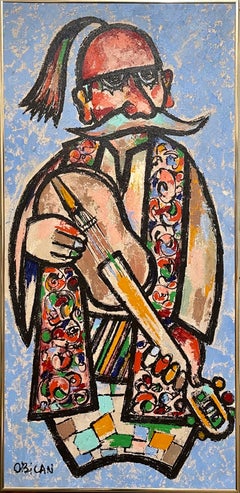
View AllLarge Naive European Folk Art Oil Painting Jovan Obican Klezmer Jazz Musician
By Jovan Obican
Located in Surfside, FL
Genre: Other
Subject: People
Medium: Oil
Surface: Canvas
Dimensions: 35" x 16.5
Dimensions w/Frame: 35.5" x 17.25
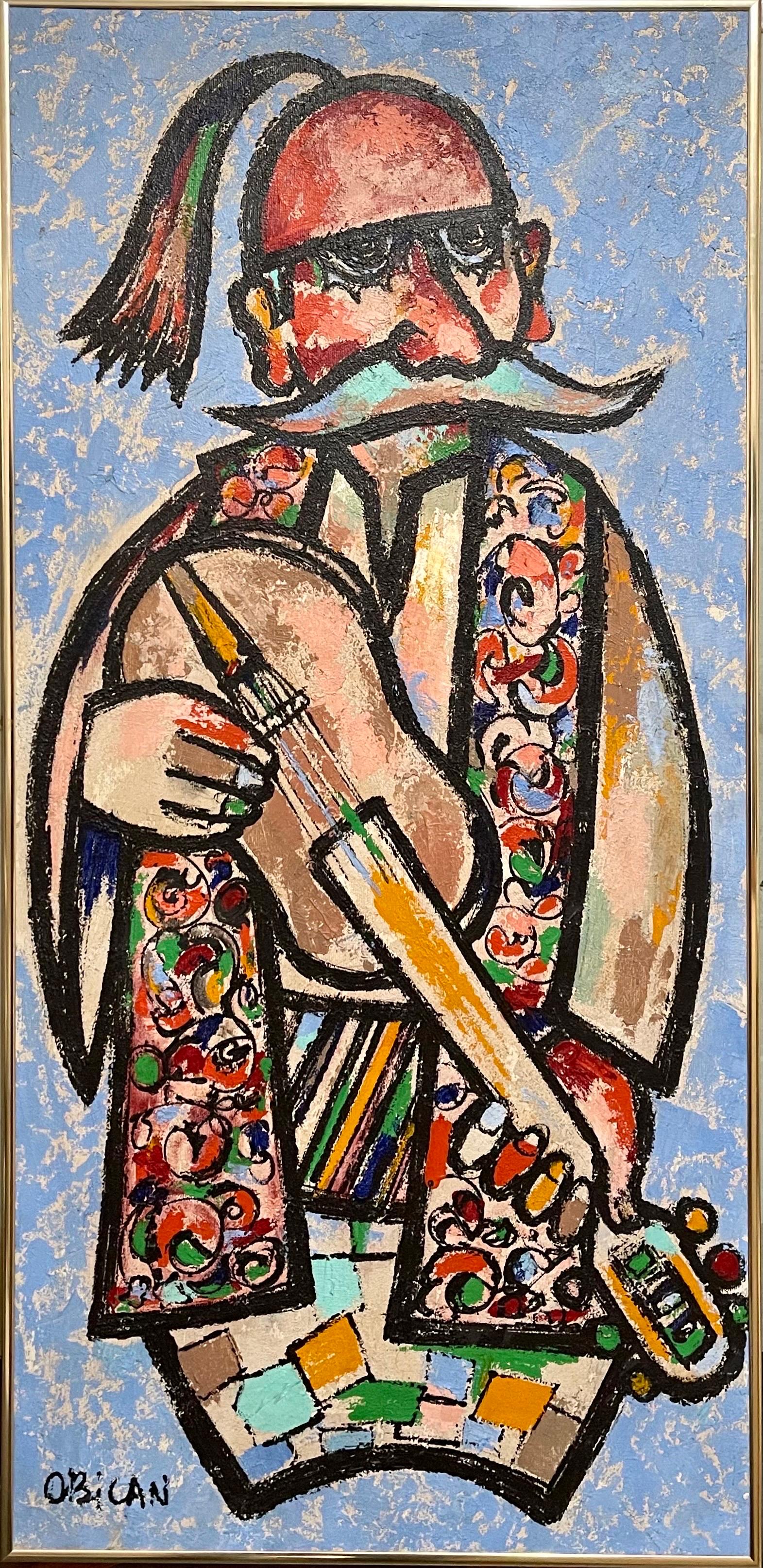
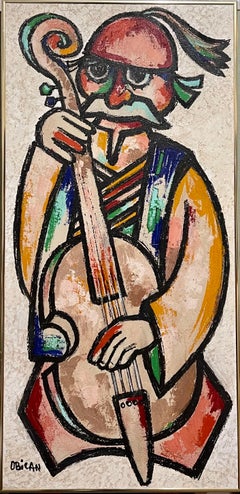
This depicts a Jazz or Klezmer musician. This one is a banjo or guitar player.
The last photo shows it in a group of three that I have available. This listing is for the one painting.
The artist Jovan Obican iconic style is child-like yet masterfully adult; a style that tells a story with sociological overtones. His funny little people are always colorful, full of spirit, living with music and birds to bring them happiness.
JOVAN OBICAN
Cannes, France, b. 1918, d. 1986
Jovan Obican (1918-1986) artist, painter, sculpture and mosaic ceramic artisan was born in Cannes, France, to his Yugoslavian parents. From childhood on, Jovan practically devoted himself to art, scratching designs into the dirt when paper was unavailable. He trained with many recognized teachers and with many styles. He finished his training, imbued with the spirit of his native country, the people, their legends, and their philosophy. It has been said that his work has a "timeless quality" and a naive, folk art, outsider art brut quality, child-like primitive style. Obican is identified with his style the world over, a style that is simple yet sophisticated; child-like yet masterfully adult; a style that tells a story with psychological, philosophical or sociological overtones. His funny little people are always colorful, full of spirit, living with music and birds to bring them happiness. Best known for his depictions of folklore and traditional costumes rendered in a playful, childlike style and for his happy Jewish wedding scenes. He often used bright colors and black outlines in his renderings of figures and animals, giving his work an illustration-like quality. Thematically, the artist’s work is similar to Marc Chagall and Jean Dubuffet for its dreamlike images and so-called naïve style of painting. Over the course of his career, the artist maintained a studio in Boca Raton, Florida and Dubrovnik, Croatia—part of former Yugoslavia— where he developed an interest in Eastern Europe’s Jewish culture. Many of his mature works depict Jewish traditions and ceremonies, including traditional Jewish weddings, the dancing of the Hora, and traditional music. There is a display of his works in his former Dubrovnik studio.
His style is a unique conglomerate of tradition, history, legends, heroes, old customs and folklore. It is a self-standing style, recognizable, cheerful, whimsical and a happy creation. Naïve art is any form of visual art that is created by a person who lacks the formal education and training that a professional artist undergoes (in anatomy, art history, technique, perspective, ways of seeing). Unlike folk art, naïve art does not necessarily evince a distinct cultural context or tradition. Naïve art is recognized, and often imitated, for its childlike simplicity and frankness. Paintings of this kind typically have a flat rendering style with a rudimentary expression of perspective.
One particularly influential painter of "naïve art" was Henri Rousseau (1844–1910), a French Post-Impressionist who was discovered by Pablo Picasso. Naïve art is often seen as outsider art that is by someone without formal (or little) training or degree. While this was true before the twentieth century, there are now academies for naïve art. Naïve art is now a fully recognized art genre, represented in art galleries worldwide.
Museums devoted to naïve art now exist in Kecskemét, Hungary; Riga, Latvia; Jaen, Spain; Rio de Janeiro, Brasil; Vicq France and Paris. "Primitive art" is another term often applied to art by those without formal training, but is historically more often applied to work from certain cultures that have been judged socially or technologically "primitive" by Western academia, such as Native American, sub saharan African or Pacific Island art (see Tribal art). This is distinguished from the self-conscious, "primitive" inspired movement primitivism. Another term related to (but not completely synonymous with) naïve art is folk art. There also exist the terms "naïvism" and "primitivism" which are usually applied to professional painters working in the style of naïve art (like Paul Gauguin, Mikhail Larionov, Paul Klee).
At all events, naive art can be regarded as having occupied an "official" position in the annals of twentieth-century art since - at the very latest - the publication of the Der Blaue Reiter, an almanac in 1912. Wassily Kandinsky and Franz Marc, who brought out the almanac, presented 6 reproductions of paintings by le Douanier' Rousseau (Henri Rousseau), comparing them with other pictorial examples. However, most experts agree that the year that naive art was "discovered" was 1885, when the painter Paul Signac became aware of the talents of Henri Rousseau and set about organizing exhibitions of his work in a number of prestigious galleries. The Earth Group (Grupa Zemlja) were Croatian artists, architects and intellectuals active in Zagreb from 1929 to 1935. The group included the painters Krsto Hegedušić, Edo Kovačević, Omer Mujadžić, Kamilo Ružička, Ivan Tabaković, and Oton Postružnik, the sculptors Antun Augustinčić, Frano Kršinić, and the architect Drago Ibler. A term applied to Yugoslav (Croatian) naive painters working in or around the village of Hlebine, near the Hungarian border, from about 1930. Some of the best known naive artists are Dragan Gaži, Ivan Generalić, Josip Generalić, Krsto Hegedušić, Mijo Kovačić, Ivan Lacković-Croata, Franjo Mraz, Ivan Večenaj and Mirko Virius. Camille Bombois (1883–1970) Ferdinand Cheval, known as 'le facteur Cheval' (1836–1924) Henry Darger (1892–1973) L. S. Lowry (1887–1976) Grandma Moses, Anna Mary Robertson...
Category
20th Century Folk Art Figurative Paintings
Materials
Canvas, Oil
Large Naive European Folk Art Oil Painting Jovan Obican Klezmer Jazz Musician
By Jovan Obican
Located in Surfside, FL
Genre: Other
Subject: People
Medium: Oil
Surface: Canvas
Dimensions: 35" x 16.5
Dimensions w/Frame: 35.5" x 17.25
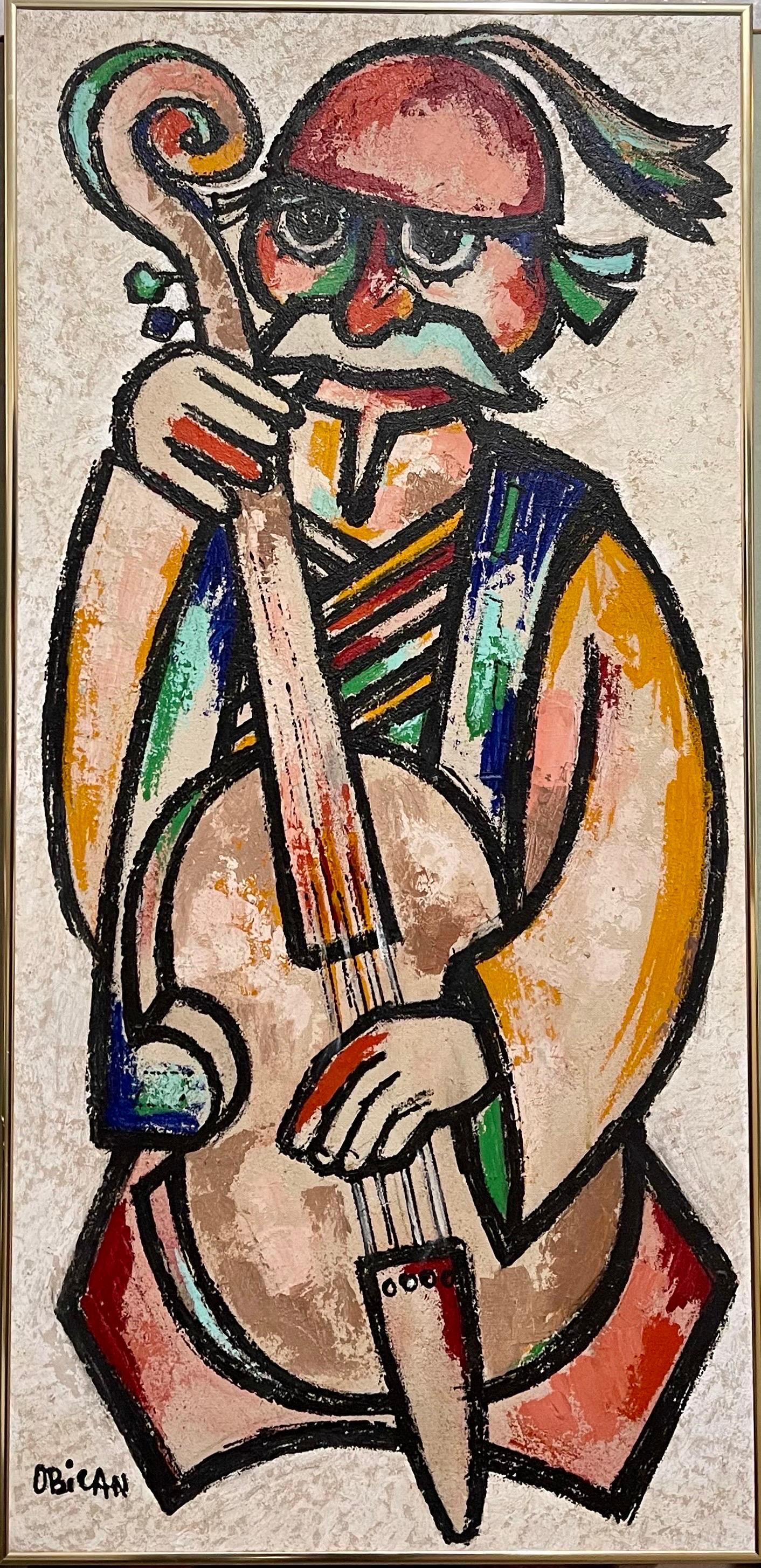
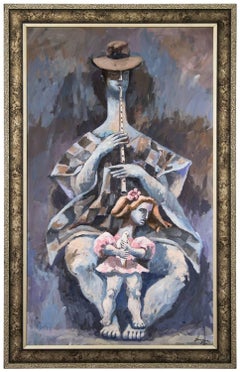
This depicts a Jazz or Klezmer musician. This one is a bass player.
The last photo shows it in a group of three that I have available. This listing is for the one painting.
The artist Jovan Obican iconic style is child-like yet masterfully adult; a style that tells a story with sociological overtones. His funny little people are always colorful, full of spirit, living with music and birds to bring them happiness.
JOVAN OBICAN
Cannes, France, b. 1918, d. 1986
Jovan Obican (1918-1986) artist, painter, sculpture and mosaic ceramic artisan was born in Cannes, France, to his Yugoslavian parents. From childhood on, Jovan practically devoted himself to art, scratching designs into the dirt when paper was unavailable. He trained with many recognized teachers and with many styles. He finished his training, imbued with the spirit of his native country, the people, their legends, and their philosophy. It has been said that his work has a "timeless quality" and a naive, folk art, outsider art brut quality, child-like primitive style. Obican is identified with his style the world over, a style that is simple yet sophisticated; child-like yet masterfully adult; a style that tells a story with psychological, philosophical or sociological overtones. His funny little people are always colorful, full of spirit, living with music and birds to bring them happiness. Best known for his depictions of folklore and traditional costumes rendered in a playful, childlike style and for his happy Jewish wedding scenes. He often used bright colors and black outlines in his renderings of figures and animals, giving his work an illustration-like quality. Thematically, the artist’s work is similar to Marc Chagall and Jean Dubuffet for its dreamlike images and so-called naïve style of painting. Over the course of his career, the artist maintained a studio in Boca Raton, Florida and Dubrovnik, Croatia—part of former Yugoslavia— where he developed an interest in Eastern Europe’s Jewish culture. Many of his mature works depict Jewish traditions and ceremonies, including traditional Jewish weddings, the dancing of the Hora, and traditional music. There is a display of his works in his former Dubrovnik studio.
His style is a unique conglomerate of tradition, history, legends, heroes, old customs and folklore. It is a self-standing style, recognizable, cheerful, whimsical and a happy creation. Naïve art is any form of visual art that is created by a person who lacks the formal education and training that a professional artist undergoes (in anatomy, art history, technique, perspective, ways of seeing). Unlike folk art, naïve art does not necessarily evince a distinct cultural context or tradition. Naïve art is recognized, and often imitated, for its childlike simplicity and frankness. Paintings of this kind typically have a flat rendering style with a rudimentary expression of perspective.
One particularly influential painter of "naïve art" was Henri Rousseau (1844–1910), a French Post-Impressionist who was discovered by Pablo Picasso. Naïve art is often seen as outsider art that is by someone without formal (or little) training or degree. While this was true before the twentieth century, there are now academies for naïve art. Naïve art is now a fully recognized art genre, represented in art galleries worldwide.
Museums devoted to naïve art now exist in Kecskemét, Hungary; Riga, Latvia; Jaen, Spain; Rio de Janeiro, Brasil; Vicq France and Paris. "Primitive art" is another term often applied to art by those without formal training, but is historically more often applied to work from certain cultures that have been judged socially or technologically "primitive" by Western academia, such as Native American, sub saharan African or Pacific Island art (see Tribal art). This is distinguished from the self-conscious, "primitive" inspired movement primitivism. Another term related to (but not completely synonymous with) naïve art is folk art. There also exist the terms "naïvism" and "primitivism" which are usually applied to professional painters working in the style of naïve art (like Paul Gauguin, Mikhail Larionov, Paul Klee).
At all events, naive art can be regarded as having occupied an "official" position in the annals of twentieth-century art since - at the very latest - the publication of the Der Blaue Reiter, an almanac in 1912. Wassily Kandinsky and Franz Marc, who brought out the almanac, presented 6 reproductions of paintings by le Douanier' Rousseau (Henri Rousseau), comparing them with other pictorial examples. However, most experts agree that the year that naive art was "discovered" was 1885, when the painter Paul Signac became aware of the talents of Henri Rousseau and set about organizing exhibitions of his work in a number of prestigious galleries. The Earth Group (Grupa Zemlja) were Croatian artists, architects and intellectuals active in Zagreb from 1929 to 1935. The group included the painters Krsto Hegedušić, Edo Kovačević, Omer Mujadžić, Kamilo Ružička, Ivan Tabaković, and Oton Postružnik, the sculptors Antun Augustinčić, Frano Kršinić, and the architect Drago Ibler. A term applied to Yugoslav (Croatian) naive painters working in or around the village of Hlebine, near the Hungarian border, from about 1930. Some of the best known naive artists are Dragan Gaži, Ivan Generalić, Josip Generalić, Krsto Hegedušić, Mijo Kovačić, Ivan Lacković-Croata, Franjo Mraz, Ivan Večenaj and Mirko Virius. Camille Bombois (1883–1970) Ferdinand Cheval, known as 'le facteur Cheval' (1836–1924) Henry Darger (1892–1973) L. S. Lowry (1887–1976) Grandma Moses, Anna Mary Robertson...
Category
20th Century Folk Art Figurative Paintings
Materials
Canvas, Oil
The Musician, Large Lating American Modernist Oil Paintng
By Alexis Duque
Located in Surfside, FL
Alexis Duque
Imaginatively charting the psychological experience of space, Alexis Duque produces paintings and drawings of buildings and domestic interiors stacked and conglomerated ...
Category
21st Century and Contemporary Contemporary Figurative Paintings
Materials
Canvas, Acrylic
Large Naive European Folk Art Oil Painting Jovan Obican Klezmer Jazz Musician
By Jovan Obican
Located in Surfside, FL
Genre: Other
Subject: People
Medium: Oil
Surface: Canvas
Dimensions: 35" x 16.5
Dimensions w/Frame: 35.5" x 17.25
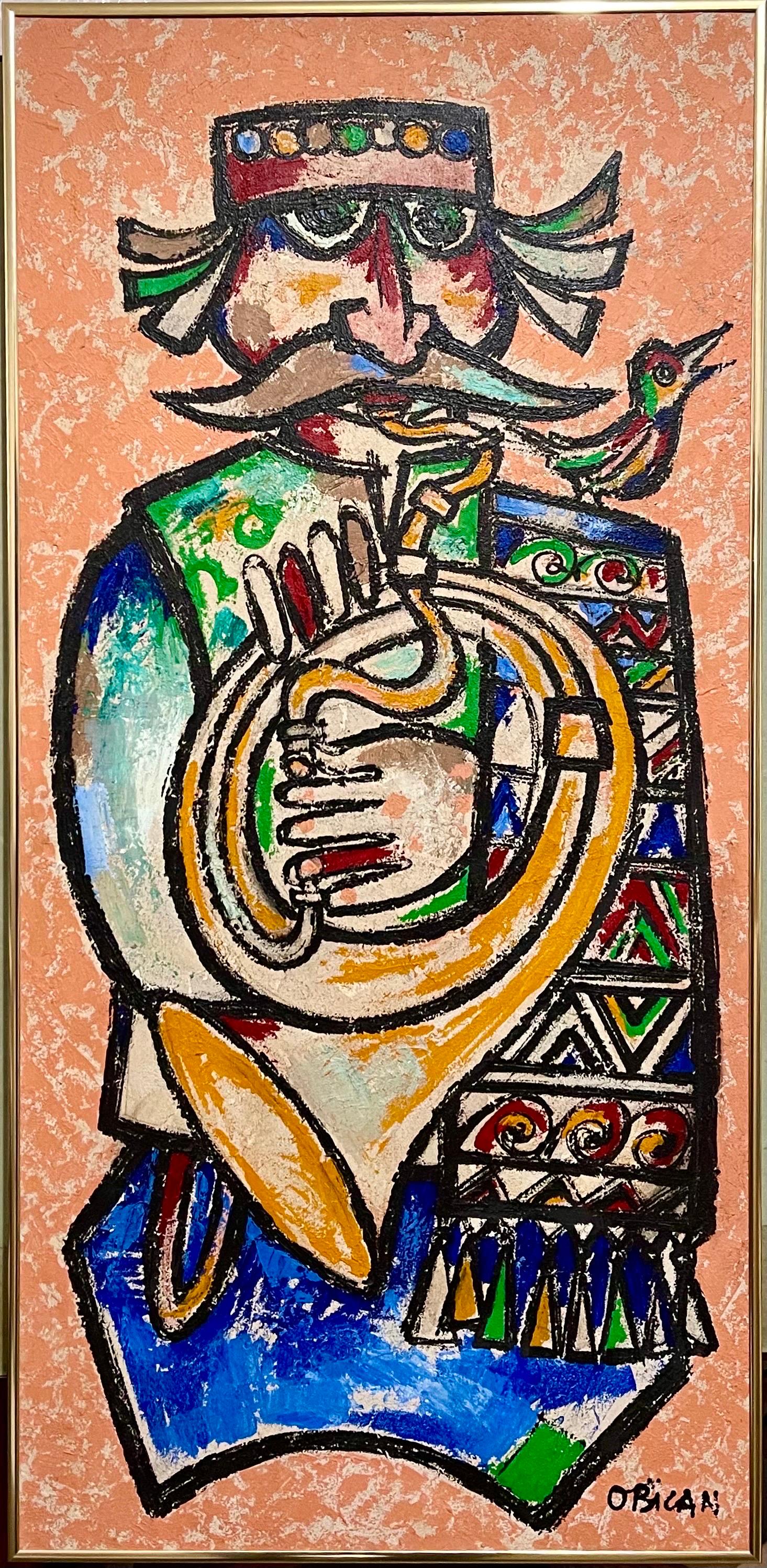
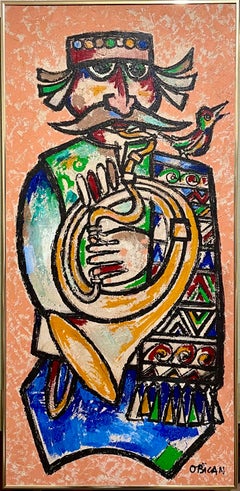
This depicts a Jazz or Klezmer musician. This one is a saxophone or trumpet horn player.
The last photo shows it in a group of three that I have available. This listing is for the one painting.
The artist Jovan Obican iconic style is child-like yet masterfully adult; a style that tells a story with sociological overtones. His funny little people are always colorful, full of spirit, living with music and birds to bring them happiness.
JOVAN OBICAN
Cannes, France, b. 1918, d. 1986
Jovan Obican (1918-1986) artist, painter, sculpture and mosaic ceramic artisan was born in Cannes, France, to his Yugoslavian parents. From childhood on, Jovan practically devoted himself to art, scratching designs into the dirt when paper was unavailable. He trained with many recognized teachers and with many styles. He finished his training, imbued with the spirit of his native country, the people, their legends, and their philosophy. It has been said that his work has a "timeless quality" and a naive, folk art, outsider art brut quality, child-like primitive style. Obican is identified with his style the world over, a style that is simple yet sophisticated; child-like yet masterfully adult; a style that tells a story with psychological, philosophical or sociological overtones. His funny little people are always colorful, full of spirit, living with music and birds to bring them happiness. Best known for his depictions of folklore and traditional costumes rendered in a playful, childlike style and for his happy Jewish wedding scenes. He often used bright colors and black outlines in his renderings of figures and animals, giving his work an illustration-like quality. Thematically, the artist’s work is similar to Marc Chagall and Jean Dubuffet for its dreamlike images and so-called naïve style of painting. Over the course of his career, the artist maintained a studio in Boca Raton, Florida and Dubrovnik, Croatia—part of former Yugoslavia— where he developed an interest in Eastern Europe’s Jewish culture. Many of his mature works depict Jewish traditions and ceremonies, including traditional Jewish weddings, the dancing of the Hora, and traditional music. There is a display of his works in his former Dubrovnik studio.
His style is a unique conglomerate of tradition, history, legends, heroes, old customs and folklore. It is a self-standing style, recognizable, cheerful, whimsical and a happy creation. Naïve art is any form of visual art that is created by a person who lacks the formal education and training that a professional artist undergoes (in anatomy, art history, technique, perspective, ways of seeing). Unlike folk art, naïve art does not necessarily evince a distinct cultural context or tradition. Naïve art is recognized, and often imitated, for its childlike simplicity and frankness. Paintings of this kind typically have a flat rendering style with a rudimentary expression of perspective.
One particularly influential painter of "naïve art" was Henri Rousseau (1844–1910), a French Post-Impressionist who was discovered by Pablo Picasso. Naïve art is often seen as outsider art that is by someone without formal (or little) training or degree. While this was true before the twentieth century, there are now academies for naïve art. Naïve art is now a fully recognized art genre, represented in art galleries worldwide.
Museums devoted to naïve art now exist in Kecskemét, Hungary; Riga, Latvia; Jaen, Spain; Rio de Janeiro, Brasil; Vicq France and Paris. "Primitive art" is another term often applied to art by those without formal training, but is historically more often applied to work from certain cultures that have been judged socially or technologically "primitive" by Western academia, such as Native American, sub saharan African or Pacific Island art (see Tribal art). This is distinguished from the self-conscious, "primitive" inspired movement primitivism. Another term related to (but not completely synonymous with) naïve art is folk art. There also exist the terms "naïvism" and "primitivism" which are usually applied to professional painters working in the style of naïve art (like Paul Gauguin, Mikhail Larionov, Paul Klee).
At all events, naive art can be regarded as having occupied an "official" position in the annals of twentieth-century art since - at the very latest - the publication of the Der Blaue Reiter, an almanac in 1912. Wassily Kandinsky and Franz Marc, who brought out the almanac, presented 6 reproductions of paintings by le Douanier' Rousseau (Henri Rousseau), comparing them with other pictorial examples. However, most experts agree that the year that naive art was "discovered" was 1885, when the painter Paul Signac became aware of the talents of Henri Rousseau and set about organizing exhibitions of his work in a number of prestigious galleries. The Earth Group (Grupa Zemlja) were Croatian artists, architects and intellectuals active in Zagreb from 1929 to 1935. The group included the painters Krsto Hegedušić, Edo Kovačević, Omer Mujadžić, Kamilo Ružička, Ivan Tabaković, and Oton Postružnik, the sculptors Antun Augustinčić, Frano Kršinić, and the architect Drago Ibler. A term applied to Yugoslav (Croatian) naive painters working in or around the village of Hlebine, near the Hungarian border, from about 1930. Some of the best known naive artists are Dragan Gaži, Ivan Generalić, Josip Generalić, Krsto Hegedušić, Mijo Kovačić, Ivan Lacković-Croata, Franjo Mraz, Ivan Večenaj and Mirko Virius. Camille Bombois (1883–1970) Ferdinand Cheval, known as 'le facteur Cheval' (1836–1924) Henry Darger (1892–1973) L. S. Lowry (1887–1976) Grandma Moses, Anna Mary Robertson...
Category
20th Century Folk Art Figurative Paintings
Materials
Canvas, Oil
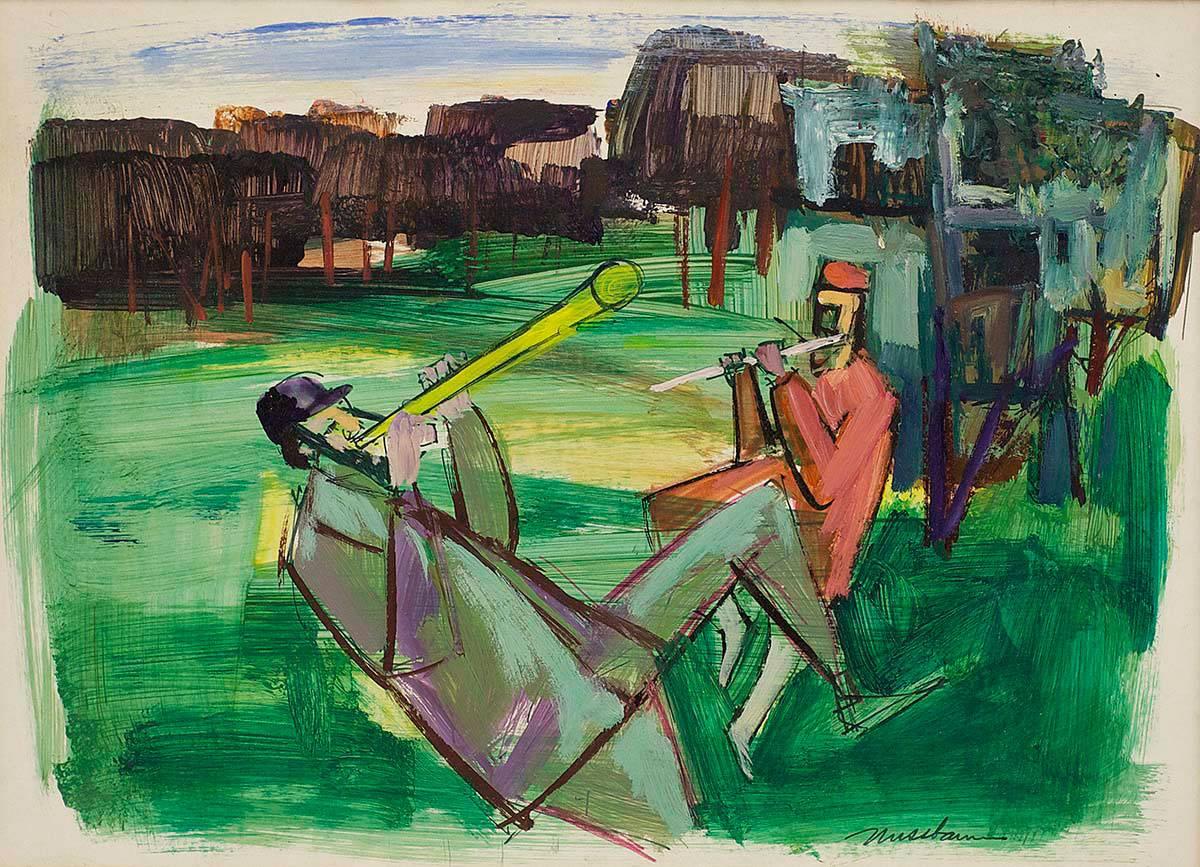
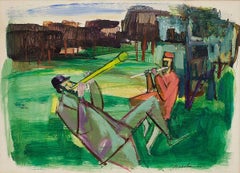
Duo with a Flute, Judaica Klezmer Musicians Modernist American Painting
By Ervin B. Nussbaum
Located in Surfside, FL
Ervin B. Nussbaum was born in Columbus, Ohio on November 11, 1914. His father, Marger, had arrived as part of the great Russian Diaspora of the time, when many Jewish families settle...
Category
20th Century Modern Figurative Paintings
Materials
Paper, Acrylic
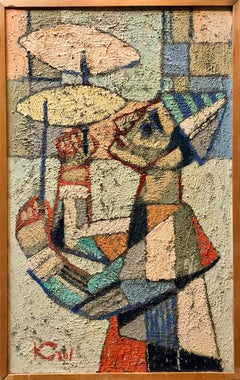
Polish French Ecole de Paris Mid Century Modernist Oil Painting Clown Juggler
By Abram Krol
Located in Surfside, FL
Abram Abraham Krol was born January 22, 1919, in Pabianice (Lodz), Poland.
Hand signed lower ledt
Oil on Canvas
Abram Krol went to France in 1938 to stu...
Category
1950s Modern Figurative Paintings
Materials
Canvas, Oil
You May Also Like
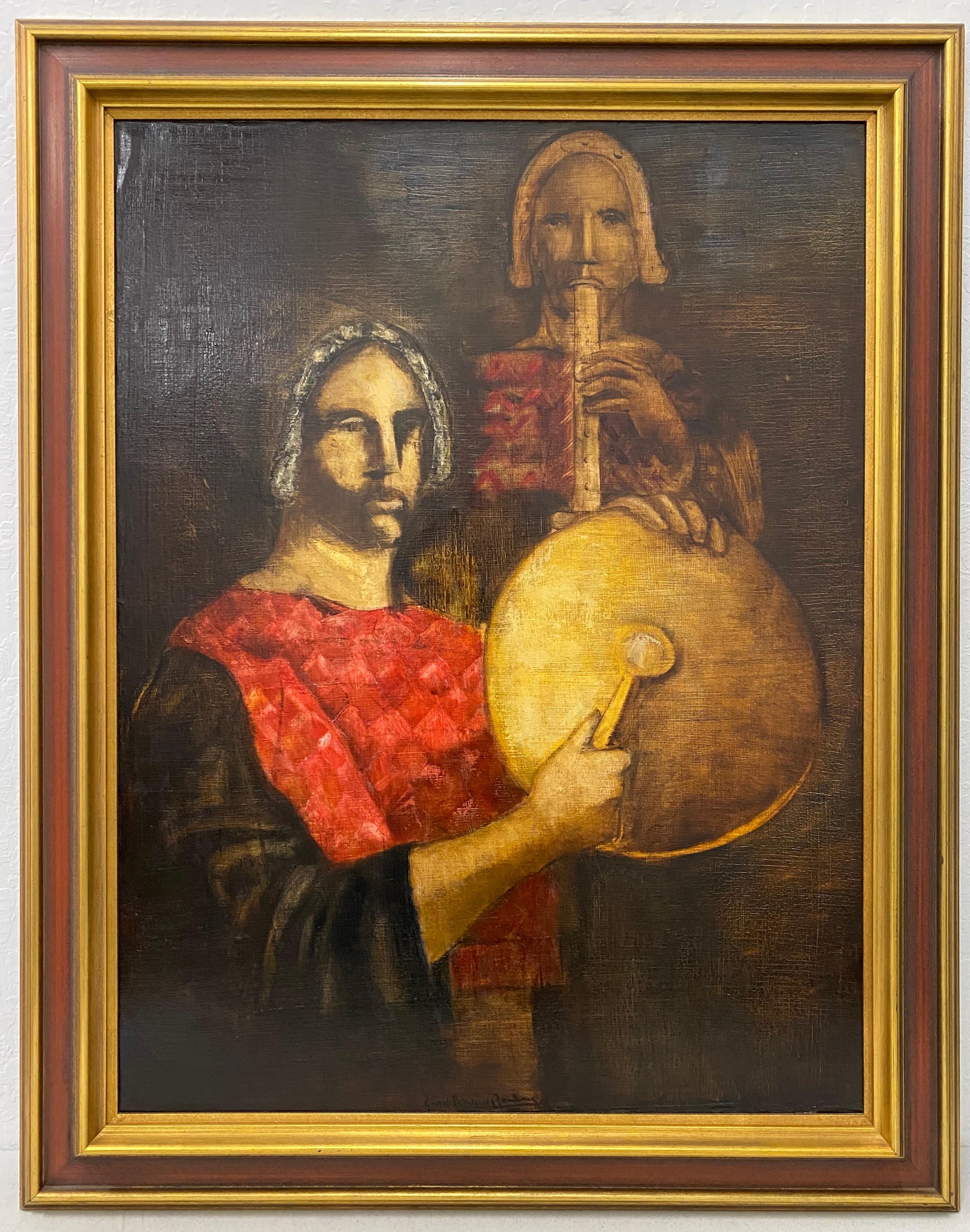
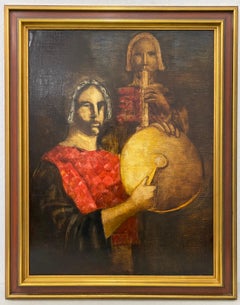
Mid 20th Century "Musicians" Original Oil Painting
Located in San Francisco, CA
Mid 20th Century "Musicians" Original Oil Painting
Fine oil portrait of two musicians
One flute player, one drummer
Original oil on linen over board
Dimensions 31" wide x 40.5" h...
Category
Mid-20th Century Impressionist Portrait Paintings
Materials
Oil
Flute Player
Located in Astoria, NY
Naondo Nakamura (Japanese, 1905-1981), Flute Player, Gouache on Paper laid to Canvas, signed with seal lower left, Angle du Faubourg Galerie d'Art label to verso, unframed. 25.75" H ...
Category
Mid-20th Century Post-War Figurative Paintings
Materials
Canvas, Paper, Gouache

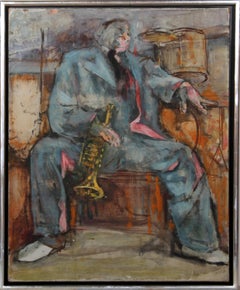
Trumpet Player, 1960
s Oil Painting by Marshall Goodman
By Marshall Goodman
Located in Long Island City, NY
Trumpet Player
Marshall Goodman, American (1916–2003)
Date: circa 1960
Oil on Canvas
Size: 30 in. x 24 in. (76.2 cm x 60.96 cm)
Frame Size: 32 x 26 inches
Category
1960s American Modern Portrait Paintings
Materials
Oil
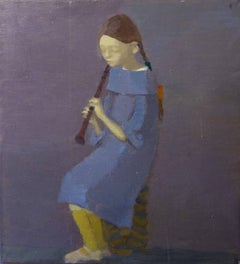
Portrait with Flute - 21st Century, Contemporary, Oil, Portrait Painting, Blue
By Igor SMEKALOV
Located in Torino, IT
Music, Flute, child, blue, gray,russian art
IGOR SMEKALOV
1965 He was born in Orenburg, where he lives and works.
1984 He graduated in Art.
1990-1995 He regularly met in Pas...
Category
Early 2000s Contemporary Figurative Paintings
Materials
Oil
Folk Singer oil painting by Byron Browne
By Byron Browne
Located in Hudson, NY
Lovely oil painting by Byron Browne. Measures 18" x 14" and framed 24" x 20" x 1 3/4".
Signed "Byron Browne" lower left.
Inscribed on canvas verso: Byron Browne / 1958 / – Folk Singer– / 18 x 14 / N.Y.C.
About this artists: Through an oeuvre displaying the re-envisioning of figural subjects and the formation of an abstract expressionist style, Byron Browne stands out among the American abstractionists of his generation. Born in Yonkers, New York, in 1907, the artist was a bright talent at the National Academy of Design in his teens. From 1924 to 1928 Browne studied at the Academy under notable artists Robert Aitkin, Charles Courtney Curran, Charles Hawthorne, Alice Murphy...
Category
1950s Modern Figurative Paintings
Materials
Canvas, Oil
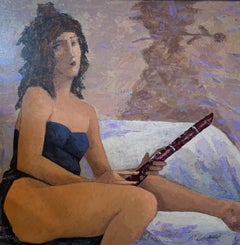
The Musician Chime - Figurative Painting by Giampaolo Talani
By Giampaolo Talani
Located in Carmel, CA
Giampaolo Talani (1955-2018)
The "mad scientist" of the art world, Talani created art out of virtually everything he touched. After completing his training at the Florence Academy of...
Category
2010s Contemporary Portrait Paintings
Materials
Oil, Board
$6,960 Sale Price
20% Off