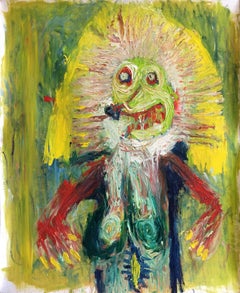
Items Similar to Figurative Expressionist Bold Pop Art Oil Painting Self Portrait Carlo Pittore
Want more images or videos?
Request additional images or videos from the seller
1 of 11
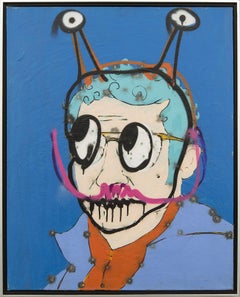
Carlo PittoreFigurative Expressionist Bold Pop Art Oil Painting Self Portrait Carlo Pittore1984
1984
$3,500
£2,657.95
€3,053.49
CA$4,934.18
A$5,246.05
CHF 2,836.90
MX$62,403.33
NOK 35,536.25
SEK 32,455.17
DKK 22,810.59
About the Item
Carlo Pittore
Oil on canvas, 1984,
Self Portrait, initialed and dated lower left,
slat framed, 21"sqr (frame) 20 X 20 canvas.
Provenance: The Private Collection of Wolf Kahn
Emily Mason
Carlo Pittore (1943 – 2005) born Charles J. Stanley was an American painter, educator, art activist, and publisher, whose primary study, teaching and body of work was figurative art and portrait painting. He was a pioneer in the Mail Art movement, he corresponded with such mail art luminaries as Buster Cleveland and Ray Johnson. Pittore is noted for opening the first independent art gallery in the East Village, Manhattan. In 1987, Pittore founded "The Academy of Carlo Pittore" in Bowdoinham, Maine.
Pittore (née Charles Stanley) was born to Stanford and Estelle Stanley in Queens, New York. He grew up on Long Island, in Port Washington, New York with his sister Marion and brother Elliott. Pittore graduated from Port Washington High School (1961), where he was active in the political and debating scenes. He then went on to graduate from the School of the Museum of Fine Arts at Tufts (1966), and post graduate from the Brooklyn Museum Art School (1978).
Pittore changed his name in the 1970s while studying abroad in Rome, Italy. The children nicknamed him "Carlo Pittore", (”Charles the Painter"). From there he went on to study at the Chelsea College of Arts in London.
In 1978, Pittore received the Max Beckmann Scholarship in Advanced Painting. It allowed him to begin studying with American feminist painter Joan Semmel at the Brooklyn Museum Art School. He also studied with visual portrait artist Alice Neel. After which, he taught art at the New York Cultural Foundation.
In the 1970s, Pittore and his close friend Bern Porter published mail art under the stamp series “Post Me”, which he published through "Pittore Euforico, New York". Pittore also published such works as "Maine Moments in New York" (1979), "Colleagues" (1979), The Adventures of Carlo Pittore" (1979) and "Salva la Campagna Romana" (1982). Pittore illustrated the book ‘’Bern! Porter! Interview!’’ with original rubber and mail stamps.
Pittore opened “La Galleria dell'Occhio” in 1980. It was the first independent art gallery in the East Village, New York City. Well known as a street level window art space open 24 hours a day, 7 days a week, it was during this time that Pittore met and became acquainted with artists such as Chuck Welch (a.k.a. the Cracker Jack Kid), Ray Johnson, and Pop Art masters Keith Haring and Andy Warhol. Pittore painted Haring from life, a fact which Haring, a student at the School of Visual Arts at the time, mentions in his journals. Pittore's works have been shown in such places as Italy, Belgium, Tokyo, Chicago, New York (Museum Modern Art, Getty Institute for Art History
The Humanities, New York City Public Library), Los Angeles, Spain, Norway; and now hang in private collections throughout the world.
Due to the devastation caused by the outbreak of HIV/AIDS in the 1980s, Pittore left the lower East Side of Manhattan and moved to Maine permanently. In 1987 he founded "The Academy of Carlo Pittore" in Bowdoinham, Maine. Here he invited artists from all over to come and share their knowledge and talents in an academic forum; whilst he himself hosted drawing classes, painted and drew the artists (and models) and also cooked for them. The full portrait of Pittore that emerges in interviews with those who knew him is a collage of Neal Cassady, Pablo Picasso, and Emeril Lagasse. Pittore founded the “Union of Maine Visual Artists” in 1975. The UMVA passed into state law the “Maine Percent for Art Program” and the “Artist’s Estate Tax Law”. From 1978 to 1980, he was a council member for the "Comprehensive Employment Training Act Artists Project" in New York City.
Just before his death in 2005, the Maine College of Art awarded Pittore an honorary Doctorate of Fine Arts. The "Carlo Pittore Foundation for the Figurative Arts" was founded in 2006.
Carlo was a thoroughgoing humanist devoted to the human figure. He drew and painted just about everyone he knew. His nudes and portraits are very much like the man himself — bold, boisterous even, frank, sensuous, and uncompromising. His oeuvre includes paintings of boxers, carnival performers, modern takes on classical paintings, portraits, self-portraits, nudes, landscapes, mail art, and his comic drawings. A figurative painter in the mkodernist manner of Lucian Freud or Alex Katz, Pittore painted in the figurative expressionist and portraiture style; focusing mainly on the nude form of study. On account of this, critics and objectors occasionally viewed his work as "erotic" rather than objective art. Throughout his life, Pittore was extremely vocal toward such critics and what he perceived to be "ignorance" toward his art or art in general. He refused the title of Gay artist. He did not shy away from either voicing his opinion in letters to the editor or removing his exhibits from art galleries or public showings. The colors red and green (symbols of the Italian flag) were two essential components in Pittore's work that defined his belief and understanding of complementary palette application. The contrast of these two color schemes arise time and again throughout his works; as can be seen in "Portrait of Blair Tily" (1987), "Opera - Self Portrait" (1981), "La Buffonera" (1983), and "Portrait of a Skeptic" (1996). Pittore's "Lincoln Portrait Series" was the only oil-on-canvas medium in which he worked without color. For this, he painted entirely in black and white due to the fact that the portraits were modeled after 19th-century photographs of Abraham Lincoln.
Wolf Kahn (1927 – 2020) was a German-born Jewish American painter. Kahn, known for his combination of Realism and Color Field, worked in pastel, oil paint, and printmaking. He studied under Hans Hofmann, and also graduated from the University of Chicago. Kahn was a resident of both New York City and, during the summer and autumn, West Brattleboro, Vermont.
- Creator:Carlo Pittore (1943 - 2005)
- Creation Year:1984
- Dimensions:Height: 21 in (53.34 cm)Width: 21 in (53.34 cm)
- Medium:
- Movement Style:
- Period:
- Condition:
- Gallery Location:Surfside, FL
- Reference Number:1stDibs: LU38216959322
About the Seller
4.9
Platinum Seller
Premium sellers with a 4.7+ rating and 24-hour response times
Established in 1995
1stDibs seller since 2014
1,864 sales on 1stDibs
Typical response time: <1 hour
- ShippingRetrieving quote...Shipping from: Surfside, FL
- Return Policy
More From This Seller
View AllItalian American Surrealist Oil Painting Ivo David Trilogia Chromatic Surrealism
Located in Surfside, FL
Trilogia
Homage to Orazio Tanelli (Italian poet)
Hand signed middle left and titled extensively and signed and dated verso.
1991
Dimensions: 30 X 24 inches.
A painter and poet born ...
Category
1990s Surrealist Figurative Paintings
Materials
Canvas, Oil
Judy Rifka Abstract Expressionist Pop Art Portrait Oil Painting Brooke Alexander
By Judy Rifka
Located in Surfside, FL
Judy Rifka (American, b. 1945)
Roman Nose
1982
Oil on canvas
Dimensions: 30 x 24 inches (76.2 x 61.0 cm) Hand signed on stretcher: Judy Rifka
Provenance: Brooke Alexander Galle...
Category
1980s Pop Art Figurative Paintings
Materials
Oil, Canvas
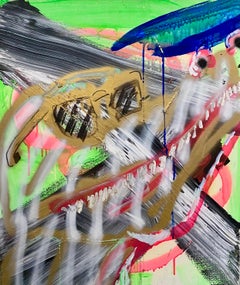
Mixed Media Oil Painting and Spray Paint Abstract Painting Selbstportrait
By Kadar Brock
Located in Surfside, FL
"Selbstportrait Und Der Sonne"
This work is part of a series of alligator paintings Brock made in 2007. All are painted in a somewhat similar and b...
Category
Early 2000s Contemporary Abstract Paintings
Materials
Canvas, Oil, Spray Paint, Acrylic
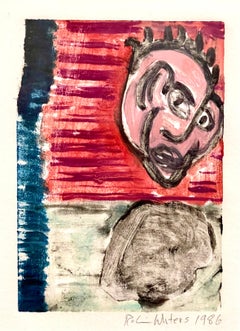
Conceptual Pop Art Color Oil Monotype Painting Abstract Figure Robin Winters
By Robin Winters
Located in Surfside, FL
Robin Winters (American, born 1950),
Untitled (Red Face) from "Cherry Block Series" 1986, monotype, pencil signed and dated lower right, plate: 6"h x 8.5"w, overall (with frame): 22.25"h x 18.25"w. Provenance: Property from a Private Collection, San Francisco.
Winters was invited to make monotypes at Experimental Workshop in San Francisco, (they printed Richard Bosman, Sam Francis, Claire Falkenstein, Deborah Oropallo and Kenneth Noland and many more greats). Winters chose to paint on wood blocks rather than the more usual metal plates in order to capture the organic quality of the natural material. He exploited a salient characteristic of the monoprint in Ghost Story by adding new painted elements onto the increasingly faint ghost images that result from successive impressions from a single block. In so doing he achieved the effect of transparent layers of color and shadow imagery. Winters's brightly-colored monotypes portray an array of figures and landscapes (and an occasional still-life) that, although can be seen in the context of a general trend away from abstraction that has marked the 1980s, defy strict stylistic categorization. They are neither realistic nor abstract, psychological self-examinations nor narrative fictions, but they contain elements of all of these approaches. Like Jonathan Borofsky, Winters derives much of his subject matter from dreams, believing that through his private fears and obsessions he can touch similar emotions in others. Although at first glance Winters's images look as if they could have been made by a child, closer attention reveals sly art historical references to Jackson Pollock and Pattern Painting (the drip and splatter backgrounds), Mark Rothko (the three-part horizontal compositions) and Minimalism (the gridded Cherry Block Series: Bread Beat).
Robin Winters (born 1950 in Benicia, California) is an American conceptual, multi-disciplinary, artist and teacher based in New York. Winters is known for creating solo exhibitions containing an interactive durational performance component to his installations, sometimes lasting up to two months. Winters first emerged in the burgeoning Soho NYC art scene of the 1970s. An early practitioner of the Relational Aesthetics (social interaction as an art medium) Winters also created in works through sculpture, installation, performance, painting, drawing and prints. His art maintains a whimsical spirit, and he often returns to ongoing themes involving faces, boats, cars, bottles, hats and jesters or fools. Winters has incorporated such devices as blind dates, double dates, dinners, fortune telling, and free consultation in his performances. Throughout his career he has engaged in a wide variety of media, such as performance art, film, video, writing prose and poetry, photography, installation art, printmaking, drawing, painting, ceramic sculpture, bronze sculpture, and glassblowing.
Winters was born in Benicia, California in 1950 to lawyer parents. As a child his hobby was collecting glass bottles found on the beach and under old buildings, which would later influence him as an artist. In 1968, Winters had his first durational performance, entitled Norman Thomas Travelling Museum. The artist drove a Volkswagen bus decorated in collage, many of the images relating to current events and politics. Inside was what the artist described as a “reliquary” containing many objects, including a bottle collection. Winters took the van to shopping centers and even as far as Mexico. That same year, Winters opted not to register for the military draft. Although he was deemed fit to serve, Winters refused. In 1975 the resulting legal proceedings finally came to a close after it was proven that the artist had been harassed by the local draft board. In his teens and early twenties, Winters became acquainted with several local artists who helped shape his aesthetic, most notably Manuel Neri and Robert Arneson. By the early 1970s, Winters was studying at the San Francisco Art Institute (SFAI) and had relocated to San Francisco. At this time Winters became friends with the Bay Area conceptual artists Terry Fox and Howard Fried, and participated in several of Fried's performance works. In 1972 Winters was accepted into the Whitney Independent Study Program in New York City. After coming to New York City, Winters helped support himself by working for various artists, among them the performance artist Joan...
Category
1980s Pop Art Figurative Paintings
Materials
Monoprint, Monotype
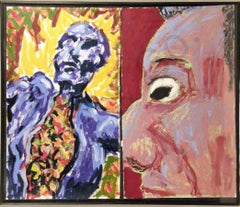
UNTITLED, 1981 DIPTYCH Neo Expressionist Figures Peter Julian Oil Painting
By Peter Julian
Located in Surfside, FL
Peter Julian (born 1952 in Buffalo, New York) is an American artist best known for his Neo-expressionist paintings in the 1980s. His first major exhibition was in New York in 1982 at The New Museum as part of the museum’s annual “New Work/New York” series of exhibitions. THis piece is from that exhibition.
(New Work / New York. 1982; 34 pages; staple-bound; 34 pages; 44 b/w illustrations. Essays by Lynn Gumpert and Ned Rifkin. Foreword by Marcia Tucker. Artists: Tom Butter, Tom Evans, John Fekner, Judith Hudson, Peter Julian, Cheryl Laemmle...
Category
1980s Neo-Expressionist Figurative Paintings
Materials
Paper, Oil
Large Venezuelan Expressionist Oil Painting Diego Barboza Latin American Master
Located in Surfside, FL
Diego Barboza - 1945-2003
Hand signed and dated 1988 Oil on Canvas
Diego Barboza was born the Carabobo street of Maracaibo, Venezuela on February 4, 1945. He was a Venezuelan Neo Figurative Painter who is among the most famous and influential figures in Venezuelan art history. Diego Barboza opened a new chapter in Latin America, beyond the surreal or the magical realism of the Modern Latin American Masters. He created a new language of dislocation and transgression. Personages became distorted to the point that was very exaggerated forms His figures twisted and contorted without losing their presence or their pull. Extremities muscles, and bones burst into an explosive compound of divergent and convergent lines. Through eruptive brushstrokes and fractured outlines. Barboza created a world of illusions.
Barboza was born into a upper-middle-class family. He stopped going to school at 12 years old, and he registered himself at the School of Visual Art in the City of Maracaibo Venezuela. Barboza studied at the School of Visual Arts in Caracas, Venezuela. Barboza began his training as an artist at age 12 in his native Maracaibo when he left formal education to enroll in the then School of Plastic Arts of Zulia, then Julio Arraga School of Plastic Arts, where he was a student in the modeling, collage and Drawing of Angelina Curiel. His first collages, in the sixties, show the influence of American Pop Art. In 1967 he exhibited at the Ateneo de Caracas his series 'Los Ratones', a proposal then 'criticized by critics as unprecedented in Venezuela'. In his tribute to the film "Nosferatu" Friedrich Murnau included 32 drawings as well as two-dimensional objects. In 1968 he moved to London where he studied at the London College of Printing. From that time is his '30 Girls with Nets', an action in which 30 students of the London College of Printing, dressed in black and covered by white nets, toured London public places, behaving naturally. His 'street expressions', which he later called 'poetic actions', symbolized a breakdown of social restraints through unusual behaviors that sought to provoke public reactions. Upon his return to Venezuela in 1973, Barboza continues with this line of work, being recognized as one of the initiators of Venezuelan conceptual art. In the 1980's Diego Barboza turned to painting, the New Venezuelan Figuration. Here belongings and the feminine figure fill the work of that time, in which he embodied his intimacy and daily life through scenes of furnishings and flowers that included objects from his workshop and home. His nudes were made from live model, then to follow the path of distortion resulting in their unmistakable females: a figure that represented their personal way of appreciating beauty. Barboza presented his first individual exhibition at the Centro de Bellas Artes of Maracaibo Venezuela. In 1963, he traveled to London when the Conceptual Art movement started, he had the support of the London New Art Lab Gallery. On March 7, 1970 Barboza displayed his first work on Conceptual Art, which he called Art of Action. In London with the performance of 30 Girls with nets (30 Muchachas con redes). His second work was Nets and Hats in markets and restaurants (Con sombreros y redes en mercados y restaurantes). In London UK. His third The Centerpiece (El Ciempies) and the fourth Expression on a laundry-mat (Expresiones en una lavandería)
In 1974. Baboza returned to Venezuela. Where he presented two very important Conceptual Art works: The Armadillo Box (La Caja del Cachicamo) and from the School of Athens to the New School of Caracas (De la Escuela de Atenas a la Nueva Escuela de Caracas). Closing his cycle of Conceptual Art creation. IN Venezuela a sort of impromptu academy started up at Claudio Perna’s house. Eugenio Espinoza, Roberto Obregón, Antonieta Sosa, Alfred Wenemoser, Yeni and Nan, Sigfredo Chacón, Diego Barboza, Luis Villamizar, Margherita D’Amico, Pedro Terán, Alfredo del Mónaco, as well as international figures who happened to be visiting Venezuela such as Antoni Muntadas, Charlotte Moorman, and Roman Polanski would gather there. Venezuela, especially Caracas, was a rich field of action for modernism in South America. Venezuelan Geometric Abstraction, Op art and Kinetic Art dominated through crucial figures like Jesús Rafael Soto, Gego, Alejandro Otero, and Carlos Cruz Diez, the country’s kinetic art made a fundamental contribution internationally. The Greater London Arts Association and the Arts Council of Great Britain did several exhibitions of (North, Central, South, London, Wales, Scotland and Ulster) to show the actual Visual Arts in all of the United Kingdom and Diego Barboza was invited for this event with a solo exhibition, expressions around a cylinder (Expresiones alrededor de un cilindro).
Diego has made numerous solo and group exhibitions, obtaining rewards since 1963. He is represented in the most important museums of Venezuela, as well as in England, Brazil, Colombia and Cuba. In 1986 he was awarded the Municipal Visual Arts Award of the Municipal Council of the Federal District and in 1997 he received the National Prize for Plastic Arts granted by the National Council of Culture, CONAC.
Select Group Exhibitions
1964 Ateneo de Caracas, Caracas, Venezuela
1965 Salón Arturo Michelena, Valencia, Venezuela
1968 Salón Oficial Museo de Bellas Artes, Caracas, Venezuela
1971 Art Spectrum London, London, Great Britain
1972 Serpentine Gallery, London, Great Britain
1973 Midland Group Gallery, London, Great Britain
1974 Galería BANAP, Caracas, Venezuela
1975 Casa de Las Américas, La Habana, Cuba
Museo de Bellas Artes, Caracas
Galería de Arte Nuevo, Buenos Aires, Argentina
1976 Museo de Arte Moderno, Bogotá, Colombia
Museo de Arte Contemporáneo, Sao Paulo, Brazil
Museo de la Tertulia, Cali, Colombia
Bienal de Venecia, Venecia, Italy
1979 Centro de Artes y Comunicación, Buenos Aires, Argentina
1980 Galería NBC, Memphis, Tennessee, USA
1981 Galería de Arte Nacional, Caracas, Venezuela
Museo de Arte Contemporáneo, Medellín, Colombia
Museo de Bellas Artes, Caracas, Venezuela
1986 Museo de Arte La Rinconada, Caracas, Venezuela
1989 Galería Venzor, Chicago, Illinois, USA
1990 Museo Bellas Artes, Santiago de Chile, Chile
1992 Ambrosino Gallery, Coral Gables, Florida, USA
1993 Museo de Arte de Petare, Caracas, Venezuela
Centro de Arte Lia Bermúdez...
Category
1980s Neo-Expressionist Figurative Paintings
Materials
Canvas, Oil
You May Also Like
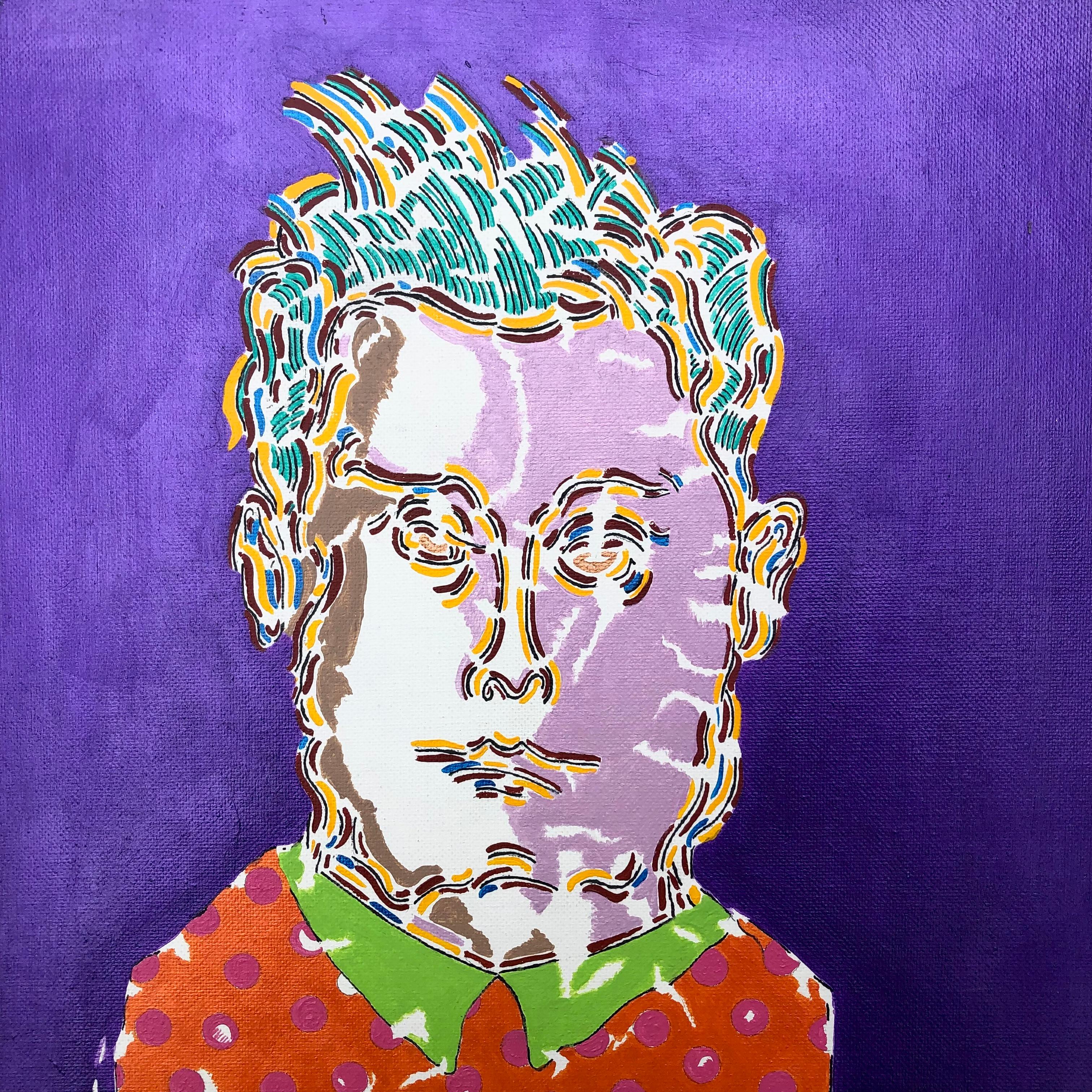
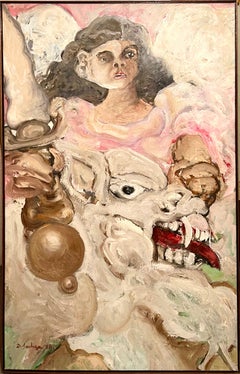
That Guy Mike, Original Painting
Located in San Francisco, CA
Artist Comments
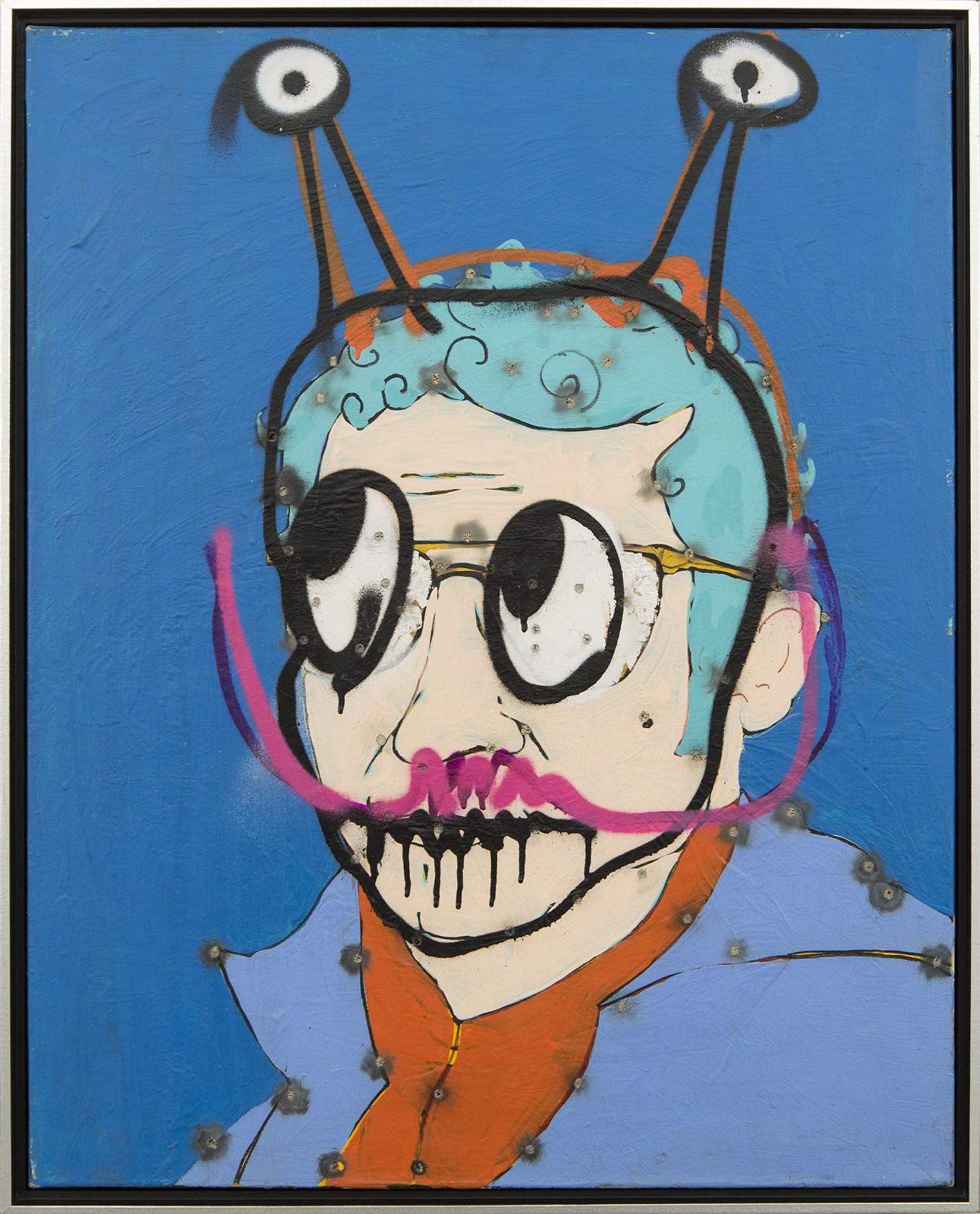
"That guy Mike looks nothing like him," says artist John McCabe. "His hair isn't quite so aqua. Maybe they are the same height." He...
Category
21st Century and Contemporary Pop Art Figurative Paintings
Materials
Acrylic
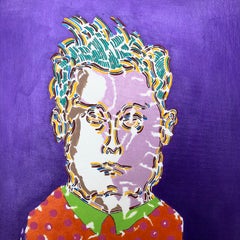
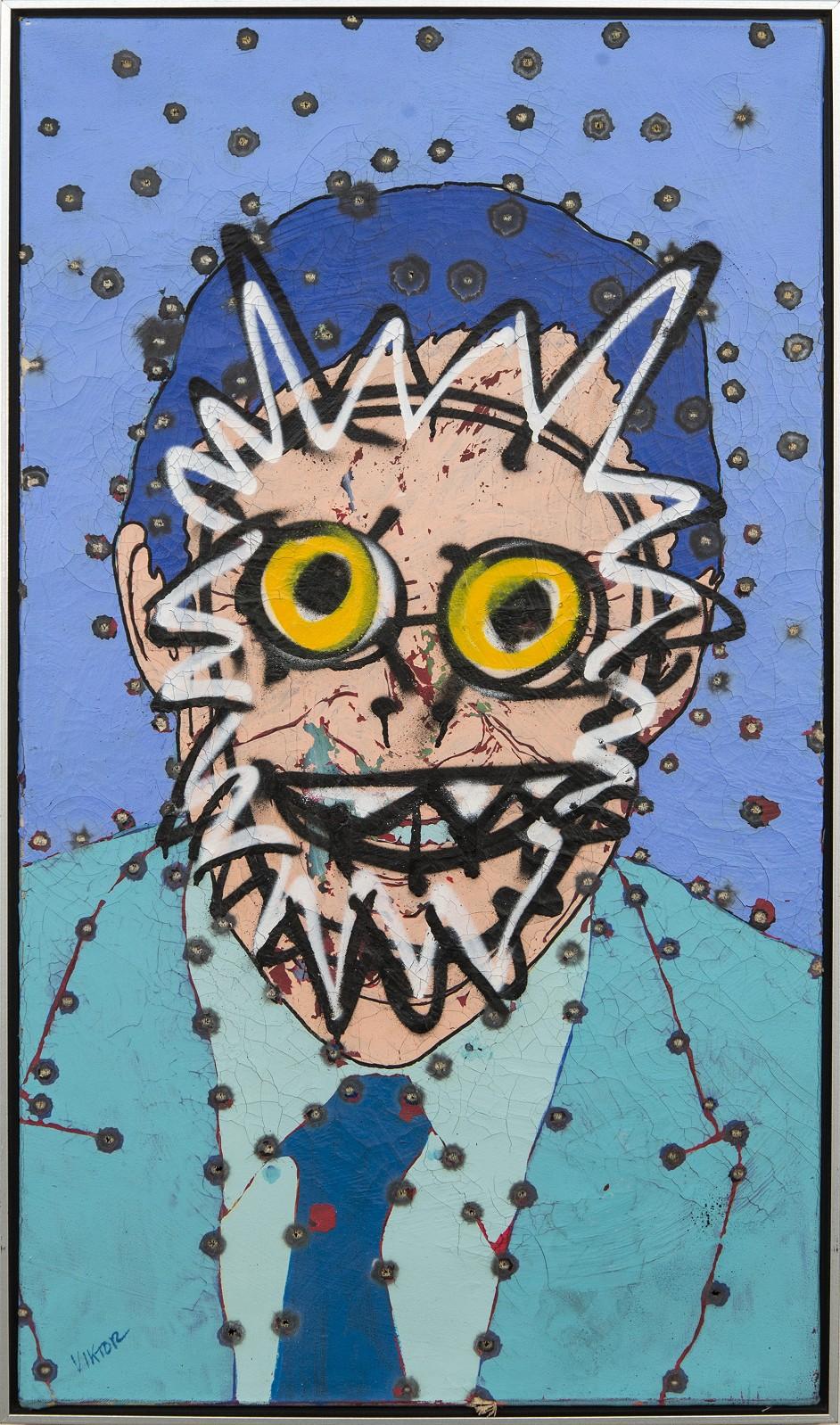
Marc - graphic, portrait, pop-art style, cultural, acrylic painting on canvas
By Viktor Mitic
Located in Bloomfield, ON
Taking caricature portraiture to a new level, Viktor Mitic has portrayed 'Marc' in the guise of a zombified 1950s radio announcer. The bright blocks of co...
Category
2010s Contemporary Figurative Paintings
Materials
Gold Leaf
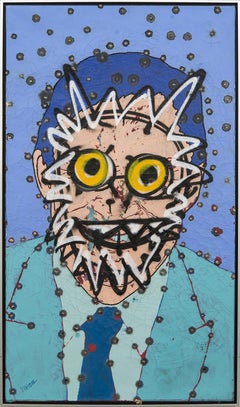
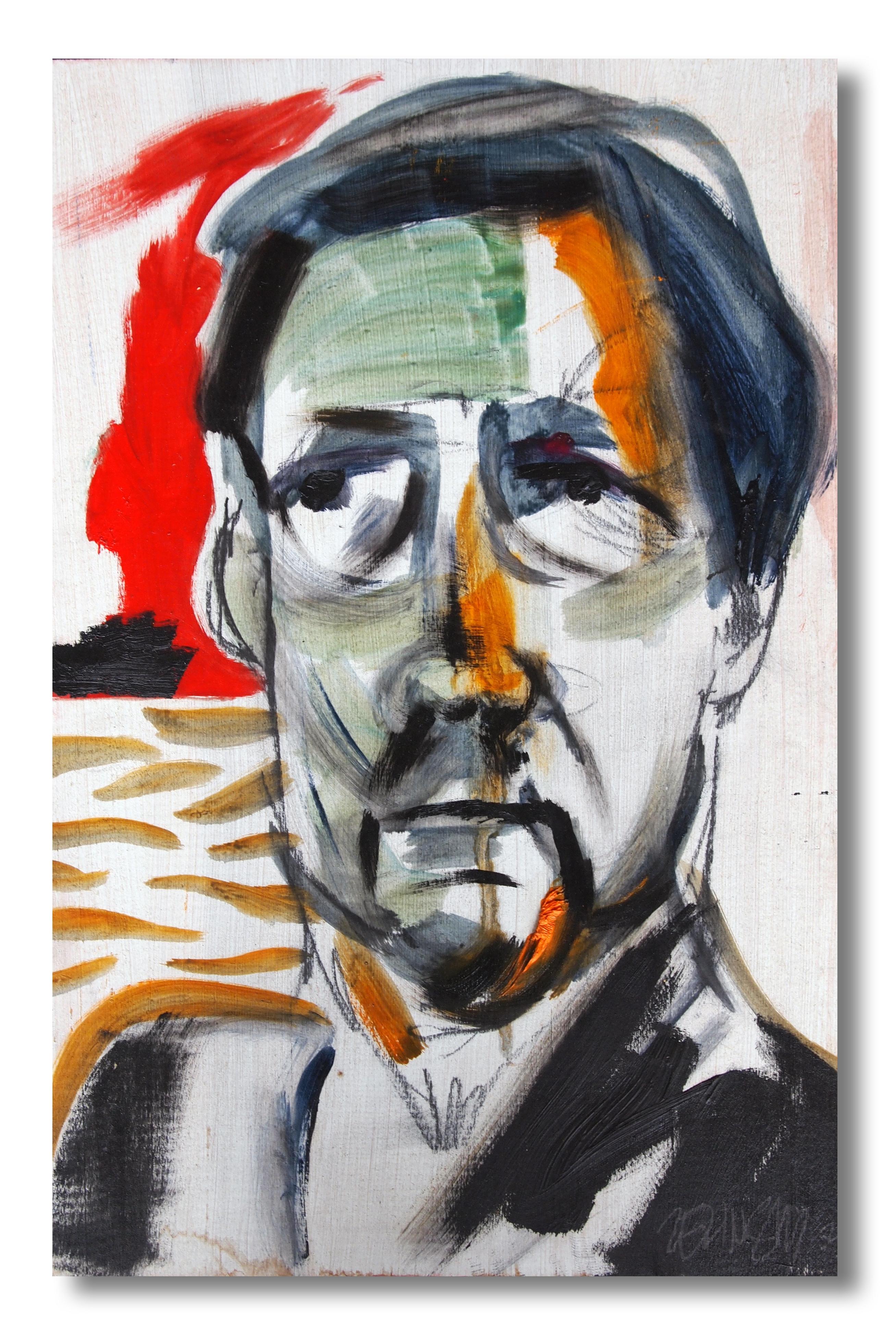
oil portrait, Painting, Oil on Wood Panel
By Edward Zelinsky
Located in Yardley, PA
Portrait of a Dutch friend :: Painting :: Contemporary :: This piece comes with an official certificate of authenticity signed by the artist :: Ready to Hang: No :: Signed: Yes :: Si...
Category
Early 2000s Contemporary Paintings
Materials
Oil
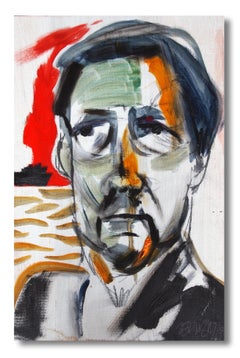
Self Portrait (Selfie) - graphic, pop-art, acrylic painting on canvas
By Viktor Mitic
Located in Bloomfield, ON
Utilizing a pop-inspired aesthetic with bold colour blocks and a simplified portraiture design, Mitic riffs on the ubiquitous selfie culture, comical filters, and more deeply, survei...
Category
2010s Contemporary Figurative Paintings
Materials
Gold Leaf
$5,600 Sale Price
20% Off
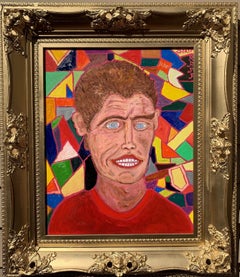
One-Of-A-Kind painting on canvas "Crash Kennedy" by Serg Graff, Gold Frame, COA
Located in Palm Coast, FL
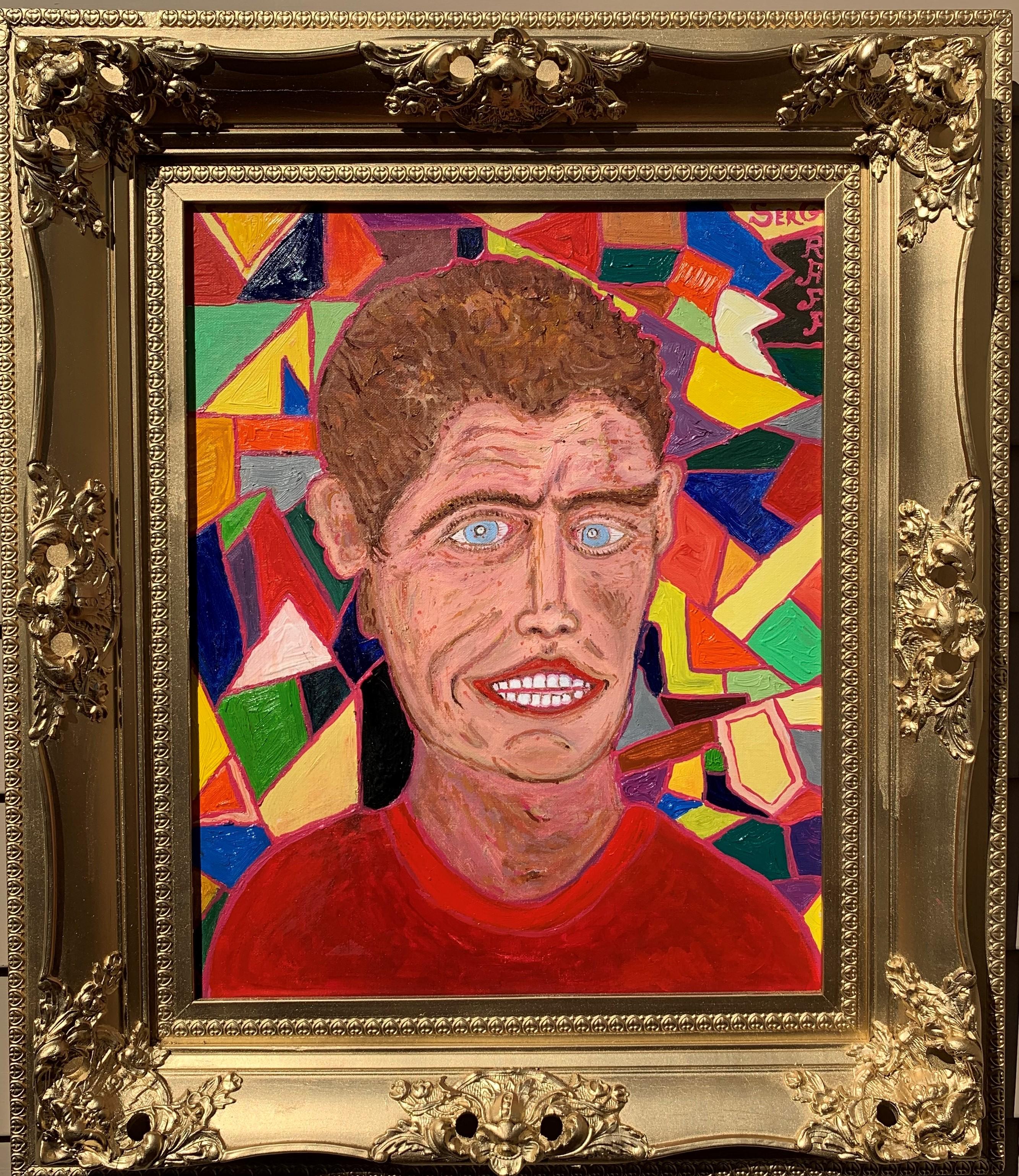
This is a rare, unique original acrylic and oil painting on canvas by contemporary visionary artist Serg Graff, titled "Crash Kennedy." Executed in a naïve primitivism style, this bo...
Category
2010s Abstract Impressionist Portrait Paintings
Materials
Acrylic
Jeremy on acid - Julien Wolf, 21st Century, Contemporary figurative painting
By Julien Wolf
Located in Paris, FR
Oil on canvas
Signed
Unique work
Category
2010s Expressionist Figurative Paintings
Materials
Canvas, Oil