Want more images or videos?
Request additional images or videos from the seller
1 of 6
Daniel GreeneSOPHIE- SPRING ST., portrait of girl, subway station, new york city, hyper-real2017
2017
$64,000List Price
About the Item
About the Seller
5.0
Vetted Professional Seller
Every seller passes strict standards for authenticity and reliability
Established in 1982
1stDibs seller since 2013
32 sales on 1stDibs
Authenticity Guarantee
In the unlikely event there’s an issue with an item’s authenticity, contact us within 1 year for a full refund. DetailsMoney-Back Guarantee
If your item is not as described, is damaged in transit, or does not arrive, contact us within 7 days for a full refund. Details24-Hour Cancellation
You have a 24-hour grace period in which to reconsider your purchase, with no questions asked.Vetted Professional Sellers
Our world-class sellers must adhere to strict standards for service and quality, maintaining the integrity of our listings.Price-Match Guarantee
If you find that a seller listed the same item for a lower price elsewhere, we’ll match it.Trusted Global Delivery
Our best-in-class carrier network provides specialized shipping options worldwide, including custom delivery.You May Also Like
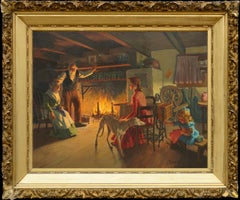
"The Family Hearth" - Turn of the Century Cozy Interior Figurative Scene
By Charles Everett Johnson
Located in Soquel, CA
Charming turn-of-20th Century interior painting that takes the viewer back to simpler times with grandmother, grandfather, mother sewing and a young girl playing with her greyhound a...
Category
Early 1900s Realist Interior Paintings
Materials
Linen, Oil
$2,920 Sale Price
20% Off
H 31 in W 37 in D 4 in
A Jolly Time -- German Genre Tavern Painting, 1918
Located in Soquel, CA
Wonderful German genre painting of 17th century tavern scene in style of Franz Hals by Karl Josef Muller (German, 1864-1942) dated 1918. Signed and dated lower left corner "Karl Muller - Hamburg 1918". Condition: Good; professionally restored: Canvas restreched on new stretcher bars; five repairs made to small tears in canvas (see image); cleaned and re-varnished with UV-resistant varnish. Unframed. Image size: 39.5"H x 55"W. We have the original frame which needs some extensive repair to the gesso. Happy to include the frame with the painting as is.
Karl Müller was born in Hamburg-Altstadt in 1865. His wealthy Jewish parents Abraham Müller (1832-1896), citizen of the Hanseatic city since 1869, and Henriette "Jette", b. Burchard (born 1832 Neubuckow / Mecklenburg), had a cigar factory at Spielbudenplatz 5 in St.Pauli. When Karl Müller was ten years old, next to factory and warehouse, now at Speersort 11 (Altstadt), there was also a branch in Altona-Ottensen with the address Am Felde 68. The family lived at the time at Pferdemarkt 13 (Old Town).
After attending the Jewish Foundation School at the Zeughausmarkt, Karl Müller completed a three-year lithography apprenticeship. From 1886 to 1888, he studied at the Royal Saxon School of Applied Arts in Dresden with the history and decoration painter Donadini, then with Professor Hanke of the Prussian Academy of Arts in Berlin.
Karl Müller's painting style was conventional-realistic and did not follow modern trends. In 1891, the oil paintings "Preparation for the Service", "In the guardroom", tattoo", "gymnastics lesson", "covert patrol” and "return from the field service exercise”, whose main motive almost always soldiers formed.In 1893, he painted the" invasion of the 76er " as a horizontal format in black and white, the painting was acquired by the Museum of Hamburg History in 1930. The disposition of Karl Müller could be classified as "kaisertreu" and "national" (Maike Bruhns) at this time - not by chance he acted with his Nicknamed "Soldatenmüller", he successfully participated in exhibitions in Berlin and Hamburg before the turn of the century.
Even at this time, the frequent change of residence is striking: 1893 Papendamm 25 (Rotherbaum), 1896 Bundesstraße 9 (Rotherbaum). In 1898 he was in the Hamburg address book as a "genre and portrait painter" with the residential address 1. average 43 (Rotherbaum) out.
At the age of 38, Karl married in 1903 in the Hanseatic city of the Jewish Louise Hauer (born 12.2.1872 in Hamburg), called "Lieschen". Before her marriage, she lived with her mother at Grindelberg 78. Her father, Martin Hauer (1836-1897), also born in Hamburg and was a citizen of the city since 1862, owned a factory for soap and perfume. In 1904 and 1911, the two daughters Karla and Lotte were born.
1904, the family lived at this time in the Bogenstraße 20, Karl Müller commissioned a portrait of the emigrated hamburger Henry Jones opening the same lodge in the Hartungstraße 9-11. Already at this time he might have been a member of the Hamburg Artists Association of 1832.
Starting from 1908 further change of dwellings on the basis of the telephone books are comprehensible: nearly yearly the family moved and moved thereby from the Grindel quarter over Hoheluft east to Harvestehude and Winterhude. Around 1912 she moved into an apartment in Sierichstraße 156. Here, the landlord Schröder provided the artist with an area of around 45 square meters as a studio on the dry floor. But the building police criticized this use and after some disputes, the painter had to move once again with family and studio. The official telephone directory recorded as an address from 1914 to 1918 Klosterallee 20 (Harvestehude).
Friedrich Jansa described Karl Müller's changed motif choice in his artist's glossary in 1912: "In recent years he has been watercolouring a lot in the Hamburg area and now mainly takes his motifs from Hamburg harbor...
Category
1910s Realist Interior Paintings
Materials
Linen, Oil

$6,000 Sale Price
20% Off
H 39.5 in W 55 in D 1 in
Partida de Tresillo
Located in Madrid, ES
JOSÉ JIMÉNEZ ARANDA
Spanish, 1837 - 1903
PARTIDA DE TRESILLO
signed, located & dated “Jz. Aranda / Madrid. 1893.” (lower right)
oil on canvas
31-1/2 x 39-1/3 inches (80 x 100 cm)
unframed
BIBLIOGRAPHY
- This picture being mentioned and illustrated in “LA ILUSTRACION ESPAÑOLA Y AMERICANA”, Madrid, September 15, 1895
- B. Pantorba, José Jiménez Aranda, 1973, p. 75, 203
- José Jiménez Aranda, 1837-1903: Centro Cultural El Monte, Seville, October 2005, illustrated p. 102
EXHIBITED
Madrid National Exhibition of 1895
PROVENANCE
Private Collection, USA
José Jiménez Aranda (7 February 1837 – 6 May 1903) was a Spanish painter and brother of the painters Luis Jiménez...
Category
1890s Realist Figurative Paintings
Materials
Oil, Canvas
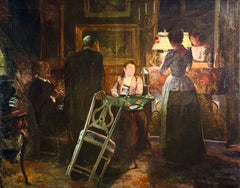
"The Barber of Seville", Early 20th Century Oil on Canvas by José Villegas
Located in Madrid, ES
JOSÉ VILLEGAS CORDERO
Spanish, 1844 - 1921
THE BARBER OF SEVILLE
signed & dated "J. Villegas. / Junio 1913." (lower left)
oil on canvas
19-3/8 x 28-3/4 inches (49 x 73 cm.)
framed: 27-1/2 x 36-3/4 inches (69.5 x 93 cm.)
PROVENANCE
Private Collector, Seville, Spain
José Villegas Cordero (Seville, August 26, 1844-Madrid, November 9, 1921) was a Spanish painter. He directed the Prado Museum between 1901 and 1918.
He was the brother of the painter Ricardo Villegas Cordero. He began his apprenticeship very young with José María Romero, with whom he remained for two years until entering the School of Fine Arts in Seville, where he was under the tutelage of Eduardo Cano.
In 1860, when he was only 16 years old, he sold his work Little Philosophy for 2,000 reais at the Seville Exhibition. In 1867 he traveled to Madrid, where he entered Federico Madrazo's studio. There he established friendship with painters Eduardo Rosales and Fortuny.
He went regularly to the Prado where he copied Velázquez, from whom he acquired spontaneity and the use of color for his technique.
Finally, and out of admiration for Fortuny's orientalist painting, he returned to Seville and organized an excursion to Morocco.
At the end of 1868 he decided to travel to Rome accompanied by the painters Rafael Peralta and Luis Jiménez Aranda...
Category
1910s Realist Figurative Paintings
Materials
Canvas, Oil
$9,510
H 19.3 in W 28.75 in
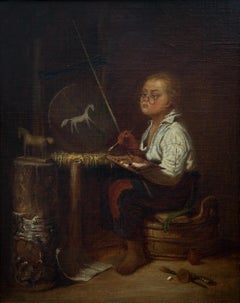
Oil Painting Called "The Young Artist" by Swedish Johan Christoffer Boklund
Located in Stockholm, SE
Introducing a captivating oil painting by Johan Christoffer Boklund (1817-1880). The artwork depicts a young boy practicing his painting skills. Seated beside him is a wooden horse t...
Category
19th Century Realist Interior Paintings
Materials
Canvas, Oil, Board
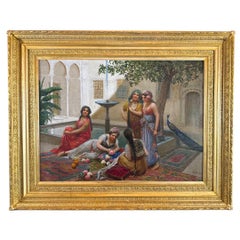
Harem Girls in the Palace Courtyard 19th Century Antique Oil Painting on Canvas
By Fabio Fabbi
Located in Jacksonville, FL
Description:
Fabio Fabbi: A Master of Orientalist Intrigue
The painting is signed on the bottom left side.
Fabio Fabbi, an esteemed Italian artist of the late 19th and early 20th centuries, emerged as a prominent figure within the Orientalist art movement. Born in Rome in 1861, Fabbi’s passion for capturing the exotic and mysterious landscapes and cultures of the East would define his artistic career and leave an indelible mark on the art world.
Fabbi’s artistic journey began with formal training at the Accademia di Belle Arti in Rome, where he developed a deep appreciation for classical techniques and aesthetics. However, it was his encounters with Orientalist themes and subjects that ignited his imagination and set him on a path to becoming a renowned master of Orientalist art.
One of Fabbi’s most captivating works, “Harem Girls in the Palace Courtyard,” stands as a testament to his exceptional talent for depicting scenes of intrigue and sensuality within the luxurious settings of the Ottoman Empire. This mesmerizing painting invites viewers into the opulent world of a harem, where a group of beautiful women gracefully gather in a sunlit courtyard. Fabbi’s brushwork skillfully captures the vibrant colors, exquisite textiles, and intricate architectural details that define the environment.
In “Harem Girls in the Palace Courtyard,” Fabbi delves into the alluring realm of the harem, exploring the interplay between power, desire, and secrecy. With meticulous attention to detail, he captures the expressions and body language of the women, evoking a sense of mystery and sensuality. The play of light and shadow adds depth and dimension to the composition, further immersing viewers in the rich atmosphere of the scene.
Fabbi’s ability to weave narratives within his artworks sets him apart. “Harem Girls in the Palace Courtyard” not only showcases his technical skill but also tells a story—a glimpse into a hidden world that fascinates and captivates. Through his artistry, Fabbi offers a nuanced portrayal of Eastern culture, emphasizing the beauty and complexity that lie beneath the surface.
Throughout his career, Fabio Fabbi gained recognition and admiration for his Orientalist works. His paintings were exhibited in prominent galleries across Europe, where audiences marveled at his ability to transport them to distant lands and evoke a sense of wonder and intrigue. Fabbi’s talent for capturing the essence of Orientalist themes and his exquisite attention to detail earned him a place among the most respected artists of his time.
Fabio Fabbi’s legacy lives on through his remarkable artworks. His ability to portray the mysteries and allure of the East continues to inspire and captivate art enthusiasts worldwide. “Harem Girls in the Palace Courtyard” exemplifies Fabbi’s mastery of the Orientalist genre, inviting viewers to step into a world of beauty, enchantment, and hidden desires.
His paintings exhibited at prestigious venues in Turin and Milan. Knighted in the Order of the Crown of Italy in 1892. Notable works include the Sacred Heart...
Category
19th Century Realist Figurative Paintings
Materials
Canvas, Oil
$75,000
H 23.75 in W 31.75 in
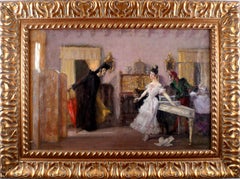
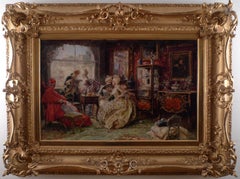
The Cardinal
s Visit
Located in Madrid, ES
SALVADOR SÁNCHEZ BARBUDO
Spanish, 1857 - 1917
THE CARDINAL'S VISIT
signed, located and dated "Barbudo / ROMA 1902" (lower right)
oil on canvas
22 x 33-2/3 inches (55.5 x 85.5 cm.)
framed: 36-1/2 x 48-1/4 inches (92.5 x 122.5 cm.)
PROVENANCE
Private Collection, Munich
LITERATURE
Visita con el cardenal combines the two most salient characteristics of Sánchez-Barbudo's work: the search for novelty of theme and narrative content, and the use of minutely detailed brushwork and luminosity. Sánchez-Barbudo specialised in elaborate 'costume pictures', delighting the viewer with impressive details finely rendered with dazzling technical virtuosity.
Here, Sánchez-Barbudo depicts a well-to-do bourgeois family receiving a cardinal in their home. The interior, sumptuously furnished in the rococo style, along with the rich costumes and fabrics, are beautifully observed. Yet beyond the high technique lavished upon the composition, the treatment is comic and full of character and suffused with a gently satirising anti-clericalism.
The cardinal, far from getting the attention he expects, is, literally, sidelined, his expression and body language showing his pique. There is no doubt that contemporary collectors and spectators took pleasure in the sight of noble self-respecting figureheads of the church being brought back down to earth. The comedy was appealing, and the message suited the prevailing political mood of an increasingly secular middle-class buying public.
Salvador Sánchez Barbudo was born on March 14, 1857 in Jerez de la Frontera (Cádiz). He was one of the most important Spanish artists of the "casacón" genre, who followed the Fortuny tradition in Rome. During his childhood he was under the protection of the Marquis del Castillo and in 1875 he moved to Seville where he attended the School of Fine Arts, becoming a disciple of José Villegas...
Category
Early 1900s Realist Figurative Paintings
Materials
Canvas, Oil
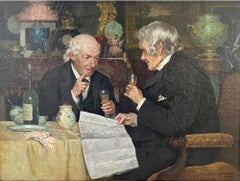
"A Toast" Louis Charles Moeller, American 19th Century Realist Genre Painting
Located in New York, NY
Louis Charles Moeller
A Toast
Signed lower right
Oil on canvas
12 x 16 inches
Louis Charles Moeller was a master of American genre painting. His meticulously detailed, highly finish...
Category
19th Century Realist Figurative Paintings
Materials
Canvas, Oil
$7,600 Sale Price
20% Off
H 18 in W 22 in
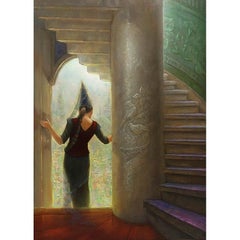
Up the stairs to the garden of the heart. 2019, oil on canvas, 70x50 cm
By Igor Maikov
Located in Riga, LV
Igor Maikov (1966)
Education:
1981 - 1984 The Art Academy of Latvia
1973 - 1983 Salaspils Primary and Secondary School
Exhibitions:
1994 - Group Exhibition «Rol-Art», Latvia
...
Category
2010s Realist Figurative Paintings
Materials
Canvas, Oil
$2,282 Sale Price
20% Off
H 27.56 in W 19.69 in
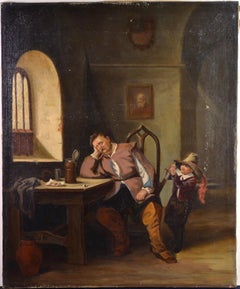
Old Times House Interior Scene with Naughty Boy 19th century Genre Oil Painting
Located in Stockholm, SE
The painting captures a wonderfully amusing family moment set in the 16th century. In the center of the painting we see the father, exhausted by worries and dozing in his chair in fr...
Category
Late 19th Century Realist Interior Paintings
Materials
Canvas, Wood, Oil
$350
H 24 in W 19.7 in D 1 in
More From This Seller
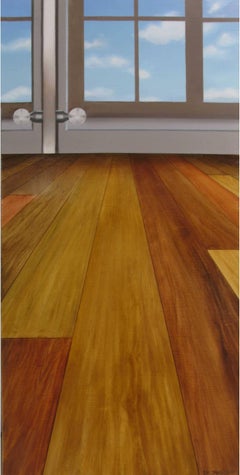
View AllSKY IN LIVING ROOM - Contemporary Realism / Interior Scene with Window
By Sunghee Jang
Located in New York, NY
SungHee Jang, a South Korean artist and MFA graduate of the School of Visual Arts, illuminates on canvas seemingly empty interiors and landscapes.
Category
2010s Realist Interior Paintings
Materials
Canvas, Oil
DAYLIGHT - Contemporary Realism / South Korean Artist / Light and Shadow
By Sunghee Jang
Located in New York, NY
Original Oil Painting by Sunghee Jang. Signed and dated by the artist on verso.
Sunghee Jang (b. 1977, Seoul, Republic of Korea) completed her BFA at Sungshin Women’s University in...
Category
2010s Contemporary Interior Paintings
Materials
Linen, Oil
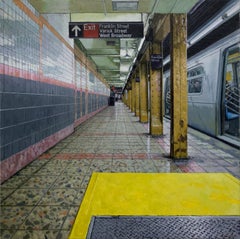
CONVERGENCE - Realism / New York City / Subway
By Richard Combes
Located in New York, NY
Original painting by Richard Combes
Category
2010s Contemporary Interior Paintings
Materials
Canvas, Oil
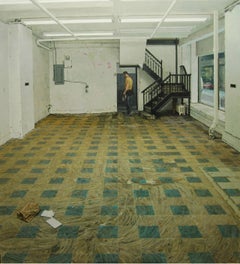
SPACE FOR RENT - Realism / Empty Room with tiled floors and white walls
By Richard Combes
Located in New York, NY
A British-born, American based painter, Richard Combes focuses his subjects on the forgotten corners of New York City, subway stations, the cobblestone streets with puddles in Tribec...
Category
21st Century and Contemporary Contemporary Interior Paintings
Materials
Canvas, Oil
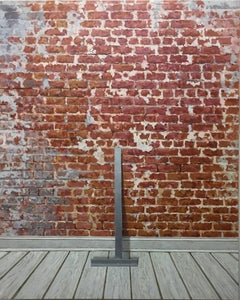
CENTER POINT - Photorealism / Exposed Red Brick Wall / Contrast
By Richard Combes
Located in New York, NY
A British-born, American based painter, Richard Combes focuses his subjects on the forgotten corners of New York City, subway stations, the cobblestone streets with puddles in Tribec...
Category
2010s Contemporary Interior Paintings
Materials
Canvas, Oil
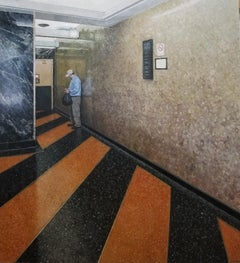
COMMUNICATION, NYC - Elevator / Interior / Male Figure / Old Building / New York
By Richard Combes
Located in New York, NY
A British-born, American based painter, Richard Combes focuses his subjects on the forgotten corners of New York City, subway stations, the cobblestone streets with puddles in Tribec...
Category
2010s Contemporary Interior Paintings
Materials
Canvas, Oil
Recently Viewed
View AllMore Ways To Browse
Raggedy Ann
Restaurant Scene Paintings
Richir Herman
Roman Soldier Art
Romantic 1900 Oil Painting
Romero De Torres
Rose Freymuth Frazier
Sad Vintage Clown
Salome Dance
San Sebastian Paintings
Scott Campbell
Soviet Oil Painting
Surfboard Painting
The Flute Player
Theatrical Oil Painting
Tony Geiger
Tony Karpinski
Ugly Painting