Items Similar to Virgin and Child, a paiting by David Teniers the Younger after Palma Vecchio

Want more images or videos?
Request additional images or videos from the seller
1 of 12
David Teniers the YoungerVirgin and Child, a paiting by David Teniers the Younger after Palma Vecchioca. 1655
ca. 1655
On Hold
$43,389.79
On Hold
£32,524.72
On Hold
€36,500
On Hold
CA$59,985.12
On Hold
A$65,300.55
On Hold
CHF 34,859.05
On Hold
MX$788,327.36
On Hold
NOK 438,309.27
On Hold
SEK 407,379.65
On Hold
DKK 278,054.13
About the Item
Provenance:
Dukes of Marlborough Collection, Blenheim Palace until its sale at Christie's London on 26 July 1886 (lot 172)
English private collection until its sale at Christie's London on 11 December 1992 (lot 363)
Erna Weidinger Collection (1923 - 2021) - Austria
Literature :
Georg Scharf - A list of the pictures in Blenheim Palace - Catalogue raisonné Part 2 - London 1862 (page 166 - number 199 "after Palma Giovane")
Charles Davies - A collection of one Hundred and Twenty Paintings by David Teniers (from Blenheim Palace) - The property of His grace the Duke of Malborough. On exhibition at Mr. Davis' Galleries - London 1884 (page 30 - number 199; "after Palma Giovane")
This painting is presented in the "Blenheim" type frame. Such frames were used to uniformly frame the 120 pasticci by Teniers at Blenheim Palace.
This 'pasticcio' by Teniers, a preparation for the engraving by Jan Popels depecting the Virgin and Child after Palma Vecchio, is moving in many ways. It is the last remaining evidence of the existence of this painting, which has now disappeared. It is one of 246 copies of old master paintings from the collection of Archduke Leopold William of Habsburg, painted by David Teniers to illustrate the Theatrum Pictorium, the first illustrated catalogue of European art history published in 1660. Like half of them, it then became part of the collections of the Dukes of Malborough at Blenheim until the sale of this ensemble in 1886. It is still displayed in its Blenheim-style frame, a model that was created in the 18th century to present these paintings in a homogeneous way.
1. David Teniers II, painter to Archduke Leopold William of Habsburg
Son of David Teniers the Elder and Dymphna de Wilde, David Teniers II probably received his first painting lessons from his father, before continuing his training in the studio of Adriaen Brouwer.
In 1632 he became a member of the Antwerp Guild, specialising in small religious formats and genre paintings. He became friends with Jan Brueghel the Elder, known as de Velours, and in 1637 he married hisdaughter Anne. In 1647 he worked for Archduke Leopold William of Habsburg, who governed the Spanish Netherlands, and in 1651 he followed him to Brussels as a court painter.
His responsabilities included the management of the Archduke's art collection and the production of an illustrated catalogue: The Theatrum Pictorium which was published in 1660. For this catalogue he painted small copies of Italian, mainly Venetian, paintings from the Archduke's collection. These paintings served as models for engravers and were called "pasticci". This collection of paintings was bequeathed by Leopold William to his nephew, Emperor Leopold 1st , and today it forms the core of the collections of the Kunsthistorisches Museum in Vienna.
2. The last testimony of a Palma Vecchio painting now lost
The engraving by Jan Popels allows us to identify this painting as a work by Palma Vecchio, although it had long been attributed to his grand-nephew Palma il Giovane. This painting is known from the successive inventories made by the Habsburgs: it was numbered 230 in the collection of Archduke Leopold-Guillaume and measured 60 x 100 cm. Donated in 1662 to Emperor Leopold 1er, it appears in the inventory of the Stallburg Palace in Vienna in 1735 and in a final inventory in 1772, before being lost.
This painting was probably bought, like many other Venetian paintings (including, for example, Giovanni Bellini's Bathing Woman painted around 1515), from the heirs of the Duke of Hamilton, who had himself bought it from Bartolomeo della Nove or Nicolo Renier.
Painted around 1510-1512, this painting is the only known example in which Palma Vecchio depicts a theme that was very common in the 15th century, that of the Virgin breastfeeding the Child Jesus. She is accompanied on her right by St. John the Baptist (recognisable by his animal skin and the phylactery "ecce agnus dei", i.e. "here is the Lamb of God", hanging from his cross-shaped staff) and on her left by St. Catherine of Alexandria, with the palm of martyrdom in her left hand, resting on the wheel miraculously broken during her martyrdom.
3. Jan Popel's engraving and the 'Blenheim' frame
In the absence of Palma Vecchio’s painting, it is difficult to compare Teniers' execution of this pasticcio with the original. We can however highlight the subtle way in which he was able to render the Venetian atmosphere of the painting and the delicacy of the child suckling at his mother's breast under the tender eyes of the two saints.
Jan Popel's engraving (last photo in the gallery – not for sale), which is very close in size to our pasticcio, faithfully reproduces the composition, obviously on an inverted basis. The message on the phylactery that appeared on the Palma Vecchio painting was erased during the engraving, as it could not be read in reverse.
What is very interesting about this pasticcio, apart from the testimony of a lost work, is that it retains its 'Blenheim' frame in which the entire collection purchased by John Churchill (1650 - 1722), the first Duke of Marlborough, was framed in the 18th century. These paintings were displayed in the early nineteenth century in Blenheim’s billiard room, where they remained until their sale in 1886.
4. The Theatrum Pictorium and the pasticci
Leopold William of Habsburg (1614 - 1662) was the last son of Emperor Ferdinand II of Habsburg and Maria Anna of Bavaria and the brother of Emperor Ferdinand III. Governor General of the Spanish Netherlands from 1647 to 1656, he built up one of the most splendid collections of paintings of his time, in which Venetian masterpieces predominated.
David Téniers II, who entered his service in 1647, supervised the publishing venture of the Theatrum Pictorium by painting small replicas of paintings from the collection to serve as "modello" (preparatory sketches) for the engravings in this book, which was published after the Archduke's return to Vienna in 1660. Most of the pasticci were made in a format relatively close to the one we are presenting (around 17 x 23 cm), but some are smaller (usually portraits measuring around 17 x 12 cm) and a few are larger, up to 22.9 x 31.3 cm (Adam and Eve after the Expulsion from the Earthly Paradise from the Courtauld Institute in London).
Pasticci have always been a subject of collecting and today the largest group of pasticci is held at the Courtauld Institute Gallery in London (fourteen) while the Kunsthistorisches Museum in Vienna, which holds the majority of the Archduke's paintings, holds seven of them. Other sets of several pasticci are also held at the National Gallery of Ireland in Dublin, the Wallace Collection in London, the Metropolitan Museum of Art in New York, the Princetown University Art Museum, the Glasgow Museum, the Stedelijk Museum in Lakenhal, Leiden, and the Musée du Louvre in Paris, while a number of other institutions hold a single pasticcio.
Based upon the Blenheim inventories, the marks No. 18 and No. 192 visible on the verso of our panel were used to designate first the pictorial genre to which the painting belongs, and second its inventory number.
Main bibliographical references :
David Teniers and the Theatre of Painting (collective work) - Courtauld Institute of Art Gallery - 2006
Philip Rylands - Palma Vecchio - Cambridge University Press 1972
- Creator:David Teniers the Younger (1610 - 1690, Flemish)
- Creation Year:ca. 1655
- Dimensions:Height: 11.13 in (28.28 cm)Width: 13.57 in (34.47 cm)
- Medium:
- Movement Style:
- Period:1750-1759
- Condition:Oil on monoxyl oak panel 6 11/16”x 8 15/16” (17 x 22.7 cm ) – Framed : 11 1/8”x 13 9/16” (28.3 x 34.4 cm).
- Gallery Location:PARIS, FR
- Reference Number:1stDibs: LU1568211458292
David Teniers the Younger
David Teniers the Younger was a 17th-century Flemish painter known for his luminous depictions of peasant life. His work was greatly influenced by the tavern scenes of Adriaen Brouwer and the fluid paint handling of Peter Paul Rubens. Born on December 15, 1610 in Antwerp, Belgium, he was the son of the artist David Teniers the Elder, with whom he studied as a youth. Notably, Teniers later married the daughter of the painter Jan Brueghel the Elder. In the early 1630s, the Haarlem-based painter Brouwer moved to Antwerp, Teniers exposure to his low-genre paintings was a turning point in his career. Over the following decades, he enjoyed a popular reputation around Europe. Though most of his works were modest in scale, he was a prolific artist and is thought to have completed some 2,000 paintings over the course of his career. Teniers died on April 25, 1690 in Brussels, Belgium. Today, his work can be found in the Louvre in Paris, the National Gallery of Art in London, the Hermitage Museum in St. Petersburg, and the Rijksmuseum in Amsterdam, among others.
About the Seller
5.0
Vetted Professional Seller
Every seller passes strict standards for authenticity and reliability
Established in 2020
1stDibs seller since 2021
10 sales on 1stDibs
Typical response time: <1 hour
- ShippingRetrieving quote...Shipping from: PARIS, France
- Return Policy
More From This Seller
View AllAn intriguing Lucretia by the Follower of the Master of Female Half Lengths
Located in PARIS, FR
This painting depicting the suicide of Lucretia intrigues us with its strangeness. Although inspired by the artworks of the Master of Female Half-Lengths, it differs from them in its...
Category
16th Century Old Masters Nude Paintings
Materials
Oak, Oil
Mercury and Io, a rediscovered painting by Jean-Baptiste Marie Pierre (ca. 1740)
Located in PARIS, FR
We would like to thank Mr. Nicolas Lesur for confirming the autograph nature of the entire composition after a direct examination of the painting on November 27, 2024.
This painting...
Category
1740s Old Masters Figurative Paintings
Materials
Canvas, Oil
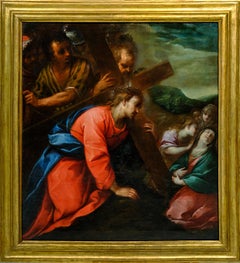
Christ Falling on the Way to Calvary, a painting by Carlo Francesco Nuvolone
Located in PARIS, FR
This painting by Carlo Francesco Nuvolone, the great Lombard master of the mid-seventeenth century, is striking for its dazzling composition and the brilliant colors of Christ's tuni...
Category
1640s Old Masters Figurative Paintings
Materials
Canvas, Oil
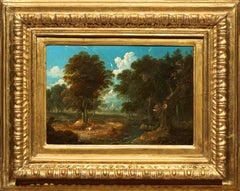
Stag Hunting in the Vicinity of Nuremberg by a German Artist Peter von Bemmel
Located in PARIS, FR
This small landscape shows a hunting scene: two riders are chasing a stag with their dogs at the edge of a forest. Signed by Peter von Bemmel, it is typical of the production of this...
Category
1720s Old Masters Landscape Paintings
Materials
Copper
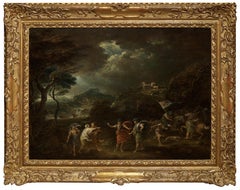
Macbeth and the Three Witches a Painting on Panel by Francesco Zuccarelli
By Francesco Zuccarelli
Located in PARIS, FR
This painting, created during Zuccarelli's stay in England, represents the decisive moment when Macbeth, together with Banquo, meets the three witches who announce that he will be Ki...
Category
1760s Old Masters Landscape Paintings
Materials
Oil, Wood Panel
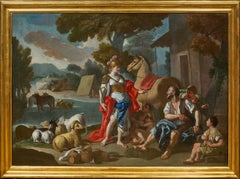
Erminia and the Shepherds, a painting by Francesco de Mura (Napoli 1696 - 1782)
By Francesco de Mura
Located in PARIS, FR
In this masterly painting, Francesco de Mura presents the meeting of Erminia and the shepherds, a famous episode taken from the seventh canto of Torquato Tasso's Jerusalem Delivered....
Category
1760s Old Masters Figurative Paintings
Materials
Canvas, Oil
You May Also Like
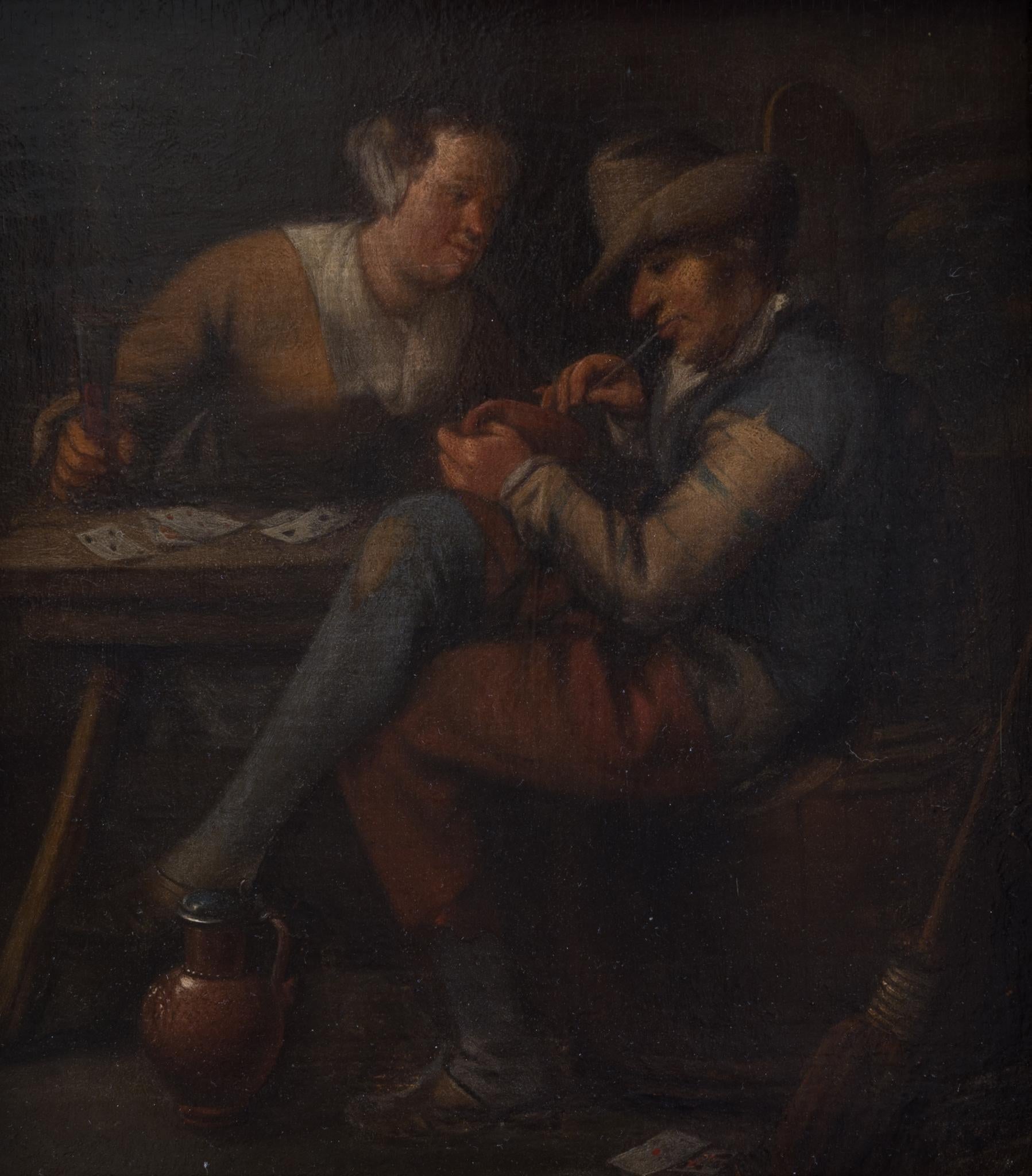
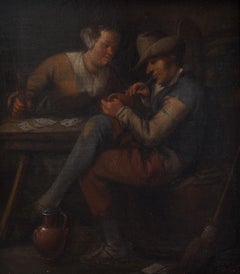
The Card Players by a Flemish 1600s Artist
By Flemish School, 17th Century
Located in Stockholm, SE
Flemish 1600s School
The Card Players
oil on oak panel
panel dimensions 22.5 x 20 cm
frame included
Provenance:
From a Swedish private collection.
Condition:
Flat and stabl...
Category
17th Century Old Masters Figurative Paintings
Materials
Oak, Oil, Panel
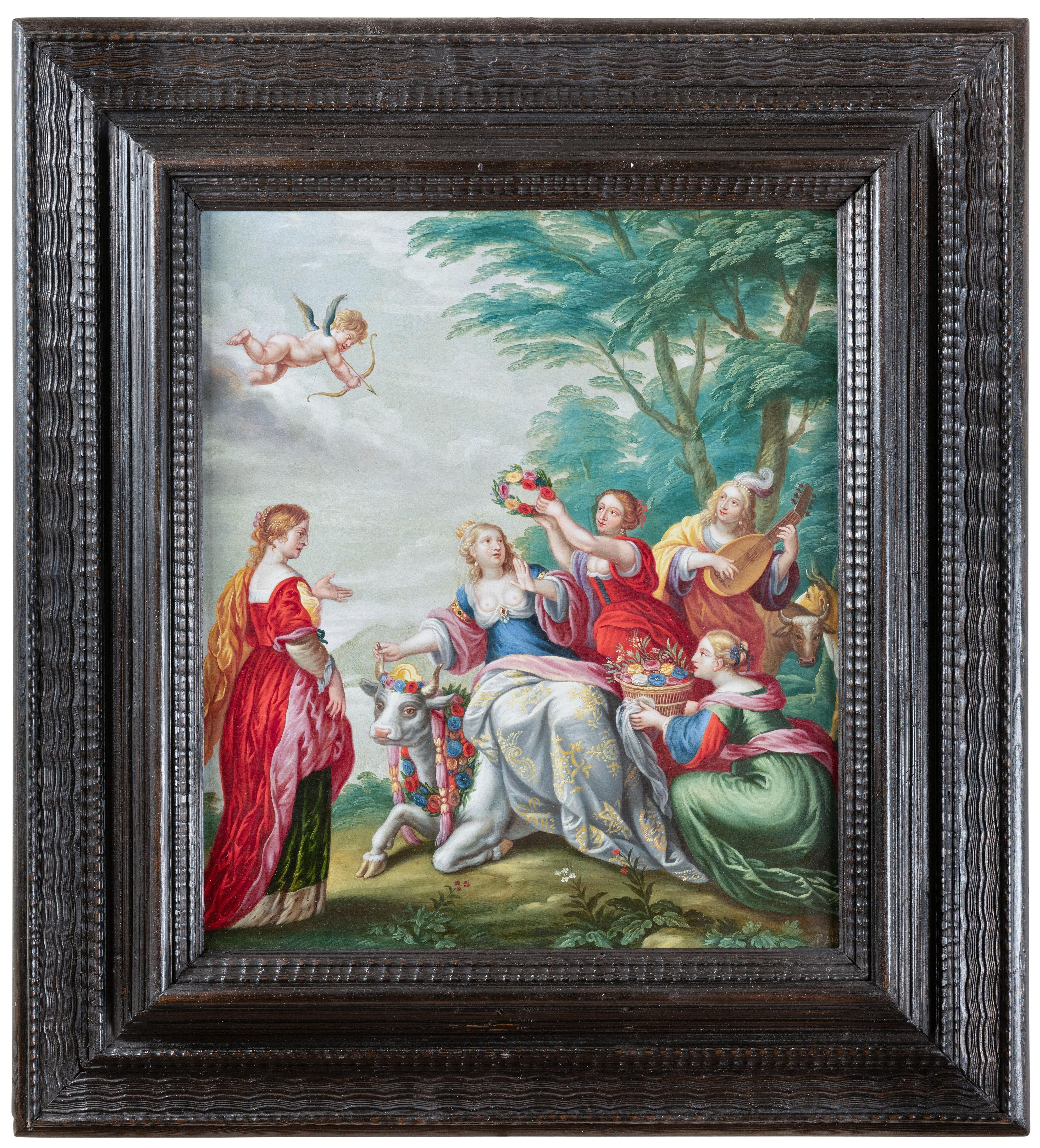
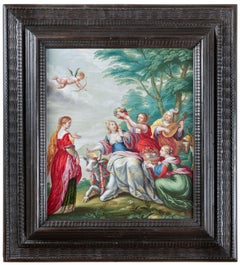
The Rape of Europa, signed Peter Sion (1624-1695), Antwerp, 17th century
Located in PARIS, FR
The Rape of Europa
By Peter Sion (Antwerp, 1624-1695)
Signed in the lower right corner P. Sion
17th century Antwerp School
Oil on copper, dim. h. 53 cm, w. 45 cm
Moulded and ebonized...
Category
17th Century Old Masters Figurative Paintings
Materials
Oak, Oil, Wood Panel
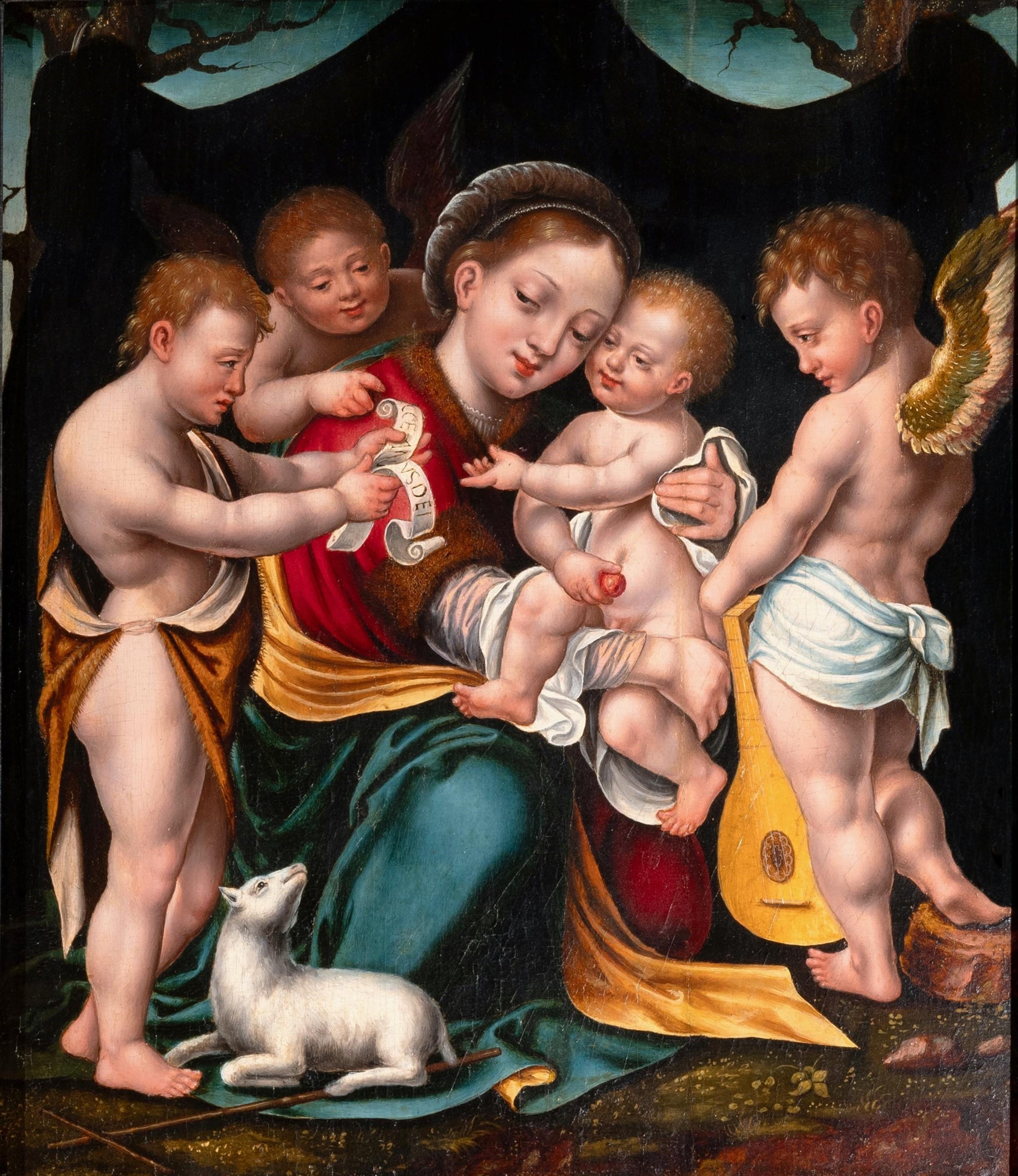
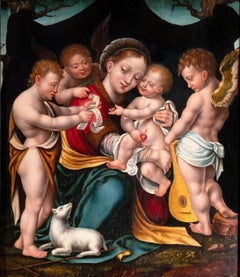
Madonna and child with angels, circle of Joos Van Cleve, 16th c. Antwerp school
By Joos van Cleve
Located in PARIS, FR
Madonna and Child with Saint John the Baptist and angels
Circle of Joos Van Cleve (1485 – 1541)
16th century Antwerp school
Oil on oak panel
Dimensions: h. 32 cm (13 in.), w. 28.5 cm...
Category
16th Century Old Masters Figurative Paintings
Materials
Oak, Oil
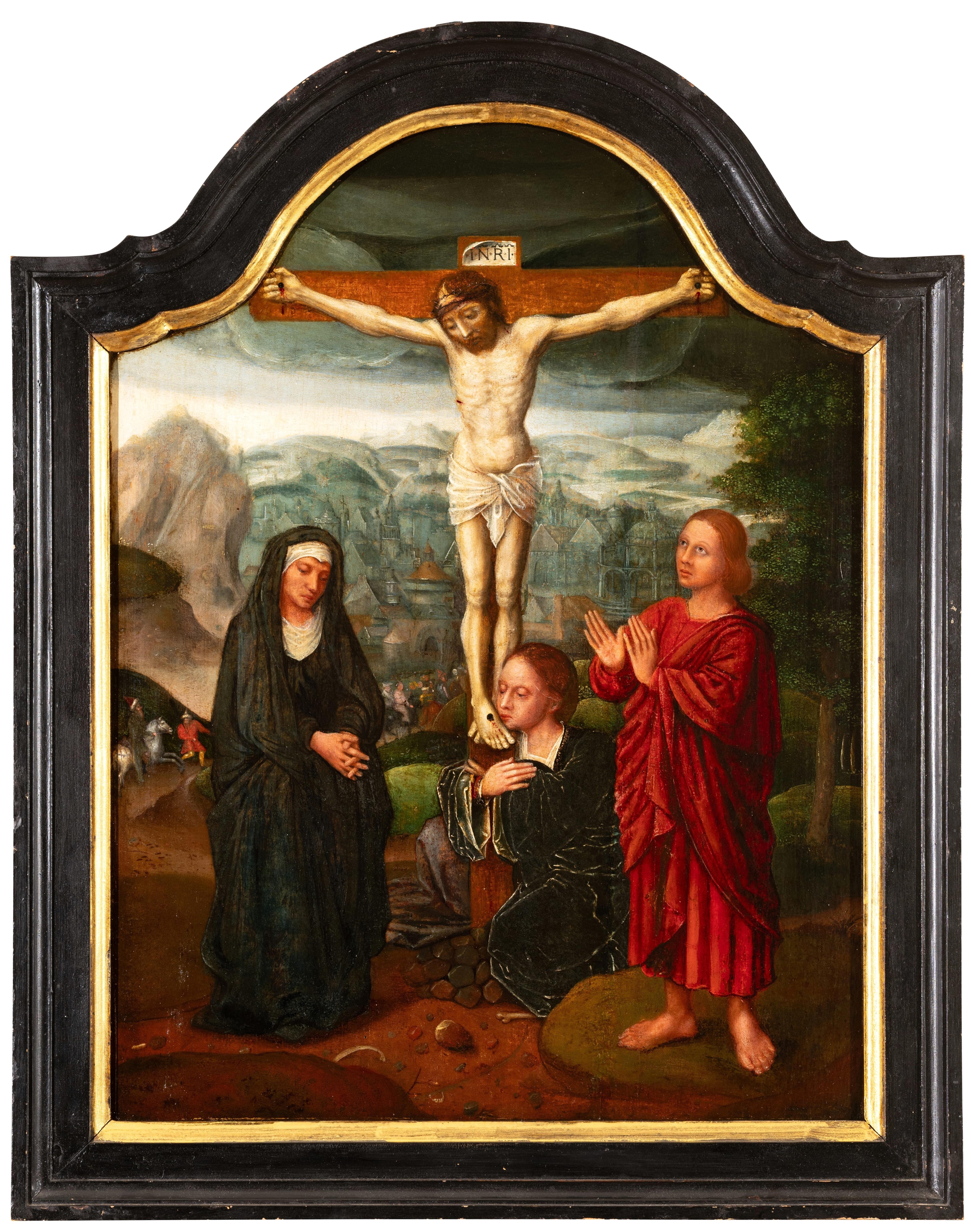
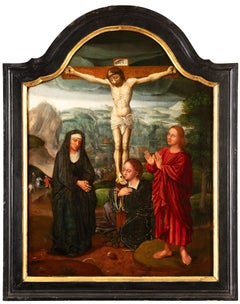
Crucifixion, Bruges school, Flemish, mid 16th century
Located in PARIS, FR
Crucifixion, cercle of Adriaen Isenbrandt, mid 16th century
School of Bruges, cercle of Adriaen Isenbrandt (actif 1510-1551)
Oil on oak panel with its original ebonized frame
Dimensi...
Category
16th Century Old Masters Figurative Paintings
Materials
Oak, Oil, Wood Panel
Rest on the Flight into Egypt - Attributed to Pieter Van Avont - 17th c. Flemish
By Pieter van Avont
Located in PARIS, FR
Rest during the Flight into Egypt - The Virgin and Child with St. John the Baptist and the angels in a Landscape.
Attributed to Pieter Van Avont (1600-1652)
17th century Antwerp School, circa 1630
Oil on oak panel,
Dimensions: h. 38 cm, w. 50 cm (14.96 in x 19.68 in)
Flemish style frame in ebonized and moulded wood
Framed: h. 56 cm, w. 68.5 cm (22.04 in. x 26.97 in.)
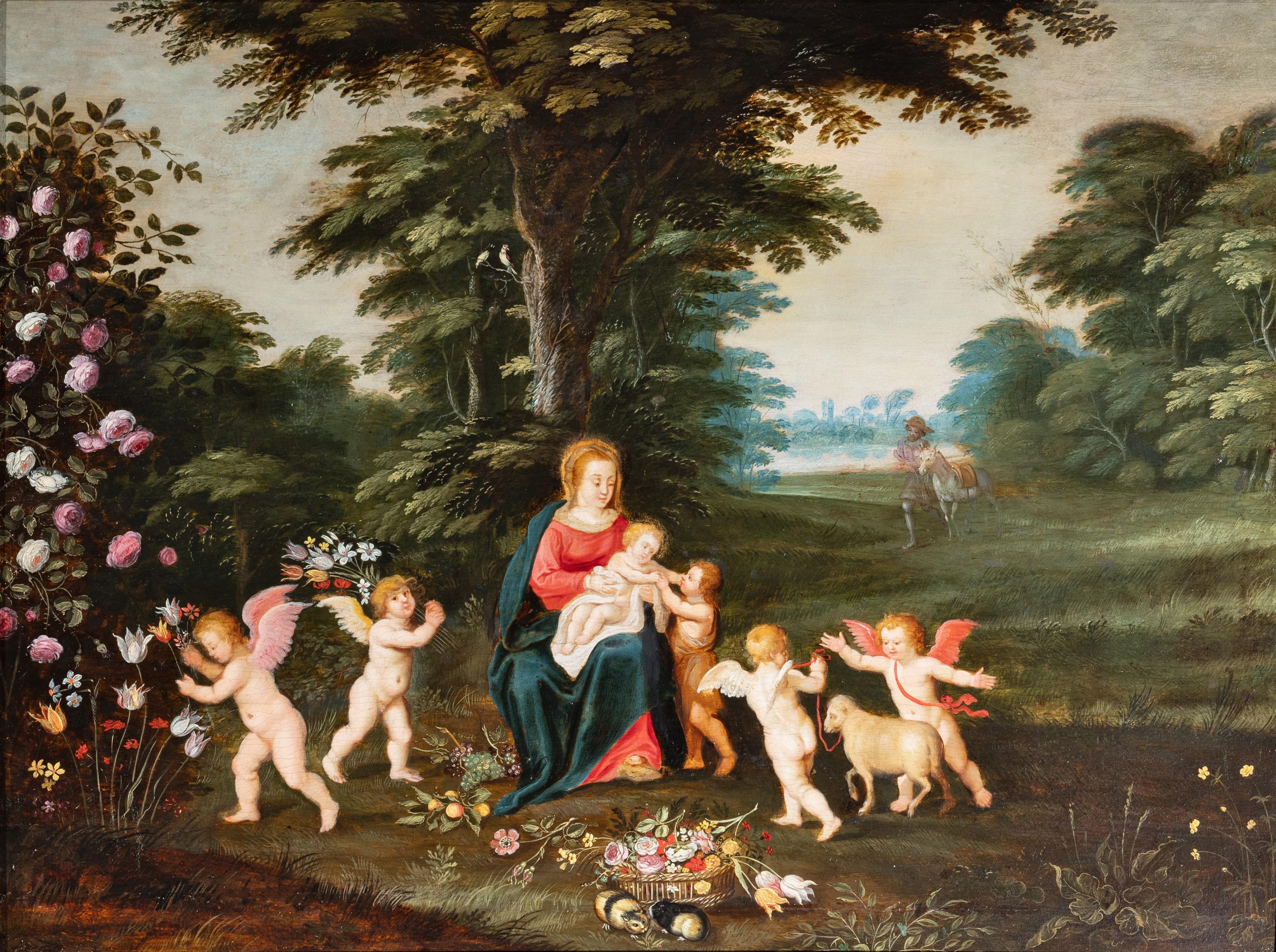
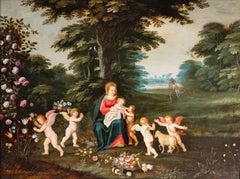
In the heart of a lush wooded landscape, the Virgin with Jesus rests in a green clearing accompanied by Saint John the Baptist and the cherubs. Seated to the left of the composition, the Virgin Mary holds the Child on her lap; the little Saint John the Baptist wearing the camel-skin tunic (his attribute) stands before Jesus to exchange a few caresses. On the right, the couple of cherubs are playing with the lamb of Saint John the Baptist, bringing a jovial character to the scene. A pair of gardening putti on the left pick flowers to bring bouquets to the Virgin and Jesus. Spring flowers such as tulips, daffodils and anemones that grow abundantly around them and enrich the composition with their shimmering colors. A lush rose bush blooms to the left of the figures offering delicate roses. (The rose is the flower associated with the Virgin Mary, who is the "mystical rose," the one that does not bear the "thorn of sin")
At the feet of the Virgin are bunches of grapes (symbol of the future passion of Christ) as well as apples (symbol of the original fall of Man but also of the Redemption in Christ) In the foreground we find a wicker basket filled in profusion with beautiful flowers and guinea pigs nibbling on the blades of grass. In a cleverly arranged disorder, these elements of the still life with their strong symbolic power accentuate the religious theme, but are also an opportunity for the artist to demonstrate his know-how in the still life genre that is gaining momentum in Antwerp. The landscape behind the figures consists of a large tree with a twisted trunk and a luminous opening to the horizon placed on the right. We see Saint Joseph arriving with a donkey, a small reminder from the artist that the composition is associated with the episode of Rest during the flight into Egypt.
The calm expanse of this bucolic forest opening onto the luminous distance, with its profusion of symbolic flowers and fruits, is particularly suited to this sacred scene. The theme of Jesus' sacrifice and his tragic fate is mitigated by cherubs who play with innocence and carelessness in the face of the fragility of life symbolized by cut flowers. The great mastery of the painter is manifested by the finesse of the drawing enhanced by the delicacy in the application of the brushstrokes bringing a multitude of details. The richness of the whole is exacerbated thanks to the choice of colours, this varied palette is an undeniable asset of our work.
The virtuosity of our artist lies in his versatility, as much concerned with the success of the landscape and flowers as with the modelling of his figures. The cherubs with their naked bodies are gracefully illuminated by warm colours with subtle shadows, while the still life is rendered with astonishing realism, both in the precision of the drawing and in the countless shades of the flowers.
There are several compositions similar to ours, of which below are the closest versions:
• Sale, Jean-Claude Anaf et Associés, Lyon, 08/02/1998, attributed to Pieter Van Avont, oil on panel, h. 48 cm, l. 71 cm (recorded on RKD n° 31451). Comment: identical composition, only St Joseph with the donkey is different)
• Christie's New York sale, 29/01/1998, Pieter Van Avont, oil on copper, h. 23.8 cm, w. 24.8 cm
• Dorotheum sale, Vienna, 25/04/2017, Pieter Van Avont and Jan Breughel II, oil on copper, h .26 cm, w. 39 cm
• Hermitage Museum, Saint Petersburg, Russia, Pieter Van Avont, oil on panel, h. 50.5 cm, w. 71.7 cm
Peter van Avont, Flemish painter (Mechelen, 1600 - Antwerp. 1652)
Born in Mechelen, he is mentioned in 1620 as a member of the painters' guild of his hometown. He left in 1 622 for Antwerp, where he was also a member of the guild. He collaborated with many painters, including Jan Brueguel the Younger, David Vinckboons, Lucas van Uden...
Category
17th Century Old Masters Landscape Paintings
Materials
Oak, Oil
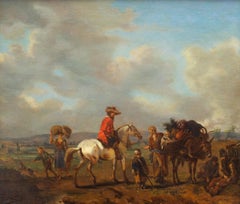
Landscape with Gentleman on Horseback and Peasant Woman Receiving Alms
By Philips Wouwerman
Located in Stockholm, SE
Workshop / Circle of Philips Wouwerman (1619-1668)
Landscape with Gentleman on Horseback and Peasant Woman Receiving Alms
oil on oak panel
12.40 x 14.17 inches (31.5 x 36 cm)
wit...
Category
17th Century Old Masters Landscape Paintings
Materials
Oak, Oil, Wood Panel
More Ways To Browse
Virgin And Child
Billiard Room
18th Century Italian Religious Paintings
Child 18th Century Painting Portrait
St John The Baptist
Lamb Of God
18th Century Oil Paintings For Sale
Adam And Eve Oil Painting
Master Copy Painting
Virgin Child Painting
Old Master Copies Painting
Agnus Dei
Giovanni Bellini
Jan Brueghel The Elder
Virgin And Child Painting
David Elder
Oil Paitings
St Catherine Of Alexandria