Items Similar to First Time on the Art Market - Dancer Tying Her Shoes, c. 1916
Want more images or videos?
Request additional images or videos from the seller
1 of 9
Dick BeerFirst Time on the Art Market - Dancer Tying Her Shoes, c. 1916c. 1916
c. 1916
$21,977.84
£16,487.40
€18,500
CA$30,429.91
A$33,072.08
CHF 17,723.61
MX$401,553.82
NOK 222,509.22
SEK 206,343.48
DKK 140,935.66
About the Item
Dick Beer (b. London 1893 - d. Stockholm 1938)
Dancer Tying Her Shoes, c. 1916
(Dansösen knyter sina skor, c.1916)
oil on canvas
unframed 102 x 80 cm
Provenance:
Within the family Beer until today.
Exhibited:
Göteborgs konsthall, 1944.
Konstgalleriet Borås, 1947.
Malmö museum, 1950.
Konstakademien, Stockholm, 1973.
Åmells Konsthandel – En internationell kubist, Stockholm
London, 2008.
Millesgården – Dick Beer – Impressionist
Kubist, 2012.
Condition:
The painting remains unrestored and would benefit from evaluation by a professional conservator. Certain areas of the canvas require reinforcement to the stretcher to ensure its long-term stability. These considerations have been reflected in the artwork's pricing. Contact us for more information.
Essay:
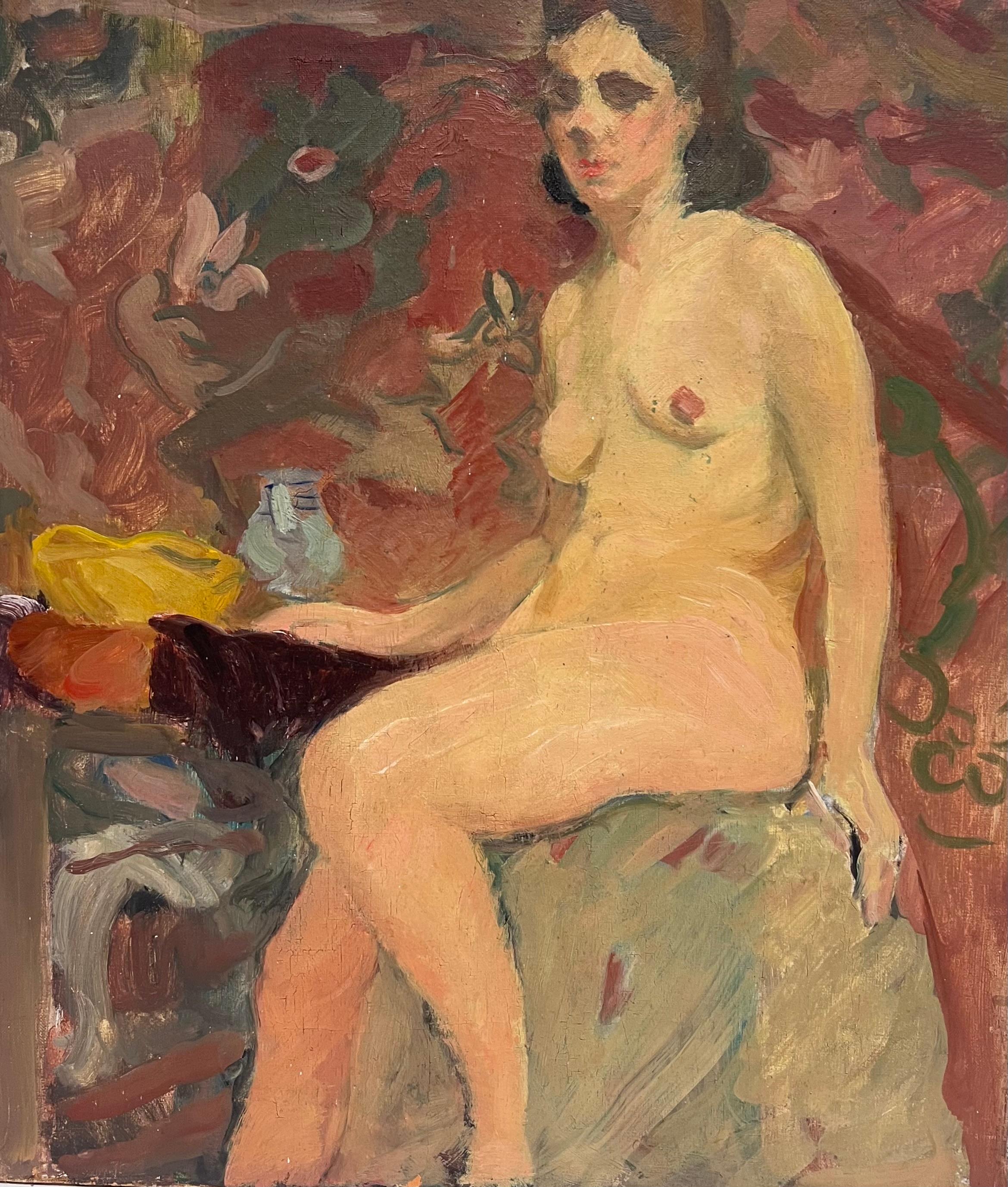
This striking painting by Swedish artist Dick Beer, titled Dancer Tying Her Shoes (Dansösen knyter sina skor), is considered one of his masterpieces. Created around 1916, the work depicts a woman seated on the edge of a bed, delicately tying her dance shoes. The scene is imbued with a sense of movement and emotional depth, evoking comparisons to the works of Degas, yet rendered in Beer’s distinctive style.
The painting invites the viewer to wonder about the identity of the woman and her story. Why is she half-dressed, preparing her shoes? Was she a muse, a lover, or perhaps an intimate part of Beer’s own life?
Interestingly, Beer revisited this motif about two years later, creating a cubist interpretation of the same subject. This earlier version, however, captures a unique vulnerability and immediacy, standing as a testament to Beer’s versatility and emotional depth as an artist.
The significance of Dancer Tying Her Shoes is further highlighted by its inclusion in several prestigious exhibitions over the decades:
Göteborgs Konsthall (1944)
Konstgalleriet Borås (1947)
Malmö Museum (1950)
Konstakademien, Stockholm (1973)
Åmells Konsthandel: En internationell kubist, Stockholm
London (2008)
Millesgården: Dick Beer – Impressionist
Kubist (2012)
About Dick Beer (1893–1938)
Born in London, Dick Beer relocated to Sweden in 1907. He studied art at Althins Målarskola and the Royal Swedish Academy of Fine Arts, before moving to Paris in 1912. His artistic journey was interrupted by World War I, during which he served as a volunteer on the French side. After recovering from injuries at Château de Rochefort—a location shared with the renowned Fernand Léger—Beer became deeply influenced by cubism.
Beer’s works evolved over his career, oscillating between realism, expressionism, and cubism. While his cubist works faced harsh criticism early on, they later gained recognition as some of the finest examples of Swedish modernism. Today, Beer’s art is celebrated for its emotional depth and technical skill, with pieces held in major collections including the Nationalmuseum, Moderna Museet, and several regional museums in Sweden.
This particular painting is not only an exceptional example of Beer’s artistry but also a window into the personal and historical narratives that defined his short but impactful life.
- Creator:Dick Beer (1893 - 1938, Swedish, British)
- Creation Year:c. 1916
- Dimensions:Height: 40.16 in (102 cm)Width: 31.5 in (80 cm)
- Medium:
- Movement Style:
- Period:
- Condition:The painting remains unrestored and would benefit from evaluation by a professional conservator. Certain areas of the canvas require reinforcement to the stretcher to ensure its long-term stability. These considerations have been reflected in price.
- Gallery Location:Stockholm, SE
- Reference Number:1stDibs: LU1445215471712
Born in London, Dick Beer relocated to Sweden in 1907. He studied art at Althins Målarskola and the Royal Swedish Academy of Fine Arts, before moving to Paris in 1912. His artistic journey was interrupted by World War I, during which he served as a volunteer on the French side. After recovering from injuries at Château de Rochefort—a location shared with the renowned Fernand Léger—Beer became deeply influenced by cubism. Beer’s works evolved over his career, oscillating between realism, expressionism, and cubism. While his cubist works faced harsh criticism early on, they later gained recognition as some of the finest examples of Swedish modernism. Today, Beer’s art is celebrated for its emotional depth and technical skill, with pieces held in major collections including the Nationalmuseum, Moderna Museet, and several regional museums in Sweden.
About the Seller
5.0
Platinum Seller
Premium sellers with a 4.7+ rating and 24-hour response times
Established in 2020
1stDibs seller since 2020
221 sales on 1stDibs
Typical response time: 1 hour
Associations
International Confederation of Art and Antique Dealers
Associations
- ShippingRetrieving quote...Shipping from: Stockholm, Sweden
- Return Policy
More From This Seller
View AllSeated Nude in the Studio – A Modernist Study from the 1920s
Located in Stockholm, SE
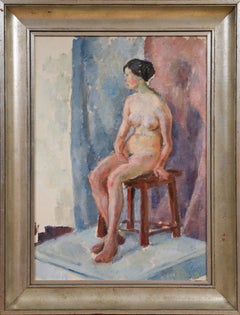
This evocative oil painting, titled Studio Muse, depicts a seated nude in a quiet moment of contemplation. The model is shown in profile, resting on a simple wooden stool against a n...
Category
1920s Modern Figurative Paintings
Materials
Canvas, Oil
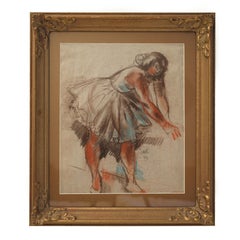
Ballet Dancer by Jules Schyl, Pastel on paper, Similarities with Degas
By Jules Schyl
Located in Stockholm, SE
Jules Schyl (Sweden, 1893-1977)
Title: Ballet Dancers
A Ballet Dancer painting is a rare find for an artist mostly known for his oeuvre with Cubism and Expressionist paintings. The current painting has many similarities with Degas sketches...
Category
1940s Impressionist Figurative Drawings and Watercolors
Materials
Paper, Crayon, Pastel
$1,342 Sale Price
54% Off
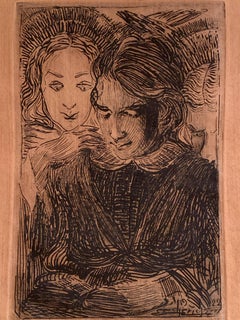
Composition with Reading Girl by an Unknown Artist, Ink on Paper, Dated 1922
Located in Stockholm, SE
Unknown Swedish Artist
Composition with Reading Girl
inkl on paper
indistinctly signed and dated Eric Eric SON? 1922
frame included
Category
1920s Figurative Drawings and Watercolors
Materials
Paper, Ink
$801 Sale Price
50% Off
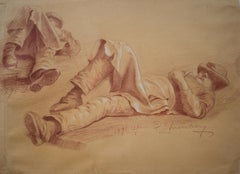
Sleeping Youth, 1895 – Early Academic Study by Paul Ehrenberg, Age 19
Located in Stockholm, SE
Paul Ehrenberg (1876–1949)
Sleeping Boy, 1895
Red chalk on paper
sheet 38 × 52 cm (14.96 × 20.47 inches)
framed 61 × 74 cm (24.02 × 29.13 inches)
signed and dated twice
Essay:
Thi...
Category
1890s Impressionist Figurative Drawings and Watercolors
Materials
Paper, Chalk
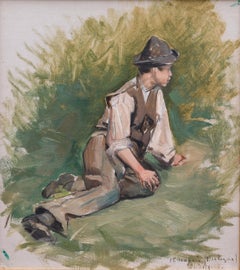
Lost in Thoughts, Oil Sketch Painted in Brittany (Bretagne), Before 1890
Located in Stockholm, SE
We are delighted to offer a unique and evocative piece by the Swedish artist Ingeborg Westfelt-Eggertz. This small oil sketch captures a moment in time, portraying a young man seated...
Category
1880s Landscape Paintings
Materials
Canvas, Masonite, Oil
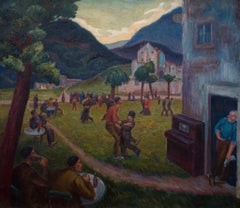
Popular Dance at Corsica, I. By Swedish Artist Dick Beer, c.1924
Located in Stockholm, SE
Dick Beer (b. London 1893 - d. Stockholm 1938)
Folkliv på Korsika, I (Popular Dance at Corsica, I)
oil on canvas
signed Dick Beer
c. 1924
canvas dimensions 88 x 100 cm
Exhibited:
The Royal Academy Stockholm 1973;
Millesgården – Dick Beer – Impressionist & Kubist, 2012
Dick Beer was born in 1893 in London as Richard Beer, the youngest of five brothers. His father, John Beer (1853-1906), was a watercolourist who was born in Stockholm and left Sweden at the age of 17. John Beer instructed his sons in drawing and painting, among other things. A number of sketchbooks bear testimony to the boys’ talent.
Dick Beer’s parents died in 1906 and 1907. Barely 15 years old, Beer arrived in Sweden as an orphan. First he lived with relatives and finally he ended up at Reverend Laurell in Västergötland.
Dick Beer began his artistic studies at the Althin School of Painting in Stockholm in 1908 and continued at the Royal Academy of Arts in the autumn of 1910, but in September 1912 he broke off his studies and travelled to Paris. He rented a studio and enrolled at the Colarossi and Grande Chaumière academies.
In the summer of 1913, Dick Beer travelled to Pont-Aven in Bretagne in order to paint. In September the same year, he held his first solo exhibition in Stockholm which he gave the French title Exposition des tableaux de Bretagne et autour de Paris. The exhibition proved a success. Many of the paintings were executed in a light palette in a style inspired by the impressionists.
In 1914, Dick Beer undertook an extensive study trip to Italy, Tunis, Morocco and Spain, which resulted in canvases overflowing with colours and light. When the French army mobilised, he volunteered and was enlisted in the French Foreign Legion. In 1915 Dick Beer sustained severe head injuries in a grenade attack, which resulted in deafness and a nervous condition that would plague him for the rest of his life. Two of his brothers died the following year, fighting for the English army.
Dick Beer was hospitalised and convalesced at Château de Rochefort. Here he started painting again, in an impressionist style, a painting dominated by blue and green hues.
In 1918, Dick Beer married Ruth Öhrling, a dentist, and their son John was born later in the year. During this time, Beer began experimenting with cubist painting and created several large compositions, including the painting “The Arab Café”.
In the years that followed, Dick Beer was based in Paris, where he often moved house. He was instructed by André Lhote, who encouraged his students to work freely in the studio and provided them with individual critique. Beer often travelled to Bretagne or Provence. His artist friends came from all over Europe and included Amedeo Modigliani. Dick Beer exhibited fairly regularly in Paris between 1919 and 1934 and made a name for himself in French artist circles.
In the summers, Ruth regularly rented a house in the countryside, often at Lake Mälaren. She kept a large house with many models and friends and there was a lot of painting and discussions. In 1933, the couple divorced but Ruth still loved Dick...
Category
1920s Post-Impressionist Figurative Paintings
Materials
Canvas, Oil
You May Also Like
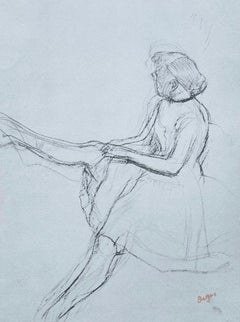
Edgar Degas, Seated Dancer, Removing Her Slipper, 1945 (after)
By Edgar Degas
Located in Southampton, NY
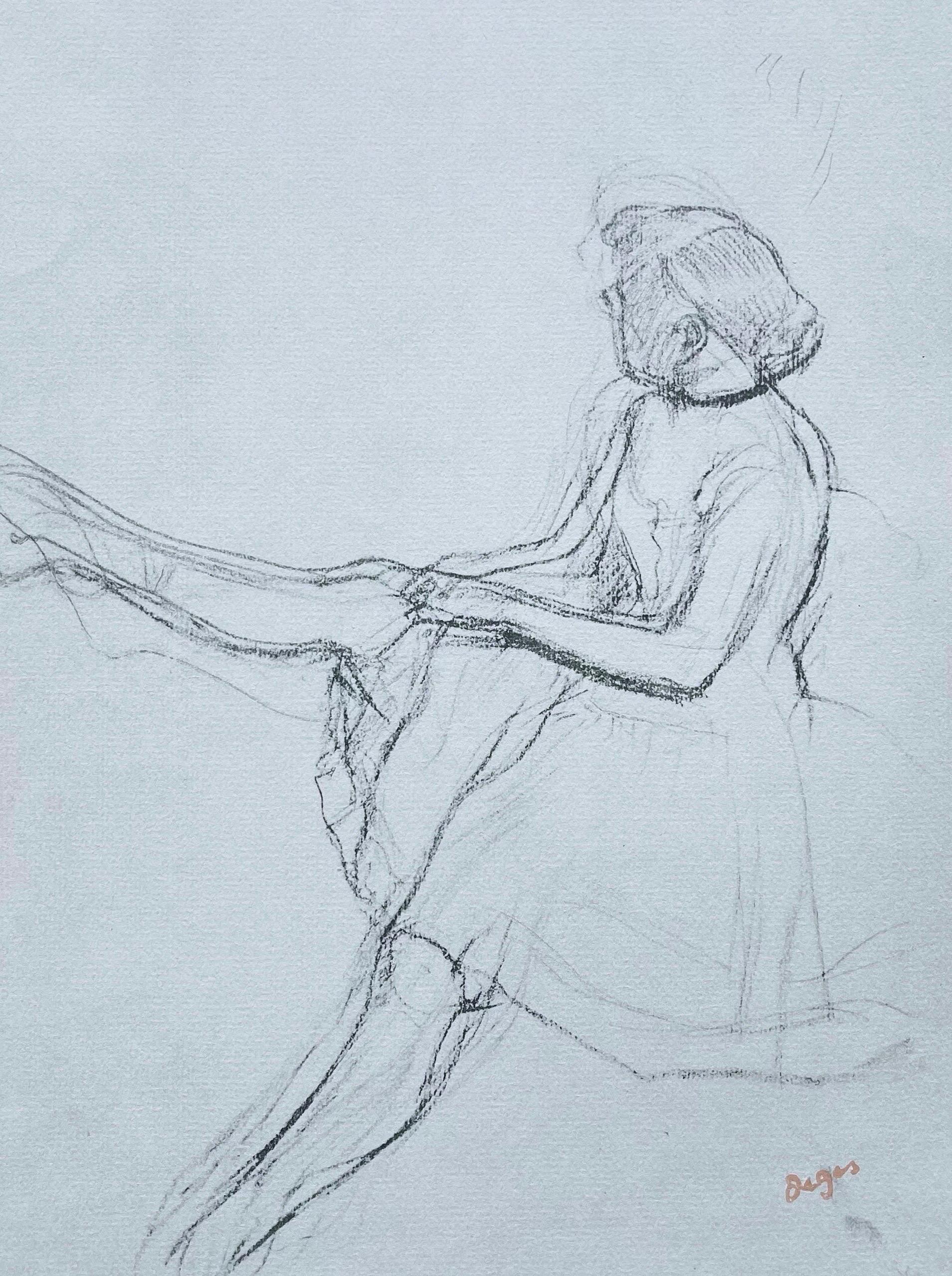
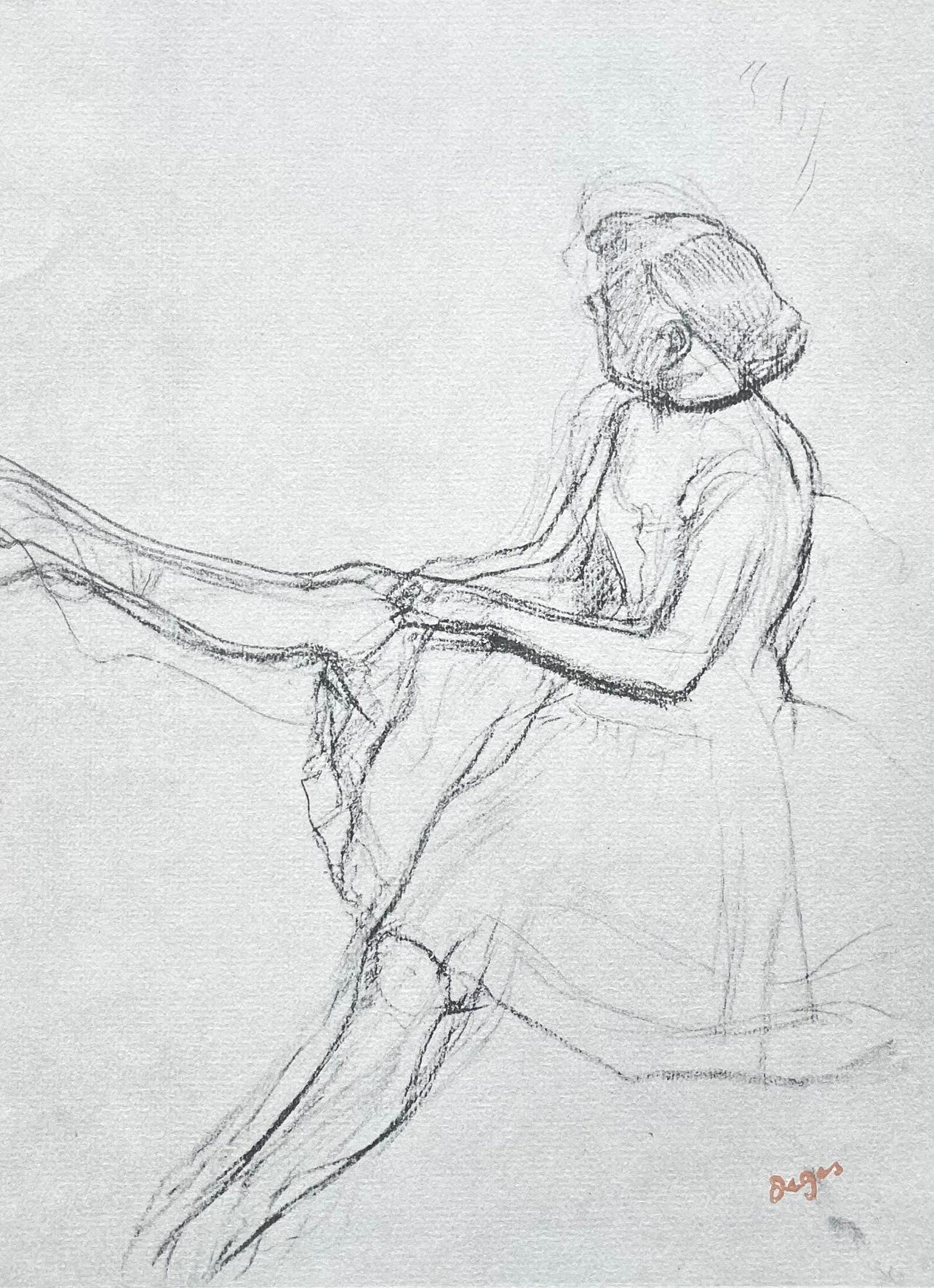
This exquisite lithograph after Edgar Degas (1834–1917), titled Seated dancer, removing her slipper, originates from the 1945 folio Degas, Ten Ballet Sketches. Published by The Studio Publications, Inc., New York, rendered and printed by Albert Carman, City Island, 1945, this work reflects Degas’s sensitive mastery of line, movement, and intimate observation, capturing the grace, poise, and psychological immediacy that define his iconic ballet imagery. In Seated dancer, removing her slipper, Degas reveals gesture and inner emotion through economical contour and lyrical nuance.
Executed as a lithograph and pochoir on velin paper, this work measures 17 x 13 inches (43.18 x 33.02 cm). Signed in the plate and unnumbered as issued. Rendered and printed by Albert Carman, City Island, one of the notable American ateliers specializing in fine art lithography during the mid-20th century.
Artwork Details:
Artist: After Edgar Degas (1834–1917)
Title: Seated dancer, removing her slipper, from Degas, Ten Ballet Sketches, 1945
Medium: Lithograph and pochoir on velin paper
Dimensions: 17 x 13 inches (43.18 x 33.02 cm)
Inscription: Signed in the plate and unnumbered as issued
Date: 1945
Publisher: The Studio Publications, Inc., New York
Printer: Albert Carman, City Island, 1945
Condition: Well preserved, consistent with age and medium
Provenance: From the 1945 folio Degas, Ten Ballet Sketches, published by The Studio Publications, Inc., New York
Notes:
Excerpted from the album, Born in Paris in 1834, Edgar Degas lived, and surely loved the life of that city during most of his years. These continued somewhat sadly beyond those of most of his friends— into the debacle of the first World War, during which he died in 1917. Judging by the frequency with which he used them as models, he must have had an especial admiration for the ballet girls who followed a profession that at the time brought none of the glory and prosperity which attend it today. New aspects of the human body, revealed in movement, fascinated him. But his occupation with the simply anatomical side of his subjects never resulted in a cold interpretation. On the contrary there is a warmth and sympathy that pervades all of his work. The drawings here represent the painter in one important phase of his multi-sensitive view of life; and permit an insight which a more ambitious work might not do-into the operation of the creative process, the artist's transformation of reality as it passes through the mesh of his sensibilities. The Edition of this Portfolio is limited to MMMD examples. Rendered by Albert Carman.
About the Publication:
Degas, Ten Ballet Sketches, published in 1945 by The Studio Publications, Inc., New York, stands as one of the most elegant and scholarly mid-century American fine art folios devoted to the ballet imagery of Edgar Degas. Conceived as a high-quality interpretive portfolio, the album presents a series of lithograph-and-pochoir renderings based on Degas’s original drawings, executed with exceptional attention to tonal subtlety, contour fidelity, and the emotional interiority that defines the artist’s draftsmanship. Rendered and printed by Albert Carman on City Island, the publication embodies an American postwar effort to restore and celebrate European masterworks through meticulous handcraft and artisanal color application, honoring Degas’s distinctive line and the atmospheric delicacy of his studio-based studies. Produced in a substantial edition of MMMD examples, the portfolio offered audiences rare access to Degas’s private working drawings—images rarely seen outside institutional collections—while exemplifying the technical refinement and interpretive care characteristic of Carman’s workshop. Today, Degas, Ten Ballet Sketches remains a sought-after historical publication, valued for its craft, fidelity to Degas’s aesthetic, and its role in preserving and disseminating the artist’s intimate ballet imagery in a beautifully executed mid-century fine art format.
About the Artist:
Edgar Degas (1834–1917) was a French painter, draughtsman, printmaker, and sculptor whose groundbreaking fusion of classical draftsmanship, modern experimentation, and psychological depth helped define the trajectory of Western art, positioning him as one of the most influential figures of the nineteenth and early twentieth centuries; renowned for his depictions of ballet dancers, racehorses, theater scenes, cafe life, domestic interiors, milliners, laundresses, and women at their toilette, Degas reimagined observational realism through radical compositional innovation—employing extreme cropping, asymmetrical framing, oblique viewpoints, and dramatic lighting that anticipated photographic and cinematic language long before these technologies shaped visual culture, and although associated with Impressionism, he rejected plein-air spontaneity in favor of studio-based discipline rooted in the linear precision of Jean-Auguste-Dominique Ingres, the expressive chromaticism of Eugene Delacroix, and the modernity of Edouard Manet while also drawing inspiration from Japanese ukiyo-e prints, classical sculpture, and early photography; his independent artistic philosophy resonated with and helped shape the innovations of Pablo Picasso, Alexander Calder, Alberto Giacometti, Salvador Dali, Joan Miro, Wassily Kandinsky, Marcel Duchamp, and Man Ray, whose explorations of movement, form, dream logic, abstraction, and conceptualism all find antecedents in Degas’s investigations into seriality, temporality, and the fragmented figure, and his pioneering use of pastel, monotype, and wax sculpture fundamentally transformed each medium, influencing artists from Henri Matisse, Francis Bacon, Lucian Freud, and Giacomo Manzu to Paula Rego, contemporary realists, experimental photographers, and choreographers; his works are held in nearly every major museum collection worldwide—including the Musee dOrsay, the Louvre, the Metropolitan Museum of Art, the National Gallery of Art, the Art Institute of Chicago, the Courtauld Institute, and the National Gallery, London—affirming his central place in the history of art, and the highest auction record for Degas was achieved at Sothebys London on February 3, 2015, when Danseuses en Bleu sold for 37,033,000 GBP, cementing his status as one of the most sought-after and enduringly significant artists of the Western canon.
Edgar Degas lithograph...
Category
1940s Impressionist Figurative Prints
Materials
Lithograph
$796 Sale Price
20% Off
Free Shipping
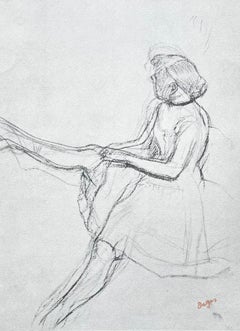
Degas, Seated dancer, removing her slipper, Ten Ballet Sketches (after)
By Edgar Degas
Located in Fairfield, CT
Medium: Lithograph and stencil on vélin paper
Year: 1945
Paper Size: 17 x 13 inches
Inscription: Signed in the plate and unnumbered, as issued
Notes: From the folio, Degas, Ten Balle...
Category
1940s Impressionist Figurative Prints
Materials
Lithograph
$716 Sale Price
20% Off
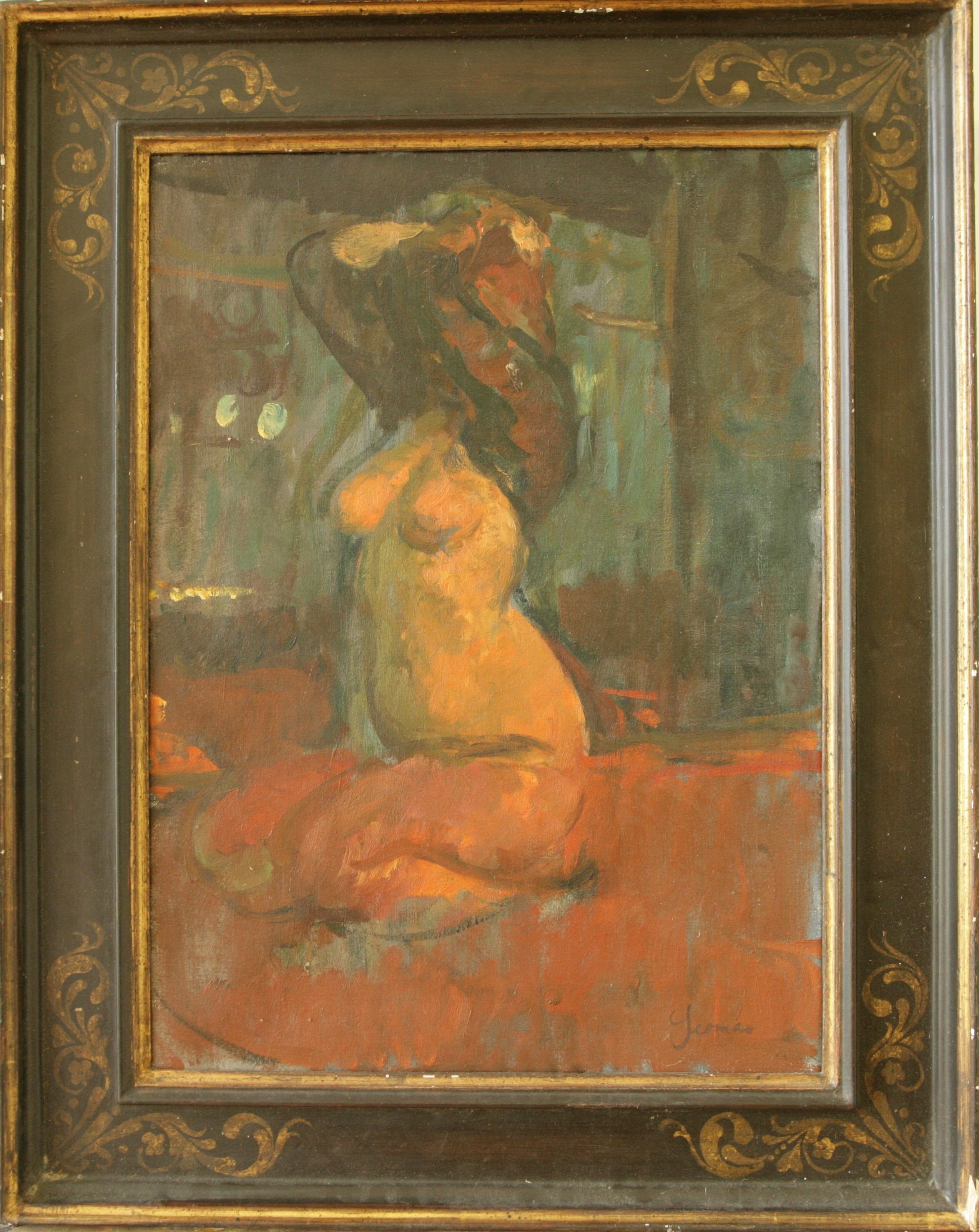
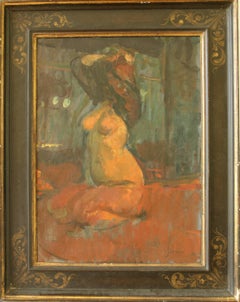
MARTIN YEOMAN Dancer Woman Undressing Nude Oil Painting Post-Impressionist
By Martin Yeoman
Located in Pollenca, Illes Baleares
Martin Yeoman was born in 1953, and studied with Peter Greenham at the Royal Academy Schools, London, from 1975 to 1979. He was awarded scholarships tha...
Category
Early 2000s Post-Impressionist Nude Paintings
Materials
Oil
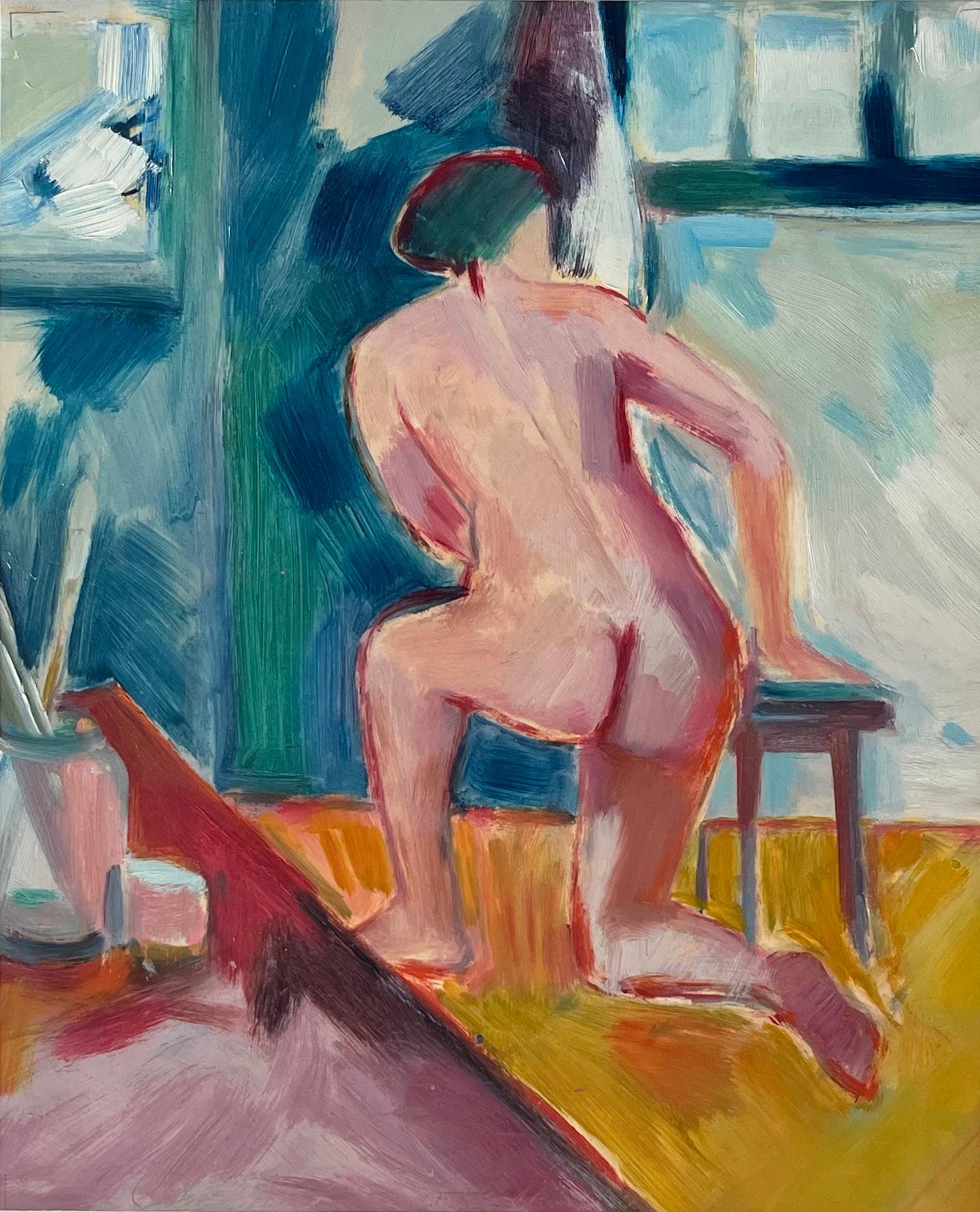
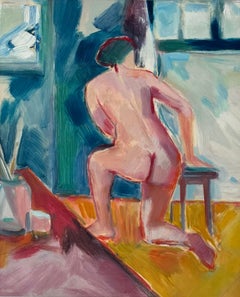
Original Oil Painting of a Nude Figure Kneeling Next a stool in a Studio Setting
Located in Cirencester, Gloucestershire
Title: Original Oil Painting of a Nude Figure Kneeling Next a stool in a Studio Setting
Artist: Roland Pichard
Signed: Bottom right
Medium: Oil on oil paper, mounted on card
Size...
Category
Mid-20th Century Post-Impressionist Still-life Paintings
Materials
Oil
1930
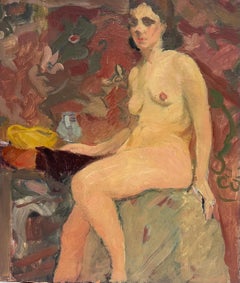
s French Post Impressionist Oil Painting Portrait of Seated Nude Lady Model
Located in Cirencester, Gloucestershire
The Artists Model, Nude Lady posing for the artist
circa 1930's
Artist/ School: Suzanne Dinkés (French, 1895 - 1984)
Medium: oil on canvas, unframed
Size : 22 x 18.5 inches
Provenanc...
Category
Mid-20th Century Post-Impressionist Nude Paintings
Materials
Oil
Untitled (Woman Removing Her Stockings)
By Everett Shinn
Located in Fairlawn, OH
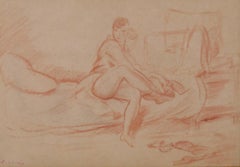
Untitled (Woman Removing Her Stockings)
Conte crayon on paper. c. 1905
Signed lower right: E Shinn
Provenance:
James Graham & Sons, New York (labels)
Ronald C. Sloter, Columbus
Colum...
Category
Early 1900s Ashcan School Nude Drawings and Watercolors
Materials
Conté
More Ways To Browse
Dick Beer
Blacksmith Painting
Boots Painting
Botticelli Paintings
Cartoon Oil Paintings
Eiffel Oil Painting
Emile Othon Friesz
Figurative Neoclassical Paintings
Francoise Nielly
Harris Marcus
Hyper Realist Art
Mexican Girl
Oil Paintings Arab
Painting Of A Clown
Painting Pirate
Paintings By Ernesto
Pietro Ruffo
Rizaldy Celi Jr