1 of 6
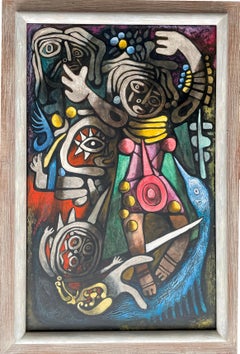
Dorothy Eugenie BrettThe Pawnee Horse Thief1953
1953
$42,500List Price
About the Item
Authenticity Guarantee
In the unlikely event there’s an issue with an item’s authenticity, contact us within 1 year for a full refund. DetailsMoney-Back Guarantee
If your item is not as described, is damaged in transit, or does not arrive, contact us within 7 days for a full refund. Details24-Hour Cancellation
You have a 24-hour grace period in which to reconsider your purchase, with no questions asked.Vetted Professional Sellers
Our world-class sellers must adhere to strict standards for service and quality, maintaining the integrity of our listings.Price-Match Guarantee
If you find that a seller listed the same item for a lower price elsewhere, we’ll match it.Trusted Global Delivery
Our best-in-class carrier network provides specialized shipping options worldwide, including custom delivery.You May Also Like
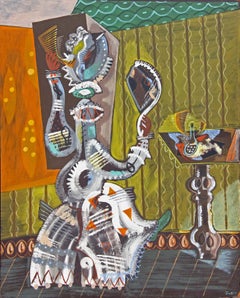
Abstract American Modernist Oil Painting "Dressing for the Party" by Zoute 1951
Located in Rochester, NY
Abstract Modernist oil painting by Zoute dated 1951. Oil on Masonite. I believe the subject in the painting is the artist's wife Thelma Salter. Zoute used himself and his wife almost exclusively as models. Painted in 1951. Unframed.
Presented by Joseph Dasta Antiques.
Zoute (Born-Leon Salter, 1903-1976) was self-taught and well exhibited during his lifetime. He painted from 1940-1954 (he stopped painting at this later date due to his wife's illness and death and never painted again) A self-taught artist, he was part of the great modern wave. He exhibited with many of the most notable artists of the day such as Picasso, Braque, Klee and others at the invitation only State University of Iowa International Show 1946-1947. He had numerous one man shows at NYC galleries, Mortimer Levitt / Joseph Heller...
Category
Mid-20th Century Modern Figurative Paintings
Materials
Masonite, Oil
$3,950
H 60 in W 48 in D 0.1 in
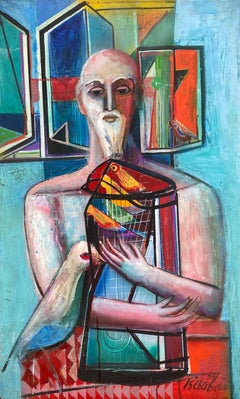
“The Wizard”
By Nahum Tschacbasov
Located in Southampton, NY
Here for your consideration is a mid century modern oil painting on masonite by the well known Russian/American artist, Nahum Tschacbasov. The painting depicts an old man with a long wispy beard holding a group of birds. Signed lower right and dated 1954. Presently unframed. Condition is very good. Provenance: The estate of the artist Nahum Tschacbasov.
Nahum Tschacbasov
Biography :
Russian-American artist Nahum Tschacbasov (1899-1984) is known for his cubo-surrealistic works which feature a strong psychological element. Some of his work bears a resemblance to work of another Russian-American artist--David Burliuk. He was somewhat of a late starter, moving to Paris in 1932 to study under Adolph Gottlieb, Marcel Gromaire and Fernand Leger. He had his first exhibition in Paris in 1934. He then returned to the US where he joined Rothko and Gottlieb at the Galery Seccession. He was one of the co-founders of The Ten, a group of social conscious abstract painters which included Rothko, Gottlieb, Joseph Solman and Ilya Bolotowsky, among others.
In 1944, he began to work at Stanley Hayter's Atelier 17, a center for surrealistic ideas. Between 1936 and 1943, he had five one-man exhibitions at the ACA Galleries and participated in five group shows. He also exhibited at the Whitney, the Pennsylvania Academy of Fine Arts, the Knox Albright Museum, the Chicago Institute of Fine Art and Corcoran, among others. His work can be found in the permanent collections of the Met, the Whitney, the Brooklyn Museum and the Jewish Museum.
Tschacbasov has been the subject of two recent retrospective at Fletcher Gallery, Woodstock, NY and Arthur...
Category
1950s Modern Figurative Paintings
Materials
Masonite, Oil
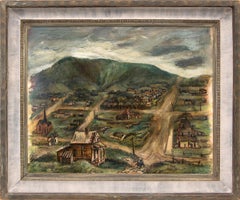
1942 Martyl Schweig “Victor, Colorado” Ghost Town Landscape Oil Painting
By Martyl Suzanne Schweig Langsdorf
Located in Denver, CO
This original 1942 oil painting, titled “Victor, Colorado,” is a vivid and historically important landscape by acclaimed American artist Martyl Suzanne Schweig (1918–2013). Painted en plein air during a 1940s tour of Colorado’s fading mining towns with noted artist Adolph Dehn...
Category
1940s American Modern Landscape Paintings
Materials
Masonite, Oil
$9,500
H 31.5 in W 37.5 in D 1.75 in
Striking Hollywood Regency Portrait of a Red Haired Lady by Kughler 1932
By Francis Vandeveer Kughler
Located in Rochester, NY
Hollywood regency portrait painting of a young woman by Francis Kughler (American 1901-1970). Oil on canvas board. Circa 1932. Unframed.
Born in New York City in 1901, Francis Vandeveer Kughler attended Cooper Union, the Mechanics' Institute, and the National Academy of Design School of Art where he met Charlotte Livingston, an artist, whom he was later to marry.
During this period he was the winner of a Tiffany scholarship, which provided him a summer of landscape painting at the Louis Comfort Tiffany estate at Oyster Bay, L.I.
In the 1940s, Kughler became the President of the Salmagundi Club, a well-known art club in Washington Square in New York City.Well-known as a muralist, society portrait painter and lithographer, he was a prolific painter who made cityscapes, landscapes, and nudes. He and his wife, Charlotte Livingston, lived and worked in Bronx, New York.
mid century modern wpa impressionist...
Category
Mid-20th Century Modern Figurative Paintings
Materials
Masonite, Oil

$1,275
H 0.3 in W 16 in D 20 in
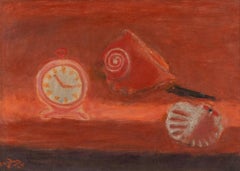
Coquillage et réveil en rouge by Henri Hayden - Still Life Painting
By Henri Hayden
Located in London, GB
Coquillage et réveil en rouge by Henri Hayden (1883-1970)
Oil on paper laid down on isorel
33.5 x 46 cm (13 ¹/₄ x 18 ¹/₈ inches)
Signed and dated lower le...
Category
1960s Modern Figurative Paintings
Materials
Masonite, Oil, Laid Paper
$5,191
H 13.19 in W 18.12 in
Mervin Jules Folk Singer Portrait, Signed
By Mervin Jules
Located in New York, NY
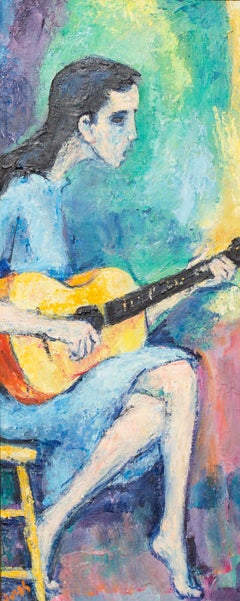
Mervin Jules (American, 1912-1994)
Folk Singer, 20th century
Oil on masonite
18 x 7 1/2 in.
Signed lower left: Jules
Provenance: Garelick's Gallery, Detroit
Matte included, no fram...
Category
20th Century American Modern Figurative Paintings
Materials
Masonite, Oil
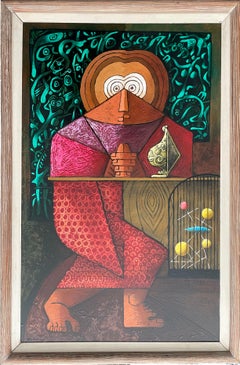
The Magician oil and tempera painting by Julio de Diego
By Julio de Diego
Located in Hudson, NY
Julio De Diego’s Atomic Series paintings made an extraordinary statement regarding the shock and fear that accompanied the dawn of the nuclear age. In the artist’s own words, “Scientists were working secretly to develop formidable powers taken from the mysterious depths of the earth - with the power to make the earth useless! Then, the EXPLOSION! . . . we entered the Atomic Age, and from there the neo-Atomic war begins. Explosions fell everywhere and man kept on fighting, discovering he could fight without flesh.”
To execute these works, De Diego developed a technique of using tempera underpainting before applying layer upon layer of pigmented oil glazes. The result is paintings with surfaces which were described as “bonelike” in quality. The forms seem to float freely, creating a three-dimensional visual effect. In the 1954 book The Modern Renaissance in American Art, author Ralph Pearson summarizes the series as “a fantastic interpretation of a weighty theme. Perhaps it is well to let fantasy and irony appear to lighten the devastating impact. By inverse action, they may in fact increase its weight.”
Exhibited
1964 Marion Koogler McNay Art Institute, San Antonio, Texas
This work retains its original frame which measures 54" x 42" x 2"
About this artist: Julio De Diego crafted a formidable persona within the artistic developments and political struggles of his time. The artist characterized his own work as “lyrical,” explaining, “through the years, the surrealists, the social-conscious painters and the others tried to adopt me, but I went my own way, good, bad or indifferent.” [1] His independence manifested early in life when de Diego left his parent’s home in Madrid, Spain, in adolescence following his father’s attempts to curtail his artistic aspirations. At the age of fifteen he held his first exhibition, set up within a gambling casino. He managed to acquire an apprenticeship in a studio producing scenery for Madrid’s operas, but moved from behind the curtains to the stage, trying his hand at acting and performing as an extra in the Ballet Russes’ Petrouchka with Nijinsky. He spent several years in the Spanish army, including a six-month stretch in the Rif War of 1920 in Northern Africa. His artistic career pushed ahead as he set off for Paris and became familiar with modernism’s forays into abstraction, surrealism, and cubism.
The artist arrived in the U.S. in 1924 and settled in Chicago two years later. He established himself with a commission for the decoration of two chapels in St. Gregory’s Church. He also worked in fashion illustration, designed magazine covers and developed a popular laundry bag for the Hotel Sherman. De Diego began exhibiting through the Art Institute of Chicago in 1929, and participated in the annual Chicago Artists Exhibitions, Annual American Exhibitions, and International Water Color Exhibitions. He held a solo exhibition at the Art Institute of Chicago in the summer of 1935. Though the artist’s career was advancing, his family life had deteriorated. In 1932 his first marriage dissolved, and the couple’s young daughter Kiriki was sent to live with friend Paul Hoffman.
De Diego continued to develop his artistic vocabulary with a growing interest in Mexican art. He traveled throughout the country acquainting himself with the works of muralists such as Carlos Merida, and also began a collection of small native artifacts...
Category
1940s American Modern Abstract Paintings
Materials
Masonite, Oil, Tempera
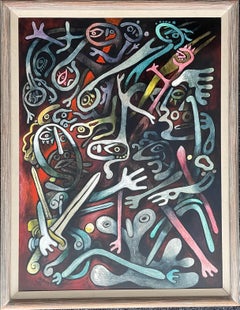
St. Atomic oil and tempera painting by Julio de Diego
By Julio de Diego
Located in Hudson, NY
Julio De Diego’s Atomic Series paintings made an extraordinary statement regarding the shock and fear that accompanied the dawn of the nuclear age. In the artist’s own words, “Scientists were working secretly to develop formidable powers taken from the mysterious depths of the earth - with the power to make the earth useless! Then, the EXPLOSION! . . . we entered the Atomic Age, and from there the neo-Atomic war begins. Explosions fell everywhere and man kept on fighting, discovering he could fight without flesh.”
To execute these works, De Diego developed a technique of using tempera underpainting before applying layer upon layer of pigmented oil glazes. The result is paintings with surfaces which were described as “bonelike” in quality. The forms seem to float freely, creating a three-dimensional visual effect. In the 1954 book The Modern Renaissance in American Art, author Ralph Pearson summarizes the series as “a fantastic interpretation of a weighty theme. Perhaps it is well to let fantasy and irony appear to lighten the devastating impact. By inverse action, they may in fact increase its weight.”
Exhibited
1950 University of Illinois at Urbana "Contemporary American Painting"
1964 Marion Koogler McNay Art Institute, San Antonio, Texas
This work retains its original frame which measures 54" x 36" x 2".
About this artist: Julio De Diego crafted a formidable persona within the artistic developments and political struggles of his time. The artist characterized his own work as “lyrical,” explaining, “through the years, the surrealists, the social-conscious painters and the others tried to adopt me, but I went my own way, good, bad or indifferent.” [1] His independence manifested early in life when de Diego left his parent’s home in Madrid, Spain, in adolescence following his father’s attempts to curtail his artistic aspirations. At the age of fifteen he held his first exhibition, set up within a gambling casino. He managed to acquire an apprenticeship in a studio producing scenery for Madrid’s operas, but moved from behind the curtains to the stage, trying his hand at acting and performing as an extra in the Ballet Russes’ Petrouchka with Nijinsky. He spent several years in the Spanish army, including a six-month stretch in the Rif War of 1920 in Northern Africa. His artistic career pushed ahead as he set off for Paris and became familiar with modernism’s forays into abstraction, surrealism, and cubism.
The artist arrived in the U.S. in 1924 and settled in Chicago two years later. He established himself with a commission for the decoration of two chapels in St. Gregory’s Church. He also worked in fashion illustration, designed magazine covers and developed a popular laundry bag for the Hotel Sherman. De Diego began exhibiting through the Art Institute of Chicago in 1929, and participated in the annual Chicago Artists Exhibitions, Annual American Exhibitions, and International Water Color Exhibitions. He held a solo exhibition at the Art Institute of Chicago in the summer of 1935. Though the artist’s career was advancing, his family life had deteriorated. In 1932 his first marriage dissolved, and the couple’s young daughter Kiriki was sent to live with friend Paul Hoffman.
De Diego continued to develop his artistic vocabulary with a growing interest in Mexican art. He traveled throughout the country acquainting himself with the works of muralists such as Carlos Merida, and also began a collection of small native artifacts...
Category
1940s American Modern Abstract Paintings
Materials
Masonite, Oil, Tempera
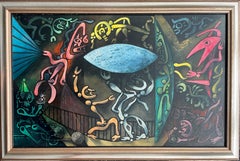
Inevitable Day – Birth of the Atom oil and tempera painting by Julio De Diego
By Julio de Diego
Located in Hudson, NY
Julio De Diego’s Atomic Series paintings made an extraordinary statement regarding the shock and fear that accompanied the dawn of the nuclear age. In the artist’s own words, “Scientists were working secretly to develop formidable powers taken from the mysterious depths of the earth - with the power to make the earth useless! Then, the EXPLOSION! . . . we entered the Atomic Age, and from there the neo-Atomic war begins. Explosions fell everywhere and man kept on fighting, discovering he could fight without flesh.”
To execute these works, De Diego developed a technique of using tempera underpainting before applying layer upon layer of pigmented oil glazes. The result is paintings with surfaces which were described as “bonelike” in quality. The forms seem to float freely, creating a three-dimensional visual effect. In the 1954 book The Modern Renaissance in American Art, author Ralph Pearson summarizes the series as “a fantastic interpretation of a weighty theme. Perhaps it is well to let fantasy and irony appear to lighten the devastating impact. By inverse action, they may in fact increase its weight.”
Bibliography
Art in America, April 1951, p.78
About this artists: Julio De Diego crafted a formidable persona within the artistic developments and political struggles of his time. The artist characterized his own work as “lyrical,” explaining, “through the years, the surrealists, the social-conscious painters and the others tried to adopt me, but I went my own way, good, bad or indifferent.” [1] His independence manifested early in life when de Diego left his parent’s home in Madrid, Spain, in adolescence following his father’s attempts to curtail his artistic aspirations. At the age of fifteen he held his first exhibition, set up within a gambling casino. He managed to acquire an apprenticeship in a studio producing scenery for Madrid’s operas, but moved from behind the curtains to the stage, trying his hand at acting and performing as an extra in the Ballet Russes’ Petrouchka with Nijinsky. He spent several years in the Spanish army, including a six-month stretch in the Rif War of 1920 in Northern Africa. His artistic career pushed ahead as he set off for Paris and became familiar with modernism’s forays into abstraction, surrealism, and cubism.
The artist arrived in the U.S. in 1924 and settled in Chicago two years later. He established himself with a commission for the decoration of two chapels in St. Gregory’s Church. He also worked in fashion illustration, designed magazine covers and developed a popular laundry bag for the Hotel Sherman. De Diego began exhibiting through the Art Institute of Chicago in 1929, and participated in the annual Chicago Artists Exhibitions, Annual American Exhibitions, and International Water Color Exhibitions. He held a solo exhibition at the Art Institute of Chicago in the summer of 1935. Though the artist’s career was advancing, his family life had deteriorated. In 1932 his first marriage dissolved, and the couple’s young daughter Kiriki was sent to live with friend Paul Hoffman.
De Diego continued to develop his artistic vocabulary with a growing interest in Mexican art. He traveled throughout the country acquainting himself with the works of muralists such as Carlos Merida, and also began a collection of small native artifacts...
Category
1940s American Modern Abstract Paintings
Materials
Masonite, Oil, Tempera
Ceremonial Dancers oil and tempera painting by Julio De Diego
By Julio de Diego
Located in Hudson, NY
Artwork measures 48" x 30" and framed 56 ¼" x 38 ¼" x 3"
Provenance:
John Heller Gallery, NYC, circa 1975 (label verso)
The artist's daughter
Corbino Galleries, Sarasota, FL (1990)...
Category
1940s Modern Abstract Paintings
Materials
Masonite, Oil, Tempera
$26,000
H 48 in W 30 in