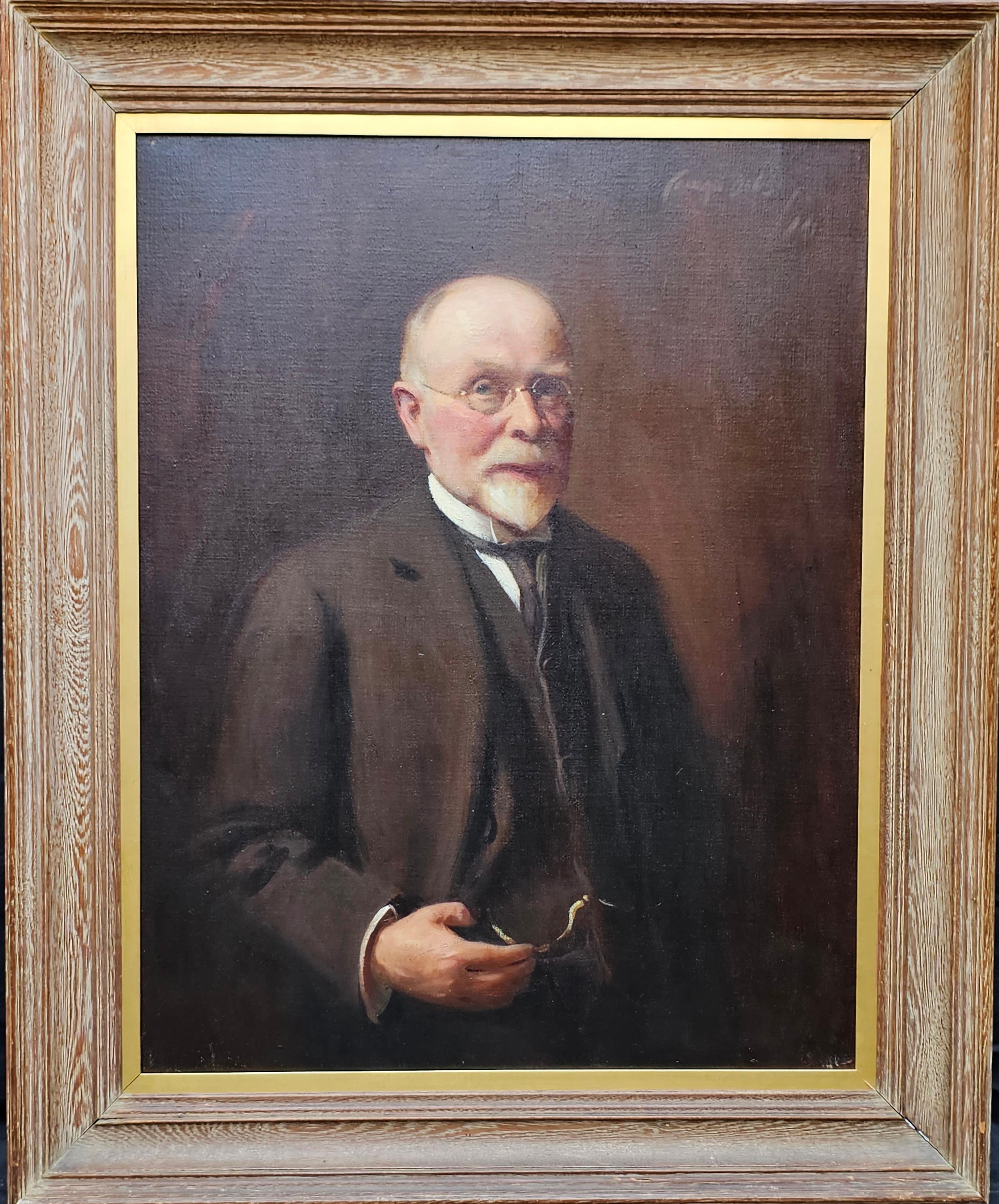
Items Similar to "John Van Schaick Lansing Pruyn" Eastman Johnson, Prominent Gentleman Portrait
Want more images or videos?
Request additional images or videos from the seller
1 of 11
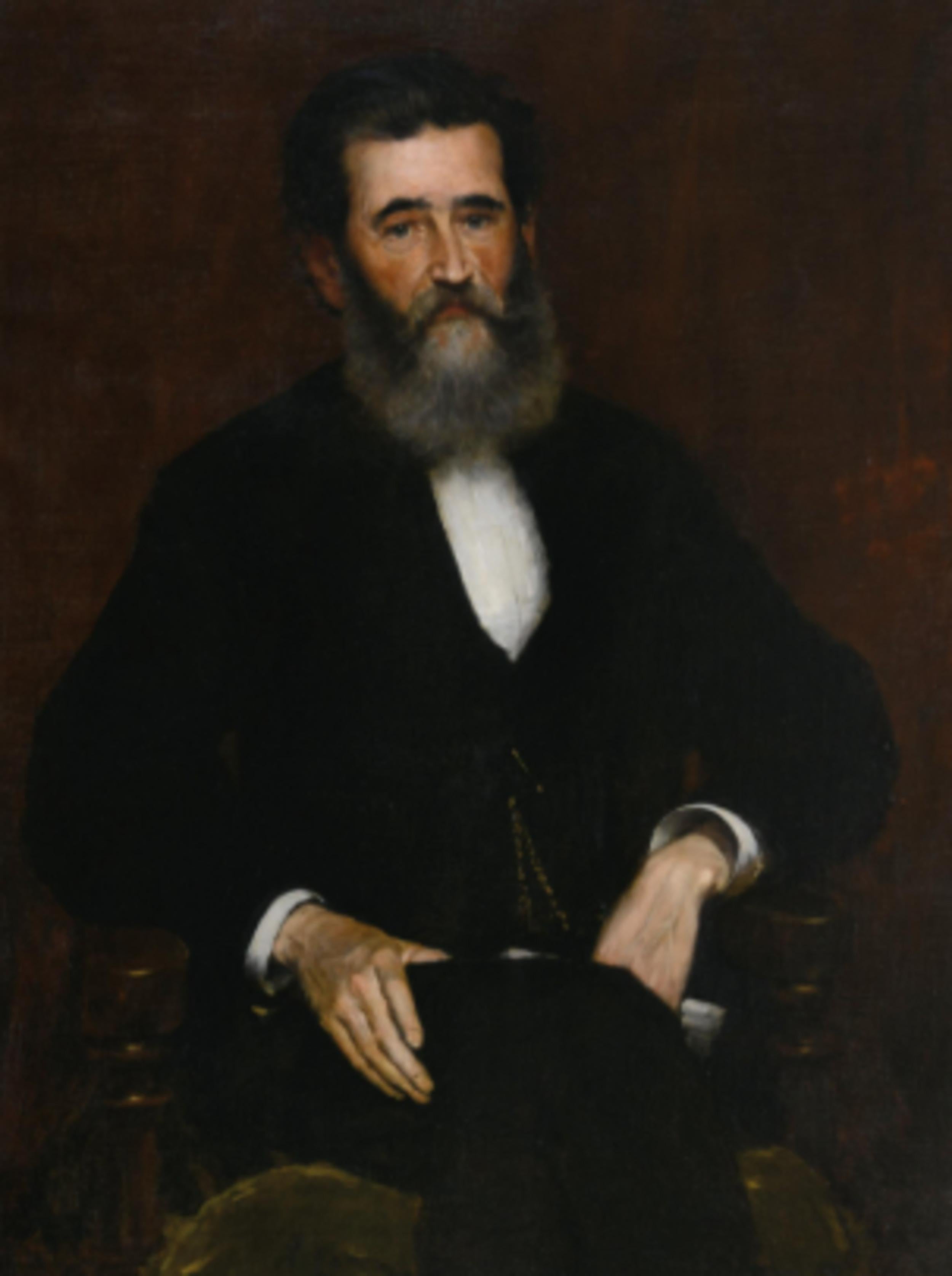
Eastman Johnson"John Van Schaick Lansing Pruyn" Eastman Johnson, Prominent Gentleman Portrait1883
1883
$9,500
£7,234.24
€8,261.04
CA$13,348.67
A$14,646.04
CHF 7,714.83
MX$174,230.07
NOK 98,826.03
SEK 90,241.66
DKK 61,717.95
About the Item
Eastman Johnson
John Van Schaick Lansing Pruyn, 1883
Initialed and dated lower left
Oil on canvas
28 x 18 inches
For many years the foremost genre painter in the United States, Eastman Johnson was among the first American artists of his generation to receive extensive training abroad. His oeuvre thus serves as an important link to two generations, combining traditional, domestic subjects with more advanced technique and expression.
Johnson was born in Lovell, Maine, in 1824, but he grew up in nearby Fryeburg. In 1834 his family moved to Augusta, where his father was involved in state government. There he opened a crayon-portrait studio at age 18, after first working briefly in a Boston lithography shop. About two years later, he moved to Washington, D.C., where he took black-and-white likenesses of eminent national figures, such as Dolly Madison and John Quincy Adams, in the hope of building a gallery of famous personages. By 1846 he had returned to Boston, where he received a good deal of patronage from the family of Henry Wadsworth Longfellow.
His artistic apprenticeship began in earnest in 1849, when he traveled to Düsseldorf, Germany, and received rigorous training in drawing at that city's academy. More congenial, however, was the time he spent in the studio of Emanuel Leutze, where he concentrated on painting. In 1851 he went to London to see the Universal Exposition and then relocated to The Hague, remaining for over three years. His lengthy stay at The Hague was somewhat unusual for an American artist, but he apparently found much inspiration in the Dutch Old Masters as well as ready patronage through August Belmont, the wealthy American ambassador. His European education ended with several months spent in the Parisian studio of Thomas Couture before the death of his mother brought him home in 1855.
For the next few years Johnson cast about for work, traveling to Lake Superior to visit a sister and sketch members of the Chippewa Tribe, painting in Cincinnati, renting a studio in New York, and spending time with his family in Washington, D.C. The turning point came in 1859 with the exhibition in New York of his Negro Life in the South (New-York Historical Society). His ambiguous picture of the leisure activities of a group of slaves was a sensation at a time when the topic of slavery was being universally debated, and it resulted in his election as an Associate to the National Academy of Design. For two decades thereafter, Johnson explored themes of national life with his humble interior scenes and larger rural tableaux, each picture usually the result of careful study through numerous drawings and oil sketches.
Johnson exhibited widely and was active in the National Academy, the Century and Union League Clubs, the Metropolitan Museum, and even the Society of American Artists, a group normally associated with a younger generation of painters. He was comfortable in upper-class society, owned a large home in Manhattan, and spent his summers on the island of Nantucket, the scene of many of his paintings. During the last twenty years of his life, his work changed distinctly. Although quite successful in the field of genre painting, he gave it up for unknown reasons and returned to portraiture, the artistic activity of his youth. Able to command extremely large fees, he spent the rest of his life painting the likenesses of prominent gentlemen of New York City, where he died in 1906.
- Creator:Eastman Johnson (1824-1906, American)
- Creation Year:1883
- Dimensions:Height: 36 in (91.44 cm)Width: 26 in (66.04 cm)
- More Editions Sizes:Unique WorkPrice: $9,500
- Medium:
- Movement Style:
- Period:
- Condition:
- Gallery Location:New York, NY
- Reference Number:1stDibs: LU1841216046692
About the Seller
5.0
Platinum Seller
Premium sellers with a 4.7+ rating and 24-hour response times
Established in 2022
1stDibs seller since 2022
133 sales on 1stDibs
Typical response time: <1 hour
- ShippingRetrieving quote...Shipping from: New York, NY
- Return Policy
More From This Seller
View All"Portrait of Louis Prang" William Merritt Chase, Impressionist Portrait
By William Merritt Chase
Located in New York, NY
William Merritt Chase
Portrait of Louis Prang, 1884
Signed center right "WM M Chase"
Oil on canvas
41 1/2 x 30 1/2 inches
Provenance
The artist
Louis Prang
Gift from the sitter to R...
Category
1880s American Impressionist Figurative Paintings
Materials
Canvas, Oil
"Jules Bastien LePage" Augustus Saint-Gaudens, Bas Relief of French Painter
By Augustus Saint-Gaudens
Located in New York, NY
Augustus Saint-Gaudens
Jules Bastien LePage
Bronze
14 1/4 x 10 1/8 inches
Augustus Saint-Gaudens was born in 1848 in Dublin, Ireland. His father, Bern...
Category
1880s Realist Figurative Sculptures
Materials
Bronze
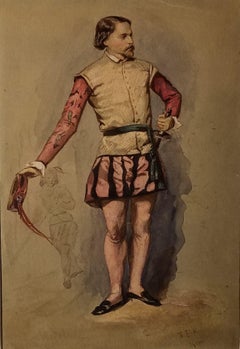
"Portrait of an Italian Fencer, " John Frederick Kensett, Hudson River School
By John Frederick Kensett
Located in New York, NY
John Frederick Kensett (1816 - 1872)
Portrait of an Italian Fencer, circa 1845-47
Watercolor on wove paper
13 1/8 x 8 1/8 inches
Signed with initials and inscribed lower right "J.F.K. Rome"
From October 1845 through the spring of 1847, Kensett lived in Rome. He attended classes where he sketched from live models, and he sketched in the countryside outside Rome and around Florence, Perugia, and Venice, places he visited with his artist friends. He fulfilled commissions for paintings from Americans in Italy, and by 1847 his career was well established.
Son of an English immigrant engraver, John Kensett lacked enthusiasm for that medium and became one of the most accomplished painters of the second generation of Hudson River School painters. His reputation is for Luminism, careful depiction of light, weather, and atmosphere as they affect color and texture of natural forms. He was particularly influenced by the painting of Asher Durand in that he focused on realism and detail rather than the highly dramatic views associated with Thomas Cole. Going to the western United States in the mid 1850s and the 1860s, he was the first of the Hudson River School painters to explore and paint the West.
Kensett was born and raised in Cheshire, Connecticut, and learned his engraving from his father, Thomas Kensett with whom he worked in New Haven, Connecticut until 1829. He continued working until 1840 as an engraver of labels, banknotes and maps and was employed part of that time by the American Bank Note Company in New York City. There he met Thomas Rossiter, John Casilear, and other artists who urged him to pursue painting. In 1840, he and Rossiter, Asher Durand, and Casilear went to Europe where Kensett stayed for seven years and supported himself by doing engraving but became accomplished in landscape painting.
Having sent canvases of Italian landscapes back to New York, he had a reputation for skillful painting that preceded him. When he returned to New York City in 1847, he was an "instant success" and very sought after by collectors. Two of his Italian landscapes had already been purchased by the American Art Union. By 1849, he was a full member of the National Academy of Design and was generally popular among his peers. His studio was a gathering place with travelers stopping by to see his canvases and to identify "precise locations in the Catskills or Newport or New England in the oil sketches and drawings that covered his walls." (Zellman 170). For the women, he was a popular bachelor, "romantic looking with high forehead and sensitive expression." (Samuels 262)
He was also sought after by many organizations. Among his activities were serving on the committee to oversee the decoration of the United States Capitol in Washington DC, and becoming one of the founders of the Metropolitan Museum in New York.
An inveterate traveler, Kensett spent summers on painting excursions away from New York City. One of these trips was a special painting excursion with fifteen other artists sponsored by the B & O Railroad from Baltimore, Maryland to Wheeling, West Virginia. Unlike many of the Hudson River painters...
Category
1840s Hudson River School Figurative Paintings
Materials
Paper, Watercolor
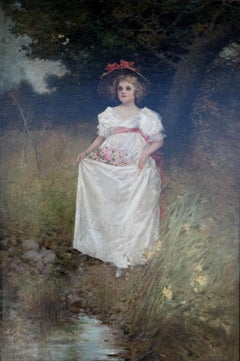
"Portrait of a Woman" Edward Percy Moran, Early American Portrait, Bucolic
By Edward Percy Moran
Located in New York, NY
Edward Percy Moran
Portrait of a Woman
Signed lower right
Oil on canvas
30 x 20 inches
Provenance:
The Madison Gallery, Atlanta
Percy Moran was the son of marine painter Edward Mo...
Category
1890s Academic Figurative Paintings
Materials
Canvas, Oil
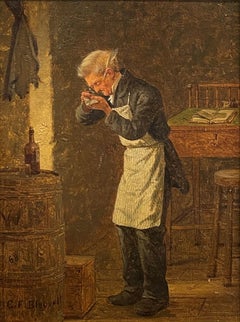
"The Doubtful Bill" Charles Blauvelt, 19th Century Genre Painting Money Interior
Located in New York, NY
Charles Blauvelt
The Doubtful Bill, 1868
Signed and dated lower left
Oil on canvas
12 1/4 x 9 1/2 inches
Provenance:
Private Collection, Connecticut...
Category
1860s Figurative Paintings
Materials
Canvas, Oil
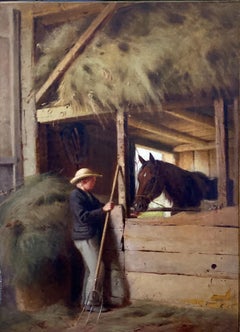
"Interior of a Stable" William Hart, Hudson River School Antique, Boy and Horse
By William Hart
Located in New York, NY
William M. Hart (1823 - 1894)
Interior of a Stable
Oil on canvas
17 x 12 inches
Provenance
William Macbeth Gallery, New York
Mrs. Mabel Brady Garvan Collection
Christie's New York, Sporting Art, November 28, 1995, Lot 116
Ann Carter Stonesifer, Maryland
Estate of above
Brunk Auctions, Asheville, North Carolina, January 27 2018, Lot 777
Exhibited
New York, The Metropolitan Museum of Art, Life in America, April 24 - October 29, 1939, no. 123, illustrated.
New York, Macbeth Gallery, 1892: Sixtieth Anniversary Exhibition, April 1952, p. 5, no. 18.
Literature
Turner Reuter Jr, Animal and Sporting Artists in America, Middleburg, Virginia, 2008, p. 306.
Gary Stiles, William Hart: Catalogue Raisonné and Artistic Biography, no. 1126, illustrated.
It should be noted that the Francis Patrick Garvan and Mrs. Mabel Brady Garvan collection, of which this painting was a part of, was one of the foremost American Art collections and now makes up a large part of the Smithsonian American Art Museum and the Yale University Art Gallery collections.
Born in 1823 in Paisley, Scotland, William Hart emigrated with his parents to the United States at the age of nine and settled in Albany, New York. It was here that Hart first began his artistic training when he was placed under the tutelage of Messrs, Eaton & Gilbert, the prestigious coach-makers from Troy, New York. During this time, Hart learned how to decorate coach panels, covering them with either landscapes or figurative compositions. At the age of seventeen, he was eagerly contemplating an artist’s profession. Consequently, he left the mechanical trade of coach-making and began expanding his artistic pursuits to more refined endeavors.
Hart followed coach-making with decorating window shades and later developed an interest in portraiture. Around 1840, he established his first formal studio in his father’s woodshed in Troy. There, he created many likenesses of individuals, affording him a nominal income. Once, he remarked that he felt prouder over his first fee of five dollars for painting a head then for the larger sums he would command later in his career. Nevertheless, his wages from portraits during this early period proved insufficient. Thus, he expanded into landscape painting, allowing him to barter his works or sell them for modest prices.
In 1842, Hart moved to Michigan in an attempt to further his success; portraiture remained his primary means of support. Unfortunately, his experiences in the West were disappointing. Hart spent three years living a rough existence until he finally returned to Albany in 1845. Upon his return, he fully devoted himself to the art of landscape painting. Despite his failing health, he worked diligently to perfect his skill until 1849 when he traveled abroad to his native land of Scotland. This trip was made possible through the generosity of his patron and advisor, Dr. Ormsby of Albany. For three years, he studied in the open-air, creating brilliant sketches of the Scottish Highlands and the surrounding British Isles.
Returning to Albany once more in 1852, Hart enjoyed improved health and was reinvigorated with purpose. The following year, he moved to New York and opened a studio, promoting himself as a specialist in landscape painting. Hart became a regular contributor to the National Academy of Design. His works received a great deal of attention from artists and connoisseurs alike, all of whom praised him for his fresh, self-taught style. In 1855, he was designated as an associate of the National Academy of Design; three years later he was elected to Academician. In 1865, he was unanimously chosen to be the first president of the Brooklyn Academy of Design. It was during his tenure there that he delivered his famous lecture The Field and Easel, which emphasized the distinguishing principles of landscape art in America. Hart argued that landscape painters should express the “look of the place” being depicted.Critics during the 1870s noted his sensitive balance between capturing a strict “real” interpretation of nature and that of a more “ideal” sentimental tone. For instance, in 1869, Putnam Magazine noted that Hart brought back “exquisite studies” of the surrounding Tappan...
Category
19th Century Hudson River School Animal Paintings
Materials
Canvas, Oil
$60,000 Sale Price
20% Off
You May Also Like
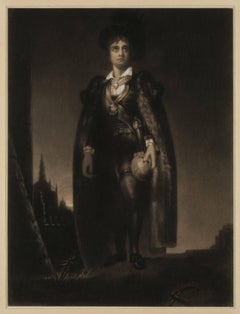
John Phillip Kemble as Hamlet, Act V, Scene I
By Eastman Johnson
Located in Fairlawn, OH
Signed and dated (on back) "January 1845/ J.E.J."
Provenance:
Mr. and Mrs. Bertram Rowland, Buckingham, PA
Mr. and Mrs. Edward Abraham, West Chester, PA
Hirschl & Adler Galleries...
Category
1840s Portrait Drawings and Watercolors
Materials
Charcoal
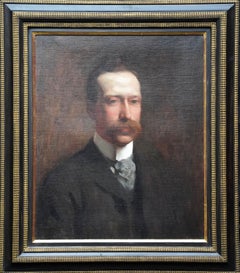
Portrait of a Gentleman - British Edwardian art male portrait oil painting
Located in Hagley, England
This lovely British Edwardian Impressionist portrait oil painting is by noted artist Percy William Gibbs. Pained circa 1910 it is a head and shoulders portrait of a gentleman in a da...
Category
1910s Impressionist Portrait Paintings
Materials
Oil
Portrait of Doctor Carter, Scottish 19th Century Signed Oil Painting
Located in London, GB
Oil on board, signed, titled and dated '1858' on verso
Image size: 10 1/2 x 18 1/2 inches (26.5 x 47 cm)
Gilt frame
This is a wonderful portrait that was painted by John Burr at a t...
Category
Late 19th Century Portrait Paintings
Materials
Oil, Board
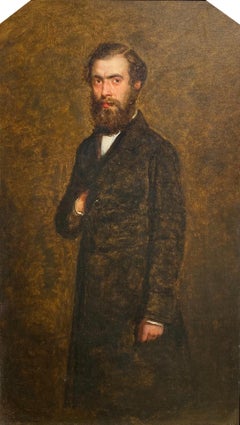
Portrait of Mr R H Sinclair - Scottish 1914 art male portrait oil painting
By David Cowan Dobson
Located in Hagley, England
This impressive large portrait realist oil painting is by noted Scottish artist David Cowan Dobson. One of a pair, the sitter is Mr R H Sinclair and dates to 1914. He is beautifully ...
Category
1910s Realist Portrait Paintings
Materials
Oil
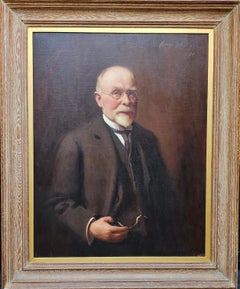
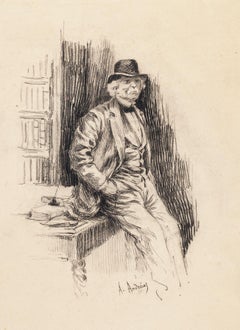
Portrait of Gentleman - Original Lithograph by A. Achenbach - Late 19th Century
By Andreas Achenbach
Located in Roma, IT
Portrait of gentleman is an original lithograph on ivory-colored paper realized by the German artist and drawer Andreas Achenbach in the middle of the XIX Century.
Signed on the lo...
Category
Late 19th Century Modern Figurative Prints
Materials
Lithograph
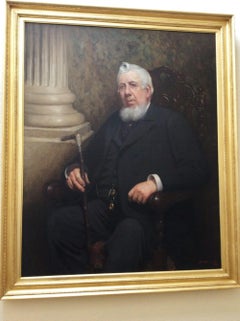
Portrait Of A Gentleman George Williams Kenworthy by John Dalziel Kenworthy
Located in York, GB
John Dalziel Kenworthy portrait of a gentleman . Fine, large and imposing oil on canvas housed in a gilt frame.
The sitter is unidentified, he has an aristocratic and characterful lo...
Category
Early 1900s Old Masters Portrait Paintings
Materials
Oil
More Ways To Browse
Nantucket Antique
Black And White Figures
Cincinnati Painting
Oil Woman 1960s
Painting Woman In Chair
Pianist Painting
Rabbi Studying
Red Lips Painting
Renaissance Large Painting
Rest On The Flight Into Egypt
Reut Harel
Robert Wright
Russian Girl
Ruth Opper
San Luis Potosi
Sarah Jane
Seville Oil Painting
Sir Lawrence Alma Tadema