Video Loading
Want more images or videos?
Request additional images or videos from the seller
1 of 15

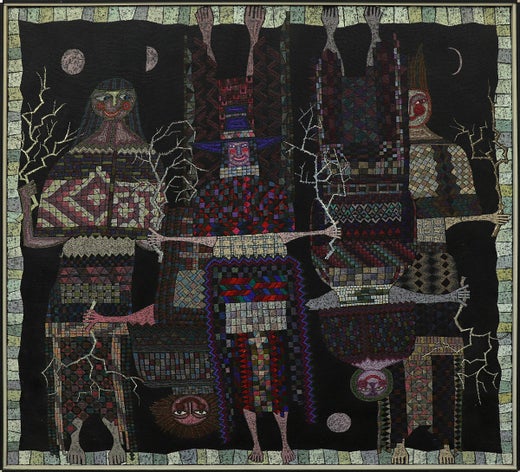
Edward Marecak
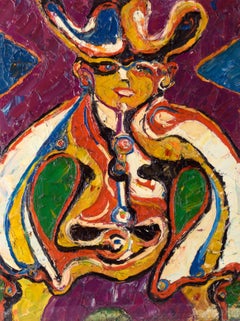
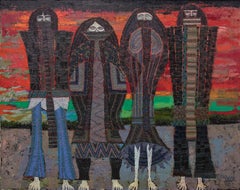
Sybil (The Prophetess), 1970s Abstract Figurative Oil Painting, Pink Blue Red

1976

Price:$4,650
$6,200List Price

You May Also Like

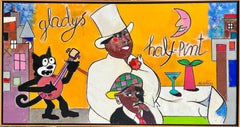
Large Richard Merkin Painting Harlem Jazz Club, New Yorker Magazine Cover Artist
By Richard Merkin
Located in Surfside, FL
Richard Marshall Merkin (American, 1938-2009) Gladys and Half-Pint Hand signed 'Merkin' (center right), Titled, inscribed, dated, and initialed 'GLADYS BENTLEY AND FRANKIE 'HALF-PINT' JAXON 1997/R.M.' verso. Oil on canvas 37 1/2 x 72 in. (95.3 x 182.9 cm) framed 39 1/4 x 74 x 2 in. Gladys Alberta Bentley (August 12, 1907 – January 18, 1960) was an American blues singer, pianist, and entertainer during the Harlem Renaissance. Her career skyrocketed when she appeared at Harry Hansberry's Clam House, a well-known gay speakeasy in New York in the 1920s, as a black, lesbian, cross-dressing performer. She headlined in the early 1930s at Harlem's Ubangi Club, where she was backed up by a chorus line of drag queens. She dressed in men's clothes (including a signature tailcoat and top hat), played piano, and sang her own raunchy lyrics to popular tunes of the day in a deep, growling voice while flirting with women in the audience. On the decline of the Harlem speakeasies with the repeal of Prohibition, she relocated to southern California, where she was billed as "America's Greatest Sepia Piano Player" and the "Brown Bomber of Sophisticated Songs". She was frequently harassed for wearing men's clothing. She tried to continue her musical career but did not achieve as much success as she had had in the past. Bentley was openly lesbian early in her career, but during the McCarthy Era she started wearing dresses and married, claiming to have been "cured" by taking female hormones. Frankie "Half-Pint" Jaxon, born Frank Devera Jackson was an African American vaudeville singer, stage designer and comedian, popular in the 1920s and 1930s. He was born in Montgomery, Alabama, orphaned, and raised in Kansas City, Missouri. His nickname of "Half Pint" referred to his 5'2" height. He started in show business around 1910 as a singer in Kansas City, before travelling extensively with medicine shows in Texas, and then touring the eastern seaboard. His feminine voice and outrageous manner, often as a female impersonator, established him as a crowd favorite. By 1917 he had begun working regularly in Atlantic City, New Jersey and in Chicago, often with such performers as Bessie Smith and Ethel Waters, whose staging he helped design. He served slightly less than a year in the United States Army in 1918–1919 and rose to the rank of sergeant. In the late 1920s he sang with top jazz bands when they passed through Chicago, working with Bennie Moten, King Oliver, Freddie Keppard and others. He performed and recorded with the pianists Cow Cow Davenport, Tampa Red and "Georgia Tom" Dorsey, recording with the latter pair under the name of The Black Hillbillies. He also recorded with the Harlem Hamfats. In the 1930s, he was often on radio in the Chicago area, and led his own band, titled Frankie "Half Pint" Jaxon and His Quarts of Joy. Jaxon appeared with Duke Ellington in a film short titled Black and Tan (1929), and with Bessie Smith in "St. Louis Blues" (1929). Cab Calloway's "Minnie the Moocher" (1931) is based both musically and lyrically on Jaxon's "Willie the Weeper" (1927). Richard Merkin, Sometimes described as Rhode Island’s most famous New York artist, Richard Merkin has led a dual life for nearly 40 years - teaching at RISD while enjoying a celebrated painting career based in New York City. He has exhibited in countless gallery and museum shows in the US and abroad and is represented in the permanent collections of the Smithsonian Institution, The Museum of Modern Art, the Whitney Museum, the RISD museum and many others. In addition to contributing drawings and paintings to The New Yorker (along with, Art Spiegelman, Saul Steinberg, Harper’s, The New York Times Sunday Magazine and several books on Erotica and Baseball, he is a contributing editor for Vanity Fair and a former style columnist for GQ. Merkin’s honors include a Tiffany Foundation Fellowship and the Rosenthal Foundation Award from the American Academy of Arts and Letters. Museums and Selected Collections : The American Federation of Arts, New York, NY Brooklyn Museum, Brooklyn, NY Chrysler Museum of Art, Norfolk, VA First city Bank, Chicago, Ill Fisk University Art Gallery, Nashville, TN Hallmark Collections, Kansas City, MO Massachusetts Institute of Technology, Cambridge, MA Maimi-Dade Junior College, Miami, FL Michigan State University, East Lansing, MI Minnesota Museum of Art, Minneapolis, MN Museum of Modern Art, New York, NY Museum of Art, Rhode Island School of Design, RI McClung Museum, University of Tennessee, Knoxville, TN Pennsylvania Acadamy of the Arts, Philadelphia PA Prudential Insurance Company, Boston, Ma Prudential Insurance Company, Newark, NJ Rose Art Museum, Brandeis University, Waltham, MA Sara Robey Foundation, New York, NY Smithsonian Institution, Washington, DC State University of Brockport, Brockport, NY Whitney Museum of American Art, New York, NY Selected Publications : 1986-Present Contributing Editor, Vanity Fair ..1988-Present, New Yorker... 1988-Present, style column, GQ...1997, Text and Illustration for The Tijuana Bibles, published by Simon & Shuster, 1995, Illustrated book, Leagues Apart: the Men and Times of the Negro Baseball Leagues published by Morrow. 1967 Cover of the Beatles “Sgt. Peppers Lonely Hearts Club Band” Album (Mr. Merkin appears in the back row, right of center) RISD: MFA in Painting, 1963; Professor, Department of Painting special skill: Merging his role as flaneur (connoisseur of city life) with his role as painter and social historian, Merkin retrieves lost cultural artifacts – a Turkish cigarette, a gangster, a bowler and generally “things most people don’t know about” – and reconstitutes their Jazz Age virtues on canvas in cubist, comic-laced landscapes of tropical color. (ala Robert Crumb and Ben Katchor) breaking in: Perpetually on the fly from his middle-class Brooklyn background, Merkin found the perfect escape in the mid ‘60s in George Frazier, a dapper Boston columnist who inspired the emerging New York painter’s overnight reinvention of himself. The elements of structure, stability and surprise he admired in this well-dressed dandy – a cool linen suit, a splash of suspender, a polka dot scarf and pearl-handled walking stick – soon surfaced in paintings peopled by impeccable underdogs of café society along with his personal pop heroes: William Burroughs, Bobby Short and Krazy Kat...
Category

1990s American Modern Abstract Paintings

Materials

Canvas, Oil Pastel, Oil

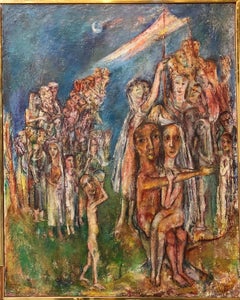
Abstract Procession Jewish Wedding Chuppah Oil Painting Modernist Judaica
By Sabina Teichman
Located in Surfside, FL
Genre: Modern Subject: Abstract Medium: Oil Surface: Canvas Country: United States Sabina Teichman: (1905-1983) Studied at Columbia Univ. (BA, MA), also with Charles J. Martin and Arthur J. Young. Exhibits include WMAA, Art USA, 1958, PAAM, Butler Institute Amer. Art, Audubon Artists Ann., Womens Westchester Center. Sabina Teichman's paintings have a touch of fauvist vitality and responsiveness and color. Her Lyrical Paintings convey the great joy of life which is hers. the joy is so profound that it cannot be obtained in traditional art forms and so it has become necessary for Sabina to create new forms to express the euphoria. As the dynamic colors emerge from her luxuriously coated brush, she surrenders to a newly realized adventure in abstract expressionism. A boldness belies he femininity which yields an exciting style and a joyful freshness. Sabina Teichman illuminates the canvas with strokes of color that affect the very soul of the viewer , for she feels that color inspires the inner being of man. Her response to color elation. Dynamic colors emerge from the luxuriously coated brush of this artist, surrendering to her newly realized adventure in abstract impressionism. A boldness belies her femininity which yields an exciting style and a joyful freshness. Sabina Teichman illuminates the canvas with strokes of color that affect the very soul of the viewer, for she knows as did Goethe, that color inspires the inner being of man. Sabina Teichman's own response to color is elation. Widely known as a figurative painter, one reviews her earlier style only to find that all shapes lived within the surrounding of abstract settings which now dominate her most recent paintings. The Vatican Museum's collection of contemporary art has acquired Sabina Teichman's painting The Prophet given in response to an expressed desire of a representative of Pope Paul VI, who said that, to the best of his knowledge, it was the first painting by a living American to become part of the Vatican. Member of Audubon Artists, Provincetown Art Association Argent Galleries, New York, 1947. Salpeter Gallery, New York, 1949, 1952, 1954. Shore Galleries, Boston, 1955. A C A Gallery, New York, 1957, 1960, 1963, 1969. A C A Gallery, Rome, 1965. Orpheus...
Category

1950s American Modern Figurative Paintings

Materials

Canvas, Oil

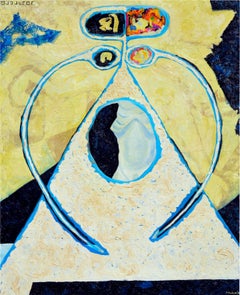
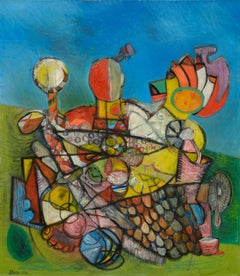
Mid Century Yellow and Blue Large Scale Abstract
By Louis Earnest Nadalini
Located in Soquel, CA
Stunning and expressive large scale oil painting by mid-century San Francisco artist Louis Earnest Nadalini (American, 1927-1995). Signed "Nadalini" lower right. Unframed. Image size...
Category

1950s American Modern Abstract Paintings

Materials

Canvas, Oil, Wood Panel

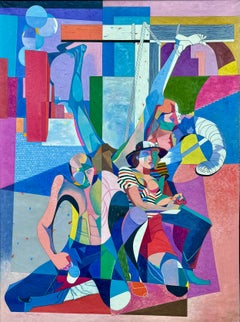
Figurative Cubist Surrealist Abstraction Mid 20th Century American Modern Large
By O. Louis Guglielmi
Located in New York, NY
Figurative Cubist Surrealist Abstraction Mid 20th Century American Modern Large O. Louis Guglielmi (1906 - 1956) OBSESSIVE THEME 44 x 33 inches Oil on canvas Signed and dated '48 lo...
Category

1940s American Modern Abstract Paintings

Materials

Canvas, Oil

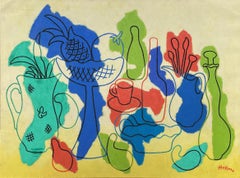
"Untitled" Albert Heckman, 1950s Modernist Abstracted Still Life Painting
By Albert Heckman
Located in New York, NY
Albert Heckman Untitled, circa 1950 Signed lower right Oil on canvas 21 1/4 x 29 inches Albert Heckman was born in Meadville, Western Pennsylvania, 1893. He went to New York City to try his hand at the art world in 1915 after graduating from high school and landing a job at the Meadville Post Office. In 1917, at the age of 24, Heckman enrolled part-time in Teachers' College, Columbia University's Fine Arts Department to begin his formal art education. He worked as a freelance ceramic and textile designer and occasionally as a lecturer at the Metropolitan Museum of Art. In the early 1920s, at the age of almost 30, he graduated with a Bachelor of Arts degree from Columbia Teachers College. He was especially impacted by his instructor at Columbia, Arthur Wesley Dow. After graduating, he was hired by the Teachers' College as a Fine Arts instructor. He stayed with Columbia Teachers' College until 1929, when he left to attend the Leipzig Institute of Graphic Arts in Leipzig, Germany. Isami Doi (1903-1965), who was born in Hawaii, was arguably his most impressive student at Columbia. Doi is now regarded as one of the most prominent artists hailing from Hawaii. Heckman became an active member and officer of the Keramic Society and Design Guild of New York in the 1920s as part of his early commercial art career. The Society's mission was to share knowledge and showcase textile and ceramic design exhibits. In 1922, Heckman married Florence Hardman, a concert violinist. Mrs. Heckman's concert schedule during the 1920s kept Albert and Florence Heckman apart for a significant portion of the time, but they spent what little time they had together designing and building their Woodstock, New York, summer house and grounds. A small house and an acre of surrounding land on Overlook Mountain, just behind the village of Woodstock, were purchased by Albert and Florence Heckman at the time of their marriage. Their Woodstock home, with its connections, friendships, and memories, became a central part of their lives over the years, even though they had an apartment in New York City. Heckman's main artistic focus shifted to the house on Overlook Mountain and the nearby towns and villages, Kingston, Eddyville, and Glasco. After returning from the Leipzig Institute of Graphic Arts in 1930, Mr. Heckman joined Hunter College as an assistant professor of art. He worked there for almost thirty years, retiring in 1956. Throughout his tenure at Hunter, Mr. Heckman and his spouse spent the summers at their Woodstock residence and the winters in New York City. They were regular and well-known guests at the opera and art galleries in New York. Following his retirement in 1956, the Heckmans settled in Woodstock permanently, with occasional trips to Florida or Europe during the fall and winter. Mr. Heckman's close friends and artistic career were always connected to Woodstock or New York City. He joined the Woodstock art group early on and was greatly influenced by artists like Paul and Caroline Rohland, Emil Ganso, Yasuo Kuniyoshi, Andre Ruellan, and her husband, Jack Taylor. Heckman operated a summer art school in Woodstock for several years in the 1930s with support from Columbia University, where these and other Woodstock artists gave guest lectures. The Potter's Shop in New York City hosted Mr. Heckman's first art show in December 1928. The exhibit received some positive reviews from critics. The American Institute of Graphic Arts chose the plate of "Wehlen, Saxony" as one of the "Fifty Prints of the Year in 1929." There were sixteen etchings displayed. The remaining plates depicted scenes in Saxony, Germany, while five of the plates were based on scenes in Rondout, New York. Heckman started switching from etching to black and white lithography by the early 1930s. A lifelong admirer of Heckman's artwork, Mr. Gustave von Groschwitz organized a significant exhibition of Heckman etchings and lithographs at the Ferargil Gallery in New York City in 1933. The exhibition traveled to the Stendahl Galleries in Los Angeles (May 1933), the Charles Lessler Gallery in Philadelphia (May 1933), J.L. Hudson in Detroit (June 1933), and Gumps in San Francisco (July 1933). Together with his early etchings, the exhibition featured brand-new black and white lithographs depicting scenes in and around Woodstock as well as "A View from Tudor City...
Category

1950s American Modern Figurative Paintings

Materials

Canvas, Oil

Colorful Samurai, Large-Scale Modern Figural Geometric Abstract
Located in Soquel, CA
Colorful Samurai, Large-Scale Modern Figural Geometric Abstract Colorful modern figural abstract of a samurai figure fractured into fields of color and pattern by S. Baker (Susan Baker...
Category

1990s American Modern Figurative Paintings

Materials

Canvas, Oil, Stretcher Bars

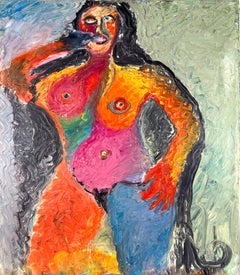
Vintage Abstract Expressionist Standing Pensive Figurative Nude - Heavy Impasto
Located in Soquel, CA
Vintage Abstract Expressionist Standing Pensive Figurative Nude - Heavy Impasto Abstract expressionist figurative composition of a nude woman by California artist Harald "Harry" Dr...
Category

1970s American Modern Figurative Paintings

Materials

Canvas, Oil, Stretcher Bars

"On Guard" Heavy Impasto Expressionist Figure
Located in Soquel, CA
"On Guard" Vintage Abstract Expressionist Heavy Impasto Figure Abstract expressionist figurative composition of a man in a button down shirt with a brimmed hat by California artist ...
Category

1970s American Modern Figurative Paintings

Materials

Canvas, Oil, Stretcher Bars

"Liberty" Heavy Impasto Expressionist Nude Portrait of a Lady Standing
Located in Soquel, CA
"Liberty" Heavy Impasto Expressionist Nude Portrait of a Lady Standing Abstract expressionist portrait of a woman standing with one arm raised over her head by California artist Har...
Category

1970s American Modern Figurative Paintings

Materials

Canvas, Oil, Stretcher Bars

"Personage" Heavy Impasto Expressionist Portrait of Lady with a Hat
Located in Soquel, CA
"Personage" Heavy Impasto Expressionist Portrait of Lady with a Hat Abstract expressionist portrait of a woman wearing a hat by California artist Harald "Harry" Dry Schmidt (America...
Category

1970s American Modern Figurative Paintings

Materials

Canvas, Oil, Stretcher Bars

More From This Seller

View All
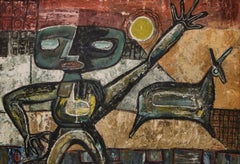
George Cecil Carter Mid-Century Modern Abstract Figurative Oil Painting, 1950s
Located in Denver, CO
This rare 1950s oil painting by Colorado abstract expressionist George Cecil Carter presents an abstracted figurative portrait of a couple—believed to represent Georgia O’Keeffe and Alfred Stieglitz. Rendered with bold brushwork and a dynamic modernist palette, the piece reflects Carter’s distinctive ability to merge abstraction with figuration, capturing both movement and emotional depth. Housed in a custom frame, the painting comes from a private collection in Denver, Colorado. Carter (1908–1993) was a central figure in Colorado’s mid-century modernist movement. A self-taught artist influenced by modernist painter Charles Ragland Bunnell, Carter developed a uniquely expressive style that drew upon his working-class background as a miner and machinist. He exhibited nationally and worked alongside artists including Al Wynne, Mary Chenoweth...
Category

1950s American Modern Figurative Paintings

Materials

Oil

Howard Schleeter 1949 Original Gouache Wax Painting – Abstract Southwest Art
By Howard Schleeter
Located in Denver, CO
This striking original 1949 gouache and wax painting, titled "Fetishes", is a powerful work by acclaimed New Mexico modernist Howard Schleeter (1903–1976). Rich with symbolic abstrac...
Category

1940s American Modern Abstract Paintings

Materials

Wax, Gouache

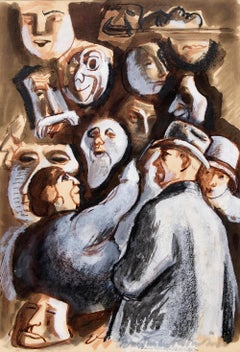
Vendor of Masks, 1930s Original Modernist Gouache Painting of Carnival Scene
By Boardman Robinson
Located in Denver, CO
This captivating 1930s modernist gouache painting by Boardman Robinson (1876–1952), titled The Vendor of Masks, depicts a striking mask vendor’s display with male and female figures,...
Category

1930s American Modern Figurative Paintings

Materials

Gouache

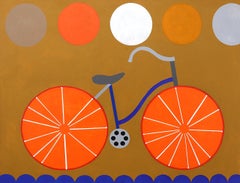
Large 1960s Modernist Bicycle Oil Painting by Mary Chenoweth – Postmodern Art
Located in Denver, CO
This striking large-format oil painting on canvas by renowned 20th-century Colorado artist Mary Chenoweth dates to the 1960s and exemplifies the bold sp...
Category

Mid-20th Century Modern Abstract Paintings

Materials

Oil, Canvas

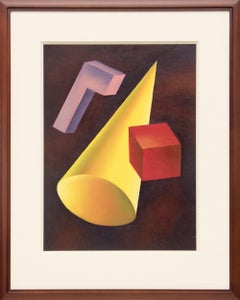
Mid-Century Geometric Abstract Oil Painting by Ralph Anderson, Framed, 1960s
By Ralph Anderson
Located in Denver, CO
Discover this stunning geometric abstract painting by celebrated 20th-century artist Ralph Anderson, a bold and sophisticated example of mid-century modern art. Executed in oil on pa...
Category

Mid-20th Century Modern Figurative Paintings

Materials

Oil

The Four Winter Months by Edward Marecak, 1985 Denver Modernist Oil Painting
By Edward Marecak
Located in Denver, CO
“The Four Winter Months” is a striking 1985 original oil painting by acclaimed Denver modernist Edward Marecak (1919–1993). This evocative work features four abstract, semi-stylized ...
Category

20th Century Folk Art Abstract Paintings

Materials

Canvas, Oil

Recently Viewed

View All