Want more images or videos?
Request additional images or videos from the seller
1 of 17
Emilio Grau SalaLe Piano - Post Impressionist Figurative Interior Painting by Emilio Grau Salac.1950
c.1950
$23,438.69List Price
About the Item
- Creator:Emilio Grau Sala (1911-1975, Spanish)
- Creation Year:c.1950
- Dimensions:Height: 32 in (81.28 cm)Width: 37 in (93.98 cm)
- Medium:
- Movement Style:
- Period:
- Condition:Very good original condition.
- Gallery Location:Marlow, GB
- Reference Number:Seller: LFA02341stDibs: LU415313836412
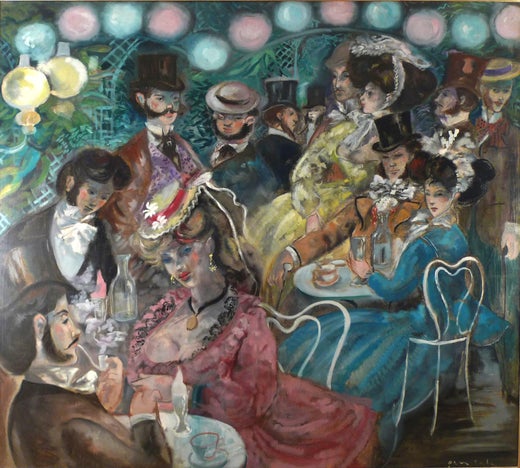
Emilio Grau Sala
Emilio Grau Sala came from a family of artists. He was born in Barcelona in 1911 and his father, a good cartoonist, had been one of the promoters of the "Salon des Humanistes" and made his exhibitions normally in "Sala Parés", Barcelona. His first works were exhibited at the Salon des Independents. In the years 1930-33 he had painted under the influence of Cubism, especially that of Torres García. It is from that time a painting of the port of Barcelona, geometric and structural, which completely anticipated what would later be his work. His personality began fully painting watercolors and oils with a certain fantasy character, with a point of decorative instinct and themes full of naivety and grace. Romantic interiors, paddocks, port scenes, sailors, etc. Grau Sala was essentially a Mediterranean painter, son of post-impressionism and enriched with French painting of the last fifty years. Mediterranean because his work has the color and light of that land.
He understood and assimilated impressionist painting very well, and for that reason he was never subject to the modules of a formulist realism, nor the sexigencias of the forms. In Paris he found the best environment to give us a fruitful and intense work, because he could use the expressive potential of French art to enrich it.
All this made him a very esteemed artist everywhere where his work was known. He was also very often required to illustrate books and publications in Paris. Also his posters were very successful. He painted a large number of subjects, but perhaps the theme of horse racing is where you can see in a very clear way the joyful and optimistic life that was lived at that time. In this fabric there is an explosion of juicy and vivid colors full of ingenuity and simplicity in its composition. Only a teacher could turn the complicated into something simple and beautiful. Before this work we feel a deep emotion, the emotion of before starting a horse race. Joy and nervousness at the same time. Especially since it is a direct emotion. There are no intermediaries between our eyes and what the work intends to tell us. This is precisely what seduces and catches us of this painting. His works can be found in the Museums of the Villa de Paris, L'Ile de France Museum, at the Château de Sceaux, Honfleur Museum, La Rochelle Museum, Barcelona Museum, Tossa de Mar Museum, Philadelphia Museum, Museum of Buenos Aires, etc. EXHIBITION
Museo de Arte Moderno, Madrid
Galería Muller, Buenos Aires
Dindley Gallery, New York
Outdoor and Autumn Halls, Paris
Galería Charpentier, París
Monique de Groote, París
Sala Parés, Barcelona
Sala Rovira, Barcelona
Sala Syra, Barcelona
About the Seller
5.0
Gold Seller
Premium sellers maintaining a 4.3+ rating and 24-hour response times
Established in 2001
1stDibs seller since 2016
710 sales on 1stDibs
Typical response time: 3 hours
Authenticity Guarantee
In the unlikely event there’s an issue with an item’s authenticity, contact us within 1 year for a full refund. DetailsMoney-Back Guarantee
If your item is not as described, is damaged in transit, or does not arrive, contact us within 7 days for a full refund. Details24-Hour Cancellation
You have a 24-hour grace period in which to reconsider your purchase, with no questions asked.Vetted Professional Sellers
Our world-class sellers must adhere to strict standards for service and quality, maintaining the integrity of our listings.Price-Match Guarantee
If you find that a seller listed the same item for a lower price elsewhere, we’ll match it.Trusted Global Delivery
Our best-in-class carrier network provides specialized shipping options worldwide, including custom delivery.You May Also Like
Looking at the World
By Paula Craioveanu
Located in Santa Monica, CA
Oil on canvas
Category
21st Century and Contemporary Fauvist Interior Paintings
Materials
Canvas, Oil
"Synagogue Interior Scene with Figure" Post-Impressionist Oil Painting on Canvas
By Jacques Zucker
Located in New York, NY
An outstanding oil painting depicting a religious figure seated in a Synagogue with decorated columns and in between arches. The bright colors and quick brush strokes are what make t...
Category
20th Century Post-Impressionist Figurative Paintings
Materials
Canvas, Oil
$4,500
H 26 in W 26 in D 4.5 in
Elegant Lady in French Interior, 1960
s French Post Impressionist Oil Painting
By Josine Vignon
Located in Cirencester, Gloucestershire
Elegant Lady in Interior next to a Bowl of Fruit
by Josine Vignon (French 1922-2022)
signed and stamped verso
oil painting on canvas, unframed
canvas: 2...
Category
Mid-20th Century Post-Impressionist Figurative Paintings
Materials
Canvas, Oil
$1,333 Sale Price
30% Off
H 26 in W 21 in D 1 in
1960
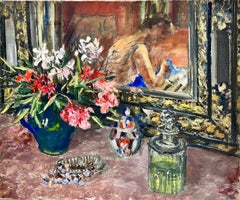
s French Interior Scene Lady Reflection in Window Sewing Still Life Flowers
By Josine Vignon
Located in Cirencester, Gloucestershire
Interior
by Josine Vignon (French 1922-2022)
stamped verso
oil painting on canvas, unframed
canvas: 24 x 29 inches
very good condition
provenance: from the artists estate, France
J...
Category
Mid-20th Century Post-Impressionist Interior Paintings
Materials
Canvas, Oil
$1,857 Sale Price
30% Off
H 24 in W 29 in D 1 in
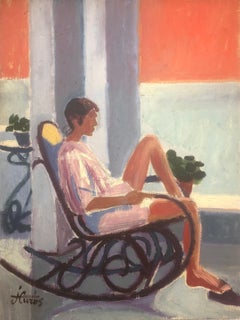
Woman in rocking chair oil on canvas painting fauvism nude
By Jordi Curos
Located in Sitges, Barcelona
Jordi Curós Ventura (1930-2007) - Woman in rocking chair - Oil on canvas.
Work measurements 61x46 cm.
Frameless.
Jordi Curós Ventura (Olot, Girona, March 4, 1930) is a Spanish paint...
Category
1970s Fauvist Figurative Paintings
Materials
Canvas, Oil
$546 Sale Price
42% Off
H 24.02 in W 18.12 in
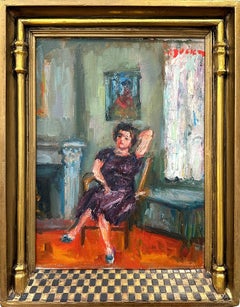
"Interior Scene in Paris" Post-Impressionist Oil Painting on Canvas Framed
By Jacques Zucker
Located in New York, NY
A charming oil painting depicting an interior scene of an elegant woman crossing her legs, reclining on a chair. She exudes a calmness while we can feel the breeze coming through th...
Category
20th Century Post-Impressionist Figurative Paintings
Materials
Canvas, Oil
$2,500
H 17 in W 13.5 in D 2.5 in
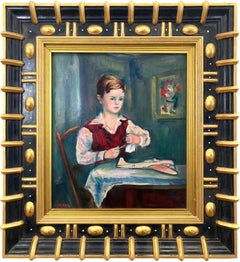
"Young Boy with Toy Airplane" Post-Impressionist French Oil Painting on Canvas
By Jacques Zucker
Located in New York, NY
This painting depicts a whimsical portrait of a young boy with light brown hair against a viridian green background. The piece is done in a highly impressionistic manner and is a won...
Category
20th Century Post-Impressionist Figurative Paintings
Materials
Canvas, Oil, Wood Panel
$3,500
H 23.5 in W 21.5 in D 2 in
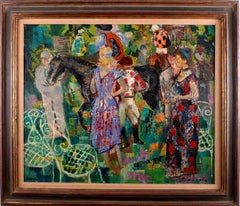
Paddock
By Emilio Grau Sala
Located in Madrid, ES
EMILIO GRAU SALA
Spanish, 1911 - 1975
PADDOCK
signed "Grau Sala" (lower right)
oil on canvas
21-1/3 x 25-1/2 inches (54 x 65 cm.)
framed: 27-1/2 x 32 inches (70 x 81 cm.)
PROVENANCE...
Category
1960s Post-Impressionist Figurative Paintings
Materials
Canvas, Oil
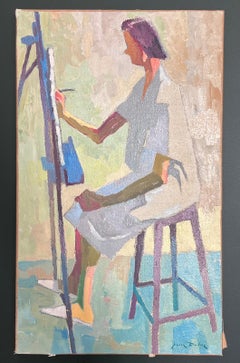
1950s French Post Impressionist Oil Painting Self Portrait Artist at Easel
Located in Cirencester, Gloucestershire
The Artist at her Easel
by Jean Dulac (French 1902-1968)
signed oil on canvas, unframed
canvas: 22 x 13 inches
provenance: private collection, Lyon, France
condition: very good and s...
Category
Mid-20th Century Post-Impressionist Figurative Paintings
Materials
Oil, Canvas
$1,143 Sale Price
30% Off
H 22 in W 14 in
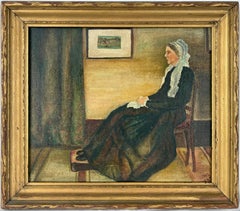
Whistlers Mother by Anonymous Artist Original Oil on Canvas 1924 after Whistler
Located in Soquel, CA
Whistlers Mother by Anonymous Artist Original Oil on Canvas 1924
Nicely executed painting after James McNeil Whistler of his mother by an anonymous artist (American, 19th-20th C.)
I...
Category
1920s Post-Impressionist Figurative Paintings
Materials
Canvas, Oil, Stretcher Bars
$1,150
H 17.5 in W 19.5 in D 1 in
More From This Seller
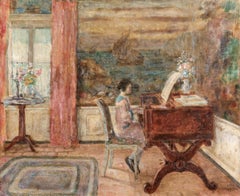
View AllThe Piano Recital - Impressionist Figurative Interior Oil by Frederick Frieseke
By Frederick Carl Frieseke
Located in Marlow, Buckinghamshire
Signed and dated oil on canvas figure in interior painting by American impressionist painter Frederick Carl Frieseke. The piece depicts a young girl in a pink dress seated at a piano...
Category
1920s American Impressionist Figurative Paintings
Materials
Oil, Canvas
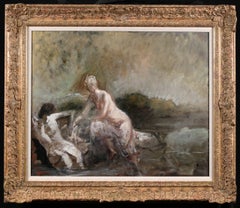
Les Baigneuses - Impressionist Figurative Landscape Oil by Jean Louis Forain
By Jean Louis Forain
Located in Marlow, Buckinghamshire
Signed impressionist figurative oil on canvas circa 1890 by sought after French impressionist painter Jean Louis Forain. The piece depicts bathers in a dark landscape.
Signature:
Signed lower right
Dimensions:
Framed: 32"x37"
Unframed: 24"x29"
Provenance:
Private French collection
Jean Forain was the son of a painter and decorator and was apprenticed to a visiting card engraver. He studied briefly under Gérôme and Carpeaux at the École des Beaux-Arts in Paris and regularly visited the Louvre, where he copied works by the masters. It is said that for a time he made a precarious living by selling small drawings in the style of Grévin. He went on to collaborate on various publications as a draughtsman and columnist, starting in 1876 on La Cravache and then collaborating on the newspapers Le Journal Amusant, Le Figaro and L'Écho de Paris. This introduced him to the diverse worlds of Paris society - the world of the theatre, of shows, and of literature - where he wryly noted the habits and shortcomings particular to each. This led him to follow a route very characteristic of this period, already seen in the work of Steinlen, Caran d'Ache and Toulouse-Lautrec in the journals La Pléiade, La Vogue...
Category
1890s Impressionist Figurative Paintings
Materials
Canvas, Oil
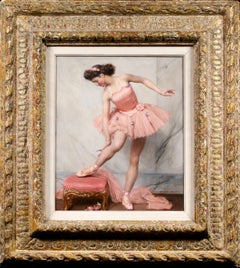
Une Ballerine - Realist Figurative Oil Painting by Auguste Leroux
Located in Marlow, Buckinghamshire
Signed oil on canvas figure in interior circa 1930 by French realist painter Jules Marie Auguste Leroux. The work depicts a brunette ballerina wearing a pink tutu and pointe shoes st...
Category
1930s Realist Figurative Paintings
Materials
Canvas, Oil
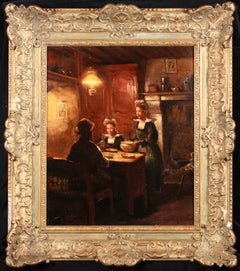
A Breton Interior - Impressionist Interior Oil Painting by Edouard Cortes
By Édouard Leon Cortès
Located in Marlow, Buckinghamshire
Signed figures in interior oil on canvas circa 1910 by sought after French impressionist painter Edouard Leon Cortes. This charming and nostalgic work depicts a family enjoying dinne...
Category
Early 20th Century Impressionist Interior Paintings
Materials
Canvas, Oil
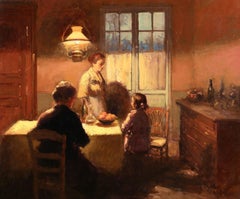
Interieur - Effet de Lampe - Impressionist Interior Oil by Edouard Cortes
By Édouard Leon Cortès
Located in Marlow, Buckinghamshire
Signed figures in interior oil on canvas circa 1920 by sought after French impressionist painter Edouard Leon Cortes. This charming and nostalgic work depicts a family in a typical Breton kitchen scene. An elderly lady is seated at the table with her back to the artist and a young girl also sits at the table beside a bowl of oranges and a carafe of red wine. Another lady stands at the table under the light of the lamp.
Signature:
Signed lower right
Dimensions:
Framed: 29.5"x34"
Unframed: 21.5"x26"
Provenance:
Salon des Independants - 1922 exhibition
Galleries Maurice Sternberg - Chicago
Original artists label with title and number "9" on the reverse.
Edouard Leon Cortes, the son of the painter Antonio Cortès, was sent to the front during World War I to sketch enemy positions. In civilian life, his base was in Lagny in the former studio of Cavallo-Peduzzi. Although he travelled extensively in France. Notably in Normandy, Brittany, the Champagne region and Savoy painting...
Category
1920s Impressionist Figurative Paintings
Materials
Canvas, Oil
Deux vieillards aux chatons - Impressionist Figurative Oil by J F Raffaelli
By Jean-Francois Raffaelli
Located in Marlow, Buckinghamshire
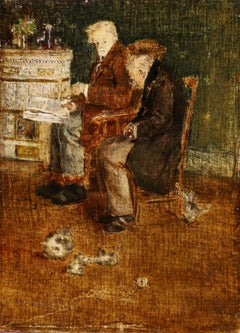
Signed figures in interior oil on panel by French impressionist painter Jean-Francois Raffaelli. The piece depicts two old men seated in an interior. One is reading his paper as the other naps and there are several kittens on the floor. Painted in the artist's distinctive style.
Signature:
Signed lower left
Dimensions:
Framed: 9.5"x8"
Unframed: 5.5"x4"
Provenance:
Brame & Lorenceau have confirmed the authenticity of this work and it will be included in the digital catalogue raisonne of the painter which is under preparation
A certificate of authenticity fromBrame & Lorenceau accompanies this painting
Private collection - United States
Original artists label verso
Jean-François Raffaëlli's father was a failed Italian businessman and Raffaëlli himself was, among other things, a church chorister, actor and theatre singer. He then studied under Gérôme at the École des Beaux-Arts in Paris. He travelled to Italy, Spain and Algeria and on his return to France settled in Asnières.
In 1876, on a trip to Brittany, he first saw the potential of realist subject matter, if treated seriously. He became involved in meetings of artists at the Café Guerbois, where the Impressionist painters used to gather. As a result, Degas, contrary to the advice of the group, introduced Raffaëlli to the Impressionist exhibitions - according to one uncertain source as early as the very first exhibition, at the home of Nadar, and certainly to those of 1880 and 1881.
In 1904, Raffaëlli founded the Society for Original Colour Engraving. He first exhibited at the Salon de Paris in 1870 and continued to exhibit there until he joined the Salon des Artistes Français in 1881, where he earned a commendation in 1885, was made Chevalier of the Légion d'Honneur in 1889 and in the same year was awarded a gold medal at the Exposition Universelle. In 1906 he was made Officier of the Légion d'Honneur. He was also a member of the Société Nationale des Beaux-Arts. In 1884, a private exhibition of his work cemented his reputation.
He contributed to several newspapers such as The Black Cat (Le Chat Noir) in 1885 and The French Mail (Le Courrier Français) in 1886 and 1887. He published a collection entitled Parisian Characters, which captured his favourite themes of the street, the neighbourhood and local people going about their lives. In 1880 he participated, with Forain, on the illustration of Joris Karl Huysmans' Parisian Sketches (Croquis Parisiens). He also illustrated Huysman's Works. As well as working as an illustrator, he also made etchings and coloured dry-points.
His early attempts at painting were genre scenes, but once he was settled in Asnières he started to paint picturesque views of Parisian suburbs. From 1879 onwards, his subject matter drew on the lives of local people. These popular themes, which he treated with humanity and a social conscience, brought him to the attention of the social realist writers of the time such as Émile Zola. In addition to his realist style, Raffaëlli's dark palette, which ran contrary to the Impressionist aesthethic, helped to explain the opposition of those painters to his participation in their exhibitions. More concerned with drawing than colour, he used black and white for most of his paintings. Towards the end of his life, he lightened his palette, but without adopting any other principles of the Impressionist technique.
After painting several portraits, including Edmond de Goncourt and Georges Clémenceau, he returned to genre painting, particularly scenes of bourgeois life. Later in his career, he painted mainly Breton-inspired sailors and views of Venice. His views of the Paris slums and the fortifications, sites which have almost completely disappeared, went some way towards establishing a genre in themselves and perpetuated the memory of the area: The Slums, Rag-and-Bone Man, Vagabond, Sandpit, In St-Denis, Area of Fortifications. His realistic and witty portrayal of typical Parisian townscapes accounts for his enduring appeal.
Born in Paris, he was of Tuscan descent through his paternal grandparents. He showed an interest in music and theatre before becoming a painter in 1870. One of his landscape paintings was accepted for exhibition at the Salon in that same year. In October 1871 he began three months of study under Jean-Léon Gérôme at the École des Beaux-Arts in Paris; he had no other formal training.
Raffaëlli produced primarily costume pictures until 1876, when he began to depict the people of his time—particularly peasants, workers, and ragpickers seen in the suburbs of Paris—in a realistic style. His new work was championed by influential critics such as J.-K. Huysmans, as well as by Edgar Degas.
The ragpicker became for Raffaëlli a symbol of the alienation of the individual in modern society. Art historian Barbara S. Fields has written of Raffaëlli's interest in the positivist philosophy of Hippolyte-Adolphe Taine, which led him to articulate a theory of realism that he christened caractérisme. He hoped to set himself apart from those unthinking, so-called realist artists whose art provided the viewer with only a literal depiction of nature. His careful observation of man in his milieu paralleled the anti-aesthetic, anti-romantic approach of the literary Naturalists, such as Zola and Huysmans.
Degas invited Raffaëlli to participate in the Impressionist exhibitions of 1880 and 1881, an action that bitterly divided the group; not only was Raffaëlli not an Impressionist, but he threatened to dominate the 1880 exhibition with his outsized display of 37 works. Monet, resentful of Degas's insistence on expanding the Impressionist exhibitions by including several realists, chose not to exhibit, complaining, "The little chapel has become a commonplace school which opens its doors to the first dauber to come along."An example of Raffaëlli's work from this period is Les buveurs d'absinthe (1881, in the California Palace of Legion of Honor Art Museum in San Francisco). Originally titled Les déclassés, the painting was widely praised at the 1881 exhibit.
After winning the Légion d'honneur in 1889, Raffaëlli shifted his attention from the suburbs of Paris to city itself, and the street scenes that resulted were well received by the public and the critics. He made a number of sculptures, but these are known today only through photographs.[2] His work was also part of the painting event in the art competition at the 1912 Summer Olympics. In the later years of his life, he concentrated on color printmaking. Raffaëlli died in Paris on February 11, 1924
Museum and Gallery Holdings:
Béziers: Peasants Going to Town
Bordeaux: Bohemians at a Café
Boston: Notre-Dame; Return from the Market
Brussels: Chevet of Notre-Dame; pastel
Bucharest (Muz. National de Arta al României): Market at Antibes; Pied-à-terre
Copenhagen: Fishermen on the Beach
Douai: Return from the Market; Blacksmiths
Liège: Absinthe Drinker...
Category
1890s Impressionist Figurative Paintings
Materials
Oil, Panel
Recently Viewed
View AllMore Ways To Browse
Fruit Bowl Oil On Canvas
Oil Painting Piano
Les Fleurs Du Mal
Baudelaire Les Fleurs Du Mal
Red Piano
By Emilio Grau Sala
Bel Ami
Di Donna
Jean Auguste Dominique Ingres
John The Baptist Painting
Military Oil Painting
Nandalal Bose
Nude Mother
Oil Paintings Feather
Russian Civil War
Stage Design Art
16th Century Painted Panels
Adolf Zardins