Items Similar to Erminia and the Shepherds, a painting by Francesco de Mura (Napoli 1696 - 1782)
Want more images or videos?
Request additional images or videos from the seller
1 of 11
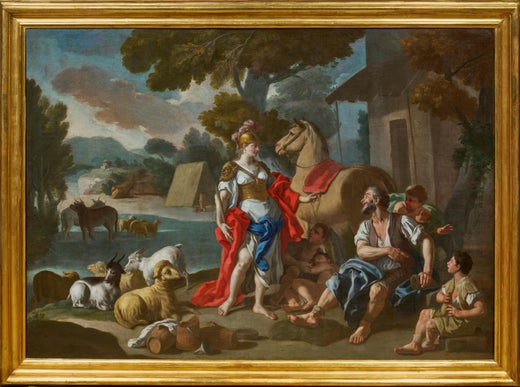
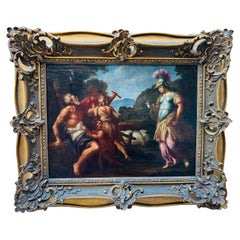
Francesco de MuraErminia and the Shepherds, a painting by Francesco de Mura (Napoli 1696 - 1782)ca. 1760
ca. 1760
$87,937.94
£65,651.66
€73,500
CA$121,140.85
A$132,914.60
CHF 70,013.03
MX$1,581,159.34
NOK 896,858.43
SEK 818,954.21
DKK 560,098.05
About the Item
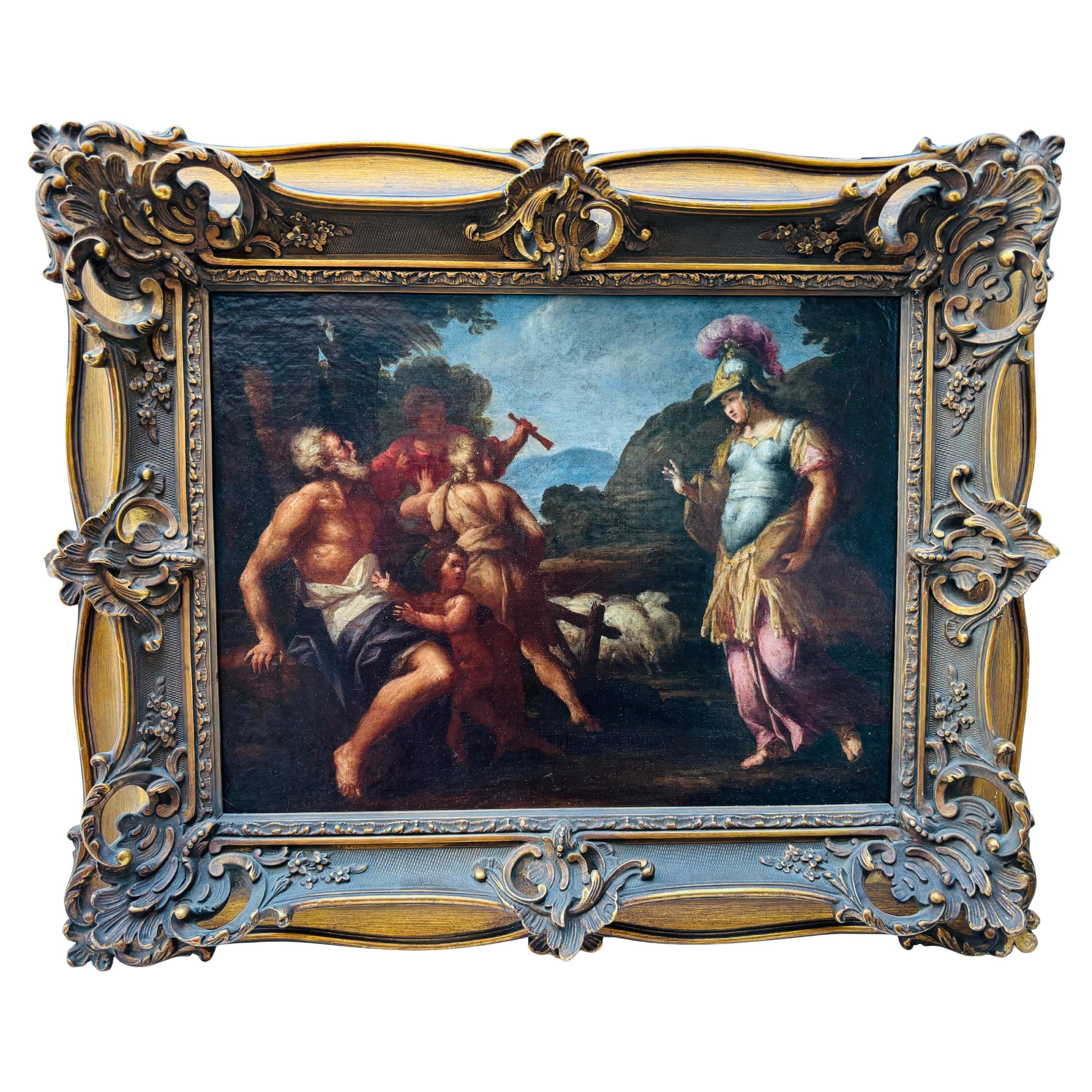
In this masterly painting, Francesco de Mura presents the meeting of Erminia and the shepherds, a famous episode taken from the seventh canto of Torquato Tasso's Jerusalem Delivered. The artist is offering us a synthesis of the chromatic seductions of the rococo and neoclassical influences and presents a luminous, quiet version of this episode, in which the frieze of the main characters stands out against an Arcadian landscape.
1. Francesco de Mura, a rococo heir to the Neapolitan Baroque and a precursor of Neoclassicism
Francesco de Mura was born and died in Naples in 1696 and 1782 respectively. Like his contemporaries Giambattista Tiepolo (1696 - 1770), William Hogarth (1697 - 1764) and François Boucher (1703 - 1770), he is strongly, justifiably identified with his native place, to the extent that his art can be said to represent that place in his time.
After a short apprenticeship in the studio of the painter Domenico Viola, De Mura joined, at the age of 12, the studio of Francesco Solimena (1657 - 1747), the leading figure in Neapolitan painting since Giordano's death in 1705. He was to be durably influenced by Solimena's painting, although from 1730 onwards his art gradually began to differ, with a lighter chromatic range and a greater attention to the environment in which his characters are depicted.
Much of his work produced around 1730, was unfortunately lost to Allied bombing in 1945, when the abbey of Mont Cassin, for which he had produced over thirty paintings and frescoes, was bombed.
In 1742-1743, he spent 18 months at the court of Turin, where he had been invited by King Charles-Emmanuel III of Savoy. During this stay, he was influenced by other painters working for the monarch, in particular Carle van Loo (1705 - 1765) and Corrado Giaquinto (1703 - 1766). It was in Turin that his palette became definitively clearer; back in Naples, he asserted his style, which combines the lightness and dynamism of rococo with neoclassical-inspired forms. His characters are distinguished by their discreet, measured gestures, their studied attitudes subtly conveying their emotions in a pre-romantic manner.
In numerous compositions inspired by mythology, ancient history but also by Jerusalem Delivered, De Mura echoes the theatrical and operatic subjects of Pietro Metastasio, whose artistic ideals and cultural sensibility he shares. These works, to which the present one belongs, are characterized by the clarity of their composition, the elegance of forms and attitudes, all aimed at conveying the feelings that animate their characters.
Endowed with a remarkable longevity for his time, Francesco de Mura continued to paint right up to the end of his life, fulfilling his last commission (a series of door tops for the palace of Caserta) in 1782, the very year of his death.
2. Erminia and the Shepherds, an enchanted interlude in Jerusalem Delivered
Erminia is a princess of Antioch, whose story is told in the sixth and seventh cantos of Jerusalem Delivered. Out of love for Tancredi, Erminia steals the armor of Clorinda, a female warrior with whom Tancredi is in love, to join him and nurse him back to health after a battle in which he has been wounded. Arriving at the Christian camp, she is pursued by horsemen who mistake her for Clorinda.
Carried away by the gallop of her horse, Erminia escapes her pursuers but get lost into a deep forest. In the early hours of the morning, on the banks of the River Jordan, she meets an old shepherd who comforts her by offering her hospitality. She finds inner peace during this bucolic sojourn, melancholically engraving the name of Trancredi on the trees of the forest that surrounds her.
The noise and fury of the battles is followed by the peace of pastoral life, made up of simple pleasures that no one disturbs. Some commentators have seen Erminia as a double of Torquato Tasso, disillusioned by the intrigues of the Ferrara court, which he dreamed of deserting. Like the author, Erminia oscillates between the extremes of euphoria and depression; fragile, she feels as an alien. While the disguise with Clorinda's armor gives her the illusion of a false identity, more courageous and unscrupulous, it does not free her from her true nature: timid, passionate and distraught.
The story of Erminia had also seduced Pietro Metastasio (1698 - 1782), a poet and opera librettist contemporary of De Mura, who is said to have written the libretto for the eponymous serenade premiered in Naples on June 13, 1723 with a music by Scarlatti (with the famous castrato Farinelli in the title role).
3. Description of the artwork and related artworks
Francesco de Mura depicts the decisive moment of the unexpected encounter between Erminia, just off her horse, and an elderly shepherd, in an Arcadian setting on the banks of the Jordan River. The appearance of the two main characters is theatrical, as Erminia's contraposto posture opposes that of the shepherd. This type of composition can be found in other artworks by Francesco de Mura, such as Christ and the Samaritan Woman (1752) in the Seattle Museum.
A comparison with a painting of the same subject by Solimena (recently on sale at Pandolfini - last photo in the gallery) sheds light on the particularity of Francesco de Mura's art. It illustrates the lasting influence of Solimena on his pupil (which can be seen in particular in the figure of the old shepherd, presented by Francesco de Mura in a position very similar to that used by Solimena), but also the fundamental differences in the pictorial approach developed by Francesco de Mura: simplification of forms, lightening of the chromatic range, attention paid to the surrounding landscape.
This artistic evolution - and persistent filiation - can also be illustrated by a youthful work by Francesco de Mura, presented at Sotheby's in 2008. The composition of this early version remains very similar to Solimena's, even if it is greatly simplified by the disappearance of the winged figures.
The very tight framing echoes Solimena's composition, and does not offer the opening onto an idyllic landscape. Erminia, shown taking off her helmet, is rather ungraceful; the shepherd, who is portrayed in a statical manner, does not have the virtuoso elegance he will acquire in the definitive version which we are presenting.
In the painting we are presenting, the artist anticipates neoclassical compositions through the figure of Herminia, who evokes Roman statues of Athena with her helmet, but also through the use of bright colors and simple forms, as in the discreet still life of geometrically shaped containers displayed at Erminia's feet.
Another version of the same subject belongs to the Bavarian State Collections. These two versions are very similar, and it is difficult to determine whether one predates the other. The main differences are Erminia's right hand, which is holding a spear pointing to the ground in the Bavarian version, and the presence of a figure beside the hut in the background.
4. Provenance and framing
This painting was first presented at auction with Sotheby
Co in London in 1963. The sale included paintings from various English private collections (Duke of Fife, Mrs L.M.H Blyth, Mrs J.G Hickson, Baroness J.M De Lagatinerie, Major A. Binny), and it is likely that this painting might be a souvenir of the Grand Tour, of which around 1760 Naples was an essential stopover.
Our painting is presented in an 18th-century Italian carved and gilded wood frame, which is probably its original frame.
Main bibliographical reference :
Arthur R. Blumenthal - In the light of Naples - the Art of Francesco de Mura - Giles London 2016
- Creator:Francesco de Mura (1696-1782, Italian)
- Creation Year:ca. 1760
- Dimensions:Height: 50 in (127 cm)Width: 70 in (177.8 cm)
- Medium:
- Movement Style:
- Period:1760-1769
- Condition:127 x 177.8 cm (148 x 200 cm framed) 18th century Italian frame in carved and gilded wood Provenance: Sotheby Co sale (London) 13/03/1963 The work is listed in the Fondation Zeri s photographic archives.
- Gallery Location:PARIS, FR
- Reference Number:1stDibs: LU1568214011232
Francesco de Mura
Francesco de Mura was an Italian painter of the late-Baroque period, active mainly in Naples, Rome and Turin. His late work reflects the style of neoclassicism. He was the favorite pupil of Francesco Solimena. He worked with Domenico Viola and in his atelier, he met his contemporary Mattia Preti. De Mura was a very appreciated and valued artist, known for his religious subjects but also a skilled portraitist. His works of art are exposed in the most important churches in Naples and Italy, and his masterpieces are exposed in many national and international museums.
About the Seller
5.0
Vetted Professional Seller
Every seller passes strict standards for authenticity and reliability
Established in 2020
1stDibs seller since 2021
10 sales on 1stDibs
Typical response time: <1 hour
- ShippingRetrieving quote...Shipping from: PARIS, France
- Return Policy
More From This Seller
View AllMercury and Io, a rediscovered painting by Jean-Baptiste Marie Pierre (ca. 1740)
Located in PARIS, FR
We would like to thank Mr. Nicolas Lesur for confirming the autograph nature of the entire composition after a direct examination of the painting on November 27, 2024.
This painting...
Category
1740s Old Masters Figurative Paintings
Materials
Canvas, Oil
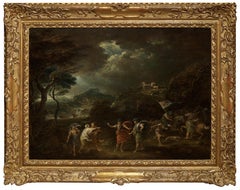
Macbeth and the Three Witches a Painting on Panel by Francesco Zuccarelli
By Francesco Zuccarelli
Located in PARIS, FR
This painting, created during Zuccarelli's stay in England, represents the decisive moment when Macbeth, together with Banquo, meets the three witches who announce that he will be Ki...
Category
1760s Old Masters Landscape Paintings
Materials
Oil, Wood Panel
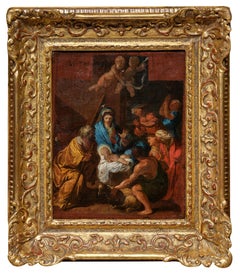
A first thought for Nicolas Loir
s Adoration of the Shepherds at the Louvre
Located in PARIS, FR
In an intimate atmosphere dominated by warm colors, Nicolas Loir offers us here a first thought, tightly focused and rigorously arranged, of the Adoration of the Shepherds in the Louvre Museum, in which he expresses his admiration for the art of Nicolas Poussin.
1. Nicolas Loir, a 17th-century Parisian artist inspired by Bourdon and Poussin
Nicolas Loir was born in Paris in 1623. His father, a goldsmith, first placed him with Simon Vouet and then with Sébastien Bourdon. At the age of 23, in 1647, he left for Rome, where he stayed for two years, drawing inspiration from the classicism of Raphael and, above all, Nicolas Poussin, whom he met and deeply admired.
On his return to France in 1649, he received his first major commissions for religious paintings for Parisian churches, the most prestigious of which was the May of Notre Dame for the year 1650. He also received numerous secular commissions for hotels and châteaux in the Paris region. Admitted to the Academy in 1663, he joined Le Brun's team and participated in the decoration of the royal castles of Vincennes, the Tuileries, and Versailles. Appointed professor at the Academy in 1666, then assistant to the rector in 1668, he died in 1679.
He married Marguerite Cotelle, daughter of the painter Jean I Cotelle, a specialist in monochrome paintings, and sister of the painter Jean II Cotelle. Dezallier d'Argenville, who owned several of his drawings, tells us that he was a man of gentle and modest temperament, deeply honest, and highly esteemed by his contemporaries, including as a portrait painter. We can see his amiable character features reflected in his portrait by Jean Tiger, which is kept at the Palace of Versailles (4th photo in the gallery).
2. Description of the painting and related artworks
Our painting depicts the adoration of the Holy Child, presented in the center of the composition on a pristine white cloth that catches the eye, by the shepherds. While the figure draped in yellow on the left is likely Saint Joseph, the Virgin Mary is depicted from the front, contemplating the Child with her right hand raised, her fingers spread as if to indicate her amazement at the realization of this Mystery. The five figures on the left, all dressed quite simply, are the shepherds who have come to worship the Child, as evidenced by the kid goat lying at his feet. Two cherubs carrying phylacteries fly in the sky and complete the composition.
Our Nativity was painted in oil on canvas coated with a brown-red preparation, visible in the two upper corners left unpainted, which is typical of French painting in the mid-17th century and found in the work of Nicolas Poussin. The overall atmosphere of the painting reveals Poussin's decisive influence, whether through the color palette dominated by primary colors (the blue of the Virgin's cloak, the orange-red of the shepherds' cloaks on the right, the bright yellow of St. Joseph's cloak on the left), the rather tubular treatment of the figures, but also through numerous direct references to Poussin's paintings. Examples include the two cherubs, which seem to be inspired by those above the Martyrdom of Saint Erasmus...
Category
Mid-17th Century Old Masters Figurative Paintings
Materials
Canvas, Oil
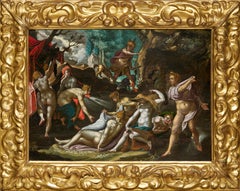
Diana and Actaeon, a Mannerist painting after Joseph Heintz the Elder
Located in PARIS, FR
This painting seduced us with its rich colors. Depicting Diana and her companions surprised by Actaeon, it was inspired by an engraving by Aegidius Sadeler II after a painting by Jos...
Category
17th Century Old Masters Nude Paintings
Materials
Oil, Wood Panel
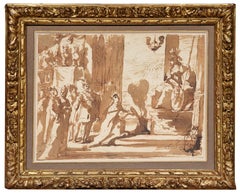
Allegory of the Treaty of Angoulême, a drawing attributed to Donato Mascagni
Located in PARIS, FR
We would like to thank Mrs. Ursula Verena Fischer Pace for suggesting the attribution to Donato Arsenio Mascagni.
We were immediately seduced by the rich tonalities of this allegory...
Category
1620s Old Masters Figurative Drawings and Watercolors
Materials
Ink
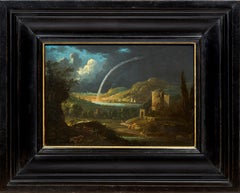
River Landscape with Shepherds and Architecture, a painting by Jan van Bunnik
By Jan van Bunnik
Located in PARIS, FR
This painting has been the subject of a study by the art historian Fabrizio Dassie (available on request), confirming its inclusion in Jan van Bunnik’s corpus.
In this painting, Ja...
Category
Late 17th Century Old Masters Landscape Paintings
Materials
Copper
You May Also Like
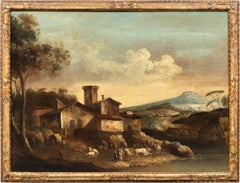
Francesco Tironi (Venetian master) - 18th century landscape painting - Shepherds
Located in Varmo, IT
Francesco Tironi (Venice 1745 - Venice 1797) - Venetian landscape with shepherds and herds.
95 x 130 cm without frame, 107 x 140 cm with frame.
Antique oil painting on canvas, in a...
Category
Late 18th Century Rococo Landscape Paintings
Materials
Canvas, Oil
$5,982 Sale Price
28% Off
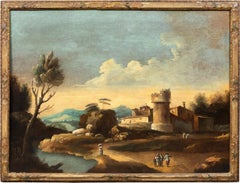
Francesco Tironi (Venetian master) - 18th century landscape painting - Shepherds
Located in Varmo, IT
Francesco Tironi (Venice 1745 - Venice 1797) - Venetian landscape with shepherds and herds.
95 x 130 cm without frame, 107 x 140 cm with frame.
Antique oil painting on canvas, in a...
Category
Late 18th Century Rococo Landscape Paintings
Materials
Canvas, Oil
$5,982 Sale Price
28% Off
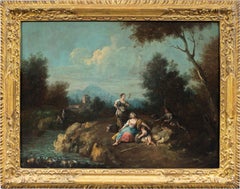
Giuseppe Zais (Venetian master) - 18th century landscape painting - Figures
By Giuseppe Zais (Canale d
Agordo, Belluno 1709 - Treviso 1781)
Located in Varmo, IT
Giuseppe Zais (Forno di Canale 1709 - Treviso 1784) - Landscape with shepherds and spinner.
48 x 63.5 cm without frame, 59 x 74.5 cm with frame.
Oil on canvas, in a carved and gild...
Category
Mid-18th Century Rococo Figurative Paintings
Materials
Canvas, Oil
Old Master Allegorical oil painting of “Erminia and The Shepherds”
By Giovanni Francesco Barbieri (Il Guercino)
Located in Vancouver, British Columbia
A fully restored small northern Italian Baroque painting on canvas that may have been painted as a study, (or what is referred to as a bozzet...
Category
Antique 17th Century Italian Baroque Paintings
Materials
Canvas
A Sheperdess surrounded by her flock, 17th century
By Philipp Peter Roos (Rosa di Tivoli)
Located in GB
This painting—attributed to the circle of Philipp Peter Roos (1655–1706)—depicts a shepherdess tending her animals in a rustic, mountainous landscape. The young woman sits on a rock ...
Category
17th Century Landscape Paintings
Materials
Oil, Canvas
Baroque Italian painter - 18th century landscape painter - Sheperds
Located in Varmo, IT
Italian painter (18th century) - Arcadian landscape with flock and shepherds.
56 x 70 cm without frame, 63.5 x 79 cm with frame.
Antique oil painting on canvas, in a wooden frame (...
Category
Early 18th Century Rococo Landscape Paintings
Materials
Canvas, Oil
$1,196 Sale Price
64% Off
More Ways To Browse
The Shepherd
Antique Shed
Antique Bombs
Antique Hut
The Furies
Antique Viola
18th Century Oil Paintings For Sale
Antique Painting Auction
Van Loo
Arcadian Landscape
Antique Fifes
Galloper Horse
Antique Gilded Italian Frame
Female Warrior
Torquato Tasso
Solimena Francesco
Oil Painting Little Girl
Oil Paintings 70 X 55