Items Similar to Orientale
Want more images or videos?
Request additional images or videos from the seller
1 of 5
Henri Fantin-LatourOrientale1899
1899
$28,750
£21,489.83
€24,796.11
CA$40,247.10
A$42,524.65
CHF 22,873.29
MX$509,164.11
NOK 286,575.63
SEK 262,461.68
DKK 185,158.05
About the Item
Signed, lower right: Fantin
Provenance:
Gustave Tempelaere (1840–1904), Paris; possibly by descent to his son:
Julien Tempelaere (1876–1961) and with F.
J. Tempelaere, Paris, probably stock number 4465 ; where acquired by:
Alexander Reid (1854–1928), Glasgow and with the Lefèvre Gallery
Private Collection, Montreal, before 1981; and by descent to:
Private Collection, Connecticut
Literature:
Madame Fantin-Latour, Catalogue de l’œuvre complet (1849-1904) de Fantin-Latour, établi et rédigé, Paris, 1911, p. 189, cat. no. 1764.
Henri Fantin-Latour began his artistic training early in life, first with his father, Jean-Théodore Fantin-Latour, in 1846 and later studying at the Petite Ecole de Dessin and the Ecole des Beaux-Arts. Fantin-Latour was at the center of the art scene in Paris and he befriended the likes of Édouard Manet, Eugène Delacroix, J.-A.-D. Ingres, Camille Corot, and Gustave Courbet. Despite his proximity to the many of the leading painters of the day, Fantin-Latour’s style remained independent but clearly influenced by the major artistic currents of Romanticism and Impressionism. His aesthetic and style do not fit neatly into one category but were certainly in line with the cutting-edge trends of the time. During his lifetime he exhibited at both the Salon and the Salon des Refusés, and through his acquaintance with James McNeill Whistler, his works were greatly appreciated and found an audience of enthusiastic collectors in England.
While he is perhaps best-known today for his still-life painting, Fantin-Latour painted in a wide range of genres, including allegorical and mythological works. The subject of the present work is somewhat enigmatic. Although it is titled Orientale in the catalogue of works assembled by the artist’s wife, Victoria Fantin-Latour, the subject is only broadly “Orientalist.” Rather it seems to be a personal evocation of an exotic world distant from fin-de-siècle France. The central figure, her arm and hip belt adorned with jewelry, has removed her top shawl and spun it about her naked torso, her right leg moving forward in a sinuous suggestion of a dance. She is accompanied by musicians playing a guitar, tambourine, and drum in a scene that at once recalls that of a Middle Eastern harem, though the setting is one of classical architecture replete with Corinthian columns. Three figures observe the performance, including a woman reclining on the floor, her bare back exposed to the viewer.
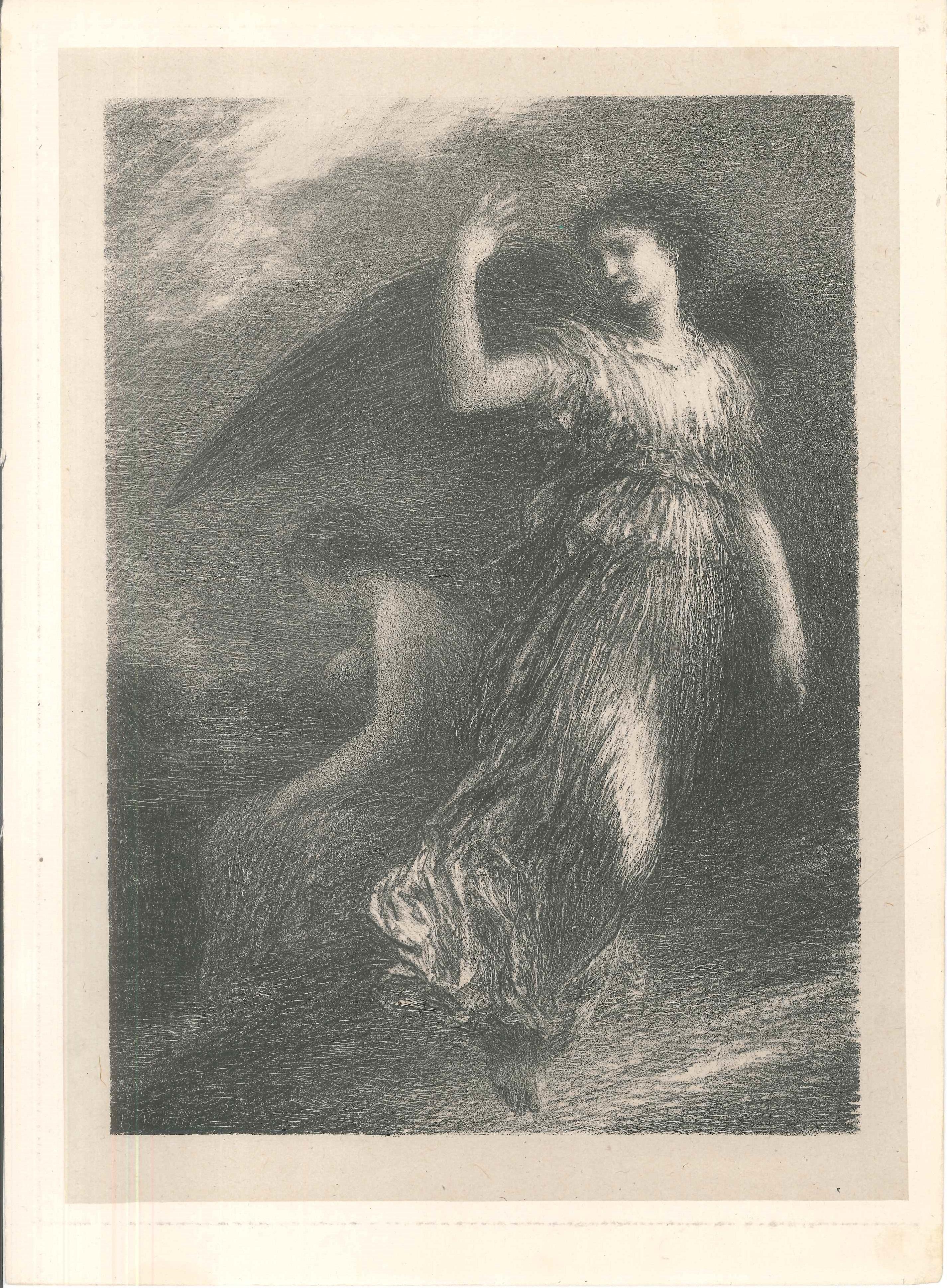
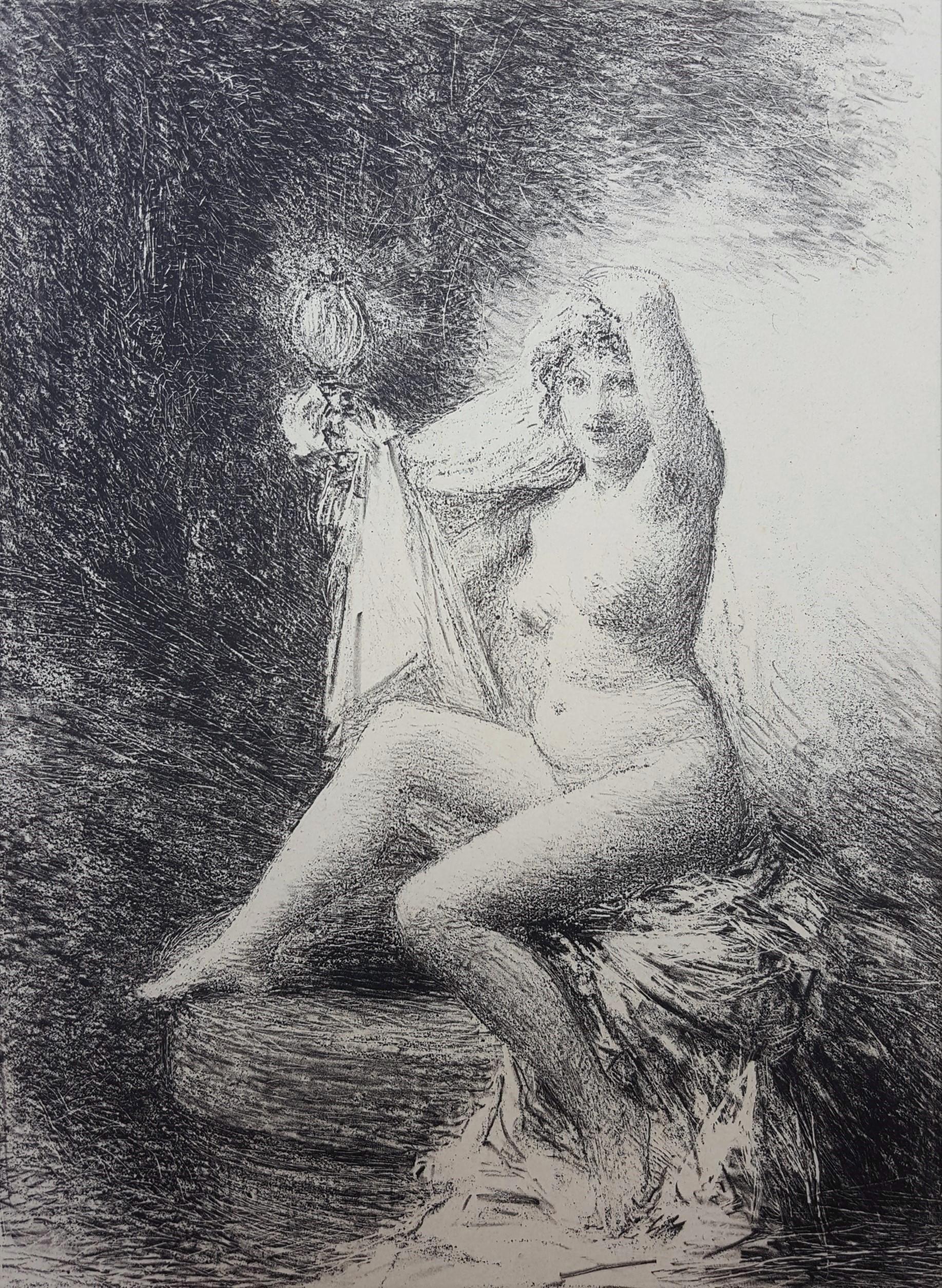
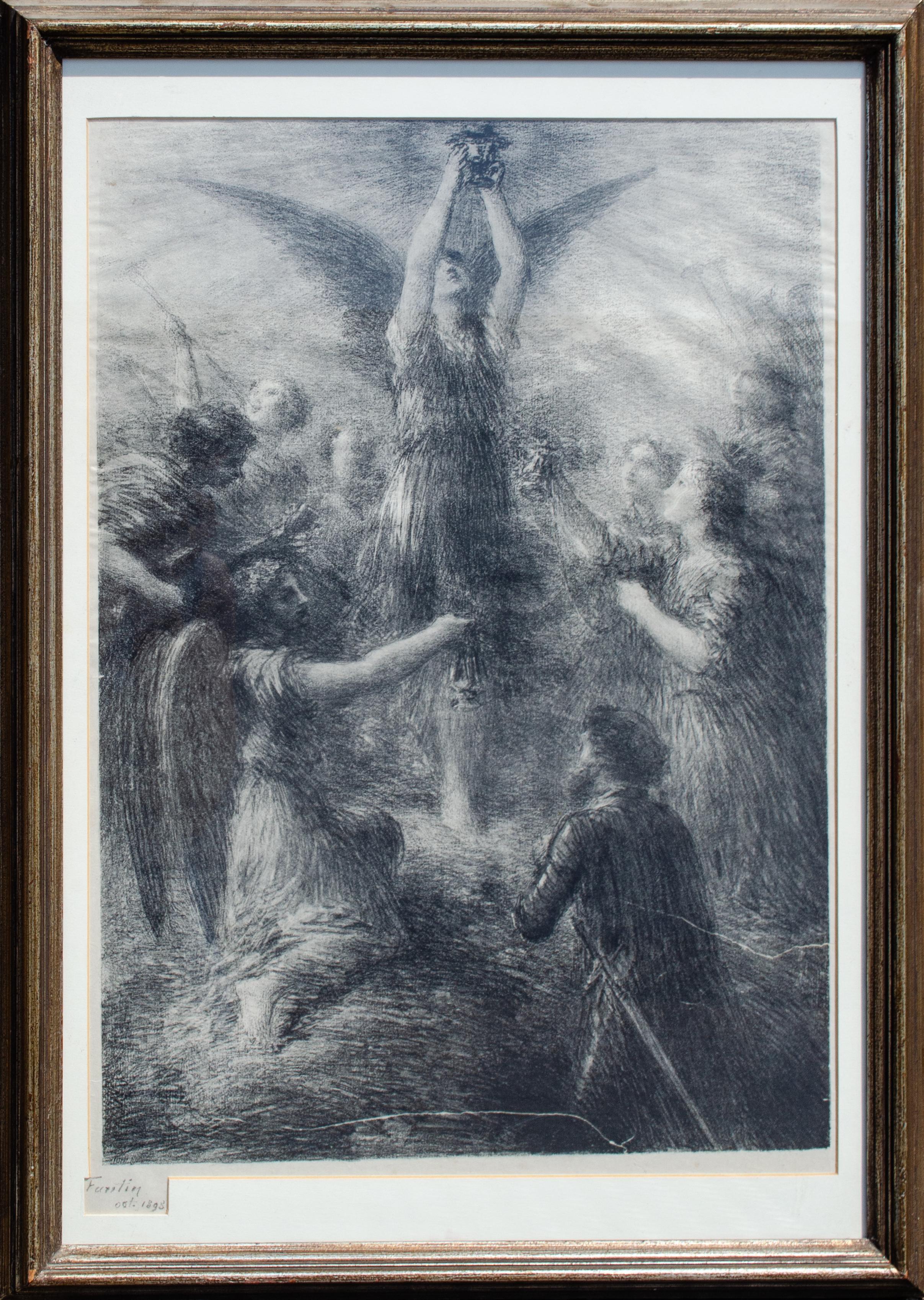
Fantin-Latour frequently depicted semi-nude women in relaxed poses, but in 1898 and 1899, he was particularly taken by the subject of women dancing and making music in classical settings. He produced a lithograph of 1898 (Fig. 1), as well as two paintings on canvas—one in the Glasgow Museums (Fig. 2) and another in a private collection (Fig. 3)—that are comparable in type to the present work—each titled The Dance. Consistent among them is the focus on the single, scantily clad dancer that waves a swath of purple fabric behind them. The backgrounds of the paintings are each populated with classical columns that frame glimpses of landscape beyond. In our work, the figures surrounding the dancer are grouped closely together in a tight but harmonious composition. The rich colors of the draperies—purple, blue, red, and gold—stand out in the somewhat dark interior, each appearing to catch glints of light.
Fantin-Latour’s sensitivity to color and light effects finds its root in his early training copying Old Master paintings—particularly his appreciation for the Venetian painters Titian and Veronese—as well as the influence of his Impressionist painter friends. The dramatic lighting and the application of the paint in almost hatched brushstrokes, lending a beautiful sketchy quality to the present work, are both characteristic of some of the artist’s finest figural paintings.
Henri Fantin-Latour’s authorship of this painting has been confirmed by Sylvie Brame and François Lorenceau, authors of the forthcoming catalogue raisonné of the artist (written communication, 4 May 1996 and 25 May 2021).
Henri Fantin-Latour
Henri Fantin-Latour, in full Ignace-Henri-Jean-Théodore Fantin-Latour (born Jan. 14, 1836, Grenoble, France—died Aug. 25, 1904, Buré), French painter, printmaker, and illustrator noted for his still lifes with flowers and his portraits, especially group compositions, of contemporary French celebrities in the arts. Fantin-Latour’s first teacher was his father, a well-known portrait painter. Later, he studied at the school of Lecoq de Boisbaudran and attended the École des Beaux-Arts. He exhibited at the official French Salons, but in 1863 he also showed his work in the rebel Salon des Refusés. Although academic in manner, Fantin-Latour was independent in style. He had numerous friends among the leading French painters of his day, including J.-A.-D. Ingres, Eugène Delacroix, Camille Corot, Édouard Manet, and Gustave Courbet. His portrait groups, often arranged in rows of heads and figures like 17th-century Dutch guild portraits, are perhaps most interesting for their portrayal of various literary and artistic persons of the time. Fantin-Latour’s flower paintings were particularly appreciated in England, where, through James McNeill Whistler and Sir John Everett Millais, Fantin-Latour found a patron in Edwin Edwards. A wealthy amateur engraver, he supported Fantin-Latour for years by purchasing his still lifes. The last period of Fantin-Latour’s life was primarily devoted to lithography. In the Salon of 1876 he exhibited L’Anniversaire, honouring composer Hector Berlioz, and thereafter his lithographs were shown regularly. Most characteristic were his delicate portraits and imaginative drawings illustrative of the music of Richard Wagner, Berlioz, and others. He also illustrated Adolphe Jullien’s biographies of Wagner (1886) and Berlioz (1888).
About the Seller
5.0
Recognized Seller
These prestigious sellers are industry leaders and represent the highest echelon for item quality and design.
Established in 1997
1stDibs seller since 2012
24 sales on 1stDibs
Typical response time: 1 to 2 days
- ShippingRetrieving quote...Shipping from: New York, NY
- Return Policy
More From This Seller
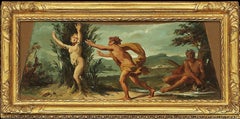
View AllSeven Scenes from the Life of Apollo
By Jacopo Guarana
Located in New York, NY
Attributed to
Jacopo Guarana
(Verona 1720 – 1808 Venice)
Canvas, unsigned
The Deeds of Apollo
Provenance: Suida-Manning Collection
These seven scenes are brilliant evocations o...
Category
18th Century and Earlier Baroque Figurative Paintings
Materials
Oil
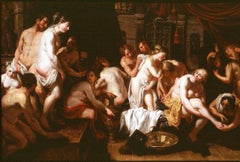
Esther in the Women
s House of Ahasuerus
By Artus Wolfort
Located in New York, NY
Born in Antwerp, Artus Wolffordt received his training in Dordrecht where he became a master in 1603 at the age of twenty-two. He returned to his native city in 1615 and initially worked as an assistant to Otto van Veen...
Category
17th Century Old Masters Paintings
Materials
Oil, Panel
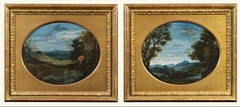
Two Scenes of Diana and Actaeon (a pair)
By Giovanni Battista Viola
Located in New York, NY
Provenance:
Robert L. and Bertina Suida Manning, New York, until 1996
Private Collection, USA
Giovanni Battista Viola was born in Bologna a...
Category
17th Century Baroque Landscape Paintings
Materials
Copper
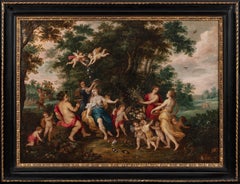
Allegory of Abundance
Located in New York, NY
Painted in collaboration with Hendrick van Balen (Antwerp, 1575 – 1632).
Provenance: Private Collection, Uruguay, since the 1930s.
The eldest son of Jan Br...
Category
17th Century Old Masters Paintings
Materials
Copper
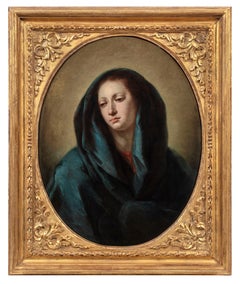
Head of the Virgin
Located in New York, NY
Provenance: Private Collection, Paraguay.
This unpublished Head of the Virgin is a new addition to the rich corpus of paintings by Giovanni Battista Tiepolo. While the artist freque...
Category
18th Century Old Masters Figurative Paintings
Materials
Oil, Canvas
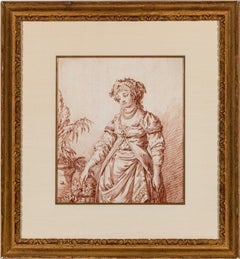
Woman in Fantasy Costume (pair)
By Jean Baptist Le Prince
Located in New York, NY
The pair consists of the present work and an engraving after it by the hand of Giles DeMarteau (Liège 1722 – 1776 Paris) titled Woman in Fantasy Costume, after Jean Baptiste Le Prince, and measuring, 10 ⅜ x 8 ⅝ inches (26.5 x 22 cm).
DeMarteau's engraving is inscribed at the bottom:
Le Prince inv. del. / Demarteau sc. / A Paris ches Demarteau Graveur du Roi, rue de la Pelterie à la Cloche...
Category
18th Century Drawings and Watercolor Paintings
Materials
Paper, Chalk, Engraving
You May Also Like
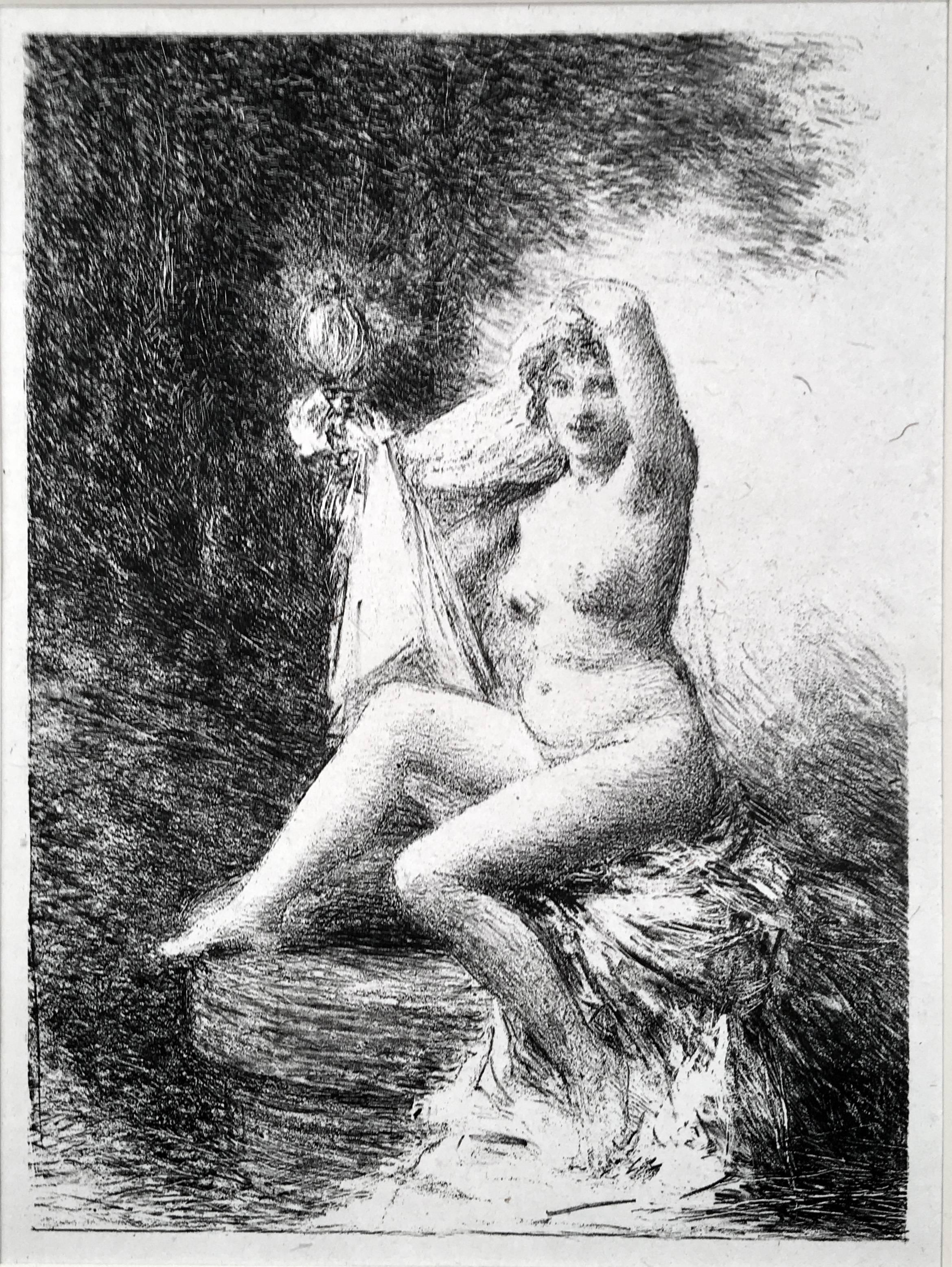
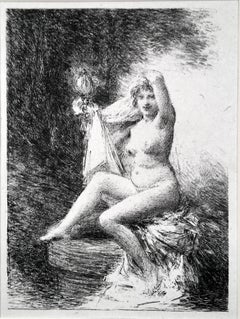
Vérité (petite planche)
By Henri Fantin-Latour
Located in New York, NY
Henri Fantin-Latour (1836-1904),Vérité (petite planche), 1900, lithograph. Hediard-Mason 156, first state (of 3). A proof of the first state before the edition published in La Revue...
Category
Early 1900s Impressionist Nude Prints
Materials
Lithograph
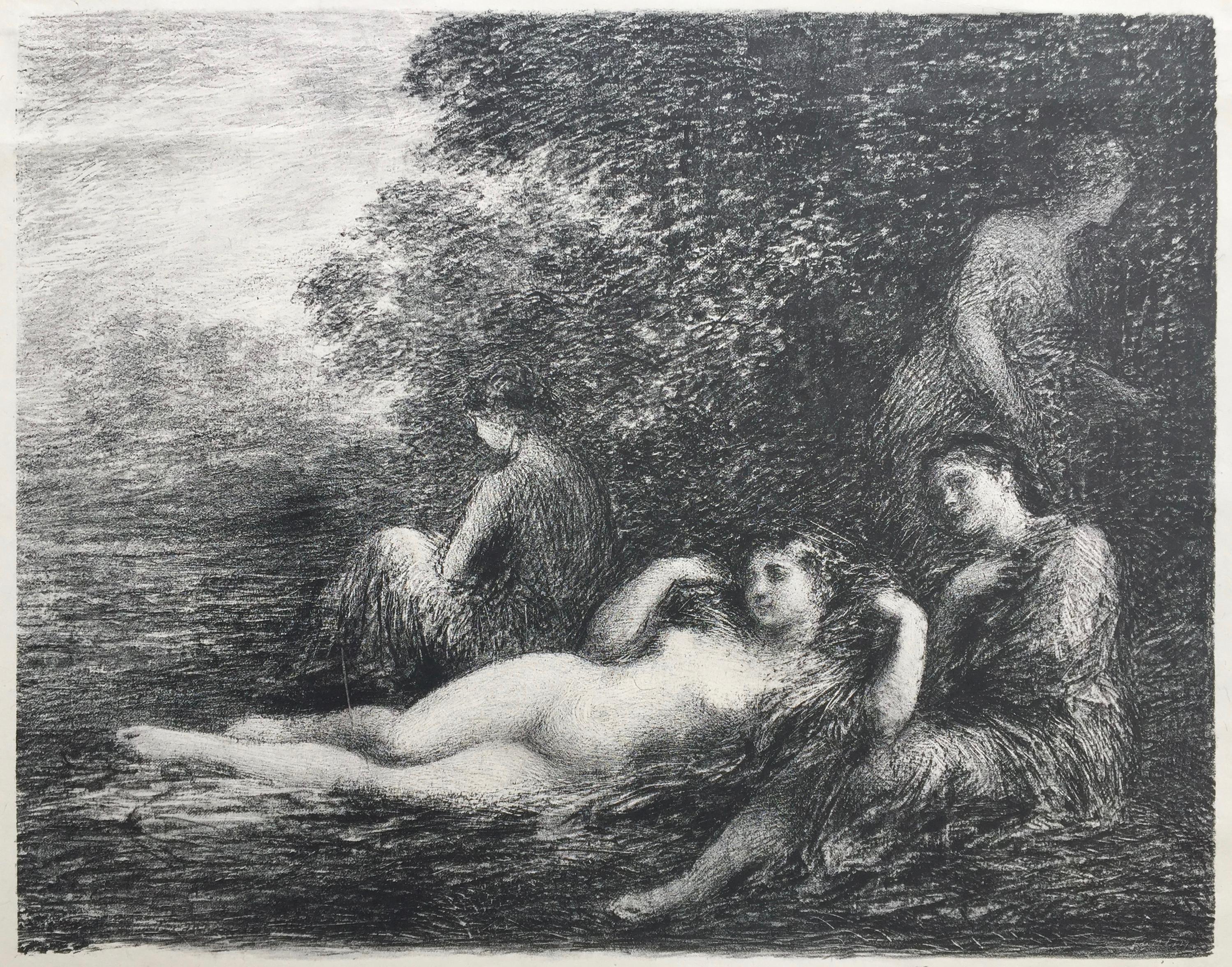
BAIGNEUSES
By Henri Fantin-Latour
Located in Santa Monica, CA
HENRI FANTIN-LATOUR (French 1836-1904)
BAIGNEUSES (4e grande planche), 1898 (Hediard 138 II/II)
It’s one of 6 works that formed a suite of images published ...
Category
1890s French School Figurative Prints
Materials
Lithograph
$650 Sale Price
31% Off
Duo des Troyens
By Henri Fantin-Latour
Located in Roma, IT
Beautiful lithograph on Chinese paper, hand signed on plate on the lower right margin. Third state on four. Excellent conditions, including an ivory colored cardboard passepartout 47...
Category
1890s Modern Figurative Prints
Materials
Lithograph
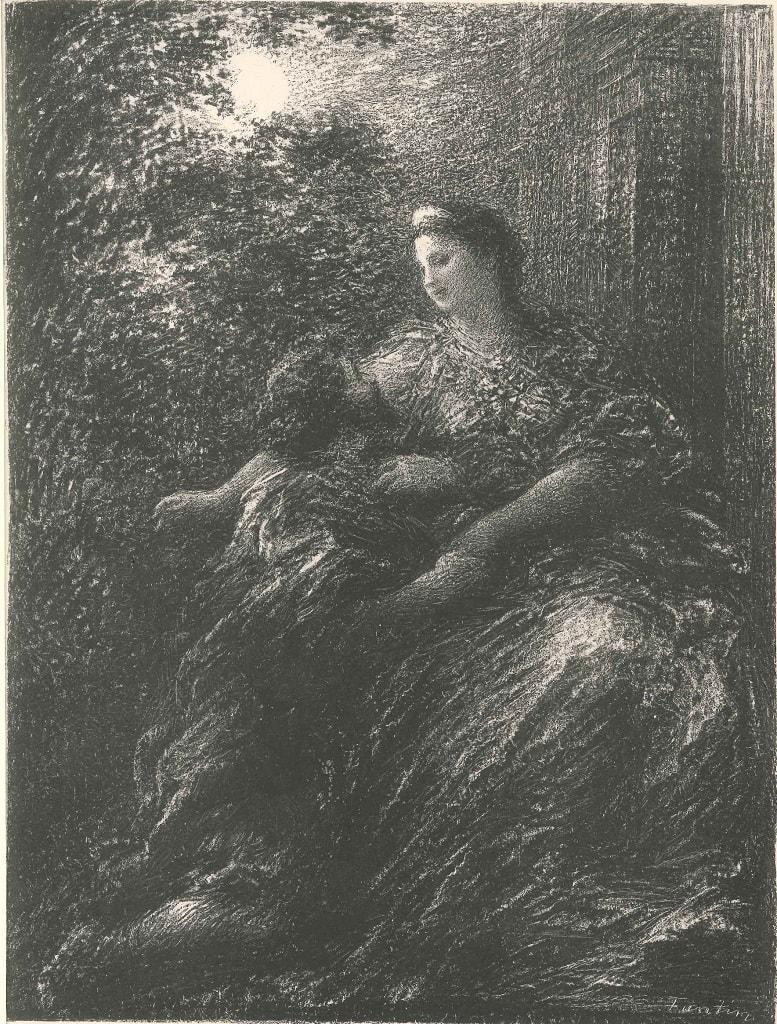
Le Paradis et la Péri - Lithograph by Henri Fantin-Latour - 1901
By Henri Fantin-Latour
Located in Roma, IT
Le Paradis et la Péri is a wonderful black and white lithograph on China paper applied, realized in 1901 by the French artist Henri Fantin-Latour (Grenoble, 1836- Buré 1906).
From Robert Schumann...
Category
Early 1900s Modern Figurative Prints
Materials
Lithograph
Vérité (Truth) /// French Modern Impressionist Art Lithograph Nude Figurative
By Henri Fantin-Latour
Located in Saint Augustine, FL
Artist: Henri Fantin-Latour (French, 1836-1904)
Title: "Vérité (Truth)"
Portfolio: Revue de l'Art Ancien & Moderne
*Issued unsigned
Year: 1900 (third state of three)
Medium: Original...
Category
Early 1900s French School Nude Prints
Materials
Lithograph
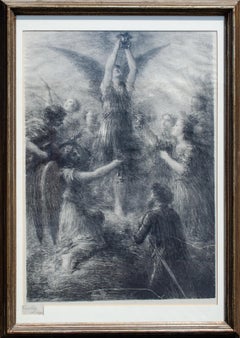
Henri Fantin-Latour "The Appearance of the Holy Grail" Old Master Print
By Henri Fantin-Latour
Located in New York, NY
Henri Fantin-Latour
Prelude de Lohengrin (2e planche) (The Appearance of the Holy Grail), 1898
Sight: 19 1/2 x 13 3/4 in.
Framed: 24 3/4 x 17 1/2 x 1 1/2 in.
Signed and dated in the ...
Category
1890s French School Figurative Prints
Materials
Lithograph