Want more images or videos?
Request additional images or videos from the seller
1 of 11
Irene AwretGirl with Rooster, Enamel Glazed Ceramic Plaque
About the Item
- Creator:Irene Awret (1921 - 2014, German)
- Dimensions:Height: 22.5 in (57.15 cm)Width: 17.5 in (44.45 cm)
- Medium:
- Movement Style:
- Period:
- Condition:wear to frame and matting. piece is in great condition.
- Gallery Location:Surfside, FL
- Reference Number:1stDibs: LU382124748
About the Seller
4.9
Platinum Seller
Premium sellers with a 4.7+ rating and 24-hour response times
Established in 1995
1stDibs seller since 2014
1,858 sales on 1stDibs
Authenticity Guarantee
In the unlikely event there’s an issue with an item’s authenticity, contact us within 1 year for a full refund. DetailsMoney-Back Guarantee
If your item is not as described, is damaged in transit, or does not arrive, contact us within 7 days for a full refund. Details24-Hour Cancellation
You have a 24-hour grace period in which to reconsider your purchase, with no questions asked.Vetted Professional Sellers
Our world-class sellers must adhere to strict standards for service and quality, maintaining the integrity of our listings.Price-Match Guarantee
If you find that a seller listed the same item for a lower price elsewhere, we’ll match it.Trusted Global Delivery
Our best-in-class carrier network provides specialized shipping options worldwide, including custom delivery.You May Also Like
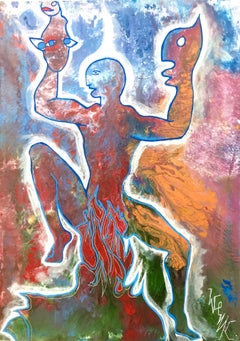
"Figura Danzante" by Enzio Wenk, 2018 -Acrylic, Enamel, Figurative Expressionism
By Enzio Wenk
Located in Bresso, IT
Translated title: "Dancing figure".
Acrylic paint and enamel on canvas.
The artist sells the handmade, original and one-of-a-kind piece, but he reserves the right to duplicate it...
Category
2010s Expressionist Figurative Paintings
Materials
Enamel
$1,787
H 27.56 in W 19.69 in D 1.19 in
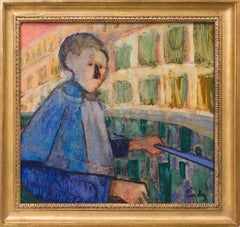
At the Theatre
By Donald Roy Purdy
Located in New York, NY
Born in 1924 Donald Purdy in the 1960s did a series of works on clay-coated paper. He loved working in this medium and he would apply oil paint and then rub it away with a cloth to ...
Category
Mid-20th Century Expressionist Portrait Paintings
Materials
Clay, Oil, Board
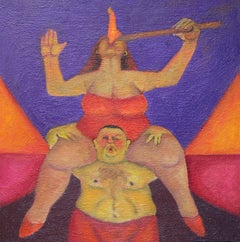
Strongman and Fire eater circus, coney island influences colorful carnival
By Stephen Basso
Located in Brooklyn, NY
Oil on board mounted on a wooden frame suitable for immediate hanging. The board has been primed with an acrylic pumice gel giving the surface a rough texture visible from the photo...
Category
2010s Expressionist Figurative Paintings
Materials
Brass
$2,200
H 24 in W 24 in D 2 in
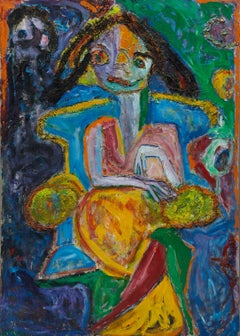
Girl In A Blue Chair
By Wyona Diskin
Located in Aramits, Nouvelle-Aquitaine
Wyona Diskin, American (1915 - 1991)
Girl In A Blue Chair
Acrylic on canvas partially painted over wire mesh, Unsigned. Framed.
Measurements: H 70.5 x W 49.5 x D 1.25 inches
Wyona ...
Category
1970s Expressionist Figurative Paintings
Materials
Wire
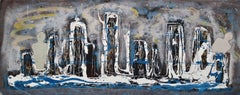
"Il motivo di un viaggio" by Enzio Wenk, 2006- Acrylic on Metal, Urban Landscape
By Enzio Wenk
Located in Bresso, IT
Translated title: "The reason for a trip"
Acrylic on metal plate.
Category
Early 2000s Expressionist Landscape Paintings
Materials
Metal
$1,608
H 15.75 in W 39.38 in
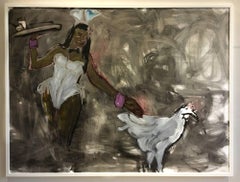
Beauties Series: Beauty and the Bird
By Jackie Felix
Located in Buffalo, NY
An original acrylic on paper expressionist painting by American contemporary female artist Jackie Felix.
This painting from Felix's Beauty Series was exhibited in the artist's solo ...
Category
1980s Expressionist Figurative Paintings
Materials
Silver Leaf
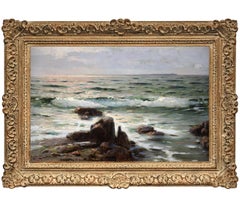
Oil painting on canvas " Rough sea with coastline on the horizon " by Schubring
By Richard Schubring
Located in Gavere, BE
Schubring, Richard (1853-1902)
Rough sea with coastline on the horizon
Oil on canvas. Signed and dated lower right. “1895”
Richard SCHUBRING is an artist born in 1853 and deceased...
Category
1890s Expressionist Landscape Paintings
Materials
Gold Leaf
$5,361
H 11.82 in W 16.93 in D 0.79 in
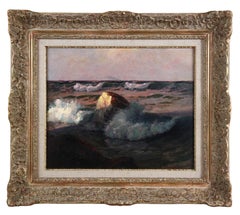
Oil painting on board "Rough sea with steamer on the horizon" by S.A.Vinogradoff
Located in Gavere, BE
Sergey VINOGRADOV ( 1869 - 1938 )
Rough sea with steamer on the horizon
Sergei Arsenievich Vinogradov ( Russian: 1869–1938 ) was a Russian-Soviet Impressionist painter; known for l...
Category
1920s Expressionist Landscape Paintings
Materials
Gold Leaf
$11,318
H 21.26 in W 24.41 in D 2.37 in
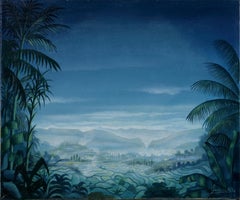
Sawah Landscape
Located in Amsterdam, NL
A sawah landscape, Sumatra
Signed and dated 'Sonnega '54' (lower right), and annotated 'Voor Jan de Bas 1-1-1970 / R de Bas' (on the reverse)
oil on canvas, 50,5x60,5 cm
Provenance:
- Collection Pieter de Bas (1909-1979) Mr de Bas was head of the MULO school and acting head of the HBS school in Medan. Thence by descent to the present owner.
Exhibited:
- Hotel de Boer, Medan 1954, where acquired by the first owner.
The light I observed everywhere was of a special quality, fluorescent blue, shone from nowhere but radiated from every point, oddly with great depth and intensity. The light in an entirely different dimension came from nowhere and went nowhere shimmering with the glow of a bright blue jewel. The most important thing I discovered was of being omnipresent and able to understand everything at the same time, yes I could fathom creation completely.
Auke Sonnega, born March 9, 1910 in Leeuwarden, known as the painter, primarily of young Balinese men and women.
Originally raised in the reformed denomination, the parents of Auke apparently practised theosophy and their children, including Auke were taught these principles. The talent for drawing revealed itself at an early stage which in 1926 lead to a 4-year study of textile design at the Academy for Art and Craft in Amsterdam.
He completed the academy in 1930 and worked in a carpet factory in Twente until 1934 and then followed in his sister Aafje’s footsteps leaving the Netherlands to go to the Dutch East Indies where in 1935 he started working as a graphic designer with an advertising bureau in Batavia. He was able to travel through Java and Bali on the motorbike that he brought with him from Europe, and was paid for his travelogue, enhanced with his own photo’s which appeared in several Dutch newspapers and magazines.
In the 1930’s two Europeans, Walter Spies and Rudolf Bonnet...
Category
Mid-20th Century Expressionist Landscape Paintings
Materials
Canvas, Oil
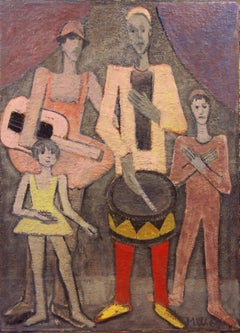
Gaukler Familie mit Instrumenten (Family of Jesters with Instruments)
Located in Mc Lean, VA
German Modernist
Category
1960s Expressionist Figurative Paintings
Materials
Canvas, Oil
$18,500
H 45.5 in W 31.75 in
More From This Seller
View AllGirl
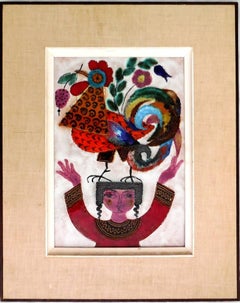
Rooster Enamel Glazed Ceramic Plaque Israeli Artist Awret Naive Folk Art
By Irene Awret
Located in Surfside, FL
This is a rare ceramic plaque painted with enamel glaze by famed Israeli German artist Irene Awret is signed Awret Safed on the verso. the actual glazed ceramic is 10X15 inches.
Irèn...
Category
1950s Expressionist Figurative Paintings
Materials
Enamel
Girl
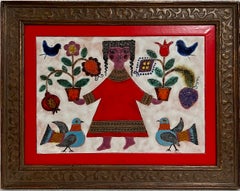
Plants Enamel Glazed Ceramic Plaque Israeli Artist Awret Naive Folk Art
By Irene Awret
Located in Surfside, FL
This is a rare ceramic plaque painted with enamel glaze by famed Israeli German artist Irene Awret (these are generally hand signed Awret Safed on the verso. I just have not opened the frame to check) the actual glazed ceramic is 10.25 X 14.75 inches.
It depicts a girl or woman with potted plants, birds, pomegranates and other fruits and flowers in a naif, folk art style.
Irène Awret was born to a Jewish family in Berlin called Spicker, the youngest of three children. Her mother died in 1927, when Irène was six years old. In 1937 she was forced to stop high school, due to the Nazi race laws. Because she could not continue her regular studies, her father sent her to study drawing, painting and art restoration with a Jewish painter. Among his students were a large number of German Jews who knew they would have to leave Germany within a short time and would require a profession to enable them to support themselves.
When the situation grew worse, following the Kristallnacht (the first major attack on German and Austrian Jews in November 1938), her uncle decided to move to Belgium. In 1939 the situation became even worse - her father was fired from his job and the family were forced to leave their home. As a result, Awret's father tried to send her and her sister to Belgium, with the help of smugglers. The first smuggler proved to be a double agent and they were sent back from Aachen to Berlin. Two weeks later they made a second, successful, attempt to sneak across the border.
Awret worked for a Dutch Jewish family as a maid. As she had her room and board there, she was able to save enough money to study art part-time at Brussels' Académie Royal des Beaux-Arts. A few months later Awret's father joined her and her financial situation became easier. She left her job and studied full-time, helping support herself with restoration work when it was available and by painting portraits to order.
Later, Awret found a hiding place on a farm in Waterloo with a Jewish family who were connected with the underground. In January 1943 she had to return to Brussels, living with a false identity card which stated she was a married woman with two children. Awret succeeded in renting an attic without informing the police where she was - she told her landlady that she had been forced to flee her husband because he beat her. While there, she supported herself by restoring wooden sculptures.
A Jewish informer gave her up to the Gestapo, accompanying the two Gestapo men who arrested her. Awret was able to take a bag containing food and drawing materials. She was detained in the Gestapo cellars in Brussels where she drew. Because there was nothing there to draw, she sketched her own hand (view this work). Awret was interrogated in order to reveal the hiding place of her father who was still in Brussels. The National Socialist regime was determined to persecute him, even though he had fought for Germany in World War I and been permanently disabled. They stepped up their torture and brought Awret before Hartmann, the head of the Gestapo in Brussels. When Hartmann saw her block of drawings, he asked her where she had studied art and halted the interrogation.
Awret was placed in a narrow cell and then transferred to Malines camp, which the Belgian's called Mechelen. Malines was a transit camp to Auschwitz, regularly sending 2000 people at a time. Although she arrived just before Transport No. 20, Irène Awret avoided being included. Instead she was put to work in the leather workshop, decorating broaches. While she was there, Hartmann visited the camp and spotted her: "I could have discovered where your father is hiding," he told her. When her artistic talents became known, she was transferred to the Mahlerstube (artist's workshop) where she worked producing graphics for the Germans until the end of the war. When Carol (Karel) Deutsch (whose works are now on view at Yad Vashem) was sent from Mechelen to his death with his wife, he left young Irene his paintbox. Irene also recalls seeing the great painter Felix Nussbaum and his wife being pushed into a boxcar bound for the gas, and tells of the aftermath of the famous 20th Train incident, when a young Jewish doctor armed only with a pistol and helped by two unarmed friends with a lantern ambushed one of Mechelen's Auschwitz-bound trains carrying 1,618 Jews, most of whom had fled Eastern Europe for Belgium.
Awret's job enabled her to paint and draw - mainly in pencil, but also in watercolors and oils. In the artists' workshop she met a Jewish refugee from Poland - Azriel Awret - who would later become her husband. Among the other artists in the workshop were Herbert von Ledermann-Vütemberg, a sculptor from an aristocratic family with Jewish roots, Léon Landau, and Smilowitz, who perished in the camps in the East. Irène and Azriel tried to bribe a German officer to prevent Smilowitz's deportation. Not only were they unsuccessful, but they were almost put onto the same train. Jacques Ochs was another artist with whom they became friends in the camp. Ochs, a French-born Protestant who lived in Belgium, was interned as a political prisoner. He remained in Belgium after liberation.
After the war the Awrets immigrated to Israel and made their home in Safed. They continued to work, and were instrumental in founding Safed's artists' quarter.
The Beit Lohamei Haghetaot (Ghetto Fighters' House Museum) art collection holds works donated by Awret. These date from her time in Malines camp and from her stay in Brussels after the war, when she was in the company of orphans who had hidden while their parents were sent to Auschwitz. Her highly expressive works have made their way to exhibitions at theTel Aviv Museum, the Haifa Museum of Modern Art and the Modern Art Gallery in Washington, D.C., as well as into the private collections of such individuals as Dr. Jonas Salk...
Category
1950s Expressionist Figurative Paintings
Materials
Enamel
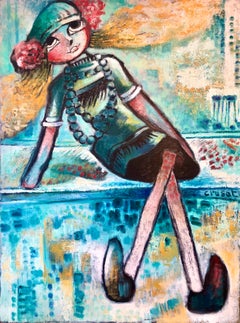
Large French Expressionist Oil Painting, Girl, Poupèe, the Doll, Ecole de Paris
Located in Surfside, FL
Signed on recto and signed verso, titled, and inscribed Montmartre by the artist. This is a large colorful expressionist painting of a girl doll with long blonde or ginger redhead pigtails. It is titled Poupee 1925 and depicts an Art Deco era flapper girl in a beret.
Roger Crusat (French Expressionist artist, poet and lithographer) is known for ballet troupe set design and theatre backdrop painting and architectural motifs. Roger Crusat was born in 1917 in Roussillon, Provence, France. Crusat's early works depict the colorful countryside of Provence in the South of France, As a young man Crusat performed many jobs in the troupe, designing costumes, and even dancing. But, most important, he painted the scenery for the troupe's performances. It was while working in this capacity that he learned the essentials of scenery painting that remain evident in his mature work. Crusat was a student of Andre Fons-Godail at Beaux-Arts in Perpignan when he was called to serve in World War II. After being wounded in 1940, he returned to study under Rene Jaudon at Beaux-Arts in Paris. Crusat was known by his contemporaries as "the Catalan painter of Montmartre" where he lived with his wife until his death in 1994. Cracked and peeling walls framed by rusting water pipes are a common sight in Montmartre. What others considered unnecessary, Crusat included. Water pipes were his cherished motif. Supposed by some to be a symbol of decay and monotony, Crusat's Impressionist water pipes like arteries in the body, convey life. Crusat won the prestigious Prix Populiste for his "Descente d'Eau" (Water Pipes) in 1956.
Crusat's mature work retains the essentials of good scenery painting. Intricate detail will not be found, but broad, solid abstract shapes abound. His subtle colors, dense in texture, are meant to compliment his subjects, not distract from them. The critics considered him a lyric expressionist and a "painter of Man" in his portrayal of the anguish of daily life and the regrets of the past. Crusat exhibited at many of the same Salons as the post-impressionists and expressionists. Salon des Independants was co-founded by Georges Seurat. Degas had only one exhibition during his lifetime, and it was at the Galerie Durand Ruel in Paris. Gauguin had also exhibited his Tahitian paintings. Crusat's works were exhibited there in 1955.
SELECT AWARDS
1954 Le Prix de la Jeune Peintre
1955 Prix des Amateurs d'Art & des Collectionneurs, Galerie Gazette des Beaux Arts, 140 rue
Faubourg St. Honore, Paris Les Jardins des Abbesses purchased by the Republic of
France, Prix de la Ville de Marseilles, Prix Othon Friesz
1956 Prix Populiste, Prix de Amedeo Modigliani
1957 Grand Prix International de Vichy, Prix de la Fondation Greenshields
1959 IVeme Grand Prix de Peinture du Festival de Vichy
1967 Le Prix des Amis de Brantôme, Perigord, France
1970 Prix de la Critique Academy de Vernet a Vichy,"La Nuit, Premiere Etude"
Roger Crusat, Half-closed shutters , poems enriched with four original lithographs (175 numbered copies) drawn on Henri Deprest's presses on February 13, 1975 , Éditions Matignon 34, 1975.
Personal exhibitions
Durand-Ruel Gallery, Paris, 1955 [ 1 ] .
Galerie Rivière, Paris, november 1958 [ 4 ] .
Le Roux and Mathias, auctioneers in Paris, Sale of the Roger Crusat workshop , Hôtel Drouot , Paris, Thursday October 27, 1994 [ 5 ] .
Jack's American Bistro, Glens Falls , September- october 2004 [ 6 ] .
Collective exhibitions
Galerie Roger, Lyon , October 1946 [ 7 ] .
Salon des Indépendants , Paris, from 1952 [ 8 ] .
Exhibition Discover , Galerie Charpentier , Paris, 1955.
Populist Salon, Paris, 1956.
Salon des Amis de Brantôme, 1957.
Hundred painters and oil - Exhibition on the occasion of the centenary of the first oil drilling , Musée Galliera , october 1958 [ 9 ] .
“An artist from Roussillon whose invoice calls for a flattering comparison with that of a Soutine or a Rebeyrolle . Indeed, following their example, he focuses on familiar scenes: Girls on the balcony or in the basket , Laundresses weighing heavily on the iron, draft horses or plucked turkeys, who stand next to a magnificent portrait of a man in a red dressing gown . Hasn't the Prix Populiste already crowned its merits? " - Jean Jacquinot
SELECT EXHIBITIONS
Galerie La Gentilhommiere, Paris
La Salle Arago, Perpignan, Salon des Indépendants, Salon d'Automne
Biennale de Menton, Menton
Galerie des Jacobins, Lyon
Galerie Durand-Ruel, Paris
Salon de la Nationale
Galerie Bassano, Paris
Salon Populiste
Salon de Romans
Galerie Motte, Geneva, Switzerland
Exposition à Quiberville sur Mer - Normandie
Galerie Charpentier
Salon Confrontation: Bernard Buffet, Roger Crusat, Jean Jansem, Franck Innocent...
Category
Mid-20th Century Expressionist Figurative Paintings
Materials
Canvas, Oil
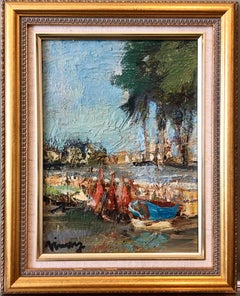
French Expressionist Ecole de Paris Oil Painting Boats on French Riviera
By Jean Vinay
Located in Surfside, FL
Jean Vinay was a self-taught artist though he received artistic guidance from Albert Marquet, the Fauvist, who he knew through his travels in French North Africa. Jean Viney...
Category
20th Century Expressionist Landscape Paintings
Materials
Canvas, Oil
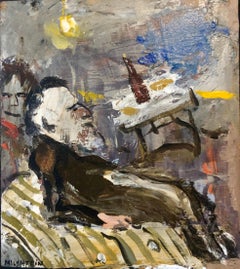
French Israeli Surrealist Judaica Jewish Oil Painting Rabbi at Table, Bottle
By Zvi Milshtein
Located in Surfside, FL
This is a small oil painting on on panel. A Rabbi at a Farbrengen
15.5 X 14.5 with frame.
6.5 X 5.5 painting alone
Zwy Milshtein (Zvi Tzvi Milstein) BIOGRAPHY 1934 Born in Kishinev...
Category
20th Century Expressionist Figurative Paintings
Materials
Oil, Panel
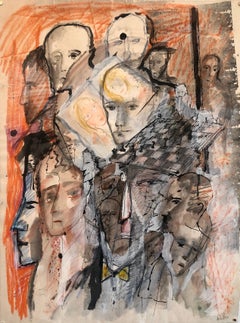
Chess Game Set French Israeli Surrealist Watercolor Gouache Painting
By Zvi Milshtein
Located in Surfside, FL
This is a large hand signed mixed media paiting on Arches French paper. A chess game encounter. Figurative Abstract Expressionist painting.
Zwy Milshtein (Zvi Tzvi Milstein) BIOGRA...
Category
20th Century Expressionist Figurative Paintings
Materials
Mixed Media, Watercolor, Gouache
Still Thinking About These?
All Recently ViewedMore Ways To Browse
Enamel Art Plaque
Jewish Sculpture
Holocaust Art
Enamel Plaque Painting
Vintage Boxcar
Painting With Plaque
African Children
Framed Native American
Bangladesh Art
Bennett Oil Paintings
Children Book Illustrations
Dan Mccaw
Indian Woman
Painting Woman Sitting
Roller Skates Used
Roller Skates
Roller Skating
Russian Impressionist Painting