Want more images or videos?
Request additional images or videos from the seller
1 of 12
Jamini RoyJamini Roy "Mother and Child" Original Painting
Price:$31,000
$38,500List Price
About the Item
- Creator:Jamini Roy (1887 - 1972, Indian, Bengali)
- Dimensions:Height: 29.5 in (74.93 cm)Width: 15.75 in (40.01 cm)
- Medium:
- Period:
- Condition:
- Gallery Location:San Francisco, CA
- Reference Number:1stDibs: LU1378211075742
About the Seller
4.9
Vetted Professional Seller
Every seller passes strict standards for authenticity and reliability
1stDibs seller since 2020
573 sales on 1stDibs
Typical response time: 7 hours
Authenticity Guarantee
In the unlikely event there’s an issue with an item’s authenticity, contact us within 1 year for a full refund. DetailsMoney-Back Guarantee
If your item is not as described, is damaged in transit, or does not arrive, contact us within 7 days for a full refund. Details24-Hour Cancellation
You have a 24-hour grace period in which to reconsider your purchase, with no questions asked.Vetted Professional Sellers
Our world-class sellers must adhere to strict standards for service and quality, maintaining the integrity of our listings.Price-Match Guarantee
If you find that a seller listed the same item for a lower price elsewhere, we’ll match it.Trusted Global Delivery
Our best-in-class carrier network provides specialized shipping options worldwide, including custom delivery.You May Also Like
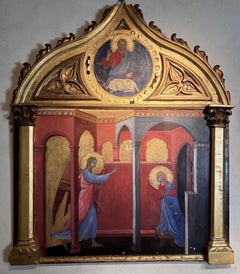
Italian Renaissance Style Tempera on Gold Ground Panel Painting the Annunciation
Located in Firenze, IT
This Italian tempera painted on gilt wood gold ground panel is a Tuscan religious artwork in the style of late Renaissance - early Gothic period. The sc...
Category
19th Century Renaissance Figurative Paintings
Materials
Gold Leaf
$8,384
H 48.43 in W 40.16 in D 1.97 in
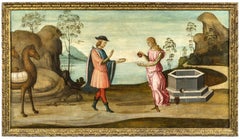
Rebecca at the Well
Located in New York, NY
Provenance:
Dr. James Henry Lancashire, Manchester-by-the-Sea, Massachusetts, by 1925; probably by descent to:
Private Collection, Cumberland Foreside, Maine, until 2018
This unpublished panel is a characteristic work of the Master of the Apollo and Daphne Legend, an anonymous Florentine painter in the circle of Bartolommeo di Giovanni, Domenico Ghirlandaio, and Sandro Botticelli. The artistic personality of the Master of the Apollo and Daphne Legend was independently recognized by Everett Fahy and Federico Zeri at roughly the same moment in time. Fahy originally dubbed this artist the Master of the Ryerson Panels but later adopted Zeri’s name for the artist, which derives from his eponymous works from the Samuel H. Kress collection (Figs. 1-2). Fahy posited that the artist was most likely a pupil of Ghirlandaio active from roughly 1480 to 1510, and that he may be identifiable with one of Ghirlandaio’s documented pupils to whom no works have been securely attributed, such as Niccolò Cieco, Jacopo dell’Indaco, or Baldino Baldinetti. The present painting was first attributed to this master by Everett Fahy in 1989, who became aware of its existence only after publishing his definitive studies on the artist.
The surviving body of work by the Master of the Apollo and Daphne Legend is largely composed of series of panels treating the same theme. In addition to the works illustrating the legend of Apollo and Daphne, there are also series on the themes of Susanna and the Elders and the story of Saint Joseph, among others. The subject of the present panel is drawn from Genesis 24, the story of Isaac. It is possible that our painting relates to another work by the artist depicting the Sacrifice of Isaac formerly in the collection of E. A. McGuire in Dublin, Ireland (Fig. 3), and that these two panels were originally part of a decorative scheme based on the story of Isaac.
Although the Master’s paintings of this type have traditionally been considered painted fronts of wedding chests, known as cassoni, the scale of these paintings and the fact that they are often part of a series indicates that they are more likely spalliera panels—paintings set into furniture or the wainscoting of a room. The biblical episode depicted in this painting centers on the theme of marriage, which suggests that this work was likely commissioned for the domestic interior of a newly married couple. The Master has transcribed into paint even the minute details of this Old Testament story, in which Abraham sends a servant to travel by camel to the land of his father and seek out a wife for his son Isaac. The servant is here shown at the well...
Category
15th Century and Earlier Old Masters Figurative Paintings
Materials
Oil, Tempera, Wood Panel
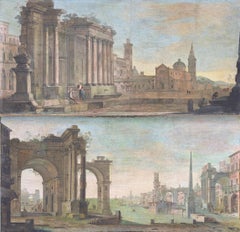
Pair of Italian 18th Century Tempera on Canvas Classical Paintings "Capriccio"
By Pietro Paltronieri
Located in Rome, IT
A fine pair of huge Italian 18' century Capriccio with Classical ruins, tempera oil on canvas .
Atr.Pietro Paltronieri, il Mirandolese (Mirandola 1673-1741 Bologna).
Measurements ...
Category
Mid-18th Century Old Masters Landscape Paintings
Materials
Tempera
$77,859
H 48.04 in W 100.01 in D 2.37 in
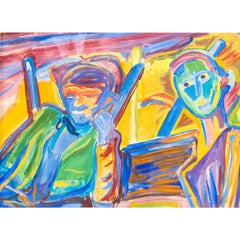
Wilhelm Ohm (1905-1965), Double Portrait with Chairs, circa 1950
Located in Greding, DE
Expressive portrait of a man and a woman looking directly at the viewer as well as indicated chairs.
The execution of a series of chair paintings served Wilhelm Ohm (1905 Stettin -...
Category
1950s Abstract Expressionist Figurative Paintings
Materials
Paper, Tempera
$10,181
H 43.71 in W 53.55 in D 1.58 in
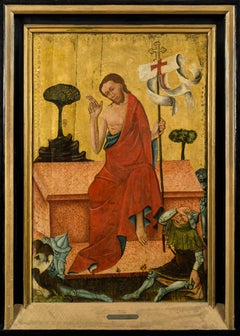
The Resurrection of Christ
Located in New York, NY
Provenance:
with “Mr. Scheer,” Vienna, by July 1918; where acquired by:
Jindřich Waldes, Prague, 1918–1941; thence by descent to:
Private Collection, New York
Literature:
Rudolf Kuchynka, “České obrazy tabulové ve Waldesově obrazárně,” Památky archeologické, vol. 31 (1919), pp. 62-64, fig. 5.
Jaroslav Pešina, “K datování deskových obrazů ve Waldesově obrazárně,” Ročenka Kruhu pro Pěstování Dějin Umění: za rok (1934), pp. 131-137.
Jaroslav Pešina, Pozdně gotické deskové malířství v Čechách, Prague, 1940, pp. 150-151, 220.
Patrik Šimon, Jindřich Waldes: sběratel umění, Prague, 2001, pp. 166, 168, footnote 190.
Ivo Hlobil, “Tři gotické obrazy ze sbírky Jindřicha Waldese,” Umění, vol. 52, no. 4 (2004), p. 369.
Executed sometime in the 1380s or 1390s by a close associate of the Master of the
Třeboň Altarpiece, this impressive panel is a rare work created at the royal court in Prague and a significant re-discovery for the corpus of early Bohemian painting. It has emerged from an American collection, descendants of the celebrated Czech industrialist and collector Jindřich Waldes, who died in Havana fleeing Nazi-occupied Europe.
The distinctive visual tradition of the Bohemian school first began to take shape in the middle of the fourteenth century after Charles IV—King of Bohemia and later Holy Roman Emperor—established Prague as a major artistic center. The influx of foreign artists and the importation of significant works of art from across Europe had a profound influence on the development of a local pictorial style. Early Italian paintings, especially those by Sienese painters and Tommaso da Modena (who worked at Charles IV’s court), had a considerable impact on the first generation of Bohemian painters. Although this influence is still felt in the brilliant gold ground and the delicate tooling of the present work, the author of this painting appears to be responding more to the paintings of his predecessors in Prague than to foreign influences.
This Resurrection of Christ employs a compositional format that was popular throughout the late medieval period but was particularly pervasive in Bohemian painting. Christ is shown sitting atop a pink marble sarcophagus, stepping down onto the ground with one bare foot. He blesses the viewer with his right hand, while in his left he holds a triumphal cross with a fluttering banner, symbolizing his victory over death. Several Roman soldiers doze at the base of the tomb, except for one grotesque figure, who, beginning to wake, shields his eyes from the light and looks on with a face of bewilderment as Christ emerges from his tomb. Christ is wrapped in a striking red robe with a blue interior lining, the colors of which vary subtly in the changing light. He stands out prominently against the gold backdrop, which is interrupted only by the abstractly rendered landscape and trees on either side of him.
The soldiers’ armor is rendered in exacting detail, the cool gray of the metal contrasting with the earth tones of the outer garments. The sleeping soldier set within a jumble of armor with neither face nor hands exposed, is covered with what appears to be a shield emblazoned with two flies on a white field, somewhat resembling a cartouche (Fig. 1). This may be a heraldic device of the altarpiece’s patron or it may signify evil, referencing either the Roman soldiers or death, over both of which Christ triumphs.
This painting formed part of the collection assembled by the Czech industrialist and founder of the Waldes Koh-i-noor Company, Jindřich Waldes, in the early twentieth century. As a collector he is best remembered for establishing the Waldes Museum in Prague to house his collection of buttons (totaling nearly 70,000 items), as well as for being the primary patron of the modernist painter František Kupka. Waldes was also an avid collector of older art, and he approached his collecting activity with the goal of creating an encyclopedic collection of Czech art from the medieval period through to the then-present day. At the conclusion of two decades of collecting, his inventory counted 2331 paintings and drawings, 4764 prints, and 162 sculptures. This collection, which constituted the Waldesova Obrazárna (Waldes Picture Gallery), was first displayed in Waldes’ home in Prague at 44 Americká Street and later at his newly built Villa Marie at 12 Koperníkova Street. This Resurrection of Christ retains its frame from the Waldes Picture Gallery, including its original plaque “173 / Česky malíř z konce 14 stol.” (“Czech painter from the end of the 14th century”) and Waldes’ collection label on the reverse.
The Resurrection of Christ was one of the most significant late medieval panel...
Category
15th Century and Earlier Old Masters Paintings
Materials
Tempera, Panel
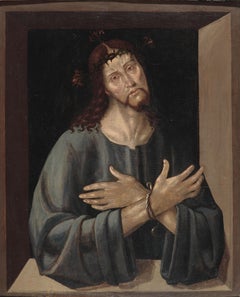
15th Century By Maestro della Pala Sforzesca Ecce Homo Tempera on Panel
Located in Milano, Lombardia
15th Century Maestro della Pala Sforzesca
Title: Ecce Homo
Medium: Tempera on Panel
Dimensions: without frame 64.9 x 53.2 – with frame 82 x 70 x 5 cm
Beautiful "cassetta" frame in e...
Category
15th Century and Earlier Old Masters Figurative Paintings
Materials
Tempera, Panel
$52,129 Sale Price
20% Off
H 25.6 in W 21.07 in
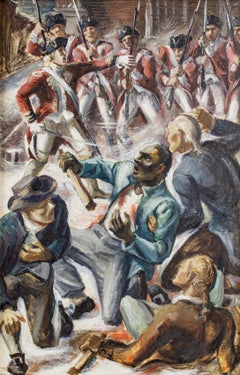
Oil Painting Titled "The Death of Crispus Attucks", by Thomas Dietrich, 1943
Located in New York, NY
Thomas M. Dietrich 1912-1998
The Death of Crispus Attucks, 1943
Tempera and oil on board
21 x 15 inches
Signed and dated: Tom Dietrich 1943
Thomas M. Dietrich was an artist in residence at Lawrence College for 30 years and painted in the American Regionalist style. He exhibited yearly at the Art Institute of Chicago where he also received the acclaimed International William Tuthill Prize for watercolors in 1941 (Charles Burchfield won the associated Logan prize that same year) Dietrich also received a Louis Comfort Tiffany Foundation fellowship and was a founding member of the Wisconsin Watercolor Society.
In 1943 Deitrich painted The Death of Crispus Attucks, depicting the historical battle known as the Boston Massacre...
Category
1940s Figurative Paintings
Materials
Oil, Tempera
$16,000
H 21 in W 15 in D 2 in
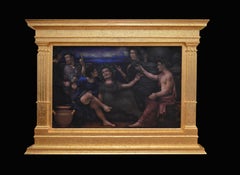
School of Stoics
Located in Mokena, IL
The School of Stoics brings the viewer into an airy evening discussion at an agora overlooking the Aegean Sea. Amidst the silent water and grained marble, a group of stoics debate logic, reason, and nature. Agreement and disagreement prevail in the noble gestures of their bodies. Soon you see an individual's gaze directed towards you, raising their hand, calling you to join the conversation.
Technical:
53” x 39”. Tempera on panel with 24k gold water-gilded frame. Painting and frame produced by artists Justas and Vilius Varpucanskis. This piece utilizes the "rules of craftsmanship" as outlined in Cenino Cennini's Il Libro dell'Arte. 21st century contemporary artwork that employs techniques, philosophy, and visual language of the Italian High Renaissance...
Category
21st Century and Contemporary Renaissance Figurative Paintings
Materials
Gold Leaf
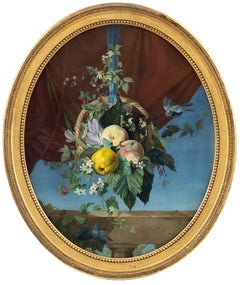
Still life with basket of fruit and birds
Located in Paris, IDF
Monogrammist V. R.
French School, Second Half of the 19th Century
Still life with basket of fruit and birds
Tempera on canvas
Monogrammed lower right under a Viscount's Crown
74 x...
Category
Late 19th Century French School Still-life Paintings
Materials
Tempera
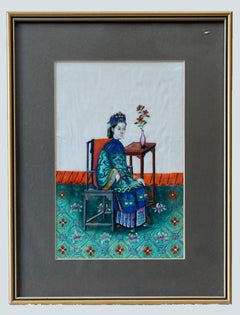
Chinese courtesan
By 19th Century Chinese school
Located in GB
The painting is a delicate Chinese export artwork rendered on rice paper, showcasing the refined detail and stylistic elegance characteristic of 18th to 19th-century export art made ...
Category
19th Century Ming Figurative Paintings
Materials
Tempera, Rice Paper
More From This Seller
View AllMaryn Hunzeker "Explorers" Original Casein Painting c.1960
By Maryn Hunzeker
Located in San Francisco, CA
Maryn Hunzeker "Explorers" Original Casein Painting c.1960
Fantastic mid modern painting by noted artist Maryn Hunzeker.
Created with casein on panel. Dimensions 26" x 18 1/4". The...
Category
Mid-20th Century Impressionist Figurative Paintings
Materials
Casein, Panel
Charles Gresham "Reading by the Window" Original Oil Painting c.1970
Located in San Francisco, CA
Charles Gresham "Reading by the Window" Original Oil Painting c.1970
Fine vintage oil painting by San Francisco artist and philanthropist Charles Gres...
Category
Mid-20th Century Impressionist Figurative Paintings
Materials
Canvas, Oil
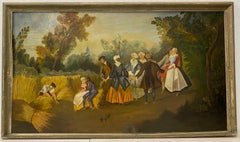
Antique European School "Summer" Oil Painting After Nicolas Lancret c.1900
Located in San Francisco, CA
Antique European School "Summer" Oil Painting After Nicolas Lancret c.1900
Original oil on board. Dimensions 37" wide x 21" high
Frame dimensions 40....
Category
Early 20th Century Impressionist Figurative Paintings
Materials
Wood, Oil
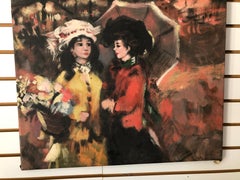
Mystery Mid Century French School
Located in San Francisco, CA
Charming mid century French School oil on canvas. Signed Bornheizel?? I think. Either way a very talented painter. It comes unframed and measures 24 inches wide by 20 high.
Category
Mid-20th Century Figurative Paintings
Materials
Oil
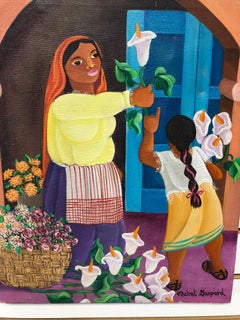
Michel Gaspard "Flowers for Mama"
Located in San Francisco, CA
Michel Gaspard is a French postwar and contemporary artist, born in 1947. Charming scene of child giving her mother flowers. The style reminds me of som...
Category
1980s Figurative Paintings
Materials
Oil
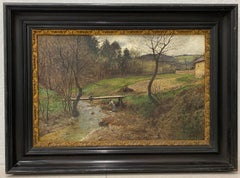
Victor Mytteis Hungarian Country Landscape with Figures c.1902
Located in San Francisco, CA
Victor Mytteis (1874-1936) Hungarian Country Landscape with Figures c.1902
Charming oil painting titled "A brook w/ a bench"
Original oil on canvas by listed Hungarian artist Victo...
Category
Early 20th Century Impressionist Landscape Paintings
Materials
Canvas, Oil
Still Thinking About These?
All Recently ViewedMore Ways To Browse
Master Copy
Red Haired Woman Oil Painting
Vintage Circus Painting
Cuban Artists Painting
Oil Paintings Naive
Painting By Franco
Black Woman In Red Dress Painting
Double Bass
Dior 1987
Oil Paintings Signed By Stuart
Rococo Oil Paintings
Native American Indian Oil Paintings
New York City Subway Light
Roma E
Nursery Rhyme
Old Man Oil Painting 19th Century
Super Hero
Iran Paintings