Items Similar to Lady Dormore - A 16th Century Portrait of a key member of Shakespeare
s England
Want more images or videos?
Request additional images or videos from the seller
1 of 9
John De CritzLady Dormore - A 16th Century Portrait of a key member of Shakespeare
s Englandcirca 1595
circa 1595
$130,786
£95,000
€111,307.25
CA$180,353.11
A$190,946.90
CHF 103,335.06
MX$2,282,166.62
NOK 1,288,058.07
SEK 1,177,883.42
DKK 831,322.23
About the Item
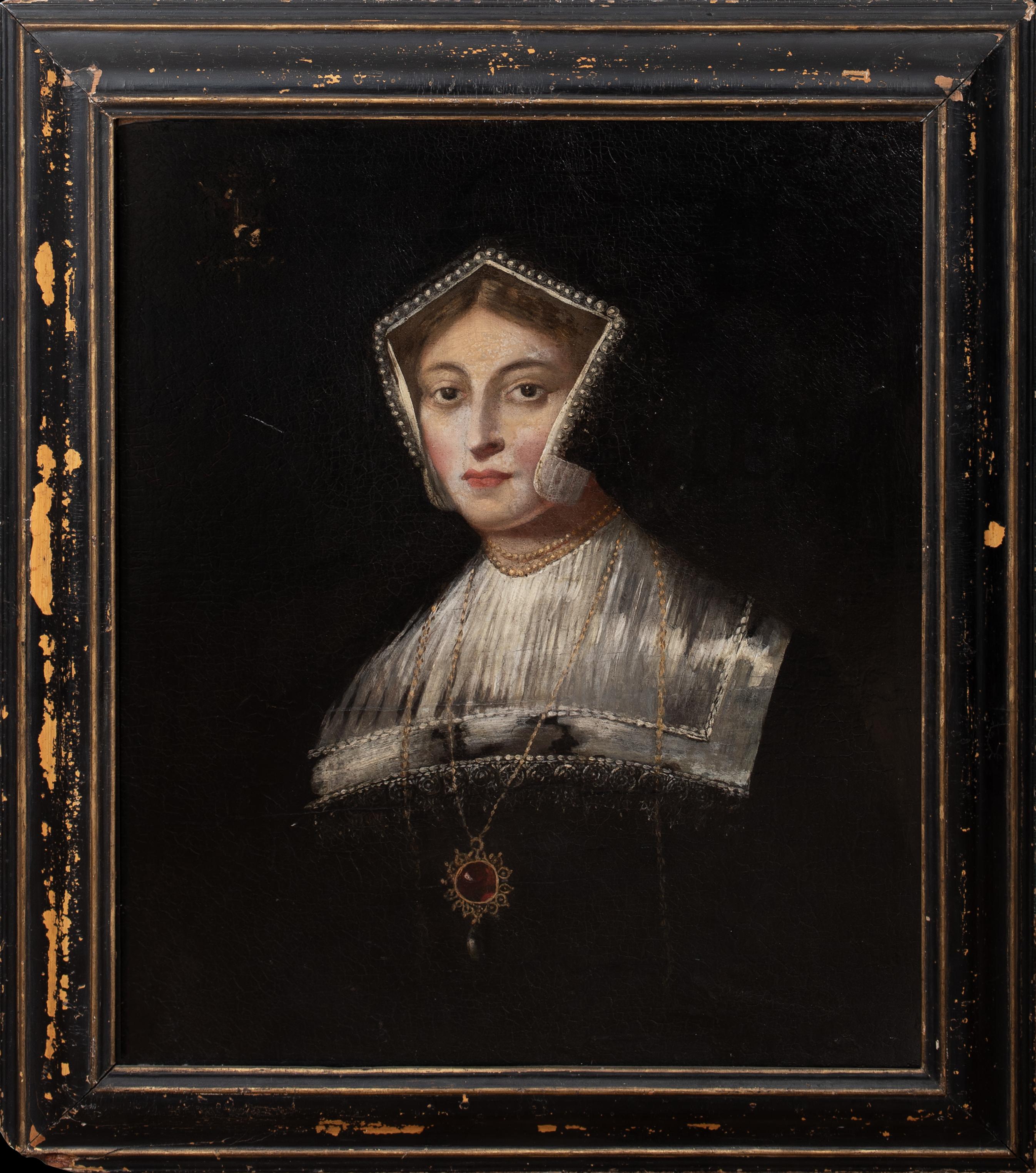
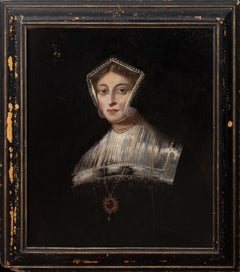
Lady Dormer, Mary Browne
c. 1592
oil on panel
35 x 29 inches, unframed;
41 x 34.75 inches, inc. frame
Inscribed 'Lady Dormore'
Mary married Henry Wriothesley, 2nd Earl of Southampton who gave birth to Henry Wriothesley, 3rd Earl of Southampton - one of the great figures in Shakespears"s circle and founder of the Virginia company, developers of Virginia USA.
Henry Wriothesley, born 6 October 1573 at Cowdray House, Sussex, was the only son of Henry Wriothesley, 2nd Earl of Southampton, by Mary Browne, the only daughter of Anthony Browne, 1st Viscount Montague, and his first wife, Jane Radcliffe.[5] He had two sisters, Jane, who died before 1573, and Mary (c. 1567 – 1607), who in June 1585 married Thomas Arundell, 1st Baron Arundell of Wardour.[6]
After his father's death, Southampton's mother married firstly, on 2 May 1595, as his second wife, Sir Thomas Heneage (d. 17 October 1595), Vice-Chamberlain of the Household, and secondly, between 5 November 1598 and 31 January 1599, Sir William Hervey. She died in November 1607.[7]
Early life
When his father died on 4 October 1581 Southampton inherited the earldom and landed income valued at £1097 6s per annum. His wardship and marriage were sold by the Queen to her kinsman, Charles, Lord Howard of Effingham, for £1000. According to Akrigg, Howard then "entered into some further agreement, of which no documentation can now be found, which transferred to Lord Burghley personally the custody and marriage of the young Earl, but left Howard holding his lands", and late in 1581 or early in 1582 Southampton, then eight years of age, came to live at Cecil House in the Strand.[8]
In October 1585, at age twelve, Southampton entered St John's College, Cambridge,[9] graduating M.A. on 6 June 1589.[10] His name was entered at the Gray's Inn legal society before he left the university, and he was admitted on 29 February 1588.[11]
On Southampton's 16th birthday, 6 October 1589, Lord Burghley noted Southampton's age in his diary, and by 1590 Burghley was negotiating with Southampton's grandfather, Anthony Browne, 1st Viscount Montague, and Southampton's mother, Mary, for a marriage between Southampton and Lord Burghley's eldest granddaughter, Elizabeth Vere, daughter of Burghley's daughter, Anne Cecil, and Edward de Vere, 17th Earl of Oxford.[12] However the match was not to Southampton's liking, and in a letter written in November 1594, about six weeks after Southampton had turned 21, the Jesuit Henry Garnet reported the rumour that "The young Erle of Southampton refusing the Lady Veere payeth £5000 of present payment".[13]
In 1591 Lord Burghley's Clerk in Chancery, John Clapham, dedicated to Southampton a poem in Latin, Narcissus, recounting the Greek legend of a beautiful young man who perishes through self-love. According to Akrigg, Southampton was now spending much of his time at court. He was in attendance when Queen Elizabeth visited Oxford in late September 1592, and was praised fulsomely in the Latin poem written by John Sandford to commemorate the Queen's visit. In October 1592 Southampton's grandfather, Viscount Montague, died. Montague had been a Knight of the Garter, and on 3 May 1593 Philip Gawdy of Clifford's Inn (a law school and Inn of Chancery) wrote to his brother, Bassingbourne Gawdy, that Southampton had been nominated to the Order, together with the Lord Keeper, Lord Burgh, and Lord Willoughby de Eresby. Shortly thereafter, in his Honour of the Garter dated 26 June 1593, George Peele referred to him as "Gentle Wriothesley, Southampton's star", claiming erroneously that an Earl of Southampton had been among the founding Knights.[14] However it was not until 1603 that Southampton was invested in the Order under King James.
Southampton and Shakespeare
Henry Wriothesley at 21
Shakespeare's dedication to Southampton of The Rape of Lucrece, 1594
In 1593 Shakespeare dedicated his narrative poem Venus and Adonis to Southampton, followed in 1594 by The Rape of Lucrece. Although the dedication to Venus and Adonis is more restrained, the dedication to The Rape of Lucrece is couched in extravagant terms: "The love I dedicate to your lordship is without end ... What I have done is yours; what I have to do is yours; being part in all I have, devoted yours." This type of vaunting language was not particularly unusual though, because other dedications of the day always excessively praised any noble person sponsoring the author's work – mainly for political, and above all financial, reasons.
Nathan Drake, in Shakespeare and his Times, was the first to suggest that Southampton was not only the dedicatee of Shakespeare's two long narrative poems, but also the "Fair Youth" of the Sonnets.[15] The title page refers to the "onlie begetter of these insuing sonnets Mr W.H.," and it had earlier been inferred that the Sonnets were addressed to "Mr. W.H.". Drake, however, adopting Chalmers' suggestion that one meaning of "beget" is "bring forth", argued that Mr. W.H. was merely the procurer of the manuscript rather than the "Fair Youth" addressed in the poems.[16] Other adherents of the theory that Southampton was the addressee of the Sonnets have suggested that his initials, H.W. (Henry Wriothesley), were simply reversed by the publisher to conceal his identity.[17] However Honan argues that although Southampton "may be involved in Shakespeare's sonnets", "there is no real likelihood that he traduced him by drawing his portrait as the fickle, treacherous Young Man of the sonnets, who is implicitly 'lascivious' (sonnet 95), 'sensual' to a 'fault' or to his 'shame' (sonnets 34, 35), and ridden with vices".[12]
Despite extensive archival research, no documents have been found concerning their relationship apart from the dedications to Shakespeare's two long narrative poems. Nicholas Rowe, on the authority of poet and playwright William Davenant (1606 – 7 April 1668), stated in his Life of Shakespeare that Southampton once gave Shakespeare £1000 to "go through with a purchase,"[18] but Honan terms this a myth.[12]
The 1590s
Southampton received dedications from other writers in the 1590s. On 27 June 1593 Thomas Nashe completed his picaresque novel, The Unfortunate Traveller, and dedicated it to Southampton,[19] terming him "a dere lover and cherisher . . . as well of the lovers of Poets, as of Poets themselves",[20] and in 1593 Barnabe Barnes published Parthenophil and Parthenope with a dedicatory sonnet to Southampton.[21] In 1595 Gervase Markham included a dedicatory sonnet to Southampton in The Most Honorable Tragedy of Richard Grinvile, Knight.[22] On 2 March 1596 John Florio's Italian/English dictionary was entered in the Stationers' Register.[23] In his dedication, Florio, who was for some years in the Earl's "pay and patronage", complimented Southampton on his fluency in Italian, saying he "had become so complete a master of Italian as to have no need of travel abroad to perfect his mastery of that tongue".[24] In 1597 Henry Lok included a sonnet to Southampton among the sixty dedicatory sonnets in his Sundry Christian Passions.[25] In the same year William Burton dedicated to him a translation of Achilles Tatius's, Clitophon and Leucippe.[26]
On 4 October 1594 Southampton's friend, Sir Henry Danvers, shot Henry Long, brother of Sir Walter Long, in the course of a local feud between the Danvers and Long families. Sir Henry and his elder brother, Sir Charles Danvers, fled to Titchfield, where Southampton sheltered them. The brothers were outlawed, and eventually escaped to the continent where they took refuge at the court of King Henri IV.[27]
On 17 November 1595, Southampton jousted in Queen Elizabeth's accession day tournament, earning a mention in George Peele's Anglorum Feriae as "gentle and debonaire". However, according to Akrigg, "Gentle and debonair he may have been, but we never again hear of Southampton being high in the graces of Queen Elizabeth".[28]
On 13 April 1596 the Queen specifically instructed Robert Devereux, 2nd Earl of Essex, not to take either Southampton or the Earl of Derby,[29] with him on an expedition for the Relief of Calais, and it also appears that Southampton did not accompany Essex on the Cadiz Expedition that summer.[30] In February 1597 Southampton challenged the Earl of Northumberland to a duel with rapiers, requiring intervention by the Queen and Privy Council, and on 1 March stood godfather at the christening of Sir Robert Sidney's daughter, Bridget. Later that year Southampton was with Essex on his "inglorious" Voyage to the Azores, where according to Rowland Whyte, "My Lord of Southampton fought with one of the Kings great Men of Warre, and suncke her". On his return he made his first appearance in the House of Lords on 5 November, and was put on several committees, but became a "chronic absentee". By this time he was in serious financial difficulties, and had turned over administration of his estates to two trustees, who by the end of the year had sold some of his lands.[31]
In 1598 Southampton was involved in a brawl at court with Ambrose Willoughby,[32] one of the Queen's esquires of the body, who had ordered him to leave the presence chamber where he was playing at primero after the Queen had retired for the evening. Southampton struck Willoughby, and "Willoughby puld of some of his locke", for which the Queen gave Willoughby thanks, saying "he had done better yf he had sent hym to the porters lodge, to see who durst have fetcht hym out".[33] There is a suggestion that underlying the altercation was something Willoughby had said which caused trouble between Southampton and his mistress, Elizabeth Vernon, one of the Queen's Maids of Honour. The Queen forbade Southampton to present himself at court, although he was soon allowed back. Nonetheless it was reported by Rowland Whyte at the beginning of February that "My Lord of Southampton is much troubled at her Majesties straungest Usage of hym". Faced with his financial difficulties and the Queen's disfavour, Southampton determined to live abroad for a time, and seized the opportunity of accompanying Sir Robert Cecil on an embassy to Henri IV of France. On 6 February Southampton was granted licence to travel abroad for two years, and by March he and Cecil were in Angers, where on 7 March Southampton was presented to the French King.[34]
When Cecil returned to England from his failed mission in April, Southampton remained at the French court, planning to travel to Italy with Sir Charles Danvers and Sir Henry Danvers, whom he had helped to escape from England in 1594 after the murder of Henry Long. At that juncture the Queen decided to pardon the Danvers brothers, and they were back in England on 30 August 1598, at which time Southampton also returned in secret, and married his pregnant mistress, Elizabeth Vernon. He left for the continent almost immediately, but by 3 September the Queen had learned of the marriage and consigned Elizabeth Vernon, one of her chief ladies-in-waiting, to the Fleet Prison for marrying without royal permission.
The Queen ordered Southampton to return to England forthwith, but he remained in Paris for two months, losing large sums in gambling. By the beginning of November he was back in England, also lodged in the Fleet, where he remained for a month, during which time Elizabeth Vernon gave birth to a daughter, Penelope. To add to his difficulties, Southampton was at this time involved in a dispute with his mother, the Dowager Countess, over her prospective marriage to Sir William Hervey. Lord Henry Howard was brought in to smooth matters between mother and son, and the Countess and Hervey were wed in early January 1599.[35]
In 1599, during the Nine Years War (1595–1603), Southampton went to Ireland with Essex, who made him General of the Horse, but the Queen insisted that the appointment be cancelled. Southampton remained on in personal attendance upon the Earl, rather than as an officer. However, Southampton was active during the campaign and prevented a defeat at the hands of the Irish rebels when his cavalry drove off an attack at Arklow in County Wicklow. Shortly after the Essex's Rebellion in February 1601, William Reynolds, a soldier who had served with Essex in Ireland in 1599, mentioned Southampton in a letter to Sir Robert Cecil. Speaking of certain men involved in the Essex rebellion who had not yet been arrested, Reynolds wrote:[36]
I do mervell also what becam of pearse edmones, the earle of Essex man, borne in strand neare me, and which has had many rewards
preferments by the earle essex, his villany I have often complained of, he dweles in London, he was corporall generall of the horse in Ierland under the earle of Sowthamton, he eate
drank at his table and lay in his tente, the earle of Sowthamton gave him a horse, which edmones refused a 100 markes for him, the earle Sowthamton would cole and huge him in his armes and play wantonly with him. This pearse began to fawne and flatter me in Ierland offering me great curtesie, telling me what pay grases
giftes they earles bestowed uppon him, therby seming to move and anymate me to desiar and looke for the like favour, But I coeld never love
afecte them to make them my frends, esspecially essex whoes mynd I ever mistrusted....
According to Duncan-Jones, Reynolds' letter hints that 'rewards could be obtained from either or both of the two Earls in return for sexual favours'. On the other hand, Duncan-Jones concludes that Reynolds may have been a paranoid schizophrenic, and that by his own statement he had written over 200 letters to the Queen, Privy Council, and members of the clergy wherein he had "complaynid of al the abewses and vilent oppresseones
sodometicall sines over flowing this land".[37]
On his return from Ireland, Southampton attracted notice as a playgoer. "My Lord Southampton and Lord Rutland," wrote Rowland Whyte to Sir Robert Sydney in 1599, "come not to the court: the one doth but very seldom. They pass away the time in London merely in going to plays every day".[38]
Southampton was deeply involved in the Essex's Rebellion of 1601, and in February of that year he was sentenced to death. Cecil, who urged the Queen to show the greatest possible degree of clemency, obtained the commutation of his penalty to life imprisonment.
Life under King James
Southampton c.1600
On the accession of James I Southampton resumed his place at court and received numerous honours from the new king. On the eve of the abortive rebellion of Essex he had induced the players at the Globe Theatre to revive Richard II, and on his release from prison in 1603 he resumed his connection with the stage. In January 1605 he entertained Queen Anne with a performance of Love's Labour's Lost by Burbage and his company, to which Shakespeare belonged, at Southampton House.[39]
He seems to have been a born fighter, and engaged in more than one serious quarrel at court, being imprisoned for a short time in 1603 following a heated argument with Lord Grey of Wilton in front of Queen Anne. Grey, an implacable opponent of the Essex faction, was later implicated in the Main Plot and Bye Plot. Southampton was in more serious disgrace in 1621 for his determined opposition to Buckingham. He was a volunteer on the Protestant side in Germany in 1614, and in 1617 he proposed to fit out an expedition against the Barbary pirates.
Southampton was a leader among the Jacobean aristocrats who turned to modern investment practices — "in industry, in modernizing their estates and in overseas trade and colonization."[40] He financed the first tinplate mill in the country, and founded an ironworks at Titchfield. He developed his properties in London, in Bloomsbury and Holborn; he revamped his country estates, participated in the efforts of the East India Company and the New England Company, and backed Henry Hudson's search for the Northwest Passage.
A significant artistic patron in the Jacobean as well as the Elizabethan era, Southampton promoted the work of George Chapman, Samuel Daniel, Thomas Heywood, and the composer Alfonso Ferrabosco the younger. Heywood's popular, expansionist dramas were compatible with Southampton's maritime and colonial interests.[41]
Virginia Company
Henry Wriothesley, whose name is included in the 1605 panel of the New World Tapestry, took a considerable share in promoting the colonial enterprises of the time, and was an active member of the Virginia Company's governing council. Although profits proved elusive, his other visions for the Colony based at Jamestown were eventually accomplished. He was part of a faction within the company with Sir Edwin Sandys, who eventually became the Treasurer, and worked tirelessly to support the struggling venture. In addition to profits, Southampton's faction sought a permanent colony which would enlarge British territory, relieve the nation's overpopulation, and expand the market for English goods. Although profits largely eluded the Virginia Company, and it was dissolved in 1624, the other goals were accomplished.
His name is thought by many to be the origin of the naming of the harbour of Hampton Roads, and the Hampton River. Although named at later dates, similar attribution may involve the town (and later city) of Hampton, Virginia, as well as Southampton County, Virginia and Northampton County. However, the name Southampton was not uncommon in England, including an important port city and an entire region along the southern coast, which was originally part of Hampshire. There are also variations applied in other areas of the English colonies which were not part of the Virginia Company of London's efforts, making the origin of the word and derivations of it as applied in Virginia even more debatable.
Later life and death
In 1624 Southampton was one of four Englishmen appointed to command troops fighting in the Low Countries against the Spanish. Shortly after their arrival the earl's eldest son, James Wriothesley, succumbed to a fever at Rosendael. Five days later, on 10 November 1624, Southampton died of the same cause at Bergen-op-Zoom, aged 51. Both were buried in the parish church of Titchfield, Hampshire.
Mary Browne (1552–1607)
On 19 February 1566 Southampton married, at her father's house in London, the thirteen-year-old Mary Browne (d. 1607), daughter of Anthony Browne, 1st Viscount Montagu, by Jane Radcliffe, the daughter of Robert Radcliffe, 1st Earl of Sussex.[13] On 19 March 1566 he was admitted to Lincoln's Inn.[14] On reaching the age of majority in 1566 he sued his livery, and was granted licence to enter on his lands by letters patent dated 7 February 1568.[15] According to Elzinga, Southampton had six residences and landed income between £2000 and £3000 in the 1560s, and 'lived in a grand way, maintaining a large and lavish household'.[16]
The strains between Southampton's religion and the Elizabethan regime first became apparent when in February 1569 Southampton's brother-in-law, Sussex, wrote to Sir William Cecil urging that Southampton be 'rather charitably won than severely corrected'. That summer Queen Elizabeth was Southampton's guest at Titchfield Abbey, but in November both Southampton and his father-in-law, Viscount Montague, were implicated in the Northern Rebellion. In a letter dated 1 December 1569 the Spanish ambassador, Guerau de Spes, wrote to the Duke of Alba that both Montague and Southampton 'have sent to me for advice as to whether they should take up arms or go over to your Excellency'. According to Akrigg, Montague and Southampton set sail for Flanders, but were driven back by contrary winds. Although they were ordered to come immediately to court to explain their actions, to all appearances things were smoothed over, and neither Southampton nor his father-in-law was punished for his involvement.[17] However matters came to a head in May 1570 when Pope Pius V excommunicated the Queen, and English Catholics were required to choose between loyalty to religion and loyalty to the sovereign. Southampton sought counsel from John Lesley, Bishop of Ross, at a secret meeting in the marshes of Lambeth, where they were intercepted by the watch, and in consequence, on 18 June 1570 the Privy Council ordered Southampton's arrest and confined him to the house of Henry Becher, Sheriff of London. On 15 July he was placed in the custody of Sir William More at Loseley, where More was under instructions to induce Southampton to take part in Protestant devotions in the household. After doing so, Southampton was released in November.[18]
A year later, in September 1571, under questioning concerning the Ridolfi plot, the Bishop of Ross incriminated Southampton by revealing the entire story of their meeting in Lambeth marsh. Southampton was arrested at the end of October and confined to the Tower for 18 months. He was finally released on 1 May 1573, and again placed in the custody of Sir William More at Loseley. On 14 July he was permitted to live with his father-in-law at Cowdray, although his liberty was still restricted.[19]
On 6 October 1573 Southampton wrote elatedly to Sir William More to announce the birth of his son, Henry Wriothesley, 3rd Earl of Southampton.[20] The next six years were a period of stability in Southampton's life, with the Queen granting him small offices and other signs of favour. His income was augmented at his mother's death in 1574, and he began construction of a mansion at Dogmersfield.[21] However his relationship with his wife gradually deteriorated, and by about 1577 he forbade her ever to see again a certain Donsame, 'a common person'. When in 1580 it was reported to him that she had been seen at Dogmersfield with Donsame, he forever banished her his 'board and presence', forcing her to live at one of his Hampshire estates under close surveillance. The Countess defended herself with spirit, denying adultery and accusing one of the Earl's servants, Thomas Dymock, of having been the cause of the contention between herself and her husband. Years later the Jesuit Robert Persons charged Charles Paget with having been responsible for the falling out between the Earl and his father-in-law over the Earl's treatment of his wife.[22]
Matters took a further turn for the worse when the authorities were advised in August 1581 that the Jesuit Edmund Campion had been in contact with the Earl through Thomas Dymock.[23]
Southampton died 4 October 1581 at his house of Itchell, near Dogmersfield, Hampshire, and was buried at Titchfield on 30 November. He left an estate valued at £1097 6s per annum. In his will the Earl named both Thomas Dymock and Charles Paget as executors. The will was contested, with some success, by the Countess, with support from Robert Dudley, 1st Earl of Leicester, and by 11 December 1581 a settlement had been reached between the Countess and the executors under which Dymock retained the Earl's generous bequests to him, but agreed to relinquish administration of the Earl's estate to Edward Gage, another of the executors.[24]
Marriage and issue
By Mary Browne Southampton had an only son, Henry Wriothesley, 3rd Earl of Southampton, and two daughters, Jane, who died before 1573, and Mary (c. 1567 – 1607), who married Thomas Arundell, 1st Baron Arundell of Wardour.[25]
After Southampton's death his widow, Mary, married firstly, on 2 May 1595, as his second wife, Sir Thomas Heneage (d. 17 October 1595), Vice-Chamberlain of the Household, and secondly, between 5 November 1598 and 31 January 1599, Sir William Hervey. She died in November 1607, leaving a will proved 14 November in which she directed burial at Titchfield 'as near as may be unto the body of my honorable and dearlie beloved Lord and husband Henrie late Earle of Southampton'.[26
Life
Browne was born at Cowdray House, Midhurst, Sussex, in 1552, the eldest son and heir of Anthony Browne, 1st Viscount Montagu (1528–1592), by his first marriage to Lady Jane Radcliffe, a daughter of Robert Radcliffe, 1st Earl of Sussex. He was twin brother to Mary Browne (1552–1607), later Countess of Southampton, but they lost their mother at the birth. Their grandfather was another Sir Anthony Browne (died 1548), knight of the shire for Surrey, and their great-grandfather, Sir Anthony Browne (died 1506) held the office of Standard Bearer of England. By 1558 their father, Lord Montagu, had married secondly Magdalen Dacre, by whom he had three further sons, George, Thomas and Henry, and three daughters, Elizabeth, Mabel and Jane.[1] Browne's relationship with his stepmother appears to have been close. She was said to have had 'so solicitous a care of his health as if he had been her own child', and was so far from preferring her own children at Browne's expense that when an incident occurred which incurred Viscount Montagu's displeasure against his eldest son and heir, 'she pacified her husband', and brought Browne into his father's favour again.[2]
In 1572[3] Browne married Mary Dormer, a daughter of Sir William Dormer (died 1575) by his second wife, Dorothy Catesby. They had two sons, Anthony-Maria, born in March 1574,[3] who shortly after his father's death in 1592 succeeded his grandfather as Viscount Montague, and John;[1] and three daughters, Dorothy, who married Edmund Lee, Jane, who married Sir Francis Englefield, 1st Baronet (ca. 1561–1631) and Katherine, who married a man named Throckmorton.
In 1580 Browne was Sheriff of Surrey and of Kent, an office usually held for only one year.[4]
On 19 February 1565/66, at the age of thirteen, Browne's twin sister Mary had married, from their father's house in London, Henry Wriothesley, 2nd Earl of Southampton. On 1 November 1573, a month after Mary had given birth to her son, Henry Wriothesley, 3rd Earl of Southampton, the 2nd Earl wrote to Sir William More that he and his wife would stop at Loseley on their journey to London, which they were making in the company of 'my brother Anthony Browne and his wife'.[5] However this happy state of affairs did not long continue. In about 1577 the 2nd Earl, for reasons unknown, had forbidden Mary ever to see again a certain Donsame, 'a common person'. When in 1580 it was reported to him that she had been seen at Dogmersfield with Donsame, he forever banished her his 'board and presence', forcing her to live at one of his Hampshire estates under close surveillance. The Countess defended herself with spirit in a long letter to her father, Viscount Montague, on 21 March 1580, denying adultery and accusing one of the Earl's servants, Thomas Dymock, of having been the cause of the contention between herself and her husband. The two families and their servants were drawn into the trouble between Mary Browne and her husband. An entry in the register of the Privy Council records that one of the 2nd Earl of Southampton's servants had been committed to the Marshalsea on 23 February 1580 'for certain misdemeanours by him used against Mr Anthony Brown, the eldest sonne of the Lord Montacute'.[6]
- Creator:John De Critz (1551 - 1642)
- Creation Year:circa 1595
- Dimensions:Height: 41 in (104.14 cm)Width: 34.75 in (88.27 cm)
- Medium:
- Movement Style:
- Period:
- Condition:
- Gallery Location:London, GB
- Reference Number:1stDibs: LU67333819102
About the Seller
5.0
Vetted Professional Seller
Every seller passes strict standards for authenticity and reliability
Established in 1990
1stDibs seller since 2017
46 sales on 1stDibs
Typical response time: 12 hours
- ShippingRetrieving quote...Shipping from: London, United Kingdom
- Return Policy
More From This Seller
View AllPortrait of Bridget Drury Lady Shaw, formerly Viscountess Kilmorey
By Sir Peter Lely
Located in London, GB
Sir Peter Lely (Soest 1618 – 1680 London)
Portrait of lady with a crown, possibly Bridget Drury Lady Shaw, formerly Viscountess Kilmorey, later Lady Baber (d.1696) c.1665
Oil on canvas
46 1/2 x 40 3/4 inches, Framed
42 1/4 x 36 1/4 inches, Unframed
Inscribed left [……….]Isabella
James Mulraine wrote the following for this piece:
This portrait dates to the middle of the 1660s, the decade when Lely’s career took off as successor to Sir Anthony van Dyck. At the Restoration Charles II had appointed him Principal Painter to the King and paid a pension £200 per annum ‘as formerly to Sr. Vandyke...’1 Lely had trained in Haarlem and he was in his early twenties when he came to London in 1643. He was an astute businessman and a wise courtier. In 1650 he painted a portrait of Oliver Cromwell (Birmingham Museum and Art Gallery) while maintaining links with the Royalist exiles through the 1650s. He had arrived in England as a painter of small-scale portraits and lush scenes of nymphs in landscapes in a Dutch style. His experience of Van Dyck in English collections transformed his painting. His lavish and alluring vision of Arcadia exactly captured the spirit of the Court and as Principal Painter he dominated English portraiture for the next twenty years. Lely ran a highly efficient studio along Netherlandish lines, employing a team of specialists like the drapery painter John Baptist Gaspars and young artists-in-training like Nicolas de Largilliere. He had numerous rivals during that period, and by 1670 he had introduced numbered standard poses to speed up production, while collaborating with printmakers for further revenue and advertising. He died in 1680 of a stroke while painting, working to the last.
The portrait, painted at a date when Lely’s poses and execution were still individual and inventive shows a lady sitting at three-quarter length facing away from the viewer. She has begun to turn towards the viewer, a pose with a long pedigree in art, first used by Leonardo da Vinci in the Mona Lisa (Louvre). She steadies her blue drapery where it might slip from her arm with the movement, a flash of realism beautifully captured. Like Van Dyck, Lely painted his female sitters in a timeless costume rather than contemporary fashion, showing a loose gown and floating silk draperies. It presented the sitter as a classical ideal. The portrait would not date.
The saffron dress may be the work of a drapery painter but the brown scarf must be by Lely himself, and appears unfinished, broadly sketched in behind the shoulder. The delicate blue glaze and nervous highlights suggest shimmering translucence. Lely was a master of painting hands – his hand studies are marvels of drawing – and the lady’s hands are superb, exactly drawn, delicately modelled and expressive. The fidgety gestures, clutching the gown, fiddling with the edge of the scarf, give the portrait psychological bite, suggesting the personality behind the calm courtier’s expression, adding to the sense shown in the look of the eyes and mouth that the lady is about to speak. The portrait’s language is Vandykian. The inspiration comes directly from Van Dyck’s English portraits of women. Lely owned Van Dyck’s Portrait of Lady Elizabeth Thimbleby and Dorothy Viscountess Andover (National Gallery, London) and the sitter’s costume quotes Lady Andover’s saffron dress and brown scarf. But Lely paints a generation who sat nearer to the ground and through a dialogue of expression and gesture he shows sitters who are more flesh and blood than Van Dyck’s.
The background with a column and curtain is different to those shown in most of Lely’s portraits of women. They tend to include trees or fountains, with a glimpse of landscape. But there are other examples. A portrait of the King’s reigning mistress, Barbara Villiers Duchess of Cleveland...
Category
1660s Portrait Paintings
Materials
Oil
$71,588 Sale Price
20% Off
Free Shipping
Portrait of Anne, Lady Russell, later Countess of Bedford
By Anthony van Dyck
Located in London, GB
A three-quarter length portrait of Anne, Lady Russell, later Countess of Bedford (1615-1684), in a blue dress. Attributed to Sir Anthony Van Dyck.
Anne C...
Category
17th Century Portrait Paintings
Materials
Oil
$209,257 Sale Price
24% Off
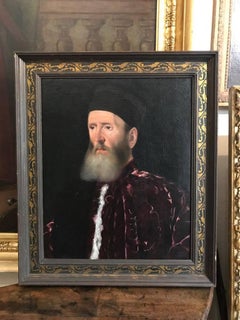
16th Century Italian Renaissance Old Master Portrait of a Procuratore
By Jacopo Bassano
Located in London, GB
Jacopo BASSANO (c. 1510-1592, Italian)
Portrait of a Procuratore
Oil on canvas
30 ¼ x 26 inches (including frame)
Provenance: Lucien Bonaparte’s Collection (as Portrait of Doge Priuli, Tiziano); Rich-mond, Virginia Museum, Portrait of Doge Lorenzo Priuli.
The painting is a portrait of a man half-length, on a black background. It is a three-quarter portrait, according to a custom very common in the genre of portraiture in sixteenth century. The man is wearing a decorated...
Category
16th Century Old Masters Portrait Paintings
Materials
Oil
$242,298 Sale Price
20% Off
Free Shipping
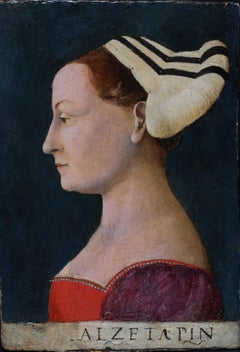
Portrait of an Italian Noblewoman
Located in London, GB
15th century, Italian
Circle of Antonio del Pollaiuolo (1429-1498)
Portrait of an Italian Noblewoman
Oil and tempura on poplar panel
With partial inscription: ALZETAPIN
Provenance:...
Category
15th Century and Earlier Renaissance Portrait Paintings
Materials
Oil, Tempera, Wood Panel
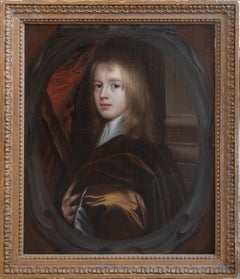
17th Century Oil Painting Portrait of a Young English Boy
By Gerard Soest
Located in London, GB
Gerard SOEST (1600 - 1681)
Portrait of a Young Boy
oil on canvas
35.5 x 30.5 inches inc. frame
Gerard Soest (circa 1600 – 11 February 1681), also known as Gerald Soest, was a portra...
Category
17th Century Old Masters Portrait Paintings
Materials
Oil
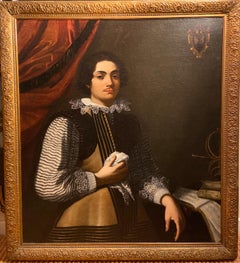
17th Century Italian Oil Painting Portrait of Music Prodigy Girolamo Frescobaldi
Located in London, GB
Portrait of Girolamo Frescobaldi (1583-1643)
Attributed to Antiveduto Della Grammatica (1571-1626)
Oil on Canvas
1605-1609
Framed in a Nineteenth Century gild and composite frame
44....
Category
Early 17th Century Baroque Figurative Paintings
Materials
Oil
You May Also Like
Portrait of a Spanish Noble Lady - 17th Century Old Master art oil painting
Located in Hagley, England
This stunning, large portrait oil painting is attributed to Spanish Old Master Claudio Coello who is considered the last great Spanish painter of the 17th century. It has formerly been the property of Lady Beatrice...
Category
1680s Old Masters Portrait Paintings
Materials
Oil Crayon
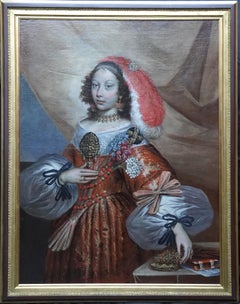
Portrait Of Lady Isobel Mackenzie, Countess of Seaforth (1636-1715) 17th Century
Located in Blackwater, GB
Portrait Of Lady Isobel Mackenzie, Countess of Seaforth (1636-1715), 17th Century
Studio of John Michael Wright (1617-1694)
Large 17th century portrait of Isobel Mackenzie, Countes...
Category
17th Century Portrait Paintings
Materials
Canvas, Oil
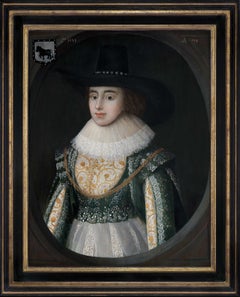
Rare Jacobean Portrait on Panel Lady Elizabeth Wheeler née Cole 1623 Historical
By Cornelius Johnson
Located in London, GB
A Rare Jacobean Portrait of Lady Elizabeth Wheeler (née Cole), 1623
Attributed to Cornelius Johnson (1593–1661)
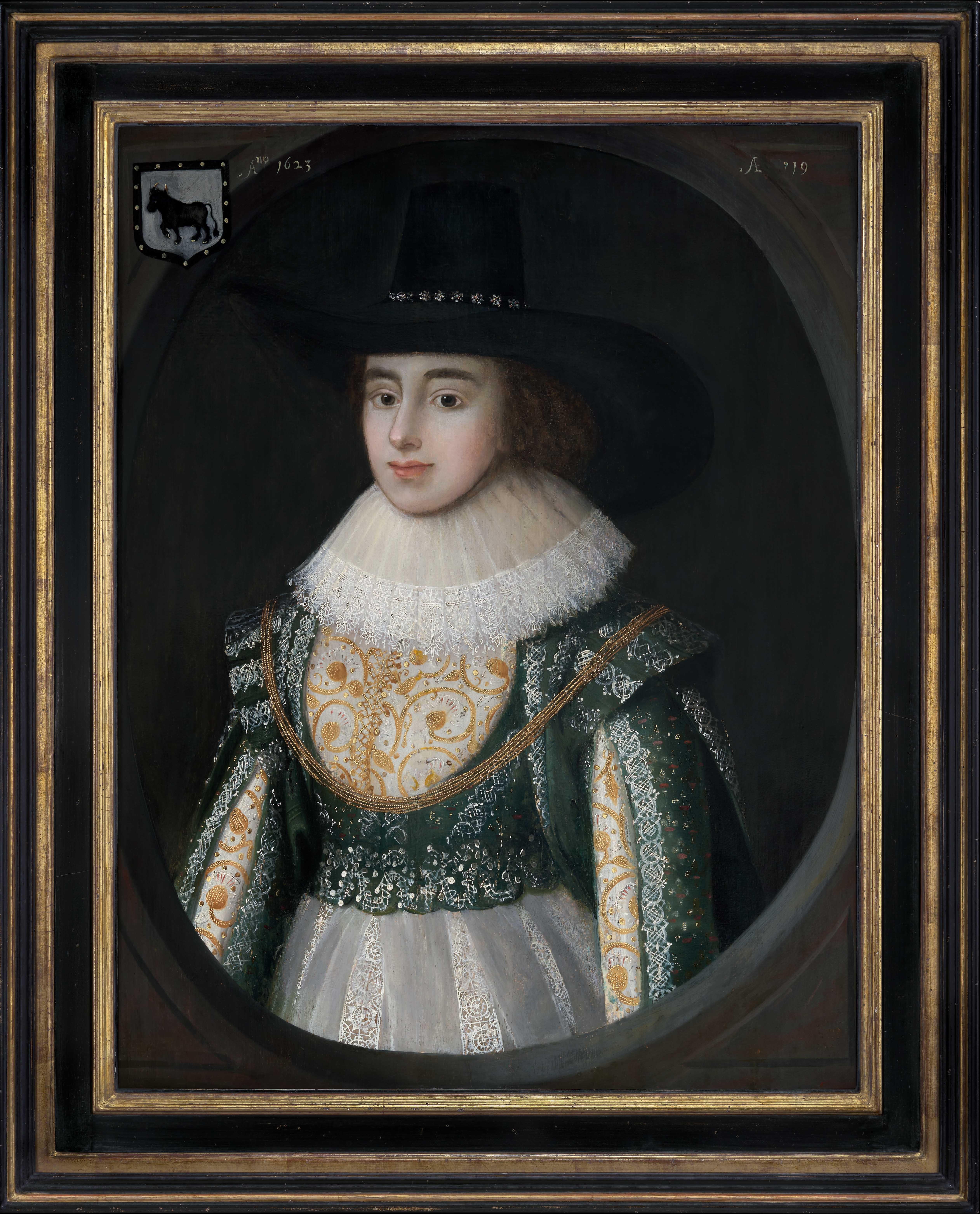
This remarkably rare early oil on panel, presented by Titan Fine Art, has emerged as far more than an anonymous “Portrait of a Lady.” Preserved in outstanding condition—its surface retaining exceptional clarity in the lace and textiles—it has only recently been reunited with the identity of its sitter: Elizabeth Cole (1607–1670), later Lady Elizabeth Wheeler, a Westminster gentlewoman whose later life brought her into intimate royal service as laundress for His Majesty’s person. That combination—high quality, uncommon survival, a newly identified sitter, and a life that intersects directly with the last acts of Charles I—places this portrait in a category of genuine rarity. It is not simply a beautiful Jacobean likeness; it is a rediscovered historical document - legible and compelling.
The sitter is presented half-length against a dark ground, enclosed within a painted sculpted oval surround that functions like an architectural frame. This device, fashionable in the 1620s, concentrates the viewer’s attention and heightens the sense of social presentation: the sitter appears both physically and symbolically “set apart,” as if viewed through a refined aperture. The portrait’s immediate power, however, lies in the costume—an ensemble of striking modernity for c. 1623 and rendered with a precision that survives with remarkable crispness.
She wears a deep green gown—a fitted overgown with open sleeves—over a finely embroidered linen jacket (a stiffened bodice/waistcoat garment). The sleeves form pronounced “wings” at the shoulder, a structurally assertive fashion detail of the early 1620s that enlarges the silhouette and signals sophistication. Beneath the green overlayer, the white linen jacket is richly ornamented in gilt embroidery. The goldwork is arranged as scrolling foliate forms—looping, curling tendrils punctuated by seed-like stippling—organised into balanced compartments across the bodice and sleeves. The motifs read as stylised botanical forms with rounded fruit-like terminals and leaf elements: not literal naturalism, but controlled abundance. The technique is described with extraordinary intelligence, mimicking couched metallic thread through patterned, “stitched” marks, while tiny dots and short dashes create a lively tactile shimmer.
This embroidered jacket sits above a newly fashionable high-waisted, sheer apron or overskirt. The translucent fabric falls in soft vertical folds and is articulated with narrow lace-edged bands, giving the skirt a crisp rhythm of alternating sheer and patterned strips. At the neck, a fine ruff frames the face: a disciplined structure of pleated linen finished with delicate lace. Draped diagonally across the torso are long gold chains, painted to suggest weight and metallic gleam; they function both as ornament and as a further signifier of status. The cumulative effect is controlled luxury: she is not overloaded with jewels, but clothed in textiles whose cost and craftsmanship speak unmistakably.
The recent sitter’s identification rests on heraldic and genealogical analysis: the arms shown on the painting correspond to those recorded for several families in armorial sources, but when the lines of descent are tested against survival and chronology, the viable bearer by 1623 resolves to Cole, and—crucially—to the London branch. That resolution matters because it anchors the portrait to a very specific social world: London/Westminster civic gentry and Crown administration, the milieu in which portraiture served as both self-fashioning and social instrument. The recent identification of the sitter (the London Cole branch of the family) is not merely genealogical; it has direct implications for authorship. A London-based mercantile or civic-gentry family would have ready access to leading immigrant artists, familiarity with heraldic display conventions, and the means to commission oil on panel, still standard among Netherlandish-trained painters.
In that context, the portrait’s age inscription and date become especially revealing. The painting states the sitter to be nineteen years of age. Yet Elizabeth Cole’s birth in 1607 suggests she would be younger if the portrait is dated as early as 1623. The key insight is that the “incorrect” age is best understood not as a mistake but as a deliberate social adjustment, a performative statement rather than a documentary one. The most persuasive explanation is strategic. Portraits of high-status unmarried women were frequently made in connection with marriage negotiations. In the early 1620s, Elizabeth’s future husband, William Wheeler, was resident abroad at Middelburg in Zeeland in the Dutch Republic. If a portrait was intended to support or facilitate a match with an educated, ambitious man—“a man of learning and letters,” —then presenting a seventeen-year-old as nineteen would subtly reposition her as more mature and more nearly a peer in age, Wheeler being around twenty-two. The portrait thus becomes an instrument of alliance, not merely a likeness: an image designed to persuade, reassure, and elevate.
This reading aligns perfectly with the period’s wider conditions. The early 1620s in England were charged with anxiety and expectation: James I’s later reign was marked by court faction, diplomatic tension, and the pressures of European conflict. The so-called “art market” was inseparable from these dynamics. Portraiture flourished because it served multiple functions: it fixed lineage, advertised alliance, signalled readiness for marriage, and projected the stability of elite households in an uncertain world. For Westminster families whose power came through office, portraiture was also a declaration of belonging—proof that administrative elites possessed the cultural polish traditionally associated with older aristocratic rank.
Elizabeth’s later life vindicates the portrait’s impression of steadiness. Although no record survives of her marriage ceremony to William Wheeler, wills suggest she had married him by the mid-1630s, and there are strong grounds—consistent with the portrait’s implications—for a union already in place by the early 1630s, possibly earlier. Wheeler himself rose rapidly. By 1639 he held a manor at Westbury Leigh in Wiltshire and sought letters of denization due to overseas birth, enabling him to stand as Member of Parliament for Westbury. He leased the principal manor of Westbury the following year, coinciding with his election. In government service he became Remembrancer of the Exchequer and held office across regime change, a testament to administrative skill and political pragmatism.
It is Elizabeth, however, who makes this portrait exceptional. She became laundress for His Majesty’s person, responsible for the washing and oversight of the King’s personal linen—an office that, despite its domestic description, required unusual trust, discretion, and access. Her role becomes visible in 1643 when she was granted a warrant signed by the Speaker of the House of Commons to follow the King to Oxford with her servant after the outbreak of the Civil War. She continued to serve during the King’s captivity after 1646, and at Carisbrooke Castle in 1647 she and her maid were implicated in smuggling secret correspondence to and from Charles I, in service of escape plans. After the King’s failed attempt to escape in March 1648, she was removed—yet the King’s trust persisted: he was permitted to send her remaining jewels in an ivory casket...
Category
17th Century Old Masters Portrait Paintings
Materials
Oil, Panel
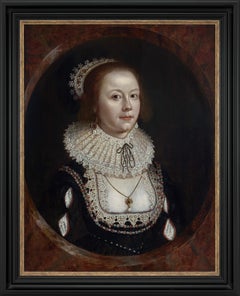
Portrait of lady, Mary Hammond in Rich Attire, Jewels, Lace c.1618-22 Historical
By Cornelius Johnson
Located in London, GB
Portrait of Mary Hammond in Sumptuous Attire, Jewels and Lace c.1618-22
Circle of Cornelius Johnson (1593-1661)
This portrait of a lady, presented by Titan Fine Art, is an exquisite example of early seventeenth-century portraiture, remarkable both for the lavishness of its subject’s attire and for the distinguished provenance that has accompanied it across four centuries that adds a rich layer of historical significance. It was once part of the notable collection of Sir William Temple, 1st Baronet (1628–1699) at Moor Park, a stately mansion in Hertfordshire. Temple was a diplomat, essayist, philosopher, and the patron of Jonathan Swift. He was a key participate at an important period in English history, helping not only to negotiate the Triple Alliance, but also the marriage between William of Orange and Princess Mary. His collection at Moor Park was well known in its day, reflecting both his cultivated taste in art and literature and his international connections.
Its fabulous attire, rendered with almost microscopic attention, is not merely decorative but emblematic of a world in which visual display was a language of power. Its provenance, stretching from the English country house and Enlightenment scholarship to modernist circles, forms a microcosm of cultural exchange across four centuries. Thus, the portrait of Mary Hammond stands as both a masterpiece of early seventeenth-century craftsmanship and a witness to the grand narrative of collecting and connoisseurship—a testament to the enduring fascination of beauty, status, and history intertwined.
By tradition the portrait depicts Mary Hammond (born c.1602), who was Sir William Temple’s mother, and the daughter of the royal physician who served James I, Dr John Hammond (c.1555–1617) and whose family owned Chertsey Abbey in Surrey. The woman appears between 18 and 25 years old, and Mary would be about 18–20 when the portrait was painted circa 1620, therefore this matches the apparent age of the sitter and the fashion perfectly.
Mary stood at the intersection of learned/courtly and gentry worlds. On 22 June 1627 she married her first cousin (a common practice for consolidating family wealth and influence during that era.) Sir John Temple (1600-1677) at St Michael, Cornhill in the City of London. The couple resided nearby, at Blackfriars. Her marriage to Sir Temple placed her at the heart of the social and political circles that shaped British history.
The couple had at least five children, and they became highly significant historical figures:
The eldest son, Sir William Temple, 1st Baronet, became a distinguished diplomat, statesman, and essayist, famous for his role in the Triple Alliance and as a patron and mentor to the writer Jonathan Swift – our portrait was in his collection. Their daughter, Martha Temple, later Lady Giffard, was a notable figure in her own right. She became her brother William's first biographer and a respected letter-writer, providing a rare female perspective on the events and high society of the time. Another son, also named Sir John Temple, became Attorney General for Ireland and was involved in the turbulent politics surrounding the English Civil War and the Act of Settlement in Ireland.
Mary died in November 1638 after giving birth to twins and was buried at Penshurst, Kent. The family's connection to Penshurst Place is a major point of interest as this historic manor was the seat of the Sidney family, a major aristocratic and literary dynasty.
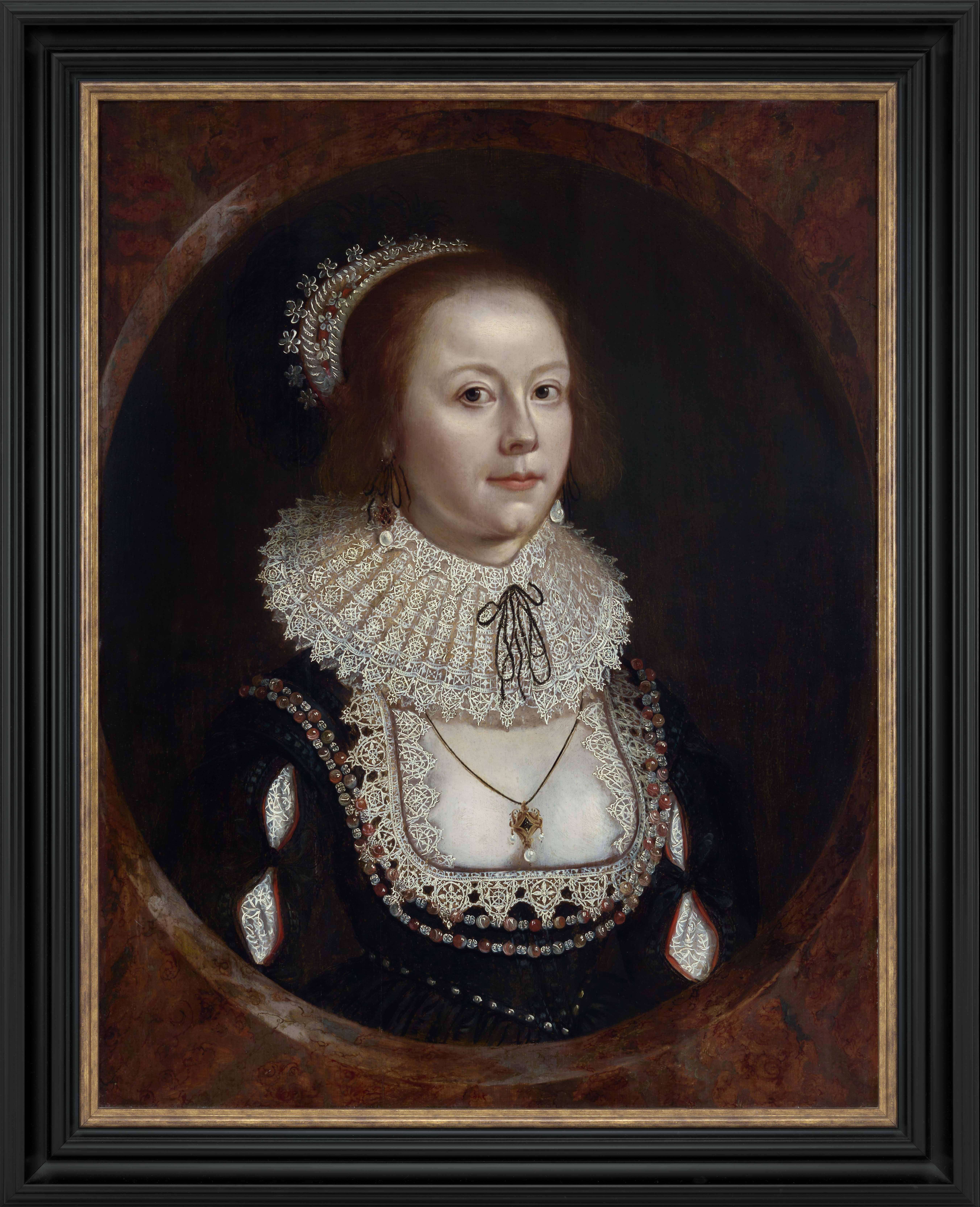
The portrait was in the collection of the Mary’s son, Sir William Temple. From there it descended to his daughter, and then to her nephew, the Reverend Nicholas Bacon of Spixworth Park, Norfolk (his mother was Dorothy Temple who died in 1758). Indeed, by this time, many Temple relics were in the collection at Spixworth including the engagement ring of the illustrious Dorothy Osborne, Lady Temple, wife of Sir William Temple. The portrait thus linked two prominent English families—the Temples and the Bacons—for generations. It is listed in a Spixworth Park inventory of 27 October 1910 by the local collector and art historian, Prince Duleep Singh. He described it with characteristic precision as: “No. 69. Lady Half Length, body and face turned towards the sinister, hazel eyes upwards to the dexter, red hair dressed low and over the ears, a jewelled coronet behind, pearl ear-rings tied with black strings. Dress: black, bodice cut low and square, with lace all round the opening and over shoulders, sleeves with double slashes showing red lining and lace under, falling thin pleated lace collar, black strings tied behind it, a jewel suspended on a black string round the neck, and a double row of agate and silver beads all round to the shoulders. M. In brown veined stone frame. Age 30. Date c.1620. It is called ‘Dutch portrait from Moor Park, mentioned by Nicholas Bacon of Coddenham and Shrubland as a very valuable painting.’
A few years later, when Robert Bacon Longe’s executors sold the contents of Spixworth Park (19–22 May 1912), the portrait appeared as lot 262, described as: “A very valuable half-length portrait on panel, ‘Dutch Lady, with deep lace collar and pearl and amethyst necklace, pendant, and ear-rings, and auburn hair, with coronet’ Early Dutch School 1620.” Following this sale the painting entered the collection of David and Constance Garnett, prominent literary figures of the early twentieth century, before being gifted to Andre Vladimervitch Tchernavin by 1949, and subsequently passed by him to the present owners in 1994.
The two great houses associated with the painting, Moor Park and Spixworth Park, further underscore its pedigree. Moor Park, in Hertfordshire, was among the grandest country estates of seventeenth-century England—its gardens famously redesigned by Sir William Temple himself and later influencing landscape design across Europe. Sir William's Temple's secretary was Jonathan Swift, who lived at Moor Park between 1689 and 1699. Swift began to write "A Tale of the Tub" and "The Battle of the Books" at Moor Park.
Spixworth Park, near Norwich, was an Elizabethan country house in Spixworth, Norfolk, located just north of the city of Norwich. It was home to successive generations of the Bacon family, one of Norfolk’s most distinguished dynasties (later, the Bacon Longe family), who were considerable land owners (owning Reymerston Hall, Norfolk, Hingham Hall, Norfolk, Dunston Hall, Norfolk, Abbot's Hall, Stowmarket, and Yelverton Hall, Norfolk). Spixworth Hall and the surrounding parkland remained in the Longe family for 257 years until 1952, when it was demolished.
Rendered with meticulous precision and sumptuous detail, the painting depicts an elegantly dressed woman—her poise, costume, and jewels all communicating a message of wealth, refinement, and social rank. Every brushstroke conveys an artist deeply attuned to the textures of luxury and the nuances of feminine dignity.
The sitter’s attire is nothing short of magnificent. Her bodice and sleeves are fashioned from the finest black silk or satin, the fabric absorbing and reflecting light in equal measure, suggesting both depth and lustre. Around her shoulders lies an opulent lace ruff—a deep, radiating lace collar worked in such intricate detail that it testifies to both the artist’s technical skill and the sitter’s extravagant taste. Lace of this quality, especially Venetian or Flemish bobbin lace, was one of the costliest materials available in early seventeenth-century Europe, its weight worth more than gold, and was a marker of prestige that rivalled jewels in value. The painter has taken great care to delineate every loop and scallop of the lace, achieving an almost tactile realism. Pale skin was also a desired beauty standard, sometimes accentuated with contrasting black ribbons or strings.
Her jewels amplify this display of affluence. Matching earrings and a delicate coronet or jewelled hair ornament with a feather adorn her hair, which is styled in the modest yet fashionable manner of the time. These details are far from decorative excess—they serve as visual emblems of social standing, refinement, and lineage. Portraits of this kind were statements of both identity and aspiration, intended to project a family’s prosperity and moral virtue to posterity.
The portrait was most likely painted in London around 1618-1622. The low-cut, décolletage-revealing neckline was fashionable in the courts of England and France during the late Elizabethan and Jacobean eras (c. 1590s-1610s), this style did not prevail in the public fashion of the Low Countries at this time. This style of lace ruff — delicate needle lace with geometric openwork — was fashionable from c.1615 to 1622, and the jewelled caul (hair net) and lace edging over a stiffened coif are consistent with high-status English women’s portraiture between 1610–1620. The puffed sleeve slash and the use of pink satin beneath black velvet belong squarely to the late Jacobean...
Category
17th Century Old Masters Portrait Paintings
Materials
Oil, Panel
Portrait of Jane Seymour (1508-1537) Second Wife of King Henry VIII 17th Century
Located in Blackwater, GB
Portrait of Jane Seymour (1508-1537) Second Wife of King Henry VIII , 17th Century
English School
Large 17th Century English Court portrait of Jane Seymour (1508-1537), Queen of En...
Category
17th Century Portrait Paintings
Materials
Oil, Canvas
Portrait of a Girl, 17th Century English School Old Masters Oil
By Gilbert Jackson
Located in London, GB
Gilbert Jackson
English Active: 1620 - 1650
Portrait of a Girl
Oil on panel, signed upper left and Inscribed upper right
Image size: 24 ½ x 20 inches
Contemporary style hand made...
Category
17th Century Old Masters Portrait Paintings
Materials
Oil
More Ways To Browse
Shakespeare Antique
16th Century Old Master Painting
16th Century Portrait Oil Paintings
Portrait Of Queen Elizabeth I
Shakespeare Painting
Portrait Of A Lady Spain
Large 16th Century Oil Paintings
Mother Mary
St John College
17th Century Oil On Panel Portrait
Italian School 17th Century Portrait
Pope Pius
Antique Outlaws
Antique Christening
Antique English Dictionary
Pirate Antique
Sister Mary
Old Antique Keys